CAA News Today
People in the News
posted by CAA — February 17, 2016
People in the News lists new hires, positions, and promotions in three sections: Academe, Museums and Galleries, and Organizations and Publications.
The section is published every two months: in February, April, June, August, October, and December. To learn more about submitting a listing, please follow the instructions on the main Member News page.
February 2016
Academe

Stacy Boldrick, formerly curator of research and interpretation at Fruitmarket Gallery in Edinburgh, Scotland, has taken up the post of lecturer in the School of Museum Studies at the University of Leicester in the Leicester, England.
Museums and Galleries
Lloyd DeWitt, curator of European art at the Art Gallery of Ontario in Toronto since 2011, has become chief curator of the Chrysler Museum of Art in Norfolk, Virginia.

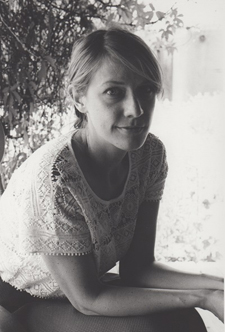 Caroline Jean Fernald
Caroline Jean Fernald has been appointed executive director of the Millicent Rogers Museum in Taos, New Mexico.
Jens Hoffmann has received a new name for his position: Susanne Feld Hilberry Senior Curator at Large for the Museum of Contemporary Art Detroit in Michigan. Hoffman is also deputy director of exhibitions and programs at the Jewish Museum in New York.

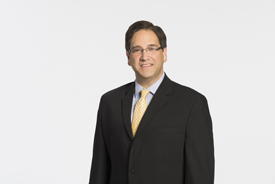 Leo G. Mazow
Leo G. Mazow, formerly associate professor of art history at the University of Arkansas in Fayetteville, has been appointed Louise B. and J. Harwood Cochrane Curator and Head of the Department of American Art at the Virginia Museum of Fine Arts in Richmond.
Art Journal Open Seeks Artists’ Projects
posted by CAA — February 17, 2016
CAA invites submissions for artists to create projects for Art Journal Open, an open-access, independently edited website that provides an agile counterpart to the quarterly Art Journal. Art Journal Open takes advantage of the unique qualities of the web to present artists’ projects, scholarly essays, conversations and interviews, notes from the field, artifacts of materials and process, and news items. The site embraces the evolving nature of multimedia formats and techniques, seeking to serve as a provisional, suggestive, and projective archive for contemporary art. Contributors include artists, scholars, critics, curators, researchers, archivists, librarians, and other cultural producers who generate primary-source material of contemporary art and the interpretative network that coalesces into the historical record. Operating on an open platform, the website is committed to fostering new intellectual exchanges. Gloria Sutton of Northeastern University serves as web editor for Art Journal Open, which publishes content on a rolling basis.
Please send a proposal describing your project, a website URL or images of your recent work, and your contact information to Sutton at art.journal.website@collegeart.org.
Grants, Awards, and Honors
posted by CAA — February 15, 2016
CAA recognizes its members for their professional achievements, be it a grant, fellowship, residency, book prize, honorary degree, or related award.
Grants, Awards, and Honors is published every two months: in February, April, June, August, October, and December. To learn more about submitting a listing, please follow the instructions on the main Member News page.
February 2016
Jay A. Clarke, Manton Curator of Prints, Drawings, and Photographs at the Sterling and Francine Clark Art Institute in Williamstown, Massachusetts, has been named a 2016 curatorial fellow by the Center for Curatorial Leadership.
Lily Cox-Richard, an artist based in Houston, Texas, has received a 2015 Houston Artadia Award, which comes with an unrestricted grant of $12,000.
Claire Daigle, associate professor and chair of the MA program in the history and theory of contemporary art at the San Francisco Art Institute in California, has won a 2015 award from the Arts Writers Grant Program, administered by Creative Capital and the Andy Warhol Foundation for the Visual Arts, for her blog, Figuring Fiction.
Susan Fisher, executive director and chief curator at the Renee and Chaim Gross Foundation in New York, has been chosen by the Center for Curatorial Leadership to join its 2016 class of curatorial fellows.
Johanna Gosse, Mellon Postdoctoral Fellow and Lecturer in the Department of Art History and Archaeology at Columbia University in New York, has accepted a 2015 award from the Arts Writers Grant Program, overseen by Creative Capital and the Andy Warhol Foundation for the Visual Arts. She will work on her book, On Site: Ray Johnson’s New York.
Valerie Hillings, curator and manager of curatorial affairs for the Solomon R. Guggenheim Foundation’s Abu Dhabi Project in the United Arab Emirates, has been selected as a 2016 curatorial fellow by the Center for Curatorial Leadership.
Elise Kirk, an artist based in Brooklyn, New York, has accepted a Working Artist Photography Award. Kirk was selected for the month of September 2015.
Courtney Martin, assistant professor in the Department of the History of Art and Architecture at Brown University in Providence, Rhode Island, has won a 2015 award from the Arts Writers Grant Program, steered by Creative Capital and the Andy Warhol Foundation for the Visual Arts. She will work on her book, A Critical Language: Lawrence Alloway’s Words to the Art World.
Theresa Papanikolas, curator of European and American art at the Honolulu Museum of Art in Hawai‘i, has been named a 2016 curatorial fellow by the Center for Curatorial Leadership.
Melissa Ragain, assistant professor of art history at Montana State University in Bozeman, has received a 2015 award from the Arts Writers Grant Program, administered by Creative Capital and the Andy Warhol Foundation for the Visual Arts. She will use the funds to work on her article, “Environmental Aesthetics in the Postwar University.”
Daniel Schulman, director of visual art for the Chicago Department of Cultural Affairs and Special Events in Illinois, has been chosen to be a 2016 curatorial fellow by the Center for Curatorial Leadership.
Martha Schwendener, an art critic for the New York Times and a PhD candidate in art history at the Graduate Center, City University of New York, has received a 2015 award in short-form writing from the Arts Writers Grant Program, administered by Creative Capital and the Andy Warhol Foundation for the Visual Arts.
Deborah Stratman, an artist and filmmaker based in Chicago, Illinois, has been named a USA Collins Fellow for 2015 in the media category by United States Artists. The award comes with an unrestricted grant of $50,000.
Deborah Willis, a photographer, curator, author, historian, and chair of the Department of Photography and Imaging at New York University’s Tisch School of the Arts, has received an honorary degree from the Institute for Doctoral Studies in the Visual Arts.
Exhibitions Curated by CAA Members
posted by CAA — February 15, 2016
Check out details on recent shows organized by CAA members who are also curators.
Exhibitions Curated by CAA Members is published every two months: in February, April, June, August, October, and December. To learn more about submitting a listing, please follow the instructions on the main Member News page.
February 2016
Juan Vicente Aliaga. Paz Errazuriz. Fondación Mapfre, Madrid, Spain, December 16, 2015–February 28, 2016.
William L. Coleman. Abodes of Plenty: American Art of the Inhabited Landscape. Mildred Lane Kemper Art Museum, Washington University in Saint Louis, Saint Louis, Missouri, January 29–April 16, 2016.

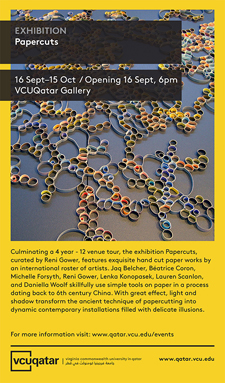 Invitation card for Papercuts
Reni Gower. Papercuts. The Gallery at Virginia Commonwealth University in Qatar, Doha, Qatar, September 16–November 24, 2015.
Reni Gower and Melissa Potter. Pulped under Pressure. Visual Arts Center, Tidewater Community College, Portsmouth, Virginia, January 16–March 3, 2016.
Alexandra Keiser. Archipenko: A Modern Legacy. Cummer Museum of Art and Gardens, Jacksonville, Florida, January 29–April 17, 2016.
Mattie M. Schloetzer. Washington Wax Works. Arts Club of Washington, Washington, DC, February 5–27, 2016.
Books Published by CAA Members
posted by CAA — February 15, 2016
Publishing a book is a major milestone for artists and scholars—browse a list of recent titles below.
Books Published by CAA Members appears every two months: in February, April, June, August, October, and December. To learn more about submitting a listing, please follow the instructions on the main Member News page.
February 2016

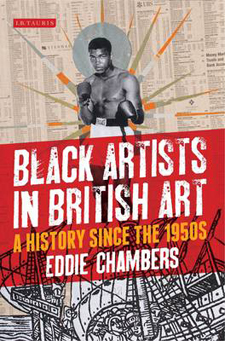
Eddie Chambers. Black Artists in British Art: A History since the 1950s (London: I. B. Tauris, 2014).

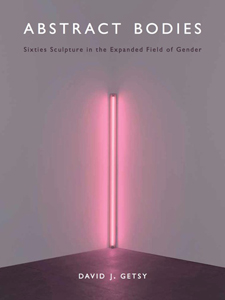
David J. Getsy. Abstract Bodies: Sixties Sculpture in the Expanded Field of Gender (New Haven: Yale University Press, 2015).

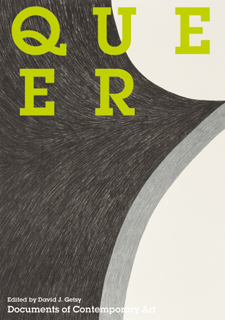
David J. Getsy, ed. Queer (Cambridge, MA: MIT Press, 2016).

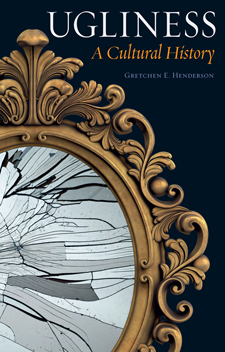
Gretchen E. Henderson. Ugliness: A Cultural History (London: Reaktion, 2015).

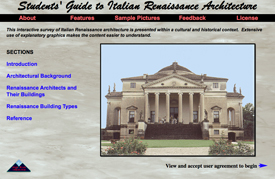
Margaret Herke and John Herke. Students’ Guide to Italian Renaissance Architecture (Denton, NC: High Rock Interactive, 2015).

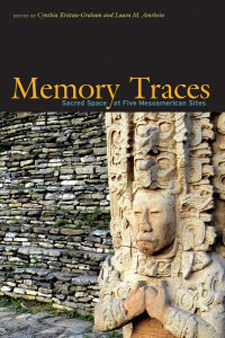
Cynthia Kristan-Graham and Laura M. Amrhein, eds. Memory Traces: Analyzing Sacred Space at Five Mesoamerican Sites (Boulder: University Press of Colorado, 2015).

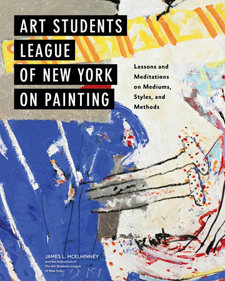
James McElhinny. Art Students League of New York on Painting: Lessons and Meditations on Mediums, Styles, and Methods (New York: Watson-Guptill, 2015).

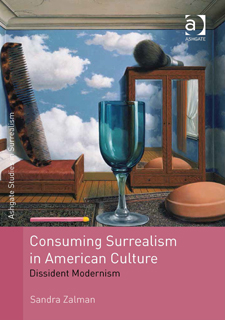
Sandra Zalman. Consuming Surrealism in American Culture: Dissident Modernism (Burlington, VT: Ashgate, 2015).
Committee on Women in the Arts Picks for February 2016
posted by CAA — February 10, 2016
Each month, CAA’s Committee on Women in the Arts selects the best in feminist art and scholarship. The following exhibitions and events should not be missed. Check the archive of CWA Picks at the bottom of the page, as several museum and gallery shows listed in previous months may still be on view or touring.
February 2016
Lisa Yuskavage: The Brood
Contemporary Art Museum St. Louis
3750 Washington Boulevard, St. Louis, Missouri
January 15–April 3, 2016
The Contemporary Art Museum St. Louis presents Lisa Yuskavage: The Brood, her first solo museum exhibition in the United States in fifteen years. The show charts the artist’s career development through twenty-five years of her painting. On view are her surreal, otherworldly figures arranged in diptychs, triptychs, and what Yuskavage calls “symbiotic portraits.”
“Merging the grand tradition of portraiture with the expansive vocabulary of female transgression and empowerment, Yuskavage’s sensuous palette and confrontational subject matter provoke the imagination and create a sometimes polarizing space: the artist presents the female body as a site of defiance and decadence.”
The sometimes doll-like figures of Yuskavage’s paintings give way to sexualized poses and hint unsettling realities beneath the exquisitely painted canvases. As Christian Viveros-Fauné says in a review of the exhibition, previously at the Rose Art Museum (published by ARTnews on September 11, 2015), “The result is a bawdy brood of shocking figures painted with classical luminosity. Despite Yuskavage’s formal delicacy and love of bright colors, it’s no stretch to say that the best of her works are as dark as Francisco Goya’s Black Paintings.”
The exhibition is accompanied by a large-scale, comprehensive publication by Skira Rizzoli, created in close collaboration with the artist.
Betye Saar: Still Tickin’
Scottsdale Museum of Contemporary Art
7374 East Second Street, Scottsdale, AZ
January 30–May 1, 2016
The Los Angeles artist Beyte Saar’s new exhibition Still Tickin’ at the Scottsdale Museum of Contemporary Art presents nearly six decades of her work exploring African American identity, spirituality, and the interconnectedness between different cultures. The exhibition is divided into three themes: nostalgia and memory; mysticism and ritual; the political and racial.
From collage to sculpture to works on paper, Saar has used her artistic career to explore the lives of black people. In video interview for the 2011 Lifetime Achievement Award from the California African American Museum, she asks “What can I do as an artist to liberate Aunt Jemima?” after encountering the racially charged figure at a flea market. “I can make her a warrior,” she answers, giving Aunt Jemima a shotgun in the seminal piece, The Liberation of Aunt Jemima (1972).
Saar began her career in the Black Arts Movement of the 1960s, using found objects such as clocks, dolls, and cages among other bits and pieces, creating assemblages and installations. The Scottsdale exhibition brings together recent work and historical pieces.
Though Saar was featured in eight Pacific Standard Time exhibitions in 2010 and received the 2012 Los Angeles Museum of Contemporary Arts Distinguished Feminist Award, she remains largely overlooked. Still Tickin’ comes to Arizona from Saar’s first museum solo exhibition in Europe at the Museum Het Domein in the Netherlands.
Firelie Báez: Bloodlines
Pérez Art Museum Miami
1103 Biscayne Boulevard, Miami, FL
October 15, 2015–March 6, 2016
The Dominican-born artist Firelie Báez’s first solo museum show, Bloodlines, at the Pérez Art Museum in Miami presents new works inspired by lineages of black resistance. Several works were created specifically for the exhibition and depict textiles, hair designs, and body ornaments, linking traditionally loaded symbols with individual human gestures.
“Báez’s new works embody a provocative investigation on decorative elements, textiles, hair designs, and body ornaments that explores methods of resistance in black communities within the United States and the Caribbean. Her exceptional paintings show a profound appreciation of diasporic histories, as well as new contemporary approaches towards painting,” said María Elena Ortiz, the museum’s assistant curator, who organized the show.
Works on view include: Patterns of Resistance (2015), a series comprising blue and white drawings centered on a textile pattern created by Báez, using different political references from social movements in the black diaspora in the United States and the Caribbean; and Bloodlines (2015), a new series of portraits inspired by the tignon, a headdress which free women of color were obligated to use by law in eighteenth-century New Orleans.
While exploring black culture, Afro Caribbean folklore, and the diaspora, Báez brings her female viewpoint, “thereby claiming the relevance of the excluded historical perspective of women of color and reclaiming the female body and mind.” A catalogue of the exhibition, featuring contributions by Naima Keith and Roxane Gay, is available.
Lorraine O’Grady: Art Is…
Studio Museum in Harlem
144 West 125th Street, New York
July 16, 2015–March 6, 2016
Lorraine O’Grady (b. Boston, 1934) began her career in art in 1980, developing pioneering works in performance, installation, and works that address subjects of diaspora and black female subjectivity. Her iconic performances include Mlle Bourgeoise Noire (1980–83), Rivers: First Draft (1982), and Art Is… (1983), whose documentation is now presented at the Studio Museum in Harlem more than three decades later, organized by the assistant curator Amanda Hunt.
The performance was held on a sunny Sunday in September 1983 as part of the African American Day Parade, a monumental event that celebrates African and African American culture and heritage and that has been taking place Harlem since 1969. Choosing this context, the artist “ensured the largest black audience possible” and intended to challenge assumptions about race and accessibility, addressing in particular the idea that creating art is a privilege available only to some.
In this landmark performance, O’Grady entered her own float, riding up Harlem’s Adam Clayton Powell Jr. Boulevard (Seventh Avenue) along fifteen collaborators, all dressed in white. The float displayed an enormous, ornate gilded frame, while the words “Art Is…” was inscribed in its decorative skirt. Along the itinerary, O’Grady and troupe jumped off the float and held up empty, gilded picture frames, inviting people to be “portrayed” in them. The response was overwhelming, as enthusiastic onlookers became participants, confirming to O’Grady that Harlem’s residents were ready to see themselves as works of art.
Hundreds of snapshots were taken by various people who witnessed the performance. Later on O’Grady collected them to compose the series of forty images that capture the energy and spirit of the original performance. These images not only document the event but also form an archive of the architectural and cultural relics of Harlem’s past through a joyful partnership between visual art and lived experience. O’Grady’s performance engaged a broad and spontaneous audience in a way that no contemporary artist had done before. The joyful engagement follows her idea that Art Is… for everyone.
Marie Lund, Rallou Panagiotou, and Mary Ramsden: Vanilla and Concrete
Tate Britain
Millbank, London SW1P 4RG, UK
November 9, 2015–June 19, 2016
As part of the Art Now series, Tate Britain presents Vanilla and Concrete: Marie Lund, Rallou Panagiotou, and Mary Ramsden. Curated by Sofia Karamani, the exhibition brings together new and recent work by emerging artists who explore everyday objects, spaces, and gestures. From the finger smudges on a touchscreen to the sun-bleached fabric of a curtain, the work of these artists gives new form and meaning to apparently mundane objects and everyday incidental moments. Based on the artists’ intimate observations of today’s world, the works draw out connections between surface and essence and address the concept of transformation between individual and cultural identity.
Marie Lund (b. 1976, Copenhagen) presents sculptures inspired by the human impact on common spaces and objects, changing the way in which they are perceived. Lund recovers curtains stained with sunlight over many years and stretches them to look like abstract paintings, marrying light traces with poetic content.
Rallou Panagiotou (b. 1978, UK) takes interest in everyday “luxury” items, from make-up and jewelry to a cocktail, and from a straw-painted toe to marks of eyeliner. Panagiotou embraces these objects as artificial extensions of the human body, investigating how they define and express the individual within a wider cultural context.
Mary Ramsden (b. 1984, London) presents paintings that are inescapably informed by our digital reality. They hint to the smudges on digital touchscreens. Her works are displayed both individually and in groups that mimic multiple windows opened on a computer screen, reflecting the messy, human touch within a pristine and impersonal environment.
The Feminist Art Project
National Museum of Women in the Arts
1250 New York Ave NW, Washington, DC 20005
Saturday February 6, 2016, 9:00 AM–4:30 PM
Coinciding with the 104th CAA Annual Conference, the Feminist Art Project is proud to partner with the Studio Arts Program at American University to bring this extraordinary event to the public on Saturday, February 6, at the National Museum of Women in the Arts. The Feminist Art Project’s TFAP@CAA Day of Panels will present a day of diverse panels and performances. This year’s theme is the representation of identity as intersectional—recognizing the multiple aspects of identity (gender, race, ethnicity, class, and sexuality) and how they intersect, compound, and complicate the very categories they construct.
A second TFAP@CAA event invites the public to participate in an interactive performative action, Feminism: Remembrance & Legacy, organized by Claudia Sbrissa and Kathleen Wentrack in honor of the tenth anniversary of TFAP and the legacy of feminism. All are invited to share their experiences with TFAP and/or offer advice to future generations in the form of a written or visually expressed “letter to a young artist.” In reciprocity, participants will receive a gift from the project collaborators reflecting the generous exchange of ideas, art, connections, and friendship through the Feminist Art Project. All responses will be available to view online.
This event is free and open to the public and does not require conference registration. View the full 2016 schedule, abstracts, panel and event descriptions, and location details on the project’s website.
Coco Fusco
Alexander Gray Associates
510 West 26th Street, New York City
January 9–February 6, 2016
Accompanying her current exhibition, Alexander Gray Associates is presenting a screening series by the interdisciplinary artist and writer Coco Fusco. The selection is a survey, brought together for the first time, of her seminal videos created over the past two decades. The first screening includes Fusco’s most recent videos on Cuba: La Confesión (2015), created for the fifty-sixth Venice Biennale in Italy; and La botella al mar de María Elena (2015), which premiered at the 2015 Göteborg International Biennial for Contemporary Art in Sweden.
News from the Art and Academic Worlds
posted by Christopher Howard — February 03, 2016
Each week CAA News publishes summaries of eight articles, published around the web, that CAA members may find interesting and useful in their professional and creative lives.
Who Should Pay for the Arts in America?
After fifty years, the ethos on which the National Endowment for the Arts was founded—inclusion and community—has been eroded by consistent political attack. As the NEA’s budget has been slashed, private donors and foundations have jumped in to fill the gap, but the institutions they support, and that receive the bulk of arts funding in this country, aren’t reaching the people the NEA was founded to help serve. (Read more from the Atlantic.)
New White Paper Examines Arts Organizations of Color
The National Center for Arts Research at Southern Methodist University released a white paper titled “Does ‘Strong and Effective’ Look Different for Culturally Specific Organizations?” that examines the distinguishing characteristics of arts organizations primarily serving Asian American, African American, and Hispanic/Latino communities. The study is designed to provide insights, based on measurable data, about the operating contexts and unique challenges that these organizations face. (Read more from the National Center for Arts Research.)
New York Arts Organizations Lack the Diversity of Their City
New York City’s cultural sector does not match the demographic diversity of the its population, though the sector is more diverse than arts organizations on the national level, according to a survey released by the city’s Cultural Affairs Department. By examining the staff and leadership at city‐funded nonprofit cultural organizations, the administration of Mayor Bill de Blasio hoped to show its commitment to promoting and building diversity among arts institutions. (Read more from the New York Times.)
How University Museums Bridge the Gap between Art and Science
It is hard to resist looking at images of your own brain. When the Berkeley Art Museum/Pacific Film Archive reopens on January 31 in a new $112 million building, visitors will see intricate drawings of radiolaria by the German biologist Ernst Haeckel and sketches of the human brain’s branching neural networks by the Spanish-born Santiago Ramón y Cajal, known as the father of neuroscience. (Read more from the Art Newspaper.)
Academics Get Real
Academic bios—such as those for department or personal websites, conference proposals, and social media—are supposed to simultaneously explain scholars’ work and “sell” their potential. While they aim to make one seem intellectually desirable and hirable, authenticity isn’t usually a priority. But what if academic bios got real? (Read more from Inside Higher Ed.)
The Limits of Open
As Coursera tweaks its business model to find a financially viable way to offer massive open online courses, critics say its MOOCs are becoming less open. Coursera has announced the release of dozens of new courses and course sequences, which it calls Specializations, in subjects ranging from career brand management to creative writing. But many new MOOCs cost $79 up front for the first of five courses or $474 prepaid for the entire program. (Read more from Inside Higher Ed.)
Teaching “Selfies”
If you’re looking for ways to improve your teaching this year, record yourself teaching in the classroom. There are many reasons why this form of self-observation works. As uncomfortable as it can be to see yourself on screen, recording yourself is also a powerful tool for reflection. It is relatively easy, low-risk, and totally customizable (Read more from GradHacker.)
What a Million Syllabuses Can Teach Us
College course syllabuses are curious documents that represent the best efforts by instructors to distill human knowledge on a given subject into fourteen-week chunks. They structure the main activity of colleges and universities. And then, for the most part, they disappear. Despite the bureaucratization of higher education over the past few decades, syllabuses have escaped systematic treatment. (Read more from the New York Times.)
Launch of New caa.reviews Website
posted by CAA — January 28, 2016
 CAA and Routledge are pleased to announce the launch of a new website for caa.reviews, an online, open-access journal of book and exhibition reviews in the visual arts. The new site has a cleaner look, is easier to navigate, and has faster and smarter search tools. New filters based on geography, time period, and genre or specialization allow readers to narrow and focus search results, making it easier to find specific articles. An important addition for caa.reviews is a Creative Commons license (CC-BY-ND), making reviews available for redistribution if the content is unaltered and appropriate credit is given.
DeWitt Godfrey, president of the CAA Board of Directors, writes: “For over seventeen years, caa.reviews has been the only scholarly journal solely dedicated to the review of books and exhibitions. The journal would not exist without the dedication and hard work of the Council of Field Editors and caa.reviews Editorial Board, past and present, who produce 150 substantial reviews each year. CAA is grateful to the Andrew W. Mellon Foundation for its original support of the journal and to Taylor & Francis for making the new version of the journal possible.”
caa.reviews, founded in 1998, publishes timely scholarly and critical reviews of studies and projects in all areas and periods of art history, visual studies, and the fine arts, providing peer review for the disciplines served by CAA. Publications and projects reviewed include books, articles, exhibitions, conferences, digital scholarship, and other works as appropriate. In reviewing and publishing recent texts and projects, caa.reviews fosters timely, worldwide access to the intellectual and creative materials and issues of art-historical, critical, curatorial, and studio practice; the journal also promotes the highest standards of discourse in the disciplines of art and art history. Explore the new site today.
Career Services Guide for the 2016 Annual Conference
posted by CAA — January 14, 2016
 CAA has designed the Career Services Guide to inform job seekers and employers about placement activities at the 2016 Annual Conference in Washington, DC. The publication, available as a PDF, will help you navigate Career Services events and provides answers to frequently asked questions. Study this guide carefully so that you will know what to expect from conference interviewing and how best to prepare for a successful experience.
Job candidates can review the basics of the conference employment search. Read about the Candidate Center, your home base at the conference, as well as Orientation, an introduction to Career Services where you can ask questions. In addition, learn more about the Online Career Center, where you can search for position listings, post application materials, and arrange interviews. The publication includes tips for improving your CV, portfolio, and supplemental application materials.
Employers will find details in the guide for renting interview booths and tables as well as recommendations for posting jobs and conducting interviews at the conference. You can begin preparations now for Career Services through the Online Career Center or onsite at the Interviewer Center.
Printed copies of the Career Services Guide will be distributed onsite at Orientation and in the Candidate Center. All conference Career Services will take place at the Washington Marriott Wardman Park Hotel. For more information about job searching, professional-development workshops, and more, visit the Career Services section of the conference website.
Committee on Women in the Arts Picks for January 2016
posted by CAA — January 10, 2016
Each month, CAA’s Committee on Women in the Arts selects the best in feminist art and scholarship. The following exhibitions and events should not be missed. Check the archive of CWA Picks at the bottom of the page, as several museum and gallery shows listed in previous months may still be on view or touring.
January 2016
 Carolee Schneemann, Eye Body: 36 Transformative Actions for Camera, 1963, action in the artist’s studio, 122 West 29th Street, New York, NY, US, 18 gelatin silver prints, 24 x 20 in. each (61 x 50.8 cm), Edition (2008): 8 of 8 + 2 AP Courtesy of C. Schneemann and P.P.O.W Gallery, New York, Photo: Erró © Carolee Schneemann, © Bildrecht, Wien, 2015, © Erró (*1932)
Carolee Schneemann: Kinetic Painting
Museum der Moderne
Mönchsberg 32, 5020 Salzburg. Austria
November 21, 2015–February 28, 2016
Work by the groundbreaking artist Carolee Schneemann takes over two floors of the Museum der Moderne in the retrospective, Kinetic Painting. More than 350 works spanning six decades, some unseen before now, present Schneemann’s oeuvre from her early career in the 1950s through the present.
“Schneemann, as a pioneer of performance art, and her seminal engagement with gender, sexuality, and the use of the body, has been a major influence on generations of younger artists,” the museum explains. The works included in Kinetic Painting explore Schneemann’s Painting Constructions, her early use of movement, and her artistic contributions through experimental film, performance, and choreography. The exhibition also offers works on loan from the Museum of Modern Art in New York, Tate in London, and the artist’s archives in the special collections of the Stanford University Libraries.
Through experimental work such as Fuses (1965) and Interior Scroll (1975/77) and her pioneering “kinetic theater” piece Meat Joy (1964), Scheenmann focuses on the female body in context, while exploring sexual pleasure. In Interior Scroll, she pulls a paper scroll from her vagina “inch by inch” and reads a monologue decrying the sexism and disparagement that women confront in the worlds of art and experimental film.
The exhibition catalogue, Carolee Schneemann. Kinetic Painting I Carolee Schneemann. Kinetische Malerei, is available in English and German. Edited by Sabine Breitwieser for the Museum der Moderne Salzburg, the book includes essays by Breitwieser, Branden W. Joseph, Mignon Nixon, Ara Osterweil, and Judith Rodenbeck, as well as selected writings by the artist.
Islamic Art Now: Contemporary Art of the Middle East (Parts One and Two)
Los Angeles County Museum of Art
5905 Wilshire Boulevard, Los Angeles, CA 90036
Part One: February 1, 2015–January 3, 2016
Part Two: January 24, 2016–ongoing
The two-part exhibition Islamic Art Now: Contemporary Art of the Middle East features LACMA’s growing collection of Islamic art. Part one focuses on twenty-five works from artists from Iran and the Arab world, including Shirin Neshat, Susan Huefana, Lalla Essaydi, Mitra Tabrizian, Mona Hautoum, Hassan Hajjaj, Wafaa Bilal, Barbad Golshiri, and Youssef Nabil, among others.
The exhibition explores the creative connections between the past, present, and future in Islamic art as artists draw inspiration from their own cultural traditions played out through each artist’s techniques and mediums. Among the works on display is Neshat’s photograph Speechless (1996) from her Women of Allah series. The photograph depicts a woman dressed in a black chador with a gun poking out from the folds and directionally toward the camera. Neshat then uses ink to inscribe Persian texts across the image.
“The Western view is that Iranian women or Muslim women are very repressed, but the reality is that in my country, women are far more radical and rebellious than men are,” Neshat says in an interview with the Washington Post on May 21, 2015. “My work is an allegorical sort of remark on the reality as I see it, as I feel it.”
The exhibition’s second part begins in late January and will feature artists from Turkey and Azerbaijan, such as Shoja Azari, Lulwah Al Homoud, Burhan Doǧançay, Fereydoun Ave, Shirin Guirguis, Newsha Tavakolian, Shadi Ghadirian, Hassan Hajjaj, Ahmed Mater, and Faig Ahmed, among others.
Us is Them
Pizzuti Gallery
632 North Park Street, Columbus, OH 43215
September 18, 2015–April 2, 2016
Us is Them at the Pizzuti Gallery in Columbus, Ohio, presents seventy-five paintings, sculpture, photographs, and video by forty-two international artists, including Carrie Mae Weems, Shirin Neshat, Michalene Thomas, and Kara Walker, among others. All works belong to the private collection of Ron and Ann Pizzuti.
According to the gallery, “the exhibition is organized to reflect timely and potent issues of social justice and current affairs across the world,” where artists create “enlightening and thoughtful works that challenge and rearrange stale notions of identity and obsolete notions of difference.”
Through presenting aspects of the common human condition through the distinct styles and mediums of each artist, the gallery creates a connection to the title, “us” is “them,” and “our shared human condition and our hope for social justice no matter who or where we are.”
Presented among the work is the Iraqi-born artist Hayv Kahraman’s Kawliya.2 (2014), depicting a woman in a boldly patterned dress, arms uncovered and hair flying. In Slow Fade to Black, Set II (2009–10) by Weems, seventeen photographs of African American women—female performers who remain underrecognized despite their achievements—present moments of glamour, entertainment, and civic engagement. The images, however, are out of focus, with many details lost. “Slow Fade to Black is a celebration but also a warning—that we must stop the established historical pattern of diminishing the significant contributions of women and particularly African American women.”