CAA News Today
CWA Picks: Fall 2025
posted Sep 10, 2025
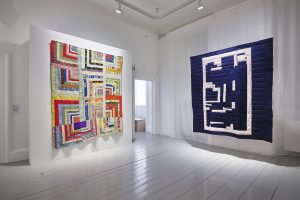
Installation view, Kith & Kin: The Quilts of Gee’s Bend, Irish Museum of Modern Art, Dublin
Several exhibitions this fall devoted to women and femme-identifying visual artists and art-world figures prompt viewers to think about place as a shaping force. Some shows, like Stéphanie Saadé’s rumination on her former family in Beirut, interact with their own surroundings. Others present art from somewhere else, expanding the works’ reach, as in Dublin, where audiences can view quilts from the famed African American circle in Gee’s Bend, Alabama. Still other shows present locations as conceptual entities, as in Mexico City, where Delcy Morelos’s espacio vientre–womb space–evokes Colombia and its people.
UNITED STATES
Aminah Robinson: Journeys Home, A Visual Memoir
October 16–March 1
The Newark Museum of Art, Newark, NJ
Drawn from the permanent collection of the Columbus Museum of Art, the institution to which MacArthur Award recipient Aminah Robinson (1940–2015) entrusted her artwork, personal belongings, and home studio, this exhibition brings together some of the artist’s most profoundly thought-provoking and emotionally resonant drawings, paintings, prints, sculptures, illustrated texts, journals, and mixed-media textiles produced from 1948 to 2012. Robinson’s folklore-based work draws upon historical research and personal narratives to present a visual memoir of the artist’s life and a compelling portrayal of the African American experience.
Cecilia Chiang: Don’t Tell Me What To Do
Through March 9
Crow Museum of Asian Art, Dallas
Self-taught artist Cecilia Chu Chiang (b. 1934) embraces spontaneity and joy with a whimsical, fluid, colorful style that she deploys across a broad spectrum of media, including Chinese ink watercolors, oils, acrylics, ceramics, printmaking, textiles, and collage. This exhibition of work from the last forty years includes images of flora, fauna, and human figures that defy convention and brim with personality.
Coco Fusco: Tomorrow, I Will Become an Island
September 18–January 11
El Museo del Barrio, New York
Borrowing its title from the award-winning 2023 monograph on the artist, this first US survey of Cuban American artist and writer Coco Fusco (b. 1960) presents more than three decades of Fusco’s artistic production, including films, photographs, texts, installations, and performances. Fusco addresses the dynamics of politics and power in relation to issues of representation, culture, and institutional critique. Among the exhibition’s offerings is Two Undiscovered Amerindians Discover the West (with Guillermo Gomez-Peña, originally performed in 1992), its cage setting a metaphor for colonialist othering.
Diana Al-Hadid: unbecoming
Through December 14
Eli and Edythe Broad Art Museum, East Lansing, MI
This survey of large-scale paintings and sculptures by Aleppo-born, New York-based Diana Al-Hadid (b. 1981) questions how constructions of femininity take hold over time. The artist’s radical reworkings of industrial and architectural materials, which interact with sources as varied as the Medusa myth, Islamic hero narratives, and Hans Memling’s Allegory of Chastity (1475), call for analogous transformations of ingrained social norms about womanhood and women’s behavior, inviting viewers to find the power in being “unbecoming.”
Douriean Fletcher: Jewelry of the Afrofuture
October 4–March 15
Museum of Arts and Design, New York
The boldly sculptural jewelry designs of Douriean Fletcher (b. 1987) articulate Black identity, embody spiritual meaning, and have helped define characters within cinematic and other imagined worlds, including the movie Black Panther. The exhibition explores how ideas of Afrofuturism materialize in Fletcher’s work, highlighting her research into African and African American jewelry traditions and her efforts to build aesthetic and cultural bridges between Black communities, countries, continents, and histories torn apart by colonialism, slavery, and oppression. Comprising more than 150 works, the show tells the inspiring story of Fletcher’s evolution from self-taught metalsmith to an influential designer.
Everyday Rebellions: Collection Conversations
October 10–July 5
Brooklyn Museum, Brooklyn, NY
This exhibition pairs new acquisitions by the Center for Feminist Art with rarely seen collection objects from disparate places and centuries. Inspired by Gloria Steinem’s 1983 feminist bestseller Outrageous Acts and Everyday Rebellions, the show highlights how contemporary women artists engage with daily life through mindful gestures of creative defiance. The rawhide and wool work Natural Idiot Strings by Iñupiaq and Athabascan artist Sonya Kelliher-Combs (b. 1969), for example, appears alongside an early twentieth-century seal intestine parka, inviting a cross-generational dialogue about Indigenous women’s creative labor.
Las Vegas Ikebana: Maren Hassinger and Senga Nengudi
Through January 11
Columbus Museum of Art at The Pizzuti, Columbus, OH
This exhibition is the first museum retrospective of the pioneering collaboration between African American artists Maren Hassinger (b. 1947) and Senga Nengudi (b. 1943), now approaching its sixth decade. While the lifelong friends have maintained solo practices rooted in sculpture and installation, Hassinger and Nengudi have together created dances, performances, videos, objects, artists’ books, and conceptual correspondences, forging a vital connection in periods of institutional neglect. Las Vegas Ikebana emphasizes the improvisational spirit, humor, and eroticism of the artists’ collaborative work, with its themes of impermanence, popular culture, and the natural world.
Lucy R. Lippard: Notes from the Radical Whirlwind
October 10–August 9
Vladem Contemporary, New Mexico Museum of Art, Santa Fe
Lucy R. Lippard (b. 1937)—writer, activist, and curator—has been a revolutionary force in the international art world for over sixty years. A resident of New Mexico since 1993, she presented the New Mexico Museum of Art in 1999 with over three hundred artworks, artist’s books, posters, political buttons, and activist ephemera from her collection, objects that in turn had been gifted to her by artists, collaborators, and other friends. This exhibition features a selection of objects from the collection and traces Lippard’s prolific career, honoring her contributions to the art world.
Mimi Ọnụọha: These Networks in Our Skin
Through September 28
Columbus Museum of Art, Columbus, OH
Mimi Ọnụọha (b. 1989) is a Nigerian American artist whose work exposes and questions the contradictory logic of technological progress. Ọnụọha’s video installation These Networks in Our Skin follows four women’s hands as they replace ethernet cables with hair and spices, countering the assumed immateriality of cloud-based technologies. The video forms part of a survey of Ọnụọha’s recent work, What Is Missing Is Still There, staged at venues across Columbus, including the Wexner Center for the Arts and the campus of Ohio State University.
Niki de Saint Phalle in Print
Through November 30
National Museum of Women in the Arts, Washington, DC
Drawn from the museum’s collection of works by Niki de Saint Phalle (1930–2002), these twenty large-scale, highly colorful prints include examples of the artist’s lively “Nana” figures (starting 1968, essentially “sassy young women” in French slang), which celebrate voluptuous female bodies. Silkscreens from her Californian Diary series (1993–94) present landscapes and figures amid soulful journal-entry–style texts that reflect on the artist’s early experience of living in Southern California, including her ruminations on activism.
Patricia Cronin: Army of Love
Through October 18
CHART Gallery, New York
New paintings, sculptures, and watercolors by New York-based artist Patricia Cronin (b. 1963), shown here in the artist’s first solo exhibition in the city in nearly a decade, constitute a monumental installation inspired by the ancient Greek goddess of love (and by archaeologist Iris Love, who discovered the remains of Aphrodite’s famous temple at Knidos in modern Turkey). Centering female power, Army of Love challenges conventional ideas of heroism, replacing conquest with compassion and reframing the idea of an “army” as a collective force for love, dignity, and care.
Portia Zvavahera: Hidden Battles / Hondo dzakavanzika
Through January 19
Institute of Contemporary Art, Boston
This first solo museum exhibition in the United States of Portia Zvavahera (b. 1985) features a suite of colorful paintings of expressive animals and human figures who come from the artist’s vivid, often portentous dreams. Engaging deeply with the Indigenous Shona and African Pentecostal faith traditions in which she was raised, Zvavahera illuminates the centrality of spirits and revelation to both belief systems.
Rana Begum: Reflection
Through December 28
SCAD Museum of Art, Savannah, GA
The works of Bangladesh-born, London-based Rana Begum (b. 1977) blur the boundaries between sculpture, painting, and architecture. Begum embraces modern industrial materials—automobile light reflectors, safety tape, glass panels, chain-link fence segments—and recontextualizes them in imaginative ways, harnessing geometry, color, and light to dynamic ends. Begum’s first museum survey in the United States demonstrates how she expands upon the legacies of abstraction, minimalism, and op art through a contemporary global lens.
Roaming Mexico: Laura Wilson
September 14–January 11
Meadows Museum, Dallas
Dallas-based documentary photographer Laura Wilson (b. 1939) began her career focusing on life along the Mexico–US border before expanding her range to produce a more comprehensive, if deeply personal, vision of Mexico. This exhibition brings together over thirty years’ worth of images documenting Wilson’s travels throughout the country and just across its northern border, including work she created as recently as this year.
Shahzia Sikander: The Last Post
Through July 12
Smithsonian American Art Museum, Washington, DC
Through its precisely inked scenes, the 2010 animated video work The Last Post by Pakistani American artist Shahzia Sikander (b. 1969) critically considers the legacy of British colonialism in Asia. The artist employs her signature approach of drawing upon and transforming iconographic motifs from Hindu, Muslim, and Western art, including Indo-Persian miniature paintings, to treat historical interactions–here, opium smuggling to China by the East India Trading Company–from a contemporary perspective.
Shattered Glass: The Women Who Elevated American Art
November 25–March 1
Canton Museum of Art, Canton, OH
Shattered Glass is the first original exhibition held at the Canton Museum of Art to highlight the work of women artists and their contributions to American art. Among the artists represented are Mary Cassatt, Elizabeth Nourse, Alice Schille, Georgia O’Keeffe, Beatrice Wood, Dorothea Lange, Maija Grotell, Selma Burke, Lee Krasner, Elaine de Kooning, Diane Arbus, Audrey Flack, Judy Chicago, Ana Mendieta, Jenny Holzer, Kara Walker, Wendy Red Star, and the Guerilla Girls.
Suzanne Jackson: What is Love
September 27–March 1
San Francisco Museum of Art, San Francisco
The fullest retrospective to date of African American artist Suzanne Jackson (b. 1944) emphasizes her innovative use of color, light, and structure to expand the parameters of painting. Works on view range from ethereal compositions of the late 1960s and 1970s in which luminous washes of pigment render imagery from Jackson’s dreams to recent three-dimensional acrylic paintings suspended in midair, some embedded with materials that draw on ancestral and cultural histories. A new large-scale commission addresses the global environmental crisis and themes of migration and improvisation.
Tawny Chatmon: Sanctuaries of Truth, Dissolution of Lies
October 15–March 8
National Museum of Women in the Arts, Washington, DC
These works by American photography-based artist Tawny Chatmon (b. 1979) include some of her gilded portraits of Black children, which evoke Byzantine mosaics, medieval icons, and the paintings of Gustav Klimt, as well as selections from her latest series, The Reconciliation (2021–). The latter incorporates assemblage, embroidery, film, and audio narrative to explode negative stereotypes and celebrate the artist’s Black subjects, who proudly display African diasporic cuisine or hold antique racist dolls that Chatmon has removed from circulation, repainted, and reclothed.
Transgresoras: Mail Art and Messages, 1960s–2020s
September 13–February 15
California Museum of Photography, Riverside
In relying on the postal service for the circulation and exchange of artworks, mail art has allowed artists in repressive societies to evade strict censorship measures, providing platforms for circulating their work and for political protest. This exhibition presents mail art by Latinx and Latin American women artists from the 1960s to the present, noting the ways that these artists have transgressed gender expectations, defied authoritarian regimes, and evaded other forms of oppression to communicate on such feminist issues as migration, community at a distance, and the legacies of colonialism.
Women Artists from Antwerp to Amsterdam, 1600–1750
September 26–January 11
National Museum of Women in the Arts, Washington, DC
Works by more than forty women artists from present-day Flanders in Belgium and the Netherlands are on view in this exhibition, including paintings, prints, sculptures, paper cuttings, and textiles, many presented for the first time in the United States. Dispelling the notion that Dutch and Flemish women artists of the seventeenth and first half of the eighteenth century were rare or obscure, this exhibition reveals their vital role in shaping visual culture during one of the most dynamic periods in the region’s history.
MEXICO
Delcy Morelos: El espacio vientre / The womb space
October 18–June 28
Museo Universitario Arte Contemporáneo, Mexico City
Delcy Morelos (b. 1967) began her artistic practice translating the visceral experience of her home country of Colombia into a pictorial format. She now creates large-format installations using materials collected from the places she visits, customizing the work to the exhibition space. In these dialogues with pictorial substance, materiality, and color, Morelos considers themes of the body, the skin, race, land, violence, gender, and emotion. Her in situ intervention at MUAC engages with pre-Columbian architecture and local materiality.
Marta Palau: Mis caminos son terrestres / My paths are terrestrial
November 15–May 3
Museo Universitario Arte Contemporáneo, Mexico City
Organized in collaboration with the Tàpies Foundation in Barcelona, this exhibition is devoted to Marta Palau (1942–2022), a pioneer of textile sculpture in Latin America who also worked in painting, the graphic arts, ceramics, and installation. The exhibition departs from the conventional chronological-biographical format to address many of the artist’s diverse fields of interest, including Indigenous and European magic, exile and migration, and the body. Palau’s appreciation for the materiality of natural fibers stands out, as does her anticolonial orientation.
CANADA
Aisha Khalid: Your Way Begins on the Other Side
Through April 26
Aga Khan Museum of Islamic Art, Toronto
The Aga Khan celebrates its tenth anniversary by unfurling a twenty-foot-long double-sided tapestry by Pakistani artist Aisha Khalid (b. 1972). The first contemporary artwork acquired by the museum, Your Way Begins on the Other Side draws inspiration from Persian garden design and Sufi poetry. On one side, wild beasts inhabit a garden against black velvet; on the other, more than a million gold-plated pins create shimmering waves on red silk. Khalid’s tapestry invites reflection on the paradoxes of beauty and pain, desire and restraint in the journey toward spiritual enlightenment.
Lee Miller: A Photographer at Work (1932–1945)
November 7–February 1
The Polygon Gallery, Vancouver, British Columbia
This exhibition explores one of the most intense and productive chapters in the professional life of American photographer Lee Miller (1907–1977). Between 1932 and 1945, Miller ran her own portrait studio in New York, shot advertising photographs for perfume and cosmetic brands, and served as fashion photographer and war correspondent for British Vogue. Miller’s work from this period reflects her adaptability to the requirements of distinct genres and audiences, attesting to the breadth of her practice.
SOUTH AMERICA
El oráculo de la noche/The Oracle of the Night: María Isabel Rueda
Through October 5
Museo de Arte Moderno de Bogotá, Bogotá
Colombian multimedia artist María Isabel Rueda (b. 1972) has built a body of work in which the visual and the rational intertwine with the dreamlike, the metaphysical, and the intuitive. MAMBO invites the visitor to dive into a rich conceptual and sensorial experience where the invisible takes shape and where each work is a message encrypted from the depths of the imagination.
A la sombra de las luces: Josefina Fontecilla
Through October 19
Museo de Arte Contemporáneo, Bogotá
A la sombra de las luces (In the Shadow of the Lights, 2019–25) comprises 160 prints on black linen by Chilean artist Josefina Fontecilla (b. 1962). The series conjures the ghosts of Francisco de Goya’s Los Caprichos (1799), in which Goya satirized members of contemporary Spanish society as witches and devils, and adapts contemporary news images of current events, including social protests and the COVID pandemic. A la sombra de las luces explores how objects and their relationship to memory are affected by exposure to light and by the passage of time.
EUROPE & UK
Barbara Kruger: Another day. Another night.
Through November 9
Guggenheim Bilbao, Spain
American artist Barbara Kruger (b. 1945) challenges viewers to think about how language functions within the structures that shape our daily lives: the media, politics, our inner dialogues. Kruger’s concise, declarative, memorable phrases set in stark black-and-white text, like “Your body is a battleground” or “I shop therefore I am,” raise urgent questions about gender, consumption, power, identity, desire, truth, and control. This exhibition marks Kruger’s first comprehensive survey in Spain.
Cecilia Vicuña: Reverse Migration, A Poetic Journey
November 7–July 2026
Irish Museum of Modern Art, Dublin
This first solo exhibition in Ireland by artist, poet, and activist Cecilia Vicuña (b. 1948) delves into themes of ancestry, ecological urgency, and the interconnectedness of humanity, inspired by Vicuña’s discovery of her own Irish heritage. Synthesizing visual art, sound, and poetry, Reverse Migration challenges audiences to listen to silenced voices, honor ancient wisdom, and reimagine our relationship with the earth at a time of urgent transformation.
Claire Fontaine: Show Less
October 10–December 6
Mimosa House, London
New and existing works by Palermo-based feminist artist duo Claire Fontaine in this exhibition include brickbats wrapped with the covers of incendiary books, a vandalized Courbet, and a series of watercolors promoting ancestral healing. Drawing upon critiques of dominant cultural, social, and political narratives by twentieth-century Italian feminist theorist Carla Lonzi, Claire Fontaine interrogates the criteria through which visibility is regulated.
Danielle Brathwaite-Shirley: THE DELUSION
September 30–January 18
Serpentine North, London
British artist Danielle Brathwaite-Shirley (b. 1995) returns to the themes of Black trans and queer culture and resistance in their most ambitious work to date, an immersive multiplayer video game that invites public engagement in the manner of a live community play. THE DELUSION presents a postapocalyptic future in which society has split into closed factions, each clinging to its own version of truth, community, and survival. By encouraging players to reflect on their own intolerances, the project aims to rehumanize conversations about polarization, censorship, and social connection.
Ketty La Rocca: you you
September 10–December 21
Estorick Collection, London
In her brief life, avant-garde artist Ketty La Rocca (1938–1976) profoundly impacted the Italian conceptual and feminist art worlds. In her series Riduzioni (Reductions, 1973–75), parts of which appear in this first UK museum exhibition dedicated to this artist, La Rocca traced the outlines of vintage postcards and similar finds on transparent paper using text, literally writing herself—and, often, a nebulous “you”—into the image and its history. Works of photography, video, and sculpture likewise capture La Rocca’s bold, witty, thought-provoking vision.
Kith & Kin: The Quilts Of Gee’s Bend
Through October 27
Irish Museum of Modern Art, Dublin
The Gee’s Bend Quiltmakers, a circle of African American women in Alabama, have produced works of political and artistic significance for two centuries. In their use of recycled fabrics, and in their honoring of African American textile traditions, Gee’s Bend quilts testify to the resilience and self-sufficiency of their creators. This first exhibition of the quilts in Ireland showcases their improvisational style, bold colors, and unique mode of abstraction. IMMA’s public programming will explore parallels with quiltmaking and other textile traditions in Ireland.
Priscilla Monge. Cuestiones de vida o muerte
Through October 5
Centro Galego de Arte Contemporáneo, Santiago de Compostela, Spain
The works of Costa Rican artist Priscilla Monge (b. 1968) dwell in “that space between the word and image and vice versa,” the artist explains. “This is the extreme where art generates a safe space, of spiritual quest and probably change.” Through her collage-like combinations of, and interventions to, such diverse media as textiles, embroidery, painting, sculpture, neon, photography, video, text, and mundane objects, Monge builds scenes and situations that confront the space between everyday life–especially female experiences, like menstruation—and their prevailing social and psychological interpretations.
Rae-Yen Song Solo Exhibition
November 15–August 24
Tramway, Glasgow
Scottish artist Rae-Yen Song (b. 1993) transforms the Tramway’s galleries into a labyrinthine subaquatic world. Visitors navigate tunnels fashioned from tentacles toward an immersive, evolving light and sound environment co-developed with sound artist Flora Yin Wong. Rae-Yen draws on family stories of an ancestor who drowned at thirteen as well as on the myth of Pangu, the Chinese and Daoist creation figure whose decomposing body became air, water, mountains, land, flora, and fauna, to create a work that honors ancestral spirits and more-than-human kinships.
A Story of South Asian Art: Mrinalini Mukherjee and Her Circle
October 31–February 24
Royal Academy, London
Indian artist Mrinalini Mukherjee (1949–2015) is best known for discreetly supported large-scale sculptures of deeply dyed, painstakingly knotted rope fibers whose curving, bilaterally symmetrical forms trouble the boundary between abstraction and figuration. In a practice that also encompassed bronze and ceramics, Mukherjee took inspiration from myriad sources, including the natural world, ancient Indian sculpture, and modernist design. This exhibition places Mukherjee alongside a constellation of artists who influenced her work, many not shown outside India before, including her mother, multidisciplinary artist and art teacher Leela Mukherjee (1916–2002), and painter Nilima Sheikh (b. 1945).
Yto Barrada: Thrill, Fill, Spill
September 26–January 11
The South London Gallery, London
In this prelude to representing France at the 2026 Venice Biennale, artist and cultural activist Yto Barrada (b. 1971) deploys textile work, sculpture, film, and painting to treat the intersection of color theory, abstraction, the ecological crisis, and cultural memory. A new series of textiles dyed with plants Barrada grows at the Mothership, an eco-residency she initiated in her hometown of Tangier, Morocco, calls attention to the impact of colonial commerce on indigenous vegetation, evoking histories of gendered labor, migration, and appropriation.
ASIA
Madhvi Parekh: Remembered Tales
September 12–October 31
DAG Gallery at the Taj Mahal Palace, Apollo Bunder, Mumbai
One of India’s most distinctive artistic voices, Madhvi Parekh (b. 1942) has spent over six decades painting fantastical realms rooted in folklore and personal memory from her childhood in Sanjaya, Gujarat. Remembered Tales presents a never-before-seen body of work that invests figures, motifs, and landscapes from Parekh’s established vocabulary with new layers of meaning. Color, silhouette, and pattern—including, here, textured grounds that recur from the artist’s 1970s works, evoking Sanjaya’s mud walls—combine to almost ecstatic effect on the artist’s canvases.
Shobha Broota: Painting Infinity
Through October 18
DAG Gallery at 22A Windsor Place, Janpath, New Delhi
Insatiable experimentation characterizes the artistic practice of Shobha Broota (b. 1943). Painting Infinity traces Broota’s evolution from early portraits to soft-edged abstractions based in lines, grids, and the dot, a motif that represents, for the artist, a point of origin and the center of existence. Broota’s wide range of approaches to the canvas are also evident here, from gently flicking oil paint to stringing thread across its surface. The resultant works invite introspection and open-ended interpretation.
MIDDLE EAST & NORTH AFRICA
Ala Younis: Past of a Temporal Universe
September 23–January 18
NYU Abu Dhabi Art Gallery, United Arab Emirates
The projects of Amman-based artist and curator Ala Younis (b. 1974) center on the physical developments and narrative intersections of the Arab geographies in which she grew up. Informed by her training in architecture and visual culture, and underpinned by her extensive archival research, her work draws subtle yet startling connections among political, social, urban, and popular imaginaries. Past of a Temporal Universe presents installations, textiles, murals, mosaics, and drawings of the last two decades, including a series of new commissions.
The Encounter of the First and Last Particles of Dust by Stéphanie Saadé
Through January 15
Sursock Museum, Beirut, Lebanon
This exhibition presents recent works by Stéphanie Saadé (b. 1983), including a new commission that reproduces the floor of the artist’s former family home in Beirut at full scale. Embroidered partitions generate spatial shifts; scraps of discarded paper indexically suggest both entropy and a contrary force—the effort to salvage the everyday, perhaps for reassembly. Through an unfolding progression of intersections, asymmetries, and intentional misalignments, the works interfere with the memory of the Sursock House and with the artist’s own domestic dislocations.
Naeemeh Kazemi: Bubble Land
Through September 15
Leila Heller Gallery, Dubai, United Arab Emirates
In this new series of hyper-detailed oil paintings of Naeemeh Kazemi (b. 1981), the ocean swirls with partially glimpsed bioluminescent creatures, clown-like figures, and confetti-like bubbles. The disorienting array provides a metaphor for modern existence, in which joy coexists with anxiety and spectacle conceals fragility. At the same time, the exhibition offers space to pause, reflect, and immerse in a universe that resists simplification.
AFRICA
One Must Be Seated
Through October 19
Zeitz Museum of Contemporary Art Africa, Cape Town
Through tapestry, sculpture, photography and video, Ghanaian American artist Rita Mawuena Benissan (b. 1995) celebrates and reimagines the royal Ghanaian umbrella and stool, symbols of Akan chieftaincy. The layout of this solo exhibition simulates the enstoolment of a prospective chief, akin to a coronation, with each successive gallery symbolizing a stage in the ritual.
The Writing’s on the Wall
September 13–March 14
SCCA Tamale, Ghana
Ghanaian and Ghanaian Diasporic women artists across multiple generations plumb their roles as knowledge-keepers, hackers, healers, and conceivers in this group exhibition featuring works by Fibi Afloe, Nyornuwofia Agorsor, Akosua Odeibea Amoah-Yeboah, Lois Selasie Arde-Acquah, Nuotama Bodomo, Priscilla Kennedy, Baerbel Mueller, Zohra Opoku, Kezia Ouomoye, Afia Prempeh, Na Chainkua Reindorf, and Naomi Boahemaa Sakyi Jr., as well as by Anna Friemoth with Penny Gentieu and Pierre Gentieu.
We Proceed in the Footsteps of the Sunlight
September 11–October 4
Zeitz Museum of Contemporary Art Africa, Cape Town
Ghanaian German artist Zohra Opoku (b. 1976) centers fabric as a medium through which to explore questions of identity, memory, and ancestral lineage. Opoku screenprints her own photographs onto predyed natural fabrics and transforms them through hand-stitched embroidery and collage into richly layered textile works, installations, and sculptures. This first museum survey of Opoku’s work presents several major bodies of work produced over the last decade, connected by the recurring themes of water, breath, and ground.
OCEANIA
And Still I Rise
Opens November 8
Art Gallery of New South Wales, Sydney
Its title an homage to Maya Angelou’s famous 1978 book of poems, this exhibition focuses on a culturally diverse, multigenerational set of women artists living in Australia, including Mia Boe, Mechelle Bounpraseuth, Rainbow Chan, Agnes Christina, Rubaba Haider, Gillian Kayrooz, Jenna Mayilema Lee, Eugenia Lim, Kyra Mancktelow, Haji Oh, Mandy Quadrio, Monica Rani Rudhar, Kim Ah Sam, Marikit Santiago, Devi Seetharam, Sancintya Mohini Simpson, Shireen Taweel, Bic Tieu, Suzann Victor, and Wendy Yu. Their conceptually challenging, physically intricate, philosophically layered works in textiles, painting, metalwork, installation and video prompt a reconsideration of contemporary Australian art.
Dangerously Modern: Australian Women Artists in Europe 1890–1940
October 11–February 1
Art Gallery of New South Wales, Sydney
At the turn of the twentieth century, an unprecedented wave of women artists left Australia to pursue international professional careers. Dangerously Modern is the first major exhibition to focus on the vital roles these artists played in the emergence of European modernism and, through the ideas they brought back, in the modernization of Australia. More than two hundred works serve to expand the current understanding of modern art movements, including Realism, Impressionism, post-Impressionism, Cubism, and abstraction.
ONLINE/VIRTUAL
A Legacy of Abstraction: Women Artists of the Arab World
Ongoing
Barjeel Foundation, United Arab Emirates
Featuring works from the Barjeel Art Foundation collection, this digital exhibition brings together more than forty twentieth-century women artists from the Arab world—some widely recognized, others long underappreciated—who worked in the abstract mode. Highlighting their contributions to modern art, the exhibition reveals the richness and diversity of these women’s approaches to abstraction, examining their myriad influences and deeply personal explorations. Featured artists include Moroccan artist Alika Agueznay (b. 1938); Beirut-based Saloua Raouda Choucair (1916–2017); and Cairo-based Menhat Helmy (1925–2004).