
CAA News Today
Exhibitions Curated by CAA Members
posted Feb 15, 2017
Check out details on recent shows organized by CAA members who are also curators.
Exhibitions Curated by CAA Members is published every two months: in February, April, June, August, October, and December. To learn more about submitting a listing, please follow the instructions on the main Member News page.
February 2017

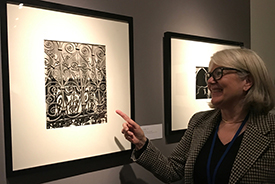 Susan Ball points to a Brett Weston photograph
Susan Ball. Towards Abstraction, 1940–1985: Brett Weston Photographs from the Bruce Museum Collection. Bruce Museum, Greenwich, Connecticut, November 5, 2016–February 12, 2017.

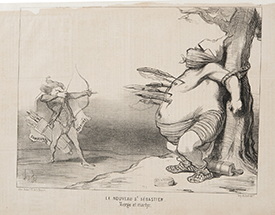 Honoré Daumier, Le Nouveau St. Sébastien. Vierge et martyr. from the series Actualités, 1849, lithograph on newsprint. Collection Zimmerli Art Museum at Rutgers, gift of William H. Helfand (artwork in the public domain; photograph by Peter Jacobs)
Christine Giviskos. Toutes Les Nouvelles – All the News: Current Events in Nineteenth-Century French Prints. Zimmerli Art Museum at Rutgers University, New Brunswick, New Jersey, January 21–July 30, 2017.

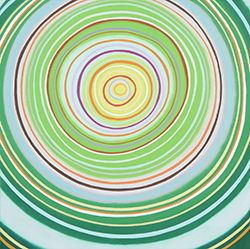 Helen Miranda Wilson, The Cool Days of Early Spring, January 4, 2009, oil on panel. Collection Zimmerli Art Museum at Rutgers, gift of Leonard Rosenberg and Colombe Nicholas (artwork © Helen Miranda Wilson; photograph by Peter Jacobs)
Donna Gustafson. Guerrilla (and Other) Girls: Art/Activism/Attitude. Zimmerli Art Museum at Rutgers University, New Brunswick, New Jersey, February 4–July 30, 2017.
Books Published by CAA Members
posted Feb 15, 2017
Publishing a book is a major milestone for artists and scholars—browse a list of recent titles below.
Books Published by CAA Members appears every two months: in February, April, June, August, October, and December. To learn more about submitting a listing, please follow the instructions on the main Member News page.
February 2017

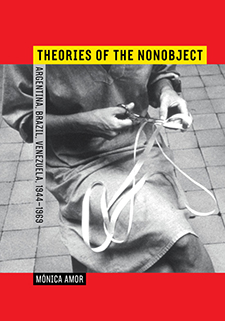
Mónica Amor. Theories of the Nonobject: Argentina, Brazil, Venezuela 1944–1969 (Oakland: University of California Press, 2016).

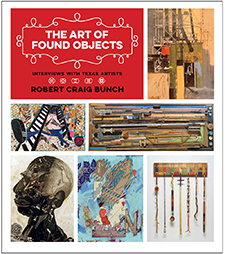
Robert Craig Bunch. The Art of Found Objects: Interviews with Texas Artists (College Station: Texas A&M University Press, 2016).

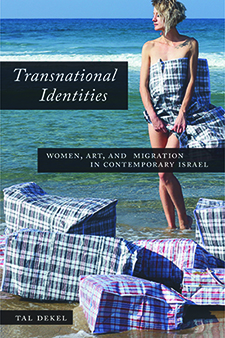
Tal Dekel. Transnational Identities: Women, Art, and Migration in Contemporary Israel (Detroit: Wayne State University Press, 2016).


Georgina G. Gluzman. Trazos invisibles. Mujeres artistas en Buenos Aires (1890–1923) (Buenos Aires: Editorial Biblos, 2016).

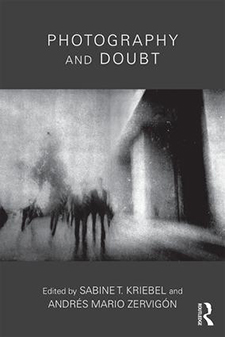
Sabine T. Kriebel and Andrés Mario Zervigón, eds. Photography and Doubt (New York: Routledge, 2017).

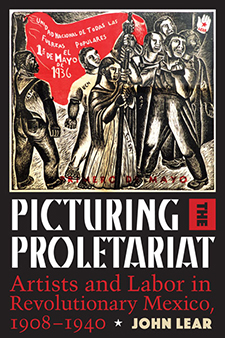
John Lear. Picturing the Proletariat: Artists and Labor in Revolutionary Mexico, 1908–1940 (Austin: University of Texas Press, 2017).

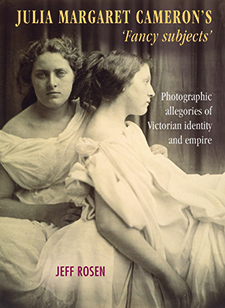
Jeff Rosen. Julia Margaret Cameron’s “Fancy Subjects”: Photographic Allegories of Victorian Identity and Empire (Manchester: Manchester University Press, 2016).


Maureen G. Shanahan and Ana María Reyes, eds. Simón Bolívar: Travels and Transformations of a Cultural Icon (Gainesville: University Press of Florida, 2016).


Lawrence Waldron. Handbook of Ceramic Animal Symbols in the Ancient Lesser Antilles (Gainesville: University Press of Florida, 2016).
News from the Art and Academic Worlds
posted Feb 15, 2017
Each week CAA News summarizes eight articles, published around the web, that CAA members may find interesting and useful in their professional and creative lives.
Art under Threat in 2016: Presenting the Figures
Freemuse registered 1,028 attacks on artists and violations of their rights in 2016 across 78 countries, continuing a worrying trend of artistic freedom increasingly coming under threat. The number of cases registered in 2016 more than doubled the amount in 2015, increasing by 119 percent, rising from 469 attacks. (Read more from Freemuse.)
What You Need to Know about Hate Speech and Free Speech
Is there any way to curb speech if it discriminates against people’s identity, like race? And when does speech become punishable under the law? Here’s what you need to know about the freedom of speech and dealing with hate speech in the current political climate. (Read more from Teen Vogue.)
We Don’t Pay Visual Artists Properly—That Needs to Change
Jane is a typical artist trying to build and maintain her career. She has had reasonable success with her art thus far but needs to subsidize her income by taking on work as a graphic designer. Now she has decided to return to art school to get university qualifications and commit fully to her professional artistic practice. (Read more from the Guardian.)
Reports of the Death of Religious Art Have Been Greatly Exaggerated
When written in the same sentence, the terms “religion” and “art” tend to turn the contemporary secularized gaze back in time to Renaissance imagery. Those old, redolent, often pious pictures of Christ Child and Madonna are pleasing to look at, but these days their principal function is to confirm how religious art existed in ages past. Present-day artists can’t possibly be interested in that anymore. (Read more from the Los Angeles Review of Books.)
The Prestige Gap
Women earn 60 percent of baccalaureate degrees and 46 percent of doctoral degrees, excluding professional programs, according to 2015 data from the National Science Foundation, yet they’re still underrepresented in many disciplines. Why? A new study points to segregation by gender based on field of study and what it calls program prestige. (Read more from Inside Higher Ed.)
The Importance of Female Friendship in Graduate School
Sometime in high school, when I was sixteen, living in the suburbs, and hopelessly devoted with the latest music, I was asked whether I prefer male or female singers. As I was answering—something about how men sang more interesting songs—it dawned on me: How many female-led bands had I heard? When was the last time a radio station played a song from an all-female band? (Read more from Inside Higher Ed.)
Metropolitan Museum Puts 375,000 Public-Domain Images in Creative Commons
The Metropolitan Museum of Art in New York has placed 375,000 images of public-domain works in the Creative Commons. This major move by one of the world’s most important museums means that users can now access pictures of many of the Met’s holdings on Wikimedia, and that these images are now subject to free use, with no copyright restrictions. (Read more from ARTnews.)
The Value of Copyright: A Publisher’s Perspective
There is no one view of copyright that fits all publishers. The publisher of a poetry magazine will likely feel differently about aspects of copyright when compared to, say, the publisher of your local phone book. Indeed, even within scholarly publishing there is a range of attitudes toward copyright. (Read more from the Scholarly Kitchen.)
The Art Bulletin Seeks Reviews Editor
posted Feb 14, 2017
The Art Bulletin Editorial Board invites nominations and self-nominations for the position of reviews editor for the term July 1, 2018–June 30, 2021 (with service as incoming reviews editor designate 2017–18). The Art Bulletin, published quarterly by CAA, features leading scholarship in the English language in all aspects of art history as practiced in the academy, museums, and other institutions.
Candidates should be art scholars with stature in the field and experience in editing book and/or exhibition reviews; institutional affiliation is not required. Candidates should be published authors of at least one book.
The reviews editor is responsible for commissioning all book and exhibition reviews in The Art Bulletin. He or she selects books and exhibitions for review, commissions reviewers, and determines the appropriate length and character of reviews. The reviews editor also works with authors and CAA’s editorial director in the development and preparation of review manuscripts for publication. He or she is expected to keep abreast of newly published and important books and recent exhibitions in the fields of art history, criticism, theory, visual studies, and museum publishing. This is a three-year term, which includes membership on the Art Bulletin Editorial Board.
The reviews editor attends the three annual meetings of the Art Bulletin Editorial Board—held in the spring and fall by teleconference or in New York, and in February at the CAA Annual Conference—and submits an annual report to CAA’s Board of Directors. CAA may reimburse the reviews editor for travel and lodging expenses for the meetings in New York in accordance with its travel policy, but he or she pays these expenses to attend the annual conference.
Candidates must be current CAA members in good standing and should not be serving on the editorial board of a competitive journal or on another CAA editorial board or committee. CAA encourages applications from colleagues who will contribute to the diversity of perspectives on the Art Bulletin Editorial Board and who will engage actively with conversations about the discipline’s engagements with differences of culture, religion, nationality, race, gender, sexuality, and access. Nominators should ascertain their nominee’s willingness to serve before submitting a name; self-nominations are also welcome. Please send a statement describing your interest in and qualifications for appointment, CV, and at least one letter of recommendation to: Art Bulletin Reviews Editor Search, College Art Association, 50 Broadway, 21st Floor, New York, NY 10004; or email the documents or inquiries to Joe Hannan, CAA editorial director. Deadline: Monday, April 3, 2017. Finalists will be interviewed on the afternoon of Friday, May 5, in New York.
Art Bulletin Editorial Board Seeks New Members
posted Feb 14, 2017
CAA invites nominations and self-nominations for three individuals to serve on the Art Bulletin Editorial Board for a four-year term, July 1, 2017–June 30, 2021. The ideal candidate has published substantially in the field and may be an academic, museum-based, or independent scholar; institutional affiliation is not required. The Art Bulletin features leading scholarship in the English language in all aspects of art history as practiced in the academy, museums, and other institutions.
The editorial board advises the Art Bulletin editor-in-chief and assists her or him in seeking authors, articles, and other content for the journal; performs peer review and recommends peer reviewers; may propose new initiatives for the journal; and may support fundraising efforts on the journal’s behalf. Members also assist the editor-in-chief to keep abreast of trends and issues in the field by attending and reporting on sessions at the CAA Annual Conference and other academic conferences, symposia, and events in their fields.
The Art Bulletin Editorial Board meets three times a year, with meetings in the spring and fall plus one at the CAA Annual Conference in February. The spring and fall meetings are currently held by teleconference, but at a later date CAA may reimburse members for travel and lodging expenses for New York meetings in accordance with its travel policy. Members pay travel and lodging expenses to attend the conference in February. Members of all editorial boards volunteer their services to CAA without compensation.
Candidates must be current CAA members in good standing and should not be serving on the editorial board of a competitive journal or on another CAA editorial board or committee. Members may not publish their own work in the journal during the term of service. CAA encourages applications from colleagues who will contribute to the diversity of perspectives on the Art Bulletin Editorial Board and who will engage actively with conversations about the discipline’s engagements with differences of culture, religion, nationality, race, gender, sexuality, and access. Nominators should ascertain their nominee’s willingness to serve before submitting a name; self-nominations are also welcome. Please send a letter describing your interest in and qualifications for appointment, a CV, and your contact information to: Chair, Art Bulletin Editorial Board, College Art Association, 50 Broadway, 21st Floor, New York, NY 10004; or email the documents or inquiries to Joe Hannan, CAA editorial director. Deadline: April 17, 2017.
Live-Streamed Sessions at CAA
posted Feb 13, 2017
CAA will present six 2017 Annual Conference sessions and events via live stream. The sessions will be streamed via CAA’s YouTube Channel. There is no charge to watch these sessions—they are free and open to the public.
Here is the schedule:
- Wednesday, February 15, 5:30–7:00 PM: Convocation, the Awards for Distinction presentations, and Mary Miller’s keynote address
- Thursday, February 16, 10:30 AM–noon: Public Art in the Era of Black Lives Matter
- Thursday, February 16, 12:15–1:30 PM: Key Conversations: Art Criticism
- Thursday, February 16, 5:30–7:00 PM: the Distinguished Scholar Session honoring Kaja Silverman
- Friday, February 17, 3:30–5:30 PM: Artist Interviews: Coco Fusco with Steven Nelson and Katherine Bradford with Judith Bernstein
- Saturday, February 18, 12:15–1:15 PM: Key Conversations: Hrag Vartanian with Amin Husain and Nitasha Dhillon of Decolonize This Place
Use the hashtags #caa2017 and #myCAA during the entire conference week!
New in caa.reviews
posted Feb 10, 2017
Vivien Green Fryd reviews Georgia O’Keeffe by Nancy J. Scott, a biography that, unlike its predecessors, draws on “the extensive correspondence, which only became available in 2006, between O’Keeffe and her husband,” Alfred Stieglitz. Although the author “does provide new information based on” the letters, “she fails to engage critically with the materials at her disposal.” Read the full review at caa.reviews.
Erica Levin reads Kaira M. Cabañas’s Off-Screen Cinema: Isidore Isou and the Lettrist Avant-Garde. In this “concise, thought-provoking study,” the author “sheds light on the brief but often overlooked period of radical filmmaking,” showing “how Lettrist cinema disrupted the signifying conventions of the film medium” and “reconceptualized the specific discursive practices embedding cinema” in postwar France. Read the full review at caa.reviews.
Rebecca Bedell discusses the exhibition catalogue Picturing the Americans: Landscape Painting from Tierra del Fuego to the Arctic. “No previous publication has offered such an expansive and inclusive survey of the hemisphere’s landscape art,” and “its collectivity of voices … substantially enriches the still-opening conversation about pan-American art.” Read the full review at caa.reviews.
Staff Interview: Alyssa Pavley
posted Feb 10, 2017
The next in a series of interviews with staff members is a conversation with Alyssa Pavley, CAA associate editor of digital publications.
How long have you worked at CAA?
Six years.
What do you do at CAA?
I work in CAA’s Publications Department, where I started out as the editorial assistant. I am currently the associate editor for digital publications and work closely on Art Journal Open.
What does CAA mean to you?
To me, CAA is a place of creative and intellectual exchange.
Can you talk about one of your favorite member moments?
One of my favorite member moments was at last year’s conference in DC, where I had a great conversation with a member who had recently joined CAA and was attending the Annual Conference for the first time. It was fantastic to be able to speak at length with her about her experience, the sessions she had attended so far and those she was looking forward to, and her career. It’s always fun to hear from someone experiencing the Annual Conference for the first time!
What do you like best about the arts and working in the arts?
It’s wonderful to work in such a creative environment. Since I work specifically in arts publishing, it’s great to be in a space where I can help others peruse their artistic and creative passions via digital publications.
Do you have a favorite moment from the Annual Conference?
It’s great when I’m able to help a conference attendee, even if it’s something as small as giving directions to the room where their next session is taking place or looking up the time a session starts—it’s nice to think that I’ve possibly made someone’s day a little less stressful! On a personal note, I love browsing through the Book and Trade Fair.
News from the Art and Academic Worlds
posted Feb 08, 2017
Each week CAA News summarizes eight articles, published around the web, that CAA members may find interesting and useful in their professional and creative lives.
MoMA Installs Works by Artists from Countries Targeted by Trump’s Travel Ban
In response to President Trump’s executive order temporarily banning immigration from seven majority-Muslim countries, the Museum of Modern Art has replaced works in its permanent-collection galleries with eight by artists from the targeted nations. The rehang was instigated and executed by staff who wanted to react to unsettling political circumstances. (Read more from Hyperallergic.)
The Battle to Save America’s Arts Endowment from Trump’s Cuts
The day before Donald Trump was installed as president, details of his administration’s plans for cuts to government spending came to light. Seemingly drawn from a blueprint published by the Heritage Foundation, the plans feature deep cuts to many vital federal programs, including the elimination of the NEA. (Read more from Apollo.)
What We Can Learn from the Brief Period When the Government Employed Artists
That the arts would be funded significantly by the federal government may raise an eyebrow today. But working under a subdivision of the Works Progress Administration known as the Federal Art Project, artists such as Jackson Pollock and Lee Krasner helped the country recover from the Great Depression, as part of President Franklin D. Roosevelt’s New Deal. (Read more from Artsy.)
State Spending on Higher Ed Continues Upward Trend
For the fourth year in a row, state spending on higher education is up nationwide. The annual “Grapevine” survey, conducted by the State Higher Education Executive Officers and the Center for the Study of Education Policy at Illinois State University, shows a 3.4-percent average nationwide increase in spending over the 2016 fiscal year, although that figure could be changed by legislation pending in Illinois. (Read more from the Chronicle of Higher Education.)
The Met: A Great Museum in Decline?
The bad news had been building for months at the Metropolitan Museum of Art. Even as crowds poured into shows on Hellenistic kingdoms and high-tech fashion, the museum’s deficit was approaching $40 million and had forced the buyout or layoff of some ninety employees. An expansion into a satellite building cost millions of dollars more than expected. (Read more from the New York Times.)
Museums Celebrate the Decriminalization of Homosexuality
Museums across the UK are preparing exhibitions to mark the fiftieth anniversary of the Sexual Offences Act, the legislation that partially decriminalized male homosexuality in England and Wales in 1967. In London, the National Portrait Gallery will present a special display on the city’s gay scene in the 1980s, while the first major exhibition dedicated to queer British art will open at Tate Britain. (Read more from the Art Newspaper.)
Nobody Is Normal
While medical researchers might miss such fine points, philosophers of medicine have been parsing the nuances and striving to define “normal” for years. One thought experiment asks us to consider variations on the ends of the spectrum that we would not consider pathological: having green eyes, being color-blind, being extremely tall or short, having photographic memory, or being a supertaster. (Read more from Aeon.)
Brad Troemel, the Troll of Internet Art
Brad Troemel’s art plays with a central paradox of the internet: the technology that was supposed to liberate us from the dreary real world has inspired a whole new set of anxieties. For the growing number of artists who use the internet to distribute their work, a key problem has become how to stand out amid a torrent of information. (Read more from the New Yorker.)
Hunter O’Hanian Welcomes you to CAA 2017
posted Feb 06, 2017
A message from CAA Executive Director Hunter O’Hanian about the 2017 Annual Conference
Greetings,
I am very much looking forward to my first Annual Conference as CAA’s new Executive Director. I think the Annual Conference Committee has done a great job presenting an amazing lineup of sessions and the CAA staff has worked hard to make sure that this will be one of the best conferences ever. Many thanks to Tiffany Dugan, Paul Skiff, Katie Apsey and the rest of the Annual Conference staff who have put in so many hours.
But we also need your help at the Annual Conference.
I’d like every attendee to think about three central ideas which will make the experience more rewarding for you and your fellow attendees.
Create an atmosphere of Inclusion – We’ve heard from past participants that they have not always felt welcome by other CAA members. Some have said that they felt marginalized due to their age, experience, or even the color of their skin. Others have said they felt somewhat judged by other CAA members based solely upon what is printed on their name badge.
Obviously we do not want any CAA member to feel this way. While the CAA staff and board will work to make everyone feel welcome and included, we ask they you do the same. Extend your hand and say hello to a stranger. Say hi to the person sitting next to you at a session. Chat with someone new in the elevator or in a coffee line. Together, we can work to make all of our members feel included.
We want to solve your problems – This year there will be more than 4,000 people in attendance at the conference. In essence, we will be creating a small town at the New York Hilton Midtown for the week. Inevitably, problems will crop up – and we want to solve them.
If you find you are having problems with membership, registration, locating information, please look for one of the CAA staff members wearing the “Ask Me!” button. They will try to quickly understand the issue and get you to someone who can resolve it as soon as possible. We are here to help and that’s what we intend to do!
We want your feedback – Building a CAA for the 21st century is the most important work ahead of us. We cannot do that without hearing what you need to help you in your respective professional fields. We need to hear from you. If you completed the recent survey, many thanks. Those results will be processed shortly.
The field and the organization is changing rapidly and we cannot strengthen it properly without hearing what you need and want. We encourage you to vote in the election for the new board of directors, either on the CAA website or on the CAA Annual Conference App. We encourage you to attend the myCAA session on Friday, February 17, 2017 at 12:15PM. If you cannot attend the session, email us noting a few things that you appreciate about CAA and a few things you would like to see improved. Or leave your comments on CAA Connect in the myCAA Discussion Community. What are the current benefits you value and what benefits would you like to see us add in the future?
Many thanks for taking the time to think about these key messages and I look forward to seeing you at the Annual Conference.
Best,
Hunter O’Hanian
Executive Director and Chief Executive Officer