
CAA News Today
Free Sessions and Events at the 2016 Annual Conference
posted Jan 25, 2016
The following sessions and events at CAA’s 104th Annual Conference, taking place February 3–6, 2016, in Washington, DC, are free and open to the public. Everything takes place at the Washington Marriott Wardman Park Hotel.
Media Lounge, all events and screenings
Wednesday, February 3–Saturday, February 6
Thurgood Marshall Ballroom West, Mezzanine Level
Looking Ahead: Changes to the CAA Annual Conference
Wednesday, February 3, 12:30–2:00 PM
Wilson B, Mezzanine Level
CAA Convocation, Awards Presentation, and Keynote Address by Tania Bruguera
Wednesday, February 3, 5:30–7:00 PM
Salon 2, Lobby Level
The NEA and NEH at 50: NEA Chair Jane Chu and NEH Chair William “Bro” Adams in Conversation
Thursday, February 4, 12:30–2:00 PM
Salon 3, Lobby Level
The Power of Storytelling: Finding and Engaging New Audiences with Jarl Mohn, President and CEO, National Public Radio
Thursday, February 4, 5:30–7:00 PM
Salon 2, Lobby Level
Past, Present, and Future: NEH at 50
Friday, February 5, 2:30–5:00 PM
Salon 2, Lobby Level
ARTexchange
Friday, February 5, 5:30–7:00 PM
Atrium, Exhibition Level
Recipients of the 2015 Professional Development Fellowships
posted Jan 22, 2016
CAA has awarded four 2015 Professional-Development Fellowships—two in the visual arts and two in art history—to graduate students in MFA and PhD programs across the United States. In addition, CAA has named two honorable mentions in art history and four in the visual arts. The fellows and honorable mentions also receive a complimentary one-year CAA membership and free registration for the 2016 Annual Conference in Washington, DC.
Receiving fellowships in the visual arts are:
- Delano Dunn, School of Visual Arts, $10,000
- Derrick Woods-Morrow, School of the Art Institute of Chicago, $4,000 (gift of the Milton and Sally Avery Arts Foundation)
The two recipients of the fellowship in art history are:
- Marin Sarvé-Tarr, University of Chicago, $10,000
- Emilie Boone, Northwestern University, $2,500 (gift of the Elizabeth A. Sackler Museum Educational Trust)
The honorable mentions for art history go to: Adrian Anagnost, University of Chicago; and Monica Bravo, Brown University. For the visual arts, honorable mentions are bestowed upon: Zhiwan Cheung, Carnegie Mellon University; Sarah Hewitt, Purchase College, State University of New York; Victoria Maidhof, San Francisco Art Institute; and Kaiya Rainbolt, San Diego State University.
DeWitt Godfrey, president of the CAA Board of Directors, will formally recognize the fellows and honorable mentions at the 104th Annual Conference during Convocation, taking place on Wednesday evening, February 3, 2016, at the Washington Marriott Wardman Park Hotel.
CAA’s fellowship program supports promising artists and art historians who are enrolled in MFA and PhD programs nationwide. Awards are intended to help them with various aspects of their work, whether for job-search expenses or purchasing materials for the studio. CAA believes a grant of this kind, without contingencies, can best facilitate the transition between graduate studies and professional careers. The program is open to all eligible graduate students in the visual arts and art history. Applications for the 2016 fellowship cycle will open in late spring.
Fellows in the Visual Arts
 Delano Dunn
Born in Los Angeles, California, Delano Dunn currently lives and works in New York. Through painting, mixed media, and collage, he explores questions of racial identity and perception through various contexts, ranging from the personal to the political and drawing from his experience growing up in South Central LA.
Dunn has had solo exhibitions in Los Angeles, New York, and Buffalo and is currently completing an MFA at the School of Visual Arts in New York. He holds a BFA from Pratt Institute in Brooklyn. Upcoming exhibitions include a solo show at the 2016 Affordable Art Fair and a group show at Artspace in New Haven, Connecticut. His work is also on view at the Delaware Center for the Contemporary Arts in Wilmington until March 4.
View images of Dunn’s work: Example 1, Example 2, Example 3.
 Derrick Woods-Morrow
Derrick Woods-Morrow was born and raised in Greensboro, North Carolina. He is an MFA student in the Photography Department at the School of the Art Institute of Chicago (SAIC) in Illinois. He holds a BA from Randolph College in Lynchburg, Virginia, and earned a postbaccalaureate certificate from the Massachusetts College of Art and Design (MassArt) in Boston. Woods-Morrow’s work has been shown at the Kinsey Institute at Indiana University, Randolph’s Maier Museum of Art, the President’s Gallery at MassArt, the Sullivan Galleries at SAIC, and the ACRE residency, where he was a Terry Plumming Scholar. He has received the Carol Becker Merit Scholarship at SAIC.
Woods-Morrow’s work explores the problematic ideals of masculinity embedded in systems that constructs gay pornography, where intimacy is frail and domination and disregard are desired traits; where oppressive force is the norm; where the African American does not exist except as fetishized commodity; and where a prevailing use of heterosexual vocabulary continues to establish masculine credibility within queer imagery.
View images of Woods-Morrow’s work: Example 1, Example 2.
Fellows in Art History
 Marin Sarvé-Tarr
Marin Sarvé-Tarr will complete a PhD in art history at the University of Chicago in Illinois in summer 2016. Her dissertation, “Seizing the Everyday: Lettrist Film and the French Postwar Avant-Garde, 1946–1954,” examines the films produced by members of Lettrism, Nouveau Réalisme, and the Situationist International; it also identifies informal networks between later rivals forged in cafés and ciné-clubs in 1950s Paris. Her project shows how artists’ collaborative films and public demonstrations impacted the agendas of publishers, cinemas, and museums that patronized artists, molded public reception of the arts, and figured social progress in reconstruction France. With support from the Deutsches Forum für Kunstgeschichte, the Getty Research Institute, and the Georges Lurcy Charitable and Educational Trust, Marin presented on religion and the avant-garde at CAA’s 2014 Annual Conference. She is also publishing a chapter on Lettrist cinema in a forthcoming volume from the European Postwar and Contemporary Art Forum, to be published later this year.
Marin earned a BA in 2008 from Scripps College in Claremont, California, where she curated The Politics of Satire: La Caricature in Post-Revolutionary France at the Clark Humanities Museum. She contributed to exhibitions and programs at the Art Institute of Chicago, the Fondation Cartier pour l’art contemporain in Paris, and the Bophana Audiovisual Resource Center in Phnom Penh, Cambodia. Marin helped to organize Interiors and Exteriors: Avant-Garde Itineraries in Postwar France (2013–14) at the University of Chicago’s Smart Museum of Art. As a 2015–16 Andrew W. Mellon Curatorial Research Fellow for the Chicago Object Study Initiative at the Art Institute of Chicago, Marin is currently preparing object-based research and publications on Surrealism.
 Emilie Boone
Emilie Boone is currently a PhD candidate in the Department of Art History at Northwestern University in Evanston, Illinois. She focuses on the history of photography, the art of the African diaspora, and American art. Her dissertation, “Visions of Harlem: Reconsidering the Studio Photography of James Van Der Zee,” demonstrates the intrinsic role of Van Der Zee’s images in constructing multivalent narratives of Harlem. Boone has written for History of Photography and African Arts and for Columbia College Chicago’s Museum of Contemporary Photography and Washington University’s Mildred Lane Kemper Art Museum in Saint Louis, Missouri. Most recently, she has contributed to an exhibition catalogue, From Within and Without: The History of Haitian Photography, for the NSU Museum of Art Fort Lauderdale in Florida. She also has an essay in the forthcoming anthology, Towards an African-Canadian Art History: Art, Memory, and Resistance.
Boone’s honors include a fellowship at the Smithsonian Institute’s National Portrait Gallery, a Fulbright fellowship at the Notman Photographic Archives, a Terra Foundation Residency in Giverny, France, and an Eliza Dangler Curatorial Fellowship at the Art Institute of Chicago. In 2011, 2013, and 2015, she was an invited participant of the Ghetto Biennale in Port-au-Prince, Haiti. A critical-studies residency at the Center for Photography at Woodstock led to her recent role as a selection panelist for the Woodstock Artist-in-Residency Program for artists working in the photographic arts. As a postdoctoral Mellon curatorial fellow, Boone looks forward to advancing her research, teaching, and curatorial engagement at the Williams College Museum of Art in Williamstown, Massachusetts.
Honorable Mentions in Visual Art and Art History
Adrian Anagnost
Adrian Anagnost is a historian of modern and contemporary art whose scholarship investigates the intersections of urban space, political economy, and aesthetic practice. She earned a PhD from the University of Chicago in Illinois in December 2015. Her dissertation, titled “Contested Spaces: Art and Urbanism in Brazil, 1928–1969,” considers how the artists and architects Flávio de Carvalho, Lúcio Costa, Lina Bo Maria Bardi, Waldemar Cordeiro, Lygia Clark, and Hélio Oiticica engaged with the built environment as a concretization of social relations in Brazil.
Before coming to Chicago, Anagnost completed an MA in modern art from Columbia University in New York, with a thesis on the contemporary photographer James Welling. She also worked in the archive and registration departments of David Zwirner in New York. Anagnost’s writings on Waldemar Cordeiro, Carol Bove, Oswald de Andrade, and Pedro Almodóvar have appeared in the Chicago Art Journal, Hemisphere: Visual Cultures of the Americas, and ArtUS. Her upcoming publications include an article on the Polish Constructivist Teresa Żarnower for the Woman’s Art Journal and an essay on the work of the contemporary artist Theaster Gates.
 Monica Bravo
Monica Bravo is an ABD doctoral candidate specializing in American art in a global context and the history of photography at Brown University in Providence, Rhode Island. She received her BA in studio art from Dartmouth College in Hanover, New Hampshire, in 2004, and an MA in art history and criticism from Stony Brook University in Stony Brook, New York, in 2009. Bravo’s dissertation examines exchanges between modernist photographers in the United States and modern Mexican artists working in painting, poetry, music, and photography, resulting in the development of a greater American modernism in the interwar period.
Bravo has been a fellow at the University of Arizona’s Center for Creative Photography, the Huntington Library, Art Collections, and Botanical Gardens in San Marino, California, and the Georgia O’Keeffe Museum Research Center in Santa Fe, New Mexico. She is currently a Wyeth predoctoral fellow at the National Gallery of Art’s Center for Advanced Study in the Visual Arts in Washington, DC.
 Zhiwan Cheung
They say that geography defines a person. Born in America and raised by Chinese immigrants, Zhiwan Cheung lives in a sort of permanent in-between state of being neither fully American nor Chinese. As a journey toward a home that does not exist, a rite of passage with no destination, he uses his work to search for a critical understanding of an impossible homecoming. Cheung’s practice focuses on the meaning and space between identities, examining the feeling of a liminal displacement through sculpture, film, and performance. In approaching this journey, he probes the intersection of national identity and the personal psyche with an open-ended, multimedia approach.
Performativity gets closer to the heart of all identity. It is no coincidence that many great actors continue to employ their characters long after the camera stopped running. For the best performances, the blurring between fake and real becomes so powerful that we cease to see the actor or the character: one is constantly subsumed by the other, leaving the residue of the actual and the imaginary to shift and ebb between various in-between-states. This sacrificing of the self and the fabrication of a persona speak to the destruction of the self for art. Or is it perhaps the other way around? James Luna, a Native American performance artist, once said, “How do you talk about things like intercultural identity[?] Do you talk about it in third person? If you sacrifice yourself, so to speak, then it becomes much more dynamic.” The sacrificing of the true self and the fabricated persona speaks to the destruction of the soul for art, or perhaps it is the other way around. Life is art. Art is life.
The intersection of national identity and the personal psyche is complex, not always clear nor fixed. As an artist, Cheung probes the paths and how and where they join and diverge. This personal odyssey explores the permanent liminal through diverse strategies and processes. It is a journey guided by an allusive visual language, with a mix of pop-cultural, art-historical, and aesthetic choices that also guide audiences into finding their own rites of passage.
View images of Cheung’s work: Example 1, Example 2, Example 3.
 Sarah Hewitt
She vows
To make plastic art
Redefine plastic art
To make you love plastic art
To challenge and bewitch you with what you think is formal or plastic
To make you bow to her craft\
Redefine craft
To weave
To weave your mind
To weave your mind into confusion
To drag you into the sacred without your consent
Let the work be deep, dark, and dirty—gritty. It comes from a place of authenticity. Sarah Hewitt is not looking to create a spectacle for fun or frivolity. This is serious business for her. She is crafting a new fabric in a manner that is complicated—as complicated and fragile as our contemporary moments.
Hewitt’s works are exhibited around the country and have garnered many awards, grants, and residencies, including the Skowhegan School of Painting and Sculpture and a fellowship at the Vermont Studio Center. This spring she will receive her MFA in visual art from Purchase College, State University of New York.
View images of Hewitt’s work: Example 1, Example 2, Example 3.
 Victoria Maidhof
Victoria Maidhof has been fascinated by unconventional people for as long as she can remember. She was raised in a middle-class suburban neighborhood where her family stood out as eccentrics. They were the only secular family on the block, and her parents encouraged their children to run wild, play hard, and reject authority. Maidhof’s father told captivating stories about his unusual upbringing, many of which revolved around his mother, a paranoid schizophrenic, and his father, a merchant marine with severe posttraumatic stress disorder.
As Maidhof got older, she became curious about other people that lived unorthodox lifestyles. Having seen the work of Mary Ellen Mark and Diane Arbus, she knew that the camera could grant permission into the lives of complete strangers. In 2003, Maidhof moved to San Francisco to study photography at the San Francisco Art Institute in California. After completing her BFA, she returned to her home town, San Diego, with her now-husband Tahan in tow. They currently reside in La Mesa, where she works full time as a photographer. Maidhof is finishing her MFA through the San Francisco Art Institute’s low-residency program.
View images of Maidhof’s work: Example 1, Example 2, Example 3.
 Kaiya Rainbolt
Kaiya Rainbolt earned her BA in English literature at Earlham College in Richmond, Indiana, and studied studio art at City College of San Francisco in California, with a focus in metalwork. She currently attends the MFA program in jewelry and metalwork at San Diego State University. Rainbolt has participated in several national juried exhibitions and has been recognized with numerous scholarships and awards.
Though trained as a metalsmith, Rainbolt currently uses a wide variety of materials in her work, including fabrics, clothing, steel, lead, and animal hide. She is focused on creating work that has the potential to elicit a visceral response from the viewer in order to promote engagement in a way that makes it easier to participate in dialogue about socially sensitive issues. Rainbolt believes that an art object, as a representation of a particular human struggle, has the potential to span differences in experience, background, and culture in a way that creates connection, generates empathy, and fosters understanding.
Changes to the Annual Conference
posted Jan 22, 2016
In 2017, CAA will change the format of our Annual Conference as we look to liven up the experience of all our members. The changes highlighted below are the result of a critical look at the event by the organization’s Annual Conference Committee.
- Proposal submission process for 2017 will open on March 1 and close on April 18
- New conference submission software: Submittable
- New time grid: all sessions will be ninety minutes in length, allowing for more sessions during the conference’s four days
- Individuals may participate in consecutive years, if their proposals are accepted
- More types of submissions and therefore more ways to participate, such as: complete session proposals, with speakers chosen in advance; proposals to chairs, who will solicit speakers through a call for papers; and independent proposals of papers
You can download and read the full report of recommendations by CAA’s Task Force on the Annual Conference.
Voting Ends Soon! 2016 Board of Directors Election
posted Jan 21, 2016
The annual CAA Board of Directors election is ongoing. To participate, all you need is your CAA member ID number and password. Visit the board election page or click the candidates’ names below to read their statements, biographies, and endorsements—and to watch their video presentations—before casting your vote:
The six candidates are:
- Dina Bangdel, Associate Professor and Director, Art History Program, Virginia Commonwealth University in Qatar
- Carma Gorman, Associate Professor and Assistant Chair, Dept. of Art and Art History, University of Texas at Austin
- N. Elizabeth Schlatter, Deputy Director and Curator of Exhibitions, University of Richmond Museums
- Andrew Schulz, Associate Dean for Research and Associate Professor, College of Arts and Architecture, Pennsylvania State University
- Roberto Tejada, Cullen Distinguished Professor, Departments of English and Art History, University of Houston
- Anuradha Vikram, Lecturer, Graduate Public Practice, Otis College of Art and Design, Los Angeles
How to Vote
Log into your CAA account with your CAA User ID# and password. Then click the Vote Now image at the center of your screen to begin the process. If you are already logged in, click the “Home” link at left, and then the “Vote Now” image.
You may vote for up to four candidates, including one write-in candidate if you wish. Ballots that indicate more than four candidates will be void. The election ends at 5:00 PM (EST) on Wednesday, February 3, 2016.
Send your Proxy
CAA encourages all members to attend its Annual Business Meeting at the 2016 Annual Conference in Washington, DC. If you cannot attend, kindly check the box appointing a proxy. By doing so, you appoint the CAA board officers named thereon — DeWitt Godfrey, John J. Richardson, Charles A. Wright, Suzanne Blier, Gail Feigenbaum, and Doralynn Pines — to vote, in their discretion, on such matters as may properly come before such a meeting.
A quorum of 100 members is required to hold the Annual Business Meeting; therefore CAA requests your proxy to insure the Annual Business Meeting can take place. Please submit your proxy by 5:00 p.m. EST on Wednesday, February 3, 2016. Thank you!
The CAA 2016 App Is Live!
posted Jan 20, 2016
 If you are attending CAA 2016, you’ll want to have the official conference app on your mobile device. The app helps you navigate the conference schedule and allows you to create your own customized schedule within the app. In addition, you can follow the app activity feed to see posts from other attendees and follow conference news. The app allows for posting to social media accounts and connecting directly with other conference attendees. Check the conference maps in the app and bookmark items and sessions of interest.
The CAA 2016 app works on most mobile platforms, including iPhones and iPads, Android devices, and Blackberries.
Instructions for Downloading:
App Information Page and Download Instructions
CAA’s conference app is available through the Google Play store and the Apple App Store. To download the app onto your mobile device, search for “CAA 2016” in the Apple or Google app stores and download the app, allowing for permissions requested by the app. The HTML5 web-based version of the app is available for attendees who have Windows or Blackberry phones or do not have a smartphone.
News from the Art and Academic Worlds
posted Jan 20, 2016
Each week CAA News publishes summaries of eight articles, published around the web, that CAA members may find interesting and useful in their professional and creative lives.
Here Are the Guerrilla Girls on The Late Show with Stephen Colbert
The anonymous feminist art collective Guerrilla Girls appeared on The Late Show with Stephen Colbert last week and talked about gender inequality in the art world. The collective is known for wearing gorilla masks and using the names of deceased female artists as monikers. Kathe, Zubeida, and Frida were the members that spoke with Colbert. (Read more from ARTnews.)
How Advocates of African American Art Are Advancing Racial Equality in the Art World
Only a small group of African Americans occupy curatorial positions at mainstream museums, relatively few African American artists have been given major solo museum shows, and works by nineteenth- and twentieth-century African American artists are undervalued by the art market relative to those by white artists of equal standing. Change doesn’t come organically, however. It takes individuals. (Read more from Artsy.)
New York Dealers Cannot Afford to Represent Emerging Artists
For visitors to New York art galleries who want to know why the prices are so high—or for artists who want to exhibit their work in those galleries—part of the blame may lie with the landlord, or with the real-estate market as a whole. Rents are high, averaging $100 to $200 per square foot in Chelsea and $80 to $120 on the Lower East Side. (Read more from the Huffington Post.)
Help Desk: Self-Promotion
I’m an artist who just got a solo show at a little gallery but have no idea how to promote it. I didn’t go to art school and don’t have a huge group of people to invite. I’m lost on how to market the show. Where do I start? (Read more from Daily Serving.)
320 Hours: Slow Looking and Visitor Engagement with El Greco
By the time the painting returned to its home in Cleveland, El Greco’s Holy Family with Saint Mary Magdalene and I had spent 320 hours and four months together. As an interpretation assistant for the Portland Art Museum, I was in the gallery four days a week, interacting with visitors, experimenting with interpretive strategies, and reflecting on this four-hundred-year-old painting. This experience gave me room to experiment with visitor engagement, changed how I approach the act of looking, and influenced my teaching outside the museum. (Read more from Art Museum Teaching.)
How to Explain Pictures to a Difficult Date
We live in an age when “kitsch” almost defies definition but is tossed around with great abandon: If Jeff Koons can turn tacky garden sculptures and gift-shop figurines into gazillion-dollar collectibles, lauded by a fair number of critics, what then becomes of kitsch? (Read more from Vasari21.)
Getting Your Citations in Order
Failure to acknowledge is not as big a sin as outright plagiarism, but there is something disconcerting about it. Two related problems necessarily task academics. One confronts those who enter a new field: how to make sure to build on already existing developments and avoid unnecessary wheel reinvention. The answer—as all research students are told—is to do the desk research first. (Read more from Times Higher Education.)
Facing an Impossible Choice
Maybe the problem with academics is that we take too much pride in our jobs. No doubt that sounds counterintuitive: How can pride in our work be a bad thing? It can when it inspires far too many PhDs to labor willingly for far too long in contingent positions. (Read more from Vitae.)
Career Services Guide for the 2016 Annual Conference
posted Jan 14, 2016
 CAA has designed the Career Services Guide to inform job seekers and employers about placement activities at the 2016 Annual Conference in Washington, DC. The publication, available as a PDF, will help you navigate Career Services events and provides answers to frequently asked questions. Study this guide carefully so that you will know what to expect from conference interviewing and how best to prepare for a successful experience.
Job candidates can review the basics of the conference employment search. Read about the Candidate Center, your home base at the conference, as well as Orientation, an introduction to Career Services where you can ask questions. In addition, learn more about the Online Career Center, where you can search for position listings, post application materials, and arrange interviews. The publication includes tips for improving your CV, portfolio, and supplemental application materials.
Employers will find details in the guide for renting interview booths and tables as well as recommendations for posting jobs and conducting interviews at the conference. You can begin preparations now for Career Services through the Online Career Center or onsite at the Interviewer Center.
Printed copies of the Career Services Guide will be distributed onsite at Orientation and in the Candidate Center. All conference Career Services will take place at the Washington Marriott Wardman Park Hotel. For more information about job searching, professional-development workshops, and more, visit the Career Services section of the conference website.
Career Services Guide for the 2016 Annual Conference
posted Jan 14, 2016
CAA has designed the Career Services Guide to inform job seekers and employers about placement activities at the 2016 Annual Conference in Washington, DC. The publication, available as a PDF, will help you navigate Career Services events and provides answers to frequently asked questions. Study this guide carefully so that you will know what to expect from conference interviewing and how best to prepare for a successful experience.
Job candidates can review the basics of the conference employment search. Read about the Candidate Center, your home base at the conference, as well as Orientation, an introduction to Career Services where you can ask questions. In addition, learn more about the Online Career Center, where you can search for position listings, post application materials, and arrange interviews. The publication includes tips for improving your CV, portfolio, and supplemental application materials.
Employers will find details in the guide for renting interview booths and tables as well as recommendations for posting jobs and conducting interviews at the conference. You can begin preparations now for Career Services through the Online Career Center or onsite at the Interviewer Center.
Printed copies of the Career Services Guide will be distributed onsite at Orientation and in the Candidate Center. All conference Career Services will take place at the Washington Marriott Wardman Park Hotel. For more information about job searching, professional-development workshops, and more, visit the Career Services section of the conference website.
News from the Art and Academic Worlds
posted Jan 13, 2016
Each week CAA News publishes summaries of eight articles, published around the web, that CAA members may find interesting and useful in their professional and creative lives.
Should Art Grants Be Awarded to Artists Who Don’t Need the Money?
When talking to the founders of the James W. Ray Distinguished Artist Award in Seattle, I was trying to raise a general discussion around the fact that many arts funders don’t take financial need into account when deciding who gets their money. I’m not talking about making need the decisive factor. I’m talking about making it one factor among several. (Read more from the Stranger.)
The Most Relevant Art Today Is Taking Place outside the Art World
When artists operate outside the gallery space, whether because their work functions best there or because they are forced to, they are both creating valuable art and making the limitations of traditional art institutions visible—physically, historically, and conceptually. Perhaps such work can even change those institutions, those structures of looking. (Read more from Artsy.)
The Robots Are Coming
Artists as diverse as Rachel Whiteread, Oscar Murillo, and Yayoi Kusama are beginning to use the high-tech fabrication methods once available to only the most commercially successful artists. Lower-cost robots that mimic an artist’s arm movements and joints are starting to replace the pricey computer-numerical-control machines that Jeff Koons uses to produce his sleek, industrial aesthetic. (Read more from the Art Newspaper.)
The Secret to All Great Art Forgeries
In A Forger’s Tale, the convicted forger Shaun Greenhalgh reveals that he drew Leonardo da Vinci’s La Bella Principessa, which has been valued upwards of $100 million. Greenhalgh even admits that he modeled the subject after a supermarket checkout girl. If his claims are true, how did this forgery go unnoticed for so long? How did it pass the sniff tests of so many art historians and purported experts? (Read more from the New Republic.)
College Degree Gap Grows Wider for Whites, Blacks, and Latinos
The racial gap in who’s graduating from college has widened since 2007, a new report shows. While more blacks and Latinos are graduating from college now, the percentage of whites graduating has grown even faster. About 33 percent of African American adults had at least a two-year college degree in 2015, up from about 28 percent in 2007. For Latinos, that figure grew to about 23 percent from 19 percent, while whites grew to 47 percent from 41 percent. (Read more from the Hechinger Report.)
Translating Research into Practice
During the past twenty years, college and university faculty have begun to utilize several areas of the learning sciences, including cognitive psychology, to inform pedagogy. Much of this work has happened in ways that have helped our profession to more effectively teach and our students to more effectively learn. However, we still have much work to do if we claim that we have a well-developed set of tools that can be applied across disciplines. (Read more from Faculty Focus.)
Helen Molesworth’s Permanent-Collection Show at MOCA Is Upending the Story of Art
Enter the permanent collection galleries of any museum of modern and contemporary art in the United States and it’s likely you’ll lay eyes on a familiar story: the muscular narrative of the Abstract Expressionists attacking their canvases, continuing through the pathways of 1960s Pop and 1970s Minimalism before landing at the Neoexpressionism of the 1980s. Pay a visit to Los Angeles’ Museum of Contemporary Art, however, and you will see that story turned on its head. (Read more from the Los Angeles Times.)
What Money Can Buy
The urge to change the world is normally thwarted by a near-insurmountable barricade of obstacles: failure of imagination, failure of courage, bad governments, bad planning, incompetence, corruption, fecklessness, the laws of nations, the laws of physics, the weight of history, inertia of all sorts, psychological unsuitability on the part of the would-be changer, the resistance of people who would lose from the change, the resistance of people who would benefit from it, the seduction of activities other than world-changing, lack of practical knowledge, lack of political skill, and lack of money. (Read more from the New Yorker.)
Workers Still Needed for the 2016 Annual Conference!
posted Jan 12, 2016
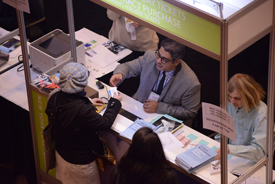 Interested in attending the 2016 Annual Conference but find the registration fees prohibitory? Working as a projectionist, room monitor, or registration attendant at this year’s event is a great way to save on conference expenses. All temporary workers who agree to twelve hours of work and a paid training meeting are given complimentary full-conference registration; they will also receive $12 per hour upon the completion of their shifts.
CAA is still accepting applicants for the following positions and shifts.
Registration Attendants
CAA seeks registration attendants to work in the registration area between Tuesday afternoon, February 2 and Saturday afternoon, February 6. Registration attendants are required to work a minimum of twelve hours, registering conference participants, checking membership statuses, and monitoring registration compliance in various session rooms. Registration attendant shifts are full-day shifts (8:00 AM–7:00 PM) and best for people who would like to complete their work commitment in a single day.
**Registration attendants must attend a training meeting on Tuesday afternoon, February 2, between 3:30 and 5:00 PM.
**Workers are still needed for shifts on Wednesday, February 3, 8:00 AM–7:00 PM, and Thursday February 4, 8:00 AM–7:00 PM.
Projectionists
CAA seeks projectionists to work in the various conference session rooms between Wednesday, February 3, and Saturday February 6. Projectionists are required to work a minimum of eleven hours and must be familiar with digital projectors and laptops.
**Projectionists must attend a training meeting on Wednesday morning, February 3, 7:30–8:30 AM.
**Many shifts still available between 9:30 AM and 5:00 PM on Thursday, February 4, and Friday, February 5.
Room Monitors
CAA seeks room monitors to work in the various conference session rooms between Wednesday, February 3, and Saturday February 6. Room monitors are required to work a minimum of eleven hours checking in session participants, monitoring membership compliance in various rooms, and taking attendance in the session rooms.
**Room monitors must attend a training meeting on Wednesday morning, February 3, 7:30–8:30 AM.
**Many shifts are still available between 9:30 AM and 5:00 PM on Thursday, February 4, and Friday, February 5.
To Apply
Send a two-page CV and a brief letter of interest to Katie Apsey, CAA manager of programs. In your letter of interest, please include the following details: (1) the maximum number of hours you can work (minimum twelve, maximum forty); (2) what days you will be in attendance and available to work (Tuesday afternoon, February 2, through Saturday night, February 6); (3) any days or session times you absolutely cannot work (when you plan on attending an important event or presenting a paper); (4) an order of preference for positions, if applying for multiple availabilities; (5) your CAA user/member ID#.
All candidates must be US citizens or permanent US residents.
Image: Working the registration booths at the 2015 Annual Conference in New York (photograph by Bradley Marks)