CAA News Today
News from the Art and Academic Worlds
posted Feb 11, 2015
Each week CAA News publishes summaries of eight articles, published around the web, that CAA members may find interesting and useful in their professional and creative lives.
President Proposes Funding Increases for Cultural Agencies and Institutions
President Barack Obama has released his administration’s fiscal year 2016 budget request to Congress. In the budget, the president recommended a range of increases in federal funding for the majority of national arts and cultural agencies, programs, and institutions. Specifically, the National Endowment for the Arts and the National Endowment for the Humanities are being recommended for a $2 million increase. (Read more from Americans for the Arts.)
Obama Requests $147.9 Million for NEH in 2016
The Obama administration today released a budget request of $147,942,000 for the National Endowment for the Humanities for fiscal year 2016. The NEH, the independent federal agency that will celebrate its fiftieth anniversary this year, awards grants supporting research, education, and public programs in history, philosophy, literature, and other areas of the humanities. (Read more from the National Endowment for the Humanities.)
Smithsonian American Art Museum Launches Effort to Create National Art Database
The Smithsonian American Art Museum is leading a group of fourteen institutions from around the country in an effort to build a shared—and searchable—online database that could spur research and scholarship about American art. One of the first in the nation to make its entire collection available through Linked Open Data, the museum received a grant from the Andrew M. Mellon Foundation to create the American Art Collective to expand the project to other museums. (Read more from the Washington Post.)
Dangers of Art (Students)
The beginning was innocent enough: a class assignment to photograph the rising and setting of the sun. Yet instead of tracking sunlight for several weeks, the camera, strapped to a major Atlanta bridge, was blown up. This case of mistaken identity over a Georgia State University student’s art project caused an unusually large commotion. But this is far from the first time student artwork has been mistaken as a dangerous device or drawn the attention of law enforcement. (Read more from Inside Higher Ed.)
The “Wild West” of Academic Publishing
Holding the odd bestseller aside, the digital disruption of the print world that is transforming commercial publishing also affects publishers of scholarly books and journals—and is changing structures for teaching, research, and hiring and promoting professors. Time-honored traditions appear vulnerable to overhaul or even extinction. Sarah Thomas, vice president for the Harvard Library, says, “We are still in the Wild West of sorting out how we will communicate our academic developments effectively.” (Read more from Harvard Magazine.)
How Reviews on Rate My Professors Describe Men and Women Differently
Easy or demanding? Boring or engaging? And what about homework? The student-evaluation site Rate My Professors contains a huge stockpile of information about what college students think of their instructors. And thanks to a new tool created by a Northeastern University professor, those millions of reviews can be mined to reveal students’ biases about male and female professors. (Read more from Chronicle of Higher Education.)
New York Museums Are Banning Selfie Sticks? What a Heroic Idea
At last, someone has stood up to the swilling tide of pseudodemocracy that threatens to turn museums into playgrounds and shopping malls. The selfie stick is now banned in many New York museums. The doctrine that a museum should be full of people at all times, however uninterested they may be, means that most big museums and art galleries will do anything, literally anything, to make themselves more approachable. (Read more from the Guardian.)
Inside Look
Last fall, as I was finishing my doctorate and applying to tenure-track jobs outside my institution, I served on a search committee for assistant-professor openings at my doctoral institution in my areas of study with my dissertation mentors—all of whom are senior scholars. Although I could have declined the service, I recognized that being on the committee would help me gain insights that could improve my own job search. (Read more from Inside Higher Ed.)
Committee on Women in the Arts Picks for the 2015 Annual Conference
posted Feb 10, 2015
Each month, CAA’s Committee on Women in the Arts selects the best in feminist art and scholarship. The following exhibitions and events should not be missed. Check the archive of CWA Picks at the bottom of the page, as several museum and gallery shows listed in previous months may still be on view or touring.
2015 Annual Conference in New York
The CWA Picks for the New York conference are dedicated to Kalliopi Minioudaki for her tremendous efforts in working on the Picks during her tenure on the CWA (2012–15). You will be missed!

Cover of the catalogue for Judith Scott: Bound and Unbound
Judith Scott: Bound and Unbound
Brooklyn Museum
Elizabeth A. Sackler Center for Feminist Art, Fourth Floor, 200 Eastern Parkway, Brooklyn, NY 11238
October 24, 2014–March 29, 2015
Bringing together sculptures and works on paper that span the eighteen years of her career, this much awaited exhibition is the first survey of Judith Scott’s work that Matthew Higgs has described as “one of the most important bodies of work—‘insider’ or ‘outsider’—produced anywhere and under any circumstances in the past twenty years.”
Judith and her twin sister Joyce were born in Columbus, Ohio. Judith was diagnosed with Down syndrome, and considered retarded due to learning difficulties caused from undiagnosed deafness. At the age of eight she was tragically separated from her sister and spent the next thirty-five years of her life as ward in Dickensian institutions for the disabled and the discarded. Her art production begun after Joyce decided to become Judith’s legal guardian and introduced her to a visionary studio art program, the Creative Growth Art Center.
Judith Scott developed a unique and idiosyncratic method to produce a body of work of remarkable originality and visual complexity. Often working for weeks or months on individual pieces, she begun by pilfering and assembling together all sorts of objects; she then enveloped and intertwined them with miscellaneous threads, twines, strings, ropes, fibers, somewhat protecting and concealing their core. As the art historian Lucienne Peiry says, her unconventional textile sculptures “are endowed with an intens
e power of expression: they resemble giant multicolored cocoons and … are evocative of magical fetishes” holding a special connection to life and death. Moreover, although it does not appear that her work was directed by intention “these sculptures conceal a secret that their author always took great care to hide…. There is no doubt but that the sculptures themselves play an essential role in embodying the physical presence—that of ‘the other twin’—throughout the feverish act of creation. Judith Scott’s approach thus involved a process that may seem paradoxical because, on one hand, it consisted of dissimulating and concealing, and on the other hand, of growing and shaping…The emotional and physical reunion with her sister led Judith Scott to recover an identity, and then to develop an intimate experience at a fantasy level where she sublimated the tearing apart of which she was a victim.”
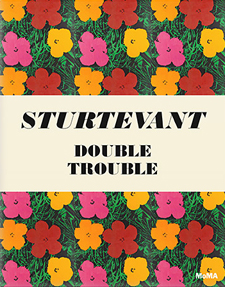
Cover of the catalogue for Sturtevant: Double Trouble
Sturtevant: Double Trouble
Museum of Modern Art
11 West 53rd Street, New York, NY 10009
November 9, 2014–February 22, 2015
Elaine Sturtevant (American, 1924–2014) began “repeating” the works of her contemporaries in 1964, using some of the most iconic artworks of her generation as a source and catalyst for the exploration of originality, authorship, and the interior structures of art and image culture. Beginning with her versions of works by Jasper Johns and Andy Warhol, she initially turned the visual logic of Pop art back on itself, probing uncomfortably at the workings of art history in real time. Yet her chameleonlike embrace of other artists’ art has also resulted in her being largely overlooked in the history of postwar American art. As a woman making versions of the work of better-known male artists, she has passed almost unnoticed through the hierarchies of midcentury modernism and postmodernism, at once absent from these histories while nevertheless articulating their structures.
Far more than copies, her versions, for instance, of Johns’s flags, Warhol’s flowers, and Joseph Beuys’s fat chairs are studies in the action of art that expose aspects of its making, circulation, and canonization. Working primarily in video since 2000, the artist remained deeply engaged with the politics of image production and reception, using stock footage from Hollywood films, television, and advertising to point to the exhaustion built into much of postwar cultural production.
This exhibition is the first comprehensive survey in America of Sturtevant’s fifty-year career and the only institutional presentation of her work organized in the United States since her solo show at the Everson Museum of Art in 1973. Rather than taking the form of a traditional retrospective, the exhibition offers a historical overview of her work from a contemporary vantage point, interspersing more recent video pieces among key artworks from all periods of her career.
Marisol: Self-Portrait Looking at The Last Supper
Metropolitan Museum of Art
Lila Acheson Wallace Wing for Modern and Contemporary Art, Design, and Architecture, Gallery 909, 1000 Fifth Avenue, New York, NY 10028
October 8, 2014–April 5, 2015
For the first time in nearly thirty years, Marisol’s monumental sculptural assemblage, Self-Portrait Looking at The Last Supper, has been on view at the Metropolitan Museum of Art, complementing the retrospective celebration of the renowned yet understudied sculptor by her recent retrospective that travelled to El Museo del Barrio this fall.
Inspired by Leonardo’s monumental fresco, Marisol (Maria Sol Escobar, b. 1930) faithfully rendered the painting’s composition into three dimensions to create this 30-foot-long installation. The biblical scene depicts Christ and his Apostles at the Passover meal, with each disciple reacting to the announcement by Jesus that one of them would betray him. The work is primarily carved from wood, with a rough, sketchy technique that includes painted and drawn elements. Marisol is particularly skillful at joining seemingly incompatible components. In fact, the seated figures are neither fully rounded nor consistently flat, oscillating between two and three dimensions. The artist chiseled the central figure of Christ from a block of salvaged New York City brownstone. Christ’s physical solidity and ashen, serene appearance contrast with the blackened, twisted figure of Judas to provide the composition’s emotional tension. In Marisol’s sculptural version of the Last Supper, a novel figure is added opposite the tableau. It portrays the artist contemplating the scene and with a hieratic presence that shares visual affinities with the stocky, solemn figures of Precolumbian sculpture.
Plastic Age: IN/OUT: Banners and Sculptures by Barbara Madsen
New York Public Library
Mid-Manhattan Library, Corner Room, 455 Fifth Avenue, New York, NY 10016
February 3–May 21, 2015
Barbara Madsen’s work is a hybrid practice between photography, print, and sculpture. Her banners, a series of photographs of inanimate plastic objects occupy the windows of the Corner Room on Fifth Avenue and 40th Street. Madsen’s sculptures facing Fifth Avenue are architectural plywood structures, jutting walls, boxed, minimal, acute—stacked on top of each other. The angled surfaces are covered with photographs of objects that have been consumed and discarded. Vibrant color plays a central tenant in her cast of objects: the child’s crimson fireman’s ladder; a lime-colored dome from a hair drier; and cobalt, yellow, scarlet plastic remnants of toys. Within the complex shadows and highlights of the images, dust and flaws are naked—the invisible becomes visible. Madsen is an artist and associate professor in the Mason Gross School of the Arts at Rutgers University known for her work in photography, prints, sculpture, and installation.
E. E. Smith: The Ballad of Delia
Kim Foster Gallery
529 West 20th Street, New York, NY 10011
January 8–February 14, 2015
The Ballad of Delia is an installation of new photo-based oil prints by E. E. Smith. This piece is part of a series in which Smith uses song forms as the point of departure for her work. The Ballad of Delia consists of ten panels of varying sizes that tell the story of Delia Greene’s murder, an account best known from covers by Johnny Cash and Bob Dylan. Like the singers, and especially the now-forgotten songwriters, Smith takes liberties with the telling of the tale, presenting various details and asking the viewer to fill in the story.
Each panel represents a clue to this murder mystery, yet stylistically they differ. The lush landscape harkens back to the evocative paintings of Albert Pinkham Ryder, drawing us into the location of the crime. Other images are shockingly explicit: the menacing axe and thick footprints allude to police photographic evidence, while the male silhouette suggests a mug shot. And the hand holding a teacup (the victim perhaps?) makes reference to film stills.
In contrast to the songs—and most likely any contemporaneous news accounts—Smith deliberately dispenses with a time-dependent linear narrative, opting instead to display several moments simultaneously. The effect is not so much “the truth” about a murder but “a truth” told without words. The trope of the murder-mystery in American culture is ubiquitous, and Smith’s iteration in The Ballad of Delia makes a compelling episode.
Louise Nevelson: Collage and Assemblage
Pace Gallery
534 West 25th Street, New York, NY 1001
January 24–February 28, 2015
Pace Gallery presents an exhibition of Louise Nevelson’s rarely seen collages, accompanied by a catalogue by Germano Celant. Nevelson began producing collages in the mid-1950s, inspired by her longstanding interest in Cubism and a correspondence with Jean Arp. Prompting her remark “the way I think is collage,” collage signifies an important aspect of her work.
The exhibition features the artist’s earliest collages, produced along her monochromatic black, gold, and white sculptures, by using scraps of wood and metal collected from the streets outside of her Little Italy studio. The show also includes examples of her later unpainted assemblages that manifest a departure from her monochromatic work, while continuing to prove the centrality of collage in her practice. Among the last works of her life, two large-scale, black wall reliefs, including Spring Street (1984), which was installed in Nevelson’s home from its completion until her death, are also part of this exhibition.
Nevelson (b. 1899 Kiev; d. 1988, New York) emigrated from czarist Russia as a child and grew up in Rockland, Maine. As an adult she returned to Europe, where she studied with Hans Hoffmann. Upon her return to the United States, she served as Diego Rivera’s assistant and later as an art instructor in the Works Progress Administration. In 1941, Nevelson had her first solo exhibition and, in 1946, was included for the first time in the Whitney Annual exhibition, which she would participate in eleven more times. The artist exhibited her first all-black sculptures in the mid-1950s. Although she worked in white and gold and later with painted steel, her developments in the 1950s sustained her work throughout the rest of her life. Considered today as one of America’s most significant artists, Nevelson has been the subject of one-artist exhibitions and retrospectives at numerous institutions in the US, and her work is found in many prominent museums and public collections worldwide.
Yael Bartana
Petzel Gallery
456 West 18th Street, New York, NY 10011
January 8–February 14, 2015
Petzel Gallery is pleased to announce a new exhibition by the Israeli artist Yael Bartana (b. 1970, Kfar-Yehezkel, Israel) that debuts her latest two films: Inferno and True Finn. This will be the gallery’s second solo show with the artist.
Bartana studied at the Bezalel Academy of Arts and Design in Jerusalem, the School of Visual Arts in New York, and the Rijksakademie in Amsterdam. She has had several solo exhibitions held at various international venues and in New York. Bartana was Poland’s choice for the 2011 Venice Biennale, where she was the first non-Polish citizen to represent the country. Bartana’s photography, film, and sound works investigate society, spirituality, and politics. Her films, film installations, and photographs challenge the national consciousness that is propagated by her native country of Israel. Homeland, return, and belonging are the central questions that she explores. Her investigation includes ceremonies, public rituals and social diversions that are intended to reaffirm the collective identity of countries. Working outside the country, Bartana observes it from a critical distance. Her early films were primarily registrations in which aesthetic interventions, including soundtracks, slowing the image, and specific camera perspectives, played a role.
In Inferno, Bartana films the inauguration of a grand temple, the destruction of it, and the worship of its debris. The starting point is the construction of a replica of Solomon’s Temple in São Paulo by an evangelical neo-Pentecostal church called the Universal Church of the Kingdom of God (UCKG). The temple is built with stones imported from Israel, as UCKG intends to bring part of the Holy Land to São Paulo, thus inverting the traditional path taken by pilgrims who would leave Brazil for the Holy Land. The film’s conflation of place, history, and belief allows Bartana to weave connections between the complex realities of São Paulo and Jerusalem. Shot and edited with stylistic references to Hollywood action epics, her film employs what she refers to as “historical pre-enactment,” a methodology that commingles fact and fiction, and prophesies and histories. Using this powerful cinematic language, Inferno combines histories of antiquity in the Middle East with Brazil’s contemporary hybrid culture.
True Finn is a documentary-style film asking eight people from Finland one simple question: who is a true Finn? Bartana’s objective with True Finn, produced in connection of Finland’s Pro Arte Foundation, was to create and record a utopian moment that would yield an answer to this question. As a result of an open call, eight Finnish residents of different ethnic, religious, and political background came to live together for seven days in a house in the countryside. Life, discussions, and specifically designed assignments were filmed, with the edited material forming the core of the artwork and allowing True Finn to probe questions about identity, nationhood, and belonging.
Diana Thater: Science, Fiction
David Zwirner
533 West 19th Street, New York, NY 10011
January 8–February 21, 2015
David Zwirner presents new work by Diana Thater in the form of a new type of installation that involves an enclosed video projection, ceiling screen, and light, as well as two new video walls. Thater is one of the most important video artists working today. Since the early 1990s, she has created a wide range of film, video, and installation-based works whose sculptural forms engage spatial perception in physical and conceptual terms. Her work pushes the boundaries of how new-media art is displayed. Through a combination of the temporal qualities of video and the architectural dimension of its installation, Thater’s work explores the artifice of its own production and its capacity to construct perception about the world through its image. Natural diversity, wildlife, and conservation have been persistent themes in the artist’s work. While her in-depth studies of ecosystems and animal behavior propose observation as a kind of understanding in itself, her ethical position is implicit in the work, providing subtly political views of the sublime.
In Science, Fiction, Thater focuses on the dung beetle and the intricate navigation system it deploys in disposing balls of animal excrement, its main source of nutrition. Recent studies have revealed that the species uses the Milky Way to orientate itself at night, currently the only insect known to do so. Thater’s video projection appears at once abstract and particular, juxtaposing the sophistication of the small insects’ navigation systems with the close-up views of their earthy setting in a meditative fusion of macro and micro realms. Deploying a new type of installation, Thater presents the footage on a screen attached to the ceiling, projected from within a closed-off, freestanding box. Mirroring the setup of the scientific experiment with the dung beetles, the white square further references the Light and Space movement in California in the 1960s. The exhibition is illuminated by soft blue lights, creating an environment that mimics the evening sky, while the walls of the box themselves are lit from below, which offers the illusion of levitation. Also on view are two video walls showing the Milky Way, respectively titled Sidereus Nuncius and The Starry Messenger.
Born in 1962 in San Francisco, Thater lives and works in Los Angeles. She studied art history at New York University before receiving her MFA from the Art Center College of Design in Pasadena, California. Over the past decade, her work has been the subject of solo exhibitions at prominent institutions worldwide, and she is the recipient of many awards. In fall 2015, the Los Angeles County Museum of Art will host a midcareer survey of her work, which will coincide with an installation at the Aspen Art Museum in Colorado.
Araya Rasdjarmrearnsook
SculptureCenter
44-19 Purves Street, Long Island City, NY 11101
January 25–March 30, 2015
SculptureCenter presents Araya Rasdjarmrearnsook, the Thai artist’s first retrospective in the United States. The exhibition, which brings together over twenty artworks spanning over a decade of the artist’s career, includes video, sculpture, and photography, presenting significant highlights as well as works that have rarely been viewed in the US. As such the show features The Class and Conversation series, for which Rasdjarmrearnsook conducts discussions with corpses, and the video Village and Elsewhere: Artemisia Gentileschi’s Judith Beheading Holofernes; Jeff Koons’ Untitled, and Thai Villagers (2011), in which a Buddhist monk leads a comical conversation about these two Western paintings in a temple. A more recent group of works featured focuses on the status of dogs in Thai culture and beyond. SculptureCenter will also include works produced specifically for this exhibition.
Rasdjarmrearnsook is one of the leading visual artists working in Southeast Asia. She is based in the northern city of Chiang Mai in Thailand, where she teaches in the Faculty of Fine Arts at Chiang Mai University. Rasdjarmrearnsook is internationally known for videos and installations that profoundly explore aspects of human experience and understanding, often touching on taboo topics such as death and insanity. In 2005 she represented Thailand in the Venice Biennale. Working with psychologically rich materials, she considers a wide range of subjects that have existed in marginal spaces, including women, the deceased, the insane, and animals. She creates complex narratives that confront societal structures of power and pedagogy. Concerned with systems of language and communication, Rasdjarmrearnsook attempts to converse with subjects who don’t speak in languages that are comprehended by or even acknowledged by mainstream society.
Looking Back: The 9th White Columns Annual
White Columns
320 West 13th Street, New York, NY 10014
January 13–February 21, 2015
Not an exhibition of women artists, this year’s White Columns Annual is curated by an all women’s curatorial collective, Cleopatra’s. Founded in 2008, Cleopatra’s works collaboratively with artists and cultural producers to create projects that forge new networks and dialogues among individuals, art practices, and institutions. These projects are realized in their flagship noncommercial storefront in Greenpoint, Brooklyn. From 2011 to 2012 the collective also operated a satellite art space in Berlin, Germany. Further investigations also occur in the form of offsite public programs, events, and printed publications, encompassing various fields and locales. The aim of Cleopatra’s is to present work and advance ideas informed by both individual and collective perspectives, and to disseminate that work and those ideas among a broad and diverse audience. Current and founding members of the Cleopatra’s are Erin Somerville, Colleen Grennan, Bridget Finn, and Bridget Donahue.
Samara Golden: The Flat Side of the Knife
MoMA PS1
22-25 Jackson Avenue, Long Island City, NY 11101
October 26, 2014–August 30, 2015
MoMA PS1 presents Samara Golden’s first solo museum exhibition and her largest installation to date: The Flat Side of the Knife. The Los Angeles–based Golden (American, b. 1973) creates immersive installations that explore what the artist calls the “sixth dimension,” where a multiple pasts, presents, and futures coexist. Golden’s multilayered installation fills the double-height of MoMA PS1’s Duplex Gallery with staircases, beds, couches, lamps, musical instruments, video, and sound. The Flat Side of the Knife combines physical with illusory spaces. Some appear only in mirrors, reflecting what the artist refers to as “layers of consciousness,” akin to psychological and hallucinatory spaces in the mind. Her use of mirrors in conjunction with sculptural elements made from a silvery insulation board allows the illusion of space to expand in multiple directions, suggesting imaginary spaces, such as adjacent rooms that do not exist in reality.
Golden received her MFA from Columbia University and has exhibited her work at the Museum of Contemporary Art, Los Angeles; SculptureCenter in New York; Night Gallery in Los Angeles; CANADA in New York; Cardi Black Box in Milan; Loyal Gallery in Stockholm; and Galerie Crevecoeur in Paris. Most recently, her work was featured in the Hammer Museum’s biennial, Made in L.A., in 2014.
Anne Imhof: DEAL
MoMA PS1
22-25 Jackson Avenue, Long Island City, NY 11101
January 31–March 9, 2015
MoMA PS1 presents DEAL, Anne Imhof’s inaugural solo project in the United States, which consists of a two-day performance followed by an exhibition. The project, conceived specifically for the museum, revolves around the structures of illegal street transactions that are underpinned by strict rules and codes while functioning beyond words and juridical regulations. Along the opening performances, nine performers will enact highly complex and abstract movements, evoking power relations, secret codes, and unspoken rules that underlie daily human interactions. Here, tasks and patterns are unceasingly repeated over an entire day and progressively shift as they push toward a point of collapse. The exhibition expands on the same formal interrogations and ideas through diverse media such as drawing, video, sculpture, painting, and a variation of the initial performance, SOTSB for DEAL, which repeats every Sunday during museum hours.
Imhof (German, b. 1978) was trained as a visual artist and considers the different media as integral to the process for creating images that gradually emerge in time. Live events, their documentation, objects, and props—Imhof believes that each component in a body of work is interrelated and of equal relevance, contributing to the creation of a visual image that is perpetually in process, highly precarious, and in a constant verge of dissolution.
Chitra Ganesh: Eyes of Time
Brooklyn Museum
Elizabeth A. Sackler Center for Feminist Art, Herstory Gallery, Fourth Floor, 200 Eastern Parkway, Brooklyn, NY 11238
December 12, 2014–July 12, 2015
The Herstory Gallery at the Brooklyn Museum is hosting Eyes of Time, an exhibition by the Brooklyn-based artist Chitra Ganesh that explores ideas of femininity, empowerment, and multiplicity. Her drawing, installation, text-based work, and collaborations suggest and excavate buried narratives typically absent from official canons of history, literature, and art. For more than a decade, Ganesh has used the iconography of mythology, literature, and popular culture to bring to light feminist and queer narratives.
For Eyes of Time, the artist draws inspiration from the museum’s encyclopedic collection to create a site-specific multimedia installation at the gallery. Eyes of Time focus on the portrayal of female power and plurality based on Kali—the Hindu goddess of destruction and rebirth—as well as other figures from Judy Chicago’s The Dinner Party as point of departure. Tales of Amnesia (2002)—a zine inspired by Indian comic books acquired by the museum—is also on view.
As stated about her creative practice, “by layering disparate materials and visual languages, Ganesh asks her viewers to ‘seek and consider new narratives of sexuality and power.’ In this process the body becomes a site of transgression and transformation, both social and psychic, doubled, dismembered and continually exceeding its limits.”
TENDREL – Interconnections
Tibet House
22 West 15th Street, New York, NY 10011
January 2–March 2, 2015
TENDREL – Interconnections is an exhibition by artists who are linked to and inspired by the life work of Jetsunma Tenzin Palmo, the first Western woman to become a Buddhist nun. Diverse yet interconnected, the themes investigated by the artists include Tibet and its culture, Buddhism, women, spiritual life, meditation, and activism. Works consist of photographs of nomads and nunneries in Tibet that provide profound insight and stark contrast to the social cultural changes of the Tibetan community, and art based on Buddhist and meditative iconography that explores the practice of visualization in painting, sculpture, drawing, and detailed stained-glass artistry. Among those presenting works are these artists: Diane Barker, Caterina De Re, Mary DeVincentis, Maxine Henryson, Heather Kessinger, Chrysanne Stathacos, Tsunma Jamyang Donma/Yulokod Studios, and Kate Temple.
Art in the First Person Lecture Series
School of Visual Arts
Various Locations in Manhattan
February 3–17, 2015
The School of Visual Arts presents the spring 2015 lineup of its Art in the First Person lecture series, jointly presented by the following departments: MA Curatorial Practice, MPS Digital Photography, BFA Fine Arts, MFA Fine Arts and BFA Visual and Critical Studies. All events are free and open to the public. The lecture series includes:
- Amy Smith-Stewart, independent curator and art advisor, on Tuesday, February 3, 6:00 PM
- Lumi Tan, curator at the Kitchen, on Tuesday, February 10, 6:00 PM
- Kira Pollack, director of photography at Time, on Tuesday, February 10, 7:00 PM
- Judith Page, artist, on Tuesday, February 17, 6:00 PM
Collective Creativity: Collaboration and Collectives in Feminist Art Practice
Feminist Art Project
Museum of Arts and Design, 2 Columbus Circle, New York, NY 10019
February 14, 2015
Committee on Women in the Arts Picks for February 2015
posted Feb 10, 2015
Each month, CAA’s Committee on Women in the Arts selects the best in feminist art and scholarship. The following exhibitions and events should not be missed. Check the archive of CWA Picks at the bottom of the page, as several museum and gallery shows listed in previous months may still be on view or touring.
February 2015
The February CWA Picks are dedicated to Kalliopi Minioudaki for her tremendous efforts in working on the Picks during her tenure on the CWA (2012–15). You will be missed!
Poetry and Exile
British Museum
Gallery 34, Great Russell Street, London
WC1B 3DG United Kingdom
October 1, 2014–March 1, 2015
Housed within the Islamic World Galleries, Poetry and Exile displays a series of works by artists of the Middle East and North Africa recently acquired by the British Museum. This small but powerful exhibition explores the effects of exile through the eyes of four women artists:Ipek Duben, Mireille Kassar, Mona Saudi, and Canan Tolon.
Tolon’s series ofink and graphite drawings, titled Futur Imparfait, is a memoir fromher exile from Istanbul to France, where she spent a decade in hospital as a result of contracting polio as a child. In the series Tolon portrays an exile not only from home, but also from her own body. Duben’s book Refugee belies the helplessness and terror suffered by people forced to flee their homeland with images on delicate gauze pages and using childlike embroidery that depicts the crossing of borders. The Istanbul-born Duben has been making books and installations that focus on identity, domestic violence, and the worldwide forced migration of the twentieth century.
The Jordanian artist Saudi combines the evocative verses of the Palestinian poet Mahmoud Darwish with drawings, while the Lebanese-born Kassar developed a series of drawings inspired by the Persian poem The Conference of the Birds. Here, Kassar conjures a story of exile from her own family history. Originally from Mosul and Mardin—present day Iraq and Turkey—her ancestors fled the Ottoman massacres of minorities during the late-nineteenth and early twentieth century.

Zoe Strauss, Drying Money, Mississippi Gulf Coast, Mid September, 2005 (artwork © Zoe Strauss)
Zoe Strauss: Sea Change
Cantor Fitzgerald Gallery
Haverford College, Whitehead Campus Center, 370 Lancaster Avenue, Haverford, PA 19041
January 23–March 6, 2015
Cantor Fitzgerald Gallery presents Sea Change, an exhibition of photographs, vinyl prints, and projected images by Zoe Strauss. Throughout this project, the celebrated Philadelphia photographer traces the aftermath of Hurricane Katrina in 2005, the BP Deepwater Horizon oil spill in southern Louisiana in 2010, and Hurricane Sandy in 2012: three ecological disasters that have changed America’s landscape.
With little formal training as a photographer or artist, Strauss (b. Philadelphia, 1970) uses photography as the most direct means of representing her chosen subjects. Her images, often both disturbing and touching, are focused mainly on American working-class experience. She founded the Philadelphia Public Art Project in 1995 with the aim of exhibiting art in nontraditional venues in order to give the citizens of Philadelphia access to art in their everyday lives. She now refers to this initiative as an “epic narrative” of her own neighborhood that reflects the beauty and struggle of everyday life.
True to her creative statement, Strauss captures the fast and slow tragedies of global warming through the portrayal of an irreparable damage and the hope of mending. Flattened sceneries and architectural remains stand alongside graffiti and signs including encouraging pleas, words that express the despair of a sudden displacement as much as the hope to return and belong, again. Sea Change is accompanied by a publication designed by Random Embassy.
Otobong Nkanga: Tracing Confessions
Museum Folkwang
Museumsplatz 1, 45128 Essen, Germany
January 23–May 18, 2015
Museum Folkwang presents Tracing Confessions, a two-part project created by Otobong Nkanga (born Nigeria, 1974). Based in the museum collection, Nkanga explores issues of identity and relationships between objects and people. As part of the Kunststiftung NRW’s project 25/25/25, Nkanga invited members of the museum’s staff to be photographed with selected pieces from this collection. During the month of January, the resulting photographs will be distributed as billboards throughout the city. Bringing the museum to the public space, the piece aims to connect with Essen residents in their everyday lives. This public intervention is presented along an installation designed specifically for the museum. Unveiling shared stories between objects and people, Tracing Confessions interrogates the origin of the museum artifacts, and in that their potential of shaping identities.
Trained in the converging traditions of performance and live arts, Nkanga leads an intensive research-based artistic practice. Her heterogeneous and multidisciplinary practice includes drawing, photography, installation, and performance art. Her sensitive observation on social and topographical changes in the environment, and on the concept of diaspora, examines the regional and cultural complexities that are embedded in these experiences. Using her own and others’ body and voice, Nkanga proves that the subjects of her projects are to be a lived and truly embodied experience. Through language and visual and physical narratives, her work invites viewers to engage in a dialogue that reflects on identity, memory, and perception.
Carolee Schneemann: Infinity Kisses
Merchant House
Herengracht 254, 1016BV, Amsterdam, the Netherlands
January 22–April 12 2015
The Merchant House in Amsterdam presents Carolee Schneemann: Infinity Kisses, an exhibition of works on paper, photographs, and a video by the renowned American multimedia artist. The exhibition pivots on a site-specific installation of the video Infinity Kisses-The Movie (2008), first shown in Amsterdam. The show is also accompanied with a fully illustrated catalogue with an essay by Kalliopi Minioudaki.
The experiential body—yet not only her own naked one, as this exhibition argues—has been paramount in Carolee Schneemann’s multifariously radical politics and idiosyncratic poetics. Focusing on the photographic series (2004) and video (2008) that sensually portray the morning kisses given to Schneemann by her cats, Cluny and Vesper, this exhibition foregrounds the radical centrality of the cat in her work—as lifelong companion and a symbol of what patriarchal culture represses and dismisses, namely female sexuality. Returning Schneemann’s legendary yet controversial interspecies “kisses” to a house that variously evokes her own—due to the fact that the Merchant House is located in a historic canal house that reminds the artist of her home in Springtown, New York, itself central in her production—this exhibition highlights the domesticity that characterizes the poetics of intimacy inherent in a great part of her work.
In contrast to the ecstatic bodies of Infinity Kisses, the accompanying works in the exhibition juxtapose gruesomely violated or caged feline bodies with news images of global atrocities. Sampling the gestural painterliness and collage aesthetics that underpin much of her work, these prints hint at the darker role the body plays in Schneemann’s sorrowful diagnosis of the malaises of modernity and patriarchy, of Western civilization, and of the current stage of the society of spectacle. An extraordinary example of her conceptual feminist poetics, Unexpectedly Research (1992) illuminates the research and “double knowledge” that underpin not only Schneemann’s feminist critique of the suppression of the sacred feminine, but also its radical bodily retrieval by the artist.

Janet Biggs, production still from Can’t Find My Way Home, 2015, four-channel video, high-definition video installation with sound, 8:35 min. (artwork © Janet Biggs)
Janet Biggs: Echo of the Unknown
Blaffer Art Museum
University of Houston,
120 Fine Arts Building, Houston, TX 77204-4018
January 17–March 21, 2015
Janet Biggs: Echo of the Unknown is part of the Science Spring at the Blaffer Art Museum. Organized by the independent curator Janet Phelps, this multidisciplinary exhibition combines video, sound, and objects to explore the role of memory in the construction of identity. Drawing from the artist’s personal memories of the effects of Alzheimer’s on various family members, stories of public figures coping with the disease, and research conducted with neurologists and geoscientists, Echo of the Unknown raises fundamental questions about how we become—and how we lose our sense of—who we are.
Works in the exhibition include Can’t Find My Way Home, a four-channel video installation inspired by memories of the artist’s grandfather, an avid mineral collector who could recall the most difficult names of mineral species yet not his own as he succumbed to the disease. This piece juxtaposes documentation of neurological research conducted in New York and Houston laboratories with footage shot in the crystal cavern below the Merkers salt mine in Germany, itself a potent metaphor for the brain and its sites of memory.
The video installation The Persistence of Hope focuses on the solace Biggs’s uncle found in his residual memory of birds. Only after his death Biggs discovered her uncle’s peculiar ritualized attempt to sustain beauty and hold onto life as he felt it fade away by gathering hummingbirds and placing them in his freezer. Alternating imagery of gravity-defying hummingbirds with footage shot in the Arctic and in laboratories where human brain cells are preserved in freezers for neurological research, The Persistence of Hope paints a tender picture of life caught between hope and futility.
Breathing without Air follows an aging mineral collector as he searches for the perfect specimen at a trade show, where he eventually loses his way among the many aisles of vendors and displays. All three pieces share a soundscape based on Glen Campbell’s 1968 song “Wichita Lineman.” Comprising scores based loosely on Campbell’s tune by various composers, Biggs’s Wichita Lineman is a haunting sonic homage to the tenacity of Campbell who, upon his diagnosis with Alzheimer’s, decided to continue to tour for as long as he could.
An ambitious series of lectures, gallery talks and panel discussions accompanies the exhibition throughout its duration, enhancing the exhibition’s role as a catalyst for cross-disciplinary learning.
Lynn Hershman Leeson: Civic Radar
ZKM | Karlsruhe
Lorenzstraße 19, 76135 Karlsruhe, Germany
December 13, 2014–April 6, 2015
Lynn Hershman Leeson has been mining body art and new media for more than forty years. Her cutting-edge work has run a broad gamut that ranges from the feminist performance Roberta Breitmore, for which she lived a double life as herself and an alter ego for most of the 1970s, to a series of science-fiction films starring Tilda Swinton. Acknowledged for her feminist politics, Hershman Leeson chronicled the feminist movement in the 2011 documentary Women Art Revolution. Yet her contributions to technologically sophisticated art have been widely understudied. Conversely, Lynn Hershman Leeson: Civic Radar, the first comprehensive retrospective of her work in a museum and especially in Germany, not only overviews all the creative phases of her work, bringing together rarely shown early works like her 1960s wax and burned sculptures along with masterful highlights, but it also strives to acknowledge her pioneering role as an innovative and influential new-media artist.
As such Civic Radar brings together works that exemplify Hershman Leeson’s multimedia investigation of identity and various modes of surveillance, such as Lorna (1983/84), one of the first interactive projects on videodisc, and Teknolust (2002), which addresses cyberidentity, artificial intelligence, cloning, and the decoupling of sexuality and human reproduction. The exhibition also include recent works that use robots, mass-communication media such as smart-phones, and the latest scientific developments in the field of genetics and regenerative medicine, including three-dimensional bioprinters that create human body parts.
Hershman Leeson received a bachelor of science in museum administration and art at Case Western Reserve University in Cleveland and a master of arts in art criticism at San Francisco State University. From 1993 through 2004 she was professor of electronic arts at the University of California, Davis. From 2004 through 2010 Hershman Leeson held the Andrew D. White Chair at Cornell University in Ithaca. In 2007 the artist assumed charge of the San Francisco Art Institute’s Film Department. Over the years, she has received numerous awards, including the Siemens Medienkunst Preis in 1995 and the Prix Ars Electronica (Golden Nica) in 1995.
Call for Editor-in-Chief of The Art Bulletin
posted Feb 09, 2015
 The Art Bulletin Editorial Board invites nominations and self-nominations for the position of editor-in-chief for a three-year term: July 1, 2016–June 30, 2019 (with service as incoming editor designate, July 1, 2015–June 30, 2016, and as past editor, July 1, 2019–June 30, 2020). The candidate should have published substantially in the field and may be an academic, museum-based, or independent scholar; institutional affiliation is not required. The Art Bulletin features leading scholarship in the English language in all aspects of art history as practiced in the academy, museums, and other institutions. bad credit loans. From its founding in 1913, the quarterly journal has published, through rigorous peer review, scholarly articles and critical reviews of the highest quality in all areas and periods of the history of art.
Working with the editorial board, the editor-in-chief is responsible for the content and character of the journal. Each issue has approximately 120 editorial pages (110,000 words), not including book and exhibition reviews, which are the responsibility of a reviews editor. The editor-in-chief reads all submitted manuscripts, refers them to appropriate expert referees for peer review, provides guidance to authors concerning the form and content of submissions, and makes final decisions regarding acceptance or rejection of articles for publication. The editor-in-chief also works closely with the CAA staff in New York, where production for The Art Bulletin is organized. This is a half-time position. CAA provides financial compensation to the editor’s institution, usually in the form of course release or the equivalent, for three years. The editor is not usually compensated directly. The three-year term includes membership on the Art Bulletin Editorial Board.
The editor-in-chief attends the Art Bulletin Editorial Board’s three meetings each year—held twice in New York in the spring and fall and once at the CAA Annual Conference in February—and submits an annual report to the CAA Board of Directors. CAA reimburses the editor-in-chief for travel and lodging expenses for the two New York meetings in accordance with its travel policy, but the editor-in-chief pays these expenses to attend the conference.
Candidates must be current CAA members and should not be serving on the editorial board of a competitive journal or on another CAA editorial board or committee. Members may not publish their own work in the journal during the term of service. Nominators should ascertain their nominee’s willingness to serve before submitting a name; self-nominations are also welcome. Please send a statement describing your interest in and qualifications for appointment, a CV, at least one letter of recommendation, and your contact information to: Chair, Art Bulletin Editorial Board, College Art Association, 50 Broadway, 21st Floor, New York, NY 10004; or email the documents to Joe Hannan, CAA editorial director. Deadline: April 1, 2015; finalists will be interviewed on May 1.
Art Bulletin Editorial Board Seeks Two Members
posted Feb 09, 2015
 CAA invites nominations and self-nominations for two individuals to serve on the Art Bulletin Editorial Board for a four-year term, July 1, 2015–June 30, 2019. The ideal candidate has published substantially in the field and may be an academic, museum-based, or independent scholar; institutional affiliation is not required. The Art Bulletin features leading scholarship in the English language in all aspects of art history as practiced in the academy, museums, and other institutions.
The editorial board advises the Art Bulletin editor-in-chief and assists him or her in seeking authors, articles, and other content for the journal. 5000 dollar loan. The group also performs peer review and recommends peer reviewers, may propose new initiatives for the journal, and may support fundraising efforts on the journal’s behalf. Members also assist the editor-in-chief to keep abreast of trends and issues in the field by attending and reporting on sessions at the CAA Annual Conference and at other academic conferences, symposia, and events.
The Art Bulletin Editorial Board meets three times a year: twice in New York in the spring and fall and once at the CAA Annual Conference in February. CAA reimburses members for travel and lodging expenses for the two New York meetings in accordance with its travel policy, but members pay these expenses to attend the conference.
Candidates must be current CAA members and should not be serving on the editorial board of a competitive journal or on another CAA editorial board or committee. Members may not publish their own work in the journal during the term of service. Nominators should ascertain their nominee’s willingness to serve before submitting a name; self-nominations are also welcome. Please send a statement describing your interest in and qualifications for appointment, a CV, and your contact information to: Chair, Art Bulletin Editorial Board, College Art Association, 50 Broadway, 21st Floor, New York, NY 10004; or email the documents to Joe Hannan, CAA editorial director. Deadline: April 15, 2015.
CAA Announces Publication of Code of Best Practices in Fair Use for the Visual Arts
posted Feb 09, 2015
 The College Art Association (CAA) has published the Code of Best Practices in Fair Use for the Visual Arts, a set of principles addressing best practices in the fair use of copyrighted materials based on a consensus of opinion developed through discussions with visual-arts professionals. It will be a vital resource for everyone working in the field, including artists, art historians, museum professionals, and editors. Initiated by CAA in 2012, the multi-year effort has been led by the Code’s authors, Peter Jaszi and Patricia Aufderheide, professors of law and communication studies respectively at American University and the leading experts on the development of codes for communities that make use of copyrighted materials in their professional practices.
Linda Downs, CAA executive director, said, “The Code is a crucial contribution to the field as a clear statement on best practices in the fair use of copyrighted materials that directly reflects a consensus from the visual-arts community. CAA is grateful to all of the artists, art historians, museum professionals, and editors, among others, who participated in the project so generously with their time and collective knowledge.”
The Code describes the relevance of fair use in five broad areas of the visual arts field:
- Analytic Writing: When may scholars and other writers about art invoke fair use to quote, excerpt, or reproduce copyrighted works?
- Teaching about Art: When may teachers invoke fair use in using copyrighted works to support formal instruction in a range of settings, including online and distance teaching?
- Making Art: Under what circumstances may artists exercise fair use to incorporate copyrighted material into new artworks in any medium?
- Museum Uses: When may museums and their staffs invoke fair use in using copyrighted works—such as images, text, and time-based and born-digital material—when organizing exhibitions, developing educational materials (within the museum and online), publishing catalogues, and other related activities?
- Online Access to Archival and Special Collections: When may such institutions and their staffs claim fair use to create digital preservation copies and/or enable digital access to copyrighted materials in their collections?
DeWitt Godfrey, CAA president and professor of art and art history at Colgate University, said, “The research undertaken in this project demonstrated that a significant amount of creative and scholarly work has been stunted by a lack of understanding or clear consensus on fair use. This Code provides a straightforward set of principles that will allow those working in the visual arts to determine when they can assert fair use in their work with confidence.”
In January 2014, CAA published Copyright, Permissions, and Fair Use among Visual Artists and the Academic and Museum Visual Arts Communities: An Issues Report, a summary of one hundred interviews with art historians, artists, museum curators, editors, and publishers describing issues related to the use of third-party images in creative and scholarly work. The Issues Report—which revealed significant challenges to creating and disseminating new work because of actual and perceived limitations of copyright—was the subject of ten discussion groups held last summer throughout the country with visual-arts professionals who deal with fair use and copyright issues on a daily basis. The Code is a result of this extensive research.
Peter Jaszi, professor of law in the Program on Information Justice and Intellectual Property at American University’s Washington College of Law, explained that “Although the visual-arts community is impressively diverse, including art-makers, individual scholars, and institutional users, its members came together determined to reach a useful consensus. The Code reflects the range of perspectives and expertise the participants brought to the process.”
Coauthor Patricia Aufderheide, university professor in the School of Communication at American University and director of the Center for Media & Social Impact, said, “Codes of best practices have proven enormously successful in enabling members of other creative communities to do their work well and effectively. They allow individuals to make judgments knowing where they fall in relation to the thinking of their peers—and that lowers risk. Further, codes give museums, broadcasters, insurers, publishers, educational institutions, and their lawyers a new and valuable tool to use in making better, more reasonable assessments of risk.”
During CAA’s 103rd Annual Conference in New York (February 11–14, 2015), the principal investigators of this project and authors of the Code, Patricia Aufderheide and Peter Jaszi, will speak publicly with Judy Metro, editor-in-chief at the National Gallery of Art and chair of CAA’s Committee on Intellectual Property; Jeffrey Cunard, cochair of CAA’s Task Force on Fair Use; and Christine Sundt, editor of Visual Resources: An International Journal of Documentation and former CAA board member. The session, which will take place on Friday, February 13, from 12:30 to 2:00 PM at the New York Hilton Midtown, is free and open to the public.
CAA’s Code of Best Practices in Fair Use for the Visual Arts is funded by the Andrew W. Mellon Foundation with additional support provided by the Samuel H. Kress Foundation.
About CAA
The College Art Association is dedicated to providing professional services and resources for artists, art historians, and students in the visual arts. CAA serves as an advocate and a resource for individuals and institutions nationally and internationally by offering forums to discuss the latest developments in the visual arts and art history through its Annual Conference, publications, exhibitions, website, and other programs, services, and events. CAA focuses on a wide range of advocacy issues, including education in the arts, freedom of expression, intellectual-property rights, cultural heritage and preservation, workforce topics in universities and museums, and access to networked information technologies. Representing its members’ professional needs since 1911, CAA is committed to the highest professional and ethical standards of scholarship, creativity, criticism, and teaching.
For more information please contact Janet Landay, CAA fair use initiative project manager, at 212-392-4420. To contact Patricia Aufderheide or Peter Jaszi, please contact Kelly L. Alexander, director of public relations, American University, at 202-885-5952.
2015 Annual Conference Registrant Information
posted Feb 06, 2015
 Thank you for registering for CAA’s 103rd Annual Conference in New York, taking place February 11–14, 2015. This text will provide you with helpful resources and tips to make your conference experience easier and more enjoyable. For a more comprehensive guide, visit the Conference Registrant Information page by logging into your CAA account, where you can access the Conference Program and Abstracts for this year and search or download the Directory of Attendees.
Onsite Check-in
As a preconference registrant, please proceed to the Third Floor West Promenade at the Hilton New York Midtown, 1335 Avenue of the Americas, where you will receive your Conference Program, badge, and tote bag at the registration booths on that floor. If you purchased special event or workshop tickets in advance, they will be included in your registration packet. Depending upon availability, you can buy special event and workshop tickets onsite in the registration area on the Second Floor Promenade.
Conference Website
The Annual Conference website is the best resource for everything related to the conference. There you can find everything from travel discounts and a searchable list of events and sessions to a list of exhibitors in the Book and Trade Fair and the Career Services Guide.
Free Mobile App
CAA is once again offering a free mobile app to help you navigate the conference. The app, which works on most mobile platforms—including iPhones and iPads, Android devices, and Blackberries—allows you to:
- Search and browse sessions and events
- Create a personalized schedule
- Find your way with maps of the conference venue
- Browse exhibitors in the Book and Trade Fair
- Share events on Twitter and Facebook
Visit conference.collegeart.org/app to download the app.
First-time Attendee?
Visit the conference website for a list of practical tips and advice on how to make the most of the four-day event. And watch last year’s preconference Google+ Hangout, which covers conference basics and answers frequently asked questions, from how to choose among the hundreds of sessions and events to what to wear.
Thanks to Attendees and Sponsors
This year’s Annual Conference promises to be our best yet—thank you for being a part of it. We look forward to seeing you in New York next week. Safe travels!
CAA appreciates the support of the 2015 Annual Conference sponsors: the Getty Foundation, the National Endowment for the Arts, Blick, the Samuel H. Kress Foundation, Alberta College of Art and Design, Artstor, Bloomsbury, Laurence King Publishing, Pearson, Prestel, Yale University Press, Richmond University, IDSVA, and Art in America.
News from the Art and Academic Worlds
posted Feb 04, 2015
Each week CAA News publishes summaries of eight articles, published around the web, that CAA members may find interesting and useful in their professional and creative lives.
No Detail Goes Unnoticed When Art Is a Click Away
The construction of new art museum buildings like that of the Whitney Museum of American Art in Manhattan’s meatpacking district naturally receives a lot of attention. But there’s another kind of construction going on that tells more about where museums are at and where they are going than any shiny new edifice: their websites. (Read more from the New York Times.)
Fighting the Wikipedia Boys’ Club
The midcentury sculptor Doris Porter Caesar’s presence on Wikipedia only came into being a year ago. Before February 1, 2014, her female nudes were mere blips waving at art history from under university archives and phonebook entries. That day, around one hundred female artists got new Wikipedia entries. The intruders behind the takeover were members of the group Art+Feminism, whose global edit-a-thon saw sessions across six countries involving more than six hundred participants. (Read more from Dazed.)
Is the Design World Still a Boys’ Club?
When Gertrud Arndt quit her job in an architect’s office in 1923 to take up a scholarship at an art and design school whose prospectus promised to welcome “any person of good repute, without regard to age or sex,” she had high hopes of studying architecture. Instead, she was told to join the weaving workshop, as were most of the other women intent on studying design at the Bauhaus. (Read more from Frieze.)
Help Desk: Interviews and Expectations
I have an interview with a critic who sent me his questions in advance, and I found them to be leading and directive. How can I approach this conversation so that I can communicate what is interesting about my work? For many artists, dealing with writers and art reviewers is an inevitable part of showing work. What are some tactics in general for making these conversations go well, for both interviewer and interviewee? (Read more from Daily Serving.)
Ten Tips for More Efficient and Effective Grading
Many instructors dread grading, not just because grading takes up a sizable amount of time and can prove itself a tedious task, but also because instructors struggle with grading effectively and efficiently. However, effective grading does not have to take inordinate amounts of time, nor does one need to sacrifice quality for speed. The following tips can help instructors grade more effectively while enhancing student learning. (Read more from Faculty Focus.)
Dealing with Inappropriate Emails from Students
About once a week I will open my inbox and be greeted by an email that will leave me at a loss for words. A few nights ago, for instance, one student emailed me at 10:30 PM on a Sunday requesting—“urgently”—a meeting at 7:30 the next morning. She wanted to discuss an assignment that was due the day after and couldn’t make it any other time during the day. I decided not to respond—at least not immediately. (Read more from GradHacker.)
Teach or Perish
My undergraduates’ career plans are a peculiar mix of naked ambition and hair-shirt altruism. If they pursue investment banking, they do so not merely to make money. Rather, they wish to use their eventual wealth to distribute solar light bulbs to every resident of a developing nation. They’ll apply to the finest law schools in hopes of some day judging war criminals at The Hague. They dream of engineering an app that will make tequila flow out of thin air into your outstretched shot glass. My students, I suspect, are receiving their professional advice from a council of emojis. (Read more from the Chronicle Review.)
Two Bronzes Attributed Convincingly to Michelangelo
A team of art historians, scientists, and anatomical experts has announced that a pair of bronze statues—meter-high, idealized, muscular nude male followers of the god Bacchus riding panthers—are by Michelangelo and date from around 1508–10. The pair, which is in a private collection, will go on display on February 3 at the Fitzwilliam Museum in Cambridge. (Read more from the Art Newspaper.)
CAA to Publish Code of Best Practices in Fair Use for the Visual Arts
posted Feb 04, 2015
On February 9, 2015, in time for the Annual Conference, CAA will publish the Code of Best Practices in Fair Use for the Visual Arts, a set of principles addressing best practices in the fair use of copyrighted materials based on a consensus of opinion developed through discussions with visual-arts professionals. It will be a vital resource for all those working in the field, including artists, art historians, museum professionals, and editors.
Printed copies of the Code will be available at Registration at the conference and at the CAA booth in the Book and Trade Fair throughout the week. It will also be available online beginning February 9.
If you are attending the conference, please come to an introductory presentation about the Code on Friday, February 13, 12:30–2:00 PM, in the Trianon Ballroom, Third Floor, New York Hilton Midtown.
CAA’s Code of Best Practices in Fair Use for the Visual Arts is funded by the Andrew W. Mellon Foundation with additional support provided by the Samuel H. Kress Foundation.
Art Journal Seeks Reviews Editor
posted Feb 03, 2015
 The Art Journal Editorial Board invites nominations and self-nominations for the position of reviews editor for a three-year term: July 1, 2016–June 30, 2019 (with service as incoming reviews editor designate, July 1, 2015–June 30, 2016). The candidate may be an artist, art historian, art critic, art educator, curator, or other art professional with stature in the field and experience in editing book and/or exhibition reviews; institutional affiliation is not required. Art Journal, published quarterly by CAA, is devoted to twentieth- and twenty-first-century art and visual culture.
Working with the editorial board, the reviews editor is responsible for commissioning all book and exhibition reviews in Art Journal. He or she selects books and exhibitions for review, commissions reviewers, and determines the appropriate length and character of reviews. The reviews editor also works with authors and CAA’s manuscript editor in the development and preparation of review manuscripts for publication. He or she is expected to keep abreast of newly published and important books and recent exhibitions in twentieth-century and contemporary art, criticism, theory, and visual culture. The three-year term includes membership on the Art Journal Editorial Board and a small annual honorarium, paid quarterly.
The reviews editor attends the three meetings each year of the Art Journal Editorial Board—held in New York in the spring and fall and at the CAA Annual Conference in February—and submits an annual report to CAA’s Board of Directors. CAA reimburses the reviews editor for travel and lodging expenses for the two New York meetings in accordance with its travel policy, but he or she pays these expenses to attend the conference topbankinfo.ru.
Candidates must be current CAA members and should not be serving on the editorial board of a competitive journal or on another CAA editorial board or committee. Members may not publish their own work in the journal during the term of service. Nominators should ascertain their nominee’s willingness to serve before submitting a name; self-nominations are also welcome. Please send a statement describing your interest in and qualifications for appointment, a CV, and at least one letter of recommendation to: Art Journal Reviews Editor Search, College Art Association, 50 Broadway, 21st Floor, New York, NY 10004; or email the documents to Joe Hannan, CAA editorial director. Deadline: April 1, 2015; finalists will be interviewed on April 30.