
CAA News Today
CWA Picks: Spring 2026
posted Mar 10, 2026
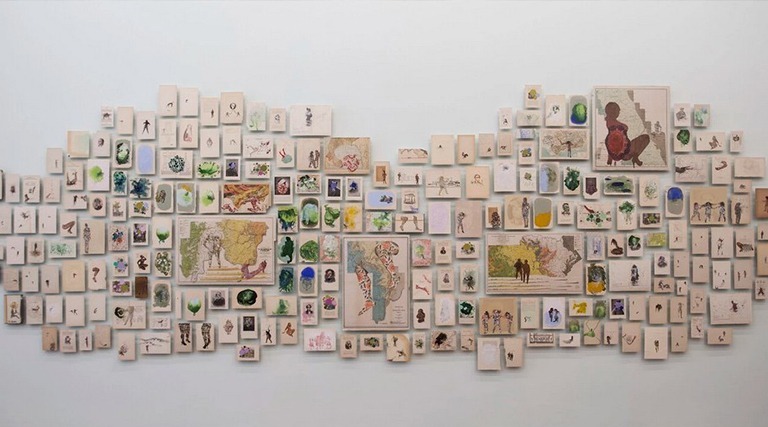
Firelei Báez, Man Without a Country (aka anthropophagist wading in the Artibonite River), 2014–15
The fraught process of becoming whole again after relocation or displacement forms a recurring theme in this season’s Committee on Women in the Arts exhibition picks. Hayv Kahraman’s new figural paintings serve as offerings to appease the earth after the artist’s loss of her home to the California wildfires (Vielmetter Gallery, Los Angeles). Vlatka Horvat documents her creation of transnational connections with hundreds of artists living outside their home countries through long-distance artwork exchanges (Museum of Contemporary Art, Zagreb). And Mechelle Bounpraseuth’s ceramic sculptures of fruits native to her parents’ home country, Laos, invite viewers to celebrate their familial dining traditions (Art Gallery of New South Wales, Sydney).
UNITED STATES
Blazing Light: Photographs by Mimi Plumb
Through May 10
High Museum of Art, Atlanta
In this first solo museum exhibition of California-based photographer Mimi Plumb (b. 1953), more than one hundred photographs taken in San Francisco and throughout the American West from the 1970s to the present capture the impact of climate change, unchecked capitalism, and ceaseless military conflict on the landscape and on the anxieties of American life.
Burnished: Pueblo Pottery at NMWA
May 8–September 7
National Museum of Women in the Arts, Washington, DC
Drawn from the NMWA’s extensive collection, these twenty-four vessels attest to the technical excellence and aesthetic diversity of Pueblo pottery by women artists in the American Southwest. Highlights include a ca. 1939 blackware jar hand-shaped and polished to a high sheen by San Ildefonso Pueblo artist Maria Martinez (1887–1980) and a 1983 pot with optically arresting black-on-kaolin white patterns of delicate, precise, densely packed lines by Acoma Pueblo potter and painter Lucy M. Lewis (1895–1992).
Eva Jospin: Into The Woods
Through June 7
Savannah College of Art and Design (SCAD) Museum of Art, Georgia
French artist Eva Jospin has been creating her signature large-scale forests and architectural follies in sculpted cardboard, embroidered silk, and other media for fifteen years. Jospin’s debut US museum exhibition highlights the astonishing intricacy of these works, inviting visitors into a world of enchantment and mystery where fantasy and nature converge.
Faith Ringgold: Artist, Storyteller, Activist
Through August 16
Sugar Hill Children’s Museum of Art & Storytelling, New York
This exhibition in Harlem honors Harlem-born artist, educator, writer, and activist Faith Ringgold (1930–2024). Materials from the artist’s archives—including facsimiles of working drawings and digital reproductions of two of her children’s books in working manuscript form, My Dream of MLK (1995) and If A Bus Could Talk: The Story of Rosa Parks (1999)—celebrate Ringgold’s love for storytelling and her commitment to social justice.
Farah Al Qasimi: Psychic Repair
Through June 7
Savannah College of Art and Design (SCAD) Museum of Art, Georgia
Photographic installations and music videos by Farah Al Qasimi activate the museum’s facade vitrines and an interior gallery. Informed by her girlhood in the United Arab Emirates and by her experiences of womanhood in the US, Al Qasimi’s highly saturated images explore rituals of self-presentation, their shaping by contemporary beauty and fashion culture, and their ties to identity, memory, and belief formation.
Firelei Báez
Through May 31
Museum of Contemporary Art (MCA) Chicago
In her monumental paintings and installations, Dominican Republic-born, New York–based artist Firelei Báez (b. 1981) creates fictional worlds that explore the legacies of colonial rule in the Caribbean and across the African diaspora. Her exuberant, colorful works contain complex and layered uses of pattern, decoration, and abstract gestures alongside symbols rooted in Afro-Caribbean cultures. In this first mid-career survey in North America, Baez challenges our understanding of acknowledged power, unsettling the often fixed categories of race, gender, and nationality and suggesting alternative histories.
Ghada Amer: Big Rumi
Through March 2026
Institute of Arab & Islamic Art at Ruth Wittenberg Triangle, New York
The Cairo-born, New York-based artist Ghada Amer frequently incorporates Arabic, English, and French texts into her work, calling attention to the ambiguities of language and translation as a means of exploring tensions between East and West. The latticework sphere titled Big Rumi, the inaugural work of IAIA’s Public Art Program, comprises a repeated aphorism in Arabic attributed to thirteenth-century mystic poet Rumi that translates to English two ways: “You are what you seek” or “What you seek is seeking you.”
Hayv Kahraman: Libations
Through March 21
Vielmetter Gallery, Los Angeles
Libations marks the first exhibition by Hayv Kahraman since her displacement by the 2025 Eaton Fire. Within her broader painting practice, which explores the poetics of loss, displacement, and migration, the Baghdad-born Kahraman seeks to make sense of her experience of the fire. These new paintings present female figures engaged in mysterious, ritualistic acts: sewing a strand of tears, revealing a portal, rhythmically whirling their long hair. The works uphold mysticism as an antidote to the ravages of ecological disaster and serve as an offering—a libation—to a burning world.
How to Be a Guerrilla Girl
Through April 12
The Getty Center, Los Angeles
Drawing on the group’s own archive, and coinciding with their fortieth anniversary, this exhibition presents the inner workings of the anonymous feminist art collective Guerrilla Girls, placing their eye-catching, humorous posters in the context of their data research, protest actions, culture jamming, and distribution methods. How to Be a Guerrilla Girl tells the story of the group’s collaborative process in their ongoing call for equity for women and artists of color in the art world.
Lay Your Burden Down
Through May 6
Seattle Asian Art Museum
Commissioned from Seattle-based Filipina American artist Carina A. del Rosario, this installation emerges from, and testifies to the power of, communal acts of care. Del Rosario invited participants to handwrite notes describing sources of stress and convened sewing circles to embroider the notes onto colorful scraps of fabric that the artist sewed into pillows and quilts. These textile works nestle in a hammock and hang on quilt racks, dispelling the anxiety of the notes through their associations with comfort and warmth.
Mona Bozorgi: Strain and Strand
Through May 17
Savannah College of Art and Design (SCAD) Museum of Art, Georgia
For her ongoing series Threads of Freedom, Mona Bozorgi begins with photographs shared on social media by Iranian women protesting the government’s hijab mandate. After printing the images on silk, Bozorgi unravels and reassembles the silk strands, creating collages that mirror the deluge of online imagery. A meditation on female bodily autonomy and on the construction of identity, Strain and Strand highlights the intimacy, vulnerability, and impact of one’s public-facing images.
Mulheres: Proposals from Brazil
Through May 10
ArtNexus Space, Miami
Representing the artistic production of fifty important Brazilian women artists, from renowned mid-twentieth-century pioneers like Lygia Clark and Lygia Pape to young representatives of contemporary art like Tadáskía and Rosa Maria Codinome (Ros4 Luz), the works in this exhibition respond to specific historical contexts and address myriad issues of gender and race, including the role of women in society, social resistance, and censorship.
Rania Matar: Where Do I Go? لوين روح؟
Through August 2
Sidney and Lois Eskenazi Museum of Art, Indiana University, Bloomington
These intimate portraits of young Lebanese women by Lebanon-born Arab American photographer Rania Matar foreground the women’s creativity, strength, dignity, and resilience amid the legacy of the Lebanese Civil War and the country’s ongoing crises. Set in locations chosen by the subjects themselves, from the Mediterranean Sea to the craggy peaks of Mount Lebanon to the traditional and modern buildings of Beirut, Matar’s photographs weave together the women, the land, and the architecture into a tapestry of beauty and anxious promise.
Shani Crowe: Red, Black, and Green
Through March 29
Museum of Contemporary African Diasporic Arts (MoCADA) Culture Lab II, Brooklyn
Chicago-based artist Shani Crowe draws this show’s namesake palette from the tri-colored Pan-African flag, an enduring symbol of African diasporic identity and liberation. Crowe employs textured hair and its ornamentation as central modalities and incorporates photographic portraiture, yarn tapestry, beading, and performance to create works that expand the Black radical imagination.
Theresa Hak Kyung Cha: Multiple Offerings
Through April 19
Berkeley Art Museum and Pacific Film Archive (BAMPFA), CA
In her videos and performances, as in her posthumously published avant-garde novel Dictée (1982), Theresa Hak Kyung Cha (1951–1982) favored “multiple telling with multiple offerings”: the creation of nonlinear narratives inviting open-ended interpretations. This first retrospective of Cha’s work in twenty-five years likewise affords a range of entry points into Cha’s work, guiding visitors through such recurring themes as memory, displacement, and the mutability of language.
Toshiko Takaezu: Dialogues in Clay
Through July 5
Princeton University Art Museum, NJ
This exhibition spotlights the pioneering ceramics of Toshiko Takaezu (1922–2011), a longtime Princeton faculty member. Drawn from the museum’s holdings, these vessels and sculptures illustrate the artist’s distinctive closed forms and painterly glazing. Works by Finnish American ceramicist Maija Grotell, who served as a mentor to Takaezu, and by the artist’s contemporaries, including Helen Frankenthaler, offer context, while reflections by Takaezu’s students underscore the artist’s importance to later generations.
Vitória Cribb: echoes of a wet finger
Through May 24
Wexner Center for the Arts, Columbus, OH
This animated science fiction short by Brazilian artist Vitória Cribb explores how technology reshapes identity, surveillance, and self-perception. Released in its cinematic version in 2025, echoes of a wet finger follows Tixa as a lizard slips into her shower and her ordinary world skews into the surreal, providing a metaphor for the fragile, sometimes mysterious experience of existing online. Tixa’s metamorphosis into a fantastical creature presents transformation as a possible form of resistance.
Vivian Caccuri: I Hear My Blood Singing
Through August 9
Mattress Factory, Pittsburgh
This installation by Brazilian artist Vivian Caccuri transforms the Mattress Factory into a visceral concert hall. Caccuri recuperates sounds that have traditionally been marginalized because of their links to pathologies, class-marked popular musical genres, and/or colonized geographies. In Caccuri’s work, these sounds assert their presence, becoming ghosts of resistance that haunt the now. Listening itself thus becomes an act of rebellion.
Yasmine El Meleegy: Red Gold
Through September 6
Mattress Factory, Pittsburgh
Cairo-based Egyptian artist Yasmine El Meleegy (b. 1991) has long explored the labor of food production and in the politics of agriculture. In her first US solo exhibition, El Meleegy turns to the salting and sun-drying of Roma tomatoes in the Nile Valley, a process that transforms the fruits into more valuable commodities, or “red gold.” El Meleegy’s salt sculptures in two and three dimensions, including vacuum-sealed tomato replicas, call attention to the complex and often invisible forces behind a favored food.
Zina Saro-Wiwa: Table Manners: Season 1
Through August 30
University of Michigan Museum of Art, Ann Arbor
In these eight videos by the Nigeria-born, Brooklyn-based artist Zina Saro-Wiwa, individuals on the Atlantic coast of Nigeria eat meals tied to the region’s cultural and natural landscapes. By centering everyday people who make direct contact with the camera as they enjoy their culinary traditions, Saro-Wiwa subverts the extractive lens often imposed on the region, offering instead a moment of connection, reflection, and quiet resistance.
MEXICO
Aquí entre nos . . . Ven y te cuento (Just Between Us… Come and I’ll Tell You)
Through May 23
Museo Archivo de la Fotografía, Mexico City
This exhibition of work by thirteen women photographers foregrounds feelings and emotional experiences, aspects of life that are often silenced by social conventions of modesty, especially for women and other marginalized groups. The photographs invite viewers to engage intimately with the themes of identity, affection, and family; of embodiment and sensory experience; of mental and physical health challenges; and of gendered violence, resistance, and transformation.
Melanie Smith: Un tiempo de libertad en que el mundo había sido posible (A Time of Freedom in Which the World Had Been Possible)
Through March 15
Museo Jumex, Mexico City
Developed in collaboration with biologist Eria Rebollar and curator Helena Chávez Mac Gregor, this video installation by British Mexican artist Melanie Smith considers the long visual history of the axolotl as a deity, scientific specimen, and cultural symbol alongside its contemporary commodification amid ecological threat. In keeping with the exhibition’s title, taken from Julio Cortázar’s short story “Axolotl,” Smith approaches the axolotl as a fluid surface that eludes a fixed identity.
Todas las cosas se mezclaron con las palabras (Everything Got Mixed Up with Words)
Through April 30
Galería Ana Tejeda, Mexico City
This exhibition places in dialogue—”mixes up”—the work of Deborah Castillo, Marianna Dellekamp, Carmen Mariscal, Yohanna M. Roa, Teresa Serrano, and Marina Vargas, establishing points of connection among their diverse approaches to words and objects and to the power of texts and things in patriarchal society. Apparently dichotomic realms intersect here: the objective and the subjective, the personal and the political, the individual and the collective.
CANADA
Elizabeth Wyn Wood
Opens April 25
National Gallery of Canada, Ottawa
Ontario modernist sculptor and art educator Elizabeth Wyn Wood (1903–1966) was celebrated for her simplified designs, natural forms, and experimentation with materials. This exhibition brings together five of Wood’s works from the AGO Collection, including the recently acquired Receiving (ca. 1957–61), a recessed relief with gold inlay of a male nude in a celestial landscape.
Helen McNicoll: An Impressionist Journey
May 8–October 12
National Gallery of Canada, Ottawa
Known for her mastery of light and for the immersive quality of her tableaux, painter Helen McNicoll (1879–1915) helped elevate the profile of Canadian art on both sides of the Atlantic, despite being deaf and living only to age thirty-five. The paintings here epitomize McNicoll’s Impressionist style and the intimacy of her portrayals of women, whether they perform agricultural labor or engage in leisure activities, often with children, in domestic settings or in the bright outdoors.
Tania Willard: Photolithics
Through May 24
The Polygon, Vancouver, British Columbia
Artist, curator, and scholar Tania Willard draws on her mixed Secwépemc and settler-Scottish ancestry in a collaborative practice that attends to the history, present, and future of the land and of the Indigenous community. The focus of this ten-year survey is Willard’s ongoing experimentation with photography as a medium of both colonization and decolonization. As the exhibition’s title suggests, Willard works directly both with the sun’s changing rays and with myriad formations of soil, crystal, metal, and sediment.
SOUTH AMERICA
Claudia Alarcón & Silät: Vivir, Tecendo (Living, Weaving)
Through August 2
Museu de Arte São Paulo (MASP), Brazil
Silät is a collective of over one hundred Wichí women weavers in northern Argentina led by Claudia Alarcón. Building on the tradition of yica bags, whose geometric motifs evoke local flora and fauna, the group weaves resilient native chaguar fibers into abstract compositions that resonate with Wichí mythology and the regional landscape. Silät has developed collaborative techniques that allow multiple members to work on a single textile, foregrounding collective authorship.
Fernanda Laguna: Mi corazón es un imán (My Heart Is a Magnet), 1992–2005
March 13–June 22
Museo de Arte Latinoamericano Buenos Aires
Fernanda Laguna has been one of the most influential figures in Argentine art for decades. Moving fluidly among literature, visual art, activism, and the management of independent spaces, Laguna has forged a distinctive, defiantly undisciplined language in which struggles, desires, generations, and communities converge. This exhibition offers the most comprehensive survey of her work to date, presenting two hundred works alongside notebooks, poetry, prose fiction, and personal photographs.
Olga de Amaral: Cuerpo textil (Textile Body)
Through May 11
Museo de Arte Latinoamericano Buenos Aires (MALBA), Argentina
This exhibition surveys the textile practice of Colombian artist Olga de Amaral from the 1960s to the early 2000s. More than fifty works drawn from public and private collections in Bogotá, Medellín, and New York testify to the visual richness and material experimentation of de Amaral’s oeuvre. Blurring the boundaries between weaving, sculpture, painting, and immersive installation, de Amaral’s works invite viewers to consider the relationship of textiles to the body and to humanity writ large.
Sandra Gamarra Heshiki: Réplica (Replica)
Through June 7
Museu de Arte São Paulo (MASP), Brazil
Since the late 1990s, Peruvian artist Sandra Gamarra Heshiki has produced sculptures, paintings, drawings, collages, and other works that invoke and challenge canonical Latin American art history, especially that of the colonial era. In the eighty works that compose her first panoramic exhibition, Gamarra trenchantly questions the neutrality of arts institutions and upholds the replica as a means of responding to dominant narratives.
Edelmira Boller: Acoplamientos (Couplings)
Through April 26
Galería Santa Fe, Bogotá
At ninety years old, Edelmira Boller returns to the opening venue of her 1984 exhibition Sculptures, which presented the artist’s first incorporations of industrial waste into her work. Today, Boller continues to investigate the function and memory of materials, as well as their relation to the body, space, and life itself. Acoplamientos brings together more than five decades of Boller’s freestanding and wall-hung sculptures, demonstrating the simultaneous breadth and coherence of her oeuvre.
Tatiana Parcero. Principio y fin (Beginning and End)
Through May 3
Walden Naturae, Pueblo Garzón, Uruguay
Through three decades of self-portraiture and photo-performance, Mexican artist Tatiana Parcero has probed the relationships between identity, memory, nature, and the body. Overlaying the nude female form with symbols in a manner that calls to mind the mapping of land, Parcero examines how personal processes, social dynamics, and natural catastrophes form part of the same fabric that connects individual experience with collective memory.
EUROPE & UK
Adorado Barragán, de Lake Verea (Adored Barragán, by Lake Verea)
Through May 10
Fundación Casa de México en España, Madrid
Mexican artist duo Lake Verea, a major force in contemporary queer photography in Latin America, pays homage to Mexican architect Luis Barragán (2006–2013) in twelve photographs of his 1948 Studio House in Mexico City. Accompanying the images are two glass spheres, a key motif for the architect that signifies his expansive, poetic way of viewing. Through an intimate and playful gaze, Lake Verea transforms spaces and constructs new visual narratives about modern Mexican architecture.
Ana Mendieta
July 15, 2026–January 17, 2027
Tate Modern, London
This major retrospective presents key works by Cuban-born American artist Ana Mendieta (1948–1985). Alongside her celebrated Silueta Series exploring the presence and absence of the human body, the exhibition features remastered films, early paintings, and some of Mendieta’s final sculptural works. It reflects Mendieta’s deep engagement with more-than-human worlds and ecological concerns; it also marks Mendieta’s important role within the US feminist art movement, including as a member of the Heresies journal collective.
Catherine Opie: To Be Seen
Through May 31
National Portrait Gallery, London
Over the past thirty years, American artist Catherine Opie has employed myriad contexts and visual formats for her photograph portraits. Conceptually rigorous and meticulously executed, these photographs make visible queer communities, mentors, collaborators, children, surfers, high school soccer players, political crowds, and Opie herself. This first major exhibition of Opie’s work in the UK asks viewers to reflect upon who has traditionally been portrayed and who has gone unseen.
Lorna Simpson
March 26–November 22
Punta della Dogana, Venice
Known for her groundbreaking conceptual photography, African American artist Lorna Simpson has made painting a critical part of her artistic practice over the past ten years. Like her photographs, Simpson’s paintings address issues of gender, race, history, and identity in the US, such as the instability of narratives and the failures of representation. The exhibition offers one of the most extensive selections of Simpson’s paintings ever to be shown in Europe.
Nancy Holt
Opens May 2
Goodward Art Foundation, Chichester
One of the few women artists associated with the Land art Movement, Nancy Holt (1938–2014) produced large-scale earthworks and site-specific installations as well as concrete poetry, audio works, film, video, photography and drawing. Drawing from astronomy and geology, Holt linked human experience to natural and cosmic systems, activating sunlight, shadows, and constellations to make viewers conscious of their position in space and time. Holt’s largest exhibition in the UK to date extends into the Goodward Art Foundation’s expansive grounds.
No Master Territories: Feminist Worldmaking and the Moving Image
Through May 3
Kunstnernes Hus, Oslo
This latest iteration of the exhibition series launched in 2022 at the Haus der Kulturen der Welt in Berlin foregrounds documentary and experimental film and video exploring gendered experience. Concentrating on the 1970s to 1990s, No Master Territories traces multiple genealogies and highlights cultural forms that are strongly inhabited by women but that have been frequently sidelined by dominant and even feminist-informed film histories: activist tapes, avant-garde experiments, essay films, docu-fictions, personal testimonies, and observational documentaries.
Shubigi Rao: Pulp I-IV
Through May 3
Tensta konsthall, Stockholm
Shubigi Rao charts the role played by women in radical library work: preventing the destruction of books and manuscripts during times of war and crisis, creating shadow libraries, and initiating programs of radical publishing. Through films, annotated photographs, books, and drawings, Rao brings attention to libraries, archives, and private collections in Sarajevo, Manila, and other regions afflicted by conflict. Pulp I-IV celebrates publications and libraries as carriers of memory and identity, language, and culture.
Vlatka Horvat: By the Means at Hand
March 10–May 10
Musej Suvremene Umjetnosti (MSU; Museum of Contemporary Art), Zagreb
For the Croatian Pavilion at the 2024 Venice Biennale, Vlatka Horvat invited some two hundred artists living “as foreigners” in different countries around the world to exchange newly made small-scale artworks with her. For every work she received, Horvat sent a collage from the series she was making while living in the pavilion. The exhibition at the MSU will present the extensive archive of Horvat’s continually shape-shifting system at the Biennale, the incoming and outgoing material traces of connection amid relocation.
ASIA
Fear No Power: Women Imagining Otherwise
Through November 15
National Gallery Singapore
For these five women artists from Southeast Asia, Amanda Heng, Dolorosa Sinaga, Imelda Cajipe Endaya, Nirmala Dutt (1941–2016), and Phaptawan Suwannakudt, art, life, kinship, and community are inseparable. Fear No Power features works from the 1960s through today, decades marked by decolonization, developmentalism, Cold War tensions, and sweeping social change. Through their diverse and situated strategies, these artists refuse a one-size-fits-all feminism, offering an array of nuanced insights into the gendered dynamics of power.
MIDDLE EAST & NORTH AFRICA
Nadia Ayari: Oblivion Rains: Notations of Gravity, Light, and Resistance
Through April 18
Selma Feriani Gallery, Tunis
In this first solo exhibition of Brooklyn-based artist Nadia Ayari in Tunis, her native city, the stylized botanical protagonists of Ayari’s paintings negotiate gravity, light, and chaos within charged and saturated atmospheres, operating as notations in a visual score registering rhythm, momentum, and time. Together, the works trace an expansive narrative about perception and persistence, revealing how color, motion, and compositional rupture can hold truth against the pull of oblivion.
AFRICA
Imbeleko: Zizipho Poswa
Through April 16
Southern Guild, Cape Town
Explorations of mothering and matrilineal traditions inform this exhibition of new earthenware sculptures by South African isiXhosa artist Zizipho Poswa. The exhibition’s title refers to an isiXhosa ceremony that introduces a newborn baby to their ancestors and honors the mother’s acts of giving birth and carrying the baby on her back. Reflecting on this tradition, and maintaining the ethos of homage that dwells at the heart of her practice, Poswa frames motherhood as both a gift and a load to bear.
Irma Stern: A Life of Displacement
Through August 17
Norval Foundation, Cape Town
This multi-year exhibition series examines the life and work of one of South Africa’s most significant modernists, Irma Stern (1894–1966). Drawing from the artist’s archives as well as her personal collection, the exhibition explores themes of movement, cultural encounter, and identity through paintings, works on paper, travel artefacts, and documentary material.
L’Art D’Être, Femmes Noires (The Art of Being, Black Women)
Through May
Musée des Civilisations Noires (Museum of Black Civilizations), Dakar
The established and emerging women artists featured here address memory, cultural heritage, and political commitment as intersecting facets of Black womanhood across Africa and its diasporas. Multiple narratives converge, reflecting the complexity of Black female identities and lived experiences. L’Art D’Être, Femmes Noires avoids didacticism to instead invite reflection on the power of storytelling through art, and it affirms that to speak of Black women is to speak of history, resilience, and presence.
Penny Siopis: Love in a Turning World
Through March 21
Stevenson Gallery, Cape Town
In her glue-and-ink–based practice, South African artist Penny Siopis foregrounds love as a position or disposition rather than as pictorial subject, even as suggestions of embracing figures and birth abound. The notion of turning operates across multiple registers in this solo exhibition, speaking to current global and psychological states of tumult as well as to the processes of transformation inherent in the artist’s materials and methods, which leave form, meaning, and emotion open rather than fixed.
Portia Zvavahera: Tanda rima (Chase Away the Darkness)
Through September 6
Norval Foundation, Cape Town
Based in Harare, Portia Zvavahera is a Zimbabwean artist internationally recognized for her deeply expressive, rhythmic paintings. The exhibition’s title comes from Shona, the language in which Zvavahera’s life and artistic practice are rooted; roughly translating to “chase away the darkness,” the phrase links this exhibition to its 2023 Cape Town predecessor: Pane rima rakakomba (There’s too much darkness.) The works in Tanda rima share an intimate and vulnerable narrative suffused by themes of motherhood, care, spirituality, and personal transition.
OCEANIA
Aunty Ellen Trevorrow: Weaving Through Time
March 21–June 21
Ararat Gallery, Textile Art Museum Australia (TAMA), Victoria
JamFactory’s ICON series, which celebrates South Australia’s most influential visual artists working in craft-based media, turns its spotlight to Aunty Ellen Trevorrow, a prolific, internationally acclaimed Ngarrindjeri weaving artist whose practice spans more than four decades. The exhibition attests to the depth and breadth of Aunty Ellen’s oeuvre, from early traditional Ngarrindjeri baskets and fish traps to recent large-scale sculptures, wearable textiles, and jewelry, some produced in collaboration with Philippines-born Australian artist Jelina Haines.
Mechelle Bounpraseuth ສູ້ສູ້ Sou Sou (You Can Do It/Stay Strong)
March 14, 2026–February 2027
Art Gallery of New South Wales, Sydney
Sydney-based artist Mechelle Bounpraseuth is known for her hand-built glossy ceramics depicting food and other homely treasures. This colorful interactive exhibition confers sacred status onto hard-to-get delights from Bounpraseuth’s parents’ homeland of Laos: mangosteen fruits piled high on a plate, dragon fruits overflowing a bowl. Visitors can sit at tables or on traditional Lao floor mats to honor family, memory, and ritual by sharing tales of their own favorite meals.
Nadia Hernández: Para verte mejor, en todo tiempo (To See You Better, At All Times)
March 21–June 21
Art Gallery of New South Wales, Sydney
Venezuela-born, Australia-based artist Nadia Hernández explores memory and its links to personal, historical, and shared experience. For her first Sydney exhibition, Hernández highlights the complexities of displacement and connection in an evolving project centered on Venezuelan protest songs. Across an immersive textile collage, mural, and soundscape, the artist assembles phrases drawn from an archive of this music into fragmented texts, illustrating how resistance and remembrance can be encoded into both song and poetry.
ONLINE/VIRTUAL
Five Women Artists from Latin America
Ongoing
National Museum of Women in the Arts (NMWA), Washington, DC
As part of #5WomenArtists, NMWA’s ongoing social media initiative to amplify women and nonbinary artists, this online exhibition features five major modern artists who bridged Latin America and the United States: Maggie Foskett (1919–2014), Fanny Sanín, Elena Presser, Ana Mendieta (1948–1985), and Graciela Iturbide. The photographs, abstract paintings, performances, and mixed-media works presented here, all taken from the museum’s own collection, innovatively confront themes of belonging, memory, and transformation.