
CAA News Today
CWA Picks: Fall 2026
posted Sep 28, 2026
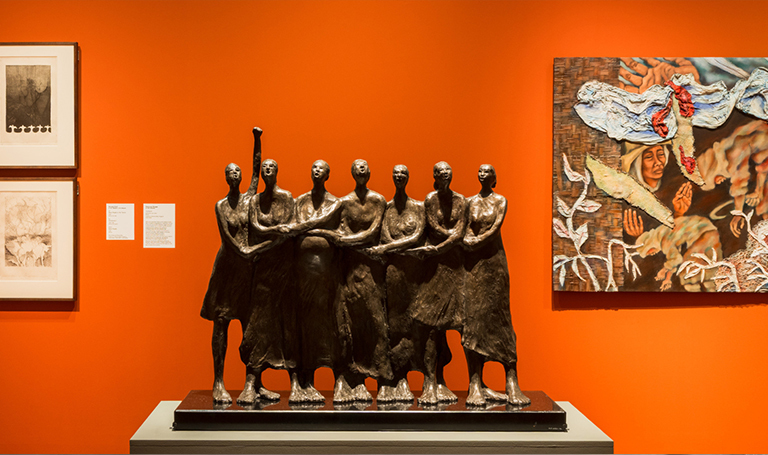
Nirmala Dutt, Dolorosa Sinaga, and Imelda Cajipe Endaya, installation view, Fear No Power: Women Imagining Otherwise, January 9–November 15, 2026, National Gallery, Singapore
How do we understand the relationship of past to present? For Lebanese artist Lamia Joreige, maps provide a site to explore the impact and aftereffects of the early twentieth-century political upheavals in the Levant (Marfa’ Gallery, Beirut). For Rohini Devasher, historical and contemporary images of the sun on four video channels engage with the past of solar science as well as with cosmic time (Bruce Museum, Greenwich, CT). And in intergenerational group exhibitions like Fear No Power: Women Imagining Otherwise (National Gallery, Singapore) and Entretejidas: Arquitectas mexicanas: Presente, pasado y futuro (Interwoven: Mexican Women Architects: Past, Present, and Future; Colegio de San Ildefonso, Mexico City), viewers themselves can ruminate on the aesthetic, thematic, and material dialogues of contemporary woman artists with their foremothers.
AFRICA
The File Cannot Be Restored
Through October 6
THK Gallery, Cape Town, South Africa
This exhibition borrows the language of digital failure to pose a question: What if the past cannot be undone, not because it is fixed, but because it continues to live within the present? The File Cannot Be Restored brings together photographs by Namibian German artist Nicola Brandt, mixed-media assemblages with beadwork by Cape Town–based Sahlah Davids, and collages and film stills by Johannesburg-based Tshepiso Moropa to examine how memory persists across landscapes, archives, inherited traditions, and everyday acts of making.
ASIA
Fear No Power: Women Imagining Otherwise
Through October 25
National Gallery Singapore
This exhibition explores how women artists across Southeast Asia have confronted, critiqued, and subverted structures of authority and state control. Paintings, sculptures, installations, prints, and works in other media by pioneering figures Imelda Cajipe Endaya, Nirmala Dutt, Dolorosa Sinaga, Phaptawan Suwannakudt, and Amanda Heng as well as by contemporary voices reveal how these artists navigate censorship, assert creative autonomy, and challenge dominant sociopolitical narratives.
Janet Cardiff: The Forty Part Motet
Ongoing
M+, Hong Kong
This groundbreaking 2001 sound installation by Canadian artist Janet Cardiff reimagines English composer Thomas Tallis’s sixteenth-century, forty-part choral composition Spem in alium (Hope in Any Other). Forty speakers arranged in an oval each play a single vocal track, inviting visitors to experience Tallis’s motet both as a collective soundscape and through the isolated human voice of each individual singer. Exploring themes of spatial intimacy and physical presence in music, The Forty Part Motet elevates audio engineering into an immersive sculptural installation.
Mariko Mori: All That Shines
October 31, 2026–March 28, 2027
Mori Art Museum, Tokyo
Over her more than thirty-year practice, Japanese artist Mariko Mori has expanded her focus from critique of social phenomena like anime culture and post-humanism to larger metaphysical concerns informed by Buddhist concepts of life, death, and the cosmos. All That Shines presents some forty works in all of Mori’s signature media—performance-based and computer-imaging photography and video, drawing, sculpture, and large-scale interactive installation—and positions the artist’s oeuvre within new contexts, including technological futurism, popular visual culture, and philosophies of consciousness.
Tada Minami: Still, Shimmering Light
Through December 6
Museum of Contemporary Art, Tokyo
Tada Minami (1924–2014) produced hundreds of abstract sculptural installations for parks, railway stations, hotels, and other urban spaces in postwar Japan. The smooth, hard surfaces of Tada’s works, like the acrylic ring Space Eye No. 4 (1975) and the monumental stainless-steel pinnacle Chiaroscuro (1979), conceal traces of manual labor, instead drawing attention to the transmission, reflection, refraction, and fluctuation of light. The approximately seventy works here span the artist’s nearly seven-decade career.
CANADA
Landon Mackenzie: Weather Patterns
Through November 22
Evergreen Arts, Coquitlam, British Columbia
Extending her decades-long investigation of abstraction and place, Canadian contemporary painter Landon Mackenzie presents a new body of innovative large-scale paintings shaped by the forces of weather. Mackenzie first set the canvases outdoors on Prince Edward Island to absorb saltwater, rain, wind, and sunshine; she then responded to their transformed surfaces in her Vancouver studio. Evoking sandstone, riverbeds, celestial bodies, and nervous systems, the works explore the intimate relationship between landscape, material process, and perception.
Marion Wagschal
Through January 17, 2027
National Gallery of Canada, Ontario
This major retrospective celebrates more than six decades of work by Marion Wagschal, whose emotionally charged large-scale figurative paintings examine memory, migration, family, sexuality, aging, and the female body. Born in Trinidad and Tobago to Holocaust survivors, and a resident of Montreal since she was nine years old, Wagschal blurs the boundaries between autobiography and fiction as she explores vulnerability, resilience, and self-determination.
CENTRAL AMERICA & THE CARIBBEAN
The Gaulin Woman: Uncovering Our Bahamian Selves
Through May 2027
National Art Gallery of The Bahamas, Nassau
Its title referring to the heron-woman of Bahamian folklore, this exhibition looks at art historian and keeper of storytelling traditions Patricia Glinton-Meicholas (1950–2025), author of the seminal book Bahamian Art 1492–1992. Tracing her close association with pioneering Bahamian modern art movement Generation ’80, The Gaulin Woman features works by artists whom Glinton-Meicholas taught, engaged with, and promoted over many years.
EUROPE & UK
Bharti Kher at the V&A
Through January 27, 2027
V&A Museum, London
Statues of women by British Indian artist Bharti Kher in the V&A’s European Sculpture Hall draw on the same classicizing naturalism and iconography as the sculptures around them, but a resin sari-veil, animal headdresses, and other non-Western attributes encourage viewers to ask questions about the figures’ cultural identity and about their agency as women, as does the house or temple enclosing the head of Kher’s new bronze colossus, Gaia (Earth), outside the museum.
Chitra Ganesh: Journey to the Great Below
Through January 17, 2027
Baltic Centre for Contemporary Art, Gateshead, UK
Chitra Ganesh reorients epic myths and historical narratives around queer and femme protagonists. Ganesh’s world-building explores such themes as psychic transformation, sexuality, power, and loss; her shape-shifting characters occupy liminal spaces, inviting us to consider utopian possibilities amid precarity and turbulence. The centerpiece of these new and recent sculptures, paintings, works on paper, and mixed-media works is a large-scale animation inspired by The Descent of Inanna into the Underworld, an ancient Mesopotamian narrative widely considered the world’s oldest recorded myth.
Grada Kilomba: O Fundo do Mundo (The Bottom of the Earth)
Through September 27
Albuquerque Foundation, Lisbon
Recognized for her subversive storytelling, Berlin-based Portuguese artist Grada Kilomba gives body, voice, and movement to silenced voices. The Bottom of the Earth envisions a futuristic ocean floor as a record of both geological and human activity, the latter often barbaric and violent, approaching the concepts of memory, trauma, violence, and repetition in an urgent yet poetic way.
Mariuccia Secol: Unraveling
Through November 1
Muzeum Susch, Switzerland
While teaching painting at a psychiatric hospital from 1965 to 1988, Italian artist Mariuccia Secol began deconstructing domestic textiles and women’s clothing, including her wedding dress. The resulting gaps and tears symbolize wounds and stretch marks on the female body but also openings for light and knowledge emerging from inner exploration. Unraveling surveys this nonagenarian artist’s practice from the 1950s onward, including recent works addressing intersectional feminist concerns, such as marginalization and ecological crisis.
Sungi Mlengeya: Earth and Sky
Through October 24
Les filles du calvaire, Paris
Tanzanian artist Sungi Mlengeya is known for her minimalist paintings of dark female figures emerging from vast white spaces. Conceived following the death of her mother, Mlengeya’s first solo exhibition in France marks an intimate turning point. Rather than questioning the finality of death, Earth and Sky focuses on what remains: inherited gestures, thought processes, and creative impulses that quietly shape subsequent generations.
MEXICO
Entretejidas: Arquitectas mexicanas: Presente, pasado y futuro (Interwoven: Mexican Women Architects: Present, Past, and Future)
Through December
Colegio de San Ildefonso, Mexico City
Part of the Mextrópoli 2026 festival, this exhibition brings together generations of Mexican women architects, more than one hundred fifty in total, who have transformed the discipline through professional practice, academia, research, and public administration. Entretejidas highlights the networks, influences, and continuities that have shaped the increasingly diverse architectural landscape of Mexico.
Marysole Wörner Baz: Redenciones marginales (Marginal Redemptions)
Through October 25
Museo de Arte Moderno, Mexico City
Marking the ninetieth anniversary of her birth, this exhibition celebrates the work of Mexican artist Marysole Wörner Baz (1936–2014). Working over the course of six decades in performance art, kinetic art, palette-knife painting, wood carving, and a wide range of other media, Wörner Baz sought to rescue and transform people, objects, and materials that which had been disregarded and to imbue them with new aesthetic and social importance.
Minia Biabiany: Nuestras escuchas (Our Listening)
Through February 14, 2027
Museo Universitario de Arte Contemporáneo, Mexico City
Guadaloupan interdisciplinary artist Minia Biabiany brings local knowledge into dialogue with the poetic imagination, exploring connections among species that share the same habitats. Here, Biabiany focuses on the ocean: as a locus of exchange and movement among humans and non-humans, and as a living archive of historical, ecological, and affective memories, not least the legacy of colonialism in the Caribbean.
Regina José Galindo: Los peores tiempos posibles (The Worst Possible Times)
Ongoing
Museo Universitario del Chopo, Mexico City
The work of Guatemalan performance artist Regina José Galindo has developed in response to the war and genocide that took place in Guatemala from the 1960s to the 1990s as well as its enduring legacy today. This exhibition surveys Galindo’s work from 1999 to the present, grouping her projects and actions into thirty-three interwoven tiempos (times) expressed through the artist’s body: times of war, genocide, migration, racism, misogyny, and more. Repetitions across works emphasize how memories and ramifications of past events continue to shape the present.
Teresa Serrano: Hedonismo y cosmetología (Teresa Serrano: Hedonism and Cosmetology)
Through March 1, 2027
Galería Ana Tejeda, Mexico City
Mexican artist Teresa Serrano addresses gender-based violence, female subjectivity, and social issues like migration and ecology through painting, drawing, sculpture, video, performance, and installation, defying the categories and movements into which contemporary Mexican art history is usually divided. The new series presented here explores pleasure, rituals of the body, and the social construction of beauty.
Valentina Guerrero Marín: Aquí, otros cielos (Here, Other Skies)
Through October 11
Museo de Arte Carrillo Gil, Mexico City
A sculptural and sensory intervention on the museum’s terrace by Mexico City–based Chilean artist Valentina Guerrero Marín invites viewers to observe the clouds from artistic, political, and environmental perspectives. Stemming from years of research on the ways human activity has altered aerial landscapes, Aquí, otros cielos (Here, Other Skies) reclaims the deeply human act of looking up at the sky to reflect on environmental transformations affecting the atmosphere and our relationship to it.
MIDDLE EAST & NORTH AFRICA
Lamia Joreige: As I Weep
Through September 23
Marfa’ Contemporary Art Gallery, Beirut
The exhibition forms part of Lebanese artist Lamia Joreige’s project Uncertain Times, which focuses on the events in Lebanon, Syria, and Palestine between the collapse of Ottoman rule in 1913–18 and the establishment of the French and British Mandates in the early 1920s. Through interventions into maps and other archival materials, and through paintings, drawings, and works in other media, As I Weep reflects on both individual and collective histories of the period, examining how narratives of the past are constructed, circulated, and reinterpreted as well as how they remain embedded in present-day realities.
OCEANIA
Cherine Fahd, The Captains, 2026
Through October 7
Museum of Contemporary Art (MCA) Australia, Sydney
Australian photographer Cherine Fahd presents a commissioned series of portraits of the twelve 2026 team captains of the Australasian National Women’s Rugby League. Fahd’s monumental black-and-white photographs—some static and contemplative, others captured at a moment of action—invite us to reflect on ideas of visibility, leadership, and legacy. The Captains shines a light on these athletes and leaders at a time when women’s involvement and recognition in sport continues to be a work in progress.
Kate Mitchell: In the Eye of the Giant
Through December
Art Gallery of New South Wales, Sydney
This enormous ascending digital scroll in the museum’s atrium visualizes seven emotional states that shape the practice of Australian artist Kate Mitchell. A succession of hundreds of colored ink drawings forms an “emotional devotional” resonating, for example, with the manuscript self-portrait of the medieval German nun Guda. Running on a continuous loop, In the Eye of the Giant acknowledges the transience of feeling and invites visitors to tune into the quiet intelligence of their own emotions.
Ruth Ige: The Evocation of Worlds
Through November 15
Te Uru Contemporary Gallery, Auckland, New Zealand
These new paintings by Nigeria-born, New Zealand-based Ruth Ige extend the artist’s ongoing exploration of identity, belonging, and representations of Blackness. In Ige’s blue-and-black semifigural canvases, acrylic paint mingles with West African indigo, Nigerian earth clays, shea butter, and other organic materials to evoke associations with nourishment, healing, adornment, ceremony, spiritual practice, ancestral tradition, and much more. Ige creates worlds where history, poetry, mythology, speculative fiction, ancestral practices, and future imaginings converge.
Shona Rapira Davies: Ko te Kihikihi Taku Ingoa (The Cicada Is My Name)
Through June 27, 2027
Christchurch Art Gallery/Te Puna o Waiwhetū, New Zealand
This commissioned installation by Shona Rapira Davies of the Ngāti Wai ki Aotea tribe memorializes the Māori children killed and displaced by the Colony of New Zealand in the Taranaki Wars (1860–1866). Created in graphite and native wood entwined within steel wire, this gigantic hanging whale’s tail calls to mind a Māori folktale of sacrifice by the tohorā (whale) for its brother the Kauri tree. It also serves to acknowledge a blight in the local history of Christchurch: the imprisonment in 1880 of 160 peaceful Parihaka protesters.
SOUTH AMERICA
Astrid González: La boca donde el agua engendra el agua (The Mouth Where Water Gives Birth to Water)
Ongoing
Museo de Arte Moderno de Medellín, Colombia
African Colombian artist Astrid González, whose practice spans video, photography, and sculpture, presents the ocean as at once a cemetery and a stage for liberation. In González’s radical imagining, sea-dwelling spiritual beings—mermaids, serpents, Haitian Vodou entities—and sensory experiences of the ocean mediate access to the vibrations of drowned ancestors. The artist’s strategies of codification rely on Afro-descendant epistemes beyond the colonial gaze.
Belkis Ayón: Mito y desobediencia (Myth and Disobedience)
Through October 12
Museo de Arte Latinoamericano de Buenos Aires (MALBA), Argentina
Belkis Ayón (1967–1999) was a leading Cuban printmaker whose explorations and reworkings of Afro-Cuban mythology transformed the field of contemporary graphic art. These seven works from the MALBA-Costantini Collection demonstrate how Ayón’s use of collagraphy, a technique in which diverse materials are collaged onto a hard substrate that is then inked and used for printing, enabled the artist to develop a visual language of remarkable tonal and textural richness.
Carolina Caycedo: Confluencias (Confluences)
Through October 4
Museu de Arte de São Paolo (MASP), Brazil
The practice of Los Angeles–based Colombian British artist Carolina Caycedo, which spans photography, installation, video, performance, and drawing, is informed by her migratory experiences. Often working collaboratively, Caycedo seeks to reconstruct a communal memory of shared resources, including urban public spaces, rivers, and mountains. Confluencias offers a comprehensive overview of Caycedo’s quarter-century-long career to date and looks closely at her recent works with connections to Brazil. The exhibition’s title refers to both the convergence of waterways and the meeting of people, ideas, and cultures.
Codesido
Through November 1
Museo de Arte de Lima, Peru
Widely recognized as Peru’s first professional woman painter, Julia Codesido (1883–1979) produced a vast and diverse body of work over the course of more than five decades. From her large-scale landscapes busy with figures to her near-abstractions, Codesido developed a distinctive style characterized by playfulness and an expressionist palette. This exhibition explores the artist’s deeply knowledgeable dialogues with successive avant-garde movements as well as with Peruvian folk art traditions.
Gala Porras-Kim: El movimiento de un registro fluvial (The Motion of an Alluvial Record)
Ongoing
Museo de Arte Moderno de Medellín, Colombia
Gala Porras-Kim, a Colombian Korean American artist based in Los Angeles, explores the ways in which museums, archives, and other institutions construct narratives around cultural objects. The recent projects in this multisensorial exhibition—including a plastic-framed hothouse that keeps mud from Yucatán Peninsula in its native moist state within a long wooden trough—examine and critique the mechanisms through which cultural meaning is produced, legitimized, and sustained.
UNITED STATES
ana segovia: the office of inter-american affairs presents
Through October 17
Kurimanzutto Gallery, New York
New paintings by Mexican artist Ana Segovia, together with extensive archival film footage and sound, address the gaucho archetype of South America’s Southern Cone. Segovia’s strongly cropped details associated with gauchos, executed in a vividly unnaturalistic palette, contribute to an intentionally fragmentary and disorienting multisensory experience for the gallery visitor, bringing attention to the artifice and performativity that underpin gender identities and national imaginaries.
Burnished: Pueblo Pottery at NMWA
Through September 27
National Museum of Women in the Arts, Washington, DC
For more than two millennia, Pueblo potters in the North American Southwest have created clay vessels for storage and ceremonial purposes. Women have been central to this tradition, imparting their knowledge and practices to daughters, granddaughters, nieces, and other women across generations. In 1998, the NMWA organized the first museum survey dedicated to women Pueblo potters. Burnished now presents the NMWA’s own pottery collection, including new acquisitions, in its first focused exhibition.
Coumba Samba: Stars and Stripes
Through January 18, 2027
Whitney Museum of American Art, New York
A Senegalese American artist based in New York, Coumba Samba is known for taking forms from the global built environment—forms that prevailing narratives of modernist abstraction and minimalism might declare neutral—and revealing the social, political, and economic structures embedded therein. For her first solo museum presentation, Samba offers an immersive site-specific installation that critically examines the development of nuclear power and the African resource extraction that has sustained it.
Edra Soto: the place of dwelling
Through March 6, 2027
Kemper Museum, Kansas City, Missouri
Edra Soto celebrates working-class communities in her native Puerto Rico by altering and recontextualizing plastic lawn furniture, electric fans, and other functional warm-weather objects. Soto’s installation for the Kemper’s annual Atrium Project assimilates the gleaming space to a chapel by investing it with mementos of her Catholic upbringing. The artist thus questions the methods of colonial indoctrination and casts vernacular design as a sacred source of guidance and direction.
Exploring Feminism
Through January 31, 2027
Dayton Arts Institute, OH
This rotating set of feminist artworks from the newly acquired Sara M. and Michelle Vance Waddell Collection, including the 2012 Deborah Kass neon sculpture Enough Already and the 2018 mixed-media Mohammad Yunus (16) by Pakistani artist Ambreen Butt, will help to better acquaint guests with the feminist movement: its origins; its cycles of protest, self-expression, and community-building; and its expanding definition of the constituents and purposes it serves.
Graciela Iturbide: Between Two Worlds
Through November 29
San Francisco Museum of Modern Art
Graciela Iturbide’s lyrical black-and-white photographs pay honor to a vast spectrum of life, both in her home country of Mexico and on her wide-ranging travels: markets and festivals, symbols, and experiences of birth and death, botanical gardens, self-portraits, and much more. This retrospective spans more than five decades of Iturbide’s work, exploring the artist’s poetic commitment to finding the extraordinary in the everyday.
Hopi Kachina Dolls: Blessings for a Balanced World
October 2, 2026–April 18, 2027
Brooklyn Museum, New York
At key points in their lives, girls and women of the Hopi tribe of northeastern Arizona receive painted cottonwood kachina dolls (tithu) representing Katsinam, the spirits who bring much-needed rain and keep society and nature in balance. In this first exhibition to examine the kachina tradition from the perspective of their recipients, fifty-three dolls from the Brooklyn Museum’s collection appear alongside baskets, jewelry, and ceramics by Hopi women artists.
Karyn Olivier: Bend, Break, Mend
Through October 11
Museum of Contemporary Art Detroit (MOCAD)
Trinidad-born, Brooklyn-raised artist Karyn Olivier works across sculpture, installation, and public intervention to examine how landscapes and built environments carry the weight of historical memory. She approaches her salvaged, industrial, and transformed materials as active records of time. Bend, Break, Mend brings together recent and newly commissioned works grounded in Detroit’s material conditions and histories, including stepwells, sundials, and playground structures that measure duration through the movement of shadows, erosion and weathering, and more.
Nengi Omuku: The Gathering
Through May 14, 2028
de Young Museum, San Francisco
In her first US solo museum exhibition, painter Nengi Omuku shares dreamlike scenes that imagine a better world for Nigerians. Here, nature becomes an important symbol of healing and possibility: figures inhabit lush forests, gardens, and waterfronts, settings often inaccessible to those living in her home country. Omuku paints on hand-woven sanyan, a historic Yoruba textile once worn for important ceremonies, connecting her visions of care and belonging to cultural continuity and the transmission of knowledge.
The Rainbow My Mother Shows Me: Echo Morgan
Through October 11
Crow Museum of Asian Art, Dallas
Echoing the tempered sentiments of the 1997 song Mortal World by Hong Kong singer Faye Wong, multidisciplinary artist Xie Rong (Echo Morgan) presents a multisensory exhibition expanding on You Don’t Always See a Rainbow After Rain, a site-specific performance created in April 2025 at the Crow. Resting on the premise that not every sorrow can be surmounted, this exhibition continues the artist’s exploration of themes of memory, identity, and heritage.
Rohini Devasher: Solar Poetics
Through November 29
Bruce Museum, Greenwich, Connecticut
This exhibition celebrates the museum’s acquisition of the immersive One Hundred Thousand Suns (2023) by New Delhi–born Rohini Devasher, a longtime amateur astronomer. This four-channel video work combines historical images from India’s Kodaikanal Solar Observatory with contemporary footage, meditating on how humanity acquires knowledge of cosmic space. Devasher’s Shadow Portraits and Sol Drawings, executed with smoke on copper and calling to mind solar flares and sunspots, offer intimate counterpoints to the monumental installation.
ONLINE/VIRTUAL
Perfil (Profile)
Ongoing
Museo de Suelos del Caribe, US Virgin Islands
Twelve expressive digital portraits by artist and civil engineer Sofía Boscio represent each of the soils classified within the American Soil Taxonomy, ten of which are found in Boscio’s native Puerto Rico. Just as the soils differ in color, texture, mineral content, and other properties that together determine their suitability to different ecosystems, the figures in Perfil are highly individualized, their physiognomies calling to mind topographical maps.