CAA News Today
Member Spotlight: Meet the new Editor-in-Chief of caa.reviews
posted Sep 30, 2026
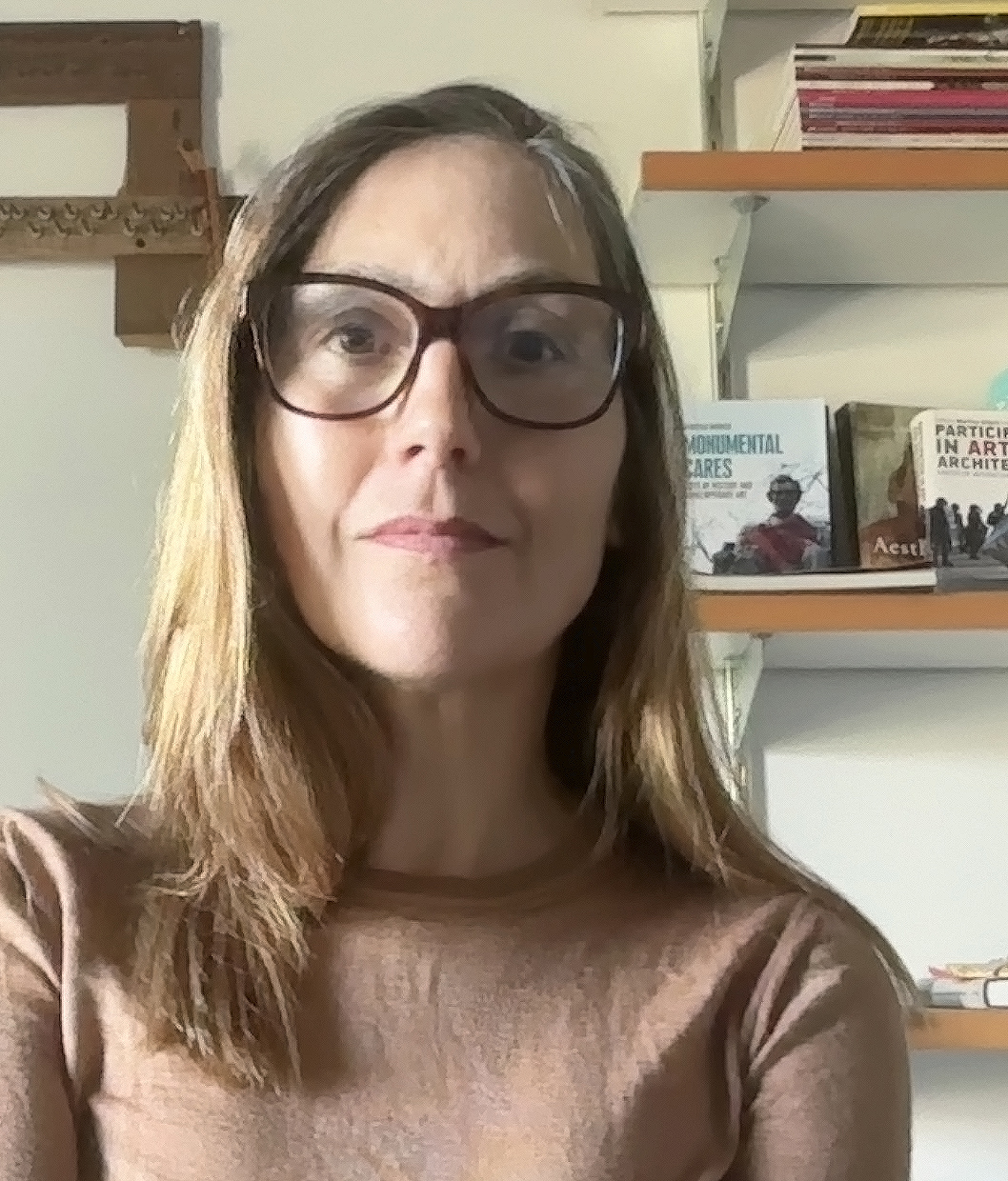
caa.reviews welcomes new EIC Mechtild Widrich!
caa.reviews is pleased to announce its new editor, Mechtild Widrich. Read our recent interview with Mechtild below!
Can you tell our members about your current academic post and research focus?
I am currently department chair of Art History, Theory, and Criticism at the School of the Art Institute of Chicago. My research is broadly concerned with art in public space, from performance to monuments, as well as aesthetic theory. An article I co-wrote with Erika Doss, “Gift Horses,” just came out in Oxford Art Journal. It looks critically at two equestrian statues from the 1920s that happen to stand right in front of my office in downtown Chicago. So, in a sense, my research is literally right outside my window.
You have also served as Art Journal’s reviews editor. What is it about publishing reviews that you find relevant? Where do reviews fit into the larger milieu of scholarly publishing?
In the best cases, reviews are a conversation. They are a way of engaging with current discourse, foregrounding marginalized art histories, amplifying publishers beyond the dominant US presses, and—ideally—maintaining a spirit of discovery and a shared pursuit of knowledge.
Reviews are vital tools in our field because they give new publications a place in the larger conversation and help shape the direction of art historical inquiry. This is especially important because some of these books are expensive, and individual scholars are much less likely to encounter them than libraries are.
Realistically, reviews also matter enormously to authors. They can be important for tenure and promotion, and they can affect a book’s visibility and sales. So they are part of the ecosystem of how academia works. And a review doesn’t have to be an uncritical rave to have that positive effect. A thoughtful, engaged review—even a critical one—can give a book a much longer life.
What motivated you to join caa.reviews, and what do you want to accomplish during your term as Editor-in-Chief?
I have been a fan of caa.reviews for years. The fact that the reviews are accessible everywhere, for free, makes it an immensely important resource. The quality is also very high, and the field editors are real experts who do this labor as a service to the field.
One of my aims is to nurture a diverse and globally representative team of field editors. I also want to think expansively about what belongs within the publication: architecture, design, craft, theory, exhibitions, and other areas alongside art history, and perspectives informed by feminist, queer, postcolonial, and racially diverse approaches.
I am deeply committed to scholarly integrity, ensuring that our rules of conduct are followed. But I am also genuinely curious about what happens when all of this research reaches us through books and reviewers. What can we learn about the state of global research on art by paying close attention to what gets reviewed, who is doing the reviewing, and how those conversations unfold? It would be hard to find a broader vantage point on the field.
How does your research and public scholarship dovetail with your vision for the journal?
I came to academia from curating and the nonprofit art world, so I have always appreciated both the insularity of art communities and subcultures and the value of art reaching a larger audience. A museum- or gallery-goer, a tourist encountering a biennial for the first time, or a student taking a required humanities class can be just as valuable an interlocutor as the senior expert in your field. Their perspectives are different, and their questions are often much more direct.
My work on monuments, on remembering and making history visible, and on performance art that exposes the social structures quietly shaping our existence almost always deals with making things public. Journals do this too. But open access online journals—and reviews that engage with authors and exhibitions in ways that open them up to new audiences—can make that public dimension especially powerful.
And finally, what are you reading and/or viewing these days—both within and outside your research demands?
In terms of exhibitions, the 2026 Venice Biennale, Minor Keys, was, despite the mixed reviews, very interesting. Curator Koyo Kouoh tragically passed away before the show opened, but I think her collaborators worked thoughtfully to fulfill her plan. That seems rare in today’s ego-driven attention economy.
Closer to home, the Museum of Contemporary Art Chicago has a show in their stairwell galleries called From the Center, exploring the many ways the critic, historian, and activist Lucy Lippard has challenged the mainstream art world for more than sixty years. I really love how the curators deal with the themes Lippard brought into the discipline and translate them into an engaging exhibition.
As for recent reading, I have immersed myself in Hannah Arendt’s The Origins of Totalitarianism—a classic, and a very long one. Some passages are extremely problematic, possibly not only from today’s point of view, but it is nevertheless gripping and relevant. A new critical edition is just due out, too.