
CAA News Today
Take the Artists and the Economic Recession Survey
posted by Christopher Howard — August 21, 2009
 The creators of the Artists and the Economic Recession Survey invite artists to share their experiences with the conditions they face in the current economic climate. The online survey, which is live through September 4, 2009, is conducted by Leveraging Investments in Creativity (LINC), a ten-year national initiative to improve conditions for artists, and supervised by Princeton Survey Research Associates International. Completing the survey takes about fifteen minutes, and all responses are anonymous.
LINC has been working with organizations around the country to distribute the survey in order to reach the widest range of artist voices possible, especially those who may not be part of formal organizational networks like CAA. Reaching as many artists as possible improves the quality of this important research and better equips everyone who advocates for artists and the arts.
In addition to completing it yourself, the organizers request that you forward the survey, which is offered in English and Spanish, to your friends and colleagues. LINC has created a simple widget that you can post on your website, newsletter, Facebook page, or blog to let others know about the survey. Each week the image will update automatically to reflect a new statistic from responses to the survey. You won’t have to worry about making changes on your end: the image will remain the same and the text at the top will be updated automatically.
Your participation is completely voluntary. If you have any questions about this survey, please contact techsupport@psra.com.
Jim Leach Is New Chairman of the NEH
posted by Christopher Howard — August 13, 2009
After receiving confirmation from the US Senate last Friday, Jim Leach was sworn in as the ninth chairman of the National Endowment for the Humanities (NEH). A Republican, Leach previously served southeastern Iowa for thirty years in the US House of Representatives, where he chaired the Banking and Financial Services Committee, the Subcommittee on Asian and Pacific Affairs, and the Congressional-Executive Commission on China. He also founded and cochaired the Congressional Humanities Caucus.
After leaving Congress in 2007, Leach was John L. Weinberg Visiting Professor of Public and International Affairs in Princeton University’s Woodrow Wilson School. In September 2007, he took a year’s leave of absence from Princeton to serve as the interim director of the Institute of Politics and a lecturer at the John F. Kennedy School of Government at Harvard University.
In a recent staff “town hall” meeting about a new “bridging cultures” theme for the NEH, Leach said, “In an era where declining civility increasingly hallmarks domestic politics and where anarchy has taken root in many parts of the world, it is imperative that cultural differences at home and abroad be respectfully understood, rather than irrationally denigrated.”
Leach graduated from Princeton, received a master’s degree in Soviet politics from the School of Advanced International Studies at John Hopkins University, and did additional graduate studies at the London School of Economics. He also holds eight honorary degrees and has received numerous awards, including the Sidney R. Yates Award for Distinguished Public Service to the Humanities from the National Humanities Alliance; the Woodrow Wilson Award from Johns Hopkins; the Adlai Stevenson Award from the United Nations Association; the Edgar Wayburn Award from the Sierra Club; the Wayne Morse Integrity in Politics Award; the Norman Borlaug Award for Public Service; and the Wesley Award for Service to Humanity.
Jim Leach Is the New Chairman of the NEH
posted by Christopher Howard — August 13, 2009
After receiving confirmation from the US Senate last Friday, Jim Leach was sworn in as the ninth chairman of the National Endowment for the Humanities (NEH). A Republican, Leach previously served southeastern Iowa for thirty years in the US House of Representatives, where he chaired the Banking and Financial Services Committee, the Subcommittee on Asian and Pacific Affairs, and the Congressional-Executive Commission on China. He also founded and cochaired the Congressional Humanities Caucus.
After leaving Congress in 2007, Leach was John L. Weinberg Visiting Professor of Public and International Affairs in Princeton University’s Woodrow Wilson School. In September 2007, he took a year’s leave of absence from Princeton to serve as the interim director of the Institute of Politics and a lecturer at the John F. Kennedy School of Government at Harvard University.
In a recent staff “town hall” meeting about a new “bridging cultures” theme for the NEH, Leach said, “In an era where declining civility increasingly hallmarks domestic politics and where anarchy has taken root in many parts of the world, it is imperative that cultural differences at home and abroad be respectfully understood, rather than irrationally denigrated.”
Leach graduated from Princeton, received a master’s degree in Soviet politics from the School of Advanced International Studies at John Hopkins University, and did additional graduate studies at the London School of Economics. He also holds eight honorary degrees and has received numerous awards, including the Sidney R. Yates Award for Distinguished Public Service to the Humanities from the National Humanities Alliance; the Woodrow Wilson Award from Johns Hopkins; the Adlai Stevenson Award from the United Nations Association; the Edgar Wayburn Award from the Sierra Club; the Wayne Morse Integrity in Politics Award; the Norman Borlaug Award for Public Service; and the Wesley Award for Service to Humanity.
Summer Obituaries in the Arts
posted by Christopher Howard — August 12, 2009
CAA recognizes the lives and achievements of the following artists, art historians, curators, photographers, architects, and other professionals and important figures in the visual arts.
- H. T. Cadbury-Brown, a British modernist architect, died on July 9, 2009. He was 96
- James Conlon, director of the Visual Media Center at Columbia University, died on July 17, 2009, at the age of 37
- Merce Cunningham, an avant-garde choreographer and dancer, died on July 26, 2009. He was 90
- Michael Dailey, a painter and teacher based in Seattle, died on August 9, 2009, at the age of 71
- Julian Dashper, a New Zealand artist, died on July 30, 2009. He was 49
- Heinz Edelmann, an illustrator and professor who worked on the film Yellow Submarine, died on July 21, 2009, at the age of 75
- Kenneth Garlick, a scholar and keeper of Western art at the Ashmolean Museum, died on July 22, 2009, at age 92
- Charles Gwathmey, an American modernist architect, died on August 3, 2009, at the age of 71
- Earl Haig, a British soldier and painter, died on July 9, 2009. He was 91
- Otto Heino, a Californian potter and educator, died on July 16, 2009, at the age of 94
- Francisco Hidalgo, a Spanish-born French cartoonist and photographer, died on July 25, 2009. He was 80
- Ingeborg Hunzinger, a German sculptor, died on July 19, 2009. She was 94
- Marcey Jacobson, a self-taught photographer who worked in Mexico, died on July 26, 2009, at age 97
- Bill Jay, a photographer, writer, and former editor of Creative Camera, died on May 10, 2009, at age 68
- Amos Kenan, an Israeli writer and artist, died on August 4, 2009, at the age of 82
- Tamara Krikorian, a video artist and public-art curator in Wales, died on July 11, 2009. She was 65
- John Lidzey, an English artist and teacher who was known for his watercolors, died on April 5, 2009, at age 74
- Michael Martin, a New York graffiti artist known as Iz the Wiz, died on June 17, 2009. He was 50
- Cecile McCann, a Californian artist and publisher of Artweek magazine, died on July 2, 2009. She was 91
- Tyeb Mehta, a major painter in postcolonial modern art in India, died on July 1, 2009, at the age of 84
- Leo Mol, a renowned Canadian sculptor, died on July 4, 2009, at the age of 94
- Charles Huntley Nelson, an artist and professor of art at Morehouse College, died on July 30, 2009. He was 39
- Joan O’Mara, a professor of art history at Washington and Lee University, died on May 24, 2009, at the age of 63
- Chris Plowman, a British artist and teacher, died in mid-July 2009. He was 56
- Constantine Raitzky, a former exhibition designer for the Metropolitan Museum of Art, died on June 29, 2009, at age 78
- Julius Shulman, a photographer of modernist architecture, died on July 15, 2009, at the age of 98
- Dash Snow, a New York–based artist, died on July 13, 2009. He was 27
Read all past obituaries in the arts on the CAA website.
Fractional Gifts Legislation Introduced in the Senate
posted by Christopher Howard — August 10, 2009
An untitled bill introduced last week in the US Senate may loosen recent government restrictions on fractional gifts of works of art to museums, reports Shelly Banjo of the Wall Street Journal. Senator Charles Schumer (D-NY), whose state contains many important art museums, patrons, and philanthropists, is sponsoring S 1605, which would reform the rules regulating fractional charitable donations of tangible personal property.
Fractional gifts—which allow Americans to give partial ownership rights of an artwork to a museum or charitable organization and take an income-tax deduction for the donated portion of its value—were common practice in the museum world until 2006, when provisions put into the Pension Protection Act of 2006 by Senator Charles E. Grassley (R-IA) made partial gifts less attractive for donors. (Namely, that work must be fully donated within ten years of the initial fractional gift, and that the value of the artwork is capped when the first gift is made.) Since then, museums noticed that the practice of fractional gifts has nearly disappeared.
Here’s more background information on fractional gifts in the New York Times in 2006 and 2008.
Fractional Gifts Legislation Introduced in the Senate
posted by Christopher Howard — August 10, 2009
An untitled bill introduced last week in the US Senate may loosen recent government restrictions on fractional gifts of works of art to museums, reports Shelly Banjo of the Wall Street Journal. Senator Charles Schumer (D-NY), whose state contains many important art museums, patrons, and philanthropists, is sponsoring S 1605, which would reform the rules regulating fractional charitable donations of tangible personal property.
Fractional gifts—which allow Americans to give partial ownership rights of an artwork to a museum or charitable organization and take an income-tax deduction for the donated portion of its value—were common practice in the museum world until 2006, when provisions put into the Pension Protection Act of 2006 by Senator Charles E. Grassley (R-IA) made partial gifts less attractive for donors. (Namely, that work must be fully donated within ten years of the initial fractional gift, and that the value of the artwork is capped when the first gift is made.) Since then, museums noticed that the practice of fractional gifts has nearly disappeared.
Here’s more background information on fractional gifts in the New York Times in 2006 and 2008.
Rocco Landesman Is New NEA Chairman
posted by Christopher Howard — August 10, 2009
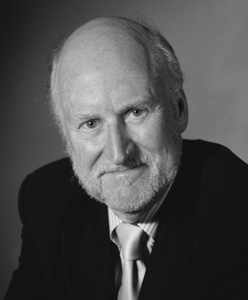 On Friday, August 7, 2009, the US Senate confirmed Rocco Landesman, a Broadway theater producer, as the tenth chairman of the National Endowment for the Arts (NEA). Nominated by President Barack Obama, Landesman succeeds Dana Gioia, who resigned in January 2009. Patrice Walker Powell, the NEA’s deputy chairman for state, regions, and local arts agencies, had served as acting chairman in the interim.
Upon his confirmation Landesman said, “I am honored to receive the Senate’s vote of confirmation. I look forward to serving the nation as Chairman of the National Endowment for the Arts. I believe this is an auspicious time for the NEA and the country. Art is essential to the civic, economic, and cultural vitality of our nation. It reflects who we are and what we stand for—freedom of expression, imagination, and vision. I am eager to work with our many partners to bring quality arts programs to neighborhoods and communities across the country.”
Born and raised in St. Louis, Missouri, Landesman pursued his undergraduate education at Colby College and the University of Wisconsin, Madison, and earned a doctorate in dramatic literature at the Yale School of Drama. At the completion of his course work, he stayed at the school for four years, working as an assistant professor.
His ensuing career has been a hybrid of commercial, philanthropic, and artistic engagements. In 1977, he left Yale to start a private investment fund, which he ran until his appointment in 1987 as president of Jujamcyn, a company that owns and operates five Broadway theaters. Before and after joining Jujamcyn, Landesman produced Broadway shows, the most notable of which are Big River (1985 Tony for best musical), Angels in America, and The Producers (2001 Tony for best musical). In 2005, he bought Jujamcyn and managed it until President Obama announced his intention to nominate him to the NEA chairmanship.
Landesman has also been active on numerous boards, including the Municipal Arts Society; an advocacy organization concerned with New York City’s public spaces and preservation; the Times Square Alliance, which has radically changed the heart of the city by improving its safety, sanitation, and aesthetic; and the Educational Foundation of America. Over the years, he returned to the Yale School of Drama and Yale Rep to teach.
Photo: Michael Eastman.
Rocco Landesman Is New NEA Chairman
posted by Christopher Howard — August 10, 2009
On Friday, August 7, 2009, the US Senate confirmed Rocco Landesman, a Broadway theater producer, as the tenth chairman of the National Endowment for the Arts (NEA). Nominated by President Barack Obama, Landesman succeeds Dana Gioia, who resigned in January 2009. Patrice Walker Powell, the NEA’s deputy chairman for state, regions, and local arts agencies, had served as acting chairman in the interim.
Upon his confirmation Landesman said, “I am honored to receive the Senate’s vote of confirmation. I look forward to serving the nation as Chairman of the National Endowment for the Arts. I believe this is an auspicious time for the NEA and the country. Art is essential to the civic, economic, and cultural vitality of our nation. It reflects who we are and what we stand for—freedom of expression, imagination, and vision. I am eager to work with our many partners to bring quality arts programs to neighborhoods and communities across the country.”
Born and raised in St. Louis, Missouri, Landesman pursued his undergraduate education at Colby College and the University of Wisconsin, Madison, and earned a doctorate in dramatic literature at the Yale School of Drama. At the completion of his course work, he stayed at the school for four years, working as an assistant professor.
His ensuing career has been a hybrid of commercial, philanthropic, and artistic engagements. In 1977, he left Yale to start a private investment fund, which he ran until his appointment in 1987 as president of Jujamcyn, a company that owns and operates five Broadway theaters. Before and after joining Jujamcyn, Landesman produced Broadway shows, the most notable of which are Big River (1985 Tony for best musical), Angels in America, and The Producers (2001 Tony for best musical). In 2005, he bought Jujamcyn and managed it until President Obama announced his intention to nominate him to the NEA chairmanship.
Landesman has also been active on numerous boards, including the Municipal Arts Society; an advocacy organization concerned with New York City’s public spaces and preservation; the Times Square Alliance, which has radically changed the heart of the city by improving its safety, sanitation, and aesthetic; and the Educational Foundation of America. Over the years, he returned to the Yale School of Drama and Yale Rep to teach.
Photo: Michael Eastman.
Exhibitor and Advertiser Prospectus for Chicago Book and Trade Fair
posted by Christopher Howard — August 06, 2009
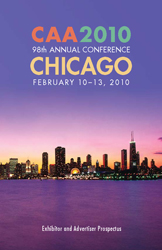 CAA’s next Annual Conference—the foremost international forum for professionals in the visual arts—takes place February 10–13, 2010, in Chicago, Illinois. The Windy City’s dramatic architectural skyline, world-renowned museums and galleries, and ultracosmopolitan Michigan Avenue provide the setting for an exciting gathering of more than four thousand artists, art historians, curators, critics, educators, and students.
An exhibit booth in the Book and Trade Fair can reach this active and distinguished group. The fair, which annually hosts more than one hundred publishers, art-materials manufacturers, and providers of art-related programs and services, will be centrally located within the conference. With three days of exhibit time, the Book and Trade Fair offers high visibility and high floor traffic for exhibitors.
In addition, an advertisement in conference publications—which include the Conference Program, Abstracts, Convocation Booklet, and Directory of Attendees—can also reach a wide audience for your publications, products, and programs.
Full details are available in the Exhibitor and Advertiser Prospectus. For questions about exhibits, please email Paul Skiff, CAA assistant director for Annual Conference, or call him at 212-691-1051, ext. 213. Interested in advertising? Contact Sara Hines, CAA marketing and development assistant, by email or at 212-691-1051, ext. 216.
Louvre Launches English-Language Version of Its Online Collection Database
posted by Christopher Howard — July 30, 2009
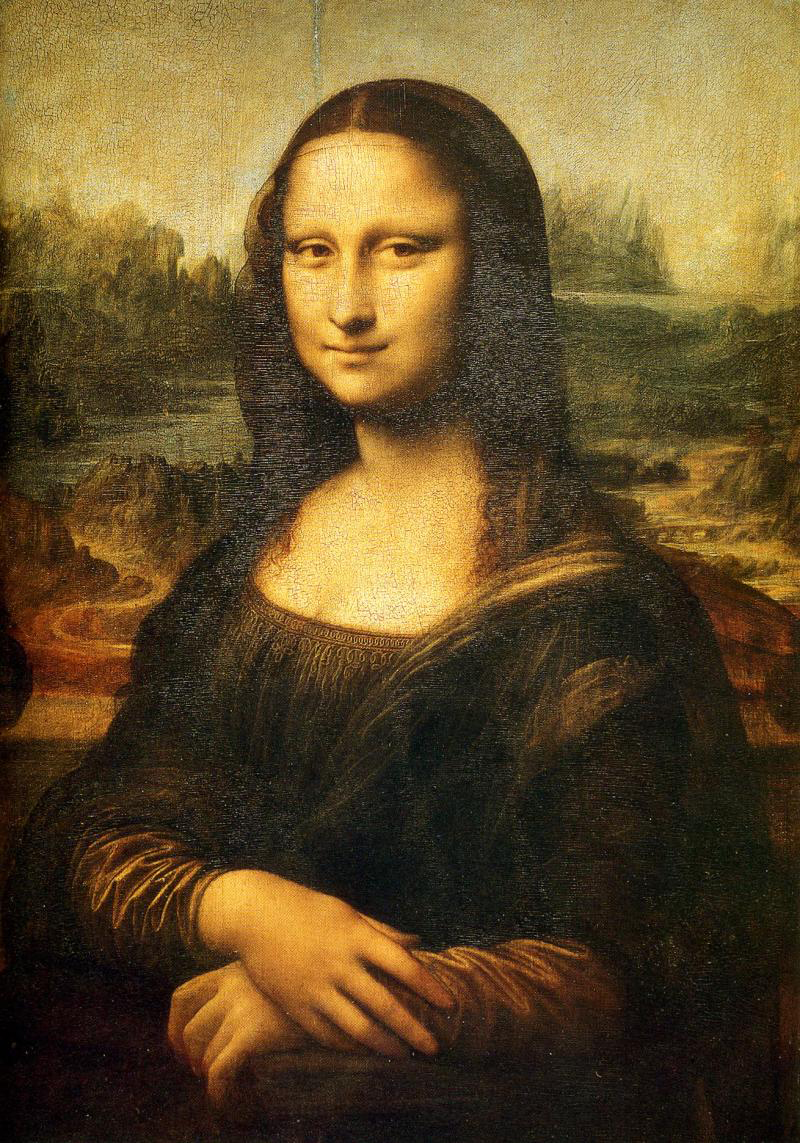 Today the Musée du Louvre in Paris has launched an English-language version of its online collection database, Atlas. This interactive research tool will allow visitors to access information on 22,000 artworks from the Louvre, view high-resolution images of masterpieces, and locate exhibited works and galleries throughout the museum. Previously available only in French, Atlas is accessible free-of-charge.
Users can enter via the main Louvre website, choose English at upper right, and then go to Collections –> Databases and select Atlas.
The launch of the English version of Atlas was initiated by and funded with a €300,000 ($380,000) grant in 2004 from the American Friends of the Louvre, which was founded in 2002 to strengthen ties between the museum and its American public. The new version of the site will provide in-depth information on the Louvre’s extensive collection to the museum’s two million English-speaking visitors as well as to educators, students, researchers, and scholars.
Launched in 2003, Atlas provides quick and easy access to an exceptionally rich database of 26,000 of the 35,000 works on permanent display at the Louvre. Currently, 5,500 artists in a variety of media are represented on the site. In addition to gallery views, Atlas also provides online visitors with a virtual “Album” through which they can gather a selection of artworks and create and navigate their own personalized tour of the Louvre.
The English-language version of Atlas will include entries on 22,000 works of art, or approximately 80 percent of the original Atlas database, showcasing works most representative of the depth and scope of the Louvre’s collection.