CAA News Today
CAA Launches Conference Website and Opens Online Registration
posted by Emmanuel Lemakis — October 08, 2009
 The CAA Annual Conference is the world’s largest international forum for professionals in the visual arts. More than four thousand artists, art historians, curators, educators, and students are expected to meet February 10–13, 2010, at the Hyatt Regency in Chicago.
2010 Annual Conference Website
The conference website, which contains registration information, travel and hotel details, Career Services features, reception and meeting listings, special events, and more, was launched yesterday.
The conference website expands on the 2010 Conference Information and Registration booklet that will arrive in members’ mailboxes later this month; new material and information will be added regularly between now and February.
Listings of session titles and chairs are also available on the conference website. Full session details, including the names of panelists and their paper titles, will be posted soon.
Register Online Now
Online registration opened yesterday. You can also buy tickets for other events, such as the Gala Reception, professional-development workshops, and postconference tours. Alternatively, you may use the printed forms in Conference Information and Registration.
Early registration is available through December 11, 2009:
- Members: $155
- Student and retired members: $90
- Nonmembers: $280
Reserve Your Hotel Room
CAA was able to renegotiate cheaper hotel rates at the Hyatt Regency Chicago, the headquarters hotel, to help save conference attendees even more money. See Travel & Lodging on the conference website for full details.
Women’s Caucus for Art Announces 2010 Lifetime Achievement Awards
posted by Christopher Howard — October 05, 2009
The Women’s Caucus for Art (WCA) has announced the recipients of the 2010 Lifetime Achievement Awards: Tritobia Hayes Benjamin, an educator and art historian from Washington, DC; Mary Jane Jacob, a curator and educator in Chicago; Senga Nengudi, an artist based in Colorado Springs; Joyce J. Scott, a visual and performance artist from Baltimore; and New York’s Spiderwoman Theater, comprising Lisa Mayo, Gloria Miguel, and Muriel Miguel.
These awards were first awarded in 1979 to Isabel Bishop, Selma Burke, Alice Neel, Louise Nevelson, and Georgia O’Keeffe in a ceremony at President Jimmy Carter’s Oval Office. Past honorees have represented the full range of distinguished achievement in the visual arts, and this year’s awardees are no exception, with considerable accomplishment, achievement, and contributions represented by their professional efforts.
Tritobia Hayes Benjamin
Tritobia Hayes Benjamin is professor of art history and director of the Gallery of Art at Howard University in Washington, DC, where she is also associate dean of the Division of Fine Arts in the College of Arts and Sciences. After receiving her bachelor’s and master’s degrees in art history from Howard, she earned a PhD in the same subject from the University of Maryland. On the faculty of Howard since 1970, Benjamin has written and lectured widely on African American art and artists, including the 1994 publication, The Life and Art of Lois Mailou Jones.
Mary Jane Jacob
Mary Jane Jacob is a curator, educator, and author noted for her work on the national and international art scene. She currently serves as professor in the Department of Sculpture and executive of exhibitions at the School of the Art Institute of Chicago. She began her curatorial career at the Detroit Institute of Arts in the late 1970s before becoming chief curator of the Museum of Contemporary Art, Chicago, and the Museum of Contemporary Art, Los Angeles. In the public realm, Jacobs has organized multiyear installations and commissioned outdoor sculptures in urban and park settings. She has also published numerous books and exhibition catalogues on contemporary art.
Senga Nengudi
Senga Nengudi is strongly committed to both creating art and arts education. Currently a lecturer at the University of Colorado in Colorado Springs in the Visual Arts and Performing Arts Department, she has always been involved with bringing arts programs emphasizing diversity to the communities in which she resides. Presently Nengudi’s sculptures are taking the form of installations of increasing size. She has been a featured performance artist, dancer, and installation artists in numerous exhibitions at major museums.
Joyce J. Scott
A native of Baltimore, Joyce J. Scott is a highly internationally regarded artist whose work incorporates various artistic media, including sculpture, jewelry, glass, printmaking, installation, and performance art. Her pieces draw strong influence from a wide range of sources: African and Native American experiences, comic books, television, popular American culture, and the culture of the streets of her urban Baltimore neighborhood. The use of beads is a central element throughout Scott’s work, helping turn her works into bold statements about such issues as racism, sexism, violence, and other forms of social injustice.
Spiderwoman Theater (Lisa Mayo, Gloria Miguel, and Muriel Miguel)
Spiderwoman Theater was founded in 1976 when Muriel Miguel gathered a diverse company of women of varying ages, races, sexual orientations, and worldviews, which included her two sisters. As the oldest women’s theater company in North America and originally emerging from the feminist movement, Spiderwoman continues moving toward its goal of creating an artistic environment where indigenous arts and culture—the three are from the Kuna and Rappahannock nations—thrive as an integrated and vital part of the larger arts community. Taking its name from the Hopi creation goddess Spiderwoman, who taught the people to weave, the theater calls its technique of creating their theatrical pieces “story weaving,” in which performers write and present personal and traditional stories that are layered with movement, text, sound, music, and visual images.
Award Ceremony in Chicago
The Lifetime Achievement Awards will be held at the Chicago Cultural Center, 77 East Randolph Street, on Saturday, February 13, 2010, in conjunction with the WCA and CAA annual conferences (WCA is a CAA affiliated society). A dinner will be held from 6:30 to 7:30 PM in the center’s G.A.R. Hall. The awards ceremony will follow at 7:30 PM in the Cassidy Theater. Tickets for the dinner—$90 before January 1, 2010, and $100 after—will be available for purchase from the WCA website. Reserved seating tickets for the awards ceremony will also be available for $10; limited general-audience seating for the awards ceremony is free and available on a first-come, first-served basis—please arrive early. For more information about WCA, please contact Karin Luner, national administrator.
Special Conference Rates on Airfare and Hotel
posted by Christopher Howard — September 28, 2009
Registration for the 2010 Annual Conference in Chicago opens in early October, but special deals on travel and lodging can be made now.
How to Get There
American Airlines offers a 5 percent discount to conference travelers. Tickets may be purchased through your local travel agent or by booking directly with American Airlines using 2620AC as the promotion code. You can also call 1-800-433-1790. This deal is good for travel between February 5 and 18, 2010; other restrictions apply.
Where to Stay
CAA recently renegotiated conference rates with the Hyatt Regency Chicago, the headquarters hotel, to offer rooms below the initial rate of $169 a night. Regular attendees and students can make their reservations online before October 31, 2009, to receive these special rates:
- Single: $139
- Double: $139
- Student: $120
- Additional person: $25 each
Room rates for regular attendees increase the closer we get to the conference. The student price remains the same, but this room block generally fills up quickly—make your reservation now and pay later. A valid student ID will be required at check-in.
Exhibitor and Advertiser Prospectus for Chicago Book and Trade Fair
posted by Christopher Howard — August 06, 2009
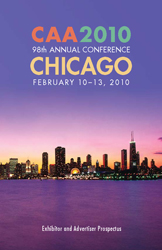 CAA’s next Annual Conference—the foremost international forum for professionals in the visual arts—takes place February 10–13, 2010, in Chicago, Illinois. The Windy City’s dramatic architectural skyline, world-renowned museums and galleries, and ultracosmopolitan Michigan Avenue provide the setting for an exciting gathering of more than four thousand artists, art historians, curators, critics, educators, and students.
An exhibit booth in the Book and Trade Fair can reach this active and distinguished group. The fair, which annually hosts more than one hundred publishers, art-materials manufacturers, and providers of art-related programs and services, will be centrally located within the conference. With three days of exhibit time, the Book and Trade Fair offers high visibility and high floor traffic for exhibitors.
In addition, an advertisement in conference publications—which include the Conference Program, Abstracts, Convocation Booklet, and Directory of Attendees—can also reach a wide audience for your publications, products, and programs.
Full details are available in the Exhibitor and Advertiser Prospectus. For questions about exhibits, please email Paul Skiff, CAA assistant director for Annual Conference, or call him at 212-691-1051, ext. 213. Interested in advertising? Contact Sara Hines, CAA marketing and development assistant, by email or at 212-691-1051, ext. 216.
CAA Offers Travel Grants to Chicago Conference
posted by Lauren Stark — July 24, 2009
Although funds are minimal, CAA will offer a limited number of Annual Conference Travel Grants to graduate students in art history and studio art and to international artists and scholars. Travel grants are funded solely by donations from CAA members—please contribute today. Charitable contributions are 100 percent tax deductible.
Graduate Student Conference Travel Grant
This $150 grant is awarded to a limited number of advanced PhD and MFA graduate students as partial reimbursement of expenses for travel to the 2010 Annual Conference in Chicago. To qualify for the grant, students must be current CAA members. Candidates should include a completed application form, a brief statement by the student stipulating that he or she has no external support for travel to the conference, and a letter of support from the student’s adviser or head of department. For an application and more information, please contact Lauren Stark, CAA manager of programs, at 212-691-1051, ext. 248. Send application materials to: Lauren Stark, Graduate Student Conference Travel Grant, CAA, 275 Seventh Ave., 18th Floor, New York, NY 10001. Deadline: September 25, 2009.
International Member Conference Travel Grant
CAA presents a $500 grant to a limited number of artists or scholars from outside the United States as partial reimbursement of expenses for travel to the 2010 Annual Conference in Chicago. To qualify for the grant, applicants must be current CAA members. Candidates should include a completed application form, a brief statement by the applicant stipulating that he or she has no external support for travel to the conference, and two letters of support. For an application form and additional information, please contact Lauren Stark, CAA manager of programs, at 212-691-1051, ext. 248. Send materials to: Lauren Stark, International Member Conference Travel Grant, CAA, 275 Seventh Ave., 18th Floor, New York, NY 10001. Deadline: September 25, 2009.
Getty Posts Session Audio from 2009 CAA Conference
posted by Emmanuel Lemakis — July 23, 2009
The J. Paul Getty Museum in Los Angeles has posted free audio recordings from eight 2009 Annual Conference sessions that took place at the Getty Center and Getty Villa. The audio can be streamed online or downloaded for playback on a computer or MP3 player. File sizes range from 41 to 142 MB.
Here are the sessions:
- “That Captured Instant of Time: Realism and Drama in Baroque Sculpture,” chaired by Catherine Hess
- “Luxury Devotional Books and Their Female Owners,” chaired by Thomas Kren and Richard Leson
- “What We Talk about When We Talk about Artist’s Books,” chaired by Marcia Reed
- “European Drawings, 1400–1900,” chaired by Lee Hendrix and Stephanie Schrader
- “Networks and Boundaries,” chaired by Thomas Gaehtgens
- “Cabinet Pictures in Seventeenth-Century Europe,” chaired by Andreas Henning
- “The Medieval Manuscript Transformed,” chaired by Kristen Collins and Christine Sciacca
- “The Art and Archaeology of Ancient Greece, Rome, and Etruria,” chaired by Karol Wight
The sessions are among several Highlights of Past Programs, which also include videos of interviews with the artists Jim Dine and Robert Irwin. The Getty’s Museum Symposia section makes available papers from a 2006 symposium, “Looking at the Landscapes: Courbet and Modernism.”
CAA offers audio recordings from many other 2009 conference sessions, as well as from other recent conferences. Please visit CAA’s Conference Audio Recordings for more information.
2009 Member Survey Results
posted by Michael Fahlund — July 16, 2009
As part of information-gathering pursuant to the preparation of CAA’s 2010–2015 Strategic Plan, a 2009 member survey was developed, coordinated, and carried out by a team under the leadership of Elizabeth Knapp, vice president in the Research Division of the marketing firm Leo Burnett Worldwide, to determine member preferences, awareness of CAA publications and programs, and motivations for joining and renewing membership.
In total, 1,451 CAA members responded to the online survey, a response rate of 11 percent (which is within an acceptable range for statistical analysis). The final sample was then weighted to accurately reflect the total CAA membership based on membership type. The results are an enlightening view into CAA members’ views and opinions, revealing important strengths but also giving direction to how the organization can use the next strategic plan to improve its programs and services.
Demographically speaking, CAA members are more likely to be female (70 percent), within the age range of 35–49 (34 percent), Caucasian (87 percent), and in academic settings (73 percent), and to have ten years or more of professional experience (48 percent).
The top three reasons individuals gave for joining CAA and renewing their memberships were for job postings (69 percent), networking (54 percent), and debate in the visual arts (50 percent).
CAA is perceived as most relevant to art historians (78 percent agree). From artist members, enthusiasm for ARTspace at the Annual Conference was one of the higher-ranking areas of interest (61 percent). CAA is viewed as a well-known organization among peers (75 percent agree) and a well-run organization (51 percent agree). Members who responded to the question about CAA’s roles believe the most important are advocacy for artists, art historians, and university art museums (24 percent), a conference provider (21 percent), and a leader of creative and intellectual discourse (17 percent). The most common contact points between members and CAA are through publications and emails. The Art Bulletin has the strongest reputation among members (64 percent). The most used features of the CAA website are membership renewal (76 percent), conference registration (70 percent), and CAA News (60 percent). At least half the members also visit the CAA website regularly. A near majority of members (45 percent) have interest in social networking through CAA.
The CAA Annual Conference is perceived as important for networking (68 percent) and career development (62 percent), an opportunity for intellectual exchange about the visual arts (58 percent), and relevant to professional development (53 percent). At the conference, members mostly likely attend sessions (76 percent), the Book and Trade Fair (65 percent), and, as noted above, ARTspace (61 percent). The most popular conference topics are criticism and theory (33 percent) and contemporary art history (31 percent).
The most popular publication topics for the future are curriculum development for teaching studio and art-history courses; legal and copyright issues in publishing; career-development strategies; and standards and guidelines in the visual arts in academia. Members agree that digital publications are valuable because they can be searched online (76 percent), are environmentally friendly (71 percent), can expand readership and distribution (59 percent), and can include dynamic content (56 percent). Members are undecided on the future of digital publications, but 49 percent of respondents do not favor online, non–peer reviewed publications.
CAA continues to advocate on issues of importance to members and to the visual arts. Among these, members feel that full-time vs. adjunct status is most important (50 percent), followed by intellectual-property issues (38 percent) and salary equity (39 percent).
In efforts to increase its visibility and recognition for the programs and services it provides, CAA is eager to know how members react to or view its name. While some members felt that the name “College Art Association” or “CAA” is not descriptive of what the organization does, or that it does not fit the mission, 65 percent believe that the name is understood in the field of visual arts. Name recognition and identity will be assessed as part of CAA’s communications activities in the strategic plan.
Other directions gathered from this survey that will be addressed in the strategic plan are to: 1) increase programming and publications for artists; 2) attract more young professionals; 3) increase the diversity of members; 4) increase career-development sessions at the conference; 5) increase interactive communications; 6) develop practical peer-reviewed publications; and 7) continue working on advocacy issues, particularly related to adjunct faculty.
CAA thanks its members for participating in this recent survey. Comments and responses have been extremely helpful and are being used to guide changes and improvements in the organization’s services.
CAA Receives a Second NEA Grant
posted by Christopher Howard — July 09, 2009
In addition to yesterday’s grant announcement, CAA is proud to report a second grant received from the National Endowment for the Arts (NEA). As part of the Access to Artistic Excellence program, the NEA awarded $20,000 to CAA in May 2009 to support ARTspace at the 2010 Annual Conference in Chicago. Designed to engage artist members, ARTspace sessions are offered free of charge and include live interviews with prominent artists; film, video, and multimedia screenings; performances; and presentations.
The NEA website has posted a list of all recipients of the Access to Artistic Excellence grant in the category of visual arts.
Submit a Session Proposal for the 2011 Annual Conference
posted by Emmanuel Lemakis — July 01, 2009
Individual CAA members may submit a session proposal for the centennial Annual Conference, taking place February 9–12, 2011, in New York. Proposals should cover the breadth of current thought and research in art, art and architectural history, theory and criticism, pedagogical issues, museum and curatorial practice, conservation, and developments in technology.
The Annual Conference Committee welcomes session proposals that include the work of established artists and scholars, along with that of younger scholars, emerging and midcareer artists, and graduate students. Particularly welcome are those sessions that highlight interdisciplinary work. Artists are especially encouraged to propose sessions appropriate to dialogue and information exchange relevant to artists.
Session proposals are only accepted online; paper forms and postal mailings are not required. To set up an account, please email Lauren Stark, CAA manager of programs, who will register your email address and provide you with a password. For full details on the submission process, please visit Chair a Conference Session. Deadline: September 1, 2009; no late applications are accepted.
CAA Receives Terra Grant for Distinguished Scholar Sessions
posted by Christopher Howard — June 29, 2009
CAA has been awarded a $42,800 grant from the Terra Foundation for American Art to support the Distinguished Scholar Sessions at the 2010 and 2014 Annual Conferences, both of which will take place in Chicago, Illinois. The purpose of the sessions is to celebrate the contributions of distinguished scholars and curators of art through panels that will bring together an honoree and five participants.
The first Distinguished Scholar Session, which took place at the 2001 conference—also held in Chicago—honored James S. Ackerman. Other illustrious past honorees include Svetlana Alpers (2009) Robert L. Herbert (2008), Linda Nochlin (2007), John Szarkowski (2006), Richard Brilliant (2005), James Cahill (2004), Phyllis Pray Bober (2003), and Leo Steinberg (2002).
The Terra Foundation for American Art, based in Chicago, Illinois, is dedicated to promoting the exploration, understanding, and enjoyment of the visual arts of the United States. With financial resources of more than $200 million and an exceptional collection of American art from the Colonial era to 1945, it is one of the world’s leading foundations focused on American art and devotes approximately $9 million annually in support of American-art exhibitions, projects, and research.