CAA News Today
A Letter from Buenos Aires
posted Sep 09, 2015
Fernando Martínez Nespral is a professor in the School of Architecture, Design, and Urbanism at the University of Buenos Aires in Argentina and a participant in the 2014 CAA-Getty International Program.
This past July, there was a thought-provoking exhibition on view in Buenos Aires at the Museo de Arquitectura y Diseño (Museum of Architecture and Design), known as MARQ. Titled Secciones, this collection of drawings by Santiago Nicolás Lovecchio added a lively local commentary to the form versus function debate in architecture.
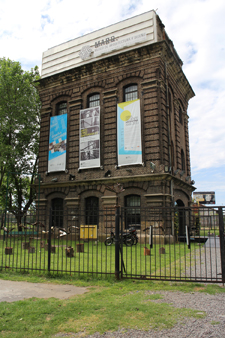 MARQ was founded by the Central Society of Architects to explore the architecture of Argentina, from its history and heritage to contemporary issues and projects. It is the first museum in the country dedicated specifically to architecture, and its activities have continued to grow since it opened fifteen years ago. The museum is situated in an old railway building on the Avenida del Libertador, sharing the Buenos Aires Museum Mile with the Museo Nacional de Bellas Artes (National Museum of Fine Arts), Museo Nacional de Arte Decorativo (National Museum of Decorative Arts), Museo de Arte Hispanoamericano (Museum of Spanish American Art), and Museo de Arte Latinoamericano (Museum of Latin American Art), among others.
Lovecchio’s exhibition presented a series of digitally enhanced pencil and ink sectional drawings of detailed plans for imaginary buildings. Each one juxtaposes clear references to landmarks of architectural history with the typical shapes and traditional forms of domestic architecture in Buenos Aires.
This local perspective on history makes sense when we consider the biography of its author. Lovecchio is a young Argentine who combines his work as a practicing architect with his teaching of architectural history. In this exhibition, he courageously addressed a subject that is at the center of academic discussions about architecture in Argentina today. I am referring to the Dwelling Theory, which favors the analysis of architecture as a setting for the activities of those who live in the buildings, rather than the study of forms.
Thus, in Ninfeo, Lovecchio includes straightforward references to Italian grottos. Similarly, in Casa para dos caballos/caballeros (House for Two Horses/Knights) and especially Casa para dos señoritas bienudas (House for Two Distinguished Ladies), he includes elements reminiscent of the interior spaces in Sir John Soane’s Museum in London. Particularly in the latter two cases, references to the architecture, customs, and lifestyles of Argentina’s upper classes in the early twentieth century come to light with remarkable vividness. They harken back to the Anchorena Palace (now the Ministry of Foreign Affairs) and the Errázuriz Palace (now the National Museum of Decorative Arts), both examples of upper-class residences in Buenos Aires.
 The academic, monumental architecture that characterizes the heritage of Buenos Aires, as seen in the abovementioned drawings, is also evident in Invernadero (Greenhouse) and the fabulous Casa cúpulas (House of Domes). But the most attractive element in these imaginary architectural studies is the critical irony that seeps lucidly through Lovecchio’s drawings. Different eras, designs, and ways of living are superimposed and reveal new perspectives and interpretations of the past and present.
The work El porteño burguesón (The Buenos Aires Bourgeoisie) starkly displays—as only sectional drawings do—the intimacies of the typical apartments and apartment dwellers of Buenos Aires’s middle class, and it combines these traditional, conservative forms with an oneiric artificial cloud of glass polygons that recall complex underground mechanisms and outdated boilers from the Industrial Revolution.
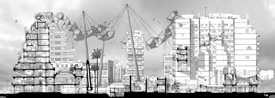 But in my opinion, La manzana porteña (Buenos Aires City Block) is where the architecture of Buenos Aires is most starkly illuminated. The drawing shows the miseries of real-estate speculation and its promise of Patios de aire y luz (Courtyards for Air and Light), as we say here—that do not provide either—along with the chaos of cables, air conditioners, and tiny windows that coexist with modest traditional houses from a previous era that are still part of our time.
The title of the exhibition, Secciones, alludes to the structural cross sections depicted in the drawings, but in Spanish, sectional drawings are called cortes (cuts, or slices). So the choice of the word secciones undoubtedly refers to the idea that Lovecchio’s sections show more than just buildings. His drawings explore nuances, complexities, and contrasts that exceed traditional interpretations of architecture.
In sum, Lovecchio’s works bring a bold, young, and specifically Argentine point of view to the ever-present idea of the “complexity and contradiction of contemporary architecture” that Robert Venturi wisely warned us about almost half a century ago.
For more information, see the MARQ website or Facebook page. To enjoy these drawings online, see santiagonlove.tumblr.com or the recent article published on Plataforma Arquitectura (text in Spanish).
Between Democracies 1989–2014: Remembering, Narrating, and Reimagining the Past in Eastern and Central Europe and South Africa
posted Sep 09, 2015
Judy Peter is head of the Department of Jewellery Design and Manufacture at the University of Johannesburg in South Africa and a 2012 participant in the CAA-Getty International Program.
In 2012, I was one of twenty international art historians from developing countries who received a travel grant funded by the Getty Foundation to attend the CAA Annual Conference in Los Angeles. One of the objectives of the CAA-Getty International Program is to encourage and strengthen conversations between developing countries about the commonality, diversity, and parallel histories in the discursive field of visual culture. To this end, Cristian Nae, a participant from Romania, and I conceptualized the research project “Between Democracies 1989–2014: Remembering, Narrating, and Reimagining the Past in Eastern and Central Europe and Southern Africa” (EESA). This transnational collaboration brings together scholars and artists from Eastern and Central Europe and South Africa, and draws from their cultural and disciplinary diversities and cohesions to contribute to the generation of knowledge.
Over the past three years, the EESA project has expanded to include conveners, curators, and institutions. Ljiljana Kolesnik from the Institute of Art History in Zagreb, Croatia, collaborated on the project until May 2015; Karen von Veh, a 2013 CAA-Getty program alumnus from the University of Johannesburg in South Africa, was included as a convener and curator for the project in 2013; and Richard Gregor, a 2013 CAA-Getty program participant from the Dom umenia/Kunsthalle Bratislava in the Slovak Republic, joined the project as a curator in 2013.
Framework
In 1994, new ideological and political shifts in South Africa were entrenched by a neoliberal democracy. Postapartheid South Africa was initially marked by nation-building strategies such as the Truth and Reconciliation Commission, idealistic notions of the Rainbow Nation, and the African Renaissance, all of which functioned as vehicles to grapple with the social constructions of identities in a new South Africa. These strategies reflected a rationalization of the postcolonial recovery with a sense of self and place, and they were premised on the assumptions of interchange, mixing, inter/transculturations, hybridity, and creolization. The realities of postcolonial negotiations eroded this naïve enthusiasm, however, and South African art is still located in unresolved identities and remains in search of a recovery of self. Many artists also continue their artistic practices of the “struggle years” by employing forms of activism or social commentary to highlight the ongoing inequalities that have not been erased with the removal of the old regime.
Regarding Eastern and Central Europe, Nae states: “East and Central Europe also emerged from a totalitarian regime twenty-five years ago with the demise of socialism. The collapse of the Berlin Wall prompted a reimagining of the formerly divided Europe on the grounds of different political imagined realities, economies, and bio-political regimes. Artists and curators revisited the logic of modernity and explored its unrealized possibilities, while at the same time questioning contested territorial marks and processes of un-belonging. In relation to temporality, issues of identity and reconstruction of the private and the collective selves became central themes in the recently unmarked and de-territorialised territorialized places of the ‘former East’. Thus, the question of coping with the socialist past and its heritage has been an important political issue in much of the art after 1989, overlapping issues of gender, ethnicity, class, and national belonging.”[1]
The EESA project consists of exhibitions, conferences, roundtable discussions, and peer-reviewed publications. Participants have presented, published, and curated texts and artworks, raising questions about how, why, and when the theoretical and artistic practices of these nations respond to the constructs of place and political disruption, memory and commemoration, transforming ideologies, and new contexts of acculturation. The project has considered to what extent an existing critical methodology, informed by postcolonial theory, psychoanalysis, and post-Marxist theory, contributes to understanding these discursive constructions. It also questions whether new interpretive principles should be envisioned in order to deal with a comparative perspective, with the internal disparities inhabiting these imaginary geographies.
At the 2016 CAA Annual Conference in Washington DC, Nae, von Veh, Gregor, and I will lead a roundtable discussion on these issues with the new group of CAA-Getty International Program participants. It will take place in advance of the EESA group’s second annual conference in September 2016 in Bratislava. Not only has this collaborative project enlarged our understanding of regional comparisons in a postcolonial world, but we hope it will provide a model for future cross-cultural projects among CAA members.
[1] Cristian Nae, email message to author, 2013.
You never know where opportunities will lead you…
posted Sep 09, 2015
Karen von Veh is associate professor of art history at the University of Johannesburg in South Africa and participant in the 2013 CAA-Getty International Program.
In 2013 I was one of the lucky recipients of a Getty travel grant to attend the CAA Annual Conference in New York. The first time I met the other grantees was when we had to give a short presentation about our research interests and show examples of the work we were studying. Ding Ning from Peking University was one of our group. Shortly after we returned to our home countries, he contacted me to ask about the possibility of showcasing the art of South Africa as an invited “special exhibition” for the Beijing Biennale in September 2015. Each year the biennale invites selected countries to produce what they call “special exhibitions” and to date they have never had exhibitions from anywhere in Africa. An exhibition of South African art would therefore be a “first” for them and a huge opportunity for us in South Africa—not only to showcase the excellence of our art production but also to align with the drive for cooperation between the BRICS nations (Brazil, Russia, India, China, and South Africa) and the various cultural and economic exchange programs that are currently underway.
Special exhibitions at the Beijing Biennale are expected to be showcases of the invited country’s cultural (fine art) production, and we decided to use this exhibition to reflect on the perceived state of our fledgling democracy. After the long struggle to introduce a democratic system and freedom for all in South Africa, one might imagine that an exhibition reflecting the current state of our democratic society might be a very cheerful and upbeat affair. However, twenty-one years after apartheid, we are still seeing the aftereffects of institutionalized inequalities, and the pace of change is not necessarily fulfilling citizen’s expectations. Annie E. Coombes’s book, History after Apartheid: Visual Culture and Public Memory in a Democratic South Africa (Durham, NC: Duke University Press, 2003), argues that cultural manifestations both reflect and affect this change in social structures and relationships. Transition is a difficult state to occupy; often beliefs or behavioral practices are so normalized that change is virtually impossible without a catalyst to shake us out of complacency and awaken us to the possibilities of alternative practices and thoughts. I believe that intellectually engaged, socially conscious art is just such a catalyst.
Bearing this in mind, my cocurators and I have chosen works by a cross section of high profile established artists—those who have been part of the struggle toward democracy and who have seen and reacted to both the good and the bad changes brought about by the new dispensation (William Kentridge, Diane Victor and David Koloane would be examples of this category). These artists have established careers and are well known at home and internationally. In addition, we made a careful selection of young emerging contemporary artists who we believe are embarking on successful careers and who have something pertinent to say about the condition of our society for the future of the youth. All the artists selected acknowledge the role of contemporary art in South Africa as a catalyst for change and raise social and political issues. Their work comments on the real impact of twenty-one years of democracy—a democracy that has allowed them the artistic freedom to comment incisively on some of the continuing challenges arising from inherited and ongoing inequality in society. The chosen examples also illustrate South Africa’s achievements in various traditional media (drawing, painting, printmaking, sculpture) and, in addition, we have included some examples of digital media and/or mixed-media works.
As I write this, we are packing up the works for transport to China and preparing to travel there ourselves in mid-September to set up the exhibition. Thinking back to the initial invitation to visit New York in 2013, I had no conception at the time of where this opportunity might lead in the future, and what fruitful projects might come from the contacts made on this occasion.
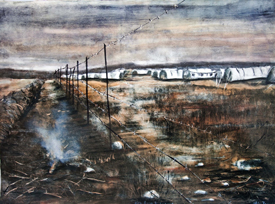
Kim Berman’s monotype is a reminder of the 2009 xenophobic attacks in South Africa. She records the tented camps put up by local authorities and aid organizations to house dispossessed foreigners, who were victims of violence and intimidation. A barbed-wire fence running through the center of the image is reminiscent of records from the Anglo Boer War concentration camps of the early 1900s. Berman is perhaps suggesting that little has changed in terms of difference, intolerance, and unequal power relations.
Image: Kim Berman, Rifle Range I, Roodepoort, 2009, monotype, 78 x 108 cm (artwork © Kim Berman)
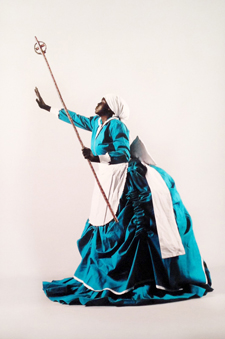
Mary Sibande performs her alter ego, Sophie, clad in Victorian attire. The color of her dress refers to the Zionist Christian Church (ZCC) uniform, and she is wielding a Zionist prayer stick. Sibande refers to the conflation of Christianity and traditions of ancestral worship that exist within the ZCC. This cultural overlap illustrates her search for identity as a young black woman living in the Westernized culture of contemporary South Africa. Her Sophie persona thus explores postcolonial South African identity and critiques stereotypical depictions of women, especially black women, in society.
Image: Mary Sibande, I put a spell on me, 2009, digital pigment print, 90 x 60 cm (artwork © Mary Sibande)
CAA as a Global Site for International Collaboration
posted Sep 09, 2015
Parul Dave Mukherji is a professor in the School of Arts and Aesthetics at Jawajarlal Nehru University in New Delhi, India. In 2013 she was a participant in the CAA-Getty International Program.
When I attended the College Art Association’s 101st Annual Conference in New York as a participant in the 2013 CAA-Getty International Program, little did I realize the long-term benefits of interacting with scholars from different parts of the world. While learning about different art-history teaching and research methodologies in areas as far flung from my native India as South Africa, Eastern Europe, Turkey, and China, among others, it was meeting art historians from neighboring countries such as Pakistan, Sri Lanka, and Bangladesh that laid the groundwork for future collaboration and the possibility of rethinking South Asian art history in both global and regional terms. It is indeed ironic that I “discovered” art historians from these South Asian nations in New York.
When Stephen Ross and Allana Lindgren invited me to contribute a chapter about South Asian visual arts to their edited volume, The Modernist World (New York: Routledge, 2015), I was reluctant to represent the art histories of Pakistan, Bangladesh, and Sri Lanka and wanted to invite art historians from these regions to write about their own art histories. The CAA-Getty Program played a key role by offering a global platform for art historians from diverse regions to meet and exchange notes about their research and pedagogical practices. Meeting a fellow participant, a young art historian from Bangladesh, AKM Khademul Haque, helped me develop a fuller account of South Asian modernism and paved the way for future collaborations. Haque, Simone Wille, and T. Sanathanan, and I coauthored the chapter “Visual Arts in South Asia” in The Modernist World.
‘Massacre of the Innocents’
posted Sep 09, 2015
Musarrat Hasan is an advisor to the Institute of Art and Design and professor of art history at Lahore College Women’s University in Lahore, Pakistan. She was a 2013 participant in the CAA-Getty International Program.
In Pakistan, the Taliban and many other militant groups have carried out terrorist activities for the last several years, killing thousands of people through suicide bombings and other horrific attacks. Their aggression has now been greatly curtailed through the joint efforts of the military and the citizens of Pakistan. However, on December 16, 2014, seven gunmen affiliated with the Taliban conducted a terrorist attack on the Army Public School in the northwestern Pakistani city of Peshawar. They entered the school and fired on school staff, teachers, and children, killing 145 people, including 132 schoolchildren between eight and eighteen years of age.
Worldwide protest and expressions of horror at this outrage followed immediately. The artists of Pakistan, like their fellow citizens, were greatly shaken by the brutal event. Through their national organization, the Artists’ Association, they decided to make their outrage public. During a meeting of the organization’s executive committee, under the leadership of Mian Ijaz ul Hassan, the group condemned the Peshawar attack and voted to devote the upcoming annual exhibition to artistic responses to this violence. The organization sent out a notice to members and all other artists in universities, cultural bodies, and international members, announcing that the annual show would be postponed by about three weeks so that all members and other artists could participate. The title for the exhibition would be ‘Massacre of the Innocents’ and it would be about the suffering of innocents all over the world.
Although Pakistani artists have previously responded to national and international events of tragic and human significance, I do not recall a collective public response to current events by artists carried out with such immediacy. There have been instances of commissioned murals years after the event, but this sort of action was unprecedented.
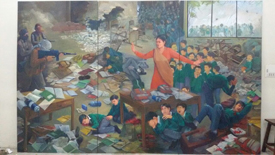 At the Lahore College Women’s University, the faculty members were also motivated to participate and decided to collectively produce the mural that is illustrated here. They pooled funds to buy oil paints, panels of stretched canvas, and other materials required for the mural. I was honored to supervise the creation of this work from conception to completion. We decided not to dwell on the gruesome murders but instead to celebrate the bravery and sacrifice of the headmistress who faced the Taliban with courage and gained time for hundreds of students to escape, even though she herself was killed in the process.
The final mural is 8 x 13 feet and demonstrates the painting skills and commitment of fourteen young faculty members who worked on weekdays and late into the night, putting their hearts and souls into the timely completion. The faculty members of the Lahore College Women’s University who worked on this project were Rifaat Dar, Aasma Majeed, Amber Muneer, Aqsa Rehan, Sadia Murtaza, Samina Naseem, Farah Khan, Ghazala Anjum Shirazi, Nighat Mahboob, Rehana Salman, Rabia Yaseen, and Maryam Baber.
The exhibition at Lahore was a great success. It stirred the community and also inspired many other artists to participate in a subsequent exhibition held at the National Art Gallery in Islamabad. The Shakir Ali Museum in Lahore collaborated with the Artists’ Association in this endeavor. The exhibition is scheduled to travel to other major cities such as Peshawar and Karachi later this year.
News from the Art and Academic Worlds
posted Sep 09, 2015
Each week CAA News publishes summaries of eight articles, published around the web, that CAA members may find interesting and useful in their professional and creative lives.
The Great Debate: Why Galleries Could Take Even More Money from Their Artists
The cultural researcher and Larry’s List cofounder Magnus Resch concluded, based on a survey of eight thousand art galleries in the US, UK, and Germany, that running an art gallery is tough, with more than half turning over less than $200,000 a year and 30 percent running in the red. It’s his solutions—many of them classic business techniques—that have whipped up the debate. None more so than the suggestion that most artists should be paid only 30 percent of sales, not the traditional 50/50 split. (Read more from the Art Newspaper.)
Fixing Grad School
Talk about graduate school being broken is beginning to sound like a broken record. Yes, it’s too focused on preparing students to become the tenure-track professors that populate academe’s endangered-species list. Yes, the better part of a decade is probably too long to spend as an apprentice, forgoing a living wage and likely accruing debt. And yes, too many people never finish. So now what? (Read more from Inside Higher Ed.)
Clearing Up Ambiguity
So what is it about ambiguity that it has to be praised to high heaven by all and sundry? Above all, how did it come to take on, at least for some, a cloak of liberal righteousness, to shift from being an aesthetic to a moral virtue, as if the text that wasn’t clear, that didn’t state its preferences clearly, were ethically superior to the text that does. In every other sphere of expression, ambiguity is a flaw. (Read more from the New York Review of Books.)
Part of Your World: On the Arts and Well-Being
What’s the most important issue in the arts? Is it declining audiences? The fact that it’s so hard to make a living as an artist? Changing demographics and cultural equity? Unsustainable business models? New technologies? Government funding? Arts education? Gentrification? Creative place-making? Spend any time reading up on arts policy and philanthropy or attending conferences in the arts and you’ll see plenty of attention devoted to all of these topics and more. (Read more from Createquity.)
Inquiry: Art History for All
That an art history–trained graduate has highly desirable and eminently transferable skills across a range of art and nonart professions ought to be good news for art history going forward, especially as there is evidence that the areas of the UK economy related to culture are growing faster than others, and outperforming the economy as a whole. (Read more from Apollo.)
The ABC of Art Criticism: Some Recent How Tos
It has often been said that writing about art is like dancing about architecture. Nearly as often, it has also been said: But I’m going to do it anyway. Whether or not the dance analogy captures all the futilities and elations of the endeavor, writing about art, experience proves, is an activity unlikely to abate. Indeed, as art’s institutional and popular reach has grown ever more expansive in the early twenty-first century, the proliferation of adjunct written discourses has perhaps never been greater. (Read more from Hyperallergic.)
The Meaning of “Inclusiveness” in a Job Ad
Lots of job ads for faculty positions include a sentence along these lines: “Inclusiveness and diversity are academic imperatives and thus are university goals, and your letter should articulate how you will cultivate diversity on our campus.” Does that mean the search is only open to minority candidates? (Read more from Vitae.)
How to Be an Adjunct (and Also a Cliché)
Understand that behind the hierarchical sense of superiority there is a cowering insecurity among the tenured who are beginning to see themselves as the minority they are. Hear them throw around the phrases “student-centered learning” and “student concerns.” Figure out “student-centered learning” is a euphemism for “good customer service,” and “student concerns” means “faculty gossip.” Realize all this language increasingly dehumanizes adjuncts and students. (Read more from the Chronicle of Higher Education.)
CAA’s Fair Use Code Receives a Key Endorsement
posted Sep 04, 2015
On September 3, the Visual Resources Association announced its endorsement of CAA’s Code of Best Practices in Fair Use for the Visual Arts, bringing to seven the number of leading associations to support this work. (https://www.collegeart.org/news/2015/07/13/caas-fair-use-code-receives-important-new-endorsements/) In its expression of support, VRA stated: “The Visual Resources Association (VRA) heartily endorses the College Art Association’s Code of Best Practices in Fair Use for the Visual Arts. This code attempts to find consensus across varied constituencies working in the field of visual arts, offering useful models for bridging the divide between those who produce works of art, those who study works of art in academic settings, and those who preserve and provide access to the work produced by the first two groups…. To visual resource and allied image professionals, a key strength of the CAA Code lies in its codification of the historically scrupulous nature of our community of practitioners. In its recommendation that practitioners continue to follow accepted professional standards for metadata, privacy and confidentiality, and the consistent use of terms and conditions, the CAA Code provides a resolute assertion on behalf of our community of practice that courts may refer to when considering fair use parameters.”
Founded in 1982, the Visual Resources Association is a multi-disciplinary organization dedicated to furthering research and education in the field of image and media management within the educational, cultural heritage, and commercial environments. The Association is committed to providing leadership in the visual resources field, developing and advocating standards, and offering educational tools and opportunities for the benefit of the community at large. VRA implements these goals through publication programs and educational activities. For more information about the association, see http://vraweb.org/.
CAA welcomes other endorsements, and encourages organizations in the field to recommend the Code to members. CAA representatives are happy to address questions and to make educational presentations. To make arrangements for a presentation, whether by webinar, conference call, or in person, please contact me at jlanday@collegeart.org. The Code and supporting materials are available at www.collegeart.org/fair-use.
The creation of CAA’s Code of Best Practices in Fair Use for the Visual Arts was funded by the Andrew W. Mellon Foundation, with additional support provided by the Samuel H. Kress Foundation.
News from the Art and Academic Worlds
posted Sep 02, 2015
Each week CAA News publishes summaries of eight articles, published around the web, that CAA members may find interesting and useful in their professional and creative lives.
Director at Uzbekistan Museum Is Dismissed and Accused of Crimes
A significant trove of modern Russian art, preserved not least by its obscure location, was engulfed in controversy last week after its longstanding director was summarily dismissed on accusations of forgery and theft. Marinika M. Babanazarova, director of the Savitsky Collection in Nukus, Karakalpakstan, said she learned that she was being forced out after running the museum since 1984. (Read more at the New York Times.)
Tips for New Teaching Assistants
This time each year, at universities like mine, hundreds of new teaching assistants prepare to teach undergraduates for the first time. Here are three principles that underscored my presentation to the graduate students this year, in hopes that they will be helpful to new teachers elsewhere. (Read more at Inside Higher Ed.)
Will Artist Royalty Rights Go Global?
A delegation of art world, copyright, and government experts from eight countries, plus European Union representatives, have called for an international review of royalty rights for artists following a conference at the World Intellectual Property Organization in Geneva. The issue was officially added to the organization’s agenda on July 3, and the topic is due to be debated in December. (Read more at the Art Newspaper.)
How Standup Comedy Became the New Performance Art
Why is the art world suddenly taking comedy so seriously? Artist and “concrete comedian” Sean Patrick Carney, who has led seminars on and written about the intersection of art and comedy, identifies art’s recent comedic turn with a renewed sense of political urgency: “People are frustrated and pissed off, justifiably so, about multiple social issues around race, economics, misogyny—you name it.” (Read more at Artspace Magazine.)
Will the Candidate Stay?
I am from a large city in the Northeast and received two on-campus interviews at small, teaching-centered public institutions in the Midwest and the West. Both jobs ultimately went to candidates who were from the area where the schools were located—they received their PhDs from a university in the area and/or adjuncted at a school in the region. What can candidates do to overcome a hiring committee’s concerns over whether they will stay in a position once hired? (Read more at Vitae.)
We Took a Tour of the Abandoned College Campuses of Second Life
Once upon a time, in the year 2007, people were really excited about Second Life. Businessweek ran a cover story with the headline “Virtual World, Real Money.” Brands opened stores in Second Life malls. Many universities set up their own private islands to engage students; some even held classes there. Most of these virtual universities are gone—it costs almost $300 per month to host your own island—but it turns out a handful remain as ghost towns. (Read more at Fusion.)
See Me, Feel Me, Touch Me: Museums Need Tech Entrepreneurs
According to the NEA, overall museum attendance fell from 2002 to 2012. More alarming still, museumgoers 75 and older were the only demographic to increase over that same period. Clearly, the museum world has a millennial challenge—namely, how can the world’s great institutions engage a twenty-first century, screen-addicted generation? How do you integrate new technology into something as classic and physical as the museum-going experience? (Read more at Entrepreneur.)
Developing Adjuncts
Non-tenure-track faculty members are the majority of the teaching force, so how are colleges and universities helping them to develop as teachers? As for many issues related to adjuncts, there’s a significant data gap on the topic, in part because adjuncts are diverse and decentralized, making them hard to study. But a new survey seeks to close the gap, and early responses provide insight into how colleges and universities’ teaching and learning centers are supporting their part-time faculty members—or not. (Read more at Inside Higher Ed.)
Exhibitor and Advertiser Prospectus for the 2016 Annual Conference
posted Aug 27, 2015
 The Exhibitor and Advertiser Prospectus for the 2016 Annual Conference in Washington, DC, is now available for download. Featuring essential details for participation in the Book and Trade Fair, the booklet also contains options for sponsorship opportunities and advertisements in the Conference Program and on the conference website.
The Exhibitor and Advertiser Prospectus will help you reach a core audience of artists, art historians, educators, students, and administrators, who will converge in our nation’s capital for CAA’s 104th Annual Conference, taking place February 3–6, 2016. With three days of exhibit time, the Book and Trade Fair will be centrally located in the Washington Marriott Wardman Park Hotel. CAA offers several options for booths and tables that can help you to connect with conference attendees in person. The priority deadline for Book and Trade Fair applications is Friday, October 30, 2015; the final deadline for all applications and full payments is Monday, December 7, 2015.
In addition, sponsorship packages will allow you to maintain a high profile throughout the conference. Companies, organizations, and publishers may choose one of four visibility packages, sponsor specific areas, events, and objects (such as the Student and Emerging Professionals Lounge and hotel room keys), or work with CAA staff to design a custom package. Advertising possibilities include the Conference Program, distributed to over four thousand registrants and press contacts in the conference tote bag, and the conference website, seen by tens of thousands more. The deadline for sponsorships and advertisements in the Conference Program is Friday, December 4, 2015; web ads are taken on a rolling basis.
Questions about the 2016 Book and Trade Fair? Please contact Paul Skiff, CAA assistant director for Annual Conference, at 212-392-4412. For sponsorship and advertising queries, speak to Anna Cline, CAA development and marketing assistant, at 212-392-4426.
News from the Art and Academic Worlds
posted Aug 26, 2015
Each week CAA News publishes summaries of eight articles, published around the web, that CAA members may find interesting and useful in their professional and creative lives.
Black Arts: The $800 Million Family Selling Art Degrees and False Hopes
Behind the shiny façade at Academy of Art University in San Francisco is a less than lustrous business: luring starry-eyed art students into taking on massive amounts of debt based on the “revolutionary principle” that anyone can make a career as a professional artist. No observable talent is required to gain admission: the school will accept anyone who has a high school diploma and is willing to pay the $22,000 annual tuition (excluding room and board), no art portfolio required. (Read more from Forbes.)
Authors, Keep Your Copyrights. You Earned Them
Most trade publishers do not ask for an outright assignment of all exclusive rights under copyright; their contracts usually call for copyright to be in the author’s name. But it’s another story in the world of university presses. Most scholarly publishers routinely present their authors with the single most draconian, unfair clause we routinely encounter—taking all the exclusive rights to an author’s work as if the press itself authored the work. (Read more from the Authors Guild.)
How to Spot a Fake: Art Forgery’s Secrets Revealed
Can you tell if someone’s lying? There are scientifically proven traits that most people exhibit when they’re cooking up a lie. Sweaty palms. Dry throat. Tight collar. Fidgety movements. But can you tell if an object is lying? You sure can. Studying how forgers have successfully pulled the wool over our eyes offers some revealing clues as to how to avoid being fooled in the future. (Read more from Salon.)
Open Letter on Precariat Fees
A large and growing portion of the academy is unemployed or underemployed, and we all must consider how we can address the situation. We are writing to ask that you move to a graduated pay scale to provide steeply discounted rates for graduate students, unemployed, and non-tenure-track faculty for both membership in your organization and attendance at conferences that you sponsor. (Read more from Material Collective.)
Soaring Art Market Attracts a New Breed of Advisers for Collectors
For decades, art advisers were a small club of professionals who personally helped build collections for clients, using their scholarship and connoisseurship. Their role was to consult and offer expertise, rarely to make deals. But the rapidly changing art market—characterized by soaring prices, high fees, and a host of wealthy new buyers—has prompted scores of new players to jump into the pool, from young art-world arrivistes to former auction-house executives with an abundance of expertise and connections. (Read more from the New York Times.)
Inertia vs. Freedom in Faculty Life
It happens like clockwork each semester. Two weeks after a course begins, I brace myself for a wave of student complaints about the daily workload of questions, reading quizzes, and recurring tasks. I never cave to their demands, for I know just as surely that the flood of protests will begin to wither and, by the fourth week of the term, will have disappeared entirely. (Read more from the Chronicle of Higher Education.)
New Study Argues Mellon Program Has No Effect on Minority PhD Degrees
The Mellon Mays Undergraduate Fellowship program—an initiative of the Andrew W. Mellon Foundation that works to boost the diversity of faculty at US colleges and universities—has “no significant effect” on PhD completion rates, according to a study by the Cornell Higher Education Research Institute, published this month by the National Bureau of Economic Research. (Read more from Philanthropy News Digest.)
Italy’s Museums Honor Archaeologist Murdered by ISIL
Flags were flying at half-mast outside all museums and cultural institutions in Italy last week, and the archaeological museum of Milan, housed in a former Benedictine monastery, will change its name to commemorate Khaled Al-Asaad, the Syrian archaeologist murdered at Palmyra by ISIL on August 18. (Read more from the Art Newspaper.)