CAA News Today
Arts in Turkey Tour for CAA Members
posted Jan 17, 2014
 Read Milton Moore’s tour diary from his trip to Turkey in October 2013, organized by Tutku Tours.
CAA has partnered with Tutku Tours to provide an exclusive offer for its members to spend two weeks exploring the ancient and contemporary sides of Turkey, from May 27 to June 10, 2014. Highlights of the Arts in Turkey Tour: Yesterday and Today trip include stops in Istanbul, Iznik, Canakkale, Troy, Assos, Ayvalik, Izmir, Pergamum, Ephesus, Kusadasi, Pamukkale, Catalhoyuk, Konya, Cappadocia, and Ankara. This tour is a one-of-a-kind experience that takes visitors on a spectacular journey through ancient and modern Turkey. Visit the workshops of local artists, learn about techniques of ancient art, and take in galleries and museums in some of the world’s oldest cities.
The tour begins with three days in Istanbul—the city on seven hills and the capital of two former empires—where travelers will visit the major attractions, including the Hippodrome, Blue Mosque, and Hagia Sophia, and also get to know the city’s vibrant street life and local art scene. The tour will then visit the Iznick Foundation’s tile factory, the archaeological site of ancient Troy, and the Pergamum acropolis. The city of Izmir, which boasts numerous museums and art galleries, comes next, and later the port city of Ephesus and Pamukkale, near the ancient city of Herapolis. A handful of other exciting stops will happen in the several days before the return flight from Ankara.
In addition to access to cultural and historic sites, the Art of Turkey Tour will provide CAA members with time for rest and relaxation. The group will stop at a carpet school in Ephesus, along with an overnight stay at a spa hotel at the Pamukkale hot springs. The end of the trip includes a stop in Cappadocia, where travelers can explore the Göreme Open-Air Museum, a vast collection of painted cave-churches dating from 1000 AD, and also watch a whirling dervishes ceremony. At the final destination, Ankara, the tour will visit the famed Museum of Anatolian Civilizations.
Getting There: Turkish Airlines provides nonstop, direct flights from the United States and Canada from the following cities: New York, Los Angeles, Washington, DC, Chicago, Houston, and Toronto.
Land and Air Rates: $3,990 per person for a double room; $4,780 per person for a single room.
The Arts in Turkey Tour features include:
- International flight from the US via Turkish Airlines
- Thirteen nights in superior hotels
- Comprehensive sightseeing as specified in the program
- Meals (thirteen dinners, four lunches, daily breakfasts)
- An official, licensed English-speaking guide throughout the tour
- Visits to art galleries
- Transportation in air-conditioned vehicles
- All entry fees to sites and museums
- A hot-air balloon flight in Cappadocia
- Local taxes and service charges
For a detailed, day-by-day tour itinerary, please download and review the Arts in Turkey Tour brochure.
caa.reviews Now Publishing as an Open-Access Journal
posted Jan 16, 2014
 CAA and Routledge are pleased to announce that caa.reviews, an online journal of book and exhibition reviews in the visual arts, is now open access. Born digital in 1998, caa.reviews fosters intellectual and creative engagement with critical issues in art history, museum scholarship, curatorial studies, and studio practice. Published on a continual basis, the content of caa.reviews—assessing scholarly books and catalogues, art exhibitions in museums and galleries around the world, academic conference and symposia, thematic essays, and more—is now freely available to all interested readers worldwide.
Becoming an open-access journal greatly enhances the reach and impact of caa.reviews, which averages approximately 150 texts a year covering all areas and periods of art history and visual studies. Readers will also be able to access several thousand reviews published since the journal’s inception. caa.reviews also publishes a list of recently published books in the arts and a compilation of dissertation titles—both completed and in progress—from graduate programs in the United States, Canada, and Great Britain.
“By offering an open-access caa.reviews, CAA can now share the expertise of its authors across a broad international spectrum of readers. Because the publication provides critical analyses of recent scholarly publications and exhibitions, caa.reviews can introduce the world to a broad range of scholarly, artistic, and curatorial projects,” said Anne Collins Goodyear, president of the CAA Board of Directors.
Earlier this year, Routledge and CAA began a new copublishing partnership. Routledge will now publish and distribute CAA’s journals, The Art Bulletin and Art Journal—both in print and online—and provide a platform for the online journal, caa.reviews. Start exploring caa.reviews today by visiting www.caareviews.org.
About Taylor & Francis Group
Taylor & Francis Group partners with researchers, scholarly societies, universities, and libraries worldwide to bring knowledge to life. As one of the world’s leading publishers of scholarly journals, books, ebooks, and reference works, Taylor & Francis offers content that spans all areas of Humanities, Social Sciences, Behavioural Sciences, Science, Technology, and Medicine.
From a network of offices in Oxford, New York, Philadelphia, Boca Raton, Boston, Melbourne, Singapore, Beijing, Tokyo, Stockholm, New Delhi, and Johannesburg, Taylor & Francis staff members provide local expertise and support to our editors, societies and authors and tailored, efficient customer service to our library colleagues.
For more information, please contact Tara Golebiewski, journals marketing associate for Taylor & Francis Group.
NHA Memo to Members
posted Jan 16, 2014
Stephen Kidd, executive director of the National Humanities Alliance (NHA), sent the following email on January 15, 2014.
NHA Memo to Members
Dear NHA Member Representatives,
Please click here for a new Memo to Members. This edition features:
- Capitol Hill news, including an overview of humanities funding in the proposed omnibus spending bill
- National Endowment for the Humanities news
- Studies, reports, and initiatives
- A compendium of humanities news articles and essays
- Federal grant opportunities
We encourage you to share this memo with your colleagues. If you have information to suggest for a future edition, please contact Erin Mosley at emosley@nhalliance.org.
News from the Art and Academic Worlds
posted Jan 15, 2014
Each week CAA News publishes summaries of eight articles, published around the web, that CAA members may find interesting and useful in their professional and creative lives.
$330 Million Pledged to Save Pensions, DIA Artwork from Detroit Bankruptcy
The mediator in Detroit’s federal bankruptcy case has announced that local and national foundations have pledged $330 million toward an effort to shore up Detroit’s ailing pensions funds and to protect artwork in the Detroit Institute of Arts. US Chief District Judge Gerald Rosen’s statement made clear that the pledges do not by themselves mean that pensions and DIA art are now beyond the reach of creditors. (Read more from the Detroit Free Press.)
Architecting Identity: What the Lobby Says about the Art Museum
As the doors to Mario Botta’s stalwart brick San Francisco Museum of Modern Art opened in 1995, its central atrium greeted visitors with the Swiss architect’s formidable grand staircase, three stories of floating granite framed by white columns and spotlighted by the serene white glow of the oculus overhead. Architecture critics deemed the stairs a monumental centerpiece reminiscent of Frank Lloyd Wright’s iconic Guggenheim ramp or the bell tower that rises above an Italian piazza. It’s gone now. SFMOMA, currently closed for construction, demolished Botta’s icon last year to make way for the museum’s forthcoming 235,000-square-foot expansion. (Read more from Blouin Artinfo.)
How Should Graduate School Change?
I recently conducted an email interview with a dean who works with graduate education in the arts and sciences at a well-endowed private institution—let’s call it Very Good University. He’s a full professor who came up through the faculty ranks and was named a dean less than a decade ago. Because I’ve shielded his identity here, he was able to offer some bracing observations about graduate school and sound prescriptions for how they might change. (Read more from the Chronicle of Higher Education.)
Using Craft Art To Explore Contemporary LGBTQ Culture
Felt paintings, yarn drawings, quilted tapestries, and crocheted sculptures—these are the types of masterpieces that exist in the craft world, marked by either their decorative, DIY, or traditional flair. Made of everything from macramé to needlepoint, these handmade objets d’art are not exactly the first things that pop into one’s mind when discussing the complex and varied realm of contemporary LGBTQ issues in art. Yet they are the subject of Queer Threads: Crafting Identity and Community, a new exhibition at the Leslie-Lohman Museum of Gay and Lesbian Art. (Read more from the Huffington Post.)
Judge Orders Renoir Painting Returned to Museum
The story began with one of those improbable tales of an artistic masterpiece uncovered at a flea market. It concluded last week, the painting still a masterpiece but the story about the flea market all the more improbable. A federal judge awarded ownership of a disputed Renoir painting to a Baltimore museum, citing “overwhelming evidence” that the painting had been stolen from the museum more than sixty years ago. The judge’s decision rejected the claims of a woman who maintained that she bought the painting at a flea market for $7. (Read more from ABC News.)
Sexism in Architecture: On the Rise
Sixty-six percent of female architects have experienced some form of sexism over their career, claims a survey from Architects’ Journal, with 31 percent reporting monthly or quarterly occurrences. This is a rise from 58 percent when the survey first launched in 2011. On top of this, 88 percent of women respondents felt that having children would hold them back in their career and 62 percent thought that the building industry still doesn’t accept the authority of female architects. Former RIBA president Angela Brady called the results “shocking” and said women needed to be particularly firm around the issue of equal pay. (Read more from the Guardian.)
How Is Nazi-Looted Art Returned?
In November German authorities revealed that more than 1,400 valuable works of art had been confiscated from the Munich flat of Cornelius Gurlitt, a reclusive octogenarian. The trove is full of the kind of avant-garde “degenerate” art the Nazis removed from Germany’s state museums, such as works by Picasso, Chagall, Matisse, and Beckmann, as well as older gems, such as an engraving by Albrecht Dürer. Some of it may have come from Jews who were forced to flee or were sent to concentration camps. Surviving heirs and museums have been coming forward as the rightful owners. How is Nazi-looted artwork returned? (Read more from the Economist.)
Twelve Trends Defining This Season’s Art-Museum Shows
The 2014 season has begun. While popular shows of artists like Magritte, Hopper, and Carrie Mae Weems continue their travels, dozens of new exhibitions devoted to modern and contemporary art are opening across the country. The season starts with a bang at the Guggenheim, where Italian Futurism, 1909–1944 tells the fast-paced story of the brash Italian vanguard. Cubism is in the spotlight at the MFA Houston, the only US stop for a huge Braque survey. Meanwhile, the Baltimore Museum of Art showcases the revolutionary spirit of German Expressionism, MoMA unveils Gauguin’s rare prints and transfer drawings, and Matisse is at San Francisco’s Legion of Honor. (Read more from ARTnews.)
Arts Victory in Congress!
posted Jan 15, 2014
Nina Ozlu Tunceli, executive director of Americans for the Arts, sent the following email on January 14, 2014.
Arts Victory in Congress!
Victory – your voice was heard on Capitol Hill.
Late last night, Congress released the details of its massive FY 2014 Omnibus spending bill. I am pleased to share that the online petition that you and 40,000 other arts advocates signed this fall helped lead the way to the National Endowment for the Arts (NEA) being allocated $146 million for the year. We cannot thank you enough for taking the time to sign and share our petition.
Because of members like you, arts advocates successfully prevented a proposed 49% budget cut from taking place!
In fact, this new funding level is, in effect, an increase over last year’s since Congress is suspending the automatic sequester cuts that began last year. NEA will now have the full spending power of $146 million to invest in community-based arts programs across the country.
Together, we provided a strong voice for the arts. We now need your support to continue this momentum with the 2014 midterm elections right around the corner. With so many Members of Congress retiring, please consider contributing today to help us educate the next generation of elected leaders.
Queer Threads: Crafting Identity and Community
posted Jan 14, 2014
 This week the Leslie-Lohman Museum of Gay and Lesbian Art in New York will open Queer Threads: Crafting Identity and Community, an exhibition of twenty-four artists from around the world who mix fine art and fiber craft traditions—from crochet, embroidery, knitting, and lace to macramé, needlepoint, quilting, and sewing—to remix contemporary gay and lesbian culture. Organized by John Chaich, Queer Threads will be on view January 17–March 16, 2014.
From an enormous pride flag flowing across two walls and morphing into a floor sculpture to an animation recreating RuPaul’s “Supermodel” video completely in cross-stitch, and from a life-sized crocheted men’s locker room to delicate embroidery on leather and antique fabrics, Queer Threads will fully activate the gallery space with both large-scale and intimate work.
Queer Threads presents both established and emerging artists from four continents including: Chris Bogia (New York), Melanie Braverman (Massachusetts), Jai Andrew Carrillo (California), Chiachio & Giannone (Argentina), Liz Collins (New York), Ben Cuevas (California), Pierre Fouché (South Africa), James Gobel (California), Jesse Harrod (Virginia), Larry Krone (New York), Rebecca Levi (New York), Aubrey Longley-Cook (Georgia), Aaron McIntosh (Maryland), Allyson Mitchell (Canada), John Thomas Paradiso (Maryland), Sheila Pepe (New York), Maria E. Piñeres (California), Allen Porter (deceased), L. J. Roberts (New York), Sonny Schneider (Denmark), Buzz Slutzky (New York), Nathan Vincent (New York), and Jessica Whitbread (Canada).
Recipients of the 2014 Awards for Distinction
posted Jan 13, 2014
CAA has announced the recipients of the 2014 Awards for Distinction, which honor the outstanding achievements and accomplishments of individual artists, art historians, authors, conservators, curators, and critics whose efforts transcend their individual disciplines and contribute to the profession as a whole and to the world at large.
CAA will formally recognize the honorees at a special awards ceremony to be held during Convocation at the 102nd Annual Conference in Chicago, on Wednesday evening, February 12, 2014, 5:30–7:00 PM. Led by Anne Collins Goodyear, president of the CAA Board of Directors, the awards ceremony will take place in the Hilton Chicago’s Grand Ballroom. Convocation and the awards ceremony are free and open to the public. The Hilton Chicago is located at 720 South Michigan Avenue, Chicago, IL 60605.
The 2014 Annual Conference—presenting scholarly sessions, panel discussions, career-development workshops, art exhibitions, a Book and Trade Fair, and more—is the largest gathering of artists, scholars, students, and arts professionals in the United States.
Yvonne Rainer, Distinguished Artist Award for Lifetime Achievement
Yvonne Rainer has been instrumental in the movement to merge the visual arts with dance, performance, and filmmaking. As a founder of the Judson Dance Theater (1962) and of the improvisational group Grand Union (1970), Rainer choreographed major dance works for many decades. She has also produced films that have been hailed globally, and her videos have dissolved the barriers between art forms and revealed a new unified vision of the arts. The author of four books and recipient of prestigious fellowships, Rainer was a longtime professor at the University of California, Irvine, where her prodigious talent and innovation has greatly influenced numerous generations of creative people.
John Berger, Distinguished Lifetime Achievement Award for Writing on Art
Over a career spanning some sixty years, John Berger has considered the visual image from the point of view of a painter, an art critic, a filmmaker, a novelist, a poet, and a human being, with the act of writing as central and significant to his many endeavors. His interdisciplinary approach has allowed him to expand exposition and argument into a more episodic, often lyrical form of writing that juxtaposes imagery—both photographic and drawn—with language that is clear, rooted in acute observation, and personal and passionate. Throughout his career Berger has invested himself in the idea of looking, of seeing past convention and rhetoric, to find a truth that resonates both historically and in the present, and to find words that in their analytical and storytelling cogency refuse subservience to the power of images. Radical in his politics, he has always stressed that art and writing are about relationships, that in their workings they illuminate how we connect with one another and with the world.
Kay Rosen, Artist Award for Distinguished Body of Work
Kay Rosen uses words and letters to examine the ways in which language structures knowledge—particularly an awareness of self and place. She first gained prominence in the 1980s alongside more pointedly feminist artists such as Nancy Dwyer, Jenny Holzer, and Barbara Kruger, all of whom used language to address issues of gender and power. Rosen’s art, however, is less concerned with enlisting words as a tool for political messaging than with demonstrating what language can do on its own, through its structure and letters, which the artist thinks of as “body parts.” For Rosen, language can subvert verbal systems of power and offer alternative ways of reading and constructing meaning without being filtered through the intentional voice of the artist. In her work, as seen in her recent exhibition Kay Rosen at Contemporary Art Gallery in Vancouver, British Columbia (June 28–November 3, 2013), viewers encounter language as an object to be seen as well as a text to be read—at once, a page, a sign, an object, and a painting.
Margaretta M. Lovell and W. J. T. Mitchell, Distinguished Teaching of Art History Award
Margaretta M. Lovell is the Jay D. McEvoy Professor of the History of Art at the University of California, Berkeley, where she has worked since 1981. In addition to her great accomplishments as a scholar of American art, Lovell has taught and mentored generations of students who are full of praise for her extraordinary selflessness, generosity, and dedication. Her creativity and imagination as a teacher and scholar are well matched by her open-minded approach to intellectual and professional issues, free of the binding orthodoxies of theory and political cant, which is regarded as a most welcome breath of fresh air. Lovell deals with students and colleagues with a sense of humanity and idealism, but her approach to mentoring is guided equally by firm grasp of the realities that young people face when moving forward in the field, which she has addressed through myriad imaginative solutions, including an innovative pedagogy seminar that has become her trademark.
W. J. T. Mitchell is not only a distinguished voice in contemporary discourse on the history and theory of art, but he is also a beloved teacher at the University of Chicago, where he is Gaylord Donnelley Distinguished Service Professor of English and Art History. His students praise him for the openness of intellectual inquiry that he nurtures both in and outside the classroom. Many speak of the lasting impact that a simple teaching device of his had on them, called a “show and tell” (a short critical analysis of a manmade object from our daily life), in which the forms of critical thinking come alive as exploratory and experimental process. Mitchell’s classes transcend disciplinary singularity, shining forth with an ecumenical approach to learning that makes the study of images accessible to students in many fields. Unpretentious and deeply humane, Mitchell has carried forward his genuine and inspirational spirit of inquiry and love of knowledge to his students across the spectrum of art history and visual culture.
Reni Gower, Distinguished Teaching of Art Award
Reni Gower is a professor of art at Virginia Commonwealth University in Richmond, where she has taught since 1981. Her dedicated instruction in painting includes complex material processes and innovative approaches and safe practices with encaustic that are widely disseminated through her instructional website and videos. Gower has also been a sought-after leader and national authority in professional practices; her Senior Seminar course has been widely modeled at other institutions. In addition, Gower has maintained a rich art career and developed an extensive body of work with an exemplary exhibition record of sustained quality. Her students and colleagues speak highly and enthusiastically of her influence in the classroom, where she challenges her students to push beyond familiar solutions and be open to experimenting with new technologies and formats.
Lorraine O’Grady, Distinguished Feminist Award
CAA recognizes Lorraine O’Grady for her considerable and important service to the feminist art community, especially in her determined efforts to underscore discrimination and bias through her performance art, photo-based work, writing, teaching, and activism. O’Grady has worked to expand the political content of art, persistently returning to a complicated place that she describes as “where the personal intersects with the historic and cultural.” As part of a small group of women of color in the Women’s Action Coalition, she has used this platform to accentuate the involvement of black women artists in contemporary culture and the perpetual disregard for their contributions. Essays such as “Olympia’s Maid: Reclaiming Black Female Subjectivity” (1992) demonstrate her powerful voice in robustly considering the disinterest in the black female. In the 1990s O’Grady turned to the visual investigations of miscegenation, and in the last decade her art has continued to challenge the marginalization of racially and socioeconomically hybridized artists.
Yukio Lippit, Charles Rufus Morey Book Award
In Painting of the Realm: The Kano House of Painters in 17th-Century Japan (Seattle: University of Washington Press, 2012), Yukio Lippit pursues three questions: What is the nature of artistic production before the advent of the category of art? What was the status of the artist as a social entity and discursive category prior to the transplantation of the European concept of the artist in the late nineteenth century? And what constitutes the “Japaneseness” of painting prior to the consolidation of the nation-state? Focusing on the Kano House of painters over the course of the seventeenth century, Lippit develops answers to these questions by eschewing more conventional methodological approaches and exploring instead a sequence of strategies employed by artists within the Kano House, or operating in tension with it, that helped to formalize a canon for painting conceived as a discrete field of practice with an identifiable national character.
Jeff L. Rosenheim, Alfred H. Barr Jr. Award
Jeff L. Rosenheim’s catalogue for the exhibition Photography and the American Civil War (New York: Metropolitan Museum of Art, 2013) is not only a major contribution to American art history, but also an equally important addition to Civil War studies and to the historiography of the United States in general. While Rosenheim clearly explains the technical aspects of photographic processes and convincingly addresses the formal and aesthetic contributions of photography to art history, he also tells a fascinating story about how photography developed as a viable art form in this country. Matching the breadth and quality of the magisterial exhibition, the catalogue masterfully chronicles the Civil War itself, seen, literally, through the eyes of the photographers and presented in the guise of the people who experienced it directly, including those who did not survive it.
Peter C. Sturman and Susan S. Tai, Alfred H. Barr Jr. Award for Smaller Museums, Libraries, Collections, and Exhibitions
Peter C. Sturman and Susan S. Tai’s exhibition catalogue The Artful Recluse: Painting, Poetry, and Politics in Seventeenth-Century China (Santa Barbara, CA: Santa Barbara Museum of Art; New York: Delmonico/Prestel, 2012) presents a probing study of how the painting, calligraphy, and poetry of the “artist recluse” intersected during the Ming-Qing Cataclysm. Entering the seemingly inaccessible physical and mental worlds of the mountain hermit and mist-covered huts of the recluse, The Artful Recluse dispels the notion that such material is inherently obscure and impenetrable to all but the learned scholar. Sturman, Tai, and other contributing authors step beyond well-worn notions of the timeless qualities of this figure in Chinese art and press deep into the tumultuous social, historic, and political context of the Ming-Qing era, revealing in particular the contradictions of artists who disengage from a world that they recognized was in rapid change while engaging it directly with their art and inviting others of a similar reclusive mindset to respond and engage.
Sascha Scott, Arthur Kingsley Porter Prize
Sascha Scott’s article “Awa Tsireh and the Art of Subtle Resistance,” published in the December 2013 issue of The Art Bulletin, ambitiously walks a fine line between the demands of scholarship and the ethics of exploitation. Using the example of Awa Tsireh’s work from the early twentieth century, Scott shows that Pueblo paintings promoted and displayed by Anglos as authentically Native American in fact withheld cultural knowledge, while also offering a new framework for the study of modern Pueblo paintings that restores agency to the artists who made them. In addition, the author elucidates the balance Awa Tsireh found between two philosophical systems of knowledge—an Anglo one that seeks to share knowledge versus a Native American one that aims to control it—and convincingly identifies the artistic methods of evasion, misdirection, coding, and masking as subtly resisting Anglo regimes.
T. J. Demos, Frank Jewett Mather Award
T. J. Demos’s The Migrant Image: The Art and Politics of Documentary during Global Crisis (Durham, NC: Duke University Press, 2013) eloquently analyzes contemporary art that engages the current political reality of continual humanitarian crises while maintaining an open-ended appeal to the imagination. Writing politically and polemically, he offers well-articulated studies of works by artists such as Ursula Biemann, Emily Jacir, Lamia Joreige, Steve McQueen, the Otolith Group, Ahlam Shibli, and Hito Steyerl that take us deep into a South African gold mine, Palestinian refugee camps, Guantanamo Bay, Beirut, Baghdad, Gujarat, and the Sahara, and along other political, economic, and artistic borders. Through a series of incisive readings Demos builds a compelling case for the significance of current artistic practices that employ nontraditional documentary strategies (for which he identifies appropriate precedents) to “construct imaginative possibilities that await potential realization … to mobilize energy that will help bring about reinvented possibilities.”
Glenn Wharton, CAA/Heritage Preservation Award for Distinction in Scholarship and Conservation
The work of Glenn Wharton, an outstanding archaeological conservator, a sensitive conservator of outdoor sculpture, and a leader in the conservation of contemporary art and time-based art, has brought about a major shift in the ethics and approaches to his discipline. After serving as editor of the journal Field Notes: Practical Guides for Archaeological Conservation and Site Preservation, he devoted almost three years of research for the conservation of the monumental painted brass statue of King Kamehameha I in Honolulu, conducting the treatment as a public event in which community input influenced technical decisions. The project became the subject of Wharton’s PhD dissertation and a well-received monograph, and his subsequent publications and lectures on the treatment of the Kamehameha monument have changed the way conservators preserve sensitive cultural objects. In 2006, he took up two positions: one as conservator for time-based art at the Museum of Modern Art in New York; and the second as a faculty member in New York University’s museum-studies program. In that same year he founded the International Network for the Conservation of Contemporary Art – North America and served as its executive director until 2010. Wharton’s career has been distinguished by unceasing growth and commitment to thoroughness, as demonstrated in his rigorous publications, in the dissemination of his work, and, perhaps most important, in his exceptional generosity and dedication to teaching.
Art Journal Award
Jeanne Dunning’s “Tom Thumb, the New Oedipus,” published in the Winter 2013 issue of Art Journal, creatively and cleverly melds aspects of narrative storytelling, visual research, and textual analysis to cast new light on the enduring value of psychoanalytic models through a close reading of the folk-tale character Tom Thumb. It does so with humor and clarity, and is at once a pleasure to read and a careful prod to the imagination. The pairing of the text with the veritable archive of Tom Thumb imagery supports and illustrates the artist’s thesis; it also encourages the reader to creatively speculate about the place and importance of the visual details within these images. In this, the piece provides an excellent model of the best artist projects imaginable for a print publication.
Morey and Barr Award Finalists
CAA recognizes the 2014 finalists for the Charles Rufus Morey Book Award and the Alfred H. Barr Jr. Award for their distinctive achievements:
Morey Finalists
- Jacqueline E. Jung, The Gothic Screen: Space, Sculpture, and Community in the Cathedrals of France and Germany, ca. 1200–1400 (New York: Cambridge University Press, 2013)
- Joan Kee, Contemporary Korean Art: Tansaekhwa and the Urgency of Method (Minneapolis: University of Minnesota Press, 2013)
- Cynthia Robinson, Imagining the Passion in a Multiconfessional Castile: The Virgin, Christ, Devotions, and Images in the Fourteenth and Fifteenth Centuries (University Park: Pennsylvania State University Press, 2013)
Barr Finalist
- Jean-Louis Cohen, Le Corbusier: An Atlas of Modern Landscapes (New York: Museum of Modern Art, 2013)
Barr Award for Smaller Museums, Libraries, Collections, and Exhibitions
- Colin G. Calloway, ed., Ledger Narratives: The Plains Indian Drawings of the Lansburgh Collection at Dartmouth College (Norman: University of Oklahoma Press, in cooperation with the Hood Museum of Art, Dartmouth College, 2012)
Contact
For more information on the 2014 Awards for Distinction, please contact Emmanuel Lemakis, CAA director of programs. Visit the Awards section of the CAA website to read about past recipients.
Proposed Amendment to the CAA By-Laws
posted Jan 13, 2014
Dear Colleagues:
Thank you for your membership in the College Art Association. Starting on January 6, 2014, CAA will open its online election. Not only do we have an excellent slate of six candidates to be considered for Board service, but we request your vote on a proposed amendment to the By-laws of College Art Association.
The amendment grows out of a detailed analysis of CAA’s current membership structure, and reflects the results of a recent member survey evaluating the most highly valued aspects of membership. Based on this study, designed in part to assess the needs of contingent faculty, the Board determined that it made sense to streamline the numerous categories of membership now in place and to develop a structure based on benefits rather than on income. Some of the new benefits that will be made available include online journal access, additional online access to a non-CAA publication published by Taylor & Francis (the new co-publisher of CAA’s journals), and JPASS access at a fifty percent discount, as well as discounted, part-time membership for contingent faculty.
Because changing the membership categories requires amending the By-laws, the Board unanimously adopted a resolution at its October 27, 2013 meeting recommending the amendment to the By-laws available at http://www.collegeart.org/pdf/caa_by-laws_amendment_02_2014.pdf. The Board believes that this change will benefit members and sustain the services the Association provides. The amendment also provides for flexibility in enabling the Association to make further changes to the membership structure as may be deemed desirable in the future.
We encourage you to review the proposed amendment to the By-laws and we urge you to cast your vote on January 6th.
With appreciation of your support of CAA, we look forward to welcoming you at the 2014 Annual Conference in Chicago!
All best wishes for the season,
Sincerely yours,

Anne Collins Goodyear
President, College Art Association
Co-Director, Bowdoin College Museum of Art
Live Video Chat and Q&A about CAA’s Publishing Grants
posted Jan 13, 2014
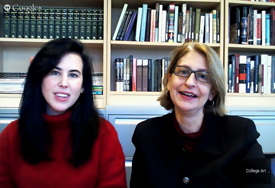 WHEN: Wednesday, January 15, 3:00 PM (EST)
WHERE: RSVP and watch online here
Whether you’re in the middle of a grant application or just thinking about applying, this live Google Hangout will be a valuable resource for you.
The College Art Association offers a robust program of publishing grants to authors and publishers of scholarly books in art history, visual studies, and related subjects. Join CAA’s director of publications Betty Leigh Hutcheson and editorial manager Alex Gershuny to get practical tips and advice about CAA’s grants, as well as answers to all your questions! You’ll also hear from former juror Susan Higman Larsen (Director of Publishing and Collections Information, Detroit Institute of Arts) about how the awards committee evaluates proposals, and from past grant recipient Karl Whittington (Assistant Professor, Ohio State University) about his experience of the application process.
Submit your questions in advance to caabook@collegeart.org or on Twitter with the hashtag #caapubgrants. Meiss/Mellon Author’s Book Award, the Millard Meiss Publication Fund, and the Wyeth Foundation for American Art Publication Grant.
Learn more about CAA’s publishing grants at www.collegeart.org/publications/pgrants. The spring deadline for the Meiss/Mellon Author’s Book Award and the Millard Meiss Publication Fund is March 15, 2014. The deadline for the Wyeth Foundation for American Art Publication Grant is September 15, 2014. This event will cover all three grants.
Committee on Women in the Arts Picks for January 2014
posted Jan 10, 2014
Each month, CAA’s Committee on Women in the Arts selects the best in feminist art and scholarship. The following exhibitions and events should not be missed. Check the archive of CWA Picks at the bottom of the page, as several museum and gallery shows listed in previous months may still be on view or touring.
January 2014

Jennifer Yorke, Pretty Little Lies, 2012, collage and acrylic on paper, 30 x 22 in. (artwork © Jennifer Yorke)
Jennifer Yorke: Twerks on Paper
Packer Schopf Gallery
942 West Lake Street, Chicago, IL 60607
January 10–February 15, 2014
Fashion! Food! Sex! Death! Through her Twerks on Paper, Jennifer Yorke laughs at them all. In her collages, the failures and flaws of the body assert themselves over the seductive veneer of beauty and propriety created by both costume and custom. Despite our best efforts to create controlled, socially appropriate selves, our bodies are often filled with unruly desires and only imperfectly contain the sticky, the smelly, and the wet. Yorke demonstrates the absurdity of our efforts at control through humor—and the humors that seep and spurt out of her fashionable figures. She conflates fashion’s celebration and distortion of the body with our more day-to-day experience of its flaws, failures, and expellants, encouraging us to shake our asses at them.
Faith Wilding: Fearful Symmetries
Three Walls
119 North Peoria Street, No. 2C, Chicago, IL 60607
January 10–February 22, 2014
Although best known for her contribution to Womanhouse—the 1972 performance Waiting—and for her role in the formation of the first Feminist Art Program in Fresno and Cal Arts, Faith Wilding remains largely understudied. As the first major retrospective of her work, Fearful Symmetries spans forty years and brings together and contextualizes the studio practice—especially works on paper—that accompanies Wilding’s performative work, illuminating the allegorical imagery that underpins her feminism and the centrality of transformation and emergence in its articulation. As such the exhibition highlights the theme of becoming—as transformative event and threshold to transfiguration—as a state of in-between-ness, evoked by iconographic motifs such as leaves, the chrysalis, hybrid beings, or “waiting” itself.
Alongside the exhibition is a curated archive featuring Wilding’s work with the collaborative research and performance group subRosa; rare videos of performances made throughout her career; and papers and publications dating from her participation in the feminist art movement in the 1970s. A series of special events will punctuate the exhibition, including a performance and discussion with Irina Aristarkhova on January 9.

Nora Schultz, image from Parrottree—Building for Bigger Than Real, 2013 (artwork © Nora Schultz)
Nora Schultz: Parrottree—Building for Bigger Than Real
Renaissance Society
University of Chicago, 5811 South Ellis Avenue, Chicago, IL 60637
January 12–February 23, 2014
The Renaissance Society presents the first museum solo exhibition of Nora Schultz, a Berlin-based artist who produces sculptural installations that double as analogue printing studios. Her primary materials are discarded objects scavenged from her studio and the site of her exhibitions, often in the form of metal bars and sheets, grates, tubes, and plastics. Schultz repurposes this refuse into sculptural objects, as well as contact printing devices, stencils, and even simple rotary presses with which she prints (often as public performance) abstractions scaled from the intimate to the monumental, exhibited individually or in accumulating heaps. Deeply engaged with material and process, Schultz’s installations are themselves, at times, engines of ongoing artistic creation.
Hannah Höch
Whitechapel Gallery
77-82 Whitechapel High St, London E1 7QX, United Kingdom
January 15–March 23, 2014
The Whitechapel Gallery presents the first major UK exhibition of the influential German artist Hannah Höch (1889–1978), an important member of the Berlin Dada movement and a pioneer in collage. Splicing together images taken from popular magazines, illustrated journals, and fashion publications, Höch created a humorous and moving commentary on society, in particular questioning traditional gender and racial stereotypes, during a time of tremendous social change. She also established collage as a key medium for satire with extraordinary skill and beauty.
Nargess Hashemi: The Pleasure in Boredom
Gallery Isabelle van den Eynde
Street 8, Alserkal Avenue, Unit 17, Al Quoz 1, Dubai, United Arab Emirates
January 12–February 27, 2014
Nargess Hashemi (b. 1979, Tehran) takes a new direction in her latest show, deviating from largely figurative works centering on themes of domesticity and everyday life and moving in a surprising new trajectory. The Pleasure in Boredom charts Hashemi’s process of developing over ten years worth of experimentation on graph paper. Doodling in notebooks from a young age, the artist has made the practice somewhat of a lifelong obsession. Using only the most basic materials, Hashemi adopts a commonly unfocused and subliminal practice and refines it, resulting in vibrant artworks of great complexity. The title of the exhibition references an essay by E. H. Gombrich, in which the art historian examined the psychology behind the act of doodling and explored its artistic merit. A doodle by its very nature is a subconscious impulse, something that we are naturally compelled to do in a dreamlike, absentminded state. In her new series, Hashemi has evolved this instinctual act into artistic endeavors of great structure and precision.
Salla Tykkä: The Palace
Baltic Centre for Contemporary Art
Gateshead Quays, South Shore Road, Gateshead, NE8 3BA, United Kingdom
November 22, 2013–March 2, 2014
The Finnish artist Salla Tykkä (b. Helsinki, 1973) is known for photographs and videos with historically and psychologically charged narratives. Her dramatically edited footage plays with cinematic structures and is often set to familiar, grandiose film scores. Since 2008, Tykkä has been completing a trilogy of films: Victoria (2008), Airs above the Ground (2010), and, most recently, Giant (2013), which was partially commissioned by the Baltic Centre for Contemporary Art. The Palace comprises an installation featuring all three works and is the first exhibition to bring them together. It also marks the international premiere of Giant.
Victoria is a documentation of the nightly blossoming of the giant water lily; a ten-minute time-lapse of the plant’s life cycle as it unfurls its petals in the dark. The lily blossoms over two nights; the first night it is white and when it opens for a second time a day later, its color has changed to a red hue. European explorers brought Victoria amazonica and Victoria cruziana from South America to Europe and named them after Queen Victoria. Tykkä offers the plant as a symbol of colonial power and domination in the nineteenth century.

Chryssa Romanos, Labyrinth, 1965, collage on canvas, 55 x 65 cm (artwork © Chryssa Romanos)
Chryssa Romanos
The Breeder
45 Iasonos St, GR 10436, Athens, Greece
January 17–February 17, 2014
Focusing on Chryssa Romanos’s 1960s collage on canvas and her recent décollage on Plexiglas, this exhibition surveys the practice of this outstanding Greek artist—a vanguard member of the Greek diaspora in Paris from the 1960s to the 1980s and a neglected female participant in intersecting circles of the Parisian avant-garde—whose reputation has suffered from the usual predicament of gender, including the overshadowing of her work from that of her life partner, the celebrated artist Nikos Kessanlis.
Romanos began as an abstract painter in Greece, rebelling against both the academic realism favored by the art establishment and the social realism propagated by the communist party, though she was an active member of it. In the early sixties she moved to Paris and became affiliated, along with Nikos, with intersecting circles of the Parisian avant-garde, especially those evolving around the critic Pierre Restany. Reconsidering the communicative role of her art, she rediscovered herself in 1964 as a Pop collagist, turning to what Restany called the “sociological reality”—yet through a surfeit of print media rather than the everyday objects of “urban folklore”—in order to launch a staunch critique of societal injustice, industrialization and the society of spectacle, as put by Kalliopi Minioudaki in the exhibition Power Up: Female Pop Art (at the Vienna Kunsthalle in 2010), where she mapped Romanos’s work in the context of Pop.
In several collages, which constitute the first part of this exhibition at the Breeder, Romanos “explicitly criticized consumerism, exposing its inextricability with vital engines of capitalism, such as war. In her Reportage series, for instance, she unmasked the fallacies of capitalist democracy and the industries that supported its domestic myths in the years of decolonization struggles and the Vietnam War—by mimicking the symbiosis of advertising and photojournalism in print media, while sarcastically miscaptioning scenes of famine or war with alluring advertising messages and unfit captions. In her various versions of the Luna Parc (1965) series—structured as a vicious shooting gallery—the consumerist cornucopia of the American Dream, promised to the Cold War era consumer by means of the consumer goods that are pasted around targets—is suggestively predicated upon the extinction of humanity, whether by its shooting, or its rendering into mass. This is at least suggested by the anthropocentric collages that constitute the targets.” Such signature collages were well received when exhibited in Charlottenburg, West Berlin, in 1965 and at the São Paolo Biennial in 1967. In response, however, to a studio visit by Restany—who demanded she substitute clippings with found objects as a true Nouveau Realist would do—Romanos resolutely quit what she considered, by her account, as the most important step in her career: her political Pop.