CAA News Today
Practice Your Interviewing Technique at the Chicago Conference
posted Sep 19, 2013
Students and emerging professionals have the opportunity to sign up for a twenty-minute practice interview at the 2014 Annual Conference in Chicago. Organized by the Student and Emerging Professionals Committee, Mock Interview Sessions give participants the chance to practice their interview skills one on one with a seasoned professional, improve their effectiveness during interviews, and hone their elevator speech. Interviewers also provide candid feedback on application packets.
Mock Interview Sessions are offered free of charge; you must be a CAA member to participate. Sessions are filled by appointment only and scheduled for Thursday, February 13, 1:00–3:00 PM and 4:00–6:00 PM; and Friday, February 14, 9:00–11:00 AM and 2:30–4:30 PM. Conference registration, while encouraged, is not necessary to participate.
To apply, download, complete, and send the Mock Interview Sessions Enrollment form to Megan Koza Young, chair of the Student and Emerging Professionals Committee. You may enroll in one twenty-minute session.
You will be notified of your appointment day and time by email. Please bring your application packet, including cover letter, CV, and other materials related to jobs in your field. The Student and Emerging Professionals Committee will make every effort to accommodate all applicants; however, space is limited.
Onsite enrollment will be limited and first-come, first-served. Sign up in the Student and Emerging Professionals Lounge starting on Wednesday, February 12, at 4:00 PM.
News from the Art and Academic Worlds
posted Sep 18, 2013
Each week CAA News publishes summaries of eight articles, published around the web, that CAA members may find interesting and useful in their professional and creative lives.
In Detroit, a Case of Selling Art and Selling Out
These days, the message screens above the main ticket desk at the Detroit Institute of Arts regularly flash the phrase “Thank You Voters.” Unusual as it may seem among announcements about exhibitions and events at this world-class museum, it belongs there. On August 7, 2012, the citizens of the three counties that contain and surround Detroit—Wayne, Oakland, and Macomb—voted in favor of a ten-year commitment to a small increase in real-estate taxes that would guarantee the institute $23 million a year, roughly two-thirds of its annual operating budget. (Read more in the New York Times.)
Sunday Dialogue: Sell Masterpieces to Help Save a City
The choice being debated in Detroit—whether to sell works from the Detroit Institute of Arts to help pay the city’s debts—is agonizing. How can we equate a few pieces of canvas with paint on them with the pensions of thousands of firefighters, nurses, police officers, teachers, and other civil servants? (Read more in the New York Times.)
More Humanities PhDs
New doctoral enrollments in the arts and humanities have been going up modestly—an average of 1 percent annually—for a decade. But data being released by the Council of Graduate Schools show that in fall 2012, arts and humanities doctoral programs saw a 7.7 percent increase—a surprising jump given the difficulty many new PhDs in those fields have in finding jobs. (Read more from Inside Higher Ed.)
Insider Tips from the Art World’s Social-Media Pros (Part Three)
To get a better sense of how museums and art organizations are adapting to and embracing the increasing centrality of social media to their missions, Blouin Artinfo spoke to the experts: the people behind some of the art world’s richest and most rewarding social-media accounts. For this third and final installment in a three-part series, we put some questions to the Contemporary Jewish Museum, the public-relations firm Fitz & Co, the Los Angeles Museum of Contemporary Art, and Creative Time. (Read more from Blouin Artinfo.)
Help Desk: Padding the Résumé
Artists are routinely asked to donate work toward the benefit of an organization. I have reached the point where I am not sure how my participation ranks along with my overall exhibition history. What is a suitable way (if any) to list auctions, charitable donations, or benefit shows on my CV? Furthermore, when panels or curators view résumés, do they view these things as positive qualities or simply as résumé padding? (Read more in Daily Serving.)
Know the Vital Players in Your Career: The Chair
In a series of essays starting with this one, I will look at the crucial professional players—found in every academic department, no matter the discipline or the institution—who can profoundly affect the progress (or lack thereof) of your career. The most crucial dyad for a new faculty member is usually you and your department head. The chair (a catchall title I will use here for ease of reference) might be the person who has the greatest sway over you from the start: in hiring, through the promotion-and-tenure stage, and beyond. (Read more in the Chronicle of Higher Education.)
Keeping Students Engaged in the Online Classroom
As an online instructor, I can fulfill the minimum requirements of the university regarding interacting with students, or I can create a learning environment that facilitates student engagement in the classroom. Students enroll in online classes because of scheduling flexibility, work-life-school balance, costs, and convenience. Although online learning holds many advantages, the potential drawbacks revolve around the lack of personal interaction between the instructor and student, as well as the student-to-student contact. Keeping students engaged in the course is a vital function of an effective instructor. (Read more from Faculty Focus.)
“If You Want to Be My Student”
Like any good graduate adviser, Chris Blattman expects a lot from his students. But just how he’s expressing those expectations has generated a fair amount of discussion at Columbia University, where he is an assistant professor of political science and international and public affairs, as well as some talk outside its walls. Blattman, who is known for his frank approach to decoding college and graduate school for students on his blog, outlines protocol for would-be advisees in a new post called “If you want to be my student.” (Read more from Inside Higher Ed.)
ROBERT STORR CONVOCATION ADDRESS
posted Sep 17, 2013
The following is an edited and revised version of the transcript of a talk given at the 2013 CAA Annual Conference in New York. The author has taken the liberty of including comments contained in his original notes for the talk that were left unspoken as well as that of smoothing out certain passages and eliminating repetitions and digressions in others.
The Art World We’ve Made, the Communities We Belong to, the Language We Use, and the Work We Have Yet to Do
Robert Storr delivers the Covocation address at the 2013 CAA Annual Confernece in New York (photograph by Bradley Marks)
Occasions of this kind are very strange. Hal Foster was speaking earlier about triangulation, and the number of triangles I can draw in this room is kind of disconcerting, starting with the fact that Hal was once my editor at Art in America. Some of the other, more consequential ones will be touched on by what I have to say.
In my office at Yale I have a framed copy of Mad Magazine that once I used in an exhibition at SITE Santa Fe. The particular strip—it’s a two-page spread—reproduces a hypothetical scene from The Lone Ranger in which the Lone Ranger and Tonto are surrounded by a band of warlike Indians. The Lone Ranger says, “Looks like we’re in trouble, Tonto.” To which his sidekick replies, “What do you mean, we, kemosabe?”
That’s Postmodernism avant la lettre. Low stealing a critical march on High. There, in a nutshell, you have the problem of the pronoun before Barbara Kruger started to mine that field and plant more explosive charges. It is an example of how many of the thoughts that we take for granted as somehow being accomplishments of Postmodernism have actually been blowing in the wind for a long time—as part of continuously developing dialogue about the obvious but habitually ignored contradictions that are embedded in our language, culture, and society. If you want to delve deeper into such things, allow me to note that as much of an admirer of Roland Barthes as I am—and I have learned a great deal from him and honor him for what he has given me—I am an equally great admirer of Oscar Wilde. His views on “The Critic as Artist” and “The Artist as Critic” were set forth seventy or eighty years in advance Barthes’s, and Wilde’s bantering practice of negative dialectic is far more entertaining and effective than the scholastic versions of those same ideas that pervade classrooms and conferences nowadays.
However, in keeping with critical theory according to Mad, I will be cautious in my use of collective terminology or pronouns. And so I will begin this brief exercise in intramural deconstruction with the question “Who’s ‘we’?”—or, better perhaps, “Whose ‘we’?”—precisely to raise the question of whether “you” want to count yourself in or count yourself out with respect to what I have to say. In the simplest terms, what I mean by the “art world” is the combination of professional and semiprofessional realities and relationships amidst which we—and I do mean all of us—do our work as artists, critics, curators, scholars, teachers, and administrators. Some of us do all those things together. Some of us do them separately or sequentially. The lucky ones are those who only have to do one at a time, which, like most lucky things, is rare. By “art community,” I want to point toward a set of elective affinities that we establish with others who are similarly dedicated to art without regard to anyone’s official designation or career status.
Among the things that strongly attracted me to the art world when I first arrived on the scene—my initial exposure to New York dates to the late 1960s and was renewed in the late 1970s and early 1980s—was that you could meet virtually anybody just by showing up. At one loft party in 1968 I met Claes and Patty Oldenburg, Lee Krasner, Christo and Jean-Claude, George Segal, and Jasper Johns. At another in 1978 I met Ana Mendieta and Carl Andre, and at another in 1980s—if memory serves—Nancy Spero and Leon Golub, David Wojnarowicz, Julie Ault, and Irving Petlin. The distinctions among people were not hard and fast, and the hierarchies in which they operated were surprisingly fluid in many though by no means all ways. Of course glass ceilings were everywhere, but on the whole people didn’t care a whole lot about who you were “officially”—they cared about what kind of energy you brought to the occasion. Bringing energy was your passport to being part of the art community because despite the constant commotion, the art world never has enough. Certainly never enough of the positive kinds.
For what it is worth, I’ve held professional positions in all the categories named above. But like many others here in this room, and many of the people that I have worked with over the years, I’ve also made my living at a host of jobs that have absolutely no standing whatsoever. Things like Sheetrocking, art handling, catering, and the like. For many years, I was a librarian and bookseller. Most of my education comes from the things I read while hiding in the stacks, browsing the shelves when floor-walking to prevent theft, or tending the cash register with one eye out for customers and one on the book tucked in my lap. By now I have worked at just about every level of what we routinely call the Culture Industry.
Now, I have always been very leery of that term—Culture Industry. Mostly I dislike it when it is used with glib pessimism or thinly veiled condescension by people who have never worked for any other industry. People who, adding insult to injury, persist in thinking that they are the saving remnant of unalienated labor and uncompromised criticality exempt from the challenges and delusions facing the rest of us who toil in ignorance for the sake making a living, if not in some state of schizophrenic Late Capitalist delirium. I’ve always assumed that working for a living was just something you had to do; it’s how you paid for the doing the work you wanted to do. Furthermore, I believed—and still believe—that well-chosen work that takes skill and requires ingenuity but isn’t too time consuming was preferable to an exalted career that was stultifying and time wasting. In sum, that an honest day’s work for an honest day’s pay at a blue-collar or a white-collar job is pretty much the same thing except for the wages and benefits. Which is to say, it is capitalist business as usual in a society where—alas—there is no socialist alternative. There’s no Ivory Tower either, just an Ivy Covered Mall.
Of course, the truth of the matter is that there is such a thing as the Culture Industry. We all know it, and one way or another all of us are, perforce, “cultural industrialists.” Some of us are in positions of authority; others work for others those who command and are delegated power by them. None of us is immune from the compromises inherent in such affiliations—and none of us is entirely innocent of the offenses committed by the Culture Industry as a whole. Standing altogether outside it is not something that any of us can plausibly claim to be doing, not if we play an active role in the systems that “produce” culture and especially not if we enjoy the perquisites of that system. Correspondingly, one appreciates the candor of people who frankly admit that they are inside it, people who identify as best they can their actual place in the system and are straightforward about the tradeoffs they have made to arrive in it and make the best of their advantages. People, moreover, who try to be as honest as possible in judging others with respect to the problems and privileges they too have chosen to make their own and the charges that might conceivably be leveled against them as well.
Now, when I say “we” with regard to having made the art world what it has become, I mean my generation, more or less: the baby boomers and their younger siblings. We have come of age rising to positions of power that we once vigorously protested. Having done so, we are subject and should be subject to protest. With that in mind I keep a porcelain statuette from the Chinese Cultural Revolution nearby, a statuette of a professor on his knees wearing a dunce cap with an righteously accusatory member of the Red Guard standing behind him. In reality the mass hysteria of the Little Red Book of which I caught a distant glimpse in those days was not a laughing matter. But gallows humor has its merits, and I know that such a comeuppance remains a possibility—because we have in fact become the “figures of authority” we once considered our perpetual enemies. The jury is still out on whether we have also become the “ciphers of regression” we took them to be, but inasmuch as it is supposed to be a jury of our peers we should be careful that it is not packed in ways that make self-criticism a pro forma ritual and all other judgments those of an ideologically dogmatic kangaroo court. In any event there’s no doubt that the outstanding question is: “Have we actually done better at playing our part in a system we have chosen to enter than our predecessors did, or have we failed to do better than they did or even as well as we could.”
Those who are much younger than I have ample reason to dissociate themselves from this part of what I have to say, and to complain that they have inherited a situation for which they should not be held responsible. Indeed they are not responsible. In fact, that situation may have scant place for them at all, either in the near term or the long term, and even then only room at the very top or very bottom and in the margins but little if any at the core. It’s an art world that was built during a time of enormous prosperity—and also of cultural myopia and self-centeredness. The important thing we must come so terms with—and here again I am speaking of all of us, young and old, inside as well as outside the magic circle—is that the old art world has run its course. It’s over, a thing of the past, and all of us know it. Whatever comes next will not be another iteration of the “postwar modernist” or “postwar postmodernist” model of an art world, nor an improvement on it extrapolated from it. It will, and must be, fundamentally different. In almost all cases in which the arc of a great empire reaches its apogee and turns downward—which is not the same thing as beginning a long inevitable slide into decadence, although such definitive decline is always a possibility—the diminution of momentum and influence that results rattles many and affects absolutely everyone. In “our” own art world we are experiencing such a diminution of growth and influence—and in many locales a sharp contraction of opportunity in relation to the supply of aspirants—even as we are simultaneously witnessing the unanticipated proliferation, expansion, and diversification of other art worlds.
One of the best tests of how serious people are in their cultural politics is whether, under these circumstances, they cling to their privileges—claiming that they, among all people, are entitled to them, whereas those other people are not—or whether they begin to reexamine those privileges and begin to consider what new social contracts need to be written, what new professional standards need to be set and observed.
As I indicated at the outset, there are a lot of problems with Adorno’s way of characterizing the Culture Industry and those who labor in it, partly because he, as a scholar and semiprofessional composer, was immensely uncomfortable with the fact that others made their money from their cultural production. He didn’t like jazz because he saw it as being a form entirely subordinate to the demand for commercial entertainment. But aside from being inexplicably incurious and insensitive—not to say knuckleheaded and tone deaf—not liking jazz in the 1930s and 1940s was in one way or another enmeshed in cultural prejudice against the people who made it—mostly blacks. In that respect avant-garde “purism” wasn’t all that much better than the reactionary populism of the period. In sum Adorno’s conception of music and of modernism generally could not have been more elitist in its fashion, even though the cause in which it was ostensibly being put forward was Marxism. Looking backward, the whole situation makes one wonder how Robert Farris Thompson would have handled Adorno’s condescension toward Afrocentric genres. For starters, perhaps, by dancing circles around his rhythmically challenged professorial counterpart. Meanwhile, looking backward and forward as well as at the present, we know that few if any of Adorno’s disciples in the art-historical guilds have written extensively—if at all—about African or African American art.
Such biases and blind spots are prevalent and problematic in much of the cultural heritage of the Frankfurt School, which, for all its positive contributions, was undeniably Eurocentric to a fault. We should be grateful for those who did not propagate or suffer such ingrained attitudes, but we should never forget that a good deal of critical theory was tainted by them—and still is. Meanwhile, Adorno’s “jazz problem” is a class problem as well as an ethnic one. Like many academicians, he implicitly as well as explicitly looked down on those who made art to sell art, and his complaint against jazz bespoke that contempt. Yet artists—at least those who have galleries—understand that if they are to continue to develop their work, they must find a market for it. And they must maintain that market in all the ways required by their industry. I don’t scorn those who have a salaried teaching job—I have one too—but it is all too easy for somebody with such a guaranteed income to “tut-tut-tut” about people who work with their hands as well as their minds, all too easy to bemoan the supposed commercialism of those in other economic sectors in which deals are made—as if professors in a position to do so don’t negotiate hard for salaries and benefits—and to scold people who are unapologetically merchants and actively “move the merch”—as if scholars didn’t keep a fairly exact count of their number of publications.
Unfortunately, though, it happens a lot. The awkward fact of the matter is that art has always sold for money. Art has always been involved in social strivings. Art has always been involved in patronage. Not long ago I was in India, where I visited the caves at Elephanta, and a guide pointed out to me that underneath one of the transcendent carved Hindu figures was an inscription naming the person who paid for it. Of course in Renaissance paintings we frequently see donors on their hands and knees in front of crowded nativity scenes, donors put there at their own request by the artist in order to be remembered for having paid for the picture. Still, the cry of “Oh my God, there’s gambling going on in Rick’s Café” echoes throughout an awful lot of cultural criticism, and it tells us that those who have just made this shocking discovery—or have suddenly chosen to be theatrically shocked by something they noticed a while back—have not been thinking historically about the fact that there’s always been gambling going on in Rick’s Café. The pertinent questions are: “ Who owns the casino? Who’s playing? What’s the ante to get into the game, and what are the stakes if you want to stay? Are the tables level? Are the cards stacked? Who wins? Who loses? What do those who walk away with the pot do with it?” In this context, one is better off reading Fyodor Dostoyevsky or tough-guy detective stories than Karl Marx.
In any case, when I started out I was naïve to the extent that I did not have a clear idea about what I wanted or how I was going to survive. Like many of you, I had my studio practice. And, like many of you, I also had other things on the side. To keep moving toward my vague goals and make ends meet while I sharpened my focus I lived “betwixt and between” for a very long time. I was thirty-nine years old before I got my first tenure-track teaching job. I was forty before I ever worked in a museum. Up until this time, everything I managed to do was catch-as-catch-can. Now many if not most of my students, be they artists or art historians, find themselves in a similar situation but in a very different world. Because things aren’t going to break for them the way they used to—they way they did for me. Many of those who teach are essentially destined to be eternal adjunct professors. My sister, who is a social historian, was an adjunct professor at a university in Canada until she was in her late forties, and only got a tenure-track job and finally tenure past the age when most people would have thrown in the towel. There are many others in our fields who have been in her situation and who never succeed in finding any degree of security or recognition.
Robert Storr (photograph by Bradley Marks)
Nevertheless when I started out knowing what I wanted to do in general terms but not knowing how I was going to support myself, I did not have great expectations. I certainly never imagined that I would ever live in a lavish way, not that I do even now. I’m utterly surprised that I have had the jobs that I’ve had and the financial security that I have. (Many friends do not.) Maybe some of the people who gave them to me are surprised, too! In any case, I am grateful for my situation and have never felt that it was owed to me. What I aspired to was to spend my life, or as much of it as I could manage, doing the thing that interested me most. And, as I stated before, in support of that ambition I planned to do work that took the least away from me and gave the most back to my primary concern. That was the prospect in the 1970s. It seemed to be a reasonable way to go about things.
Having said all of that, I am now in a world—we are now in a world—and by “we” I mean all of us in this room—in which that way of going at things—simply launching yourself based on a series of part-time jobs in order to do in your spare time what you want to do—is the longest of long shots and may be all but impossible. We all know that one can no longer support oneself—much less other people if one has them in one’s life—on part-time jobs. The generation of postwar artists to which this year’s awardee Ellsworth Kelly belongs could rent a studio for $100 or $200 a month and get a lot of space. And they could pay for it by carpentry, art handling, bartending, paste-up, and other such things—and still have three, four, or even five days a week left over for themselves. Those days are behind us.
The same thing is true for people entering the Culture Industry on the art-historical side of the equation, as academics, museum workers, and so on. If you’re going to teach part time at three, four, or even five different places as I once did—one course here, one course there, up and down the Eastern Seaboard, back and forth from the Midwest to the West—in most cases you still can’t make enough to survive decently for very long and, given the stress of such employment, you won’t be able to produce much if any serious scholarly work. So we’ve reached a point in which even the most intense drive to do something smacks right up against the possibility that one may never be able to do it at all, or not very well, throughout an entire “career,” much less follow a career path that proceeds in a rational, predictable fashion from one stage to the next in the manner Allan Kaprow more or less predicted would become norm for artists in the 1960s when he wrote his brilliant polemic against the old bohemia, “The Artist as a Man of the World.”
Times are not good. They have not been good for quite some while—and they’re not going to get better any time soon, if ever. The dire budget cuts currently taking place in the California educational system were mentioned earlier today—Kaprow taught at UC San Diego for many years—and California was the national model for the support of teaching the arts in state colleges and universities. So that situation is an ominous bellwether of what is to come in more vulnerable systems. I work at Yale University, which is one of the richest universities in this country, and I can tell you that as the dean of the School of Arts I have had to impose sharp budget cuts for five years running. So far we have been able to protect student aid and faculty positions and salaries. Everything else—down to pencil counting, literally—has seen reductions. It’s not going to get any better for quite a while. We’re making a concerted effort to raise money and with some success we’ll try to ride out the storm with as little damage as possible. But the days one could take resources more or less for granted and ignore the looming long-term future of the institutions in which we work are over. And the days when faculty and students could blithely expect somebody else to mind the store so that they could do exactly as they wished without a thought to the economic realities in their corner of the Culture Industry are over as well.
Respect for people who hold institutions together is as important as respect for people who build them. The “avant-garde” entrepreneurs who created the great alternative-space system in this country are extraordinary in every way. But the people who manage to operate creatively within big Behemoths—be it Yale or MoMA or the California system or wherever it is—and who hold those institutions together in fair-minded and aesthetically forward-looking ways year in and year out, from budget cut to budget cut, also represent a force for good in our community, although one that is not much recognized or honored. I’m not speaking about myself—I’ve had more than enough attention. I’m pleading for some of the people mentioned earlier in today’s proceedings, some of the people with whom I worked closely and who, as Rodney Dangerfield said, “can’t get no respect,” at least not in quarter where “institutions” are viewed monolithically.
Indeed, one of the principles failings of what passes for “institutional critique” is an inability or unwillingness to address specifics and a penchant for sweeping generalizations that too often brush aside inconvenient historical facts, anomalies, and counterexamples—not least of them the instances in which professionals inside museums, foundations, and universities have fought the good fight and occasionally won it. As someone who has worked in the Behemoths of which I spoke just now, I am an ardent advocate of institutional critique. But institutional critique should “start at home”—as an “inside job”—and what I am trying to do is to foster one in our world, of our sector of the Culture Industry. During most of the last twenty-five years, when the topic has come up, the institutions being critiqued are The Market and The Museum. What has not happened is an institutional critique of the educational system that feeds into the market and museum sectors. That system is the third leg of the stool that holds the art world together and on which the art community sits. On the whole we have evaded examining ourselves too closely, avoided parsing the contradictions of our own positions and responsibilities in too much detail. There’s not been much in the way of an autocritique—and certainly not a Maoist but not even a coherent Marxist one—among academics in this period of time, though many academics subscribe to Marxist ways of thinking. And whenever the issue arises, finger-pointing and evasion begins—because people don’t want the scrutiny. They don’t really want to be told that they are not entitled to many of the things they have come to expect. They don’t want to hear that the things they have come to expect may actually be taken away from them because these things cannot be sustained after all, and that sustaining the essential parts of institutions sometimes requires doing without something one has become accustomed to. Something that may be taken away not by some terrible specter of reaction, though they abound and I am not making excuses for their false economies, but by thoughtful people trying to make the best of a bad turn of events. (In the Academy, crying wolf and making gross comparisons between our troubles and Germany under Adolf Hitler or Italy under Benito Mussolini is frequently the first line of denial when it comes to realities that have shifted beyond anyone’s ability to prevent their shifting.) In practice institutional critique may mean radically resetting or staunchly reaffirming priorities—at a cost. It may mean that a basic, long-haul redistribution of shrinking rather than expanding resources is the business at hand. It means doing that in a manner that is responsible and fair but above all one that is consistent with the fundamental purposes of that institution as well as consistent with the promises implicitly or explicitly made to those who enroll in them and those who work for them. So far as universities are concerned those questions also include the working conditions of those who staff them, which, to a large extent, means relatively recent graduates of the system. How long can American schools maintain their current levels of excellence based on underpaid adjuncts that serve year in and year out, without ever having a realistic chance of rising above their entry-level status? How long can they continue to hand out diplomas without fully informing students of the long odds of their finding ultimately employment in their field? The allocation of labor in the educational system resembles migrant farm labor in far too many respects, and it’s been that way for a long time.
When I talk about “we” who must address these issues in this particular set of circumstances, I am, as I said, talking about the people of my generation. But this “we” has to be subdivided in some important ways. The “we” I am speaking was once overwhelmingly composed of people like me, white Anglo-Saxon Protestant males. It took a scandalously long time for other “we’s”—women, people of color—to break into the monochrome, monogendered, and for that matter predominantly straight art world. And “we” should not pat ourselves on the back for the progress that “we” have all too slowly made because the work is far from done. For example, the Yale School of Art, which has graduated artists of color in appreciable numbers since the 1960s—from Howardena Pindell and Martin Puryear to Kehinde Wiley, Mickalene Thomas, and Wangechi Mutu—but when I became dean there was only one artist of color in a tenured faculty position in the School of Art: Robert Reed, who teaches there still. That had been the situation since the early 1960s when he was hired. Which makes it obvious that none of the discussion of “diversity” since before the deaths of Martin Luther King Jr. and Malcolm X had any effect on the actual representation of African Americans at one of the leading universities in a heavily black North American city. Meanwhile, in 1990 Sheila Levrant de Bretteville was the first tenured female faculty member to be hired at Yale, and due to the paucity of available positions she remains one of only two women with tenure. An equivalent dearth of people of color has prevailed at MoMA, where the only ranking curator of African descent from the 1960s into the new millennium was Kynaston McShine.
I mention these statistics because despite the prevalent talk about a postracial, postsexist society, they describe the abidingly conservative reality within nominally liberal institutions. Inaction does speak louder than words! Institutional critique under such circumstances means more than adding courses on The Other and The Subaltern or exposing the inconsistencies and failures of other parts of the system; it means analyzing our own inconsistencies and failures and then taking appropriate corrective action. Theory without praxis, as thinkers from Aristotle to Marx will tell you, is doomed to failure. It also condemns the disengaged theorist to self-incriminating disclaimers.
A while back Adrian Piper told me that she once asked Rosalind Krauss why she hadn’t written on any artists of color, and Krauss answered that she would if she could identify one of sufficient “quality.” Sound familiar? Like the neocons Clement Greenberg or Hilton Kramer? In any case I don’t believe Krauss has yet found what she was looking for. Indeed Art since 1900—a textbook edited by Krauss, Foster, Yve-Alain Bois, and Benjamin Buchloh—contains two chapters on artists of color, both of which were farmed out to an adjunct member of the team. So far as I know, these chapters were the only ones handled in that manner suggesting that even when the “discourse of The Other” gets its due as “metacritique,” actually paying attention to others is still considered a distraction from the main events of art history.
The other side of the coin of correcting the longstanding exclusivity of “we” is, of course, that once women, people of color, and others who have been kept out of the power structure are finally brought into it, they will join the “we” that has problems to address besides those which may have been partially ameliorated. I would like to mention a few in particular. As I look at the last twenty-five years in this field—by “this field” I now mean the whole of it, whether it is classes taught in art schools or classes taught in art-history departments—I am repeatedly struck by a set of phenomena we usually identify with the financial sector. If we’re going to engage in institutional critique, there’s no way of sidestepping it in our own. Because know without any doubt that spasms of inflation and deflation threaten the world economy, and we know that derivatives aplenty were created out of thin air, resulting in untold risks to the value of everything. We know that dubious financial schemes and absurd social and political propositions were sold to the general public based on predictions that things would turn out a certain way with little regard for what would happen if they didn’t. We know that our entire economy nearly collapsed because of the misuse of abstract ideas and the career-making, brand-building flogging of bogus ideological products.
The same thing has happened in our world, and the potential consequences are equally severe. In the academy we have witnessed the spawning of all manner of theoretical derivatives, that is to say, highly attenuated versions of once-compelling ideas. We have rogue hedge funders too, in other words, speculators who predict one outcome but then as a matter of caution or cynicism bet against the thing that they just predicted. Divided between Utopians convinced that sooner or later the Revolution will sweep away the mess we’re in, and Dystopians who are just as sure that tomorrow we’ll become Nazi Germany—they are nevertheless at pains to secure their institutional futures as if the sky were the limit and there were no clouds on the horizon. As in the financial sector we have heard old “common sense” laws being pooh-poohed, and all manner of generalizations built on suppositions that have not been, and frequently cannot be, proved or disproved. Did a given prediction come true? How might we find out? Even asking such questions calls down the accusation that one is stuck in old ways of thinking or, worse, crudely anti-intellectual.
As a result we have a several generations of students who run around referring to historical paradigms and using ideological catch phrases in the studio or outside the studio, in seminars or outside seminars, with little if any idea of what those paradigms or phrases actually signify. If I’m not mistaken, Ernest Mandel—a Belgian Marxist whose lectures I attended and whose ideas I take seriously (though no longer trust)—was the first person to develop an extended model of Late Capitalism, although there were cranks like Lyndon LaRouche who did as well. Parenthetically, at this juncture I’d venture that at its best critical theory has been a useful analytic tool, though never a useful political tool, but all too often it has been the basis for a genre of what one might call Social Science Fiction—the artistically conservative Jean Baudrillard, being one of its exemplars—with the likes of Larouche and other ideological cultists being the Scientologists of the imploded radicalism of the generation of ‘68.
In any case Late Capitalism, whatever it may have been for Mandel, has not turned out as he predicted it would. Indeed, Frederic Jameson and others influenced by Mandel have backed away from the term, but still it remains part of the catechism of critical theory. In any case, rather than capitalism’s “lateness,” which I take to mean its immanent decline or failure, we are confronted with rampant, astonishingly adaptable capitalism, in particular novel state capitalisms of every description developing in countries that were formerly socialist. I suppose that one could argue that this is just one of the stages along the way to what Mandel and others predicted, but there’s not much to go on in these theories regarding when we will know that we have in fact reached capitalism’s next and “final” stage. Instead of living through the era Late Capitalism, we’re living through that of Late Socialism, and while I take absolutely no comfort in this fact, what I’m trying to say is that using simultaneous vague and grandiose terms of this kind as general descriptions of a complex set of social and economic relationships that condition how culture changes, how it’s disseminated, and how it’s thought about does no good at all and may do a fair amount of harm to the young people trying to figure things out for themselves.
If you have a student who hands you a paper or presents you with a picture and says, “And this is about late capitalism,” the obvious question is, “Well, what do you mean by that?” Of course, most students don’t know because most of them have been taught by professors who bandy about such ideas without having grounded them in economics or history with the rigor that scholars in those fields would require. Most students don’t know how to begin to teach themselves because the history of these ideas has actually been obscured, kept away from them—because the level of abstraction common in art schools and art-history departments has been kept so high, and the game of keep-away has been so perfectly manipulated by a wink and a nod among primary users of these ideas who have no desire to be called to account, that if anybody really asks the stump-the-teacher questions—“What do you mean by that and what examples can you offer? Did the thing you say was going to come about actually happen?”—they are met with silence or with a barrage of obfuscation and brow beating. For obvious reasons, though, such moments seldom come. Students and skeptical colleagues have been too intimidated by the claims of those who introduced these counterfeit notions and built their reputations on their derivatives. Nobody so far as I know repealed the laws of gravity. And nobody repealed the laws of supply and demand. Instead, the antiempirical practices of economic fantasists nearly brought us to our knees: men and women who believe in Ayn Rand the way others once believed in Mao. Critical theorists are playing for smaller stakes, but calling their bluff can amount to the same thing.
Remember the days when it was the Republicans who said, “You are unfortunately a fact-based constituency, and we’re in a brave new world.” I have heard some of my colleagues say, “You are a crude positivist because you ask questions about matters of fact.” Now, I am the son, brother, and brother-in-law of historians. I learned social scientific methods from Marc Bloch to Fernand Braudel at the dinner table. I have a fairly clear idea of what the pertinent historical methodologies—plural!—are, and what their value can be. But so much of what we do or see being done in our field nowadays is not art history at all; it’s ideological historicism. It’s the comparison of one situation to another without regard for obvious differences of moment, of social, cultural, economic, and political setting, of the disparity between aims and outcomes, what should have happened and what did, and without any requirement that theories or speculations be checked against evidence.
Robert Storr (photograph by Bradley Marks)
For example, in the 1980s it was an article of faith in certain quarters that Neoexpressionism signaled a slide into crypto-Nazi barbarism. Moreover, this canard is alive and well in articles and textbooks that fill the bibliographies of courses and seminars. Now, let’s get real! Ronald Reagan was not my cup of tea at all—but he was not Hitler. And Julian Schnabel is not my cup of tea either, though he has made some images I can’t forget and will get credit from me for that—but he is not remotely the equivalent of the painters officially favored by Hitler, whose taste was narrower than that of most Fascists and who mounted the famous Degenerate Art exhibition to condemn Expressionism even when practiced by Nazi fellow travellers like Karl Schmidt-Rotluff and Emil Nolde. Since we’re among art historians, we should be clear while we are at it, that during the 1920s and 1930s the aesthetic Left and Right were easily confused because members of the avant-garde and the arrière-garde kept switching sides and because, apart from Hitler, neither the Right (Fascism) nor the Left (much of Stalinism) had a consistent party-line aesthetic until late in the day. During the 1970s and 1980s things were tidied up by critics eager to rewrite history in the image of their prescriptive norms. In their hands abstraction became ipso facto “progressive” and figuration ipso facto “regressive,” with scant room for nuance. The thing that went unmentioned is that while a large number of figurative painters were on the Right, although by no means all were Fascists, an equal number were on the Left—in Germany, France, the USSR, England, Mexico, Brazil, the United States, etc.—many of them actively so. Meanwhile, a good many of the Futurists, who were, generally speaking, abstract artists, were actively Fascists while as a rule the figurative Metaphysical painters—although backward looking—were not.
In other words, the caricature that skewed art history in the early 1980s was a polemic, but it was a polemic authored by an art historian based on historical examples that were patently false. Why do I mention this? Because, as I mentioned before, those articles are assigned and read today. Because those terms and those examples are used and cited today. Because the abstract, conceptual, and other “neo-avant-gardes” of the 1970s who recoiled in horror at a stylistic sea change and the advent of new generation, creating an overtly distorted “history” for strategic ends. Because when my students in art history or studio programs repeat these falsehood one doesn’t know where to begin to disabuse them, how to disentangle the snarl of conclusions drawn from those dogmas. Because these falsehood are the official opinion of very large parts of our community, and a few if any of those who have disseminated them—and many hold high posts in the academic establishment—have any interest whatsoever in recanting or revising those views, or even just modestly saying “Oops!” Evidently “theorizing” means never having to say you’re sorry.
Lest this sound too sweeping on my part, let me say that T. J. Clark, with whom I disagree on some issues, is an art historian I greatly respect and from whom I’ve learned much. So too was Meyer Schapiro, whom I knew and about whom I wrote. Thanks to him Marxist art history in this country flourished in many influential ways; thanks to him as well psychoanalysis and semiotics entered the field in similarly rigorous and thoughtful ways. I also knew and admired Leo Steinberg, whose work I reread regularly. It is possible to be engaged with all of those thinkers and yet dissent from the uses if not misuses to which their work has been put by people who eagerly seek to legitimize their work by association but who cannot hold a candle to them.
Now let’s consider the matter of predictions. Remember when painting was declared obsolete and photography was held up as superior to it, because as a multiple photography used more modern technology and as a multiple was less subject to commodity fetishism? Tell that to Andreas Gursky, and when you’re done ask Schnabel if his work has ever sold at auction for a price approximating what Gursky gets for a single print from of one of his many editions. Remember the end of the museum? Now an awful lot of the people who were involved in that “discourse” are regulars on museum panels, and quite a few found themselves museum jobs. Indeed, it would seem they always aspired to jobs in museums but while waiting to be tapped they threw stones at the glass house they hoped to inhabit—maybe just to get attention. As a young critic I too did my fair share of criticizing museums—as Larry Rivers and Frank O’Hara long ago pointed out, it goes with the territory—but I never intended to work in one and turned down a MoMA job when Kirk Varnedoe first offered it to me, never expecting to be asked again. When asked a second time and after canvasing artist friends about whether to accept the offer—Félix González-Torres’s encouragement was the decisive vote—I discovered that museums are pretty interesting places to work after all. I also discovered that some of the most radical people around were actually working in museums already. By which I mean people who made substantial change happen while others just talked about it. Barbara London, for one example; Deborah Wye, for another. Both were long-term curators at the Modern who had without fanfare opened its doors to new media, new artists, and cultural diversity. So I applaud dissenters going into museums, just as I respect radicals who teach, because I look forward to having colleagues both inside and outside institutions with whom to work on the project of changing them—because if you have alliances across that membrane, you can do remarkable things
Nevertheless we keep hearing the same the screed that The Museum is inherently the enemy of art, that The Museum is inherently the toy of the rich—as if everyone with wealth was of the same opinion about culture and politics, which I can assure is not the case—that The Museum is inherently inhabited by lackeys of the Cultural Industry whose only agenda is to advance their careers and the special interests of those who hire them. Well, I am not going to say that museums aren’t in trouble—they are. I use the plural because they are not all the same, in mission, in history, in location and hinterland, in resources, or in flaws. But individual agency and collective action can make and has made a difference. At times dissent compels one to break ranks. I am doing that here in the academic world. And at times one must step away to make change. On the same score I think I am safe in saying that I’m the only person in this room who has walked away from a senior curatorship at the Museum of Modern Art because I didn’t think I could do the job under the current administration the way it needs to be done. I am not boasting, but sometimes “institutional critique” requires taking actions that have painful consequences.
On to other things: whose opinions does one take seriously? About two weeks ago, I was invited to a restaurant in Paris by friends, who had also invited Alain Badiou. I’d read some of his writing and we had an pleasant conversation—or rather I listened to him expound in a bonhomous way, mostly about very old Leftist ideas, and we ate a couple of rich steak frites with good red wine. And as the talk of revolution proceeded I was reminded, as I have been before, of a passage in Gustave Flaubert’s Sentimental Education in which he describes how the radical nature of the post-1848 generation was ruined by rhetoric and good dinners. About ten years ago I had lunch with Paul Virilio, during which I listened as he spoke marvelously about megalopolis and terrorism. I was captivated, as one can easily be, by his carefree theory spinning and his elegant turns of phrase. Indeed, his gift for juggling words and ideas is really very suggestive, and there are uses for that kind of thing. But then after he’d been talking about the modern city for a hour or more I said, “Listen, Paul, when you’re next in New York, would you look me up?” At which point the man who was our host said, “You know, he’s never been to New York. He doesn’t fly.” Which means he’s also not been to Mexico City, São Paulo, Tokyo, Mumbai, Beijing, or Los Angeles. Yet he is an expert on megalopolis.
Many years ago, Ezra Pound wrote in his ABC of Reading that generalizations are checks written against the bank of knowledge. The question always is: what is there to back them up with? Criticism has been kiting checks in our world for the last quarter century. It’s time, I think, to send the collection agency around and ask what is behind some of these generalizations. Not in order to destroy the fundamental points being made by the people that have bounced so many theoretical checks—often their ostensible aims are legitimate—but to make those points better, to make them work, to intellectually restore the currency we use.
The radical impetus behind much critical theory is inarguable and positive, but that positive impetus has been corrupted by cavalier if not frankly dishonest casuistry, and above all by historically untethered interpretation of the key concepts. There is also a dark side to such practices. Slavoj Žižek is all over the place, talking up the marvels of revolutionary violence and political terror. But this is sinister sophistry in a world in which bloody terror is practiced with equal callousness by insurgents and by states that could not care less about Jacobin discourse. Once again, as in the 1960s and 1970s, we are reliving the cycle that goes from idealism to terror, from Ban the Bomb to the Red Army Faction, from the Student Nonviolent Coordinating Committee to the Symbionese Liberation Army. In that context it is highly problematic that Žižek should be held up as an intellectual hero encouraging people to be bravely destructive, following examples set in distant historical circumstances—Maximilien de Robespierre and the French Revolution, Leon Trotsky and the Russian Revolution—without really taking responsibility for how this resonates with people who live in places where terrorism has become a harsh reality and where the responses to terrorism, to the hysterical counterterrorists, are equally dangerous to us all.
Going back to art history proper—and reflecting on all the places where Virilio has not been but where a good many of us have been—we need a whole new generation of scholars ready to write serious critical, analytical, synthetic, even narrative art histories about what happened in Mumbai, what happened in Johannesburg, and what happened in a host of places where there had been active art worlds for over a century, or at least a for “short century.” The Latin American art world is as old as ours. The year 1913 is the date of the Armory Show that kicked off modernism in this country; if I’m not mistaken the Week of Modern Art in 1917 did the same in Brazil. Yet there really isn’t a readily available, thoroughly integrated history of art for our students that has both of these developments running side by side as it moves forward to the present, such that the southern and northern hemispheres of this part of the world are treated holistically—not “globally,” as I hate that term, which should be given back to business and the military—and treated across the board as postcolonial history. The United States is a postcolonial country, no less than Brazil is a postcolonial country—or Mexico, Cuba, Peru—no less than all of the Caribbean and all of South America, and no less Canada. My wife is Canadian, and she keeps telling me, “Don’t forget us!” And we shouldn’t. So that when we talk about Georgia O’Keeffe we also think of Emily Carr and Anita Malfatti, not as add-ons to existing histories of the avant-garde in New York and Paris, as has been the custom, and not as women belatedly inserted into the canon to correct its gender bias, although that much needed to be done, but rather as protagonists integral to the story of the origination of modern art worldwide.
Thinking in such cosmopolitan terms isn’t just a backward-looking project. It’s forward looking too—and I address these next remarks to those of you on the studio side. Because, if you are currently an abstract painter and somewhat unsure of whether there’s a place for you in the scheme of things, maybe you should be looking at Argentina, Venezuela, and Brazil, as well as Central Europe, to find aesthetic examples that correspond to your interests, examples that will teach you and challenge you to do more with what you’ve got. Work by artists you’ve not previously heard from but who are every bit a part of the modernist project as those to whom you’ve been overexposed.
In sum, we have a lot to teach that we have not taught, but we have an awful lot more to learn before we even begin to teach. And all of us have to rid ourselves from the presumption that this is merely an adjustment or retrofitting of our existing models. It actually entails fundamental rebuilding of all of them, which requires dismantling them first without becoming fixated on negation as an end in itself. We have to disenthrall ourselves from ideological generalizations that have bedeviled exchange among us and slowed the process of resetting our compasses. We have to wean ourselves for a time from speculative thought as a substitute for actual research. We have to do what Arthur Rimbaud calls for in his prose poem “Adieu,” in A Season in Hell, which recounts his decision to foreswear the intoxicating ether of Symbolism and come back down to earth in order to become “absolutely modern.”
In conclusion, I’m going to read a short passage that I’ve included in a couple of essays and reread often myself, and then end with one short anecdote. It won’t take more than five minutes, so I hope that’s all right. It’s a passage by one of the greatest and most studied modernist critics that, strangely enough, is seldom cited. Maybe once I’ve read it you’ll understand why that’s the case. It’s from Charles Baudelaire’s review of the Salon of 1855. He wrote:
Like all my friends I have tried more than once to lock myself in a system so as to be able to pontificate as I liked.
Parenthetically, think of all the books on all the critical-theory shelves at Saint Mark’s Bookstore, books of which most people who buy them read just a chapter or two, only to move onto the next one, and the next, generally without going the distance in any of them. And generally, without admitting to themselves or anyone that they were just grazing in the first place—no shame in that, I suppose; Walter Benjamin did it but he confessed—until they took up another fashionable idea. Now back to Baudelaire:
But a system is a kind of damnation that condemns us to perpetual backsliding. We are always having to invent another and this is a form of cruel punishment. Every time some spontaneously unexpected product of universal vitality would come and give lie to my puerile and old-fashioned wisdom, much to be deplored daughter of Utopia, in vain did I shift or extend criteria. It could not keep up with universal man.
By the way this is the middle of the nineteenth century, so I’m not going to anachronistically regender his text, but you understand what he’s saying.
It could not keep up with universal man. It was forever chasing multi-form multi-colored beauty that dwells in the infinite spirals of life. Under the threat of being constantly humiliated by another conversion, I took a decision—to escape from the horrors of these philosophic apostasies, I arrogantly resigned myself to modesty. I became content to feel. I came back and sought sanctuary in an impeccable naivete. I humbly beg pardon of the academics of any kind who inhabit the different workshops of our art factory….
Baudelaire wrote this a hundred years before Adorno:
for only there has my philosophic conscience found rest, and at least I can now declare insofar as a man can answer for his virtues that my mind now enjoys a more abundant impartiality.
Miwon Kwon just spoke about the book that won her an award here today and explained that she had embarked naïvely on a project that bore enormous fruit. I’ve read parts of her book, and it is indeed an example of what rigorous thinking can actually accomplish. But that initial spark of naïveté is the essential element. Or as Sol LeWitt said in “Sentences on Conceptual Art,” the first step in the process is to make a leap of faith—which in his view qualified Conceptual artists as mystics. That said all subsequent steps must be rigorous and methodical. Making art that way is not highly touted these days, and that idea of thinking critically about art in such a manner is even less so. So let me end with a brief story, and I hope I don’t embarrass the colleague about whom I am speaking in doing so.
When I was at the Institute of Fine Arts, I was befriended by Günter Kopcke. Günter is an old-school German scholar of the classical antiquity, a remarkably erudite man who in addition to his study of ancient art has maintained an active interest in contemporary art. It was he who gave me copies of the catalogues from the second installment of Documenta in 1959. I had been looking for them and said so. He had them but didn’t want them anymore and just handed over these treasures to me. It was an act of great kindness and solidarity. Günter and I had lunch from time to time, and once he seemed pretty depressed. He was very worried about the institute, he was worried about the field, but mostly he was worried about his research. I could feel a kind of melancholy taking hold of him, and I was really quite concerned about what might happen, what would he do.
Later he came to me greatly cheered up and said that he had concluded that he was stuck. He didn’t have a hypothesis or project to pursue. He didn’t know what he wanted. So he decided to use his upcoming sabbatical to go to the Acropolis and walk the grounds from end to end until an idea came to him. His plan was no plan, beyond returning to the place he had studied for most of his life, a place about which he knew the literature better probably than anybody, in all the languages that he speaks. As learned, as thoughtful, and as subtle a man as he could possibly be, he elected to go unburdened by any expectations in order to reconnect with something that had once inspired him. It was a Baudelarian wager. And it worked.
I think basically we’re at that stage again in a lot of fields. I think a lot of us need to just set down all the things we think we know, all the books we have read, all the pictures we have seen, all of the formulations we have perfected for lectures—by the way, I’m getting out of the lecture business, so you’ll be glad to know this is one of my last—and begin to think afresh based on renewed primary experience of something that exists in the world. As in Ellsworth Kelly’s case, it can be a matter of noticing something while looking out the window of a speeding car and wanting to make something from that glimpse—for example the shadow of a half-open garage that you drive by. Or it can be a particular detail of architecture that you realize nobody has ever talked about before. Or it can be an unusual turn of phrase—one of the marvelous things about Leo Steinberg was that he was as avid a reader as he was a looker, and he horded a wealth of verbal gems with a space set aside in his mind for the most memorable nonsense. He read like a writer, not just in order to grasp an argument or find fault with one, but for the inflexions of language, for the pleasures of the text.
In summation all I would simply say is that for a lot of us the work ahead really consists, number one, of taking full responsibility for the fact that “we” have made this corner of “our” art world—not somebody else, not some other generation, not some sociological deus ex machina. “We” have made this art world and, number two, it does not work. And we should never lose sight of the fact that some of the people who have made other parts of the art world are our allies rather than our enemies. There are people in museums I trust more than those I trust in my own field. There are gallerists whom I trust more than people in my own field. My community is made up of people who have reason to trust one another because they have a common interest in making the most of something to which they have decided to dedicate their lives. That many decided to dedicate their lives to that thing before they had any professional or career aspirations or prospects whatsoever. Many are doing it now—a younger generation—after realizing that they have very limited career prospects and few reasons to expect they’re going to make a living out of it. That is where we are, and we need to look at it squarely. We need to be very severe with those who will persist in distracting us ideologically and those who try in vain to persuade us that it’s really up to somebody else to fix it. It’s up to “us.” Thank you.
Scalar Webinars: Announcing Our Fall Schedule
posted Sep 17, 2013
The Alliance for Networking Visual Culture sent the following email on September 16, 2013.
Scalar Webinars: Announcing Our Fall Schedule
To follow up on our recent Beta release, the Scalar development team will be offering a series of free online webinars this Fall.
Our “Introduction to Scalar” webinars will cover basic features of the platform: a review of existing Scalar books and a hands-on introduction to paths, tags, annotations and importing media. Our “Intermediate Scalar” webinars will delve into more advanced topics including the effective use of visualizations, annotating with media and a primer on customizing appearances in Scalar. Finally, one advanced webinar will cover Scalar’s RDF-based API as well as Scalar’s theme engine for programmers who wish to utilize the platform’s internal components when creating interfaces.
Our Fall schedule will include five dates:
- Introduction to Scalar – September 26, 10am-12pm (PST)
- Intermediate Scalar – October 17, 10am-12pm (PST)
- Introduction to Scalar – November 14, 4pm-6pm (PST)
- Advanced Scalar/API – November 21, 10am-12pm (PST)
- Intermediate Scalar – December 12, 4pm-6pm (PST)
Scalar is a free, open source authoring and publishing platform that’s designed to make it easy for authors to write long-form, born-digital scholarship online. Scalar enables users to assemble media from multiple sources and juxtapose them with their own writing in a variety of ways, with minimal technical expertise required.
September 2013 Issue of The Art Bulletin
posted Sep 13, 2013
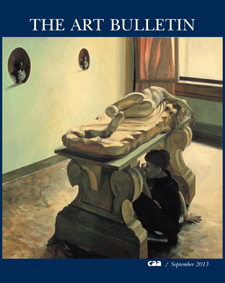 The September 2013 Art Bulletin, the leading publication of international art-historical scholarship, is the third issue of the journal’s centennial year. In the opening text, “Regarding Art and Art History,” David Summers traces his career as a trajectory of changing perspectives on art history. For the “Notes from the Field” section, eleven authors—Eric Fischl, Jan Assmann, Malcolm Bull, Darby English, Ludmilla Jordanova, Mary Miller, Steven Nelson, Ajay Sinha, Gloria Sutton, Gerrit Walczak, and David E. Wellbery—ponder the role of time in art. The September “Interview” features Partha Miller and Keith Moxey discussing the emergence of a world art history.
In his essay “Graphic Knowledge,” Peter Parshall analyzes Albrecht Dürer’s treatise on human proportion to reveal a fear of the transgressing power of imagination that, he argues, ultimately hobbled the artist and his legacy. Next, Matthew M. Reeve explores Horace Walpole’s neo-Gothic villa, Strawberry Hill, showing the role of the eighteenth-century Englishman’s sexuality in the design and reception of the house. In “Rhetorics of Place and Empire in the Fountain Sculpture of 1830s Havana,” Paul B. Niell examines the reconfiguration of international forms, iconography, and materials in three public fountains erected in Cuba during the 1830s to show how a burgeoning Atlantic world city negotiated its relation with the Spanish Empire and its emerging distinctiveness as a local setting. Finally, Namiko Kunimoto considers the Japanese artist Tanaka Atsuko’s Electric Dress in relation to a changing urban and industrial context in postwar Japan that provoked shifts in the status of gender, underscoring the frailty of female subjectivity.
In a “Centennial Review Essay,” H. Perry Chapman discusses what she calls the “problem with artists” by reconsidering two influential books: Ernst Kris and Otto Kurz’s Legend, Myth, and Magic in the Image of the Artist: A Historical Experiment (1934); and Rudolf Wittkower and Margot Wittkower’s Born under Saturn: The Character and Conduct of Artists; A Documented History from Antiquity to the French Revolution (1963). Then, Jacqueline E. Jung assesses Herbert L. Kessler and David Nirenberg’s edited volume, Judaism and Christian Art: Aesthetic Anxieties from the Catacombs to Colonialism, alongside Nina Rowe’s The Jew, the Cathedral, and the Medieval City: Synagoga and Ecclesia in the Thirteenth Century. Last, Peter Chametzky considers a recent exhibition and publishing project on a German art critic, which includes Konstanze Rudert’s catalogue, In the Network of Modernism: Kirchner, Braque, Kandinsky, and Klee … Richter, Bacon, Altenbourg, and Their Critic Will Grohmann, and Rudert and Volkmar Billig’s anthology, Will Grohmann: Texte zur Kunst der Moderne.
CAA sends The Art Bulletin to all institutional members and to those individuals who choose to receive the journal as a benefit of their membership. The next issue of the quarterly publication, to appear in December 2013, will feature essays on the artists Frederic Church and Awa Tsireh, Vasari’s alleged account of Roman Jews “adoring” Michelangelo’s Moses, and the contested status of color in Indian nationalism, among other topics.
Arts in Turkey Tour: Yesterday and Today
posted Sep 12, 2013
 CAA has partnered with Tutku Tours to provide an exclusive offer for its members to spend two weeks exploring the ancient and contemporary sides of Turkey, from May 27 to June 10, 2014. Highlights of the Arts in Turkey Tour: Yesterday and Today trip include stops in Istanbul, Iznik, Canakkale, Troy, Assos, Ayvalik, Izmir, Pergamum, Ephesus, Kusadasi, Pamukkale, Catalhoyuk, Konya, Cappadocia, and Ankara. This tour is a one-of-a-kind experience that takes visitors on a spectacular journey through ancient and modern Turkey. Visit the workshops of local artists, learn about techniques of ancient art, and take in galleries and museums in some of the world’s oldest cities.
The tour begins with three days in Istanbul—the city on seven hills and the capital of two former empires—where travelers will visit the major attractions, including the Hippodrome, Blue Mosque, and Hagia Sophia, and also get to know the city’s vibrant street life and local art scene. The tour will then visit the Iznick Foundation’s tile factory, the archaeological site of ancient Troy, and the Pergamum acropolis. The city of Izmir, which boasts numerous museums and art galleries, comes next, and later the port city of Ephesus and Pamukkale, near the ancient city of Herapolis. A handful of other exciting stops will happen in the several days before the return flight from Ankara.
In addition to access to cultural and historic sites, the Art of Turkey Tour will provide CAA members with time for rest and relaxation. The group will stop at a carpet school in Ephesus, along with an overnight stay at a spa hotel at the Pamukkale hot springs. The end of the trip includes a stop in Cappadocia, where travelers can explore the Göreme Open-Air Museum, a vast collection of painted cave-churches dating from 1000 AD, and also watch a whirling dervishes ceremony. At the final destination, Ankara, the tour will visit the famed Museum of Anatolian Civilizations.
Getting There: Turkish Airlines provides nonstop, direct flights from the United States and Canada from the following cities: New York, Los Angeles, Washington, DC, Chicago, Houston, and Toronto.
Land and Air Rates: $3,990 per person for a double room; $4,780 per person for a single room.
The Arts in Turkey Tour features include:
- International flight from the US via Turkish Airlines
- Thirteen nights in superior hotels
- Comprehensive sightseeing as specified in the program
- Meals (thirteen dinners, four lunches, daily breakfasts)
- An official, licensed English-speaking guide throughout the tour
- Visits to art galleries
- Transportation in air-conditioned vehicles
- All entry fees to sites and museums
- A hot-air balloon flight in Cappadocia
- Local taxes and service charges
For a detailed, day-by-day tour itinerary, please download and review the Arts in Turkey Tour brochure.
Register for the Mentoring Sessions at the Chicago Conference
posted Sep 11, 2013
The deadline for applications to participate in CAA’s two conference mentoring sessions—the Artists’ Portfolio Review or Career Development Mentoring—has been extended to Friday, January 17, 2014.
As a CAA member, you have access to a diverse range of mentors at Career Services during the 102nd Annual Conference, taking place February 12–15, 2014, in Chicago. All emerging, midcareer, and even advanced art professionals can benefit from one-on-one discussions with dedicated mentors about artists’ portfolios, career-management skills, and professional strategies.
You may enroll in either the Artists’ Portfolio Review or Career Development Mentoring—please choose one. Participants are chosen by a lottery of applications received by the deadline; all applicants are notified of their scheduled date and time slot by email in early 2014. Both sessions are offered free of charge. Conference registration, while encouraged, is not necessary to participate. All applicants must be current CAA members.
Artists’ Portfolio Review
The Artists’ Portfolio Review offers CAA members the opportunity to have digital images or DVDs of their work reviewed by artists, critics, curators, and educators in personal twenty-minute consultations. Whenever possible, CAA matches artists and mentors based on medium or discipline. You may bring battery-powered laptops; wireless internet, however, is not available in the room. Sessions are filled by appointment only and are scheduled for Thursday, February 13, and Friday, February 14, 2014, 8:00 AM–NOON and 1:00–5:00 PM each day.
To apply, download and complete the Career Development Enrollment Form or fill out the paper form in the 2014 Conference Information and Registration booklet, which will be mailed to all individual and institutional CAA members in October 2013. Send the completed form by email to Lauren Stark, CAA manager of programs; by fax to 212-627-2381; or by mail to: Artists’ Portfolio Review, College Art Association, 50 Broadway, 21st Floor, New York, NY 10004. Deadline extended: January 17, 2014.
Career Development Mentoring
Artists, art historians, art educators, and museum professionals at all stages of their careers may apply for one-on-one consultations with veterans in their fields. Through personal twenty-minute consultations, Career Development Mentoring offers a unique opportunity for participants to receive candid advice on how to conduct a thorough job search; present cover letters, CVs, and digital images; and prepare for interviews. Whenever possible, CAA matches participants and mentors based on medium or discipline. Sessions are filled by appointment only and are scheduled for Thursday, February 13, and Friday, February 14, 2014, 8:00 AM–NOON and 1:00–5:00 PM each day.
To apply, download and complete the Career Development Enrollment Form or fill out the paper form in the 2014 Conference Information and Registration booklet, which will be mailed to all individual and institutional CAA members in October 2013. Send the completed form by email to Lauren Stark, CAA manager of programs; by fax to 212-627-2381; or by mail to: Career Development Mentoring, College Art Association, 50 Broadway, 21st Floor, New York, NY 10004. Deadline extended: January 17, 2014.
News from the Art and Academic Worlds
posted Sep 11, 2013
Each week CAA News publishes summaries of eight articles, published around the web, that CAA members may find interesting and useful in their professional and creative lives.
DIA in Peril: A Look at the Museum’s Long, Tangled Relationship with Detroit Politics and Finances
Anyone who thinks that art and politics inhabit separate spheres within civic life need only explore the roller-coaster history of the Detroit Institute of Arts. The latest example, of course, is Detroit’s bankruptcy. The crisis, which has attracted international attention, could cripple—or kill—one of America’s finest encyclopedic art museums, the signature cultural institution not only in Detroit but for the state of Michigan. (Read more in the Detroit Free Press.)
Responding to Negative Feedback about Your Art
I recently had an email conversation with an artist who had just been through battle on her blog. After years of extensive blogging, she received her first negative comment, an inflammatory comment about a post she had written with some derogatory comments about her art thrown in for good measure. The level of vitriol in the comment was a bit dumbfounding, especially since it didn’t seem to be coming from a dissatisfied customer, rather from a random visitor to the site who wouldn’t seem to have any good reason to be so … blunt. (Read more in Red Dot Blog.)
Insider Tips from the Art World’s Social-Media Pros
To get a better sense of how museums and art organizations are adapting to and embracing the increasing centrality of social media to their missions, Blouin Artinfo spoke to the experts: the people behind some of the art world’s richest and most rewarding social-media accounts. For this second installment in a three-part series, we put some questions to workers at the Brooklyn Museum the Walker Art Center, the Museum of Contemporary Art in Chicago, the Henry Art Gallery, and the Queens Museum of Art. (Read more from Blouin Artinfo.)
Museum Jobs That Didn’t Exist in 2003
Many of these new positions, whether or not they are grounded in new technologies, reflect deeper changes in organizational focus and culture. When the Victoria and Albert Museum appoints Sophia George as their first game designer in residence, it acknowledges that gaming has become a new literacy through which people can connect with museum content. When the Worcester Art Museum hires Adam Rozan as director of audience engagement and the Oakland Museum of California engages Lisa Sasaki as director of audience and civic engagement, it signals a subtle but profound shift in organizational focus. (Read more from Center for the Future of Museums.)
The Adjunct Advantage
A major new study has found that new students at Northwestern University learn more when their instructors are adjuncts than when they are tenure-track professors. The study—released by the National Bureau of Economic Research—found that the gains are greatest for the students with the weakest academic preparation. And the study found that the gains extended across a wide range of disciplines. The authors of the study suggest that by looking at measures of student learning, and not just course or program completion, their work may provide a significant advance in understanding the impact of non-tenure-track instructors. (Read more from Inside Higher Ed.)
Belittled Women
One recent afternoon, a gallerist visiting from the United States walked into the office of an established London gallery, openly accessible from the exhibition space. “Hello girls,” he said in greeting to the two young women who were working at adjacent desks. The visitor (male, white, middle-aged) assumed that these “girls” (female, white, seemingly in their 20s) were not gallerists, but rather gallerinas. (Read more in Frieze.)
Technology Sheds Light on Six Great Art Mysteries
Beneath the familiar faces of hundreds of paintings lining the walls of the National Gallery of Art in Washington, DC, a host of secrets sit, waiting to be discovered. Whether a Picasso or Leonardo, every canvas holds brushstrokes that might conceal something else: a secondary painting, perhaps, or a mystery waiting to be untangled by John Delaney, the museum’s senior imaging scientist. On a typical day, he patiently places a painting in front of a specialized camera and completes a scan, which will reveal not just what’s under the paint, but also what is happening at each layer of paint that lies under the surface. (Read more in National Geographic.)
The Conversations We’re Not Having—Overcoming Uncertainty, Chilling Effects, and Open-Access Complacency
On more than one occasion in the past year, I’ve overheard a publisher or librarian note that there is an important topic in the library world, one that has major implications for libraries’ futures, and for librarianship in general. Yet, these observers have noted, very few librarians are willing to publicly discuss this topic. The topic is how open access threatens to defund libraries and marginalize their librarians and staffs. (Read more in the Scholarly Kitchen.)
In Less Than 24 Hours…
posted Sep 10, 2013
Americans for the Arts sent the following email on September 10, 2013.
In Less Than 24 Hours…
Over 17,000 advocates signed our online petition for Congress to oppose the 49% cut to the NEA!
Now that Congress has returned from recess to resume debates over these budget cuts, we need to increase our number of petition signers to have an even bigger impact before the proposed cuts hit the House and Senate floors.
Will you lend your voice to the 15,000 who have already signed?
Today also kicks-off National Arts in Education Week. Did you know that over 18 million kids in every single state benefitted from the ripple effect of the NEA’s investment last year alone? These grants create a lasting impact by inspiring kids across the country, regardless of socio-economic status, to think of music and art as relevant to their own lives.
Please sign the petition and ensure all kids have access to arts education!
Nina Ozlu Tunceli
Executive Director
P.S. Have you had a chance to view the #BeTheARTbeat Crowd-Sourced video? See why others are inspired to be a part of the Arts Action Fund.
Serve as a Mentor at the Chicago Conference
posted Sep 10, 2013
For the 102nd Annual Conference, taking place February 12–15, 2014, in Chicago, CAA seeks established professionals in the visual arts to volunteer as mentors for two Career Services programs: the Artists’ Portfolio Review and Career Development Mentoring. Participating as a mentor is an excellent way to serve the field and to assist the professional growth of the next generation of artists and scholars.
Art historians and studio artists must be tenured; critics, museum educators, and curators must have five years’ experience. Curators and educators must be currently employed by a museum or university gallery.
Artists’ Portfolio Review
CAA seeks artists, critics, curators, and educators to serve in the Artists’ Portfolio Review. In this program, mentors review and provide feedback on digital images or DVDs of work by artist members in personal twenty-minute consultations. Whenever possible, CAA matches artists and mentors based on medium or discipline. Mentors provide an important service to artists, enabling them to receive professional criticism of their work.
Interested candidates must be current CAA members and prepared to give five successive twenty-minute critiques in a two-hour period on one of the two days of the review: Thursday, February 13, and Friday, February 14, 2014, 8:00 AM–NOON and 1:00–5:00 PM each day. Conference registration, while encouraged, is not required to be a mentor. Please send your CV and a brief letter of interest to Lauren Stark, CAA manager of programs. Deadline: December 13, 2013.
Career Development Mentoring
CAA seeks mentors from all areas of studio art, art history, art education, film and video, graphic design, the museum professions, and other related fields to serve in Career Development Mentoring. In this program, mentors give valuable advice to emerging and midcareer professionals, reviewing cover letters, CVs, digital images, and other pertinent job-search materials in personal twenty-minute consultations. Whenever possible, CAA matches participants and mentors based on medium or discipline.
Interested candidates must be current CAA members and prepared to give five successive twenty-minute critiques in a two-hour period on one of the two days of the review: Thursday, February 13, and Friday, February 14, 2014, 8:00 AM–NOON and 1:00–5:00 PM each day. Conference registration, while encouraged, is not required to be a mentor. Please send your CV and a brief letter of interest to Lauren Stark, CAA manager of programs. Deadline: December 13, 2013.
Career Development Mentoring is not intended as a screening process by institutions seeking new hires. CAA does not accept applications from individuals whose departments are conducting a faculty search in the field in which they are mentoring. Mentors should not be attending the conference as candidates for positions in the same field in which mentees may be applying.