CAA News Today
Photographer Dawoud Bey Is the Keynote Speaker for the Chicago Conference
posted Oct 22, 2009
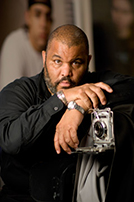 The renowned photographer Dawoud Bey will deliver the keynote address during Convocation at the 2010 CAA Annual Conference in Chicago. A resident of the conference city, Bey is Distinguished College Artist and Associate Professor of Art at Columbia College Chicago. He is the second photographer in four years to speak at Convocation, with Duane Michals delivering the keynote address at the 2007 conference in New York.
Convocation, which also includes the presentation of the CAA Awards for Distinction, takes place at the Hyatt Regency Chicago on Wednesday evening, February 10, 2010, 5:30–7:00 PM. The event is free and open to the public.
Bey earned a BA at Empire State College and an MFA at the Yale University School of Art, and he has been teaching for more than thirty years. He began his artistic career in 1975 with a series of photographs, Harlem, USA, that was later exhibited in his first solo exhibition at the Studio Museum in Harlem in 1979. He has since had numerous exhibitions worldwide, at such institutions as the Art Institute of Chicago, the Barbican Centre in London, the Los Angeles County Museum of Art, the Detroit Institute of Arts, the High Museum of Art in Atlanta, the National Portrait Gallery in London, the Wexner Center for the Arts in Ohio, and the Whitney Museum of American Art in New York, where his works were included in the 2000 Whitney Biennial.
Since 1992 he has completed several collaborative projects working with young people and museums together in a broad dialogue that seeks to create an engaging space for art making and institutional interrogation. These projects, such as photographs from the Character Project, have also been aimed at broadening the participation of various communities served by these institutions.
The Walker Art Center in Minneapolis organized a midcareer survey of his work in 1995 that traveled to institutions throughout the United States and Europe. A major publication, Dawoud Bey: Portraits, 1975–1995, was published in conjunction with that show. Aperture published his latest project, Class Pictures, in 2007 and mounted an exhibition of this work that has been touring museums nationally.
Bey’s works are included in permanent collections of art museums worldwide, including the Art Institute of Chicago, the Brooklyn Museum, the Detroit Institute of Arts, the Los Angeles County Museum of Art, and the Museum of Contemporary Art in Chicago, among others. He has received numerous fellowships over the course of his career, including those from the John Simon Guggenheim Memorial Foundation and the National Endowment for the Arts.
A writer as well as an artist, Bey has published critical writings on contemporary art in books and journals throughout the US and Europe. He is the author of several groundbreaking essays, including “The Black Artist as Invisible (Wo)Man” in the catalogue for High Times, Hard Times: New York Painting, 1967–1975 (2006), in which he places the work of African American artists Al Loving, Joe Overstreet, Howardena Pindell, and Jack Whitten within this important era in art history. Bey is also the author of “David Hammons: In the Spirit of Minkisi” (1994), which was one of the first texts to place this important African American artist within the tradition of Black Atlantic cosmological tradition. This essay appeared as the catalogue essay for Hammon’s survery exhibition at the Salzburger Kunstverein in Vienna. Closer to home, his text “Authoring the Black Image” was published in the Art Institute of Chicago’s book The VanDerZee Studio, accompanying the eponymous exhibition from 2004.
The above portrait photograph is © Bart Harris.
Fall 2009 Art Journal Published
posted Oct 21, 2009
 In her editor’s introduction to the Fall 2009 issue of Art Journal, Judith Rodenbeck discusses a text by Erwin Panofsky that she relates to the current interest in reenactment. Making a further connection to the four essays and the roundtable discussion in the current issue, she suggests that “Panofsky’s insistence on the detailed and intertwined study of form, content, and context here bears reconsideration, albeit under the revised skies of our own time.”
In “Imperious Griffonage,” Hajime Nakatani explores the role of the Chinese written character in the work of the artist Xu Bing and several of his contemporaries, finding that both the standard script characters and Xu’s inventive pseudocharacters show curious signs of a life of their own. In an essay that contextualizes Jo Baer’s paintings and writing of the late 1960s, Patricia Kelly accentuates the artist’s innovative exhibition strategies, intended to engage the viewer in a participatory manner.
Jane McFadden writes about the art of Walter de Maria in “Earthquakes, Photoworks, and Oz,” focusing first on his photoworks of the 1960s and then on his best-known work, The Lighting Field, and its mediation through photography. In her essay on the reception of Louise Bourgeois’s 1964 Stable Gallery exhibition, Elyse Speaks examines the consistency of the artist’s treatment of themes of the body and the home.
Art Journal assembled an expert panel of scholars for a critical discussion of the promises and pitfalls of transcultural exchange in The Third Mind: American Artists Contemplate Asia, 1860–1989, a 2009 exhibition at the Guggenheim Museum. Alexandra Munroe, the chief curator of the exhibition, responds.
In the Reviews section of this issue, Clark Buckner considers three recent books on curatorial and exhibition practice, Marc James Léger examines two books about art and activism, and Soraya Murray evaluates two books on new-media art.
New Report Compares Virtual-Gallery Software
posted Oct 20, 2009
 Technology in the Arts has published a free report, entitled Virtual Gallery Software Review, that reviews and compares three software applications—Virtual Galleries, Image Armada, and SceneCaster/3D Scenes—designed to help artists, curators, and art organizations create three-dimensional virtual exhibitions. This type of technology can provide not only a useful alternative experience for audiences that cannot physically attend a live exhibition, but it can also potentially help students and professionals learn about exhibition planning and installation.
The task of building virtual galleries or exhibitions can often be daunting and costly. Despite software that facilitates the development of virtual environments for conferences, commercial expos, and education, solutions for creating virtual art exhibitions have been scarce. For these reasons, two important criteria for the study were ease of use and user-friendly design. The primacy of these criteria also prompted the researchers to exclude Second Life because of its steep learning curve for environment creation.
Researchers looked for five features desirable in an application used by artists and arts professionals: ease of creating an exhibition; quality of images; flexibility of creating an exhibition; ease of navigation in the three-dimensional space; and ease of publishing or distributing the gallery. The report contains individual descriptions of the three applications, as well as comparisons of their features, such as Mac and PC compatibility, hardware requirements, internet-based viewing, and image and lighting manipulation.
Technology in the Arts, an organization that explores the intersection of arts management and technology, offers services such as consulting, professional-development training, webinars, an online resource directory, monthly podcasts, and a discussion-based blog. It is part of the Center for Arts Management and Technology, an applied research center at Carnegie Mellon University exploring ways in which arts managers can employ online technologies to meet their organizational goals and engage audiences more effectively.
Free Public Program in New York on Orphan Works
posted Oct 14, 2009
CAA invites members in the tristate area of New York, Connecticut, and New Jersey to attend an upcoming panel on orphan works, entitled “Lost and Found: A Practical Look at Orphan Works.” The program is free and open to the public, but registration is required.
Lost and Found: A Practical Look at Orphan Works
Tuesday, October 20, 2009
Meeting Hall, New York City Bar Association, 42 West 44th Street, New York
How should the law treat “orphan works”? Please join us as we discuss proposals that would enable copyrighted works to be used when their owners cannot be located to obtain necessary permissions. What should be the obligations of potential users with respect to searching for copyright owners? How should infringement claims be handled if a copyright owner emerges? Do different types of copyrighted works present unique issues? What roles might registries and recognition and detection technologies play? Our speakers will address these and related questions, focusing on orphan images.
June M. Besek, executive director of the Kernochan Center for Law, Media, and the Arts, is the panel moderator. Speakers are:
- Brendan M. Connell, Jr., Director and Counsel for Administration, Solomon R. Guggenheim Foundation
- Frederic Haber, Vice President and General Counsel, Copyright Clearance Center
- Eugene H. Mopsik, Executive Director, American Society of Media Photographers
- Maria Pallante, Associate Register for Policy and International Affairs, US Copyright Office
- Charles Wright, Vice President and Associate General Counsel, Legal and Business Affairs, A&E Television Networks
“Lost and Found” is sponsored by the Art Law Committee (chaired by Virginia Rutledge) and the Copyright and Literary Property Committee (chaired by Joel L. Hecker) of the New York City Bar Association, in conjunction with Columbia Law School’s Kernochan Center for Law, Media, and the Arts.
Free Public Program in New York on Orphan Works
posted Oct 14, 2009
CAA invites members in the tristate area of New York, Connecticut, and New Jersey to attend an upcoming panel on orphan works, entitled “Lost and Found: A Practical Look at Orphan Works.” The program is free and open to the public, but registration is required.
Lost and Found: A Practical Look at Orphan Works
Tuesday, October 20, 2009
Meeting Hall, New York City Bar Association, 42 West 44th Street, New York
How should the law treat “orphan works”? Please join us as we discuss proposals that would enable copyrighted works to be used when their owners cannot be located to obtain necessary permissions. What should be the obligations of potential users with respect to searching for copyright owners? How should infringement claims be handled if a copyright owner emerges? Do different types of copyrighted works present unique issues? What roles might registries and recognition and detection technologies play? Our speakers will address these and related questions, focusing on orphan images.
June M. Besek, executive director of the Kernochan Center for Law, Media, and the Arts, is the panel moderator. Speakers are:
- Brendan M. Connell, Jr., Director and Counsel for Administration, Solomon R. Guggenheim Foundation
- Frederic Haber, Vice President and General Counsel, Copyright Clearance Center
- Eugene H. Mopsik, Executive Director, American Society of Media Photographers
- Maria Pallante, Associate Register for Policy and International Affairs, US Copyright Office
- Charles Wright, Vice President and Associate General Counsel, Legal and Business Affairs, A&E Television Networks
“Lost and Found” is sponsored by the Art Law Committee (chaired by Virginia Rutledge) and the Copyright and Literary Property Committee (chaired by Joel L. Hecker) of the New York City Bar Association, in conjunction with Columbia Law School’s Kernochan Center for Law, Media, and the Arts.
CAA Launches Conference Website and Opens Online Registration
posted Oct 08, 2009
 The CAA Annual Conference is the world’s largest international forum for professionals in the visual arts. More than four thousand artists, art historians, curators, educators, and students are expected to meet February 10–13, 2010, at the Hyatt Regency in Chicago.
2010 Annual Conference Website
The conference website, which contains registration information, travel and hotel details, Career Services features, reception and meeting listings, special events, and more, was launched yesterday.
The conference website expands on the 2010 Conference Information and Registration booklet that will arrive in members’ mailboxes later this month; new material and information will be added regularly between now and February.
Listings of session titles and chairs are also available on the conference website. Full session details, including the names of panelists and their paper titles, will be posted soon.
Register Online Now
Online registration opened yesterday. You can also buy tickets for other events, such as the Gala Reception, professional-development workshops, and postconference tours. Alternatively, you may use the printed forms in Conference Information and Registration.
Early registration is available through December 11, 2009:
- Members: $155
- Student and retired members: $90
- Nonmembers: $280
Reserve Your Hotel Room
CAA was able to renegotiate cheaper hotel rates at the Hyatt Regency Chicago, the headquarters hotel, to help save conference attendees even more money. See Travel & Lodging on the conference website for full details.
Should Libraries Toss Their Old Print Journals? A New Report on Digitizing Library Collections
posted Oct 06, 2009
Many journals are sufficiently preserved digitally and housed in print repositories so that some libraries can responsibly withdraw their own print holdings, according to a new report published by Ithaka S+R. Written by Roger Schonfeld and Ross Housewright, “What to Withdraw: Print Collections Management in the Wake of Digitization” takes a system-wide approach to the needs of libraries and their users collectively, rather than focusing on regions, systems, or consortia.
“Libraries are right to push aggressively into the digital future but should do so with an awareness about risk and tradeoffs,” said Housewright, an analyst at Ithaka S+R, the strategy and research arm of the nonprofit organization ITHAKA, which is also the parent company of JSTOR and Portico.
Looking at reasons for retaining and preserving physical copies of scholarly journals, “What to Withdraw” proposes minimum time periods that require libraries to give access to both print and digital versions. It then offers a minimum number of required print copies to retain. Based on this analysis, the report concludes that certain print journal backfile sets are well enough digitized and contain few enough images that it is unlikely there will be future demand for them by users.
Some print materials, the authors warn, may not yet be ready for broad withdrawal without risk. For these materials, several strategies are recommended to give libraries more flexibility. First, organizations responsible for digitization programs should provide more transparency on the quality of their digitization work and participate in ongoing efforts to upgrade the quality of their scans. In addition, libraries should form deeper partnerships with publishers and other digitizers.
“There is an opportunity before us to make a system-wide impact on print collection management,” said Housewright, “but in order to do so libraries and digitizers need to commit to collaboration at a level unseen today.”
Women’s Caucus for Art Announces 2010 Lifetime Achievement Awards
posted Oct 05, 2009
The Women’s Caucus for Art (WCA) has announced the recipients of the 2010 Lifetime Achievement Awards: Tritobia Hayes Benjamin, an educator and art historian from Washington, DC; Mary Jane Jacob, a curator and educator in Chicago; Senga Nengudi, an artist based in Colorado Springs; Joyce J. Scott, a visual and performance artist from Baltimore; and New York’s Spiderwoman Theater, comprising Lisa Mayo, Gloria Miguel, and Muriel Miguel.
These awards were first awarded in 1979 to Isabel Bishop, Selma Burke, Alice Neel, Louise Nevelson, and Georgia O’Keeffe in a ceremony at President Jimmy Carter’s Oval Office. Past honorees have represented the full range of distinguished achievement in the visual arts, and this year’s awardees are no exception, with considerable accomplishment, achievement, and contributions represented by their professional efforts.
Tritobia Hayes Benjamin
Tritobia Hayes Benjamin is professor of art history and director of the Gallery of Art at Howard University in Washington, DC, where she is also associate dean of the Division of Fine Arts in the College of Arts and Sciences. After receiving her bachelor’s and master’s degrees in art history from Howard, she earned a PhD in the same subject from the University of Maryland. On the faculty of Howard since 1970, Benjamin has written and lectured widely on African American art and artists, including the 1994 publication, The Life and Art of Lois Mailou Jones.
Mary Jane Jacob
Mary Jane Jacob is a curator, educator, and author noted for her work on the national and international art scene. She currently serves as professor in the Department of Sculpture and executive of exhibitions at the School of the Art Institute of Chicago. She began her curatorial career at the Detroit Institute of Arts in the late 1970s before becoming chief curator of the Museum of Contemporary Art, Chicago, and the Museum of Contemporary Art, Los Angeles. In the public realm, Jacobs has organized multiyear installations and commissioned outdoor sculptures in urban and park settings. She has also published numerous books and exhibition catalogues on contemporary art.
Senga Nengudi
Senga Nengudi is strongly committed to both creating art and arts education. Currently a lecturer at the University of Colorado in Colorado Springs in the Visual Arts and Performing Arts Department, she has always been involved with bringing arts programs emphasizing diversity to the communities in which she resides. Presently Nengudi’s sculptures are taking the form of installations of increasing size. She has been a featured performance artist, dancer, and installation artists in numerous exhibitions at major museums.
Joyce J. Scott
A native of Baltimore, Joyce J. Scott is a highly internationally regarded artist whose work incorporates various artistic media, including sculpture, jewelry, glass, printmaking, installation, and performance art. Her pieces draw strong influence from a wide range of sources: African and Native American experiences, comic books, television, popular American culture, and the culture of the streets of her urban Baltimore neighborhood. The use of beads is a central element throughout Scott’s work, helping turn her works into bold statements about such issues as racism, sexism, violence, and other forms of social injustice.
Spiderwoman Theater (Lisa Mayo, Gloria Miguel, and Muriel Miguel)
Spiderwoman Theater was founded in 1976 when Muriel Miguel gathered a diverse company of women of varying ages, races, sexual orientations, and worldviews, which included her two sisters. As the oldest women’s theater company in North America and originally emerging from the feminist movement, Spiderwoman continues moving toward its goal of creating an artistic environment where indigenous arts and culture—the three are from the Kuna and Rappahannock nations—thrive as an integrated and vital part of the larger arts community. Taking its name from the Hopi creation goddess Spiderwoman, who taught the people to weave, the theater calls its technique of creating their theatrical pieces “story weaving,” in which performers write and present personal and traditional stories that are layered with movement, text, sound, music, and visual images.
Award Ceremony in Chicago
The Lifetime Achievement Awards will be held at the Chicago Cultural Center, 77 East Randolph Street, on Saturday, February 13, 2010, in conjunction with the WCA and CAA annual conferences (WCA is a CAA affiliated society). A dinner will be held from 6:30 to 7:30 PM in the center’s G.A.R. Hall. The awards ceremony will follow at 7:30 PM in the Cassidy Theater. Tickets for the dinner—$90 before January 1, 2010, and $100 after—will be available for purchase from the WCA website. Reserved seating tickets for the awards ceremony will also be available for $10; limited general-audience seating for the awards ceremony is free and available on a first-come, first-served basis—please arrive early. For more information about WCA, please contact Karin Luner, national administrator.
Inside Higher Ed Reports on the “Great Universities Have Great Museums” Movement
posted Oct 01, 2009
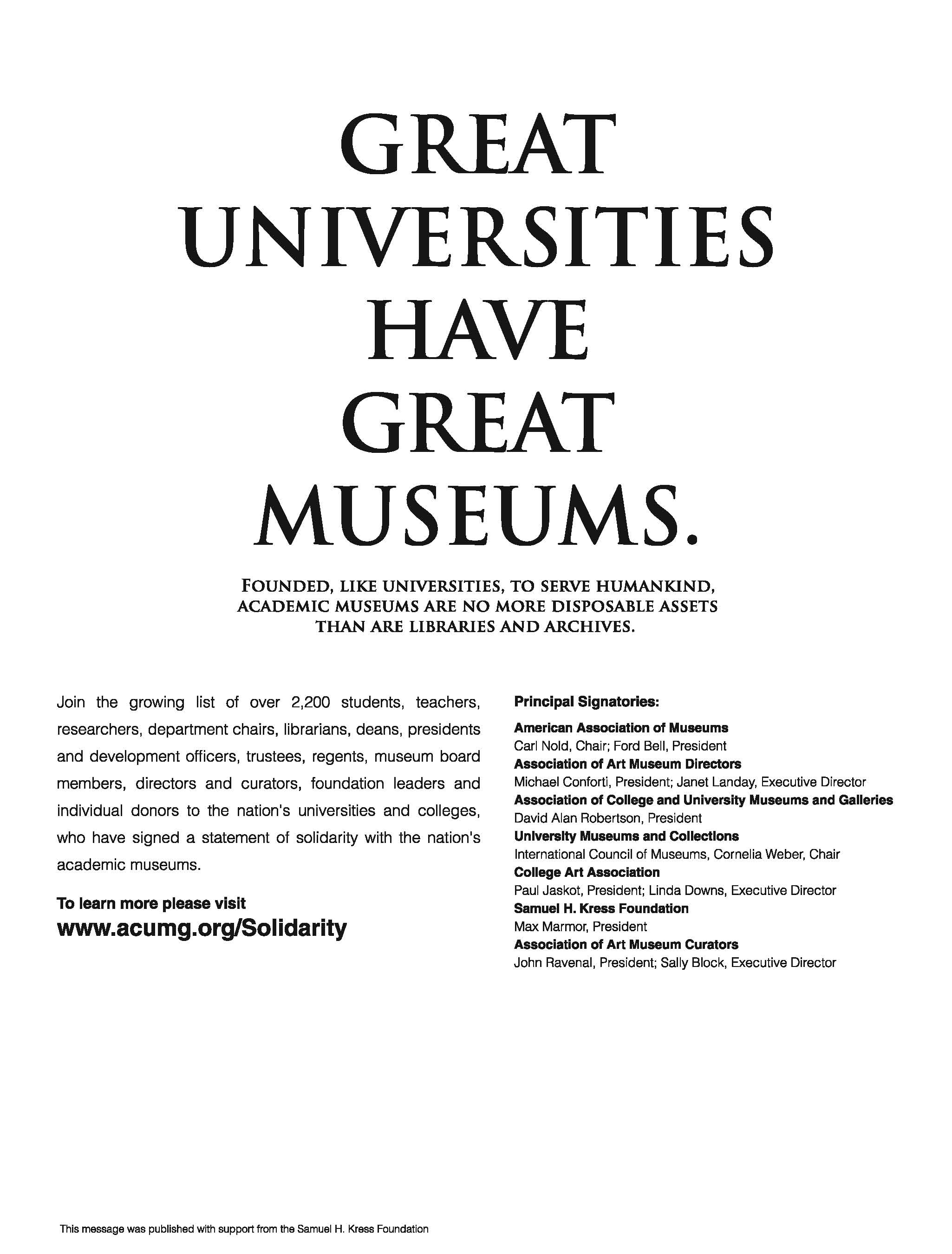 Today in Inside Higher Ed, Scott Jaschik reports on recent work of a task force, comprising representatives from seven national and international organizations, that is raising awareness of the value of university and college art museums and galleries in light of recent events involving attempts by schools to sell work from their collections.
In “Avoiding the Next Brandeis,” Jaschik talks to the task-force cochair David Alan Robertson, director of Northwestern University’s Mary and Leigh Block Museum of Art, who is “trying to impress upon [regional higher-education accrediting agencies] that museums shouldn’t be viewed as extras, but as ‘teaching institutions and research institutions.’” Jaschik continues, “Another strategy being discussed is encouraging colleges to define the financial exigency plans—or what they would do in a severe financial crisis—and to make the case that museums should not be the first institutions to be closed.”
Lyndel King, task-force cochair and director and chief curator of the Frederick R. Weisman Art Museum at the University of Minnesota, Twin Cities, tells the reporter that “we need to educate college administrators and governing boards that disposing of their collections can’t be a way to fill the coffers or seen as an easy way to bring in money.”
The task force comprises representatives from CAA, the American Association of Museums, the Association of Art Museum Directors, the Association of College and University Museums and Galleries, the International Council of Museums, the Samuel H. Kress Foundation, and the Association of Art Museum Curators. The next meeting of the task force will take place on January 9, 2010, in Sarasota, Florida, in conjunction with the midwinter gathering of the Association of Art Museum Directors.
You may read the petition, published by the task force in July 2009, and include your name and affiliation in the growing list of signatories. A prominent advertisement will appear in the Chronicle for Higher Education later this month; you can download a PDF of it or click and save the above image for use in blogs, press, and more. The task force had planned to include all signatories in the ad, but the list has exceeded 2,200 names and institutional affiliations—too many to include in print.
Inside Higher Ed Reports on the “Great Universities Have Great Museums” Movement
posted Oct 01, 2009
Today in Inside Higher Ed, Scott Jaschik reports on recent work of a task force, comprising representatives from seven national and international organizations, that is raising awareness of the value of university and college art museums and galleries in light of recent events involving attempts by schools to sell work from their collections.
In “Avoiding the Next Brandeis,” Jaschik talks to the task-force cochair David Alan Robertson, director of Northwestern University’s Mary and Leigh Block Museum of Art, who is “trying to impress upon [regional higher-education accrediting agencies] that museums shouldn’t be viewed as extras, but as ‘teaching institutions and research institutions.’” Jaschik continues, “Another strategy being discussed is encouraging colleges to define the financial exigency plans—or what they would do in a severe financial crisis—and to make the case that museums should not be the first institutions to be closed.”
Lyndel King, task-force cochair and director and chief curator of the Frederick R. Weisman Art Museum at the University of Minnesota, Twin Cities, tells the reporter that “we need to educate college administrators and governing boards that disposing of their collections can’t be a way to fill the coffers or seen as an easy way to bring in money.”
The task force comprises representatives from CAA, the American Association of Museums, the Association of Art Museum Directors, the Association of College and University Museums and Galleries, the International Council of Museums, the Samuel H. Kress Foundation, and the Association of Art Museum Curators. The next meeting of the task force will take place on January 9, 2010, in Sarasota, Florida, in conjunction with the midwinter gathering of the Association of Art Museum Directors.
You may read the petition, published by the task force in July 2009, and include your name and affiliation in the growing list of signatories. A prominent advertisement will appear in the Chronicle for Higher Education later this month; you can download a PDF of it or click and save the above image for use in blogs, press, and more. The task force had planned to include all signatories in the ad, but the list has exceeded 2,200 names and institutional affiliations—too many to include in print.