
CAA News Today
NEA Releases Report on How Americans Use Electronic Media to Participate in the Arts
posted Jul 06, 2010
 According to a new report published by the National Endowment for the Arts (NEA), Americans who participate in the arts through the internet, television, radio, computers, and handheld devices are almost three times more likely to attend live arts events than nonmedia participants (59 percent versus 21 percent). Users of technology and electronic media also attend, on average, twice as many live arts events—six versus three in a single year—and see a wider variety of genres.
The report, called Audience 2.0: How Technology Influences Arts Participation, looks at who is participating in the arts through electronic media, what factors affect their participation, and the relationships among media-based arts activities, live attendance, and personal arts creation. Audience 2.0 has determined that media-based arts participation appears to encourage—rather than replace—attendance at live arts events. Among the conclusions:
- Education continues to be the best predictor of arts participation among adults, both for live attendance and through electronic media. Survey respondents with at least some college education were more likely than respondents with a grade-school education to have used electronic media to participate in the arts
- For many Americans—primarily older Americans, lower-income earners, and racial/ethnic minority groups—electronic media is the only way they participate in arts events
- The 15.4 percent of US adults who use media only to engage with the arts are equally likely to be urban or rural
- Twenty-one percent (47 million) of all US adults reported using the internet to view music, theater, or dance performances in the last twelve months. Twenty-four percent (55 million) obtained information about the arts online
Audience 2.0 expands on the research published in the NEA’s 2008 Survey of Public Participation in the Arts (SPPA). This survey, conducted in partnership with the US Census Bureau and released last year, is the nation’s largest, most representative study of arts participation among American adults. Since 1982, SPPA has measured American adult participation in activities such as visits to art museums or galleries and attendance at jazz and classical music concerts, opera and ballet performances, and musical and nonmusical plays. SPPA categorizes these as “benchmark” activities, providing a standard group of arts activities for more than two decades of consistent trend analysis. Audience 2.0 takes a closer look at how audiences use electronic media to engage in these benchmark activities.
In an agency first, the new report is being released only in an electronic format that includes multimedia features. Chairman Rocco Landesman’s video greeting is accompanied by a video commentary on the report from Sunil Iyengar, NEA director of research and analysis. Additionally, each chapter will open with videos from arts organizations that represent each of the benchmark disciplines tracked by the report. Arts organizations can use findings from Audience 2.0 to better understand their audiences’ uses of technology and electronic media.
As part of its ongoing analysis of SPPA data, the NEA is making raw data and detailed statistical tables available to researchers and the public. The tables highlight demographic factors affecting adult participation in a variety of art forms.
Propose a Session for the 2012 Annual Conference in Los Angeles
posted Jun 30, 2010
CAA invites individual members to propose a session for the 2012 Annual Conference, taking place February 22–25, 2012, in Los Angeles. Proposals should cover the breadth of current thought and research in art, art and architectural history, theory and criticism, pedagogical issues, museum and curatorial practice, conservation, and developments in technology. The Los Angeles conference closes CAA’s Centennial year, which will begin at the New York meeting in February 2011.
The Annual Conference Committee welcomes session proposals from established artists and scholars, along with younger scholars, emerging and midcareer artists, and graduate students. Particularly welcome are those proposals that highlight interdisciplinary work. Artists are especially encouraged to propose sessions appropriate to dialogue and information exchange relevant to artists.
Proposals are only accepted online; paper forms and postal mailings are not required. To set up an account in CAA’s content management system, please email Lauren Stark, CAA manager of programs, who will register your email address and provide you with a password. For full details on the submission process, please visit Chair a Conference Session. Deadline: September 1, 2010; no late applications are accepted.
CAA’s Committee on Women in the Arts Publishes Its July Picks
posted Jun 29, 2010
CAA’s Committee on Women in the Arts (CWA) has inaugurated a new section of the CAA website, called CWA Picks. Each month, the committee will produce a curated list of exhibitions, conferences and symposia, panels, lectures, and other events related to the art and scholarship of women.
The CWA Picks for July 2010 include an exhibition of prints by June Wayne in Washington, DC; screenings of films by Sally Potter at the Museum of Modern Art in New York; and a forum on women working in glass art in Seattle. In addition, all five exhibitions in the CWA Picks for June are still on view.
Center for Social Media Publishes Fair-Use Guidelines for Communications Scholars
posted Jun 28, 2010
The Center for Social Media, part of the School of Communication at American University in Washington, DC, has published the Code of Best Practices in Fair Use for Scholarly Research in Communication. Patricia Aufderheide, the center’s director, and Peter Jaszi, a professor of law at the university’s Washington College of Law and head of the Program on Information Justice and Intellectual Property, worked with an ad hoc committee on fair use and academic freedom assembled by the International Communication Association to write the text.
The Code of Best Practices in Fair Use for Scholarly Research in Communication is targeted to the work of communications scholars, which draws on the empirical research methods of the social sciences and the qualitative studies of the humanities.
Like their counterparts in other academic areas, including art and art history, communications scholars are often unsure of their rights under United States copyright law. The new best practices give them general information about fair use and describe four situations in which it usually applies: analysis, criticism, and commentary of copyrighted works; quoting copyrighted material for illustration; using copyrighted work to stimulate response, discussion, and other reactions during research; and storing copyrighted material in personal collections and archives.
For more on how copyright relates to art and art history, please visit CAA’s website section on Intellectual Property and the Arts.
ProQuest Takes over the Bibliography of the History of Art from the Getty Research Institute
posted Jun 23, 2010
The Getty Research Institute (GRI) has announced an agreement with ProQuest, an information-technology firm supporting global research, that will allow ProQuest to take over the indexing of the International Bibliography of Art (IBA), better known as the Bibliography of the History of Art (BHA). The agreement will not only provide a secure future for a resource considered central to the study of art history, but will also assure its continuing development and its accessibility to researchers around the world.
ProQuest will distribute IBA content created by GRI—covering the years 2008 through 2009—and build on it by adding new index records going forward. ProQuest will retain the editorial policies that made IBA a trusted and frequently consulted source in the field, continuing to provide full abstracts and subject indexing for its wide international and multilingual range of periodicals, monographs, and catalogues. Over time, ProQuest intends to expand coverage of art from Asia, Latin America, and Africa, in response to requests from art librarians and researchers. Since its founding in 1972, the bibliography has mostly covered European and American art from late antiquity to the present.
ProQuest, which operates expansive digital archives of newspapers, dissertations, and journals, also publishes specialist databases in the arts, such as ARTbibliographies Modern, Design and Applied Arts Index, and the International Index to Music Periodicals. Further, BHA, discontinued at the end of 2007, has long been available to researchers through ProQuest on the CSA Illumina platform. Users will welcome IBA with its expanded coverage and similar format, and ProQuest will enable IBA to be cross-searched with these other major bibliographies and complementary full-text resources.
As part of the ProQuest family, IBA will benefit from ProQuest’s acclaimed editorial operations, with its emphasis on subject expertise and manual indexing for specialist arts and humanities resources. ProQuest will make existing IBA content available immediately, and at the same time bring the database up to date—no additions have been made to it since December 2009—and continuing to add new records. IBA will migrate to ProQuest’s all-new platform in early 2011.
GRI has supported bibliographical services for art history since 1981, when it took over the International Repertory of the Literature of Art (RILA), which was then housed at the Sterling and Francine Clark Art Institute after many years. Beginning in 1985, GRI partnered with the French Centre National de la Recherche Scientifique (CNRS), which produced the Répertoire d’Art et d’Archéologie (RAA), a publication similar to RILA. RILA and RAA merged to become BHA, which appeared first in 1991, published by CNRS’s database production and distribution arm, the Institut de l’Information Scientifique et Technique (INIST).
BHA was produced jointly by GRI and INIST until 2008. Thereafter, GRI continued producing records under the new name of IBA before budgetary constraints led to the difficult decision to discontinue its support earlier this year. At this time, GRI made IBA (as well as the historical data in BHA and RILA) freely available on its website, so the historical data would continue to aid researchers. Thomas Gaehtgens, GRI director, confirms that “we will continue to make the historical BHA and RILA data available on the website free of charge to researchers who access it.”
Audio Downloads from the 2010 Chicago Conference Still Available
posted Jun 21, 2010
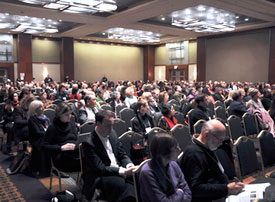 The 2010 Annual Conference in Chicago, one of the best attended in recent years, had an incredibly diverse array of sessions. Audio recordings for eighty-one of those panels are now available for sale.
A set of MP3 audio recordings from the Chicago conference is available for only $149.95, either as a download or on interactive CD-ROMs. Individual sessions, available only as downloads, are $24.95 each. Please visit Conference Media to view the list of sessions and to order.
Available sessions include such timely topics as “Lifeloggers: Chronicling the Everyday” and “Autofictions, Avatars, and Alter Egos: Fabricating Artists.” Thematic art-historical topics, on analyzing repetition in ancient art and on violence and narrative in early modern art, also make appearances, as do state of the field talks on the art history of the African diaspora and on American-art textbooks. Included in the mix are pedagogical sessions involving “Autonomizing Practices in Art, Art History, and Education” and “WTF: Talking Theory with Art and Art-History Undergrads,” among others.
Whether you took part in, attended, or missed a particular conference session, these recordings are a must-have for your library, research, or teaching. Listen to them while walking across campus, while driving in your car or using public transportation, or while relaxing in your home.
In addition to the Chicago sessions, you can also purchase session audio recordings from the 2006–9 conferences in Boston, New York, Dallas–Fort Worth, and Los Angeles. See http://conference.collegeart.org/audio for details.
Photo: The audience of a 2010 Annual Conference session (photograph by Bradley Marks)
Senior Conservator Says Haiti’s Paintings Can Be Restored
posted Jun 16, 2010
The Institute of Museum and Library Services (IMLS) has released a podcast interview with Susan Blakney, a senior painting conservator and the founder of Westlake Conservators. She traveled to Haiti May 4–8, 2010, to assess the conservation needs of artwork damaged by the January earthquake.
Blakney and two other conservators visited a dozen museums, which she reports have made great strides in retrieving and storing damaged artwork. She describes seeing five hundred paintings that were stacked “in a pile like pancakes,” awaiting conservation care. Haitians are anxious to save their paintings, which are one of their “national loves and largest exports,” she says. However, the country does not have the materials it needs to conserve these integral parts of its social history, she adds. Conservators will be needed for many years to help restore the country’s artwork and to train Haitian artists on conservation techniques. Blakney is certain that the paintings she assessed can be restored to exhibition standards.
Blakney was part of emergency conservation team sent to Haiti by the American Institute for Conservation (a CAA affiliated society) with support from IMLS. These efforts are part of the Smithsonian Institution’s Haitian Cultural Recovery Project, which is also receiving support from the President’s Committee on the Arts and the Humanities, the National Endowment for the Humanities, the National Endowment for the Arts, and the Broadway League. The US Committee of the Blue Shield, a nonprofit, nongovernmental organization dedicated to the protection of cultural property affected by conflict or natural disasters, is serving as the international coordinator of this conservation effort.
June Obituaries in the Arts
posted Jun 15, 2010
CAA recognizes the lives and achievements of the following artists, scholars, photographers, critics, collectors, museum directors, and other important figures in the visual arts. Of particular interest is a text on the artist and teacher Marvin Lowe, written especially for CAA by Wendy Calman.
- Arakawa, an artist born in Japan but based in New York who with his wife strove to halt aging with paintings and installations, died on May 18, 2010. He was 73
- Louise Bourgeois, an internationally acclaimed artist who created psychologically charged work in sculpture and on paper that has inspired countless artists, died on May 31, 2010, at the age of 98. CAA’s Committee on Women in the Arts is preparing a tribute to Bourgeois, to appear on the CAA website later this month
- David Dillon, a longtime architecture critic for the Dallas Morning News and the author of a dozen books, died on June 3, 2010, at the age of 68
- Brian Duffy, a fashion and portrait photographer known for his fiery temper as much as his work in swinging London as part of the Black Trinity, died on May 31, 2010. He was 76
- Teshome H. Gabriel, a cinema scholar in the School of Theater, Film, and Television at the University of California, Los Angeles, died on June 14, 2010
- Dennis Hopper, a maverick yet revered Hollywood actor who was also a photographer and a collector of modern art, died on May 29, 2010. He was 74
- Lester Frederick Johnson, an American figurative painter who was a member of the second generation of Abstract Expressionists, died on May 30, 2010. He was 91
- Donald Krieger, an artist and performer based in Los Angeles who also taught graphic design and began curating, died on May 3, 2010. He was 57
- Marvin Lowe, an artist, musician, and longtime professor of printmaking at Indiana University, died on April 28, 2010, at the age of 87. Read Wendy Calman’s special obituary on him
- Sigmar Polke, a highly influential German painter who in the 1960s helped found Capitalist Realism with Gerhard Richter and Konrad Lueg, died on June 10, 2010. He was 69
- Stephen Smarr, a master glass artist based in Bloomsbury, New Jersey, died on May 28, 2010, at the age of 53
- Michael Wojas, the owner of and bartender at London’s infamous Colony Room Club who served Francis Bacon, Damien Hirst, Sarah Lucas, and Tracey Emin, died on June 6, 2010. He was 53
- Tobias Wong, a New York–based conceptual designer and artist who was included in exhibitions at the Cooper-Hewitt and Museum of Modern Art, died on May 30, 2010. He was 35
- James N. Wood, president of the J. Paul Getty Foundation and the director of the Art Institute of Chicago for twenty-four years, died on June 11, 2010. He was 69
Read all past obituaries in the arts on the CAA website.
Marvin Lowe: In Memoriam
posted Jun 15, 2010
Wendy Calman is associate professor and cohead of printmaking at the Henry Radford Hope School of Fine Arts at Indiana University in Bloomington.

Marvin Lowe (photograph provided by Wendy Calman)
Marvin Lowe, an artist, musician, and professor emeritus at Indiana University, died peacefully on April 28, 2010, in Tucson, Arizona. He was 87 years old.
Lowe was born in Brooklyn, New York, on May 19, 1922. He attended Brooklyn Technical High School, studying math and physics while cultivating an early love for music, particularly jazz. Joining the Navy during World War II, he played tenor saxophone in Artie Shaw’s navy band, and in the band on the battleship Arkansas. Home from war, Lowe played with big bands led by Raymond Scott, Woody Herman, and Bobby Sherwood. On tour in St. Louis, he met the Watkins Twins, Juel and June, a professional vaudeville act whose signature performance included dancing on point atop a bass drum. Lowe married Juel on April 1, 1949. Music and dance filled their life together. Their daughter Melissa, born in 1955, became a professional ballerina, and their granddaughter Claire is an accomplished dancer in her own right.
Lowe entered the Juilliard School to study musical composition, then received a BA in English literature from Brooklyn College in 1955, spending his free time visiting art museums. He also began to draw. Performing in nightclubs, Lowe became friends with the iconic artist Larry Rivers, who also played sax. Lowe showed him his drawings, and Rivers was encouraging. Tired of the distractions of life as a jazz musician, Lowe applied to the printmaking program at the University of Iowa, where under the direction of Mauricio Lasansky he spent the next four years developing as an artist. Playing jazz to support his family, Lowe also took a job in the Physics Department, reawakening a childhood interest in astronomy and cosmology, elements that would resurface frequently in his work.
Receiving his MFA in 1960, Lowe taught at Berea College in Kentucky and at Bucknell University in Pennsylvania. At a workshop in Florence, Italy, he met the artist Rudy Pozzatti, and “the rest is history.” Lowe was hired at Indiana University, Bloomington, in 1967, where he and Pozzatti worked together building the IU Printmaking Workshop’s outstanding reputation for teaching and research. Joined by Wendy Calman in 1976, they spent fifteen years creating one of the most successful and highest-ranked printmaking programs in the United States.

Marvin Lowe, Earth, 1995, acrylic and college on paper (artwork © Marvin Lowe; photograph provided by Wendy Calman)
Lowe’s works have been shown in over two hundred national and international exhibitions, and can be found in eighty permanent museum, university, and corporate collections, most notably the British Museum, the Japan Print Association (Tokyo), the Library of Congress, the New York Public Library, the Smithsonian Institution, the Art Institute of Chicago, the Philadelphia Museum of Art, and the Brooklyn Museum. He has had over fifty solo exhibitions and received more than thirty awards, among them a National Endowment for the Arts Artist’s Fellowship and a Ford Foundation grant.
Retired from teaching in 1991, Lowe created an extensive repertoire of works forging new directions. His mixed-media pieces, which include aspects of collage, painting, and printmaking, some over ten feet wide, incorporated figurative elements, astrological charts, and decorative ritual forms. Ideas about science, politics, history, and music resound throughout this period. Lowe continued to live and work in the studio built for him by his family in Tucson, Arizona, where he settled after his wife Juel died in 2002.
Writing about their friend and colleague, Pozzatti and Calman stated, “His most important contributions are the least tangible. His exciting intellect, his energy, his tenacity, his generosity, and his great sense of humor have given those of us fortunate enough to have worked with him a presence that will remain as an inspiration to us all.”
Lowe is survived by his daughter Melissa Lowe Hancock; son-in-law Jory Hancock; granddaughter Claire Elise Hancock; nieces and nephews Geoffrey, Greg, and Cynthia Cortelyou, and Wedge and Kelly Watkins; and extended family. The legacy of his life lives on through them and the many students whose lives he touched.
Committee on Women in the Arts Picks for June 2010
posted Jun 10, 2010
Each month, CAA’s Committee on Women in the Arts singles out the best in feminist art and scholarship from North America and around the world. CWA Picks may include exhibitions, conferences, symposia, panels, lectures, and other events. The following selections should not be missed.
June 2010

Maude Kerns, Composition #85 (In and Out of Space), 1951, oil on canvas, 28 × 22 in. Gift of the Estate of Maude I. Kerns, collection of Jordan Schnitzer Museum of Art, University of Oregon, Eugene (1969:8.7). (photograph provided by the Whatcom Museum)
Show of Hands: Northwest Women Artists 1880–2010
Whatcom Museum
121 Prospect Street, Bellingham, WA 98225
April 24–August 8, 2010
The exhibition coincides with centennial of women’s suffrage in Washington State. Featuring more than ninety works of art by sixty-three women artists from Washington, Oregon, and British Columbia, Show of Hands celebrates women’s contributions to the legacy of Northwestern art and examines the myriad talents women of the Northwest have displayed since 1880 through painting, drawing, sculpture, photography, video, and installation.
Lil Picard and Counterculture New York
Grey Art Gallery
New York University, 100 Washington Square East, New York, NY 10003
April 20–July 10, 2010
Lil Picard and Counterculture New York features over seventy works by a pioneering feminist artist who played varied and acknowledged roles in the New York art world from the 1950s through the 1970s. This first comprehensive exhibition presents paintings, sculptures, drawings, collages, and several landmark installations and performances, as well as photographs, writings, and films. All works are drawn from the collections of the University of Iowa Museum of Art, which organized the show, and from the University of Iowa Libraries, which houses the artist’s extensive papers.
Pictures by Women: A History of Modern Photography
Museum of Modern Art
11 West 53rd Street, New York, NY 10019
May 7, 2010–March 21, 2011
Women have expanded the roles of photography during its 170-year history by experimenting with every aspect of the medium. Organized by Roxana Marcoci and Eva Respini, Pictures by Women: A History of Modern Photography presents a selection of outstanding photographs by women artists, charting the medium’s history from the dawn of the modern period to the present day. Including more than two hundred works, the exhibition features celebrated masterworks and new acquisitions by Diane Arbus, Berenice Abbott, Claude Cahun, Imogen Cunningham, Rineke Dijkstra, Florence Henri, Roni Horn, Nan Goldin, Helen Levitt, Lisette Model, Lucia Moholy, Tina Modotti, Cindy Sherman, Kiki Smith, and Carrie Mae Weems, among many others. The exhibition also highlights works drawn from a variety of curatorial departments, including Bottoms, a large-scale Fluxus wallpaper by Yoko Ono.
In Praise of America: Selections from the Sellars Collection of Art by American Women
Huntsville Museum of Art
300 Church Street South, Huntsville, AL 35801
June 13–August 29, 2010
Selected from the museum’s recent acquisition of over four hundred nineteenth- and twentieth-century works of art by American women, this exhibition presents accomplished landscapes, portraits, and genre scenes that celebrate the dramatic scenery, diverse people, and distinctive spirit of our great nation. Bringing a previously unseen facet of art history to life, the Sellars Collection offers a unique opportunity to discover contributions of women artists forged during a period of struggle and little recognition. The largest public collection of its kind, many of the artists represented in the collection studied at major academies, received accolades and awards, and pioneered the way for those who would follow. In Praise of America features approximately forty paintings, sculptures, and works on paper and includes engaging florals, still lifes, portraits, genre scenes, and landscapes reflecting different regions of the United States.

Ayumi Shigematsu, Circuit Tree, 2006, stoneware (artwork © Ayumi Shigematsu; photograph © Hideya Amemiya and provided by International Arts and Artists)
Soaring Voices: Recent Ceramics by Women from Japan
American University Museum
Katzen Arts Center at American University, 4400 Massachusetts Avenue NW, Washington, DC 20016
June 15–August 15, 2010
Through eighty-six works by twenty-five women artists, this exhibition, organized by International Art and Artists, showcases contemporary interpretations of a traditional art form through a range of motifs inspired from the natural world: plants, shells, mountains, rivers, and the play of light and shadow. Other sources of inspiration for these ceramic vessels can be found in the Noh Theater and kimono patterns of the Edo Period.