
CAA News Today
Svetlana Alpers Is CAA Distinguished Scholar
posted by Christopher Howard — November 10, 2008
The honoree of the 2009 Distinguished Scholar Session is Svetlana Alpers, a historian of seventeenth-century art and professor emerita of the University of California, Berkeley. Inaugurated in 2001, this Annual Conference session pays tribute to a renowned scholar who has made significant contributions to the field.
The Distinguished Scholar Session, entitled “Paintings/Problems/Possibilities” and chaired by Mariët Westermann of New York University, centers on the art of painting. The panel—which includes Alpers, Carol Armstrong of Yale University, Thomas Crow from New York University’s Institute of Fine Arts, the painter James Hyde, and Stephen Melville of Ohio State University—will focus on six pictorial images proposed by Alpers. The session takes place on Thursday, February 26, 2009, 2:30–5:00 PM, at the Los Angeles Convention Center, Room 502AB, Level 2.
After earning a BA from Radcliffe College in 1957, Alpers completed her doctorate in fine arts at Harvard University in 1965. She began teaching at the University of California, Berkeley, in the early sixties and remained there until her retirement in 1994.
Her books—among them The Art of Describing: Dutch Art in the Seventeenth Century (1983); Rembrandt’s Enterprise: The Studio and the Market (1988), which won CAA’s Charles Rufus Morey Book Award in 1990; and Tiepolo and the Pictorial Intelligence (1994), written with Michael Baxandall—have had an enormous impact on the discipline of art history. In 1983, Alpers founded the interdisciplinary journal Representations with Stephen Greenblatt; she remains a corresponding editor to this day.
An artist and a scholar, Alpers, together with James Hyde and the photographer Barney Kulok, recently completed a series of prints, Painting Then For Now. Fragments of Tiepolo at the Ca’ Dolfin, that is based on three paintings in the Metropolitan Museum of Art by the eighteenth-century Venetian artist Giambattista Tiepolo. An exhibition of these works was held at David Krut Projects in New York in 2007 and accompanied by a publication.
Alpers is CAA’s ninth distinguished scholar, joining a list of illustrious past honorees: Robert L. Herbert (2008), Linda Nochlin (2007), John Szarkowski (2006), Richard Brilliant (2005), James Cahill (2004), Phyllis Pray Bober (2003), Leo Steinberg (2002), and James Ackerman (2001).
Please read Mariët Westermann’s article on Svetlana Alpers and her accomplishments, which is also published in the November 2008 CAA News.
Leonardo López Luján Is Convocation Speaker
posted by Christopher Howard — November 04, 2008
 Leonardo López Luján, senior researcher and professor of archaeology at the Museo del Templo Mayor, Instituto Nacional de Antropología e Historia (INAH), in Mexico City, will deliver the keynote address during Convocation at the 2009 CAA Annual Conference in Los Angeles. Convocation takes place at the Los Angeles Convention Center on Wednesday evening, February 25, 5:30–7:00 PM.
For nearly thirty years, López Luján has worked on the excavations of the Templo Mayor (Grand Temple), a fifteenth-century Aztec pyramid and its surroundings that are located in the heart of the Mexican capital; he has been director of the project since 1991. The temple lies beneath the Zócalo, also known as the Plaza de la Constitución, one of the largest public squares in the world. The project began when a monument to the Moon goddess Coyolxauhqui was found by electrical workers on the site of the old temple. During the last several years, other impressive monuments have been uncovered around the Great Temple of Tenochtitlan, among them the largest Aztec sculpture ever found, that of the Earth goddess Tlaltecuhtli.
In his talk, López Luján will focus on the most recent archaeological discoveries, while giving an overview of the history of archaeology in the Aztec capital. He will also discuss other topics, among them the recovery of the Tlaltecuhtli stone, an iconographic analysis that may unveil this sculpture’s functions and meanings, the rich offerings buried underneath it, and the possible presence of a royal tomb in this area of the sacred precinct.
Currently senior researcher at the Museo del Templo Mayor, where he has worked since 1988, López Luján is also senior professor at the Escuela Nacional de Antropología e Historia (ENAH) and the Escuela Nacional de Conservación, Restauración, y Museografía (ENCRyM) since 1987. He earned his doctorate in archaeology, with highest honors, at the Université de Paris-X in Nanterre in 1998. Before that he attended ENAH from 1983 to 1990, receiving a BA and MA—also with highest honors. López Luján was a fellow in Precolumbian studies in 2005–6 at Dumbarton Oaks in Washington, DC, and received a John S. Simon Guggenheim Fellowship in 2000. He has also taught and researched in Rome and Paris and at Princeton University.
López Luján has written and cowritten many books on the archaeology of Central Mexico. In The Offerings of the Templo Mayor of Tenochtitlan (originally published in Spanish in 1993; revised by the University of New Mexico Press in 2005), he presents the spectacular findings of Templo Mayor Project—masks, jewelry, skeletal remains of jaguars and alligators, statues of gods, precious stones, and human remains—from 1978 to 1997. The first English edition, published by the University Press of Colorado in 1994, was named Outstanding Academic Book by Choice and received the Eugene M. Kayden Humanities Award.
Mexico’s Indigenous Past, authored with Alfredo López Austin (1996; second English edition: University of Oklahoma Press, 2005), offers a panoramic view of the three super-areas of ancient Mexico—Mesoamerica, Aridamerica, and Oasisamerica—which stretched from present-day Costa Rica to what is now the southwestern United States. The book begins more than thirty thousand years ago and ends with European occupation in the sixteenth century.
With Davíd Carrasco and Eduardo Matos Moctezuma, he is most recently the author of Breaking through Mexico’s Past: Digging the Aztecs with Eduardo Matos Moctezuma (Albuquerque: University of New Mexico Press, 2007), an overview of their work on the Museo del Templo Mayor.
For more on López Luján and the Templo Mayor, please download Johanna Tuckman’s “In Search of an Aztec King” from the Summer 2008 issue of American Archaeology.
November CAA News Published
posted by Christopher Howard — November 03, 2008
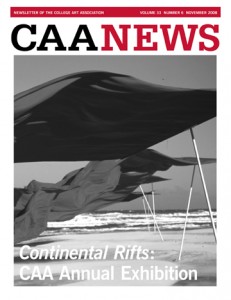 The November CAA News has just been posted to the CAA website. Click on the cover at left to download a PDF of the issue. Printed copies for individual and institutional members will be mailed soon, to arrive in mid-November.
Read about Leonardo López Luján, the renowned archaeologist who is giving the keynote address at Convocation at the 2009 Annual Conference in Los Angeles, and about Continental Rifts: Contemporary Time-Based Works of Africa, the CAA Annual Exhibition at UCLA’s Fowler Museum curated by Mary Nooter Roberts. The issue also contains important conference information, including how to apply to, and become a mentor for, the Artists’ Portfolio Review and Career Development Mentoring programs.
The deadline for submissions to the January issue is November 10, 2008. Please see the newsletter submission guidelines for instructions or write to Christopher Howard, CAA News editor.
Americans for the Arts Merges with Business Committee for the Arts
posted by Christopher Howard — October 31, 2008
Two nonprofit arts-advocacy groups, Americans for the Arts and Business Committee for the Arts (BCA), announced yesterday that they will merge their operations, creating the largest-ever advocacy group for the arts in the private sector. The partnership will further enable the organization to generate increased private-sector support for the arts and arts education by engaging and educating business leaders nationwide on the economic impact and value of the arts in business and community settings.
Americans for the Arts has issued a press release on the merger and also published two lists of frequently asked questions for its members and the general public.
Americans for the Arts Merges with Business Committee for the Arts
posted by Christopher Howard — October 31, 2008
Two nonprofit arts-advocacy groups, Americans for the Arts and Business Committee for the Arts (BCA), announced yesterday that they will merge their operations, creating the largest-ever advocacy group for the arts in the private sector. The partnership will further enable the organization to generate increased private-sector support for the arts and arts education by engaging and educating business leaders nationwide on the economic impact and value of the arts in business and community settings.
Americans for the Arts has issued a press release on the merger and also published two lists of frequently asked questions for its members and the general public.
Authors, Publishers, and Google Reach Settlement
posted by Christopher Howard — October 29, 2008
The Authors Guild, the Association of American Publishers, and Google today announced a groundbreaking settlement agreement on behalf of a broad class of authors and publishers worldwide that would expand online access to millions of in-copyright books and other written materials in the United States from the collections of a number of major US libraries participating in Google Book Search. The agreement, reached after two years of negotiations, would resolve a class-action lawsuit brought by book authors and the Authors Guild, as well as a separate lawsuit filed by five large publishers as representatives of AAP’s membership. The class action is subject to approval by the US District Court for the Southern District of New York.
The agreement promises to benefit readers and researchers, and enhance the ability of authors and publishers to distribute their content in digital form, by significantly expanding online access to works through Google Book Search, an ambitious effort to make millions of books searchable via the web. The agreement acknowledges the rights and interests of copyright owners, provides an efficient means for them to control how their intellectual property is accessed online, and enables them to receive compensation for online access to their works.
To read more about this landmark settlement, visit the Authors Guild v. Google Settlement Resources Page and the Google Book Search Copyright Settlement. The Chronicle of Higher Education, Inside Higher Ed, the New York Times, and Wired all report on the story.
October Obituaries
posted by Christopher Howard — October 27, 2008
CAA recognizes the lives and careers of the following individuals in the arts, all of whom recently passed away.
- Albert Boime, an art historian and longtime professor at the University of California, Los Angeles, who researched the social history of art, died on October 18, 2008. He was 75
- Robert H. Chaney, a Houston business man who collected contemporary Asian and British art, died October 22, 2008
- Patricia Faure, a Los Angeles–based art dealer, died October 21, 2008, at the age of 80
- Jason Gleeson, an Australian artist and art critic who helped shape the collections of the National Gallery of Australia, died on October 20, 2008, a month shy of his 93rd birthday
- Ardeshir Mohasses, an Iranian-born political cartoonist and satirist whose work was the subject of a recent exhibition at the Asia Society in New York, died on October 9, 2008. He was 70
- Iba Ndiaye, a highly influential modern painter from Senegal who also lived and worked in Paris, died October 5, 2008, at the age of 80
- Paritosh Sen, a pioneering and well-known Indian artist, died October 22, 2008. He was 80.
Read all past obituaries in the arts on the CAA website.
Free Digital Images for Scholarly Publications
posted by Christopher Howard — October 16, 2008
CAA reminds you that three major museums—the National Gallery and the Victoria and Albert Museum in London and the Metropolitan Museum of Art in New York—have made digital images of works from their collections available for free for scholarly publications.
National Gallery
As part of its ongoing commitment to support scholarship and encourage research into England’s collection of old-master paintings, the National Gallery waives reproduction charges for digital images for use in academic books and journals that meet specific criteria and where orders are processed and delivered via its Picture Library website. Authors publishing academic work relating to the gallery’s collection are encouraged to use high-quality digital images available only from National Gallery Images, where charges will be waived for nonprofit, short-run publications. Discounts are also available for image use in student theses, academic presentations or lectures, and noncommercial private use.
Images are available at A4 and A5 at 300 dpi/ppi. The picture files themselves are derived from fully color-calibrated digital-image files created by the National Gallery. The color is therefore consistent across all images in the collection, meaning image users are able to make informed comparisons about color, tone, and brightness, and be assured of consistent color reproduction through to print.
Victoria and Albert Museum
Since early 2007, the Victoria and Albert Museum in London has ended charging reproduction fees for its images used in scholarly publications. Publishers will be able to download images from the museum’s collection of more than 25,000 works directly from its website.
The museum keeps a broad definition of “scholarly.” The images will be available to students and teachers, as well as to publishers, for use in their research and coursework. The museum will continue to charge commercial publications, but their termination of fees for reproduction may encourage other institutions to follow suit.
Metropolitan Museum of Art
In 2007 the Metropolitan Museum of Art formed a partnership, called Images for Academic Publishing, with the nonprofit digital-image provider ARTstor to offer high-resolution digital images of artworks in its collection for scholarly publication—free of charge. This initiative is intended to make it easier and less expensive for authors and publishers license images for reproduction. Under a special agreement with ARTstor, this service will be available to users—both individual and institutional—who are not ARTstor subscribers.
With this important step in overcoming a longstanding obstacle to scholarly art publication, the museum aims to serve its scholarly mission by disentangling many of its most frequently requested works of art from the burden of permissions paperwork—and from the confusion that often accompanies image rental, artwork copyright, photographic copyright, and licensing. Included are many works whose copyrights have expired (generally, works created before 1923 or whose creators died more than seventy years ago) are in this cluster of images. In some instances, however, third-party copyright permissions may be needed (such as where the underlying work in an image is still under copyright). Other terms and conditions also apply.
More Information
For more information on CAA’s work on digital images, publishing, copyright, and more, please see the Intellectual Property and the Arts section of the website.
CAA Member Survey Results
posted by Christopher Howard — October 15, 2008
CAA warmly thanks the 831 participants in a recent email survey, which was sent to 8,300 members whose database records indicate that their primary profession is: art/architectural historian, artist, administrator, curator, art-museum educator, or librarian. The results of the survey will be presented at the Board of Directors’ Strategic Planning Retreat on October 25, 2008, and will be incorporated into discussions on how to better serve all CAA members in the new strategic plan.
The survey contained one open-ended question: “What are the most pressing issues you face in your profession?” The following summary provides a synopsis of your responses, which are recorded in order of priority and frequency; many respondents gave multiple answers.
Art/Architectural Historians – 455 respondents
33% – Decrease in positions; increase in PhDs; reduction of tenured positions and increase in part-time and adjunct positions
17% – Difficulty finding publishers; insufficient number of art journals; decrease in presses publishing art history; tenure requirement for monographs vs. few presses publishing monographs
16% – Limited research funds and high cost of travel
13% – Work load vs. keeping up with the field and quality of life
11% – High cost of image reproduction; copyright restrictions
7% – Low salaries and need for pay equity
7% – Issues regarding resources and attention devoted to historical art vs. contemporary art; Western vs. non-Western art; national vs. global; traditional curriculum, research, and pedagogy vs. interdisciplinary curriculum, research, and pedagogy
7% – New technology demands: cost, training, accessibility
5% – Need for American public understanding of art and combating anti-intellectualism
4% – Viability, credibility, and relevance of art history to other disciplines
Artists – 305 respondents
40% – Earning enough to support creative work; finding jobs and job security
23% – Finding reliable galleries; support for exhibitions; support for creative work and research
19% – Need for exposure of work, networking, and negotiating the art world
17% – Low salaries and need for pay equity
13% – Reduction of tenured positions and increase in part-time and adjunct positions
5% – Maintaining art as a critical discipline on all levels of education
5% – Need for health insurance
5% – Heavy teaching load and higher expectations for productivity
5% – Need for greater preparation of entering students
Administrators – 47 respondents
45% – Decrease in federal, state, and private funding for research, travel, faculty, staff, and technology
10% – Decrease in scholarships and fellowships
10% – Reduction of full-time faculty and increase in part-time faculty
10% – Recruitment of qualified candidates for faculty positions given the expansion of disciplines and need for pedagogical expertise
7% – Decreased enrollment
6% – Need for pay equity between art historians and artists
5% – Work load vs. keeping up with the field
4% – Blurring of disciplines and need for curriculum revision; new forms of assessment
Curators – 14 respondents
44% – Financial stability of art museums; decrease in funds for research and scholarly exhibitions
19% – High stress, long hours, and diminished staff positions
15% – Devaluation of research
10% – How to communicate with the public
10% – Low salaries and need for pay equity
5% – Demands of exhibition funders
Art-Museum Educations – 6 respondents
25% – High stress, long hours, and diminished staff positions
10% – Maintaining links between museum educators and art historians
10% – Low salaries and need for pay equity
5% – Decrease in funds for public programs
Art Librarians – 4 respondents
30% – New technology equipment costs, training, and research
25% – Decreased funds for purchase of books and periodicals
10% – Recruitment of qualified candidates for staff positions
Because many respondents gave more than one answer, the percentages do not always add up to 100 percent.
HR Administrator Advocates for Adjunct Professors
posted by Christopher Howard — October 15, 2008
“Higher education—especially public higher education—would face major disruptions within five or six years if it doesn’t come up with some way to change the way adjuncts are treated.” So writes Scott Jaschik of Inside Higher Ed, summarizing the words of A. G. Monaco, a senior human-resources official at the University of Akron, speaking at the annual meeting of the College and University Professional Association for Human Resources. In his article “Call to Arms for Adjuncts . . . From an Administrator,” Jaschik reports that Monaco offered an outline of steps that colleges should take to bridge the gap between the way tenure-track professors and their adjunct and part-time colleagues are treated. If not, colleges and universities could face increasing unionization, for better or worse, from what Monaco calls “a highly educated working poor.”