
CAA News Today
Recent Deaths in the Arts
posted by Christopher Howard — July 23, 2013
In its regular roundup of obituaries, CAA recognizes the lives and achievements of the following artists, photographers, scholars, architects, educators, museum directors, and others whose work has significantly influenced the visual arts. Notable deaths this summer include the artist Sarah Charlesworth and the former Museum of Modern Art director John Hightower. In addition, CAA has published a special obituary on Jens T. Wollesen, a historian of the art of medieval Italy and Cyprus who taught at the University of Toronto for many years.
- Gabriele Basilico, a prominent Italian photographer of architecture and urban landscapes, died on February 13, 2013. He was 68
- George Paul Horse Capture Sr., former deputy assistant director for cultural resources at the Smithsonian Institution’s National Museum of the American Indian and later senior counselor to its director, died on April 16, 2013. Also known as Nay Gyagya Nee (Spotted Otter), he was 75 years old
- Sarah Charlesworth, an artist and photographer associated with the Pictures Generation, died on June 25, 2013, at the age of 66
- Alex Colville, a celebrated Canadian painter who depicted realistic scenes of everyday life, passed away on July 16, 2013. He was 92 year old
- Martha Mayer Erlebacher, a figurative artist and longtime professor at the New York Academy of Art, died on June 22, 2013. She was 75
- Paul Feiler, an Anglo-German painter of lyrical abstraction, died on July 8, 2013, at age 95. He had taught for many years at the West of England College of Art (now Royal West of England Academy) in Bristol
- Mark Fisher, a set designer for the Rolling Stones, Pink Floyd, and U2 who trained as an architect, died on June 25, 2013. He was 66
- John Hightower, director of the Museum of Modern Art in New York from 1970 to 1971, died on July 6, 2013. Hightower also led the New York State Council of the Arts from 1964 to 1970 and later served as director of the Mariner’s Museum in Newport News, Virginia, for thirteen years
- Elspeth kydd, a filmmaker, author, and scholar, passed away on April 9, 2013, at the age of 46. She had taught at the University of Toledo, the University of the West of England, and the University of the West Indies
- Henning Larsen, an award-winning architect who designed the Copenhagen Business School Dalgas Have and the Royal Danish Opera, died on June 22, 2013. He was 87 years old
- Virginia Pitts Rembert Liles, a professor of art history who served as chair of the Art Department at the University of Alabama in Tuscaloosa, died on July 5, 2013. The fall 2012 issue of the Loupe published a profile on Liles’s long, distinguished career
- Cynthia Moody, a British filmmaker and editor of documentaries and advertisements, died in summer 2013, at the age of 89. Moody was also the caretaker of the estate of her Jamaican-born uncle, the sculptor Ronald Moody
- Norman Parish, an artist and art dealer whose gallery in Washington, DC, showed the work of African American artists, died on July 8, 2013. He was 75
- Gwyn Hanssen Pigott, an Australian-born ceramicist whose work was known internationally, passed away on July 5, 2013, age 78. The National Gallery of Victoria held a major retrospective of her pottery in 2006
- Alejandro Puente, an Argentinian artist who participated in the avant-garde scene at the Instituto Di Tella in Buenos Aires, has died. Born in 1933, Puente was also associated with the geometría sensible movement
- Monica Ross, a performance artist, feminist, and professor at Central Saint Martins, University of the Arts London, died on June 14, 2013. She was 63 years old
- William Z. Slany, chief historian of the US Department of State whose work helped to recover Jewish property looted by the Nazis, died on May 13, 2013. He was 84
- Jeffrey Smart, an Australian painter based in Italy who was known for his postindustrial urban landscapes, died on June 20, 2013. He was 91 years old
- Bert Stern, a commercial photographer and documentary filmmaker best known for his portraits of Marilyn Monroe taken six weeks before her death, passed away on June 26, 2013. He was 83
- William Turner, an English artist who was a leading member of the Northern School of Lancashire painters, died on July 10, 2013, at the age of 93
- Jens T. Wollesen, a historian of medieval art who was a longtime professor in the Department of Art at the University of Toronto, died on April 22, 2013. Born in 1947, Wollesen had recently completed a book, Acre or Cyprus: A New Approach to Crusader Painting around 1300. CAA has published a special obituary on the late professor
- Walter Zanini, a Brazilian professor of philosophy and the founder of the Brazilian Committee of History of Art, died on January 29, 2013. Born in 1925, Zanini served as director of the Museum of Contemporary Art at the University of São Paulo from 1963 to 1978
Read all past obituaries in the arts in CAA News, which include special texts written for CAA. Please send links to published obituaries, or your completed texts, to Christopher Howard, CAA managing editor, for the next list.
Statement on the House Appropriations Subcommittee Draft FY2014 Spending Bill for the Interior, Environment, and Related Agencies
posted by CAA — July 23, 2013
The League of American Orchestras has circulated a statement that the National Endowment for the Arts (NEA) will be using in response to press inquiries.
Statement on the House Appropriations Subcommittee Draft FY2014 Spending Bill for the Interior, Environment, and Related Agencies
If enacted, the FY2014 budget proposed for the National Endowment for the Arts in the draft appropriations bill would severely hamper the agency’s ability to fulfill its mission of investing in arts organizations throughout all 50 states.
As the President, Congress, and the American people continue to be focused on the country’s economy, it is important to note that a dollar invested by the NEA is matched by $9 of additional investment and generates $26 in economic activity.
Last year, the NEA invested nearly $116 million through more than 2,200 grants in communities of all sizes. In turn, these nonprofit arts organizations had direct expenditures of $31.2 billion that helped support the 5.7 million arts-related jobs and 2 million working artists in this country.
The President’s FY2014 budget request recognizes the importance of this investment and lays out a strong case for funding the NEA at $154.5 million, which the full House and the Senate will review as the budget process continues.
Oppose Devastating Cuts to the National Endowment for the Humanities
posted by CAA — July 22, 2013
The National Humanities Alliance (NHA) sent the following email on July 22, 2013.
Oppose devastating cuts to the National Endowment for the Humanities
The House of Representatives Appropriations Committee released its FY 2014 Interior and Environment Appropriations bill this morning with a 49 percent ($71 million) cut for the National Endowment for the Humanities. If enacted, this funding level would devastate an agency that has already been reduced by 19 percent since 2010.
This drastic cut would end programs that provide critical support for humanities teaching, preservation, public programming, and research, and result in positive impacts on every community in the country. Programs supported by the NEH teach essential skills and habits including reading, writing, critical thinking, and effective communication that are crucial for ensuring that each individual has the opportunity to learn and become a productive member of society. Further, NEH’s programs strengthen communities by promoting understanding of our common ideals, enduring civic values, and shared cultural heritage.
Click here to send a message today to urge your Representative to vote against these devastating cuts.
Please share this message with your friends.
The NEH desperately needs your help.
Action Alert: Act Now to Preserve Critical Humanities Funding
posted by CAA — July 22, 2013
The National Humanities Alliance (NHA) sent the following email on July 19, 2013.
Action Alert: Act Now to Preserve Critical Humanities Funding
Over the last three years the budget of the National Historical Publications and Records Commission (NHPRC), an agency critical to preserving America’s documentary heritage, has been cut from $13 million to just $4.75 million. Last week, the House of Representatives proposed another 36 percent reduction that threatens to further erode this small agency’s capacity to preserve endangered collections and provide access to our shared cultural heritage. Your voice can help to ensure that the Senate acts to prevent this draconian cut.
The Senate will begin voting on NHPRC funding on Tuesday, July 23, so your senators must hear from as many of their constituents as possible before that date in order to prevent this reduction.
To preserve NHPRC funding:
1) Click the link below to send a message urging your senators to provide full funding to the National Historical Publications and Records Administration. We have provided a template letter that you may customize if you choose, so it is quick and easy.
2) Share this message with your friends.
More information on NHPRC:
The National Historical Publications and Records Administration (NHPRC) provides critical support for preservation of at-risk collections in communities around the country. Its grants leverage state, local, institutional, foundation, and other private funding by requiring 50 percent cost sharing—i.e. for every federal dollar invested, another dollar is spent from a non-federal source. NHPRC also supports publications projects of national significance such as the Papers of Abraham Lincoln and the Papers of George Washington. Just this year, it launched Founders Online, an unprecedented resource that provides online access to more than 100,000 documents of the founding generation.
It is critical that you act now to ensure that efforts to preserve and provide public access to national treasures can continue. Once these materials are lost, they are lost forever.
Click this link to send a message:
http://cqrcengage.com/nhalliance/app/write-a-letter?3&engagementId=13034
Advertise in CAA’s Directories of Graduate Programs
posted by CAA — July 19, 2013
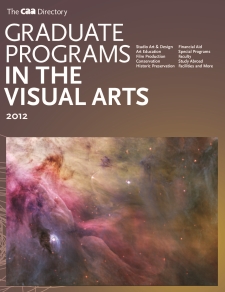 For the first time, CAA is offering advertising space in its annual directories of graduate programs in the arts. Promote your institution, program, product, or service in the go-to resource for prospective graduate students in the arts.
CAA’s directories are the most comprehensive resources available for new and incoming graduate students in fine art and design, art and architectural history, curatorial and museum studies, arts administration, art education, film production, conservation, and more in the United States, Canada, the United Kingdom, Australia, and New Zealand.
The directories provide prospective graduate students with the critical information they need to complete the application process and navigate the academic landscape, from availability of financial aid and fellowships to faculty and deadlines.
News from the Art and Academic Worlds
posted by Christopher Howard — July 17, 2013
Each week CAA News publishes summaries of eight articles, published around the web, that CAA members may find interesting and useful in their professional and creative lives.
Art Teaching for a New Age
In arts education, something profound is happening that will force us to rethink what and how we teach. Art making has changed radically in recent years. Artists have become increasingly interested in crossing disciplinary boundaries: choreographers use video, sculpture, and text; photographers create “paintings” with repurposed textiles. New technologies enable new kinds of work, like interactive performances with both live and web-based components. International collaboration has become de rigueur. And policy makers and businesspeople have embraced at least the idea of the so-called creative economy, with cities rushing to establish arts districts, and business schools collaborating with design schools. (Read more in the Chronicle of Higher Education.)
Academia’s Pink-Collar Workforce
Victoria Baldassano, an English instructor at Montgomery College and the mother of a child with disabilities, thought turning to teaching from her previous career as a journalist would offer more stable pay and a better career path. But in the nearly eight years she’s been working at the community college, she hasn’t seen much improvement in the long hours, the inadequate office space and the poor salary. Recently president of the SEIU Local 500 at Montgomery, Baldassano and her fellow part-time faculty workers are beginning to organize for better pay and working conditions. (Read more in the Nation.)
Arts Leader Sentiment Survey Results
Southern Methodist University’s National Center for Arts Research has released the results of its Arts Manager Sentiment Survey, which collected and analyzed national arts leaders’ opinions on the health of the nation’s cultural sector across a range of disciplines. The survey results indicated that, overall, arts leaders have a positive outlook for the future of their organizations in areas like attendance and revenue streams. (Read more from Southern Methodist University.)
Arts Education Has Many Benefits, but Links to Improved Academics Are Limited
A comprehensive new report called Art for Art’s Sake: The Impact of Arts Education outlines the benefits and limits of arts education by digging into data and outlining what research has already been established in the field. Among the findings: Learning music can boost students’ IQ scores and visual arts likely help students’ understanding of geometrical reasoning. But the report also notes that there’s no evidence theater and dance help with overall academic skills. (Read more from Southern California Public Radio.)
US Government Strengthen Ties with UNESCO
The United States government has confirmed it is committed to restoring relations with UNESCO, with the intention of resuming funding to the cultural agency. On July 9, President Barack Obama announced that the lawyer and writer Crystal Nix-Hines, who also raised funds for Obama’s 2012 reelection campaign, has been nominated as the next US ambassador to UNESCO. If the Senate approves her post, Nix-Hines will succeed David Killion, whose four-year term is up this summer. (Read more in the Art Newspaper.)
Mind the Gap
When Stanford University enrolled over 100,000 students in its first massive open online courses (MOOCs) in fall 2011, the subjects were database architecture and artificial intelligence. A small but growing number of MOOCs is growing in the humanities, the largest of which is a course in modern and contemporary poetry, which enrolled 36,000 students this fall. The Museum of Modern Art has offered online courses since fall 2010, which are neither massive (enrollment is capped in the low double-digits) nor free (a five-week course costs $350). Last fall I took an online course in contemporary art at MoMA, and enrolled simultaneously in the poetry class, to see what it was like. (Read more in Artforum.)
The Rapper Is Present
Three years ago, when the performance artist Marina Abramović sat in the atrium of the Museum of Modern Art for 750 hours, many people who had waited in long lines to sit across from her melted down in her presence. Abramović remained silent and still, enduring thirst, hunger, and back pain (and speculation as to how, exactly, she was or was not peeing), while visitors, confronted with her placid gaze, variously wept, vomited, stripped naked, and proposed marriage. But the other day, at the Pace Gallery in Chelsea, where Jay-Z was presenting his own take on Abramović’s piece—rapping for six hours in front of a rotating cast of art-world VIPs—viewers’ primary response was to get up and dance. (Read more in the New Yorker.)
Rescued Art: Meet Rodney Parrott, the King of Thrift-Store Finds
Last year was a banner year for dramatic art finds. A Salvador Dalí etching surfaced at Goodwill, a possible Leonardo da Vinci painting turned up at a Scottish farmhouse, and a $100,000 avian masterpiece was found in the dusty corners of someone’s attic. The series of unexpected discoveries made us wonder just how easy it is to uncover a fine art treasure outside a high-priced gallery. (Read more in the Huffington Post.)
CAA Publishes Annual Report 2012–2013
posted by CAA — July 16, 2013
 CAA has just published the Annual Report 2012–2013, which describes the organization’s accomplishments over the past year as well as other notable efforts as they relate to the Strategic Plan 2010–2015. You may download a PDF of the nineteen-page document.
Abundantly illustrated by photographs from the 2013 Annual Conference in New York, the report describes recent developments in several important areas, such as the Task Force on Fair Use, several publications initiatives (including an analysis of the financial structure and distribution of CAA’s three journals), a grant from the Alliance for Networking Visual Culture for two scholarly projects using the Scalar platform, and the CAA International Travel Grant Program, generously funded by the Getty Foundation. Also covered is an overview of the Task Force on the Strategic Plan for 2015–2020 as well as highlights from the current plan that CAA has accomplished so far, such as free wireless internet at the Annual Conference and the publication of CAA’s directories of graduate programs in the arts.
In addition, the annual report includes a membership report, a selected list of grants received during the fiscal year, and statistics related to CAA News, www.collegeart.org, Twitter, and Facebook. An update on professional-development activities and a financial statement on the 2012 fiscal year close the report.
We hope you will enjoy reading about CAA’s accomplishments.
Committee on Women in the Arts Picks for July 2013
posted by CAA — July 10, 2013
Each month, CAA’s Committee on Women in the Arts selects the best in feminist art and scholarship. The following exhibitions and events should not be missed. Check the archive of CWA Picks at the bottom of the page, as several museum and gallery shows listed in previous months may still be on view or touring.
July 2013

Martha Wilson, The Working Girl from A Portfolio of Models, 1974, 6 black-and-white gelatin-silver prints and 7 typed index cards, 20 × 14 in. (artwork © Martha Wilson)
Martha Wilson
Institute of Visual Arts
Kenilworth Square East, University of Wisconsin, 2155 North Prospect Avenue, Milwaukee, WI 53202
June 7–August 11, 2013
It’s been already forty years since Martha Wilson radically intervened in Conceptual art by including the female body, especially her own, in her endeavors. She also pioneered uses of masquerade to explore the effects of the camera in self-representation, deconstructing gender stereotypes and exposing the fluidity of gender and identity. Organized by the Independent Curators International and curated by Peter Dykhuis, this traveling exhibition examines the radical strategies and politics that underpin Wilson’s work as a visual artist—especially her performances, videos, and photo-text compositions—and as an activist and the founder of Franklin Furnace from the 1970s to today. Accompanying the exhibition is a catalogue and a parallel program that will raise interesting questions about feminism today, the state of masculinity codes, and more.
Call for Papers: “Recollecting Forward: Feminist Futures in Art Practice, Theory, and History”
Association of Art Historians Annual Conference
Royal College of Art, London, England
April 10–12, 2014
In recent years, a series of blockbuster exhibitions and several high-profile symposia have set out to assess the past and present of feminist art practice, theory, and history. This session seeks to pinpoint and debate the key issues arising from these attempts to make retrospective sense of the past forty years of feminist work in the visual arts. Does this remarkable upsurge in artistic, curatorial, and art-historical interest in art practice inflected by feminism constitute the first step in putting feminism on the map, or else does it draw a line under a diverse constellation of works, practices, and texts that are to remain forever suspended between countercultural revolution and institutional acknowledgement? Feminism’s impact on art practice, theory, and history is frequently presented either as a series of successive “waves” or as a set of (often mutually antagonistic) mother/daughter/granddaughter relations. This session for the 2014 annual conference of the Association of Art Historians aims to redress this focus on linear progression and generational division by reconsidering temporality in feminist art practice, theory, and history. The session chairs invite contributions from practicing artists, art historians, and art critics that revisit and recast historical practices and texts or otherwise explore potential feminist futures in the visual arts.
To foster a productive encounter among a multiplicity of feminist perspectives and to stimulate open dialogue among those who may have come to feminism at different moments in time and from different cultural contexts, the chairs seek short papers of twenty minutes, which will be followed by a roundtable discussion featuring all speakers. If you would like to participate, please email the chairs directly, providing an abstract of a proposed paper of twenty minutes (unless otherwise indicated): Joanne Heath, independent scholar; and Alexandra M. Kokoli, Robert Gordon University, Aberdeen. The abstract should be no more than 250 words; proposals should include your name and institution affiliation (if any). You will receive an acknowledgement of receipt for your submission within two weeks. Deadline: November 11, 2013.

Lorna Simpson, Momentum, 2010, HD video with color and sound, 6:56 (artwork © Lorna Simpson)
Lorna Simpson
Jeu de Paume
1 Place de la Concorde, Paris, France 75008
May 28–September 1, 2013
The first major survey of the work of Lorna Simpson in Europe brings together signature masterpieces from all stages of her thirty-year-long career, including examples of the large-format photo-texts from the mid-1980s that first brought her critical attention, such as Gestures/Reenactments, Waterbearer, and Stereo Styles, and several series of screen prints on felt from the 1990s, including Wigs, The Car, The Staircase, Day Time, Day Time (gold), and Chandelier. The show also presents a group of recent drawings called Gold Headed, her Photo Booths ensembles of found photos and drawings (such as Gather and Please remind me of who I am…), and several video installations, including Cloudscape and Momentum, with evocative narratives that question the way in which experience is created and (mis)perceived. As such, the exhibition traces the continuity that underpins Simpson’s experimentation with photography and film and her questioning of the conventions of gender, identity culture, and memory, especially as an African American female artist, while seeking to further illuminate the intimate relationship of text and image that characterizes her work and the centrality of memory among her thematic preoccupations.
Yoko Ono: Half-a-Wind Show
Louisiana Museum of Modern Art
Gl Strandvej 13, 3050 Humlebæk, Denmark
June 7–September 29, 2013
Another exhibition celebrating Yoko Ono’s eightieth birthday, Yoko Ono: Half-a-Wind Show is a major retrospective that seeks to reinstate her importance as a Conceptual artist, both political and avant-garde, as well as to complicate the experience of her work in various media. The show is introduced by En Trance, a major architectural installation shown for the first time in many years that offers six entry points to her work, alluding to the participatory aspect of her work while enabling different narratives of it to unfold.
The exhibition’s first section features groundbreaking experimental and conceptual works from the early 1960s, performed first in New York and later in Japan. It continues with large installations and recent works and also includes Moving Mountains, a new installation that invites its participants to form mobile sculptures from cloth bags. One area is devoted to Ono’s music videos, concert recordings, covers, posters, and more. The exhibition also emphasizes Ono’s political commitment and her efforts to engage in dialogue with people all over the world—both inside and outside the museum—through social media, billboards, and participation pieces. In Louisiana Park visitors are invited to hang their personal wishes on a Wish Tree, and large billboards throughout Copenhagen display poetic messages from the artist.
Agnès Varda
Bildmuseet
Umeå University, Konstnärligt Campus, Östra Strandgatan 30, B903 33 Umeå, Sweden
June 2–August 18, 2013
Agnès Varda (born 1928) established herself as an important figure in French cinema with her first film, La Pointe Courte (1954), which was considered as the starting point of the French New Wave—even though she was then in her mid-twenties and had no formal training as a filmmaker. Celebrating her lifelong achievement in filmmaking, Bildmuseet is showing a selection of Varda’s documentary projects from the 1960s and 1970s as well as newer works that display the boundary-transcending way in which she moves between the cinema theatre and the gallery showroom, between photography and cinema, and between moving and still images. Many of her films have political and feminist dimensions, such as Black Panthers (1968) and Réponse de femmes (1975), in which documentation and fiction overlap.

Cornelia Parker, Pavement Cracks (City of London), 2012, black-patinated bronze, 206 x 152 x 9 cm (artwork © Cornelia Parker)
Cornelia Parker
Frith Street Gallery
17-18 Golden Square, London, W1F 9JJ, United Kingdom
June 7–July 27, 2013
Bringing together new sculptural and photographic works by the acclaimed British artist Cornelia Parker that transform overlooked and often uncanny facets of the city streets such as pavement cracks, accidental spills, and discarded pieces of wood into evocative objects and images, this exhibition captures a few of the hard-to-pin down threads that mark Parker’s diverse production: her interest in architecture; the antisculptural fragility of her sculptural objects and their mode of display; and the dark, personal, or social evocations and origins of their conception.
The exhibition consists of Black Path (2013), a linear structure of black bronze that hovers above the floor and three-dimensionalizes the cracks of the paving stones of the Bunhill Fields cemetery, through which the artist has been walking her daughter to school, often playing “don’t step on the lines,” a game that rekindled childhood memories and fears of street cracks. Unsettled (2012) uses wood collected from the streets of old Jerusalem, reassembled and precariously relocated against the walls of the gallery. The found abstract patterns on cracked walls provide the inspiration for Prison Wall Abstracts: A Man Escaped (2012–13), a set of twelve photographic prints depicting the perimeter wall of Pentonville Prison in London, whose broken surface of wall had been repaired by workmen with white filler in gestural patterns worthy of any Abstract Expressionist painter. Parker captured these walls before they were obliterated forever by a layer of magnolia paint. “Jerusalem”—both the poem of Bunhill Fields cemetery’s famous incumbent, William Blake, and the “holy city” where Parker filmed her latest work—lace up all three works, especially due to the effect of the Jerusalem syndrome (the tendency of the locals to attribute religious importance to random images) on the artist and the rekindling of her childhood fascination with identifying configurations on the cracked walks of her room at bedtime.
Valérie Favre: Selbstmord, Suicide
Neuer Berliner Kunstverein
Chausseestrasse 128, 10115 Berlin, Germany
June 8–July 28, 2013
Selbstmord, Suicide presents two extensive series of works by the Swiss-born, Berlin-based painter Valérie Favre that respectively deal with life and death. The Suicide cycle (2003–13) consists of 129 small-format paintings representing scenes of self-chosen death, focusing on the moment of the radical decision to end one’s life and the self-dramatization of the theatrical moment of death. The works refer to known suicide scenes from history, art, and literature as well as from current newspaper reports. Created especially for the exhibition, the second group, called still/leben (de la fragilité des fleurs n°5) (2013), consists of small- and large-scale paintings of floral still lifes. Addressing the creative process in a diaristic manner, the artist produced a small still life of a flower arrangement every day three months prior to the show, while adding one brushstroke at a time to the larger canvases. During the exhibition, a different small work is selected daily for exhibition.

Jane and Louise Wilson, Toxic Camera, Blind Landing Lab 1 (H-Bomb Testing Facility, Orford Ness), 2012, C-print Diasec mounted with aluminum and Perspex, 86½ x 71 in. (artwork © Jane and Louise Wilson)
Jane and Louise Wilson
303 Gallery
507 West 24th Street, New York, NY
June 25–August 2, 2013
At 303 Gallery, the twin sisters Jane and Louise Wilson will for the first time combine several bodies of work, including two photographic series: Atomgrad (Nature Abhors a Vacuum) (2010–12), depicting the town of Pripyat, built in the early 1970s by the Soviet Union to house Chernobyl factory workers; and Toxic Camera, Blind Landing Lab 1 (2012), which documents the Wilson’s first publicly sited installation, on a former H-bomb test facility on Orford Ness, an island off the Suffolk Coast owned by the United Kingdom’s Ministry of Defense.
Pauline Boty: Pop Artist and Woman
Wolverhampton Art Gallery
Lichfield Street, Wolverhampton, West Midlands, WV1 1DU, United Kingdom
June 1–November 16, 2013
Pauline Boty: Pop Artist and Woman is the first survey of this major yet short-lived contributor to British Pop since the rediscovery of her work in a family barn in the early 1990s. Before written out of British Pop’s history and reduced to a pale memory of a mythic figure, Pauline Boty (1938–1966) was included in Ken Russell’s landmark 1962 television documentary Pop Goes the Easel, which introduced her as one of the four protagonists of the Royal College of Art’s Pop scene in London (alongside Peter Blake, Derek Boshier, and Peter Philips). Soon, however, Boty, who had studied stained glass, reinvented herself as a painter by grafting her penchant for abstraction and collage through a figurative Pop idiom and by passionately embracing popular culture—all while speaking subversively as a woman, that is, by using the objects of her fanzine fascination to transgressively celebrate female sexuality and desire and to critically expose the sexism of pop and visual culture.
Bringing together more than forty works, some of which were considered lost and have never before been shown, Pop Artist and Woman traces the development of Boty’s work from a stained-glass student to a British Pop painter and establishes its unmistaken Popness and the radical nature of its politics, especially its feminism. Contextual archival material and an extensive catalogue by the curator Sue Tate further establishes her importance, analyzing her neglect and shedding light onto her life and her brief media stardom as a beauty and an actress. Most important, the exhibition joins other recent scholarship and exhibitions that question the neglect of female Pop artists by standard art history.

Moyra Davey, Kevin Ayers (Psychic), 2013, chromogenic print with adhesive tape, stamps, and ink (artwork © Moyra Davey)
Moyra Davey: Hangmen of England
June 8–October 6, 2013
Tate Liverpool
Albert Dock, Liverpool Waterfront, Liverpool, L3 4BB, United Kingdom
Moyra Davey: Hangmen of England introduces the work of a New York–based photographer, filmmaker, and writer—and a star of the 2012 Whitney Biennial—to the United Kingdom as part of a program called LOOK/13 at the Liverpool International Photography Festival. The project draws attention to the intimacy of Davey’s photographic practice and her use of common objects as starting points to unravel complex themes. For this exhibition, she presents work created using photographs taken in Liverpool and Manchester. As often the case with this artist, these images are influenced by personal stories and by narratives drawn from literature and theory. They were mailed to their city of origin, allowing the creases, tape, and mailing stamps marking each photograph to provide a physical trace of its journey.
The exhibition also includes a new version of the artist’s celebrated Copperhead series. Inspired by the global economic crisis, this series consists of one hundred close-up photographs of the profile of Abraham Lincoln engraved onto the most devalued denomination of American currency—the one-cent coin—to encourage a reevaluation of the fleeting beauty of the everyday. Copperhead reflects on the psychology of money and the varieties of decay brought about by the passage of time.
News from the Art and Academic Worlds
posted by Christopher Howard — July 10, 2013
Each week CAA News publishes summaries of eight articles, published around the web, that CAA members may find interesting and useful in their professional and creative lives.
Remember Talent? Does It Still Matter in Art Education?
The cost of an education at an art school or in a college art department has gotten too expensive for merely learning how to express oneself in the likes of painting, sculpture, and printmaking. Who wants to go tens of thousands of dollars into debt just to become another starving artist? Today’s art students now look to the commercial specialties—graphic design, fashion, comic strips and graphic novels, industrial design, textiles, video, filmmaking—to provide them with postgraduate employment and, in the bargain, status as hip young determiners of society’s style. (Read more in the Chronicle of Higher Education.)
Same-Sex Ruling Brings Bumper Tax Benefits to Art-World Professionals
A decision by the US Supreme Court will bring significant tax benefits to art collectors, artists, and dealers who are in same-sex marriages. In a ruling on June 26, 2013, the court said that the federal Defense of Marriage Act, which defined “marriage” as a legal union between a man and woman only, was unconstitutional. The historic decision means better fiscal deals for gay spouses such as estate tax deduction and copyright revision, among new arrangements. (Read more in the Art Newspaper.)
Confidentiality and Faculty Representation in Academic Governance
This report argues that requiring faculty members to sign confidentiality agreements as a requirement to serve on university committees is in most cases inconsistent with widely accepted standards of shared governance and with the concept of serving as a representative. This argument does not apply to faculty serving on promotion and tenure committees and similar bodies, where faculty do not serve as representatives, but instead are elected to exercise their own professional judgment in interpreting and applying faculty-established criteria relevant to these areas. (Read more from the American Association of University Professors .)
Division of Preservation and Access Evaluates the Impact of Its Humanities Collections and Reference Resources Program
Excellence in research, education, and public programming in the humanities depends heavily upon the ongoing availability of source materials. To address this need, a National Endowment for the Humanities program called Humanities Collections and Reference Resources provides critical support to the nation’s libraries, archives, museums, and other cultural-heritage institutions to help enable long-term public access to significant collections of books, manuscripts, photographs, art and artifacts, sound recordings, moving images, and more. (Read more from the National Endowment for the Humanities.)
Yes, Kickstarter Raises More Money for Artists Than the NEA. Here’s Why That’s Not Really Surprising
During a session at the Aspen Ideas Festival, Aspen Institute president Walter Isaacson asked Perry Chen, founder of Kickstarter, whether it was true that Kickstarter now funds more arts-related projects than the National Endowment for the Arts. The crowdfunding site has, Chen told Isaacson, funded over $600 million in arts projects. (Read more in the Washington Post.)
Help Desk: Release the Press!
If you poke around the internet, you’ll find a lot of information about how to write a press release. In fact, there is so much information on the subject that I recommend you start with a broad search to familiarize yourself with the fundamentals, which are too numerous to cover here. (Read more in Daily Serving.)
Speedier Visas Planned for US-Bound Artists
A comprehensive immigration reform bill recently passed by the US Senate stands to make it easier for foreign artists to visit the country. The 1,200-page bill, which offers a path to citizenship for millions of illegal immigrants, also requires the government to process artists’ visa requests within one month of their initial filing. Under the current system, artists can wait up to six months for a visa and must pay a fee of $1,225 to receive expedited service. (Read more in the Art Newspaper.)
Learning to Love Rejection
Rejections are a dirty secret among academics. Publication successes are cause for celebration, or at least a proud listing on CVs and departmental lists. Failures—rejected papers and unsuccessful grant and promotion applications—are usually hidden and sometimes a source of shame. The result is that many scholars, especially junior ones, have unrealistic expectations. (Read more from Inside Higher Ed.)
July 2013 Picks from CAA’s Committee on Women in the Arts
posted by Christopher Howard — July 09, 2013
 Each month, CAA’s Committee on Women in the Arts produces a curated list, called CWA Picks, of recommended exhibitions and events related to feminist art and scholarship in North America and around the world.
The CWA Picks for July 2013 consist of numerous excellent exhibitions of women artists in Europe: Lorna Simpson in Paris; Yoko Ono in Denmark; Agnès Varda in Sweden; Valérie Favre in Germany; and Pauline Boty, Moyra Davey, and Cornelia Parker in the United Kingdom. Here in the United States, Martha Wilson is showing work at the Institute of Visual Arts in Milwaukee, Wisconsin, and Jane and Louise Wilson have a show at 303 Gallery in New York. The CWA Picks also list a call for papers for a session at the next annual conference of the Association of Art Historians.
Check the archive of CWA Picks at the bottom of the page, as several museum and gallery shows listed in previous months may still be on view or touring.
Image: Moyra Davey, Kevin Ayers (Psychic), 2013, chromogenic print with adhesive tape, stamps, and ink (artwork © Moyra Davey)