CAA News Today
Former CAA Fellow LaToya Ruby Frazier Wins MacArthur Foundation Fellowship
posted by Christopher Howard — September 29, 2015
 LaToya Ruby Frazier, a photographer and video artist who uses visual autobiographies to capture social inequality and historical change in the postindustrial age, has won a 2015 MacArthur Foundation Fellowship.
Frazier, an assistant professor in the Department of Photography at the School of the Art Institute of Chicago in Illinois, was a 2006 recipient of a CAA Professional Development Fellowship. At the time, she was completing her MFA in art photography in the School of Visual and Performing Arts at Syracuse University in Syracuse, New York. Before that Frazier earned a BFA in photography and graphic design from Edinboro University of Pennsylvania.
Informed by documentary practices from the turn of the last century, Frazier explores identities of place, race, and family in work that is a hybrid of self-portraiture and social narrative. The crumbling landscape of Braddock, Pennsylvania, a once-thriving steel town, forms the backdrop of her images, which make manifest both the environmental and infrastructural decay caused by postindustrial decline and the lives of those who continue—largely by necessity—to live among it.
Frazier’s work has appeared in solo exhibitions at the Brooklyn Museum in New York, the Institute of Contemporary Art in Boston, the Seattle Art Museum in Washington, and the Contemporary Arts Museum in Houston. Her first book, The Notion of Family, was published in 2014. To learn more about Frazier’s work, watch her MacArthur Foundation video.
Other winners of the 2015 MacArthur Foundation Fellowship include the author Ta-Nehisi Coates, the painter Nicole Eisenman, and the playwright Lin-Manuel Miranda. For the entire list of 2015 fellows, visit the foundation’s website.
The MacArthur Fellows Program awards unrestricted fellowships to talented individuals who have shown extraordinary originality and dedication in their creative pursuits and a marked capacity for self-direction. There are three criteria for selection of fellows: exceptional creativity, promise for important future advances based on a track record of significant accomplishment, and potential for the fellowship to facilitate subsequent creative work. The foundation does not require or expect specific products or reports from its fellows and does not evaluate recipients’ creativity during their term of the fellowship. The MacArthur fellowship is a “no strings attached” award in support of people, not projects. Each fellowship comes with a stipend of $625,000, paid out to the recipient in equal quarterly installments over five years.
Founded in 1993, CAA’s Professional-Development Fellowships program supports promising artists, designers, craftspersons, historians, curators, and critics who are enrolled in MFA, PhD, and other terminal-degree programs nationwide. The deadline for the MFA fellowship is Monday, November 16, 2015. CAA will send notifications in January 2016.
Image credit: John D. and Catherine T. MacArthur Foundation
Work with CAA at the 2016 Annual Conference!
posted by Katie Apsey — September 28, 2015
Working as a projectionist, room monitor, or registration attendant at CAA’s 104th Annual Conference, taking place February 3–6, 2016, in Washington, DC, is a great way to save on conference expenses. CAA encourages students, emerging professionals, and any interested CAA members—especially those in the Washington, DC, area—to apply for service. Students should check to see if their schools and universities are CAA institutional members as institutional membership now includes the benefit of specially discounted student memberships.
Projectionists
CAA seeks applications for projectionists for conference program sessions. Successful applicants are paid $12 per hour and receive complimentary conference registration. Projectionists are required to work a minimum of four 2½-hour program sessions, from Wednesday, February 3 to Saturday, February 6; they must also attend a training meeting on Wednesday morning at 7:30 AM (total of twelve hours minimum). Projectionists must be familiar with digital projectors. Please send a two-page CV and a brief letter of interest to Katie Apsey, CAA manager of programs. Deadline extended: January 4, 2016.
Room Monitors
CAA needs room monitors for two Career Services mentoring programs (the Artists’ Portfolio Review and Career Development Mentoring), several offsite sessions, and other conference events, to be held from Wednesday, February 3 to Saturday, February 6; they must also attend a training meeting on Wednesday morning at 7:30 AM. Successful candidates are paid $12 per hour and receive complimentary conference registration. Room monitors are required to work a minimum of twelve hours, checking in participants and facilitating the work of the mentors. Please send a two-page CV and a brief letter of interest to Katie Apsey, CAA manager of programs. Deadline extended: January 4, 2016.
Registration Attendants
CAA seeks registration attendants to work in the registration area at the 2016 Annual Conference in Washington, DC, to be held from Tuesday evening, February 2 to Saturday, February 6. Duties registration attendants must attend a training meeting on Tuesday afternoon, February 2 (between 3:30 and 5:00 PM). Successful candidates are paid $12 per hour and receive complimentary conference registration. Registration attendants are required to work a minimum of twelve hours, registering conference participants, checking membership statuses, and monitoring registration compliance in various session rooms. Please send a two-page CV and a brief letter of interest to Katie Apsey, CAA manager of programs. Deadline extended: January 4, 2016.
All candidates must be US citizens or permanent US residents.
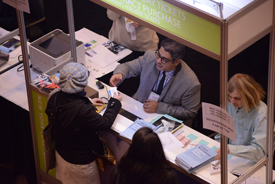
Image: Working the registration booths at the 2015 Annual Conference in New York (photograph by Bradley Marks)
Mentors Needed for the 2016 Annual Conference
posted by Katie Apsey — September 25, 2015
 For the 104th Annual Conference, taking place February 3–6, 2016, in Washington, DC, CAA seeks established professionals in the visual arts to volunteer as mentors for two Career Services programs: the Artists’ Portfolio Review and Career Development Mentoring. Participating as a mentor is an excellent way to serve the field and to assist the professional growth of the next generation of artists and scholars.
Art historians and studio artists must demonstrate significant experience in their fields; critics, museum educators, and curators must have five years’ experience.
Artists’ Portfolio Review
CAA seeks artists, critics, curators, and educators to serve in the Artists’ Portfolio Review. In this program, mentors review and provide feedback on digital images or DVDs of work by artist members in personal twenty-minute consultations. Whenever possible, CAA matches artists and mentors based on medium or discipline. Mentors provide an important service to artists, enabling them to receive professional criticism of their work.
Interested candidates must be current CAA members and prepared to give five successive twenty-minute critiques in a two-hour period on one of two days: Thursday, February 4, and Friday, February 5, 2016, 8:00 AM–NOON and 1:00–5:00 PM each day. Conference registration, while encouraged, is not required to be a mentor. Please send a brief letter of interest and your CV to Katie Apsey, CAA manager of programs. Deadline: December 14, 2015.
Career Development Mentoring
CAA seeks mentors from all areas of studio art, art history, art education, film and video, graphic design, the museum professions, and other related fields to serve in Career Development Mentoring. In this program, mentors give valuable advice to emerging and midcareer professionals, reviewing cover letters, CVs, digital images, and other pertinent job-search materials in personal twenty-minute consultations. Whenever possible, CAA matches participants and mentors based on medium or discipline.
Interested candidates must be current CAA members and prepared to give five successive twenty-minute mentoring sessions in a two-hour period on one of two days: Thursday, February 4, and Friday, February 5, 2016, 8:00 AM–NOON and 1:00–5:00 PM each day. Conference registration, while encouraged, is not required to be a mentor. Please send a brief letter of interest and your CV to Katie Apsey, CAA manager of programs. Deadline: December 14, 2015.
Career Development Mentoring is not intended as a screening process by institutions seeking new hires. CAA does not accept applications from individuals whose departments are conducting a faculty search in the field in which they are mentoring. Mentors should not be attending the conference as candidates for positions in the same field in which mentees may be applying.
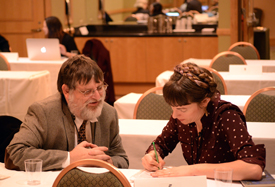
Image: CAA member Kendra Larson (right) participates in a mentoring session with Morgan Paine at the 2015 Annual Conference in New York (photograph by Bradley Marks)
Participate in ARTexchange at the 2016 Annual Conference
posted by Katie Apsey — September 24, 2015
 The Services to Artists Committee invites artist members to participate in ARTexchange, the annual meet-up for artists and curators at CAA’s unique pop-up exhibition. This social event provides an opportunity for artists to share their work and build affinities with other artists, historians, curators, and cultural producers. ARTexchange will take place at the 104th Annual Conference in Washington, DC, on Friday evening, February 5, 2016, from 5:30 to 7:30 PM.
Each artist is given the space on, above, and beneath a six-foot table to exhibit their works: prints, paintings, drawings, photographs, sculptures, and small installations; performance, process-based, interactive and participatory works are especially encouraged. Previous ARTexchange participants have found that this parameter sparked many creative display options. Depending on the number and type of submissions CAA receives, a schedule of performances may be created. Please note that artwork cannot be hung on walls, and it is not possible to run power cords from laptops or other electronic devices to outlets—bring fully charged batteries.
To participate, send an email to Katie Apsey, CAA manager of programs. Include your CAA member number and a brief description of what you plan to present. Please provide details regarding performance, sound, spoken word, or technology-based work, including laptop presentations. You will receive an email confirmation. Because ARTexchange is a popular venue and participation is based on available space, early applicants are given preference. Participants are responsible for their work; CAA is not liable for losses or damages. Sales of work are not permitted. Deadline: December 14, 2015.
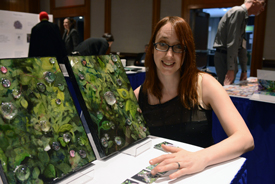
Image: A participant in ARTexchange at the 2015 Annual Conference in New York (photograph by Bradley Marks)
News from the Art and Academic Worlds
posted by Christopher Howard — September 23, 2015
Each week CAA News publishes summaries of eight articles, published around the web, that CAA members may find interesting and useful in their professional and creative lives.
What Ever Happened to Google Books?
It was the most ambitious library project of our time—a plan to scan all of the world’s books and make them available to the public online. “We think that we can do it all inside of ten years,” Marissa Mayer, who was then a vice president at Google, said to the New Yorker in 2007, when Google Books was in its beta stage. “It’s mind-boggling to me, how close it is.” Today, the project sits in a kind of limbo. (Read more from the New Yorker.)
There Is No Excuse for How Universities Treat Adjuncts
Apart from feeling sorry for the underpaid faculty, why should we care that college professors have the same job conditions as day laborers, fast-food workers, cashiers, taxi drivers, or home-care aides? They did, after all, choose to pursue a career in higher ed. Administrators at these institutions of higher learning argue that they need to use adjuncts because it is the only way to keep tuition from rising even faster than it has. And isn’t access to education the higher good? (Read more from the Atlantic.)
Why Is College So Expensive If Professors Are Paid So Little?
Twenty-five years ago, a student at a public college or nonresearch university campus would see twice as many faculty as administrators on average; now the ratio is roughly equal. Just 20 percent of the teaching workforce in 2013 were permanent or tenure track. About half worked part-time or as adjuncts, often stitching together temporary gigs at different institutions. (Read more from the Nation.)
Is This Art?
The State University of New York at Buffalo community was reeling last week after signs saying “white only” and “black only” appeared beside water fountains and bathrooms around campus. The signs were “posted by a student for a graduate art course,” said John DellaContrada, associate vice president for media relations and stakeholder communications. “We’re still looking into it.” (Read more from Inside Higher Ed.)
Exposing White Privilege
Uproar over a controversial and racially charged art project at the State University of New York at Buffalo spread well beyond campus over the weekend—with people responding to both the project and the artist’s explanation of it. Ashley Powell, a graduate student in art who placed “white only” and “black only” signs around campus last week, did so without any explanation. But amid the uproar, she published a lengthy defense of her work in the campus newspaper. (Read more from Inside Higher Ed.)
Participation in the Arts Is Driven by Education, Not Class
Among sociologists, the arts have traditionally been examined through the lens of social class. Much research has found the well off and well connected are more likely to appreciate the arts, suggesting that highbrow taste is a significant signal of status. But those studies, as a rule, have failed to distinguish between passive enjoyment of the arts (say, going to the ballet) and active involvement (actually taking a dance class). A new study from England finds making that distinction is quite revealing. (Read more from Pacific Standard.)
Why Conference Book Exhibits Persist
Absent from the debates over the relative merits of academic conferences—either as disciplinary revival meetings, intellectual proving grounds, or ancient tribal gatherings—has been any discussion of book exhibits. We usually assume those ubiquitous spaces are part of the cost of registration, and we only notice them when they’re not there. Apart from the plenary and concurrent sessions, the workshops and roundtables, book exhibits are a middle ground between scholarship and commerce. (Read more from the Chronicle of Higher Education.)
Three Tips for Handling Discussions in Online Classes
I’ve been teaching a large online class for the first time this semester. Because the course involves looking at a number of challenge interactive works and games, I emphasize discussion forums and critical debate. Discussion forums, however, present many potential problems in an online class. We only have to read the comments anywhere on the web to see that the online medium offers huge potential for miscommunication, personal attacks, trolling, and harassment—even when in the space of a virtual classroom. (Read more from ProfHacker.)
New Chair of the Art Bulletin Editorial Board
posted by Joe Hannan — September 17, 2015
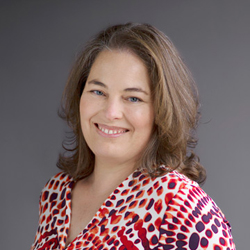 Sarah Betzer has been appointed the new chair of the editorial board of The Art Bulletin. Betzer is an associate professor in the McIntire Department of Art at the University of Virginia in Charlottesville, where she has taught since 2007. Her research examines European art of the eighteenth and nineteenth centuries взять займ с 18 лет на карту, with a particular interest in the intersections of art-theoretical debates and artistic practice. Pennsylvania State University Press published her book Ingres and the Studio: Women, Painting, History in 2012. Betzer is midway through the four-year term as a member of the Art Bulletin Editorial Board and will now complete the final two years as its chair.Image credit: Dave Woody
News from the Art and Academic Worlds
posted by Christopher Howard — September 16, 2015
Each week CAA News publishes summaries of eight articles, published around the web, that CAA members may find interesting and useful in their professional and creative lives.
President Obama Awards 2014 National Humanities Medal
The White House has awarded ten distinguished recipients the 2014 National Humanities Medal. The awardees include historians, writers, a philosopher, scholar, preservationist, food activist, and an education course. President Barack Obama conferred the medal in a September 10, 2015, ceremony in the East Room. (Read more from the National Endowment for the Humanities.)
Bookish: On the Art World’s Publishing Boom
Depending on how you look at it, the art-book industry is either in precarious straits or the midst of a golden age. Brick-and-mortar bookstores specializing in art books continue to close, giving way to online purveyors like Amazon, which don’t do so well with pricy art tomes. And traditional trade publishers have cut back on funding art titles. Meanwhile, blue-chip galleries, flush with cash in a booming art market, have picked up the slack with increasingly ambitious publishing programs. At the world’s wealthier galleries, an in-house imprint has become an essential part of business, as common as a front desk, PR team, and exhibition checklist. (Read more from ARTnews.)
How Art Reveals the Limits of Neuroscience
These days neural approaches to art are all the rage. We find it somehow compelling to think that the brain holds the answers to the questions about, well, everything that matters to us, including art. It’s hard not to be impressed by the excitement scientists feel as they try to hunt down aesthetic experience in the brain using the advanced methods and technologies of cognitive science. But art is an elusive quarry, and it leaves its clumsy predator flailing in the dust. (Read more from the Chronicle Review.)
The Brave New Museum Sputters into Life
With so many visitors—particularly the young—obsessively attached to digital devices as instruments of learning and sharing, even the most traditional art museum officials can no longer deny the imperative for technological interventions in what used to be a relatively unmediated relationship between viewer and object. First there were audio guides and websites. Now art museums are embracing everything from apps to robots to interactive pens, hoping to discern how best to enhance the gallery experience for savvy digerati, without ruining it for die-hard technophobes. (Read more from the Wall Street Journal.)
Why Art School Can Be a Smart Career Move
Art-school grads aren’t the highest earners overall, but neither are they doomed to become starving artists. “There’s a ton of evidence that prospects for graduates from art schools today are better than they’ve ever been before in terms of income, their ability to survive economic turbulence, and their preparedness for the job market of the 2020s,” says Jennifer Lena, a Columbia University professor who is senior research scholar for the Strategic National Arts Alumni Project. (Read more from Forbes.)
The International Fight over Marcel Duchamp’s Chess Set
In the process of researching Marcel Duchamp’s chess life for a commissioned art project, Scott Kildall found old pictures of the artist’s own hand-carved chess set, created around 1917. He loved the aesthetic and wanted to recreate the beautiful objects. So Kildall turned to another digital-fabrication artist, Bryan Cera, to work out how to model 3D-printable versions derived from the archival pictures. (Read more from the Atlantic.)
The Google Art Heist
The more playful Google gets, the more paranoid I get. So when I heard that, building on its plan to digitize all books, Google had opened a Cultural Institute in Paris to digitally replicate and curate all art and culture on earth, I wanted to check it out. From the most famous paintings of the Uffizi to an archive of South Korean film to virtual galleries of the pyramids, the institute has already amassed an impressive collection. (Read more from the New York Times.)
Peer Review, Preprints, and the Speed of Science
A few weeks ago my collaborators and I submitted our latest paper to a scientific journal. We have been investigating how noroviruses subvert the molecular machinery of infected cells and have some interesting results. If it passes peer review, our paper could be published in three or four months’ time. If it’s rejected, we may have to rework the manuscript before trying our luck with another journal. That will delay publication even further—it’s not unheard of for papers to take a year or more to get out of the lab and into the world, even in the digital age. (Read more from the Guardian.)
Committee on Women in the Arts Picks for September 2015
posted by CAA — September 10, 2015
Each month, CAA’s Committee on Women in the Arts selects the best in feminist art and scholarship. The following exhibitions and events should not be missed. Check the archive of CWA Picks at the bottom of the page, as several museum and gallery shows listed in previous months may still be on view or touring.
September 2015
Barbara Hepworth: Sculpture for a Modern World
Tate Britain
Millbank, London SW1P 4RG, United Kingdom
June 24–October 25, 2015
Tate Britain presents Barbara Hepworth: Sculpture for a Modern World, a retrospective of one of the UK’s most famous artists and leader of a new generation of sculptors. Sculpture for a Modern World, the first major exhibition of Hepworth in London in the last fifty years, traces the extensive practice of the artist, offering novel ways of thinking about her art. The exhibition also evidences her achievements and international recognition, while playing around different spaces in which Hepworth presented her work, such as the reconstruction in the gallery of a modernist structure that was the artist’s “ideal” environment.
Hepworth (Yorkshire, 1903) has lived in Cornwall since 1939. Being associated with the “art of St Ives,” she began to make sculptures that translated her experience of the landscape. The exhibition features more than one hundred works that unveil her extensive creative practice. The highlights include a quartet of African hardwood pieces from her postwar period; Pelagos, her celebrated elm carving inspired by the Cornish coast, as well as drawings, collages, films, rarely seen textiles, and her fascinating photographs that have never been seen in public before.
From her earliest carvings to the imposing bronze pieces of the sixties, this major retrospective explores the progression of the artist’s abstract style, showcasing many of Hepworth’s iconic sculptures that helped to define modernism in the twentieth century. As the art critic Alastair Sooke stated: “the exhibition benefits from its decision to separate Hepworth’s sculptures from those of her friend and rival Henry Moore, with whom she is all too often compared. In this case, quite refreshingly, Hepworth’s work is allowed to breathe on its own terms.”
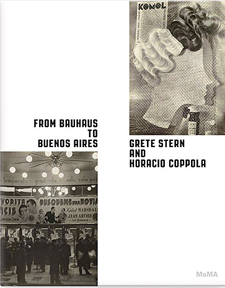
Cover of the exhibition catalogue for From Bauhaus to Buenos Aires: Grete Stern and Horacio Coppola
Grete Stern. From Bauhaus to Buenos Aires: Grete Stern and Horacio Coppola
Museum of Modern Art
11 West 53 Street, New York, NY 10019
May 17–October 4, 2015
The Museum of Modern Art presents From Bauhaus to Buenos Aires: Grete Stern and Horacio Coppola at the Edward Steichen Photography Galleries. This is the first major exhibition to focus on the work of two leading figures of avant-garde Argentinean photography, Grete Stern and Horacio Coppola. The couple met at the Bauhaus in 1932 and begun a creative life together. Among the rising threat of the Nazi powers in 1933, they fled Germany to London, and in 1935 embarked to Buenos Aires. Having been established themselves on both sides of the Atlantic, they played a key role in the arrival of modern photography in Argentina.
The exhibition begins in the late 1920s with each artist’s initial ventures into photography and typographic design, followed by a section focused on the extensive oeuvre of each artist. In 1928, Stern (born in Germany, 1904) met Ellen Auerbach at Walter Peterhans’s studio. Peterhans was Stern’s tutor, about to become head of photography at the Bauhaus. Grete and Ellen become friends and opened ringl + pit, a pioneering collaborative studio specializing in portraiture and advertising. Named after their childhood nicknames, the duo embraced commercial and avant-garde design to create protofeminist works and advertisements, using photomontage in their imagery to challenge the stereotypical presentations of women in advertising.
The highlights of Stern’s individual practice include the series Sueños (Dreams) that the artist produced between 1949 and early 1950s. This series of photomontages, commissioned as a contribution to the then-popular women’s magazine Idilio, reflects how psychoanalysis had captured the Argentinean imagination and infiltrated in popular culture. However, Stern opted to resist psychoanalyst interpretations, instead using the platform to comment on women’s unfulfilled promises and objectification at the Peronist society of the time.
Wendelien van Oldenborgh: Bete & Deise
Brazilian Screening Tour
Casa do Povo, São Paulo; Fundaj – Arte Contemporânea Recife; Capacete, Museum of Modern Art and Casa França-Brasil, Rio de Janeiro
August 5–September 30, 2015
If I Can’t Dance, I Don’t Want to Be Part of Your Revolution has commissioned the Rotterdam-based artist Wendelien van Oldenborgh’s film Bete & Deise- Brazilian Tour (2012) to be presented in several venues in São Paulo, Recife, and Rio de Janeiro during August and September. The screenings will be accompanied by conversations with the artist and invited guests, including the protagonists of the film, Bete Mendes and Deise Tigrona, who are special guests at the presentation in MAM Rio.
Van Oldenborgh (born 1962) addresses modern-day social issues in exceptional, authoritative, and multilayered works. She proposes a unique and subtle language to build a dialogue between a precisely selected social or historical theme, a space, and a film or photograph. Bete & Deise stages an encounter between two women in a building under construction in Rio de Janeiro. The actress Mendes and the Baile funk singer Tigrona have—each in their own way—given meaning to the idea of a public voice. Together these women talk about the use of their voice and their positions in the public sphere, allowing for the contradictions they each carry within themselves to surface, the artists confront us with considerations on the relation between cultural production and politics and the potential power that is generated when public issues intersect with the personal.
Shelley Spector: Keep the Home Fires Burning
Philadelphia Museum of Art
Perelman Building, 2525 Pennsylvania Avenue, Philadelphia, PA 19130
March 7–September 24, 2015
The Philadelphia Museum of Art presents Keep the Home Fires Burning by the Philadelphia-based and community-engaged artist Shelley Spector. Spector (born 1960) was invited by the curator Dilys Blum to explore the museum’s collection of textiles and create an installation of new artwork. Her moving response became Keep the Home Fires Burning, a walk-through presentation of wood- and textile-based sculpture that reflects on the universal quest for hope, home, and connectedness.
The initial inspiration for the exhibition is a lively hand-stitched embroidered work decorated with images of a home, birds, tulips, trees, and couples designed by the folk art historian Frances Lichten and sewn by her mother in 1943. The piece was later donated to the museum by the artist Katherine Milhous, who was Lichten’s companion for four decades. Spector has re-created it in the exhibition by suspending large sculptures amid freestanding works, made from discarded second-hand clothing and furniture, with the help of her mother, Anita, who has—like did Lichten’s—carefully cleaned, deconstructed, and organized the material to be transformed into sculpture by the artist. Works in Keep the Home Fires Burning—a phrase that Spector found in a letter from Milhous to Lichten—spans from large, flowerlike structures and a birdcage to tomato-shaped pincushions and wood-and-fabric lions. The display also includes works dedicated to the couple: The Egg Tree (a nod to an award-winning children’s book by Milhous) and Frances Loves Katherine, which features two figures in front of a house inscribed with the words “give sunshine to others.”

Ana Mendieta, Untitled: Silueta Series, 1978, Super 8 film, color, silent (artwork © Estate of Ana Mendieta Collection)
Ana Mendieta: Covered in Time and History: The Films of Ana Mendieta
Katherine E. Nash Gallery
Regis Center for Art, University of Minnesota, 401 21st Avenue South, Minneapolis, MN
September 15–December 12, 2015
Program: September 19, 2015, 7:00 PM, followed by a reception from 8:00 to 10:00 PM
The unique exhibition at the Katherine E. Nash Gallery on Ana Mendieta, a Cuban-born artist who was sent to the United States as a child in 1961 as part of Operation Peter Pan, features twenty-one films by Mendieta, as well as a selection of her photographic work and a documentary short on the artist by the producer Raquel Cecilia Mendieta, the artist’s niece.
“Ana Mendieta was influenced by and interested in the artistic movements of her time, including Minimalism, earth art, performance art, and feminist art as well as the historical and spiritual legacies of many cultures, ancient and modern,” the exhibition statement says. Mendieta’s films touch on subjects from sexual assault in Moffitt Building Piece and Sweating Blood, which were made in response to the sexual assault and murder of Sarah Ann Ottens, a student at the University of Iowa, where Mendieta also matriculated, to films made in Mexico, such as Silueta del Laberinto and Burial Pyramid, developing her “earth-body” esthetic, as she termed the melding of sculpture, earth art, and performance.
“Mendieta’s artwork speaks powerfully to a wide diversity of audiences across the generations because a sustained and unflinching investigation of what it means to be human can be found at the core of her work.”
The program begins on September 19 with comments on Mendieta’s artistic legacy by her sister Raquelín Mendieta, her niece Raquel Cecilia Mendieta, and Mary Sabbatino of Galerie Lelong. Other programs and discussions on the role of the artist’s prolific career follow through the exhibition.
Judy Chicago: Star Cunts & Other Attractions
Riflemaker Gallery
79 Beak Street, London
September 14–December 31, 2015
The pioneering feminist artist Judy Chicago will have concurrent exhibitions in London this fall. Included is a series of never-before-seen works in Star Cunts & Other Attractions at Riflemaker. The solo show of Chicago’s archival work from the 1960s and 1970s “celebrates the visual language and core imagery of Judy Chicago’s minimalist and early feminist work.” Included are a suite of paintings and early sculpture work. Featured will be the Star Cunts series from 1969. The series, a set of prismacolor geometric shapes, suggests a sphincter. Also on exhibit will be test plates from The Dinner Party, which permanently lives at the Elizabeth A. Sackler Center for Feminist Art at the Brooklyn Museum. The test plates attest to the time Chicago invested in her work through practice of ceramic decoration.
While the exhibition at Riflemaker is open, Chicago will also have work in the Tate Modern exhibition The World Goes Pop, opening on September 17, 2015. On view together for the first time will be her Car Hood series from the mid-1960s, which is constructed of car hoods spray-painted in bold colors and depicting male and female forms—a reflection on the Los Angeles car scene of the time.
Affiliated Society News for September 2015
posted by CAA — September 09, 2015
Community College Professors of Arts and Art History
After successful sessions at last year’s CAA and FATE Conferences, the Community College Professors of Arts and Art History (CCPAAH) will hold two events at this year’s CAA Annual Conference in Washington, DC. Our business meeting will be held on Friday, February 5, from 7:30 AM to 9:00 AM. Please bring a project idea to share with your colleagues. Our session “In and out of the Studio: New ideas for Art Appreciation” will be held at 12:30 PM on Thursday, February 4. We are looking for additional presenters who are doing interesting things in Art Appreciation. If you are interested in presenting or have any questions, please contact Susan Altman. We look forward to seeing you at the conference!
Japan Art History Forum
Yurika Wakamatsu, PhD candidate at Harvard University, was selected as the winner of the 2015 Chino Kaori Memorial Essay Prize for an essay titled “Feminizing Art in Modern Japan: Noguchi Shōhin (1847-1917) and the Changing Conceptions of Art and Womanhood.” The prize was established by the Japan Art History Forum in 2003 in memory of distinguished colleague Chino Kaori, and is awarded annually to the best research paper written in English on a Japanese art history topic.
American Academy in Rome
The American Academy in Rome (AAR) invites applications for the 2016 Rome Prize competition. Up to thirty fellowships (from six months to two years) are awarded to emerging and established artists and scholars working in a variety of disciplines, including a stipend, room & board, and individual workspace at our eleven-acre center in Rome. Please visit aarome.org/apply for submission guidelines. Applications are due November 1.
AAR presents Bodies of Knowledge, the 2015 – 2016 series of lectures, exhibitions and events. Programming features artists and scholars offering multiple readings across disciplinary and geographical boundaries — questioning assumptions about the ways in which we structure knowledge and how these categories define our understanding of history, identity and culture. Fall events in Rome include a conversation with artist Isaac Julien and curator Mark Nash on filmmaking inspired by architect Lina Bo Bardi, and an exhibition of Cy Twombly photographs, accompanied by a talk with photographer Sally Mann. In New York, the Academy presents an evening on poetry and language with Edward Hirsch and Robert Polito, and a panel discussion on cultural patrimony and collective responsibility with scholar C. Brian Rose, antiquities expert Deborah Lehr and art historian James Cuno. Visit aarome.org for details.
Women’s Caucus for Art
The Women’s Caucus for Art (WCA) is pleased to announce Susan M. King (previously Susan King Obarski), Ph.D., as the incoming president of the organization. An art historian and artist, she teaches at the Laguna College of Art and Design and at Loyola Marymount University in Los Angeles, CA. Her doctorate in Visual Studies at UC, Irvine, “Surrealism: A Marxist Enterprise in 1930s London,” included a chapter on artist Eileen Agar. She recently reviewed the J.M.W. Turner exhibitions and catalogue for caa.reviews (in press). Susan is a long time board member of WCA and past chair of the Lifetime Achievement Awards. Her two-year term as president begins in February 2016 after the CAA and WCA conferences. One of her key goals is to cross the generational divide of feminist artists, writers, and scholars to engage an open and fruitful dialogue on a range of feminist and activist issues. To that end, she is curating WATER: AN ESSENTIAL CONVERSATION, featuring historical posters from the Center for the Study of Political Graphics and contemporary graphic and video art. Founded in 1972, the WCA is an affiliate society of CAA and a founding member of The Feminist Art Project. More at nationalwca.org.
Renaissance Society of America
The Renaissance Society of America will hold its 62nd annual meeting in Boston, 31 March–2 April 2016. The program will include nearly 700 sessions, with more than 200 in Renaissance and early modern art history. The full, searchable program and schedule can be viewed on our website.
The Renaissance Society of America annually awards short-term grants supporting research projects and publications that aim to advance scholarly knowledge about the Renaissance. Many grants in art history are funded by the generous support of the Samuel H. Kress Foundation, through the Kress Mid-Career Research and Publication Fellowships in Renaissance Art History and the Kress Short-Term Research Library Fellowships for Art Historians programs. Please see our website for more information. Applicants must be members of RSA. Application deadline is 1 December 2015.
Public Art Dialogue
The newest issue of Public Art Dialogue (Volume 5, Issue Number 1) has been published. Edited by John Craig Freeman and Mimi Sheller, it is devoted to the theme of Hybrid Space and Digital Public Art. Articles include “Down the Rabbit Hole” by Esther Polak and Ivar van Bekkum; “Networked Monumental: Site, Production, and Distributed Publics—Online, and in Everyday Life,” by Dylan Gauthier; “Future Museums Now—Augmented Reality Musings” by Geoffrey Alan Rhodes; “#sQavengeRhunt: LoVid” by Tali Hinkis and Kyle Lapidus; and “The Digital: A False Division?” by Patrick Lichty. Two interviews by Dorothy Santos are included: Kate Durban and Jim Dessicino. Finally, there are two book reviews: one on Vladimir Geroimenko’s Augmented Reality Art: From an Emerging Technology to a Novel Creative Medium by Lenore Metrick-Chen; and a second on Ricciarda Belgiosojoso’s Constructing Urban Space with Sounds and Music by Shawn Greenlee. More information is available on the journal’s website.
Association of Academic Museums & Galleries
AAMG/Kellogg 2016 Leadership Seminar: Join colleagues from throughout the U.S. and beyond for AAMG’s flagship professional development program at the prestigious Kellogg School Center for Nonprofit Management, Northwestern University. Now accepting applications online. APPLICATION DEADLINE JANUARY 15, 2016.
WHO: Faculty drawn from the Kellogg School of Management Center for Nonprofit Management and seasoned professionals in the academic museum field. Up to 40 Seminar Fellows selected from a national and international application pool by the Application Review Team.
WHAT: A Certificate Program. Intensive, week-long, highly interactive learning and sharing experience with top faculty in the field of leadership and management and academic museum and gallery colleagues from across the U.S. and abroad.
WHEN: June 19 – June 24, 2016
WHERE: Northwestern University, Evanston, Illinois (metro-Chicago)
TUITION: $4,500. Limited scholarship funds may be available.
Association for Latin American Art
ALAA has launched a redesigned website aimed at providing current news and events on Latin American art to the public. The website features updated information on the ALAA bylaws, officers, book and dissertation awards, a newsletter archive, and a list of academic programs that offer graduate degrees in art history with a focus on Latin America. A Members Portal allows registered ALAA members to access a membership directory, discover fellow members’ research interests, and contribute to the public Events Calendar.
Triennial Conference: ALAA is pleased to invite proposals for papers to be presented at its Fourth Triennial Conference “Art at Large: Public and Monumental Arts in the Americas.” Hosted by the Fine Arts Museums of San Francisco in collaboration with the Department of History of Art at the University of California, Berkeley, the conference will be held the weekend of March 18–20, 2016 at the de Young Museum in San Francisco’s Golden Gate Park. Deadline September 15, 2015.
Book Award: ALAA announces its Fourteenth Annual Book Award for the best scholarly book published on the art of Latin America from the Pre-Columbian era to the present. Deadline November 15, 2015.
Association for Modern and Contemporary Art of the Arab World, Iran, and Turkey
AMCA is currently accepting submissions for the 2016 Rhonda A. Saad Prize for Best Paper in Modern and Contemporary Arab Art. Established in 2010, the award aims to recognize and promote excellence in the field of modern and contemporary Arab art. The prize honors our respected colleague and dear friend, Rhonda (1979-2010), who was, at the time of her tragic passing, in the process of researching a doctoral dissertation on modern Palestinian art in the Department of Art History at Northwestern University. Over the last five years, the prize has recognized excellence in graduate work completed on a variety of subjects in a number of disciplines at universities in the U.S. and abroad. This year, we are opening the competition to graduate students as well as to recent post-doctoral students who earned a PhD no earlier than 2013.
The prize is offered to a graduate student or recent PhDs working in any discipline whose paper is judged to provide the most significant contribution to the disciplines of Art History and Middle East Studies. Submissions must have been produced between June 2014 and December 2015, must not exceed 35 pages (excluding notes and bibliography), and must not have been previously published or be currently under consideration for publication.
Submissions are due to info@amcainternational.org by December 1, 2015. The winner will be announced during the AMCA Members Meeting, held this year at the College Art Association Annual Meeting in Washington, DC, in February 2016. The author of the winning paper will be awarded $500USD and the winning paper will be considered for publication in the Arab Studies Journal, pending the standard review process.
In October 2015, the School of Art, Design, and Media at Nanyang Technological University in Singapore brought together designers, artists, architects, and academics for a multi-disciplinary conference on contemporary Islamic art, design, and architecture. Although each discipline has its own practice and methodology, when collectively grouped under an Islamic identity, we are forced to redefine the term “Islamic.” While new forms, spaces, images, typographies, symbols, colors, and materials of contemporary Islamic art, design, and architecture share distinct cultural narratives from individual geographies, it remains essential to address how comparative and connective perspectives reorient our understanding of contemporary Islamic visual communication. This three-day conference took place October 7-9 and was an unprecedented forum dedicated to convening professionals and scholars from throughout Asia, Europe, and America who share an investment in contemporary Islamic art, design, and architecture. For more information, visit http://www.ciada2015.com/. Organization Committee: Gül İnanç, Peer Sathikh, Nada Shabout, Sarah Rogers and Dina B.
Association of Art Museum Curators and American Academy in Rome
The Association of Art Museum Curators (AAMC) and the American Academy in Rome (AAR) are pleased to announce the third year of The Samuel H. Kress Foundation AAMC Affiliated Fellowship at the American Academy in Rome. The program is intended to honor exceptional curatorial vision and help curators advance deserving projects. The purpose of the award is to provide essential funding for curators to develop projects that require research in Italy.
The Affiliated Fellowship is a 4-week appointment at the AAR, which includes housing, six lunches and five dinners a week, and access to residence hall kitchens; $1,500 in airfare; and $2,000 stipend. Affiliated Fellows have access to all the AAR facilities (including 24-hour a day access to the library and overall grounds) and all activities that occur at the Academy, such as concerts, exhibitions, conferences, lectures, and tours, etc. If desired, the Fellow can also schedule to give a talk about their project at the AAR during the Fellowship. For more information, visit http://www.artcurators.org/?KressAARFellowship or email aamc@artcurators.org.
Save the date: The 2016 AAMC Annual Conference & Meeting will be May 7 – 10 in Houston, Texas.
Society for Photographic Education
Society for Photographic Education (SPE) offers student member scholarships to offset the cost of attending SPE’s 2016 National Conference in Las Vegas, NV, March 10-13. Each award includes a $550 travel stipend, conference fee waiver, and complimentary one-year membership in SPE. For more information, visit www.spenational.org or contact info@spenational.org. Application deadline is October 15, 2015, at 11:59 PM EST.
Southeastern College Art Conference
Kevin Cates, Associate Professor of Graphic Design at the University of Arkansas at Little Rock, has been appointed to the SECAC Board of Directors.
Committee on Diversity Practices highlights for September/October 2015
posted by CAA — September 09, 2015
The CAA Committee on Diversity Practices highlights exhibitions, events, and activities that support the development of global perspectives on art and visual culture and deepen our appreciation of political and cultural heterogeneity as educational and professional values. Current highlights are listed below; browse past highlights through links at the bottom of this page.
September/October 2015
Doris Salcedo
Guggenheim Museum
New York, New York
June 26–October 12, 2015
“This major retrospective will survey the searing, deeply poetic work of Doris Salcedo (b. 1958, Bogotá, Colombia). Over the past three decades, Salcedo’s practice has addressed the traumatic history of modern-day Colombia, as well as wider legacies of suffering stemming from colonialism, racism, and other forms of social injustice. Originating in lengthy research processes during which the artist solicits testimonies from the victims of violent oppression, her sculptures and installations eschew the direct representation of atrocities in favor of open-ended confluences of forms that are fashioned from evocative materials and intensely laborious techniques. Many of her works transmute intimate domestic objects into subtly charged vessels freighted with memories and narratives, paradoxically conjuring that which is tragically absent. The Guggenheim’s presentation of Doris Salcedo will occupy four levels of the museum’s Tower galleries. It will feature the artist’s most significant series from the late 1980s to the present, as well as a video documenting her remarkable site-specific public projects and architectural interventions.”
Flawlessly Feminine: Women Who Graced the Cover of JET Magazine and Works by Willie Cole
Golden Lady: Works by Mario Moore
Diggs Gallery, Winston-Salem State University
Winston-Salem, North Carolina
July 9–December 2, 2015
“The pairing of two innovative exhibitions honoring women who graced the cover of JET Magazine, and drawings of young women with their favorite literature, is on display at Winston-Salem State University’s Diggs Gallery through December 2. The exhibits feature works by renowned artist Willie Cole and emerging artist Mario Moore.”
Black Like Who?
Birmingham Museum of Art
Birmingham, Alabama
July 11–November 1, 2015
“Issues regarding visual depictions of blackness in American art have been such highly scrutinized topics in both artistic production and museum exhibitions that one could ask what else is there to examine that has not already been sufficiently analyzed? Black Like Who? answers that inquiry with a question that considers who renders imagery of blackness and contemplates the various reasons why.
Drawing on the Museum’s collection and select loans from Birmingham private collectors, the exhibition surveys a variety of historical and contemporary works, and explores how various representations of blacks in American art have been influenced at particular historical moments by specific political, cultural, and aesthetic interests, as well as the motives and beliefs of the artists. Comprising work by both white and black artists, the diverse works examined in Black Like Who? range from romanticized Civil War depictions painted in the early 20th century by Gilbert Gaul (1855–1919) to a contemporary print by Iona Rozeal Brown (born 1966) that blends hip-hop culture with late 19th-century Japanese art.”
Deana Lawson: Ruttenberg Contemporary Photography Series
Art Institute of Chicago
Chicago, Illinois
September 5, 2015–January 10, 2016
“The first installment of the biennial Ruttenberg Contemporary Photography Series features the work of New York–based photographer Deana Lawson. For nearly a decade, Lawson has been investigating the visual expression of global black culture and how individuals claim their identities within it. Her staged portraits, carefully composed scenes, and found images speak to the ways in which personal and social histories, familial legacies, sexuality, social status, and religious-spiritual ideas may be drawn upon the body.
Lawson began her work in and around her Brooklyn neighborhood but has recently branched out nationally and internationally to places such as Louisiana, Haiti, Jamaica, Ethiopia, and the Democratic Republic of the Congo. While her themes have remained consistent, her landscapes have shifted and broadened—the global scope of the pictures, in her words, “concern and affirm the sacred black body” and speak to a collective psychic memory of shared experiences.
Lawson starts her process by researching communities she has chosen for their cultural histories. Once on site, strangers met through chance encounters become her subjects, selected for a particular expression, mannerism, style of dress, or cultural or religious affiliation. The resulting images are often inspired by multiple trips or planned well in advance. They draw upon Western and African diasporic conventions of self-presentation, popular culture, mythology, and religious rituals and beliefs—emphasizing dialogues among the past, present, and future of black culture.”
Transmissions: Art in Eastern Europe and Latin America, 1960–1980
Museum of Modern Art
New York, New York
September 5, 2015–January 3, 2016
“Transmissions: Art in Eastern Europe and Latin America, 1960–1980 focuses on the parallels and connections among an international scene of artists working in—and in reference to—Latin America and Eastern Europe during the 1960s and 1970s. The radical experimentation, expansion, and dissemination of ideas that marked the cultural production of these decades (which flanked the widespread student protests of 1968) challenge established art-historical narratives in the West. Artists from Prague to Mexico City developed alternative and ever-expanding networks of distribution and organization, via Paris, Vienna, and Venice, to circumvent the borders established after World War II, local forms of state and military repression, and Western accounts of artistic mastery and individualism. One major transformation across Latin American and Eastern European art scenes was the embrace of institutional critique and an emphasis on the creation of art outside a market context.
The exhibition brings together landmark works from MoMA’s collection by Eastern European artists including Geta Brặtescu, Tomislav Gotovac, Ion Grigorescu, Sanja Iveković, Dóra Maurer, and the anti-art collectives Gorgona, OHO, Aktual, and Fluxus East, as well as Latin American artists such as Beatriz González, Antonio Dias, Lea Lublin, and Ana Mendieta. Particular attention is paid to the group of Argentine artists clustered around the influential Instituto Torcuato Di Tella, including Oscar Bony, David Lamelas, and Marta Minujín, who confronted the aesthetic and political implications of mass media communication—including film, television, and the telex—during a vibrant, experimental period of technological innovation and political tension.
Featuring series of works and major installations, several of which are on view for the first time, Transmissions: Art in Eastern Europe and Latin America, 1960–1980 highlights multiple points of contact, often initiated and sustained through collective actions and personal exchanges between artists. The exhibition suggests possible counter-geographies, realignments, alternative models of solidarity, and new ways of thinking about art produced internationally in relation to the frameworks dictated by the Cold War.”
Philippine Gold: Treasures of Forgotten Kingdoms
The Asia Society
New York, New York
September 11, 2015–January 3, 2016
“This exhibition of more than 100 gold objects focuses on the wealth of the golden age of Butuan (pronounced boot’ wan), a polity on the southern Philippine island of Mindanao that rose to commercial prominence in the tenth century and declined in the thirteenth century. Works from ancient polities beyond Butuan, such as those on the islands of the Visayas and Luzon, bear witness to the early use of gold throughout the Philippines. A selection of the most extraordinary objects from a 1981 discovery—now in the collection of the Ayala Museum in Makati City and on view in the United States for the first time—forms the core of “Philippine Gold: Treasures of Forgotten Kingdoms.” The exhibition also includes a few important loans from public and private collections including the Central Bank of the Philippines. Featuring spectacular gold necklaces, chains, waistbands, bangles, ritual bowls, implements, and ceremonial weapons, the exhibition showcases the rich artistry and material wealth of Butuan and related island polities.”
Gates of the Lord: The Tradition of Krishna Paintings
Art Institute of Chicago
Chicago, Illinois
September 13, 2015–January 3, 2016
“This fall, the Art Institute of Chicago offers a glimpse into one of the world’s most intimate religious traditions. Bringing together over 100 artworks from private and public collections in India and the United States, Gates of the Lord: The Tradition of Krishna Paintings is the first major U.S. exhibition to explore the unique visual culture of the Pushtimarg, a Hindu denomination from Western India.
Founded in the 16th century by the saint and philosopher Shri Vallabhacharya (1479–1531), the Pushtimarg is a religious community dedicated to the devotion of Shrinathji, a divine image of the Hindu god Krishna as a seven-year-old child. The religious and artistic center of the sect is based in the temple town of Nathdwara (literally, “The Gates of the Lord”), near Udaipur in the state of Rajasthan, India. Scholars and artists have long been fascinated by the distinctive and highly aestheticized manner in which members of this group venerate Shrinathji, as well as by the legacy of miniature paintings created as a record of such worship. This exhibition showcases centuries of pichvais (textile hangings) and miniature paintings that have been created by and for the Pushtimarg in devotion of Shrinathji.
The exhibition takes visitors through a year in Nathdwara, where the daily worship of Shrinathji is characterized by the changing seasons and a bustling festival calendar. Gallery by gallery, visitors are introduced to the pichvais used as backdrops for Shrinathji in his shrine, each uniquely suited to a particular season or festival. The accompanying miniature paintings offer further insight into the Pushtimarg sect: its mode of veneration, history, and important priests and patron families. Enhancing the experience of the sect’s rich culture are festival and devotional music, a shrine reconstruction, and touchscreen kiosks that allow visitors to page through religious manuscripts, an artist’s sketchbook, and a historic photo album. The exhibition concludes with an exploration of the works, sketches, and observations of prominent 20th- and 21st-century Nathdwara artists who have kept the painting tradition flourishing through the present day.
Gates of the Lord comprises drawings, pichvais, paintings, and historic photographs borrowed chiefly from two major private collections in India, the Amit Ambalal Collection (Ahmedabad, India) and the TAPI Collection (Surat, India). These rare loans are augmented by important objects from a number of public and private collections within the United States, including the Art Institute’s own permanent collection, in order to present the richest possible story of Pushtimarg art and tradition.”
Kongo: Power and Majesty
The Metropolitan Museum of Art
New York, New York
September 18, 2015–January 3, 2016
“Central Africa’s Kongo civilization is responsible for one of the world’s greatest artistic traditions. This international loan exhibition will explore the region’s history and culture through 134 of the most inspired creations of Kongo masters from the sixteenth through the early twentieth century.
The earliest of these creations were diplomatic missives sent by Kongo sovereigns to their European counterparts during the Age of Exploration; they took the form of delicately carved ivories and finely woven raffia cloths embellished with abstract geometric patterns. Admired as marvels of human ingenuity, such Kongo works were preserved in princely European Kunstkammer, or cabinets of curiosities, alongside other precious and exotic creations from across the globe.
Kongo luxury arts from the sixteenth through the eighteenth century—many of which have never been exhibited before—will give an unprecedented historical backdrop to the outstanding work produced by master sculptors active in the same region during the nineteenth century. The array of figurative representations they produced range from miniature ivory finials for the staffs of office of Kongo leaders to the carved-wood commemorative shrine figures positioned above their burial sites.
The presentation will culminate with a gathering of fifteen monumental Mangaaka power figures produced in the Chiloango River region during the second half of the nineteenth century; these will include the celebrated example acquired by the Met in 2008, the original catalyst for the exhibition. For the first time, this electrifying form of expression will be understood as a defensive measure conceived by Kongo leaders to deflect Western incursions into this region of Central Africa.
With works drawn from sixty institutional and private lenders across Europe and the United States, Kongo: Power and Majesty will relate the objects on view to specific historical developments and will challenge misconceptions of Africa’s relationship with the West. In doing so, it will offer a radical, new understanding of Kongo art over the last five hundred years.”
Impressionism and the Caribbean: Francisco Oller and His Transatlantic World
Brooklyn Museum of Art
Brooklyn, New York
October 2, 2015–January 3, 2016
“The painter Francisco Oller contributed greatly to the development of modern art in both Europe and the Caribbean and revolutionized the school of painting in his native Puerto Rico.
Oller emerged from the small art world of San Juan in the 1840s, spending twenty years in Madrid and Paris, where he was inspired by the art of Gustave Courbet and joined the avant-garde circles of such artists as Paul Cézanne, Camille Pissarro, and Claude Monet. While European Romanticism, Realism, and Impressionism formed a critical jumping-off point for Oller’s aesthetic, his most important source of inspiration was Puerto Rico, where he painted tropical landscapes, still lifes with indigenous fruits and vegetables, and portraits of distinguished artists and intellectuals.
This is the first U.S. exhibition to present Oller’s work within both its New and Old World contexts.”
Walid Raad
Museum of Modern Art
New York, New York
October 12, 2015–January 31, 2016
“MoMA presents the first comprehensive American survey of the leading contemporary artist Walid Raad (b. 1967, Lebanon), featuring his work in photography, video, sculpture, and performance from the last 25 years. Dedicated to exploring the veracity of photographic and video documents in the public realm, the role of memory and narrative within discourses of conflict, and the construction of histories of art in the Arab world, Raad’s work is informed by his upbringing in Lebanon during the civil war (1975–90), and by the socioeconomic and military policies that have shaped the Middle East in the past few decades.
The exhibition focuses on two of the artist’s long-term projects: The Atlas Group (1989–2004) and Scratching on things I could disavow (2007–ongoing). Under the rubric of The Atlas Group, a 15-year project exploring the contemporary history of Lebanon, Raad produced fictionalized photographs, videotapes, notebooks, and lectures that related to real events and authentic research in audio, film, and photographic archives in Lebanon and elsewhere. Raad’s recent work has expanded to address the Middle East region at large. His current ongoing project, Scratching on things I could disavow, examines the recent emergence in the Arab world of new infrastructure for the visual arts—art fairs, biennials, museums, and galleries—alongside the geopolitical, economic, and military conflicts that have consumed the region. The exhibition emphasizes the importance of performance, narrative, and storytelling in Raad’s oeuvre. The artist will give lecture-performances in MoMA’s Donald B. and Catherine C. Marron Atrium multiple times a week for the duration of the exhibition.”
Joaquín Torres-García: The Arcadian Modern
Museum of Modern Art
New York, New York
October 25, 2015–February 15, 2016
“This major retrospective of Joaquín Torres-García (Uruguayan, 1874–1949) features works ranging from the late 19th century to the 1940s, including drawings, paintings, objects, sculptures, and original artist notebooks and rare publications. The exhibition combines a chronological display with a thematic approach, structured in a series of major chapters in the artist’s career, with emphasis on two key moments: the period from 1923 to 1933, when Torres-García participated in various European early modern avant-garde movements while establishing his own signature pictographic/Constructivist style; and 1935 to 1943, when, having returned to Uruguay, he produced one of the most striking repertoires of synthetic abstraction.
Torres-García is one of the most complex and important artists of the first half of the 20th century, and his work opened up transformational paths for modern art on both sides of the Atlantic. His personal involvement with a significant number of early avant-garde movements—from Catalan Noucentismo to Cubism, Ultraism-Vibrationism, and Neo-Plasticism—makes him an unparalleled figure whose work is ripe for a fresh critical reappraisal in the U.S.”