CAA News Today
Books Published by CAA Members
posted by CAA — October 15, 2016
Publishing a book is a major milestone for artists and scholars—browse a list of recent titles below.
Books Published by CAA Members appears every two months: in February, April, June, August, October, and December. To learn more about submitting a listing, please follow the instructions on the main Member News page.
October 2016

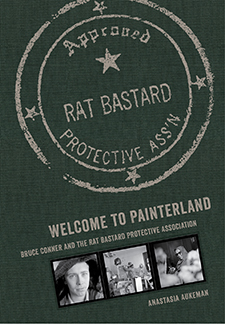
Anastasia Aukeman. Welcome to Painterland: Bruce Conner and the Rat Bastard Protective Association (Oakland: University of California Press, 2016).


Michael Corris. Leaving Skull City: Selected Writings on Art (Dijon, France: Les Presses du réel, 2016).

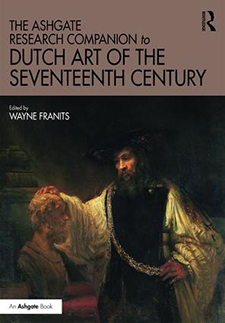
Wayne Franits, ed. The Ashgate Research Companion to Dutch Art of the Seventeenth Century (New York: Routledge, 2016).


Peter J. Holliday. American Arcadia: California and the Classical Tradition (New York: Oxford University Press, 2016).

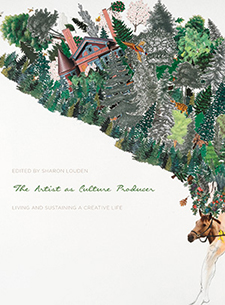
Sharon Louden. The Artist as Cultural Producer: Living and Sustaining a Creative Life (Bristol, UK: Intellect Books, 2017).

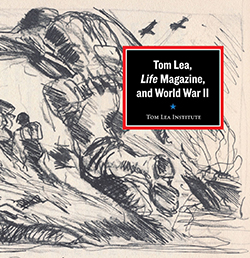
Adair Margo and Melissa Renn. Tom Lea, Life Magazine, and World War II (El Paso, TX: Tom Lea Institute, 2016).


Craig McDaniel and Jean Robertson. Spellbound: Rethinking the Alphabet (Bristol, UK: Intellect Books, 2016).

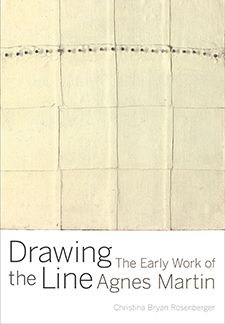
Christina Bryan Rosenberger. Drawing the Line: The Early Work of Agnes Martin (Oakland: University of California Press, 2016).

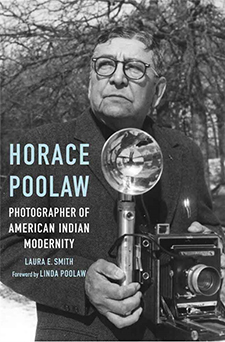
Laura E. Smith. Horace Poolaw, Photographer of American Indian Modernity (Lincoln: University of Nebraska Press, 2016).

Nicholas Stanley-Price, Mary K. McGuigan, and John F. McGuigan Jr. At the Foot of the Pyramid: 300 Years of the Cemetery for Foreigners in Rome (Bonn: Arbeitskreis selbständiger Kultur-Institute, 2016).

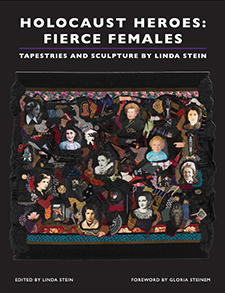
Linda Stein, ed. Holocaust Heroes: Fierce Females; Tapestries and Sculpture by Linda Stein (Philadelphia: Old City Publishing, 2016).

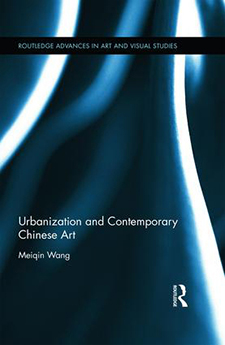
Meiqin Wang. Urbanization and Contemporary Chinese Art (New York: Routledge, 2016).
What is myCAA?
posted by CAA — October 14, 2016
With the opening of conference registration for the 2017 Annual Conference in New York, February 15-18, you might have seen us mention our new campaign, myCAA.
myCAA is a way for us to tell our members, and even those outside our membership in the arts and culture field, that we are listening. And that we want to hear from you! myCAA is about opening up the channels of communication member to member and between the CAA staff, board, committees, and affiliates. We are all in this together, each and every person involved in CAA. From the administrative and staff side of CAA, we know the organization exists because of the support of our members and those working in the visual arts field. Your support helps us in turn support you in your professional teaching, scholarship, and art making. We see this circle as vital to the impact that art historians, artists, and scholars have on the field of visual arts and on society as a whole.
We want to hear from you on CAA Connect, our new digital discussion and resource library platform. The myCAA community is where members should post any and all thoughts they have about how to make CAA an organization that serves the profession at the highest level. How to log in to CAA Connect.
At the conference, we want to hear from you. Stop a CAA staff member, board member, or committee member in the hallway, in sessions, or in the Hilton lobby! Say hello and tell us how we can make CAA the best organization it can be to support your efforts and your work.
Call us. Email us. Write to us. Send us a carrier pigeon.
We know that our members and those working in the visual arts contribute to and improve society every single day. myCAA is the call for our members to use their voices and to tell us how we can help so you can push forward and change the world.
New in caa.reviews
posted by CAA — October 14, 2016
Laura Weigert discusses Anne Teresa De Keersmaeker: Work/Travail/Arbeid, an exhibition and site-specific work at the Centre Pompidou. Each of the nine hour-long segments features “a different combination of dancers and musicians.” According to Weigert, “the concept of work” is central to the project, along with the question of “what might dance achieve in a museum.” Read the full review at caa.reviews.
Yumi Park Huntington reviews the exhibition catalogue Chavín: Peru’s Enigmatic Temple in the Andes. Edited by Peter Fux, the essays “present new archeological excavations and new interpretations of material objects.” Using “rich and abundant data,” the contributors illustrate “the importance of analyzing a culture within its network of interactions and exchanges with contemporaneous societies.” Read the full review at caa.reviews.
Heather Diack visits This Place, a traveling exhibition initiated by Frédéric Brenner and curated Charlotte Cotton. Featuring twelve internationally acclaimed photographers, the show “claims to grapple with ‘the complexity of Israel and the Westbank, as place and metaphor,’” but ultimately “does not bring the viewer any closer to understanding the realities of this highly charged terrain.” Read the full review at caa.reviews.
Brian Madigan reads Art and Rhetoric in Roman Culture, edited by Jaś Elsner and Michel Meyer. The volume “makes a case for a prescriptive approach to the understanding of Roman visual culture” based on “Aristotle’s tripartite division of rhetoric.” While the “nature of workings” of this visual rhetoric “are still vitally debated,” the book will surely benefit “advanced scholars of Roman art.” Read the full review at caa.reviews
Caa.reviews publishes over 150 reviews each year. Founded in 1998, the site publishes timely scholarly and critical reviews of studies and projects in all areas and periods of art history, visual studies, and the fine arts, providing peer review for the disciplines served by the College Art Association. Publications and projects reviewed include books, articles, exhibitions, conferences, digital scholarship, and other works as appropriate. Read more reviews at caa.reviews.
Call for Submissions for Craft Action: Genre Bending
posted by CAA — October 13, 2016
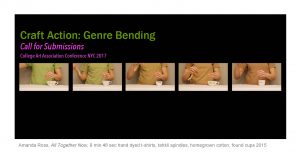 CAA Media Lounge
105th Annual Conference NYC 2017
Submission Deadline
Nov 30, 2016
Craft Action: Genre Bending
Craft Action: Genre Bending is a juried video screening exploring the role of process, skill, and action as it relates to craft mediums. The growing interdisciplinarity of craft practices is the impetus for this call for submissions of video work by practitioners engaged craft media, such as ceramics, textiles, metals, wood, and glass. The use of video with craft enables the artist to engage in using materials and tools in combination with their representation to express new ideas, addressing making by investigating not only what is shown, but how it is shown.
Media Lounge is CAA’s main stage of new media explorations where students, academics, and artists come together to build camaraderie. These methods of working with conceptual and technical content provides fodder for a dynamic dialogue of how artists’ place themselves in the larger distinction of media, both analog and digital.
Each year Media Lounge coordinates a central theme to explore the interrelationship of media across a topic. This year in NYC, Media Lounge presents screenings, panels and discussions that explore the genres of craft and video, politics and strategy, and inter-related material explorations of new media and footage that entangles what is expected of cross-disciplinary explosions of content, surrounding the theme of Genre Bending.
Genre is a way to group practices into categories that are familiar-or frame an expected experience from the audience. Media Lounge NYC 2017 uses genre and the elasticity of bending to explore new media genre relationships and their impulse of hybrid crossovers.
Anne Sophie-Lehman has theorized that the combination of craft and film produces its own unique genre, which she calls “showing making”. Part archival, part instructional, part visual pleasure, and part showmanship, this idea of genre bending and genre production is the starting point for this year’s Media Lab theme.
Craft Action: Genre Bending seeks to explore how artists bend, break, subvert, or invent new genres for craft and film. Artists will be asked to note in their application what genre/s they see themselves as bending or creating. This may be a traditional genre, like comedy, tragedy, animation, or a craft-based genre like the instructional demonstration – or a genre yet-to-be defined that can provoke new understanding and considerations.
Artwork Requirements
All video submission must be original works of art completed within the last 3 years.
Submission Guidelines
- Entries will be accepted from the link HERE
- Artists are required to submit video as Vimeo files, opening up the access of the files to shared
- The video(s) should be an excerpt totaling no longer than 5 minutes.
- Artists may submit up to three videos to be selected
Screening Dates and Panel Discussion
CAA Conference Media Lounge
February 16, 2017
Thursday 1:30-3
Guest Curators and Conference Panelists
Marilyn Zapf is the Assistant Director at The Center for Craft, Creativity & Design (CCCD) and Curator of CCCD’s Benchspace Gallery & Workshop in Asheville, NC where she has curated a number of nationally-traveling exhibitions including Made in WNC (2015) and Gee’s Bend: From Quilts to Prints (2014). Zapf teaches courses on the History of Craft at Warren Wilson College and publishes articles and reviews in international publications, including Art Jewelry Form and Crafts Magazine (UK). She is a founding member of the international experimental history of design collective, Fig. 9, holds a MA in the History of Design from the Royal College of Art and Victoria and Albert Museum in London, England, and a BA (English Literature) and BFA (Jewelry and Metalworking) from The University of Georgia. Her areas of research include craft, postmodernism and de/industrialization.
Namita Gupta Wiggers is a curator, writer, educator and artist based in Portland, Oregon. She is the Director of Critical Craft Forum, and Exhibitions Review Editor, Journal of Modern Craft. From 2004-12 Wiggers served as the Curator, and later Director and Chief Curator (2012 -14) of Museum of Contemporary Craft. She curated over 65 exhibitions, including: New Embroidery: Not Your Grandma’s Doily, Touching Warms the Art, The Academy is Full of Craft, Object Focus: The Bowl, and Manufractured: The Conspicuous Transformation of Everyday Objects (curated by Steven Skov Holt and Mara Holt Skov), and Gestures of Resistance (curated by Judith Leemann and Shannon Stratton.). She curated the first museum exhibitions on Betty Feves, Laurie Herrick, Nikki McClure, Emily Pilloton, and Ken Shores. Recent exhibitions include Across the Table, Across the Land with Michael Strand for NCECA’s 50th Anniversary, and Everything has been Material for Scissors to Shape, on view at the Wing Luke Museum of Asian American Experience. Wiggers is editing a Companion on Contemporary Craft (Wiley Blackwell), and collaborating on a project focused on gender and jewelry with Benjamin Lignel.
Entry Fee
Free
Venue
Hilton New York Midtown, College Art Association Conference, Media lounge
ArtSpace + Media Lounge
CAA’s Services to Artists Committee hosts offerings in ArtSpace and Media Lounge, a “conference within a conference” of innovative programs that are of special interest to artists, emerging professionals, and artist / educators. ArtSpace and Media Lounge programming offers an informal, dynamic setting with sessions, panels, screenings, curated media, distinguished artists interviews, exhibition opportunities and other social events. These programs are free and open to the public, and do not require CAA membership or registration fees for the conference to participate or attend.
Thank you in advance for your participation and please feel free to contact carissacarman at gmail.com if you have questions regarding the submission.
News from the Art and Academic Worlds
posted by Christopher Howard — October 12, 2016
Each week CAA News summarizes eight articles, published around the web, that CAA members may find interesting and useful in their professional and creative lives.
Cruelty and Kindness in Academia
Academics don’t have a reputation for being kind. To put it gently, higher education values intellect over affect. Kindness tends to be viewed as the opposite of criticism. Scholars, after all, are trained in critique, and not necessarily the constructive kind. (Read more from Vitae.)
Why New-Media Art Still Hasn’t Fully Gone Mainstream
Artists working in “new” media have never been so widely admired—a generation of artists in their twenties and thirties, including Amalia Ulman, Neil Beloufa, Ian Cheng, Jon Rafman, and Cécile B. Evans, are now shown internationally. Yet a quarter of a century after the emergence of digital art, it continues to raise challenges for museums, galleries, and collectors. (Read more from the Art Newspaper.)
The Questions We Should Be Asking Our Students
How much do you know about how your students study? I’ve been asking the question a lot lately, and most of the answers I’ve heard aren’t all that impressive. They’re more about how the faculty member thinks students study, how they should study, or how they aren’t studying. (Read more from Faculty Focus.)
What It Takes to Recover a Stolen Work of Art
A recent highly publicized announcement that two stolen van Gogh paintings had been recovered after fourteen years was a welcome surprise. How do thieves make off with a painting? What should a victim do after realizing they’ve been robbed? Why are only a tiny percentage of works recovered? (Read more from Artsy.)
Alizarin Crimson: Now You See It…
If a single color embodies the dividing line between pigments considered suitable for permanent works of art and those that are suspect and poor in lightfastness, Alizarin Crimson (PR 83) would be it. And yet the color is still used by many artists who are drawn to it in spite of its many problems. (Read more from Just Paint.)
Old Media, New Media, Data Media: Evolving Publishing Paradigms
Not so long ago we routinely talked of old vs. new media. The old was characterized by investment in and creation of content, which gave rise to a common set of properties—definitive and authoritative journalism and scientific reports, the fixed text, and the pursuit of the finest authors and top creative talent. New media, on the other hand, was digital and had its own set of properties. (Read more from the Scholarly Kitchen.)
The Rise of Living-Room Galleries in London
Young artists and curators throughout London are organizing public exhibitions in their own homes. Many are recent graduates who cannot afford the hefty cost of renting a temporary space. “There’s a pressing need for young artists to find inexpensive places to show art,” said Elena Colman. (Read more from the Art Newspaper.)
What’s behind Art’s Uneasy Celebrity Courtship?
The art world collectively raised its eyebrows when Sotheby’s Hong Kong announced a collaborative curated auction with Choi Seung-hyun, the 28-year-old Korean boy-band star known as T.O.P. Yet the art world’s newly discovered courtship of celebrity is deeper than it seems, which is why it’s making so many people uneasy. (Read more from Artnet News.)
New in caa.reviews
posted by CAA — October 07, 2016
Gina McDaniel Tarver reviews the exhibition and catalogue Moderno: Design for Living in Brazil, Mexico, and Venezuela, 1940–1978. The “rich multivocal production” occasionally fails “to tackle some of the complex issues it raises,” but “provides valuable insights into modern impulses and contradictions that manifested in compelling ways in Brazilian, Mexican, and Venezuelan design.” Read the full review at caa.reviews.
Anne Collins Goodyear examines the Getty Foundation’s Online Scholarly Catalogue Initiative (OSCI), which led to the creation of several digital catalogues by eight museums. Discussing “the implications of the project as a whole,” Goodyear finds the “undertaking represents but a first step,” yet “lays a significant foundation for the future of scholarship in the museum, and beyond.” Read the full review at caa.reviews.
Patricia Emerson discusses Drawing in Silver and Gold: Leonardo to Jasper Johns, an exhibition catalogue examining the history of metalpoint in Europe and the United States over the course of six centuries. By “studying a medium across stylistic boundaries,” the book “helps us to recognize the versatility of a medium that might have been thought, repeatedly, to be obsolete.” Read the full review at caa.reviews.
Caa.reviews publishes over 150 reviews each year. Founded in 1998, the site publishes timely scholarly and critical reviews of studies and projects in all areas and periods of art history, visual studies, and the fine arts, providing peer review for the disciplines served by the College Art Association. Publications and projects reviewed include books, articles, exhibitions, conferences, digital scholarship, and other works as appropriate. Read more reviews at caa.reviews.
RAAMP—A Digital Resource for Academic Museum Professionals
posted by CAA — October 06, 2016
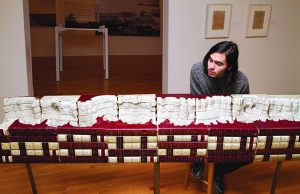 Guy Laramée, The Grand Library, 2004. Altered book, pigment, metal stand, 96 x 21 x 44 inches. Courtesy of the artist and JHB Gallery. Courtesy of University of Richmond Museums, Virginia. Photo: Gordon Schmidt/University of Richmond Communications.
RAAMP (Resources for Academic Art Museum Professionals) is an online repository and forum that collects, stores, and shares resources to promote scholarship, advocacy, and discussion related to the role of academic art museums and their contribution to the educational mission of their parent institutions. RAAMP aims to strengthen the educational mission of academic museums and their parent organizations, and is oriented toward colleagues at academic art museums as well as university and other museum colleagues. RAAMP is a project of CAA made possible with a generous grant from the Andrew W. Mellon Foundation.
The principal investigators for RAAMP are N. Elizabeth Schlatter, deputy director and curator of exhibitions at the University of Richmond Museums in Virginia and an officer of CAA’s Board of Directors; and Celka Straughn, Andrew W. Mellon Director of Academic Programs at the University of Kansas’s Spencer Museum of Art and a member of CAA’s Museum Committee. Schlatter says, “Art museums at colleges and universities today are creating some of the most dynamic connections to their academic communities. RAAMP creates a virtual place to share these accomplishments and gain inspiration from colleagues. Academic museums can use examples created by their peers and posted on RAAMP to enhance their offerings to faculty and students.”
Straughn adds, “They can find curricular materials utilizing museum resources to emphasize critical thinking skills or sample reports that demonstrate and quantify how a campus museum contributes to its parent institution. RAAMP is also a place to promote professional development activities, to find research related to academic museums, and to engage in discussions with fellow professionals.”
RAAMP was created in response to a 2013 CAA Annual Conference session organized by the organization’s Museum Committee. Attendees at the session expressed a need to have a digital space where they could easily share information and strategies for communicating how their academic museums contribute to the educational mission of their parent institutions.
RAAMP would not be possible without the help of its partner organizations: Association of American Museum Curators (AAMC), Association of American Museum Director (AAMD), and Association of Academic Museums & Galleries (AAMG), and representatives from the following US-based academic museum stakeholders:
The Art Galleries at Lafayette College, Bowdoin College Museum of Art, The Fowler Museum at the UCLA, Galleries of Contemporary Art at the University of Colorado, Colorado Springs; The Hood Museum at Dartmouth University, Lowe Art Museum at the University of Miami, Neuberger Museum at SUNY Purchase College, Samuel P. Harn Museum of Art at the University of Florida, Schnitzer Museum at the University of Oregon, Smart Museum of Art at the University of Chicago, Spelman College Museum of Art, Spencer Museum of Art at the University of Kansas, University of Iowa Museum of Art, University of Richmond Museums
Visit the RAAMP website to learn more.
Visit the RAAMP submissions page to submit materials.
News from the Art and Academic Worlds
posted by Christopher Howard — October 05, 2016
Each week CAA News summarizes eight articles, published around the web, that CAA members may find interesting and useful in their professional and creative lives.
Burning Questions: How Can I Promote My Exhibition?
I’ve got an exhibition coming up at a small artist-run gallery space. They don’t have any real budget for promotion or anything like that. So I’m wondering something: What are the best low-cost (preferably free) ways to promote my exhibition? (Read more from Burnaway.)
Islamic Extremist Sentenced to Nine Years in Prison for Destroying Timbuktu Mausoleums
In an unprecedented move, Ahmad Al-Faqi Al-Mahdi pleaded guilty to war crimes for ordering the razing of nine mausoleums and the fifteenth-century Sidi Yahia mosque in the ancient city of Timbuktu in northern Mali. The historic verdict marks the first time the international criminal court in The Hague has heard a case about the demolition of cultural heritage. (Read more from the Art Newspaper.)
What Is the Real Impact of Public Art Programs?
The production and introduction of artworks into the public domain started to be regulated and organized by national programs in the 1930s. Although state-sponsored institutions—such as the US Federal Art Project, the USSR’s Ministry of Culture, and the Chinese Communist Party’s art-related efforts—primarily pursued propaganda goals, this laid the foundation for public art programs worldwide. (Read more from Artnet News.)
Racially Charged St. Louis Contemporary Art Museum Show Sparks Outrage
Racially charged works at a Contemporary Art Museum in Saint Louis exhibition have some calling for boycotts and the resignation of the museum’s chief curator. The museum has opted to build walls around the controversial pieces of art. The show will remain up and visitors will have access to all of the work. (Read more from Fox 2 News.)
Gallery Defends Kelley Walker, Artist under Fire in St. Louis Exhibit
The New York City–based gallery representing the artist Kelley Walker has responded to the controversy surrounding a racially charged exhibition at the Contemporary Art Museum in Saint Louis, but with a statement that raises more questions than it answers. (Read more from the Riverfront Times.)
Black Arts Community Expresses Outrage with Kelley Walker
“This is a mess, and I’m uncomfortable,” said Kat Reynolds as she spoke before the capacity crowd at the Contemporary Art Museum on September 22. The panel of artists and educators—who spoke during the Critical Conversations talk presented by Critical Mass for the Visual Arts—didn’t hold back from voicing their disdain about the art that hung in the very space where the discussion was taking place. (Read more from the St. Louis American.)
Who Gets the Credit for Collaboration?
The most important part of your tenure package at a research university is—shockingly!—your research. The tricky part of scholarly evaluation is collaboration. In a tenure case, the external letter writers will be asked to evaluate your contribution to the field, which includes evaluating how much you contributed to the collaborative projects listed on your CV. (Read more from Vitae.)
How to Systemize Your Workflow
Graduate students will argue that because our tasks are so varied and diverse, because research is so unpredictable, because the very nature of good scholarly work is its novelty, nothing we do can actually be systemized effectively. But I would argue that this is exactly where we need to systemize, so that we can spend minimal time on the rote things and spend the majority of our energy and cognitive cycles on the issues that actually matter. (Read more from Inside Higher Ed.)
CAA Local College Tour
posted by CAA — September 30, 2016
Students are crucial to CAA and the work we do. Support and interest from student members allows us to provide fellowships, professional development, mentorships, and job placement services to those very same students. In the coming months, CAA is visiting several local New York colleges and universities in order to connect with our youngest and one of our most vital constituencies. Below is our upcoming schedule. We hope to see you there.
Monday Oct. 10, 10AM-12PM at Parsons Fine Arts
Tuesday Nov. 1st at Pratt Institute (Time TBD)
Wednesday Nov. 2nd at Pratt Institute (Time TBD)
Friday Nov. 18th, 12PM-4PM at School of Visual Arts
New in caa.reviews
posted by CAA — September 30, 2016
Alessia Frassani reviews The Lienzo of Tlapiltepec: A Painted History from the Northern Mixteca, a collection of multidisciplinary studies edited by Arni Brownstone. Focusing on lienzos, “large painted cloths produced after the Spanish invasion of Mexico,” the book makes “a difficult but important aspect of indigenous Mexican history and culture available to a wide audience.” Read the full review at caa.reviews.
Jennifer W. Olmsted discusses Delacroix and the Matter of Finish, an exhibition catalogue edited by curator Eik Kahng for the Santa Barbara Museum of Art. The painting The Last Words of Marcus Aurelius was the impetus for the show and publication, which “build a case” for the attribution of the artwork to Delacroix while addressing issues of “authorship, pedagogy, and inheritance.” Read the full reviews at caa.reviews.
John A. Tyson examines Krista A. Thompson’s Shine: The Visual Economy of Light in African Diasporic Aesthetic Practice. The “multifaceted,” “generally excellent” volume “explores the ways in which bling aesthetics and shining can be forms of resistance,” and “shows that non-elite culture holds up to serious academic scrutiny.”
John Szostak reads Imaging Disaster: Tokyo and the Visual Culture of Japan’s Great Earthquake of 1923 by Gennifer Weisenfeld. A “comprehensive, fascinating, and informative” contribution to the subject of “disaster culture,” the book examines a “historic catastrophe through the visual-culture lens of image production and consumption.” Read the full review at caa.reviews.
Caa.reviews publishes over 150 reviews each year. Founded in 1998, the site publishes timely scholarly and critical reviews of studies and projects in all areas and periods of art history, visual studies, and the fine arts, providing peer review for the disciplines served by the College Art Association. Publications and projects reviewed include books, articles, exhibitions, conferences, digital scholarship, and other works as appropriate. Read more reviews at caa.reviews.