CAA News Today
Parul Pandya Dhar Abstract
posted by CAA — May 22, 2018
2018 Global Conversations
Border Crossings: The Migration of Art, People, and Ideas
Sponsored by the CAA-Getty International Program and CAA’s International Committee
Featuring five alumni of the CAA-Getty International Program
Panelist: Parul Pandya Dhar
Affiliation: University of Delhi, India
Paper Title: The Mediation of the Object: Iconographies of Travel Across the Indian Ocean
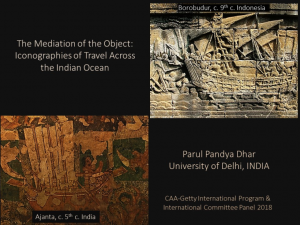
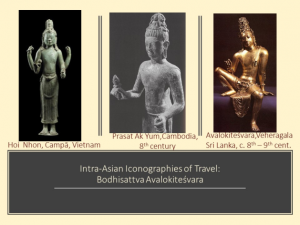
As 21st-century members of a global community accustomed to instant worldwide networks, it takes a certain degree of ‘historical imagination’ to comprehend the nature of interaction systems that had linked pre-modern societies and cultures. My paper explores the theme of ‘art and migration’ across early Indian Ocean linkages, specifically the movement of artistic ideas, objects, and people between India and Southeast Asia during the sixth to tenth centuries CE. These long-distance material and human migrations transpired on account of a variety of reasons such as pilgrimage, trade, war, diplomatic embassies, and more. Narratives of such travels and translocations, and of their subsequent localization in the different zones of contact, offer rewarding opportunities for investigating cross-cultural histories of art. Towards this objective, I will take up select case studies to explore the mobility of art-objects and their relationships to the journeys of people along the maritime silk route(s).
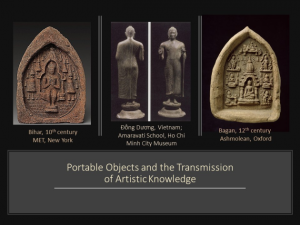
At a methodological level, I will examine the important role played by portable objects such as tiny terracottas, bronzes, illustrated manuscripts and miniature architectural models in the formulation of newer art vocabularies in distant lands, and the inextricable ways in which such material movements are tied to human endeavor and impulse for travel. My paper will highlight the specific circumstances for such translocations and translations and their bearing on particular art forms. In doing so, the paper foregrounds key methodological concerns to help understand the role of human journeys and migrant objects in shaping connected histories of early South and Southeast Asian art.
Ildikó Fehér Abstract
posted by CAA — May 22, 2018
2018 Global Conversations
Border Crossings: The Migration of Art, People, and Ideas
Sponsored by the CAA-Getty International Program and CAA’s International Committee
Featuring five alumni of the CAA-Getty International Program
Panelist: Ildikó Fehér
Affiliation: Hungarian Academy of Fine Arts, Hungary
Paper Title: Art and Migration Politics
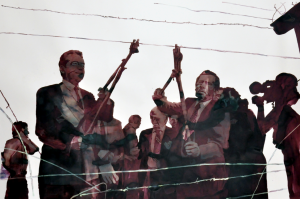
Anett Hamori, 2015
According to politicians discussing the migration of refugees into Europe, we live in the most critical times since World War II. My country, Hungary, is on the migration route from Syria to Western Europe. It will be a long and difficult process to understand the social effects and other consequences of this modern age’s migration. Still, the way artist, historians, and scientists deal with it and examine the subject can help to avoid fears, from the unknown to the unfamiliar.
Due to its political decisions, my country has frequently made headlines. There is no doubt that artists reacted immediately and in a very sensitive way to these new social challenges. I am convinced that we—art historians and professors—have the responsibility to study, document, and evaluate the works of art made by these artists in all of their aspects.
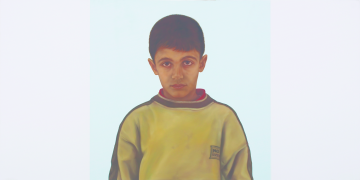
Tibor Iski Kocsis, 2015
In addition to the state-run, state-sponsored art exhibitions, there are alternative, independent, off-the-main-stream presentations of art that express the opinion of many artists and intellectuals driven by the urge to document the plight of these immigrants and explore the facts of current events. They use methods such as photography, street art, new media, or in the case of painting, Hyperrealism, a previously popular style that has been reborn today.
Brexit is also dividing Europe. What is the ultimate goal for our political structure: a united continent or political independence that emphasizes national interests? Which one is preferred? My paper will discuss how these issues and dilemmas are explored in contemporary fine arts, and new media.
Peju Layiwola Abstract
posted by CAA — May 22, 2018
2018 Global Conversations
Border Crossings: The Migration of Art, People, and Ideas
Sponsored by the CAA-Getty International Program and CAA’s International Committee
Featuring five alumni of the CAA-Getty International Program
Panelist: Peju Layiwola
Affiliation: University of Lagos, Nigeria
Paper Title: Conversations Across Borders: Fostering Art linkages in the Age of Information Technology
The limited capacity of African artists to participate in major art events and blockbuster exhibitions has sometimes been attributed to where they live. African artists who reside in the Global North appear to participate in exhibitions with greater ease. However, with improved technology, artists based on the African continent are increasingly becoming more visible, participating in biennales, art auctions, mega exhibitions and other artistic engagements that had previously been unavailable to them. With a growing reliance on the Internet and social media, there has been a gradual erasure of distance, so that the idea of “the Center” in artistic production and exhibition is giving way to multiple centers. This paper looks at the impact of digital communication technology in bringing about transnational and transcultural conversations amongst artists. The focus will be on how a curator like Bisi Silva, through her Centre for Contemporary Arts, based in Lagos, Nigeria, is using the Internet to disseminate information about her work and making connections with artists and other curators across distance and borders.
Cezar Bartholomeu Abstract
posted by CAA — May 22, 2018
2018 Global Conversations
Border Crossings: The Migration of Art, People, and Ideas
Sponsored by the CAA-Getty International Program and CAA’s International Committee
Featuring five alumni of the CAA-Getty International Program
Panelist: Cezar Bartholomeu
Affiliation: Universidade Federal do Rio de Janeiro, Brazil
Paper Title: Haruo Ohara’s photography: Japanese blossom in Brazilian culture
Haruo Ohara migrated from Japan to the south of Brazil in the 1950s to be part of an agricultural workforce formed to continuously replace slaves who were freed in 1888. As a photographer, his work encompasses three types of images: an ethnographic documentation of migration, a biographical album of life on the modern plantation, and an aesthetic portfolio of photographs that relates Brazil to modern Japan.
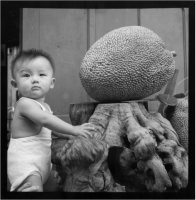
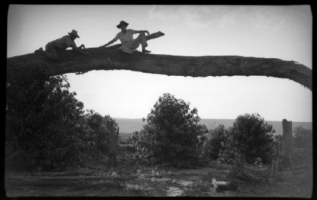
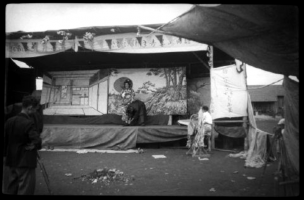
This paper situates Ohara’s work critically in Brazilian culture, while observing multiple contexts in which race and art are deeply intertwined. For that, it is necessary to consider the concept of nature in Brazil and Japan, the structure of the plantation, concepts of art and photography at the time, as well as the lack of representation of black people in plantations (or any manual labor in Brazil, for that matter). The paper also considers Ohara’s work both in a transnational and historiographical context. Within the scope of one paper, Ohara’s concept of nature will be considered through a limited number of representative photographs. Far from the idea of a menace—a “green hell,” in Ohara’s works—nature is not only a recurring theme, but may also be seen as a symbolic space where Brazilian culture, labor, and humanity are represented. The aesthetic idealization of nature tells us of the dramatic differences of life in plantations from the nineteenth century, where slaves were considered part of nature, and thus kept from proper rights within humanity, and in the 20th century, marked by European migration.
Affiliated Society News for May 2018
posted by CAA — May 22, 2018
Affiliated Society News shares the new and exciting things CAA’s affiliated organizations are working on including activities, awards, publications, conferences, and exhibitions. For more information on Affiliated Societies, click here.
International Sculpture Center (ISC)
ISC is offering new graduates the professional resources they need to launch their careers – Student/Young professional membership – at discounted rate of $45. For more info, visit https://www.sculpture.org/documents/aboutisc/specialoffers.shtml
ISC is now accepting applications for our Fall/Winter residency @ Mana Contemporary. Apply today https://www.sculpture.org/residency/mana-update.shtml
Registration opens in June for the 28th ISC Conference: Defining Moments in the Face of Change and is available to ISC members, non-members, students, and all those with an interest in sculpture. Come join us in Philadelphia for engaging panel discussions, networking events, and exciting tours & optional activities. https://sculpture.org/philly2018/
Association of Art Museum Curators (AAMC)
The Association of Art Museum Curators and AAMC Foundation is honored to present a series of three webinars on research, advances, and issues surrounding the topic of provenance. With the establishment of substantial research databases and resources, great progress has been made in researching artworks that may have been subject to unlawful appropriation during the World War II era. As museums work to make their collections accessible online, there is both the need and potential to extend these advances to other categories of objects. The first webinar will acknowledge the impact of the pioneering work in WWII era research and provide updates on the current status within the field. The second session will offer a review of work currently being undertaken for non-WWII era looting and specifically looking at fields, including but not limited to, African Art, Asian Art and Antiquities. In the final session, we will emphasize the interest and need for progress in collaboration across diverse fields, present information on sharing data, and digitization and resources in communicating knowledge. The three webinars will build from seminar to seminar, but do not require attendance at each one to gain value from an individual session. Scheduled over three Tuesdays this June 2018, registration is available at a purchase of a single session or package of all three. Members and non-members alike can register directly online, with group rate packages available to participate. Access to webinar recordings will also be available for viewing with purchase. The first webinar on June 12 is Advances in WWII Era Research; the second on June 19 is Going Beyond WWII Era Research; and the third on June 26 is Sharing Research, Asking New Questions. Register to participate today.
Association of Print Scholars (APS)
The Association of Print Scholars hosted its third annual Distinguished Lecture at the CUNY Graduate Center on January 26, 2018. The curator Rémi Mathis, of the Bibliotheque Nationale de France, delivered the lecture titled “A Means to an End: The Process of Understanding French Prints.”
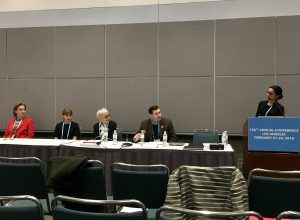
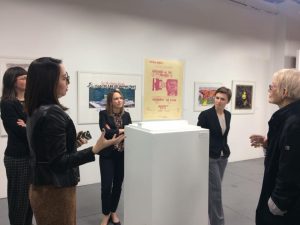
During the CAA conference in Los Angeles, many members joined us for our affiliated society panel, “Now you see it, now you don’t: Materialism and Ephemeral Prints,” chaired by Dr. Yasmin Railton of Sotheby’s Institute of Art. We also hosted a member’s reception at the East Los Angeles based workshop Self Help Graphics and toured their exhibition on Día de los Muertos.
APS is pleased to announce our 2019 CAA panel “Printing Color: Reproducing Race Through Material, Process, and Language,” chaired by Christina Michelon. Michelon is a Luce /ACLS Fellow in American Art and a PhD Candidate in Art History at the University of Minnesota-Twin Cities where she is completing her dissertation “Interior Impressions: Printed Material in the Nineteenth-Century American Home.” Her work has been supported by the Smithsonian Institution, the Winterthur Museum & Library, the Center for Craft, Creativity, and Design, the American Antiquarian Society, and the Chipstone Foundation. “Printing Color: Reproducing Race Through Material, Process, and Language” seeks to investigate the racialized dimensions of print and printmaking. The medium has played a central role in the ideological founding of “race” and its hierarchies through visual representation. However, print’s materials, processes, and the language we use to describe them interface with conceptions of race in ways that require further study. Please be on the lookout for our upcoming CFP.
Society of Historians of Eastern European, Eurasian, and Russian Art and Architecture (SHERA)
The Board of the Society of Historians of Eastern European, Eurasian, and Russian Art and Architecture (SHERA) is pleased to announce the SHERA-sponsored panel for the 50th Annual ASEEES Convention in Boston, MA, December 2018. Dr. Hanna Chuchvaha’s panel “The Passion for Collecting: Collectors and Their Collections in Imperial Russia, 1800-1917” will include papers on Zinaida Volkonskaia’s Allée de Souvenirs (Laura Schlosberg), Print Collections of Female Crafts in Late Imperial Russia (Hanna Chuchvaha), Reform and Rehang in the Tretyakov Gallery, 1913-1917 (Isabel Stokholm) and will be of interest not only to art historians but also to scholars of museology, women’s studies, and visual culture.
Association for Modern and Contemporary Art of the Arab World, Iran, and Turkey (AMCA)
Book Launch Events: “Modern Art in the Arab World: Primary Documents” (April 28 Beirut and May 23 New York)
AMCA is pleased to announce launch events in Beirut (Sursock Museum) on April 28 and in New York (MoMA) on May 23 to celebrate the publication of Modern Art in the Arab World: Primary Documents (2018), edited by Anneka Lenssen, Sarah Rogers, and Nada Shabout. Both events bring to life Modern Art in the Arab World: Primary Documents and the book’s diverse content, multiple collaborators, and rich source materials that aim to further the study of modernism in a global frame.
This anthology offers an unprecedented resource for the study of modernism: a compendium of critical art writings by 20th-century Arab intellectuals and artists. The selection of texts—many of which appear for the first time in English—includes manifestos, essays, transcripts of roundtable discussions, diary entries, exhibition guest-book comments, and letters. Traversing empires and nation-states, diasporas and speculative cultural and political federations, the documents bring to light the formation of a global modernism that includes debates on originality, public space, spiritualism and art, postcolonial exhibition politics, and Arab nationalism. The sourcebook is framed chronologically, and features contextualizing commentaries and essays to assist readers in navigating its broad geographic and historical scope. A newly commissioned essay by Ussama Makdisi provides a historical overview of the region’s intertwined political and cultural developments during the 20th century.
Speakers included:
Zeina Arida, director of the Nicolas Ibrahim Sursock Museum in Beirut
Iftikhar Dadi, associate professor in the Department of The History of Art and Visual Studies at Cornell University
Anneka Lenssen, assistant professor of Global Modern Art in the History of Art Department at the University of California, Berkeley.
Glenn D. Lowry, director of The Museum of Modern Art in New York.
Sarah Rogers, independent scholar.
Nada Shabout, professor of art history in the College of Visual Arts and Design and the coordinator of the
Contemporary Arab and Muslim Cultural Studies Initiative at the University of North Texas.
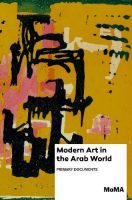
Explore source documents for Modern Art in the Arab World
AMCA has made a number of primary documents in Arabic and French available online. Click here to explore.
The Feminist Art Project (TFAP)
Call For Papers
The Feminist Art Project’s Day of Panels will be co chaired by Christen Clifford and Jasmine Wahi. The Day of Panels will be held at the Hilton in NYC at CAA on Feb 16th, 2019. The 2019 symposium will focus on rape and representation. The co-chairs are looking for papers, video and art that dwell in the sexual wounds of rape and sexual assault and look for the light of sexual justice. We seek a wide array of proposals on possible topics such as rape and representation, the meanings of sexual justice, gender and power in the art world, intersectional feminisms and responses to assault.
How has sexual assault affected feminist art practices? Who has power and why? What institutional changes need to happen to work towards sexual justice? Feminist art has long dealt with the oppressions and violations of colonialism, slavery, and couverture. TFAP 2019 is dedicated to the exploration of sex, power and justice through intersectional art and activism, academics and healing, and creating a shared space: bringing intellect and emotion together to demand bodily autonomy.
The day of panels will feature panels, video art, and a digital gallery.
Paper, panel and performance proposals should include a short (100 word) abstract /description of work, 100 word bio, and any relevant links. Header should read: TFAP 2019 Paper
Video and Image submissions should include links (and passwords, if appropriate) and up to 5 images. Please use email headers: TFAP 2019 Video or TFAP 2019 Image. All images should be labeled: LASTNAME_FIRSTNAME_TFAP.jpg
Please send proposals to
By June 14th.
Association of Academic Museums & Galleries (AAMG)
By popular demand, we’ve expanded the registration capacity for the AAMG Bootcamp Workshop. To add the workshop to your existing conference registration, please email membership@aamg-us.org
What: AAMG Bootcamp for Academic Museums
Where: Lowe Art Museum, University of Miami
When: Thursday, June 21, 9am – 3pm
with Jill Hartz and Barbara Rothermel Lowe Art Museum, University of Miami
Only open to AAMG and UMAC members; $100 (lunch and materials included)
This intensive professional development workshop covers key concepts and practices in academic museum management. Whether you’re a seasoned professional or new to the field, the workshop offers opportunities to learn about innovative and best practices and share challenges and achievements. We’ll cover mission and governance, advisory boards, strategic planning, our teaching role, working with faculty and students, community relations, and collections management and planning.
Instructors: Jill Hartz, Executive Director, Jordan Schnitzer Museum of Art, University of Oregon / President Emeritus, AAMG Barbara Rothermel, Director, Daura Gallery, Lynchburg College / Vice-Chair, UMAC
Association of Historians of American Art
Panorama: Journal of the Association of Historians of American Art has received an $8,500 grant from the Wyeth Foundation for American Art. A peer-reviewed, open-access online journal dedicated to American art and visual culture in all media, from the colonial period to the present day, Panorama welcomes submissions in various formats, including feature length articles (7,000-10,000 words), research notes (maximum of 2,500 words), book and exhibition reviews, and “Bully Pulpit” suggestions—texts that trace a conversation or debate on a topic that is of general interest to the field.
New Media Caucus (NMC)
The New Media Caucus (NMC) is pleased to announce the inaugural Advisory Board. Voted in by the Board of Directors, the members of the Advisory Board will assist with the core missions and the growth of the caucus. We welcome Hasan Elahi, internationally recognized media artist and Associate Professor of the University of Maryland; Sue Gollifer, pioneer of early computer art, Director of ISEA International and academic staff at the University of Brighton in the UK; and Guna Nadarajan, theorist, curator, and Dean and Professor at the Penny W. Stamps School of Art and Design at the University of Michigan. We look forward to working with, and learning from, our esteemed colleagues.
Society of Architectural Historians (SAH)
The Society of Architectural Historians has received a three-year, $120,000 grant from The Richard H. Driehaus Foundation for general operating support. The grant provides SAH with vital unrestricted income needed to fulfill its educational mission and support day-to-day operations.
The Society of Architectural Historians announced the 2018 recipients of the SAH Publication Awards and the SAH Award for Film and Video at its 71st Annual International Conference awards ceremony on April 20, at the Landmark Center in Saint Paul, Minnesota. The SAH Publication Awards honor excellence in architectural history, urban history, landscape history and historic preservation scholarship as well as architectural exhibition catalogues. The SAH Award for Film and Video is an annual award that was established in 2013 to recognize the most distinguished work of film or video on the history of the built environment. SAH will begin accepting nominations for the 2019 awards on June 1, 2018.
SAH is accepting applications for the 2018 SAH/Mellon Author Awards, designed to provide financial relief to scholars who are publishing their first monograph on the history of the built environment. The application deadline is May 31, 2018.
SAH is accepting abstracts for its 72nd Annual International Conference in Providence, Rhode Island, April 24–28. The submission deadline is 11:59 pm CDT on June 5, 2018. View the full call for papers at sah.org/2019.
International Association of Art Critics United States (AICA-USA)
AICA-USA‘s 2018 annual meeting was Saturday, May 19 at The Brooklyn Rail Headquarters at Industry City in Sunset Park, Brooklyn. The meeting coincided with a panel discussion featuring David Salle and Carroll Dunham.
AICA-USA board member Phong Bui says: “Ever since Susan Harris was the guest critic for the Rail’s November 2016 issue, which featured a luminous selection of our writer colleagues who are AICA members and board members, we have kept the collaboration alive with many AICA writers contributing regularly to our Art Seen reviews, such as Barbara and Alfred MacAdam, Lilly Wei, Eleanor Heartney, Amei Wallach, and Susan herself as an ongoing effort to keep the collaboration alive.
On the occasion of our forthcoming event featuring David Salle and Carroll Dunham on their respective publications, How to See and The Collected Writings of Carroll Dunham, I thought it would be a timely occasion to create a panel discussion coinciding with Industry City’s Open Studios, which invites the local artist community to participate.”
David Salle in Conversation with Carroll Dunham, moderated by Phong Bui
Panelists: Josephine Halvorson, Adam Pendleton, Martha Schwendener, and Amei Wallach
Rail HQ
253 36th Street, Suite C304
Industry City in Sunset Park
Saturday, May 19
Coffee and bagels: 10:30am
Conversation: 11am–12:30pm
AICA-USA Business Meeting: 12:30–1:00pm
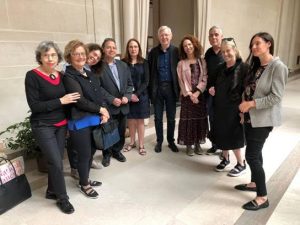
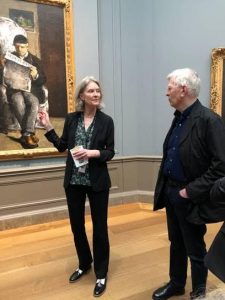
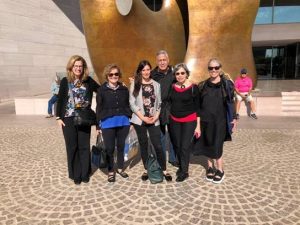
On May 8 and 9, 2018, AICA-USA members gathered in Washington D.C. for a two-day visit. 2017 AICA-USA Distinguished Critic Lecturer Paul Chaat Smith led members through his much-lauded exhibition, Americans, at the National Museum of the American Indian in Washington DC. AICA-USA member John Elderfield and his colleague Mary Morton led members through the exhibition Cézanne Portraits, which they co-curated at the National Gallery of Art.
The group also toured Lynn Cooke’s exhibition Outliers and American Vanguard Art at the National Gallery. AICA-USA was fortunate to have been granted ten VIP passes for entry to the National Museum of African American History and Culture, which members enjoyed without having to undergo the typical long wait time for entry passes.
Association for Textual Scholarship in Art History (ATSAH)
Recent member’s publications
Charles Burroughs, “Botticelli’s Stone: Giorgio Vasari, Telling Stories, and the Power of Matter.” Artibus et Historiae 76 (2017): 297–325.
Liana De Girolami Cheney, “Giorgio Vasari’s planetary ceiling: A Neoplatonic Voyage.” In Artistic Responses to Travel in the Western Tradition, ed. Sarah J. Lippert (London: Routledge Research in Art History, 2018): 158-169.
Karen Hope Goodchild, “Masaccio, Andrea del Sarto, Il Lasca, and the Sausage School of Florence.” Source. Volume 36, number 3/4 (Spring/Summer 2017): 178-187.
Sarah J. Lippert, ed. Artistic Responses to Travel in the Western Tradition
(London: Routledge Research in Art History, 2018).
ANNOUNCEMENT AWARDS for Students and Scholar
ASSOCIATION FOR TEXTUAL SCHOLARSHIP IN ART HISTORY
In commemoration of our 30th anniversary, ATSAH plans to offer two awards: one prize for the best article by an emerging scholar (no higher than Associate level). The topic may range from classical to Pre-Raphaelite art, reflecting the aims of ATSAH. The second is a small travel grant for junior scholar presenting a paper an ATSAH session. The board of ATSAH selects these awards.
For further data, contact:
Liana Cheney, PhD, President of ATSAH,
lianacheney@earthlink.net
SECAC
Lawrence Jenkens, 1st Vice-President and ex-officio chair of the SECAC Nominating Committee is pleased to announce the election of the following members to the SECAC Board of Directors for a three-year term of appointment that begins immediately: For Alabama, Wendy DesChene, Professor of Art, Auburn University; for Kentucky, Eileen Yanoviak, Director of the Carnegie Center for Art and History, New Albany, Indiana; for Louisiana: Jill R. Chancey, Assistant Professor of Art History, Nicholls State University, Thibodaux, Louisiana; for North Carolina: Kathryn Shields, Associate Academic Dean, Guilford College, Greensboro, North Carolina; and for the Third At-large Seat: Claire L. Kovacs, Director, Augustana Teaching Museum of Art, Augustana College, Rock Island, Illinois.
Community College Professors of Art and Art History (CCPAAH)
The Community College Professors of Art and Art History will have two opportunities to submit presentations for our panels next year. Please watch the news from CAA to submit a proposal for our session at next year’s conference in New York. We will also have an opportunity to submit for our panel at the FATE (Foundations in Art Theory and Education) Conference in Cincinnati next spring. Watch both of their websites for more information and the details for submissions. For more information contact Susan Altman, ccpaah@gmail.com
Foundations in Art: Theory and Education (FATE)
http://www.foundations-art.org/
FATE’s 17th Biennial Conference will be hosted by Columbus College of Art & Design in Columbus, Ohio on April 4th-6th, 2019. The call for sessions closed on May 18, but conference organizers will soon be seeking paper proposals for panel discussions and workshop events surrounding the conference theme, Foundations in Flux. http://www.foundations-art.org/conferences
Positive Space is FATE’s bi-monthly podcast providing opportunities for those passionate about art foundations to discuss and promote excellence in the development and teaching of college level foundations in art & design studio and history classes.
In Episode 30, of FATE’s Positive Space podcast we discuss creative detours, the mystery of art, becoming comfortable in your own skin, and the habit/repetition, and courage it takes to make things, with artist & educator, Gary Setzer, Associate Professor, Division Chair of the First Year Experience at the University of Arizona.
Episode 29 is a discussion about experimentation. Everyone talks about it, but practical examples of how to implement experimentation within our creative studios/classroom spaces are rarely deeply examined. Lily Kuonen, Associate Professor & Foundations Coordinator at Jacksonville University, discusses her artwork which she describes as PLAYNTINGS (play + paintings) and how the element of playful experimentation has become a crucial aspect of her teaching pedagogy.
Episode 28 was recorded live at the FATE panel at the 106th Annual College Art Association Conference held in Los Angeles, moderated by Naomi Falk, the FATE CAA Representative.
If you have podcast ideas, contact us!
Positive Space has a phone number: 904-990-FATE. Give us a call & record a message today or visit: http://www.foundations-art.org/positive-space-podcast
Membership: Starting the 2018/2019 membership period, FATE has made changes to the Individual Membership fees including a new Adjunct Faculty Membership rate for part-time and contingent faculty members: http://www.foundations-art.org/membership
Your Feedback on the 2018 Annual Conference
posted by CAA — May 21, 2018
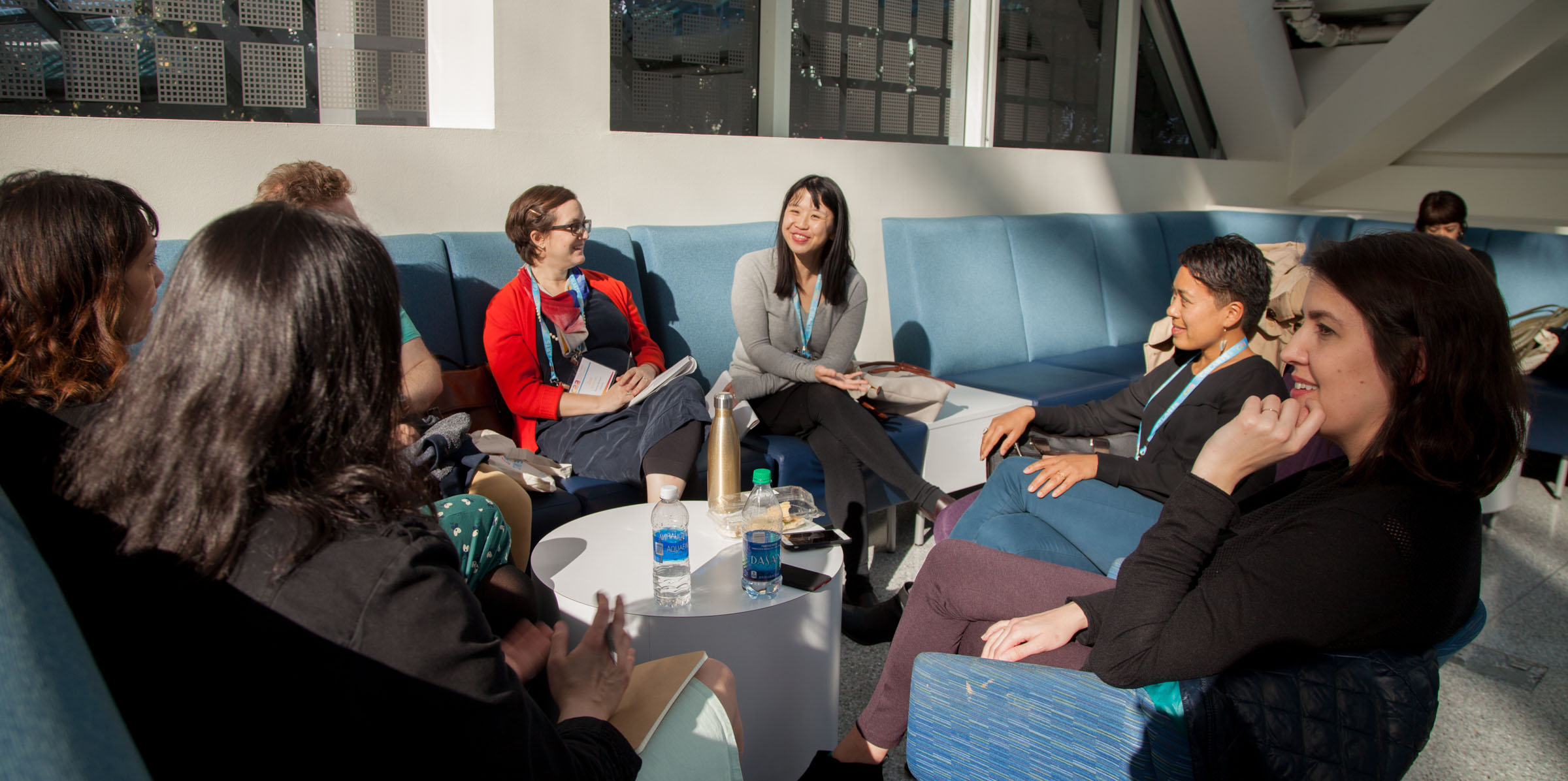
Attendees at the 2018 Annual Conference. Image: Rafael Cardenas
Artists and scholars are members of CAA because of the connections they form at our Annual Conference. But putting together an Annual Conference is no small task. The process to plan and execute the CAA Annual Conference takes the CAA staff and committees nearly a full year. You might have noticed that we opened the portal for session submissions for the 2019 Annual Conference in New York, February 13-16, just five days after we ended the LA meeting.
We received nearly 1,000 submissions for the 2019 Annual Conference – the highest number in CAA’s history. We had more than 4,200 attendees in Los Angeles. We hope to see more than 5,000 in New York.
As we set ourselves to planning CAA 2019, we take into consideration your ideas and comments. Working from feedback from the Annual Conference survey and from conversations in person we will make the NYC meeting even better.
Here is what you told us:
- More than 73% were satisfied with the 2018 Annual Conference, so that means we will keep doing a lot of the things that we do. However, many of you hated the Los Angeles Convention Center and the distance from the hotels. This is not something we plan to do again.
- There were a few problems with onsite registration and we are re-thinking how we perform this function. Even though we have a seasoned staff in this area, it is only something done once a year and we only do it for three days. That is not an excuse; it’s just that we have to get it perfect on the first day.
- About two thirds of those who attended were art historians or curators. One third of you are practicing artists. 76% of you are associated with a college or university. That tracks closely to our overall membership. Designers have said that they want to participate and you will see that we will have more offerings for them in the years to come.
- You like the phone app and the positive, welcoming feeling at the Annual Conference and the diversity of sessions. The 90-minute sessions seem to be popular. Many of you like the off-site events and enjoyed going The Getty, The Broad, The Huntington Library, and The Hammer Museum. We will continue to offer off-site events. The Book and Trade Hall remains popular. You liked hearing Catherine Opie and Helen Molesworth.
- Some of you were frustrated that there were several sessions happening on the same topic at the same time. We hate when that happens as well, and we do everything we can to avoid it. The problem is that some panelists have no flexibility in their schedule and we are forced to offer the sessions at the times the panelists can be there. But trust us, we will continue to try to not schedule topics on the same topic at the same time.
- Some felt that there was a broad diversity of topics while others felt that there were not enough sessions on their area of concentration. We want to hear more about this. Let us know how we can make this better. Remember – the members are the ones who control what is offered by submitting on a variety of topics.
- Many of you want more professional development sessions. We hear you and we will be offering more in NYC. Stay tuned for a Professional Development Survey coming your way soon. We are also making it a goal to have childcare at the New York meeting!
- Many didn’t like the fact that the Los Angeles Convention Center only had one coffee cart. It did not help that it was poorly staffed and closed mid-afternoon (Yikes!). The NYC Hilton will have many more options, and so will the immediate vicinity outside the Hilton hotel.
- On one hand, many of you liked being in LA; others hated the city and felt it was too expensive and spread out.
- While we can all use more chairs and places to sit, an overwhelming 83% of you believed that you had an opportunity to network with colleagues – one of the most important reasons we offer the Annual Conference.
- 83% of you are considering coming to NYC and we look forward to seeing you!
Keep telling us what you think. It’s how we put together a great Annual Conference.
Kevin Curry and Christopher McNulty
posted by CAA — May 21, 2018
The weekly CAA Conversations Podcast continues the vibrant discussions initiated at our Annual Conference. Listen in each week as educators explore arts and pedagogy, tackling everything from the day-to-day grind to the big, universal questions of the field.
This week, Kevin Curry and Christopher McNulty discuss the challenges and benefits of digital technology in 3D/Sculpture.
Kevin Curry is an Associate Teaching Professor at Florida State University where he teaches digital foundations and sculpture. He’s currently in London teaching a photo for non-majors class.
Christopher McNulty is Professor of Art in the Department of Art & Art History at Auburn University in Alabama and teaches sculpture to undergraduates at all levels. He is a dual citizen of France and the United States.
New in caa.reviews
posted by CAA — May 17, 2018
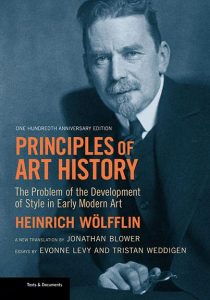


Todd Cronan writes about Principles of Art History: The Problem of the Development of Style in Early Modern Art by Heinrich Wölfflin. Read the full review at caa.reviews.
Monique Kerman reviews Phenomenal Difference: A Philosophy of Black British Art by Leon Wainwright. Read the full review at caa.reviews.
Yulia Karpova discusses Gruzinskii avangard: 1900–1930 by Iveta Manasherova and Elena Kamenskaya, and the exhibition The Georgian Avant-garde: 1900–1930s: Pirosmani, Gudiashvili, Kakabadze, and Other Artists at the Pushkin State Museum of Fine Arts. Read the full review at caa.reviews.
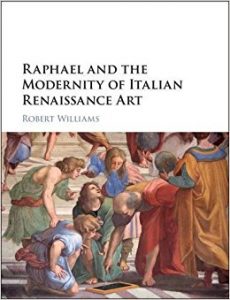
Christian K. Kleinbub explores Raphael and the Redefinition of Art in Renaissance Italy by Robert Williams. Read the full review at caa.reviews.
Announcing New Benefits for CAA Individual Members
posted by CAA — May 16, 2018

CAA is proud to announce a new suite of benefits for its members starting today. As an association concerned with supporting all aspects of its members’ lives, we are adding a series of benefits to your CAA membership that help you when you travel, with your insurance needs, and with technology and design programs. The full details about these new membership benefits will be behind the CAA membership wall shortly, but they are also ready to use now at the links below.
If you have any questions don’t hesitate to contact our membership services team at Member Services at 212-691-1051, ext. 1.
Hilton Hotels
Get discounts on your room rates when you stay at a Hilton or any of the hotels in the Hilton Hotel family.
Learn more about Hilton hotel discounts
- 10% discount at Hilton full service hotels, and 6% discount at Hilton focus service hotels, non-last room availability (NRLA) Discount
- Full Service hotels include: Waldorf Astoria Hotels & Resorts; Conrad Hotels & Resorts; Canopy by Hilton; Curio by Hilton; Hilton Hotels & Resorts; DoubleTree by Hilton; Tapestry by Hilton; and Embassy Suites by Hilton
- Focus Service Hotels include: Hilton Garden Inn; Hampton by Hilton; Homewood Suites by Hilton; Home2 by Hilton; and Tru by Hilton.
*Discounts not available during CAA Annual Conference
MetLife
Get discounts on Home, Auto, and Dental insurance with MetLife.
Learn more about Home and Auto discounts
Learn more about Dental Insurance discounts
Adobe Programs
CAA members can take advantage of two discounted Adobe programs. Adobe Creative Cloud includes the full suite of Adobe programs to give you every tool in your design toolbox.
Adobe Acrobat Pro gives you complete flexibility with PDF documents, from editing to e-signatures and more.
Association for Art History
Join the Association for Art History, the UK subject association for those involved with art history and visual culture, at a 20% discount on membership.
Please contact Association for Art History directly at +44(0)20 7490 3211 or info@forarthistory.org.uk and have your CAA membership card or CAA member ID ready.
Learn more about the Association for Art History
News from the Art and Academic Worlds
posted by CAA — May 16, 2018
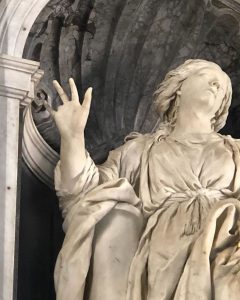
Bernini’s Santa Bibiana, with its missing finger — which has since been reattached. Image: Silvia Mosetti via NYT
DC’s Defunct Corcoran Gallery Announces the New Homes for Over 10,000 Works of Art
Four years after the gallery was abruptly closed, trustees of the institution have announced how more than 10,000 objects from its original $1 billion trove will be distributed. (artnet News)
No Pain, No Brain Gain: Why Learning Demands (A Little) Discomfort
Quality learning requires what brain scientists call “desirable difficulty.” (Fast Company)
Bloomberg Expands Arts Grant Program to Seven More Cities
Bloomberg Philanthropies is investing $43 million in more than 200 small and midsize cultural organizations. (New York Times)
The Risk of Moving Artworks: A Broken Finger and Public Outcry
An art history professor was taking a group of students through the baroque Church of Santa Bibiana when he made what he called a “macabre discovery.” (New York Times)
The Blueprint for Saudi Arabia’s Multi-Billion Euro Cultural Partnership with France
The ten-year deal gives France an exclusive role in an area almost the size of Belgium. (The Art Newspaper)
Soon You May Be Able to Text with 2,000 Egyptian Hieroglyphs
Over 2,000 new Hieroglyphs may soon be available for use on digital devices, thanks to collaboration between Egyptologists and digital linguistics. (Hyperallergic)