CAA News Today
Kelly Walters
posted by Allison Walters — December 02, 2020
Statement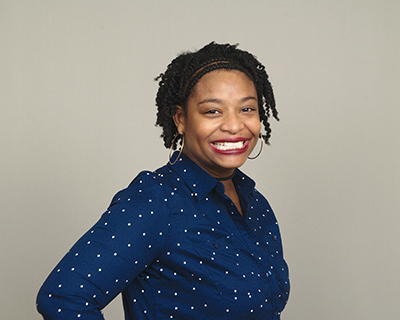
My name is Kelly Walters, and I am an Assistant Professor of Communication Design at Parsons School of Design at The New School. Prior to joining Parsons, I was an Assistant Professor at the University of Connecticut, an AICAD Teaching Fellow at California College of the Arts and an adjunct at the University of Bridgeport. Throughout my teaching career, I have had the opportunity to teach at public universities, small private liberal arts colleges and elite art institutions. The art and design programs in these environments utilize differing pedagogy on design and are reflective of the needs of the students at those institutions. All of these experiences have allowed me to see how art and design programs differ across discipline, and how teaching strategies can shift from one institution to next. Over the last few years, I have the opportunity to participate in the CAA Conference – as a presenter in 2019 and as a panel chair this past February 2020. I have always found CAA to be an invaluable resource to learn more about promotion and tenure guidelines, seek out grant opportunities or follow the most recent news in art and design scholarship. To be a CAA Board member would mean that I could help support the continuation of important initiatives like these that directly impact a diverse art and design education community.
I have engaged with the field of design as an educator, a professional graphic designer and through service to other professional organizations. I am currently an AIGA Design Educators Steering Committee member and entering my third year in this role. As the Communications Chair, I have led numerous meetings with the DEC Communications team to strategize and plan what resources and content we can share within our community for their success. Serving on this committee has provided me with necessary skills that I could bring as a CAA Board Member, including organizationals skills and the ability to work collaboratively on a team. I am excited to state my interest to participate on the CAA Board because of my extensive experience teaching and my interest in connecting people with resources or to each other. If selected as a CAA Board Member, I would be interested in supporting the following committee areas: design, diversity practices and professional practices. The multiple perspectives I hold as a Black woman, as an educator and practitioner, would make me a great Board member that would be sensitive to concerns around design and that of marginalized communities. I am excited about the prospect of moving forward art and design discourse, with a particular focus on engaging with urgent questions and critical shifts happening in relation to race, identity and representation today. I look forward to this potential opportunity and thank everyone for their time in reviewing my materials.
Wanda Raimundi-Ortiz
posted by Allison Walters — December 02, 2020
Statement
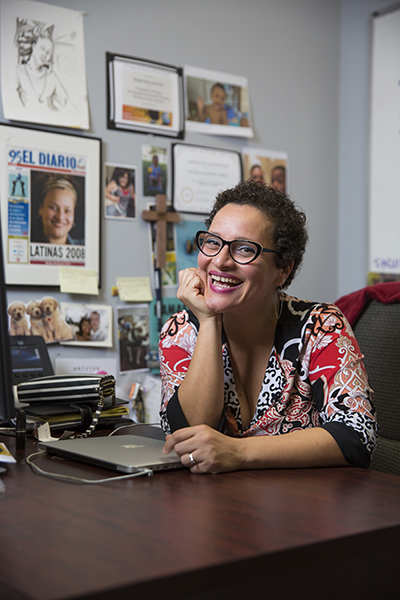
You cannot expect students to copy what they’ve never seen. It’s what drives me to affectionately describe my classes as “cultural spackle: I fill the cracks in students’ education”. I’m motivated as a first generation recently tenured Latinx professor to address diversity in both my courses and my creative research. I value modelling the excellence we wish students to become in the classroom by ensuring that students are studying a curriculum of contemporary art that is as vast as the student body. The same desire holds true for faculty and more flexible pedagogical practices. I hope to bring that same energy to share with CAA’s board.
While I am beyond happy to see such emphasis on diversity and inclusion efforts being enacted across so many platforms that we engage with regularly, I am also keenly aware of the awkwardness in attempting to “diversify” in the hands of people not immediately impacted by this “issue” as well as the intense pressure for the “diverse” faculty in institutions to ‘help’ guide faculty through seemingly uncharted terrain, serve on committees to ensure diversity quotas, provide moral support and validation to colleagues or administrators’ programming to ensure “appropriateness, etc. This invisible load placed on “diverse” faculty to facilitate/mediate pathways to a more inclusive environment, pacify departments and appease the demands of students and upper administration leaves faculty feeling, unsurprisingly, overworked, overwhelmed and undervalued.
It is my intent to utilize my experiences in this very situation to advise on how we can, at CAA, address these issues through content programming and support for faculty and administrators. Since there is strength in numbers I would be honored to lend my voice and personal experience to this organization’s commitment to such a pressing matter at a most vital moment of our lifetime. In this chilling moment, as we stand fearful of potentially losing freedoms we’d thought were won, I would like to be part of the team that moves steadfastly forward toward a truly progressive future.
Kelvin Parnell
posted by Allison Walters — December 02, 2020
Statement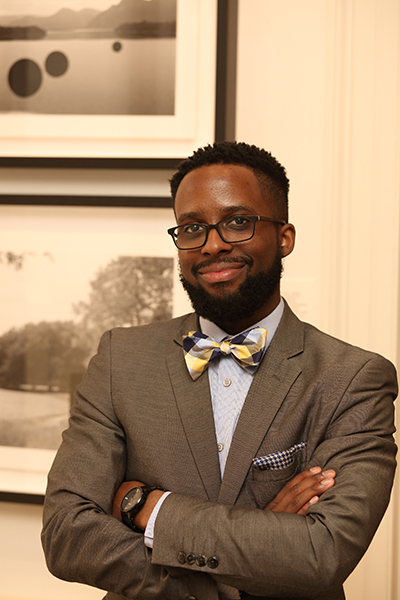
My name is Kelvin Parnell Jr, and I am grateful to be one of the College Art Association’s candidates for the Emerging Professional Director. Aligning myself with CAA’s mission of building a more diverse and inclusive scholarly community, I understand the Emerging Professional Director position to be critical to this goal’s progress. To do so, I want first to expand the scope of the position to include undergraduate students. As a young, Black undergraduate attending a university that did not support the humanities, especially the visual arts, I found it difficult to build community and the support needed to further my career. Although I knew about CAA, I often understood it as something that was not meant for me. Therefore, one of my top priorities will be to uplift and highlight the voices and concerns of those traditionally underrepresented in the field, whether they be students, professionals, or lifelong learners and admirers of the visual arts. I believe the future of CAA depends on ensuring that the association becomes more integrated with the careers and development of visual arts professionals at all stages of their careers. I want to establish that our organization’s value will continue to develop and progress beyond the annual conference by emphasizing how we are a vital and necessary resource to our members and those whose membership we wish to court.
As the world and visual arts continue to change, adapt, and evolve, so must CAA. Our organization’s emerging professionals are some of our most valuable resources as they will take up the mantle and lead the field into the future as so many have before them. But to do so, CAA must also be an active agent in the development of their careers to guarantee that change occurs. CAA must be an organization wherein we prepare our young scholars and professionals for today’s challenges and brainstorm solutions together with our more senior and experienced members about the problems of the future that have yet to manifest. During my tenure, I hope that I will be able to help bridge generational and professional divides amongst scholars, artists, and visual arts professionals through new, robust programming and mentorship, both formal and informal. Further, we must listen to, learn from, and reach out to communities and spaces we have not looked to typically to engender the change we seek. Our presence in the world of visual arts must be one that is welcoming and active. We should ensure that we engage with the public in meaningful ways and create the public’s desire to engage with us. To do so, we should work tirelessly to fulfill our mission and advocate the critical need for the arts’ study and practice.
I believe CAA should and can be an organization that provides various opportunities and venues for all of us in the visual arts to gather and exchange our ideas and experiences not just once a year, but throughout the year and throughout our careers and lifetimes. It seems to me that now, more than ever, that deep community building is desired and necessary.
Thank you for considering me for this honorable and privileged position.
Charles Kanwischer
posted by Allison Walters — December 02, 2020
Statement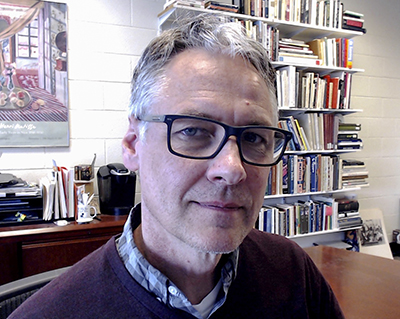
Currently, I serve as the Director of Bowling Green State University’s School of Art, a large and comprehensive program comprised of 550 students and 34 faculty members. In addition to my administrative duties, I teach courses in drawing and maintain an active studio practice focused on drawing and photography.
I believe that my strong record of national-level professional service has well-qualified me for Board service. Since 2016, I’ve served on CAA’s Professional Practice Committee. Perhaps the highlight of my PPC service was co-chairing the sub-committee that last year completed revisions to the guidelines for retention and tenure of art historians. In addition, I’ve served or continue to serve on PPC sub-committees charged with revising CAA’s guidelines for distance education, teaching digital media, baccalaureate degrees in studio art, assessment in studio art as well as CAA’s overview statement on standards/guidelines. I’m also a member of the Board of Directors of the National Council of Arts Administrators (NCAA), a CAA affiliated organization dedicated to addressing pressing issues in arts administration. In my role as Co-Chair of NCAA’s Conference Committee, I’ve co-organized three NCAA/CAA affiliate panel sessions for CAA conferences. Last year’s session, “So Who Wants to be an Arts Administrator?”, was devoted to recruitment and support of emerging administrators, an issue of great importance to the future of visual arts education. Finally, I serve as an institutional on-site evaluator for National Association of Schools of Art and Design (NASAD) accreditation and re-accreditation reviews.
Leadership of a School of Art situated within a region-focused public university with a substantial population of first-generation college students has made me especially sensitive to the issue of preserving academic access. I see this as an urgent matter. If education in the arts and humanities becomes inequitably available, then the voices and experiences of a large part of our society won’t be heard, resulting in a profound negative impact on the quality of cultural and political discourse in our country. Given what’s at stake, keeping educational and cultural institutions accessible, inclusive and diverse in the face of pandemic accelerated enrollment declines and budget cuts is a challenge we must take up collectively. As the preeminent professional organization in visual arts education, CAA is uniquely positioned to bring together its various constituencies for the purpose of jointly developing programs, strategies and advocacy language required to navigate in our present circumstances and to re-imagine our futures. It would be a singular honor to offer my experience to CAA’s Board of Director’s in a moment when the organization’s mission to assure the vitality and inclusivity of visual arts interpretation and practice has never been more necessary.
Lara Evans
posted by Allison Walters — December 02, 2020
 Statement
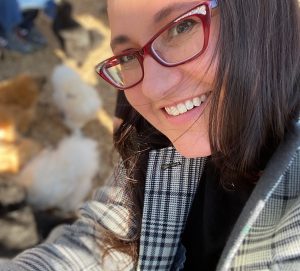
With your support, I would be pleased to join the CAA Board of Directors and contribute to increasing the organization’s diversity and inclusivity during this challenging time. Improving opportunities for artists and scholars of color has been a central priority during my career as an art historian specializing in contemporary Native American art. I was one of the first tribally enrolled individuals to receive a PhD in art history, and know how difficult the field is for students without financial resources and from groups underrepresented in the field. I have experience at a variety of institutions. I was faculty at a public liberal arts college for 8 years, and have been at a tribal college art school for the past 8 years. Because there are so few specialist in this area, I have worn many “hats,” sometimes simultaneously: faculty teaching art history and studio art courses, curator, artist-in-residence program director, Department Chair, Associate Academic Dean, grant administrator, and now also the founding director of a new research center for Native arts. I have found myself doing things I never imagined, things that have created real changes for the Native and First Nations communities I work with. Navigating through the dynamics of various institutions and working with diverse communities is a completely normal and necessary foundation of my work with students, artists, and colleagues and other educational institutions and museums. I listen, observe, and keep an eye out for ways I can serve to build relationships and opportunities. I am particularly attentive to designing programs that actively counter the structural barriers that prevent participation by underrepresented groups. It may occasionally get annoying, but I ask questions about the established “norms.” I consider how they may produce exclusion, rather than inclusion, and get creative with possible solutions.
Thank you for considering me for service to the CAA Board of Directors.
Alberto De Salvatierra
posted by Allison Walters — December 02, 2020

Statement
As an intersectional minority, I understand, first-hand, the challenges that underrepresented groups face in higher education—whether as a student or an academic. For this reason, I have endeavored to specifically address diversity and inclusion inequities through my teaching and service initiatives.
I first had the pleasure to deep-dive into these issues when, while at Harvard University, I was part of a small cohort of university leaders across the entire university tapped to join the Presidential Task Force on Inclusion and Belonging—a one-year working group of key faculty and administrators selected to 1) analyze the pedagogical and infrastructural landscape of the university, and 2) catalyze a set of recommendations that have since started to be implemented. Since then, I’ve continued my advocacy through my scholarship on teaching—especially as it relates to interdisciplinary pedagogy and practices—using art and design as a point of departure and cross-fertilization with other disciplines. Most recently, I was invited be an official delegate and speaker at the 2019 Hispanic Leadership Summit at the United Nations in New York City. Part of the summit’s opening panel (“Access to Education for Hispanics/Latinxs”), I was the youngest speaker sharing the stage with such leaders as Emmanuel Caudillo (Senior Advisor at the White House Initiative on Educational Excellence for Hispanics), Raquel Tamez (CEO of the Society of Hispanic Engineers), and Nancy Lee Sanchez (Executive Director of the Kaplan Education Foundation). In the presence of 500 delegates, I advocated for an emphasis on STEAM (rather than STEM) disciplines, more decisive support at the university level, and renewed legislation with regards to DACA students.
With this context in mind, and building on the CAA’s previous advocacy in enhancing equity, diversity, and inclusion initiatives in higher education, I believe a strong path forward for the College Art Association is to establish a renewed commitment to bringing the arts to underrepresented populations, in particular black and indigenous students, and catalyze them in existing STEAM conversations—promoting unconventional program partnerships and university-to-job pipelines. An interdisciplinary education, with creativity, design thinking, and the arts at the core, will be key to careers responsive to existing climate-change challenges and resilient to the coming technological upheaval of the “4th industrial revolution.” Moreover, due to the challenges wrought on by the on-going global pandemic, the CAA will need strong and visionary leadership on part of its Directors to help the organization navigate the uncertain times ahead. The arts have always been the soul of civilization, and to avoid their continued defunding across colleges in North America, innovative thinking will be crucial to forge a strong tomorrow.
Patricia Childers
posted by Allison Walters — December 02, 2020
 Statement
My career has been in the educational environment, focusing on graphic design and critical studies. I see intellectual engagement as a place of possibilities. In addition to teaching design, I practice professionally, and am an active member of many design organizations. But the structure of life has changed. The global pandemic, compounded with continuing issues of basic human rights and a deteriorating climate, has affected much that we value.
The MFA class of 2020 has experienced not only a loss of employment opportunity, but a loss of the support that contributed to our wellbeing. Loss, like the disbanding of The Type Director’s Club, an organization that I’ve actively supported for years, contributes to our overwhelming isolation. I am a member of the first class to graduate into this state of precarity. But uncertainty weighs heavily on the entire profession. When I facilitated a round-table discussion at the AIGA Design Educators conference, our chat box overflowed with requests for resources and advice to help navigate in isolation.
Apprehension during the transition from student to professional is not a recent phenomenon. The scarcity in teaching positions existed long before this pandemic. And a lack of guidance in writing and publishing, continuing to make work without a deadline, the expectations of maintaining scholarship and service, can daunt.
Resources like CAA assist by providing everything from creating CVs to webinars on interviewing, with efforts to demystify salaries, create mentorship programs, adjunct and labor advocacy, and sessions such as “Get Up, Stand Up: Contingent Faculty and the Future of Higher Education in the Visual Arts.” In CAA’s Art Journal Open (AJO) Kristen Galvin and Christina M. Spiker addressed the system itself. “The Cost of Precarity: Contingent Academic Labor in the Gig Economy” stated that robust discourse depends on a viable institutional ecosystem—healthy interaction and balance between populations to ensure resilience to various types of external stressors.
Today, our resilience is being tested as COVID-19 social distancing magnifies existing issues and forces us to adapt. However, our adopted platforms for communication have integrated and flattened traditional hierarchal structures of engagement. Event participation, although limited by technological advantage, is no longer limited by location. This expanded engagement has diversified communities as isolated transactions grow into ongoing relationships. Many of our “wicked problems” are being addressed through this immediate connection of people, ideas, and action.
I offer the first-hand experience of a recent student and emerging professional navigating the unpredictable. If elected, I will represent the organization’s future leaders, a group honed by adopting to crisis. But I’ve found this crisis to be a catalyst for possibilities. Platforms that provide social fraternization and leadership can build stable foundations for the future. These systems not only build relationships—but build platforms that allow others to build relationships. Through engagement, we can build for the new normal.
Roland Betancourt
posted by Allison Walters — December 02, 2020
 Statement
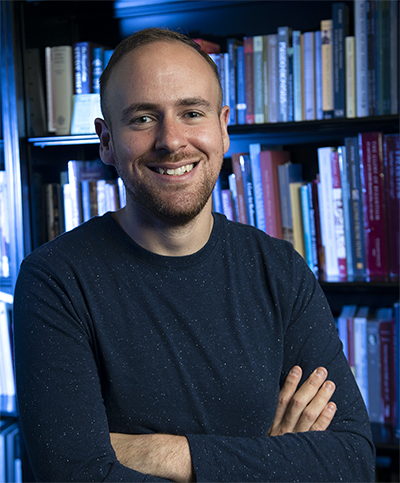
As a queer Latinx medievalist, I am intimately aware of the challenges faced by art historians of color. These challenges extend from the systematics of graduate training and the tenure and promotion system, as well as the unique precarities faced by BIPOC and LGBTQIA+ scholars doing research in the field. Recognizing my place as a tenured, full Professor, my aim is to use the privileges afforded to me to support early career scholars. My goals on CAA’s Board of Directors are twofold: first, to champion the needs and successes of BIPOC scholars, offering my understanding of the challenges faced particularly by Latinx scholars; second, to speak to the needs of pre-modern art historians, particularly from my expertise as a Byzantinist working across the medieval Mediterranean world.
Having received my PhD in 2014, I have faced the realities of today’s academy with dwindling job prospects and newfound publishing challenges amidst unchanging demands. At the same time, I have also moved swiftly through the tenure and promotion process at a large public institution. In my commitment to early career scholars, I wish to lead conversations as to how we rethink publication and peer review processes for a more ethical, equitable, and constructive scholarly landscape. As a medievalist, I also recognize that the needs of my field are severely underrepresented within CAA, which in past years has led to steep drops in membership due to a lack of representation and also in protest of said lack. My goal is to revitalize the visibility of and avenues of conversation for our constituents working on the ancient and medieval worlds.
Over the past ten years and since my early graduate school days, I have been committed to service responsibilities that enrich our field, from programming to administration. Currently, I am the Director of the PhD Program in Visual Studies at the University of California, Irvine, where I am also a Professor of Art History and Chancellor’s Fellow. Starting next year, I am the Series Editor for the Viewpoints book series, run in conjunction with the International Center for Medieval Art (ICMA) and the Pennsylvania State University Press. I have an extensive record of serving on the governing boards and steering committees of a host of organizations, including the Medievalists of Color (MoC), the Byzantine Studies Association of North America (BASANA), and the Gender in Byzantium Bibliography Project at Dumbarton Oaks / Harvard. And, at the Medieval Academy of America, I serve on the Inclusivity and Diversity Prize Committee. At UC, Irvine, I have served on three search committees for positions diversifying our curriculum in the areas of Armenian history, Iranian archaeology, and Latinx art history, film, and media studies. Additionally, my efforts have been focused on largescale fundraising for my institution, including our new LGBTQ+ Fundraising Committee, the Faculty Development Committee for the School of Humanities, and the department of Art History’s fundraising committee.
As we look ahead, my goal is to make CAA a safe, supportive, and affirming space for BIPOC, queer, and trans scholars working across our organization’s multifaceted areas. I intend to use my extensive service background alongside my extensive research and publication experience to guide CAA into the coming decade, acknowledging my personal experience in the field as a queer Latinx art historian.