CAA News Today
Member Spotlight: Meet the New Co-Editors-in-Chief of The Art Bulletin!
posted Aug 01, 2025
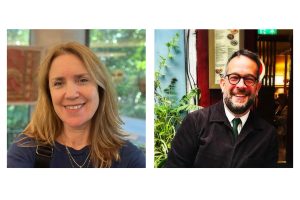
The Art Bulletin is pleased to announce its new co-editors, Maya Stanfield-Mazzi and Stephen Whiteman. CAA News is happy to introduce them here and has asked them a few questions to help members, readers, and future contributors get to know them a little better. Welcome Stephen and Maya!
Can you tell our members about your current academic posts and research interests?
Maya Stanfield-Mazzi: I am professor of art history at the University of Florida, where I have taught since 2008. I specialize in Latin American art, especially that of the Andean region during the autonomous and colonial eras. I have long been interested in textiles as expressions of Indigenous epistemologies, and the ways in which textile makers responded to outside influences from Europe and Asia. Departing from my past work on Catholic art patronage, my current book project considers secular visual culture in the mining city of Potosí, Bolivia, to chart early modernity within a colonial and multiethnic context. I am also interested in issues of cultural heritage and the ways in which art history as a discipline can be employed to preserve tangible resources and engage the broader public for current-day benefits.
Stephen Whiteman: I am professor in the art and architecture of China at the Courtauld Institute of Art, University of London, where I have taught since 2019. Prior to that, I taught at the University of Sydney for five years. I am also a Trustee of the Association for Art History, CAA’s peer organization in the United Kingdom. My research addresses questions of landscape, territory, and social and ethnic identity in China from roughly 1500 to the present. I am very engaged with digital methods in art history, as well as the potential for new approaches to the field afforded by digital alternatives to long-form writing. I am also interested in connected histories of art and architecture in China and Asia and the prospects of art history outside the construct of modern nation-states.
What is your vision for The Art Bulletin during your term as editors-in-chief?
We are excited and honored for the opportunity to steward one of the leading journals in our field during a challenging period. We are deeply invested in The Art Bulletin’s tradition of publishing art historical scholarship of the highest quality and maintaining the journal’s investment in the highest standards for editing and production. We look forward to building upon the work of previous editors in broadening the journal’s reach, demystifying its editorial processes, and working toward greater inclusivity in both authorship and readership. As scholars with expertise in two very distinct non-European fields, we are also interested in the opportunity to further extend The Art Bulletin’s voice and reach beyond its traditional ground and in ways that reflect the growth and evolution of the field over recent decades.
At the same time, we are acutely aware of the pressures that surround research, academia, and cultural institutions today. We want The Art Bulletin not just to be a journal of record, but also one that engages in ongoing conversations, within and beyond the discipline. What does art history have to contribute to the debates of today? How can art historians contribute to critical conversations or offer new perspectives on pressing issues? While we are not aiming to politicize The Art Bulletin, we hope that each issue will be one that readers want to read now, as well as in the future.
What motivated you to become E-I-Cs of The Art Bulletin? Why together? How does your research and public scholarship dovetail with your vision for the journal?
We are excited for the bird’s-eye view of the discipline that the co-editorship will offer. We both understand editorship of The Art Bulletin as an opportunity for service to the discipline. Likewise, we see editing as a form of mentorship. As such, we were each motivated by an interest in helping to shape the field through expanding opportunity, supporting research and professional development, and standing up for principles we share: academic freedom, the importance of research and the search for knowledge, and the essential role of art history and the humanities today. We were both excited about the possibilities of co-editorship. The collaborative arrangement has obvious practical advantages, but more importantly, we valued the broader perspective that two people working in different areas of the field necessarily brings to the role.
And finally, what are each of you reading/viewing these days? What is inspiring you—within and outside of the field?
SW: Within the field, I am finding a lot of inspiration in work that I feel stretches the boundaries of Chinese art and of the discipline more generally. This ranges from research on art and architecture beyond the major cultural centers of China, such as Xinjiang, Guangzhou, and Shandong, to work engaging new archives, non-Chinese languages, transcultural histories, and objects and spaces that lie outside the received canon. Away from work, I have been reading a great deal of fiction, including by authors whose narratives explore issues of identity, displacement, and relocation, such as Yvonne Owuor, Gerald Murnane, and Elif Shafak. As a migrant myself, albeit one who has moved by choice and from a privileged global position, I find much to think about in these books as I grapple with my own sense of place and seek to understand the larger experience of contemporary global migration of which I am a tiny part.
M S-M: In my research area I am struck by the current dialectic between mobility and groundedness. Scholars are showing the vast expanses across which images have traveled and their great potential for resignification, while others (often by looking closely at the archaeological record) are able to identify local narratives that arise from commitments to shared, and often very deep, pasts. Recently I have been inspired by the Beninese students featured in the 2024 film Dahomey, who passionately articulate the importance of historical artifacts for their own shared identities. With students increasingly using AI tools to express themselves, I am committed to fostering individual expression and, for art history, deepening our understanding of the nature of original research and thinking.