
CAA News Today
CWA Picks: Summer 2026
posted Jul 02, 2026
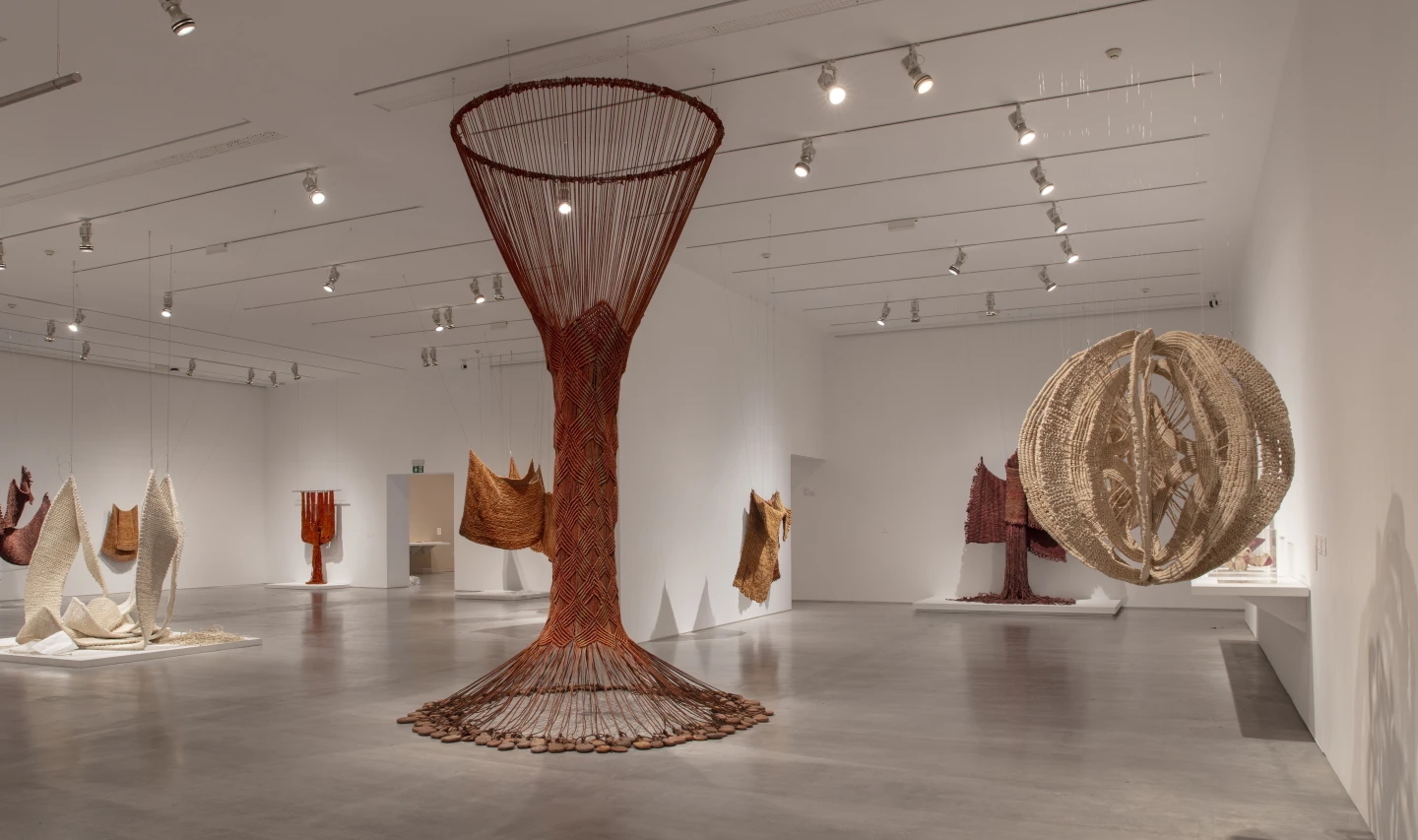
Installation view, Aurelia Muñoz: Entes (Entities), Museo Reina Sofía, Madrid
Questions of materiality, care, and cultural communication surface repeatedly in this summer’s Committee on Women in the Arts Picks. In Spain, Aurèlia Muñoz draws on ancestral fiber traditions to reflect on environmental precarity and the interconnectedness of ecosystems. In Guatemala, Rosa Elena Curruchich and Angélica Serech underscore how material practices sustain memory and care across time. In London, Laakkuluk Williamson reflects on Inuit identity and sovereignty, foregrounding relationships between bodies and land, past and present, memory and material.
UNITED STATES
Calida Rawles: Away with the Tides
Through September 5
Spelman College Museum of Fine Art, Atlanta
Merging hyperrealism with poetic abstraction, Spelman alumna Calida Rawles situates monumental Black figures in strongly undulating aqueous settings that represent racial exclusion as well as, through the reclamation of these spaces, individual healing. Away with the Tides features recent acrylic and pastel paintings alongside a large-scale video installation reflecting the natural environment and cultural milieu of the historically Black neighborhood of Overtown, Miami.
Gisela Colón: Radiant Earth
Through July 5
Bruce Museum, Greenwich, CT
Los Angeles-based artist Gisela Colón creates abstract luminescent sculptures inspired by the energies and patterns found in nature and the skies, including the mountainous terrain and sunshine of Puerto Rico, her childhood home. In collaboration with scientists, Colón has developed a unique method of layering and laminating reused plastics and other engineered materials to produce works—here, biomorphic and obelisk-like forms—whose ever-changing colors are activated by light.
Julie Buffalohead: Stories of Becoming
Through July 26
Nerman Museum of Contemporary Art, Overland Park, KS
A citizen of the Ponca Tribe of Oklahoma, Julie Buffalohead presents a new series of paintings that incorporate animals from Indigenous stories into narrative contexts from European folklore, highlighting the contrasts between a nurturing ethos and a colonizing one. Demonstrating a shift in Buffalohead’s practice since becoming a mother, the eight new works, which also include a hand-sewn wool dress, speak to how older generations pass along the knowledge of land, animals, and other living beings to the young, especially from mothers to daughters.
Modernity and Opulence: Women of the Wiener Wërkstatte
July 17–November 15
The Jewish Museum, New York
This exhibition sheds new light on how Jewish women artists, designers, patrons, and tastemakers shaped modernist aesthetics in the early twentieth-century Vienna-based modernist movement known as the Wiener Werkstätte. It places special emphasis on ceramicist Vally Wieselthier and textile artist Felice Rix-Ueno, whose extensive bodies of work have made a lasting impact on these disciplines, and it meaningfully reintroduces artists working in a wide range of media whose relationship to the history of art and design has long been overlooked.
Marietta Bernstorff: PatchWork—Women from Oaxaca, Mexico
Through September 4
Visual Arts Gallery, PCC West Campus, Tucson, AZ
Seventy blankets and twenty-five books here represent the larger ongoing international textile art project Patchwork Healing Blanket/La Manta de Curación. Initiated by Marietta Bernstorff, founder of the Oaxaca-based collective Mujeres Artistas y el Maiz (MAMAZ) and involving more than one thousand women across disparate cultures, Patchwork Healing Blanket transforms stitching into a collective response to gender-based violence and ecological harm.
Sharmistha Ray: Emergent Realities
Through July 5
Wood Street Galleries, Pittsburgh, PA
This newly commissioned three-channel animation by Sharmistha Ray brings together painting, original and found footage, and cosmic imagery in a layered visual odyssey. The channels juxtapose images of the universe—satellites drifting, comets arcing across space—with painted abstractions, drawing the viewer into a vortex where deep time and human perception loop, splinter, and converge.
Sophie Rivera: Double Exposures
Through August 2
El Museo del Barrio, New York
This is the first museum survey dedicated to groundbreaking photographer, writer, and organizer Sophie Rivera. Born and raised in New York, Rivera was active from the 1970s through the 2000s, producing photography that spans documentary images, urban landscapes, abstractions, conceptual self-portraits, and the artist’s iconic Latino Portraits series. The exhibition’s title draws on the photographic technique of layering multiple images within a single frame—here, a metaphor for Rivera’s self-described “complex amalgam of vision,” shaped by her identity as an artist, Latina, and feminist.
Subvert, Repair, Reclaim: Contemporary Artists Take Back the Nude
Through August 2
MFA (Museum of Fine Arts), Boston
Of the twelve artists who engage with the nude in this exhibition, ten are women or nonbinary: Mary Enoch Elizabeth Baxter, Nona Faustine, Xandra Ibarra, Maya Jeffereis, Gisela Charfauros McDaniel, Joiri Minaya, Cato Ouyang, Rachelle Anayansi Mozman Solano, Katherine Sherwood, and Betty Tompkins. Their performative gestures, archival interventions, and acts of redaction and repair symbolically reach into the frames—and framing—of the nude as it has traditionally appeared within museums. Addressing timely issues of bodily autonomy, agency, and accountability, they expose and challenge the power structures and inherited narratives governing visibility, authorship, and desire.
MEXICO
Con todo mi tristeza (With All My Sadness): Fátima Rodrigo
Through September 27
Museo Rufino Tamayo, Mexico City
Based on extensive research in public and private television archives, Peruvian artist Fátima Rodrigo reconstructs Latin American musical and game-show sets using everyday materials. Part of a program of site-specific installations in the central courtyard of the Museo Tamayo, With All My Sadness invites viewers to consider the interactions among modernist aesthetics, cultural exchange, and politics within popular entertainment.
Gerda Gruber: Entre verde y agua (Between Green and Water)
Through September 30
Museo de Arte Moderno, Mexico City
This first retrospective honoring the career of the Bratislava-born, Yucatan-based sculptor Gerda Gruber from the 1970s to the present highlights the breadth of her formal and material experimentation. Gruber’s works in clay, stone, textiles, wood, and more call to mind fossils, spiderwebs, eggs, bodies, and other organic forms, asking viewers to consider issues of sustainability and the role of art in confronting ecological crisis.
Ingrid Hernández: 20 años de arte _Under Construction_ (Twenty Years of Art “Under Construction”)
Through August 9
Centro de la Imagen, Mexico City
These thirteen projects created since 2003 explore the ever-changing nature of Tijuana, home of photographer, printmaker, sculptor, and installation artist Ingrid Hernández. Incorporating garage doors, fences, walls, and other everyday elements, and accompanied by previously unseen archival materials, the works in _Under Construction_ offer an intimate look at housing and life within a border city where people and objects are always in motion.
María Ezcurra: Líneas de fuga (Lines of Flight)
Through July 31
Museo de Arte Carillo Gil, Mexico City
This retrospective brings together more than two decades of work by Argentine-born Mexican Canadian artist María Ezcurra. In installations, sculptures, drawings, and performances, such as her hanging cluster of colorful ruffled dresses, Ezcurra looks at the ways displacement, sexual violence, and patriarchal gender roles affect women’s bodies and identities. At the same time, as the exhibition’s title Lines of Flight implies, Ezcurra proffers means of defying geopolitical and social boundaries—through art, memory, and care.
Remedios Varo: Habitantes de lo insólito (Inhabitants of the Unusual)
Through July 5
Museo de Arte Moderno, Mexico City
In the visual universe of Spanish surrealist painter and author Remedios Varo, who fled Europe during World War II and spent the rest of her life in Mexico, archetypal figures perform actions with the precision of scientific inquiry, the solemnity of mystical ritual, or both. In Inhabitants of the Unusual, the Museo de Arte Moderno displays its collection of Varo’s paintings alongside materials that enrich our understanding of these works: numerous preparatory sketches; notebooks filled with Varo’s hallucinatory memories and psychohumorous experiments; and books from the artist’s personal library.
CENTRAL AMERICA & THE CARIBBEAN
Otras montañas, las que andan sueltas bajo el agua (Other Mountains, Adrift beneath the Waves)
Through August 16
Museo de Arte Contemporáneo, Panama City
Transdisciplinary Caribbean artists Nadia Huggins and Tessa Mars reflect upon the ocean in this exhibition emerging from The Current IV, a three-year curatorial fellowship and research program organized by the Thyssen-Bornemisza Art Contemporary Foundation, Madrid. A multichannel video installation by Huggins and large-scale paintings and sculptures by Mars embrace a freestyle, improvisational ethos in challenging land-based power structures and reimagining natural systems.
Trixie Briceño: Sistemas de lo maravilloso (Magnificent Systems)
Through August 23
Museo de Arte Contemporáneo, Panama City
This exhibition revisits the practice of pioneering twentieth-century Panamanian artist Beatrix Briceño, whose meticulously ordered paintings transform experiences of migration, displacement, and instability into dreamlike visual worlds populated by everyday objects, abstract forms, and fragmented bodies. Archival materials and more than fifty paintings by Briceño appear alongside a new immersive light and sound installation by Panamanian digital artist Ix Shells that algorithmically reimagines Briceño’s universe.
Xa Jun Ruk’oxomal Qanima/Un solo latido/A Shared Heartbeat
Through September 6
La Nueva Fábrica, Antigua, Guatemala
This exhibition brings into dialogue two Indigenous Maya Kaqchikel artists of different generations in the town of San Juan Comalapa, Guatemala: painter Rosa Elena Curruchich (1958–2005) and fiber artist Angélica Serech (b. 1982). Curruchich emphasized women’s roles in Maya social organization through small-scale scenes documenting family life, celebrations, and relationships; Serech addresses migration, territory, and bodily memory in sculptural textiles created by applying traditional weaving techniques to contemporary materials.
CANADA
dlúne æîk’ãzñ: mouse spirit power
Through September 5
Esplanade Arts & Heritage Centre, Medicine Hat, Alberta
This solo exhibition by Heather Shillinglaw, a Denesuline and Métis artist, honors over thirty years of collaboration with her mother, Elder Shirley Norris Shillinglaw of Cold Lake First Nation, a forest medicine expert. Working in textile-based relief installations and art quilts made from reused and upcycled materials, the younger Shillinglaw invites viewers into the perspective of dlúne æîk’ãzñ, her mouse spirit guide: close to the ground, attentive to subtle shifts. She braids together Denesuline knowledge systems, plant-based practice, and texts by Métis poet Marilyn Dumont to reframe land not as a resource but as a living relation.
Dyani White Hawk: Love Language
Through October 4
Remai Modern, Saskatoon
By foregrounding Lakota forms and motifs, Sičáŋǧu Lakota artist Dyani White Hawk challenges prevailing histories and practices surrounding abstract art. This major survey gathers fifteen years of multimedia paintings, sculptures, videos, and other works that draw on intergenerational knowledge, address urgent issues of colonialist oppression, and center connection: among people, between past and present, and between earth and sky.
Ningiukulu Teevee: Stories from the Arctic
Ongoing
Winnipeg Art Gallery—Qaumajuq
Inuk graphic artist Ningiukulu Teevee, based in Kinngait on Dorset Island in Nunavut, is widely recognized as one of Canada’s leading printmakers, with her work appearing in every Cape Dorset Annual Print Collection since her 2004 debut. This presentation features stonecut prints, drawings, and mixed media works that translate Inuit creation stories, animal fables, and traditional narratives, such as those of powerful female sea spirit Sedna/Nuliajuk, into dynamic, often whimsical compositions.
Thenjiwe Niki Nkosi: Suspension (Sierra Brooks, Daisha Cannon, Luci Collins, Olivia Courtney, Naveen Daries…)
Through August 16
Museum of Contemporary Art, Toronto
This 2020 audiovisual work by Johannesburg-based artist Thenjiwe Niki Nkosi (b.1980) moves through intimate close-ups of recognizable women gymnasts of color at the height of their discipline. Accompanied by haunting music, the sequence of portraits shows the athletes immersed in intense concentration, highlighting the depth of their training and sacrifice while drawing attention to the stress of overwhelming expectations they have likewise trained to resist and overcome.
SOUTH AMERICA
El caos sensible (Sensitive Chaos)
Through July 26
Museo de Arte Moderno, Bogotá, Colombia
The works of Colombian multidisciplinary artist Ana María Rueda reflect on environmental fragility, rupture, loss, and forgetting but also uphold the possibility of healing and renewal. This first major survey of Rueda’s multidisciplinary practice across more than forty years takes its title from the 1962 book Sensitive Chaos: The Creation of Flowing Forms in Air and Water, connecting Rueda’s paintings, sculptures, and other works to the book’s argument that the rhythmic patterns of water and air underpin the systems that support life.
La Chola Poblete: Pop andino (Andean Pop)
Through August 2
Museu de Arte de São Paulo, Brazil
Argentine artist La Chola Poblete explores the complexities of Chola identity, a term used to describe mixed-race women of Indigenous descent in Latin America, and confronts the violence suffered by queer and racially marginalized groups within the legacy of colonialism. In these previously unseen large-scale watercolors, staged photographs, and sculptures, the artist blends Pop iconography with pre-Columbian imagery to question the categories that frame her body and work, affirming hybrid identities and the possibility of continuous transformation and fluidity.
Continente oscuro: Feminidad, disidencia y surrealismo en Argentina (Dark Continent: Femininity, Dissidence, and Surrealism in Argentina)
Through August 2
Museo de Arte Contemporáneo Buenos Aires, Argentina
This group exhibition brings together more than eighty-five works by Argentine dissident women artists who have appropriated and transformed the strategies of Surrealism to interrogate authority, desire, and collectivity. Departing from the hegemonic discourse that privileges the male artists of Argentine Surrealism, Continente oscuro explores the unconscious, the materiality of the body, domesticity, violence, and myth.
Un mundo raro: el legado de Beatriz González en el Museo Nacional de Colombia (A Rare World: The Legacy of Beatriz González in the National Museum of Colombia)
Through July 12
Museo Nacional de Colombia, Bogotá, Colombia
This exhibition revisits the transformative role of Beatriz González, one of Colombia’s most influential artists, as the Chief Curator of Art and History Collections at the Museo Nacional de Colombia from 1989 to 2004. Foregrounding her belief in museums as dynamic spaces for public reflection, historical inquiry, and artistic creativity, the show highlights González’s efforts to rethink museum collections, nineteenth-century Colombian art, and national historical iconography.
EUROPE & UK
Acaye Kerunen: Apoi
Through September 6
Kunstmuseen Krefeld, Germany
Ugandan artist Acaye Kerunen creates sculptural works and installations in natural fibers sourced near her home city Kampala. Incorporating baskets and other objects woven by local women’s communities, Kerunen uses such traditional techniques as knotting, braiding, sewing, to give form to the ecology, social dynamics, and colonial context of Uganda. This first solo museum exhibition devoted to Kernune occurs alongside her curation of the Ugandan Pavilion at this year’s Venice Biennale.
Archival Chain Reactions: Between and Beyond Archivo Pinto mi Raya, Re.Act.Feminism, City of Women
Through September 13
Museum of Contemporary Art Metelkova, Ljubljana, Slovenia
The exhibition brings together artworks and documents from three important yet financially precarious archives of feminist art: Pinto mi Raya (I Paint My Line, Mexico City), re.act.feminism (Berlin), and City of Women (Ljubljana). Underscoring that these bodies of material require continuous maintenance, the project aims to raise awareness about the need for funding to preserve these crucial resources. It also demonstrates how collaboration and exchange among the stewards of feminist archives can foster mutual support as well as build knowledge.
Aurèlia Muñoz: Entes (Entities)
Through September 7
Museo Reina Sofía, Madrid
Initially linked to movements such as the Nouvelle Tapisserie movement and the Catalan School of Tapestry, Barcelonitan textile artist Aurèlia Muñoz (1926–2011) transcended the realms of weaving, fiber, and craft. This comprehensive overview illustrates how Muñoz combined ancestral and contemporary techniques to address the impact of post-industrial crises on terrestrial, aquatic, and aerial ecosystems.
Candace Hill-Montgomery: A Bare Woman Mutters Nothing…
Through July 18
Hollybush Gardens, London
This first solo exhibition in the United Kingdom of African American artist Candace Hill-Montgomery highlights the experimental nature of her approach to a wide range of media, including textile assemblages, painting, photography, and writing. In a practice that continues to this day, Hill-Montgomery’s works reflect her experience of postwar segregation in New York and the revolutionary activism of the 1970s.
Carmen Laffón: Variaciones (Variations)
Through September 27
Museo Nacional Thyssen-Bornemisza, Madrid
Over her more than sixty-year career, Sevillian artist Carmen Laffón (1934-2021) returned many times to personally meaningful motifs: domestic furnishings, city buildings, a coastal salt marsh. The seventy-seven oil paintings, pastels, charcoals, and sculptures in Variations attest to the wide range of Laffón’s formal approaches to these subjects, from realism to an impressionistic near-abstraction.
Ewa Juszkiewicz
Through September 6
Museo Nacional Thyssen-Bornemisza, Madrid
In her first solo museum presentation, Gdańsk-born painter Ewa Juszkiewicz engages critically with canonical representations of feminine beauty. Juszkiewicz adopts the realism and characterizing motifs of eighteenth- and nineteenth-century women’s portraits but obscures her sitters’ faces with elaborate arrangements of fabric, hair, fruit, or vegetation. She thus draws upon a Surrealist sensibility to liberate her subjects from traditional ideals of beauty and decorum, instead opening her images to multiple readings.
Francesca Woodman: Lately I Find a Sliver of Mirror Is Simply to Slice an Eyelid
Through July 31
Gagosian Gallery, Rome
The self-portraits and images of other nude or clothed women by American photographer Francesca Woodman (1958–1981) exhibit dynamic blurring, dramatic cropping, and other unorthodox technical and formal qualities. This exhibition focuses on the artist’s affinities with Surrealism and features nearly fifty prints made during Woodman’s lifetime, many of which have never previously been exhibited.
Frida Kahlo: The Making of an Icon
Through January 3
Tate Modern, London
This exhibition considers the transformation of Frida Kahlo from a painter known locally in her hometown of Mexico City into a cultural phenomenon and a touchstone for artists around the globe. In addition to more than thirty paintings by Kahlo as well as materials from Kahlo’s archives, The Making of an Icon presents 120 works created by other artists in dialogue with Kahlo’s life and oeuvre, such as a selection from contemporary Brazilian artist Camile Fontanele de Miranda’s photographic project Todos Podem Ser Frida (Everyone Can Be Frida).
Julie Mehretu: Kairos/Hauntological Variations
Through August 30
Museum of Modern Art, Warsaw
The work of Ethiopian American artist Julie Mehretu, who is partly of Polish descent, makes its first-ever museum appearance in Poland in Kairos/Hauntological Variations. The exhibition’s title pairs the ancient Greek notion of a critical turning point with Derrida’s hauntology, a state in which the ghosts of an unresolved past haunt the present. Works include Mehretu’s analytical diagrams of the late 1990s; drawings, watercolors, and prints on paper and mylar of the 2000s; and recent large-scale, heavily layered abstractions in ink and acrylic that function as seismographs of today’s global tensions.
Kimathi Mafafo: Passion Flower
Through July 4
Kristin Hjellegjerde Gallery, Berlin
South African artist Kimathi Mafafo, whose practice spans embroidery, painting, and installation, explores the embodied experience of nature as shaped by sensation, connection, and care. The plant of the exhibition’s title is a recurring motif that pays homage to Mafafo’s late grandmother, who taught the artist about the flower’s calming and restorative properties; the petals also call to mind satellite dishes, transmitters and receivers of messages. Mafafo’s long-term collaboration with two women artists with their own embroidery styles produces richly layered surfaces that celebrate solidarity within feminine spaces.
Laure Prouvost, We Felt a Star Dying
Through July 26
Grand Palais, Paris
French artist Laure Prouvost presents a sensorially complex environment stemming from her two-year research into quantum physics. Combining video, sculpture, sound, scent, and light, the exhibition asks, “What would it feel like to perceive reality from a quantum point of view?” Tunnels, kinetic sculptures, videos, and objects suspended from the glass roof of the Grand Palais evoke the quantum phenomenon of entanglement, an interconnected world in which, as Prouvost suggests, “we are one … we are we.”
Marina Abramović: Transforming Energy
Through October 19
Gallerie dell’Accademia, Venice
Performance artist Marina Abramović is the first living woman artist to be honored with a major exhibition at the Gallerie dell’Accademia in Venice. Spanning the museum’s permanent and temporary galleries, this exhibition places the artist’s practice in dialogue with Renaissance masterpieces that have shaped the cultural identity of Venice. By situating the visitor’s body at the center of the work, the exhibition invites a durational form of looking, one that is less about passive observation and more about participation and the possibility of inner change.
Nuliaminik Neqilik (The Flesh of Wives): Laakkuluk Williamson
Through June 27
Mimosa House, London
Greenlandic-Canadian Inuk artist Laakkuluk Williamson speaks to the current international discourse on Inuit identity and agency over belongings, bodies, and territories, issues made all the more urgent within heightened attention to Greenland and the circumpolar region. The new and recent works here include the titular multimedia installation giving larger-than-life form and avenging power to the wronged wife Masaannaaq of Inuk legend. The mounting of the exhibition in Britain—near the British Museum, no less—constitutes a small revolutionary act, challenging enduring legacies of colonial power and expansion.
Ranti Bam: Sacred Groves
Through August 23
South London Gallery, London
British Nigerian artist Ranti Bam works with clay as a means of connecting spiritually with the earth and the divine. In her first solo institutional exhibition, Bam unveils large new sculptures from two series: Ifas, whose thick wrinkles come from Bam embracing the material before it dries, and Abstract Vessels, whose patterned, colorfully glazed surfaces render the works almost impishly lively presences. A new film by Ram traces humanity’s imprint on the landscape along the river through Ọṣun-Ọṣogbo, Nigeria, a forest sacred to the Yoruba fertility goddess Ọṣun.
ASIA
Nomera Yuka: Golden River
Through August 23
Aperto 21 Museum of Contemporary Art, Kanazawa, Japan
Japanese sculptor and installation artist Yuka Nomura produces slight shifts within familiar landscapes to unsettle and disrupt viewers’ perception. For this exhibition, she drew on the museum’s location in Kanazawa, where she attended school, and conducted firsthand research into the city’s history of gold panning in the Saigawa River. This new multimedia work translates the gestures of scooping and shaking into a meditation on the slow, often imperceptible forces that shape human experience and the natural world.
Sayanee Sarkar: Alchemy of Absolute Intimacy
Through July 10
Emami Art, Kolkata, India
Sayanee Sarkar’s paintings reimagine intimacy through soft chromatic fields and elusive figuration, with gradients of unsaturated color destabilizing the boundaries between form and ground. In her debut solo exhibition, the Indian artist treats the body as a fluid, sensorial space where presence and absence, self and other, remain in constant negotiation.
MIDDLE EAST & NORTH AFRICA
In Circulation: Samar Hejazi
Through July 15
Aisha Alabbar Gallery, Dubai
The textile works, prints, and spatial interventions of Palestinian American artist Samar Hejazi probe the tensions between structure and instability. Hejazi adapts materials from the Palestinian Museum Digital Archive, including house deeds and architectural plans, to reimagine ideas of home, memory, and endurance. Resisting singular interpretations, Henjazi’s works reveal that meaning is continuously reshaped through material and time, with recognizable symbols unraveling into fragmented forms at the boundary of familiarity and strangeness.
OCEANIA
MOTHER: Stories from the NGV Collection
Through July 12
National Gallery of Victoria (NGV), Melbourne
Featuring two hundred works from the museum’s collection by contemporary and historical Australian and First Nations artists as well as international artists, and drawing upon a highly diverse range of media, storytelling modes, and mythological and religious iconographic motifs, MOTHER explores both universal and culturally specific experiences of motherhood: private transformation, societal expectation, intergenerational trauma and loss, and the deep connection between motherhood, nature, and one’s country.
Slow Burn: Women and Photography/Ahi Tāmau: Māreikura Whakaahua
Through January 2027
Museum of New Zealand/Te Papa Tongarewa, Wellington
Emphasizing themes of slowness and care, this survey presents photographs from the museum’s collection by women and nonbinary artists in New Zealand/Aotearoa from the 1960s to today. Slow Burn considers the impact of first- and second-wave feminism on photography and explores the role of this medium in shaping identity, whānau (family), connections with the larger community, and one’s sense of place.