
CAA News Today
Affiliated Society News for November 2016
posted by CAA — November 15, 2016
Association of Academic Museums and Galleries
The Association of Academic Museums and Galleries (AAMG) asks for your support in reaching 3,800 listserv members! Join the most active academic museum and gallery discussion board on the web and get answers to your questions about student engagement, faculty partnerships, and more. Visit us online.
Association of Print Scholars
The Association of Print Scholars (APS) recently celebrated its second anniversary, and the organization continues to grow through the dedicated work of its officers and members. According to its by-laws, APS must elect two officers biannually. In the coming weeks, online voting will take place for the positions of vice president and treasurer. Officers will also appoint a website coordinator.
The International Fine Print Dealers Association (IFPDA) and APS collaboratively presented a panel discussion on the market for contemporary prints. The event marks the twenty-fifth anniversary of the IFPDA Print Fair, the largest and most celebrated art fair dedicated to fine prints. “Publishing the Contemporary: The State of Printmaking Today” took place on Saturday, November 5, 2016, in the Board of Officers Room at the Park Avenue Armory. The print specialist and critic Sarah Kirk Hanley moderated the conversation.
APS will host its affiliated-society panel at CAA’s 2017 Annual Conference in New York. “Collaborative Printmaking” is scheduled for Friday, February 17 at 3:30 PM in the Petit Trianon, 3rd Floor. Chaired by Jasper van Putten from Harvard University, the panel brings together a diverse group of print scholars and artists to explore the wide-ranging impact of collaboration in printmaking across cultures and times—from the European Middle Ages and colonial Peru to contemporary Johannesburg and Chicago. Speakers include: Suzanne Boorsch, Yale University Art Gallery; Emily C. Floyd, Tulane University; Kim Berman, University of Johannesburg; and Kate McQuillen, Independent Visual Artist. Please stay tuned for further updates on APS’s session, reception, and print-related activities.
APS members might enjoy reading the recent issue of Art in Print, which includes the National Gallery of Art curator Peter Parshall’s APS Inaugural Lecture, as well as responses from scholars and APS members.
Feminist Art Project
The Feminist Art Project has announced a call for submissions for “Bodies, Borders, Homes.” We live in a world of migratory population flows, resurgent nationalisms, and state-sanctioned violence. The next issue of Rejoinder web journal will explore the theme of bodies and borders in the context of these geopolitical phenomena. We invite submissions that focus on how the relationship between borders and bodies shapes our understandings of selfhood, exile, and home. Writing (including essays, commentary, criticism, fiction, and poetry) and artwork should address these relationships from feminist, queer, and social justice–inspired perspectives. We particularly welcome contributions at the intersection of scholarship and activism. For manuscript preparation details, please see our website. Rejoinder is published by the Institute for Research on Women at Rutgers University, in partnership with the Feminist Art Project, Rutgers University. Please send completed written work (2,000–2,500 words max), JPEGs of artwork, and short bios to the editor, Sarah Tobias, by December 9, 2016.
Italian Art Society
Next year marks the thirtieth anniversary of the Italian Art Society (IAS). To celebrate this milestone, the organization has initiated both membership and fundraising campaigns that will run through the end of 2016. Please encourage colleagues, students, friends, and aficionados working on or appreciative of Italian art, architecture, and visual culture to join IAS. We are encouraging our members to offer gift memberships to emerging scholars, contingent faculty, and independent scholars. Membership options begin at $20 for graduate students and include three other membership levels ($30 regular; $60 patron, and $100 institution/benefactor). New or newly renewed lapsed memberships paid by December 31, 2016, are valid until January 1, 2018.
IAS has also launched an anniversary-specific campaign to celebrate the growth and longevity of the organization. We ask members and others to consider donations in permutations of three and/or thirty ($3, $30, $300, 2 x $30, 30 x $2) to support IAS’s mission, programs, grants, charitable activities, and publications. Thus far we have raised nearly $2,000 in this fall’s fundraising campaign. During CAA’s annual meeting next February, IAS will host a gala reception to celebrate its thirtieth anniversary at the beautiful New York restaurant Il Gattopardo (13–15 West 54th Street, New York, NY 10019, less than a block from CAA’s conference headquarters, the New York Hilton Midtown). At the event we will honor several early presidents of IAS. The early history of the society may be found on our website.
Next year’s IAS/Kress Lecture will take place in Bologna in the Aula Magna of the former monastery of Santa Cristina, which now houses the Arts Department of the University of Bologna. Proposals to present the eighth annual IAS/Kress Lecture, on a topic related to Bologna or its environs, will be due in early January.
Japan Art History Forum
The Japan Art History Forum (JAHP) has announced two recent developments. First, the Japanese Art Society of America (JASA) will provide funding in support of the Chino Kaori Memorial Essay Prize. JASA will award $1,000 to the 2016 prize winner and has committed to provide a $1,000 award for the prize winner in each of the next four years, for a total of $5,000. Established in 2003 in memory of the distinguished art historian Chino Kaori, the Chino Kaori Memorial Essay Prize is awarded annually to a graduate student who has written an outstanding essay on a topic in the study of Japanese art history or visual culture. The award recognizes excellence in scholarship, with several past prize-winning essays later published in peer-reviewed journals. More information, including a list of past winners, can be found on the JAHF website. The prize continues to be supported by the University of Hawai‘i Press, which provides $400 in books from the press’s catalogue.
Second, former curatorial interns at the Clark Center for Japanese Art and Culture in Hanford, California, have created the Clark Center Graduate Travel Grant, which will award $500 annually to a graduate student of Japanese art wishing to visit a public or private collection of Japanese art for the purpose of in-person, hands-on research. The grant was created in commemoration of the closing of the Clark Center and in recognition of and heartfelt gratitude for the experience the Clarks and the center provided to the former interns and to many more young and emerging scholars in the field.
In June 2015, the Clark Center closed its doors after twenty years of offering exceptional exhibitions and programs for visitors from the local community in California’s Central Valley as well as Japanese art specialists from across the country and around the world. From its inception, the Clark Center also hosted an unparalleled curatorial internship program, which graduated a total of nineteen interns with valuable hands-on experience handling and caring for artworks, planning exhibitions, and working with the public. Bill and Libby Clark, founders of the center, not only created this rare opportunity for young scholars in the field; they also opened their home to us and welcomed us as part of their family. Seed money for this fund has been donated by the past interns of the Clark Center, and additional contributions to the fund are welcome on an ongoing basis. Donations to the Clark Center Graduate Travel Grant program can be made by visiting the JAHF website.
National Council of Arts Administrators
The forty-fourth annual conference of the National Council of Arts Administrators (NCAA) convened September 28–October 1, 2016 in Philadelphia, Pennsylvania. The organization is indebted to Hester Stinnett of Tyler School of Art at Temple University for organizing a truly exceptional conference. Featured speakers included Sean Kelley, senior vice president and director of public programming at Eastern State Penitentiary; Pepon Osorio, artist and Tyler professor; Greg Anderson, sociologist and dean of Temple University’s College of Education; and Blake Bradford, director of the Lincoln University-Barnes Foundation Museum.
The membership elected three new board members: Joe Poshek (Irvine Valley College); Jeni Mokren (State University of New York, New Paltz); and Peter Chametzky (University of South Carolina). They join returning directors Leslie Bellavance (Kendall College of Art and Design, Secretary), Lynne Allen (Boston University), Elissa Armstrong (Virginia Commonwealth University, President), Cathy Pagani (University of Alabama, Treasurer), Tom Berding (Michigan State University), Nan Goggin (University of Illinois, Urbana-Champaign), A. Blake Pearce (Valdosta State University), David LaPolombara (Ohio University), Michael Fels (Elon University), Andrea Eis (Oakland University, Past Treasurer) and Amy Hauft (University of Texas at Austin, Past President). Special thanks to Steve Bliss (Savannah College of Art and Design), Cora Lynn Deibler (University of Connecticut) and Jim Hopfensperger (Western Michigan University) for their excellent service and who rotated off the board this year.
Activities at the 2017 CAA Annual Conference include the annual NCAA reception (Thursday, February 16, 7:00–9:00 PM) and an NCAA-CAA affiliate session, “Entrepreneurship as Research, Teaching, Learning, or Service,” a fast-paced series of presentations on leadership (Thursday, February 16, 5:30–7:00 PM). NCAA welcomes new and current members, and all interested parties.
Public Art Dialogue
Public Art Dialogue (PAD) has announced the 2017 winner of its annual award for lifetime achievement in the field of public art. The artist Mierle Laderman Ukeles will be honored with an award reception during the CAA Annual Conference in New York, taking place February 15–18, 2017. PAD’s awards ceremony will take place at the Queens Museum. For more information, please see http://publicartdialogue.org/news
Society of Historians of East European, Eurasian, and Russian Art and Architecture
The Society of Historians of East European, Eurasian, and Russian Art and Architecture (SHERA) has welcomed several new members, including three institutions: St. Petersburg Arts Project, the Getty Research Institute, and ARTMargins. The organization has also received its first donation to establish the Maya Semina Graduate Student Travel Grant. Several SHERA members are participating in the Association for Slavic, East European, and Eurasian Studies convention, taking place November 17–20, 2016, in Washington, DC. The SHERA membership meeting will take place on Friday, November 18, 6:15–7:45 PM at the Washington Marriott Wardman Park.
At the CAA Annual Conference in February 2017, SHERA will host two emerging-scholar sessions and a membership meeting. “Emerging Scholars: Politics and the Collective in East European and Russian Art, Part I” will take place on Wednesday, February 15, 10:30 AM–NOON, and “Emerging Scholars: Russian Artists and International Communities, Part II” will transpire on Friday, February 17, 8:30–10:00 AM. The SHERA membership meeting will happen on Friday, February 17, 5:30–7:00 PM. All events will take place in the conference hotel.
Visual Resources Association
The Visual Resources Association (VRA) expresses gratitude to CAA and its membership for the distribution of the VRA Professional Status survey in fall 2015. VRA is pleased to announce the completion and availability of the VRA 2015-16 Professional Status Task Force Report on Professional Status. This report provides extremely valuable information about the landscape of the profession and the needs of colleagues working within a variety of visual-resource and related environments. Almost half of the 446 survey respondents identified themselves as non-VRA members, which is a good indication of how support from an organization like CAA increased the survey’s reach and our understanding of the professional status and needs of our colleagues working across related fields. Thanks again to all affiliated-society members who assisted in this important work. Please do not hesitate to contact the VRA board with questions about the report by sending a message to board@vraweb.org.
VRA has once again been included in the important Cross-Pollinator collaboration with Digital Library Federation/Galleries, Libraries, Archives, and Museums (DLF-GLAM). Through the cross-pollinator grant last year, Andrea Schuler from Tufts University attended the DLF meeting; Meagan Duever of the University of Georgia attended the VRA-ARLIS/NA joint conference in Seattle. Since this year’s grant was funded by the Samuel H. Kress Foundation, the grant can support eight new travel awards to foster collaboration among museum and digital library communities. Four $1,000 fellowships will be offered to non-DLF-affiliated GLAM professionals to attend the 2016 DLF Forum, and four DLF-affiliated practitioners will receive a $1,000 award plus free registration to attend one of the upcoming conferences of the following partnering organizations: the American Institute for Conservation; the Art Libraries Society of North America; the Museum Computer Network; and VRA.
Women’s Caucus for Art
The Women’s Caucus for Art will present its 2017 Lifetime Achievement Awards to Mary Schmidt Campbell, Audrey Flack, Martha Rosler, and Charlene Teters on Saturday, February 18, 2017, at the New York Institute of Technology in midtown Manhattan. CAA members are invited to attend the ticketed VIP Awards celebration from 6:00 to 7:30 PM that precedes the public awards presentation at 8:00 PM. The WCA Lifetime Achievement Awards were first presented in 1979 to Isabel Bishop, Selma Burke, Alice Neel, Louise Nevelson, and Georgia O’Keeffe. Like those women, this year’s awardees have made significant contributions to the visual arts. The art historian Mary Schmidt Campbell is president of Spellman College. The work of the photorealist painter and sculptor Audrey Flack is in major museum collections. Martha Rosler is a nationally known video, text, and performance artist, as well as a frequent contributor to Artforum. Charlene Teters is academic dean at the Institute of American Indian Arts as well as an artist, writer, and activist. The 2017 President’s Award for Art and Activism will be presented to the feminist curator and educator Kat Griefen.
The Lifetime Achievement Awards are the culminating event at WCA’s annual conference (held during CAA, February 16–18) that includes a Thursday evening reception for the exhibition Wage On! Women, Art, and Money at Ceres Gallery in Chelsea, professional workshops, caucus sessions, and other opportunities for networking. WCA’s affiliated-society panel on “Maternal Art and Activism” with cochairs Rachel Buller and Margo Hobbs will take place on Friday, February 17 at 10:30 AM in the Rendezvous Ballroom. Be sure to visit WCA in the CAA Book and Trade Fair, too. Early bird tickets are available for the awards VIP reception until January 7, 2017.
The Artist as Entrepreneur
posted by CAA — November 14, 2016
 New York Foundation for the Arts, 20 Jay Street, Seventh Floor, Brooklyn, NY 11201
Participants: 60
Pricing: $50
Date: Tuesday, February 14, 2017
9:30 AM – 4:00 PM
This Valentine’s Day, the College Art Association (CAA) and the New York Foundation for the Arts (NYFA) are showing their love for artists by partnering to offer professional development programming, “The Artist as Entrepreneur,” the day before the CAA Annual Conference. This day-long event has been customized to fit the needs of CAA artist members but is open to all artists. It allows participants the opportunity to attend part of the CAA Annual Conference with a ticket to a session of their choice. Participants are also welcome to join numerous conference events that are open to the public.
NYFA’s “The Artist as Entrepreneur” is a course that teaches the fundamental principles of sustainability—and ultimately profitability—in the arts. This includes topics such as strategic planning, finance, and marketing. Additional material is drawn from NYFA’s popular textbook which accompanies this curriculum, The Profitable Artist (Allworth Press, 2011). The structure is a blend of formal lectures, breakout groups, and one-on-one meetings. Participants work through a flexible and dynamic “action plan,” which provides a blueprint for their practice or specific projects. Each receives specific feedback from experts in the field as well as their peers in the course.
Register for “The Artist as Entrepreneur.”
First come, first served.
To learn more about NYFA Learning, please see a list of programs on their website.
New in caa.reviews
posted by CAA — November 11, 2016
Andy Campbell visits Black Sheep Feminism: The Art of Sexual Politics at the Dallas Contemporary. Consisting of artworks, mostly from the 1970s, by Joan Semmel, Anita Steckel, Betty Tompkins, and Cosey Fanni Tutti, the exhibition “unapologetically centralize[s] representations of the embodied experiences of (heterosexual) sex and eroticism.” Read the full review at caa.reviews.
Jeremy George reads At Home with the Sapa Inca: Architecture, Space, and Legacy at Chinchero by Stella Nair. “A critical addition to Andean studies,” the book discusses the Inca royal estate at Chinchero, Peru, and “examines the experiential aspects of this site in relation to indigenous ideologies of space and the built environment.” Read the full review at caa.reviews.
Jeannie McKetta discusses Jackson Pollock: Blind Spots at the Dallas Museum of Art. The exhibition spotlights an overlooked period of Pollock’s career: his “black paintings” made between 1951 and 1953. The works were negatively received at the time, but the show “contextualizes the monochromes by displaying them among a few of Pollock’s earlier paintings and experimental ink drawings.” Read the full review at caa.reviews.
Caa.reviews publishes over 150 reviews each year. Founded in 1998, the site publishes timely scholarly and critical reviews of studies and projects in all areas and periods of art history, visual studies, and the fine arts, providing peer review for the disciplines served by the College Art Association. Publications and projects reviewed include books, articles, exhibitions, conferences, digital scholarship, and other works as appropriate. Read more reviews at caa.reviews.
2017 CAA-Getty International Program Reunion
posted by CAA — November 10, 2016
CAA Names Recipients for
2017 CAA-Getty International Program Reunion
Celebrating five successful years of the CAA-Getty International Program, the College Art Association (CAA) is pleased to announce the selection of twenty alumni to participate in a reunion program during the 2017 CAA Annual Conference, taking place in New York City from February 15-18. Funded by a generous grant from the Getty Foundation, the alumni will join distinguished scholars from the United States for a series of four conference sessions on international topics in art history.
The twenty alumni chosen for the reunion program will travel to the Annual Conference from home countries as varied as Malaysia, Cameroon, and Argentina, to name a few. As scholars, their work encompasses an equally wide spectrum, including topics such as international modernism, Islamic architecture in Southeast Asia, and contemporary aesthetics and art. Connecting the diverse mix of cultural, environmental, and scholarly backgrounds is central to the mission of CAA.
2017 CAA-Getty International Program Reunion participants
Since 2012, the Getty Foundation has supported CAA in bringing between fifteen and twenty scholars from countries around the world to its Annual Conference. Open to professors of art history, curators, and artists who teach art history, the program boasts ninety alumni from forty-one countries. Many scholarly collaborations and exchanges have ensued, both between these international scholars and North American members of CAA, and among the international scholars themselves. The 2017 reunion will celebrate these accomplishments and deepen ties with these international scholars.
“It is a pleasure to work with CAA on the international program, which has brought so many interesting scholars from all over the world to the United States for the Annual Conference,” said Deborah Marrow, director of the Getty Foundation. “We have learned so much from the scholars’ participation and are delighted to support the upcoming reunion program. Congratulations to CAA and these remarkable alumni.”
This past summer, alumni helped to shape the reunion plans, working with members of CAA’s International Committee. Using CAA Connect, CAA’s new digital discussion platform, committee members Elisa Mandell (California State University, Fullerton), Judy Peter (University of Johannesburg, South Africa), and Miriam Paeslack (University of Buffalo), in consultation with committee chair Rosemary O’Neill (Parsons The New School for Design), moderated an online discussion about a wide range of international issues, looking for ideas that would make particularly good topics for the four conference sessions to be held in February. Linked under the heading “Global Conversations,” the daily sessions will address the following topics: “Decolonizing the Curriculum, “Dominant Ideologies and Political Trauma,” “The Trouble with (the Term) Art,” and “Transnational Collaborations and Interdisciplinarity.”
Joining the alumni at these sessions will be four members (or former members) of the National Committee for the History of Art (NCHA). Since it began, the CAA-Getty International Program has benefitted from the participation of NCHA members, both as speakers and hosts to the international colleagues. This year, Frederick Asher (University of Minnesota), Michael Ann Holly (Research and Academic Program, Sterling and Francine Clark Art Institute), Mary Miller (Yale University), and David Roxburgh (Harvard University) are each moderating one of the Global Conversations, adding their expertise to the discussions.
CAA is grateful to the Getty Foundation for its ongoing support of this program, and to the members of CAA’s International Committee and NCHA who have contributed their time and expertise to making the program a success.
About CAA
The College Art Association (CAA) is dedicated to providing professional services and resources for artists, art historians, and students in the visual arts. CAA serves as an advocate and a resource for individuals and institutions nationally and internationally by offering forums to discuss the latest developments in the visual arts and art history through its Annual Conference, publications, exhibitions, website, and other programs, services, and events. CAA focuses on a wide range of advocacy issues, including education in the arts, freedom of expression, intellectual-property rights, cultural heritage and preservation, workforce topics in universities and museums, and access to networked information technologies. Representing its members’ professional needs since 1911, CAA is committed to the highest professional and ethical standards of scholarship, creativity, criticism, and teaching. Learn more about CAA at www.collegeart.org.
About the J. Paul Getty trust and the Getty Foundation
The J. Paul Getty Trust is an international cultural and philanthropic institution devoted to the visual arts that includes the J. Paul Getty Museum, the Getty Research Institute, the Getty Conservation Institute, and the Getty Foundation. The J. Paul Getty Trust and Getty programs serve a varied audience from two locations: the Getty Center in Los Angeles and the Getty Villa in Pacific Palisades.
The Getty Foundation fulfills the philanthropic mission of the Getty Trust by supporting individuals and institutions committed to advancing the greater understanding and preservation of the visual arts in Los Angeles and throughout the world. Through strategic grant initiatives, the Foundation strengthens art history as a global discipline, promotes the interdisciplinary practice of conservation, increases access to museum and archival collections, and develops current and future leaders in the visual arts. It carries out its work in collaboration with the other Getty Programs to ensure that they individually and collectively achieve maximum effect. Additional information is available at www.getty.edu/foundation.
For more information about the CAA-Getty International Program contact Janet Landay, Project Director.
New in caa.reviews
posted by CAA — November 04, 2016
Vanessa R. Schwartz discusses the exhibition Revolution of the Eye: Modern Art and the Birth of American Television, organized by the Jewish Museum. “Television clips, furniture, artwork, and ephemera” offer insights into the “bygone age of television,” a revolutionary moment that “included the celebratory embrace of the breakdown between art, commerce, and entertainment.” Read the full review at caa.reviews.
Liz Glass reviews Seth Price’s book Fuck Seth Price, a “self-declared novel” though it “is not a novel in any recognizable sense . . . but rather a somewhat schizophrenic deluge of thoughts on art—and particularly painting—and the future of the artist in the age of the ‘digital.’” Although the “universalizing tone becomes tiresome,” his approach to the novel “is full of contemplation, contradiction, and contrivance.” Read the full review at caa.reviews.
Rachel Silberstein visits China: Through the Looking Glass, an exhibition curated by Andrew Bolton at the Metropolitan Museum of Art. An “exploration of how Chinese dress and aesthetics have influenced the Western fashion world,” the show “innovates in two primary respects,” but does not “allow the audience to explore fashion as a more complex and historical object.” Read the full review at caa.reviews.
Caa.reviews publishes over 150 reviews each year. Founded in 1998, the site publishes timely scholarly and critical reviews of studies and projects in all areas and periods of art history, visual studies, and the fine arts, providing peer review for the disciplines served by the College Art Association. Publications and projects reviewed include books, articles, exhibitions, conferences, digital scholarship, and other works as appropriate. Read more reviews at caa.reviews.
New Content on Art Journal Open
posted by CAA — November 03, 2016
Art Journal Open has recently published new content. Below are the introductory sentences of an essay, an annotated bibliography, and an artist’s project.
Kate Costello
Artist Kate Costello has created a unique animation of her limited edition book, P&P, for Art Journal Open. Costello has taken P&P—which can be read as a compendium of process images (sketches, notes)—full circle by animating and translating the analogue process of paging through the book into a digital form. This project also includes an excerpt from “The Space of the Image” by curator Rita Gonzalez, and an introduction by Art Journal Open’s web editor, Gloria Sutton. Read the full article on Art Journal Open.
Penelope Vlassopoulou
Penelope Vlassopoulou began her Metamorphosis series in her home city of Athens. The series evolved in multidisciplinary dialogue with diverse urban environments including Berlin, Belgrade, and Chicago. In March 2015, Metamorphosis returned to its point of origin with no water tracing a link between Greece’s historical past and the country’s current predicament. Read the full article on Art Journal Open.
Elizabeth Mangini
“Solitary/Solidary: Mario Merz’s Autonomous Artist”
In 1968, while demonstrating students occupied university buildings less than a mile away, the Italian artist Mario Merz hung a handful of neon lights bent into the numerals 1, 1, 2, 3, and 5 above the kitchen stove in his home on Via Santa Giulia in Turin. It wasn’t yet an artwork, just something to think about in the place where he and his wife, fellow artist Marisa Merz, gathered to talk with each other and with friends. Read the full article on Art Journal Open.
Roger F. Malina
“Art-Science: An Annotated Bibliography”
We are witnessing a resurgence of creative and scholarly work that seeks to bridge science and engineering with the arts, design, and the humanities. These practices connect both the arts and sciences, hence the term art-science, and the arts and the engineering sciences and technology, hence the term “art and technology.” Read the full article on Art Journal Open.
New in caa.reviews
posted by CAA — October 28, 2016
Hollis Clayson reads The Work of Art: Plein-air Painting and Artistic Identity in Nineteenth-Century France by Anthea Callen. The “impressive book, chockablock with technical information,” views “the visible painted mark” as not only an “index of an artist’s working methods and tools, but also the inescapable sign of the painter’s aesthetic, social, and institutional allegiances.” Read the full review at caa.reviews.
Claire Grace discusses Taryn Simon: Paperwork and the Will of Capital, an exhibition hosted at Gagosian Gallery, New York. Grace focuses on twelve sculptures that feature plant specimens yet spring “from the world of geopolitics and trade.” Although sculpture “is a departure for Simon,” the series “extends the research-driven, post-documentary axis of her photography-based practice.” Read the full review at caa.reviews.
James Housefield reviews Ruth E. Iskin’s The Poster: Art, Advertising, Design, and Collecting, 1860s–1900s. This “engaging and readable book” “rethinks the role of print media in the creation and transformations of modern art.” Arguing “persuasively for renewed examination of posters” in visual culture, the volume “contributes to the history of modern art, writ large.” Read the full review at caa.reviews.
Jessica N. Richardson examines From Giotto to Botticelli: The Artistic Patronage of the Humiliati in Florence by Julia I. Miller and Laurie Taylor-Mitchell. “A long-awaited study,” the book “traces the entire span of Humiliati art at a single location.” It “provides another model for breaking down period boundaries and envisaging images and objects as communicating through the centuries.” Read the full review at caa.reviews.
Caa.reviews publishes over 150 reviews each year. Founded in 1998, the site publishes timely scholarly and critical reviews of studies and projects in all areas and periods of art history, visual studies, and the fine arts, providing peer review for the disciplines served by the College Art Association. Publications and projects reviewed include books, articles, exhibitions, conferences, digital scholarship, and other works as appropriate. Read more reviews at caa.reviews.
Staff Interview: Paul Skiff
posted by CAA — October 27, 2016
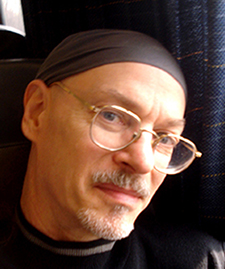 Paul Skiff
As part of the new myCAA campaign where we ask our members to share with us what CAA means to them, we thought it also makes sense to share with our members more about ourselves at CAA. In this spirit, every few weeks we will post an interview with a staff member at CAA. We want our members to know who we are also.
Our first interview in the series is with Paul Skiff, assistant director for Annual Conference.
How long have you worked at CAA?
Seventeen years.
What do you do at CAA?
I handle all space use for the Annual Conference: facility specification and coordinating with facility personnel, logistics, service providers, production, marketing, and sponsorships for the Book and Trade Fair, receptions, tours, onsite direction, and the task of working up budgets for all of this. Essentially I set up the arrangements that enable us at CAA to coordinate everyone and everything into and out of the conference.
What does CAA mean to you?
CAA is a leading international organization promoting visual art and culture in a way that has direct impact on society. The conference brings together the membership, along with related professions, for a large public event that gives a high profile to the cultural sector of the host city and contributes to defining the forward direction of culture in general.
Can you talk about one of your favorite member moments?
Too many to mention, really. CAA members are so frequently a great pleasure to work with no matter what the situation. At its base the organization is a collective, and that really guides so much of what members bring.
What do you like best about the arts and working in the arts?
Art, and culture in general, provides a basis for unity across social, cultural, national, and political boundaries. In the urban culture of the United States, cultural practice is seen as an open forum with authority to comment upon—and provide a way for coping with—the prevailing conditions of the time. Applied this way, cultural practices have as their main goal establishment of a democratizing equality. What I like about one part of the particular work I do in the arts with CAA is that my efforts serve to create opportunities for thousands of people involved in art and culture. Over my time working with CAA, this has amounted to providing a wide variety of opportunities for literally tens of thousands of people involved with art and culture.
Do you have a favorite moment from the Annual Conference each year?
The closing celebration for department staff after sessions conclude on the last day of the conference, when a year’s worth of hard work is complete and you know thousands of people had a pleasurable and fulfilling experience.
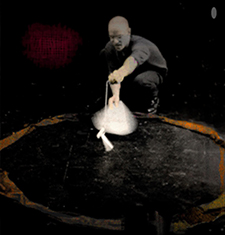 Video capture of Paul Skiff’s performance Blood Circle
What have your most recent performances consisted of?
My most recent performances have been straightforward presentations of texts and poetry spoken live, often with supplemental sound, and mostly presented for community-based cultural organizations with a vision for preserving, promoting, and strengthening local culture.
How do you feel about the differences between your art performed live or recorded on tape?
My live performance often incorporates recorded sound and images, so it is not that easy to separate the two modes of presentation. But to consider electronically recorded material separately, there is of course a vast difference with regard to the resultant sensory phenomenon. The main strength of actual live, spoken work is its generative quality, its immediacy, and its ability to create a “hearership” that can challenge existing listening institutions. With electronically recorded sound and/or images you have the rather endlessly deep toolbox of technology, which mostly amounts to applying exaggeration and distortion to live forms, and playing with time, as well as simply preserving information for transmission. I’m not saying anything profound by that, of course. Applying technology to a live performance enables an extension and transformation of form that allows for many different and new ways to present the work, seek a broader audience, and invent ever more creative solutions.
The creation of electronic information along with storage and retrieval is the most expansive creative environment for us now. At this point in our history telelectricentrism is second nature. Humanity has adapted to this so that forms of experience based on electronic image and sound increasingly dominate everyday life. We are still discovering how this is an asset and liability. It has mixed results and risky implications for our ability to really communicate. But in this for me is a great and absorbing task of applying these distorting and exaggerating technologies to instill acts of rehumanizing our culture. It’s kind of like taking something inherently dangerous and reshaping or repurposing it to provide pleasure, fulfillment, and a greater sense of shared well-being—not to mention preserving and strengthening our sense of self-worth.
New in caa.reviews
posted by CAA — October 21, 2016
Melanee C. Harvey reviews The Divine Comedy: Heaven, Purgatory and Hell Revisited by Contemporary Artists, an exhibition catalogue edited by Mara Ambrožič and Simon Njami. The volume expands on three exhibitions—each dedicated to a realm of the afterlife—and illuminates “the potential aesthetic and conceptual configurations in contemporary art that undermine parochial notions of African art.” Read the full review at caa.reviews.
Danielle Carrabino reads Faith, Gender and the Senses in Italian Renaissance and Baroque Art: Interpreting the Noli me tangere and Doubting Thomas by Erin E. Benay and Lisa M. Rafanelli. Comparing the two religious narratives, the authors combine “feminist theory and notions of reception” to argue that gender dictates the way Mary Magdalene and Thomas “experience the resurrected body.” Read the full review at caa.reviews.
Allison Myers discusses International Pop, a traveling exhibition organized by the Walker Art Center. The “ambitious show” aims to “overturn the idea of Pop as a primarily American and British movement by redefining it as a fluid sensibility with international reach.” At the Dallas Museum of Art, the layout “underscores the exhibition’s stakes in the conversation on global art history.” Read the full review at caa.reviews.
Caa.reviews publishes over 150 reviews each year. Founded in 1998, the site publishes timely scholarly and critical reviews of studies and projects in all areas and periods of art history, visual studies, and the fine arts, providing peer review for the disciplines served by the College Art Association. Publications and projects reviewed include books, articles, exhibitions, conferences, digital scholarship, and other works as appropriate. Read more reviews at caa.reviews.
Committee on Women in the Arts Picks for October 2016
posted by CAA — October 16, 2016
Each month, CAA’s Committee on Women in the Arts selects the best in feminist art and scholarship. The following exhibitions and events should not be missed. Check the archive of CWA Picks at the bottom of the page, as several museum and gallery shows listed in previous months may still be on view or touring.
October 2016
Marking the Infinite: Contemporary Women Artists from Aboriginal Australia
Newcomb Art Museum of Tulane
Woldenberg Art Center, No. 202, 6823 St. Charles Avenue, New Orleans, Louisiana 70118
August 20–December 30, 2016
The Newcomb Art Museum of Tulane presents Marking the Infinite: Contemporary Women Artists from Aboriginal Australia, which offers a unique opportunity to appreciate the diverse practices of Aboriginal Australian women artists today. The exhibition features works by Nonggirrnga Marawili, Wintjiya Napaltjarri, Yukultji Napangati, Angelina Pwerle, Carlene West, Regina Pilawuk Wilson, Lena Yarinkura, and Gulumbu Yunupingu. Coming from remote areas of the island, these respected matriarchs and leaders use art to empower their respective communities.
Immersed in ancient cultural traditions, the presented artworks speak with individual voices to universal contemporary themes. Their subject matter range from remote celestial bodies and native flowers to venerable crafts traditions and women’s ceremonies. Each work is unique in facing fundamental questions of existence, asserting both our shared humanity and differences in experiencing and valuing the same planet. As a whole, this exhibition of contemporary women artists from Aboriginal Australia emerges as an evidence of the relevance of indigenous knowledge in the twenty-first century.
Contemporary Aboriginal Australian women’s painting emerged later than the men’s practice, attracting global attentio—especially since the 1990s. Since women began to paint later, they were exposed to a broader range of global cultures. As Hetti Perkins mentions in her catalogue essay for Marking the Infinite, “While cultural activity has always been central to the secular and sacred lives of women, art making in recent decades has offered a key means for women to also maintain their social and economic independence.”
Eleni Panouklia: Its Luminous Saying Must be Left a Conjecture
Palaio Elaiourgeio
Eleusis, Greece
September 4–November 15, 2016
Palaio Elaiourgeio presents Its Luminous Saying Must be Left a Conjecture, a large-scale installation by Eleni Panouklia. Throughout this site- and time-specific mixed-media intervention that is meant to be experienced at night, Panouklia (born in Agrinio, 1972) converts industrial ruins of Palaio Elaiourgeio (Old Oil Mill) of Eleusis into an evocative earthy soundscape of dark paths and inaccessible sanctuaries.
The installation begins and ends in the backyard of the derelict factory, and it consists of two cyclically communicating outdoor and indoor environments allowing individual and collective explorations. The work immerses the viewer in a contrapuntally structured experience of darkness by transforming the backyard of Palaio Elaiourgeio into a disorderly, pulsating landscape of powerful sonorous enclosure and combining that with a lonely ritual itinerary through the silent passageway of a long building, where an interactive event awaits each viewer. Together, the two environments seek to affectively advance both timely critical and timeless existential realizations through distinct bodily and reflective enlightenments, or, better yet, “un-concealments” of the wholeness of being in darkness.
Curated by Kalliopi Minoudaki, Its Luminous Saying Must be Left a Conjecture orchestrates the awakening of multisensory explorations through the creative collaborations with the sound designer Coti K., the light designer Katerina Maragoudaki, the photographer Vassilis Xenias, and the production organizer and design consultant Georgia Voudouri.
Candice Lin: A Body Reduced to Brilliant Colour
Gasworks
155 Vauxhall Street, London SE11 5RH, UK
September 22–December 11, 2016
Gasworks presents A Body Reduced to Brilliant Colour, the first UK solo exhibition by the American artist Candice Lin. Born in Massachusetts in 1979, Lin makes work that engages with notions of gender, race, and sexuality by examining discrepant bodies, vibrant material, and disobedience. In A Body Reduced to Brilliant Colour, the artist explores how histories of slavery and colonialism have been shaped by human attraction to particular colors, tastes, textures, and drugs. Drawing from scientific theories, anthropology, and queer theory, Lin traces the materialist urges at the root of colonial violence.
The exhibition includes a low-tech installation of tubing, plastic and glass containers, porcelain filters, hot plates, and other hacked household objects; her work boils, ferments, distils, dyes, and pumps liquid containing colonial trade goods such as cochineal, sugar, and tea. Transforming prized, historically loaded commodities into a stain reminiscent of murder, feces, or menstrual blood, the exhibition speaks to these fraught histories of conquest, slavery, torture, and theft, while exploring what happens when materials so loaded with history and meaning are situated in new systems of relations.
The exhibition is accompanied by a series of events, including Eating the Edifice, an illustrated lecture/demonstration by the food historian and artist Ivan Day that will outline the evolution of edible table art from the early Renaissance to the nineteenth century.
Complaints Department: Workshop operated by the Guerrilla Girls
Tate Exchange / Switch House
Level 5, Tate Modern, Bankside, London SE1 9TG, UK
October 4–9, 2016
From October 4 to 9, the Guerrilla Girls will operate a Complaints Department. Individuals and organizations are invited to Tate Exchange to conspire with the girls and to post complaints about art, culture, politics, the environment, or any other issue they care about. Throughout the week, a series of workshops and thematic discussions will be presented, encouraging participation and assisting the public in creating statements to post on rolling bulletin boards. The week culminates in a special public event documenting and exploring what has been collectively complained about.
Feminist Avant-Garde of the 1970s
Photographers’ Gallery
16-18 Ramillies Street, London, UK
October 7, 2016–January 8, 2017
Featuring forty-eight international female artists, the Photographers’ Gallery opens its new exhibition, Feminist Avant-Garde of the 1970s, wholly curated from the Verbund Collection in Vienna. “The exhibition highlights groundbreaking practices that shaped the feminist art movement and provides a timely reminder of the wide impact of a generation of artists.” Works in photography, collage, performance, film, and video by well-known feminist trailblazers such as Cindy Sherman and Martha Rosler will be on view, along with overlooked artists such as Katalin Ladik and Birgit Jürgenssen. In fact, the exhibition includes many artists from areas of the world lesser known for feminist art.
“Through radical, poetic, ironic and often provocative investigations,” these artists used their work to question identities, gender roles, and the sexual politics of the 1970s. The exhibition is curated by Gabriele Schor from the Verbund Collection and Anna Dannemann of the Photographers’ Gallery.
The Listen Conference 2016: Feminist Futures
Bella Union
Level 1, Trades Hall, 54 Victoria Street, Melbourne, Australia
October 14–16, 2016
The three-day feminist music conference Listen returns this October with presentations, panel discussions, workshops, and live performances. “The Listen Conference provides a unique opportunity to engage in constructive discussion on ideas relating to gender, feminism, creativity, intersections within communities, writing, and performance.” Keynote speakers include the writer and feminist activist Clementine Ford and the New York–based performer and activist Alok Vaid-Menon (from the trans South Asian performance art duo Darkmatter).
Focusing on raising awareness and equality in the Australian music industry, “Listen” will cultivate “conversations from a feminist perspective around the experiences of marginalised people in Australia music.” Panels will encourage conversations on issues ranging from music making, the pros and cons of “call out culture,” race and sexism in music, and gender binaries in music and art, among other topics. The conference also features three nights of live music and movement-based performances, including experimental punk, Aboriginal mixes, dark techno, and poetry.
Adriana Marmorek: Love Relics
Nohra Haime Gallery
730 Fifth Avenue, 7th Floor, New York
September 14–October 15, 2016
Love Relics at Nohra Haime Gallery features photographs and videos by the Colombian artist Adriana Marmorek that document the ceremonial burning of twelve treasured objects associated with love. Most notable is the burning of Relic #16 and Relic #17, both wedding gowns, “showcasing the destruction of these institutional flags.”
The project originated at the end of another exhibition Reliquia, for which Marmorek exhibited fifty-one donated relics or treasures that represented memories of love or loved ones. When the exhibition finished, the artist chose to burn several of the relics, “digging deeper into the concept of eternity and ephemerality.” A ceremony was conducted for the owners of the objects, as she burned each and filmed them. “Some treasures—of love, happiness, sorrow and anger—had associated memories so deep that they had replaced the physical and enveloped an intense spiritual being.”
In addition to the videos, photographs are also on view, “capturing a split second in time,” while mementos such as an appointment book, a box of condoms, a matchbook, and a bridal bouquet are engulfed in flames.