CAA News Today
CAA Members Go to Havana
posted by CAA — August 11, 2015
Last May CAA offered a trip to Cuba to visit the Havana Biennial. In an essay, Katherine Jánszky Michaelsen, a professor of art history at the Fashion Institute of Technology, State University of New York, and a CAA member, describes her experiences in this Caribbean capital city, newly reopened to American citizens.
Outside the airport terminal we’re hit by blinding sunlight and a riot of tropical color—a golden-shower tree, and a row of the famed vintage Cadillacs and Buicks painted in Day-Glo shades of fuchsia, turquoise, and green. All week long sunshine, blue skies, lush vegetation, and vivid colors provide the backdrop of our Havana sojourn; and then there’s the music; on every other street corner someone is making music—not to mention that this is the home of the ever-popular Buena Vista Social Club band.
Timed to coincide with the XII Bienal de la Habana, the CAA trip also overlapped with the onset of the normalization of diplomatic relations between the United States and Cuba. Although Europeans have been traveling to Cuba all along, this was the first year that large numbers of Americans were able to attend the biennial. Celebration was in the air. But testing the climate for change was Tania Bruguera, the dissident Cuban artist and free-speech advocate, who was arrested—not for the first time—at a live reading she held of Hannah Arendt’s 1951 book, The Origins of Totalitarianism. Two members of our group were present at the mêlée.
As tourists we were fortunate to enjoy the expertise and connections of the Cuban-born organizer of the trip, Adolfo Nodal, a former director of the Department of Cultural Affairs in Los Angeles and author of the pioneering book on Cuban art, who has been leading trips to Cuba for a number of years. Thanks to Al, who was one of the producers, we were able to attend the world premiere of the opera Cubanacán: A Revolution in Forms; and we were invited to savor roast pork in the garden of his friend, the artist Kadir López Nieves, with whom he is working on the restoration of Havana’s vintage neon signs. In addition to our spirited and fluently English-speaking guide, Gretell Sintes, another bonus was the considerable experience of CAA member and Xavier University associate professor of art history Alison Fraunhar, also a Cuban art specialist who, for example, arranged a special lecture by Nelson Herrera Ysla, one of the original founders of the Havana biennial in 1984. Finally, traveling with CAA top brass Linda Downs and DeWitt Godfrey, and a busload of like-minded, art-savvy colleagues, ensured the exchange of useful tips, stimulating conversation, and beautiful photographs by Sherman Clarke, among others.
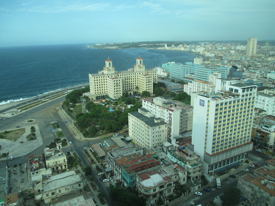 Every morning after partaking of the breakfast buffet that always included heaps of sliced mangoes, papayas, and melons, we assembled in the grand hall of the venerable oceanfront Hotel Nacional, built by McKim, Mead & White in 1930. In the evenings, after a full day of sightseeing, we’d lounge in the palm-tree-lined veranda sipping mojitos to the sound of a female salsa band. As the biennial venues were scattered around the city, it was possible to view historic tourist attractions—like the Plaza de la Revolución, or San Cristóbal cathedral, and at the same time take in a Tino Sehgal performance at the Centro de Arte Contemporáneo Wifredo Lam—or browse and buy prints at the Taller Experimental de Gráfica. Sales transactions can be made entirely on trust: you chose the work, take it with you, and send the check in the agreed amount to the Miami address of a relative or friend of the artist.
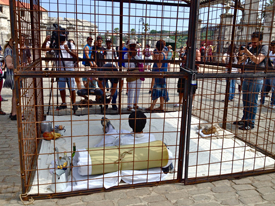 One day in the historic district we stumbled upon a large cage with a man wearing lace tights and stack heels locked inside. We later found out that this was a work by the Indian performance artist Nikhil Chopra, who after three days painting what he saw from behind the bars, hacksawed himself out and walked off to the delight of the cheering crowd that followed him. One particularly hot afternoon, we squeezed like eager sardines into the Church of San Francisco de Paula to watch 82-year-old artist Michelangelo Pistoletto smash large mirrors with a mallet.
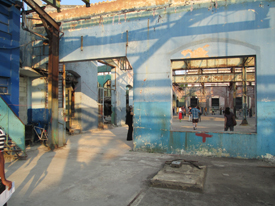
The Malecón seawall was another venue where art and life mixed seamlessly. To make up for the fact that there is no beach, Arlés del Rio created a fake one complete with sand and thatch-roofed cabañas. All along the five-mile promenade tourists and locals mingled amiably among the assorted works of art; children clambered on sculptures as if they were jungle gyms; and occasionally a wave crashing against the wall would douse us with a welcome cool spray. We were not cautioned, nor evidently did we need to be—public safety was not an issue. We saw no beggars, and apart from traffic cops there was no visible police presence. But evidence of poverty was everywhere. Unlike the spiffy, lovingly restored vintage models lined up in front of our hotel, if you hailed a cab in the street, you were likely to get a Soviet-era Lada with missing window and door-handles, springs poking through the seat, and a rattling engine spewing black fumes.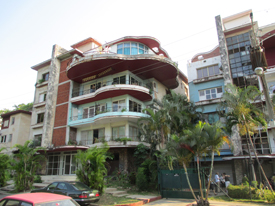 Whole neighborhoods are crumbling and derelict; former single-family houses in residential areas have been chopped up into numerous smaller units; elegant mansions are in ruins; and iconic modernist buildings from the 1950s have peeling paint. Architectural preservationists describe this neglect as “preservation by poverty,” meaning that paradoxically poverty has left extant what urban renewal would have inevitably destroyed. Designers in Havana (and elsewhere) have opportunistically embraced the romantic aesthetic of ruins. For example, Guarida, one of the top restaurants in Havana, is located in a ruined building where laundry hangs on a line in the entrance hall. Likewise, an international group show, Montañas con una esquina rota (Mountains with a Broken Corner), curated by artist Wilfredo Prieto, was staged in the roofless ruin of a former bicycle factory.
 Always at the ready, our tour bus comfortably transported us to outlying sites like Morro Cabaña, the historic colonial fortress on a hill that commands a breathtaking view of the city. A warren of small rooms connected by low barrel-vaulted corridors served as galleries that housed Zona Franca, an exhibition of about one hundred solo and group shows of both acclaimed and emerging Cuban artists. One afternoon we were taken to the Romerillo neighborhood where a year ago Alexis Leyva Machado, the artist known as Kcho, inaugurated (with a rare, surprise public appearance by Fidel Castro) an experimental community project, the Estudio Romerillo. For the biennial he organized an exhibition that took over the entire neighborhood and included artists from all over the world. There is a strong tradition of community service and sharing in Cuba, and established artists who enjoy special privileges are often moved to engage in activities to serve the common good. Carlos Garaicoa, a Cuban artist with an international reputation, is another example. In his spacious studio in a modernist building, he staged a group exhibition to launch Artista x Artista, an international exchange program that will include artist residencies and is based on the Open Studio program he started in Madrid in 2007. Yet another initiative created over the course of a decade for the benefit of the fishing village of Jaimanitas is an extensive and festive work of public art, Fusterlandia. Throughout the neighborhood, starting with his own house, the artist José Rodríguez Fuster painted murals and decorated the walls of dozens of houses with colorful ceramic shards in the manner of Antoni Gaudí.
Havana’s Museo Nacional de Bellas Artes (MNBA) comprises two separate buildings. The first, a majestic structure built in 1913 devoted to “arte universal,” was the venue for an exhibition titled Wild Noise—a collaboration with the Bronx Museum of the Arts that included an international roster of artists and explored a series of contemporary themes like identity, style, architecture, and community that are relevant to both the Bronx and Havana. Overseen by Bronx Museum director Holly Block, who has been engaged with Cuban art for two decades and is the author of Art Cuba: The New Generation, the exhibition was hailed as the most extensive cultural exchange between the US and Cuba in over fifty years; it will be followed in 2016 by an exhibition at the Bronx Museum organized by the Havana MNBA. A few blocks away, a modernist building from the 1950s that was fully restored and enlarged in the late 1990s showcases Cuban art from colonial times to the present. Except for the conspicuous absence of the obligatory museum book and gift shop, both the building and installation could easily hold their own anywhere in the world.
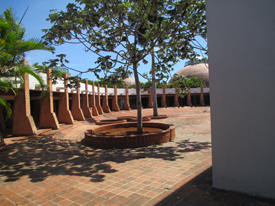 The highlight of the trip for many of us was the campus of the National Art Schools, now known as ISA (Instituto Superior de Arte). It is the subject of a book by John Loomis, Revolution of Forms: Cuba’s Forgotten Art Schools, and a poignant 2011 documentary, Unfinished Spaces, by Alysa Nahmias and Benjamin Murray. Both works tell the story that is also the subject of the opera Cubanacán: A Revolution of Forms that we attended. In 1961, while playing golf at the Havana Country Club in Cubanacán, Fidel Castro and Che Guevara had the idea that the verdant grounds of this symbol of wealth and privilege would be an ideal setting for a complex of tuition-free art schools. Architect Ricardo Porro, charged to build “the most beautiful city of the arts,” enlisted the help of two Italian colleagues Roberto Gottardi and Vittorio Garatti. Of the five proposed schools three (music, ballet, and theater arts) were sadly left unfinished in 1965 when, due to Cuba’s rapprochement with the Soviet Union, the political climate changed drastically. These buildings are now in a state of ruin and overgrown with vegetation. But the schools of modern dance and plastic arts by Porro were completed, recently restored, and continue to be in use.
The three wide arches of the entranceway of the brick-domed school of plastic arts provided the ideal backdrop for the outdoor performance of Cubanacán by the Cuban composer Roberto Valera and the American librettist Charles Koppelman. This worthy effort, previewed favorably in the New York Times, is an intriguing work in progress that deserves to be developed further, not only because it serves to publicize this unique architectural undertaking.
 It was in the daylight the following day that the building came fully to life. Low-lying, hugging the ground, the stupalike domes of red brick and contrasting white plaster are surrounded by tropical green foliage—it is as strange and unfamiliar-looking as the remains of some unknown, ancient civilization. The inside of the building is bathed in natural light from the oculi in the Catalan-vaulted domes and, due to skillful positioning of corridors and interior spaces, is ventilated and comfortable even in the midday sun. The experience of the building was made even more memorable because art students were present throughout. In keeping with the biennial’s theme of the fusion of art and life, mixed in with official exhibits were working art studios open to the public, where you could engage with the art students. When I asked a young woman whether the building was an inspiration for her, she smiled, and her eyes shining brightly, vigorously nodded her head.
Captions
Photo 1: View from the Edificio FOCSA with Hotel Nacional and gardens (rear) (photograph by Sherman Clarke)
Photo 2: Nikhil Chopra, performance The Black Pearl, Plaza de Armas, Havana (photograph by Katherine J. Michaelsen)
Photo 3: Modernist buildings in disrepair, Miramar, Havana (photograph by Sherman Clarke)
Photo 4: Group exhibition, curated by artist Wilfredo Prieto in former bicycle factory, Vedado, Havana (photograph by Sherman Clarke)
Photo 5: Inner courtyard, School of Plastic Arts, ISA, Cubanacán, Havana (photograph by Sherman Clarke)
Photo 6: CAA group on steps of Club Habana, Playa, Havana (photograph by Gretell Sintes)
Committee on Women in the Arts Picks for June 2015
posted by CAA — August 10, 2015
Each month, CAA’s Committee on Women in the Arts selects the best in feminist art and scholarship. The following exhibitions and events should not be missed. Check the archive of CWA Picks at the bottom of the page, as several museum and gallery shows listed in previous months may still be on view or touring.
August 2015
Beverly Semmes: Feminist Responsibility Project (FRP)
Weatherspoon Art Museum
Bob and Lissa Shelley McDowell Gallery, University of North Carolina, 500 Tate Street, Greensboro, NC 27413
May 24–September 6, 2015
The Weatherspoon Art Museum at the University of North Carolina in Greensboro presents the Feminist Responsibility Project (FRP) by the New York artist Beverly Semmes. The exhibition features drawings, ceramics, suspended and illuminated glass sculpture, and video work.
“The metaphors and imagery of Beverly Semmes’s art typically flow in this direction: from the female body and out into the landscape,” Ingrid Schaffner wrote in the 2011 exhibition catalogue from Rowan University Art Gallery. This is noticeably experienced through the large fabric sculpture, Buried Treasure, on view at the Weatherspoon. Buried Treasure, made of black crushed velvet, has one arm of the dress snaking its way off the wall and across the floor of the gallery, enveloping the active space. Continuing to connect mediums in space, her video, Kick, depicts Semmes kicking a reddish-pink potato across icy terrain, the color reflective of the pot sculptures dotting the gallery landscape.
“Her totemic and abstract works create alternative lenses from which to see the body in relationship to domestic or natural landscapes,” says the Weatherspoon exhibition description. In her works on paper, Semmes manipulates photographs in vintage “gentlemen” magazines, as she calls them, covering various parts of the depicted female bodies in ink to perform “a personal act of feminist censorship, blotting out the literal to leave behind abstract, nuanced images that speak in a different voice.”
Semmes will be at the Weatherspoon on Thursday, September 3, 2015, at 6:00 PM for an artist’s talk.

Linda Nochlin: Women Artists: The Linda Nochlin Reader
Edited by Maura Reilly
Recent book release
In addition to two new essays in this recently released volume, Women Artists: The Linda Nochlin Reader, readers are treated to twenty-nine of Nochlin’s essays over her career, including “Women Artists after the French Revolution” and “Starting from Scratch: The Beginnings of Feminist Art History.”
The new anthology includes the provocative essay, “Why Have There Been No Great Women Artists?”—a continuing relevant question. In May of this year, ARTnews revisited Nochlin’s groundbreaking 1971 essay (originally published in ARTnews), exploring women in the arts today, and including eight contemporary artists replies to Nochlin’s essay. In the New York Times Sunday Book Review, the journalist Chris Kraus acclaims, “Nochlin writes with a dazzling mix of erudition and candor, but what’s most remarkable about her work is that it’s driven by an exhaustive investigation as to why and how certain artworks have been meaningful to her.”
Presenting artist monographs alongside the essays, the volume collects Nochlin’s writings on artists such as Mary Cassatt, Louise Bourgeois, Cecily Brown, Kiki Smith, Miwa Yanagi, and Sophie Calle, written in a voice that feels as contemporary as when they first appeared. Women Artists: The Linda Nochlin Reader is published by Thames and Hudson and edited by Maura Reilly, founding curator of the Elizabeth Sackler Center for Feminist Art at the Brooklyn Museum in New York.
A. L. Steiner: Come & Go
Blum and Poe
2727 South La Cienega Boulevard, Los Angeles, CA 90034
July 2–August 22, 2015
The press release from Blum and Poe presents the new exhibition Come & Go by the artist A. L. Steiner in dramatic fashion: “Between the interlude of state-sanctioned exploitation and violence, the Amerikkkin project of mass incarceration and slavery, the uncertain future of California’s viability, and planetary implosion, A. L. Steiner presents an overview of her photo archive from 1995–2015.”
Despite the chance of planetary implosion, the exhibition by Steiner is a constructed “relaxing space” dedicated to the viewing of print work. Sparsely covered white walls are adorned only with a limited number of photographs and collages, while attention in the gallery is focused on a wooden desk and file system. Through the installation, and with an archivist on hand daily, the audience is encouraged to explore twenty years of Steiner’s work.
“A. L. Steiner utilizes constructions of photography, video, installation, collage, collaboration, performance, writing and curatorial work as seductive tropes channeled through the sensibility of a skeptical queer eco-feminist androgyne,” her website bio states.
In addition to the exhibition, Steiner has collaborated with a “revolving cast of subversives and interlocutors,” including a collaboration with Shinichiro Okuda/WAKA WAKA and additional live performances by Brave Accepter, Jibade-Khalil Huffman on August 15, and YACHT on August 22; and an archivist to guide viewers daily, 10:00 AM–1:00 PM and 2:00–6:00 PM.

Women Make Movies: 2015 Catalogue
Online and Print Resource
This thirty-two-page special-edition catalogue is the first in ten years released by Women Make Movies. Focused on their collection, the catalogue includes briefs and data on classics that focus on feminism and gender studies as well as films from diverse regions from across the globe. Highlighted are Academy Award winners such as Saving Face, “a harshly realistic view of violence against women in South Asia,” and new releases, Regarding Susan Sontag and Alice Walker: Beauty in Truth—illuminating portraits of the literary giants.
The catalogue is meant to facilitate rental or purchasing access to the Women Make Movies holdings. Established in 1972, Women Make Movies is a “multicultural, multiracial, non-profit media arts organization, which facilitates the production, promotion, distribution and exhibition of independent films and videotapes by and about women.” They provide distribution services and production assistance programs, while facilitating feminist media, including a special emphasis to support work by women of color.
Yoko Ono: One Woman Show, 1960–1971
Museum of Modern Art
11 West 53 Street, New York, NY 10019-5497
May 17–September 7, 2015
The Museum of Modern Art presents the first One Woman exhibition dedicated to the work of Yoko Ono. This retrospective is a survey of the decisive decade that led up to Ono’s unauthorized exhibition (One Woman Show, Museum of Modern [F] art, 1971), revalorizing one of the most misunderstood artists of the last sixty years.
Featuring Ono’s most celebrated pieces between 1960 and 1971, the exhibition brings together approximately 125 of Ono’s early objects, works on paper, installations, performances, audio recordings, and films, alongside rarely seen archival materials. During these years, Ono (born in Tokyo, 1933) moved between New York, Tokyo, and London. A pioneer in the international development of Conceptual art, experimental film, and performance art, Ono was then creating artworks that could exist as mere instructions, meant to be executed once, multiple times, or none. Since her early projects are often based on verbal or written instructions, the exhibited pieces focus in the participation on viewers, where the artist generously opens up to their diverse responses to “complete” her pieces, or perhaps towards a sense beyond a One-Woman proposal, but rather an invitation to a collaborative creativity.
Among the exhibited pieces to be highlighted are Grapefruit (1964), Ono’s influential book of instructions; the typescript for which is displayed here page by page—consisted of nothing but terse, open-ended instructions for readers to follow—and Half-A-Room (1967), an installation of bisected, incomplete, white-painted domestic objects. The film Cut Piece (1964), documentation of one of Ono’s seminal performances, is also on view. Here, Ono confronted issues of gender, class, and cultural identity by asking viewers to cut away pieces of her clothing as she sat quietly on stage. Cut Piece remains one of the most disturbing works of performance art of the 1960s, that stands as a foundation of feminist and body-centered art.
A Feminist Fiber Art Exhibition
Traveling Exhibition and Call for participation
First venue opens August 14, 2015
Organized by Iris Nectar Studio, this DIY feminist art exhibition will feature female artists from around the world whose practice focus on fiber art. The project will take the form of an art crawl throughout the Boston area, with an opening on August 14. The project was inspired by the “Guerrilla Girls’ statistics” of women underrepresented in the art world. Originally envisioned as a little exhibit to take place in a single venue for a few weeks, the initiative was transformed into a traveling exhibition using alternative art spaces all across the greater Boston area because of overwhelming response and support. The exhibition will evolve slightly, with a different lineup of artists in each new space.
The Feminist Fiber Art Exhibition will feature artwork created by artists that identify as female. The constantly growing collection include the witty—knitting from the Icelandic artist Ýrúrarí, the historic and esoterically influenced—as well as work with strong female characters embroided by Alaina Varrone (New Haven, Connecticut), “pubism” pieces by Sally Hewitt (England), and “retex” (recycled textile) sculptures from the London-based German artist Jess de Wahls. The project online also features a zine, a blog, and a call for participation.
Michelle Stuart: Topographies: Drawings & Photographic Works 1968–2015
Marc Selwyn Fine Art
9953 South Santa Monica Boulevard, Beverly Hills, CA 90212
July 18–September 5, 2015
Marc Selwyn Fine Art is pleased to announce Topographies: Drawings & Photographic Works 1968–2015, an exhibition by the New York–based artist Michelle Stuart. Stuart (b. Los Angeles, 1933) is a multidisciplinary artist best known for a rich and diverse practice, including site-specific earth works, intimate drawings, multimedia installations, paintings, sculpture, and photographs, all centered on a lifelong interest in the natural world and the cosmos. Her work questions conventional notions of drawing as it merges performative rubbing and frottage gestures with elements of the landscape itself. Stuart brings forth imagery by both adding natural materials and revealing the texture of the earth, combining the fundamentals of both drawing and photography.
Each work is a unique meditation on the nature of memory, digitally printed on sheets of archival paper. The individual panels feature untouched and altered elements, including appropriated vintage images and her own photographs, combined in a filmic manner. These dreamlike recollections of her past not only continue her life-long artistic engagement with specific locations, but also affirm the significance of place as a unique source of memory.
The exhibition highlights include #9 Zen, an iconic scroll that will be accompanied by a selection of works on paper, ranging from early collages such as Traces to more recent indexical works in which earth and seeds are pressed and merged onto her paper supports. The second gallery features a selection of her cinematic photographs, including the walk-about narratives of The Beginning, Islas Encantadas,and Past Shadows, Orkney.
Piotr Piotrowski: In Memoriam
posted by CAA — July 22, 2015
Amy Bryzgel is lecturer in history of art in the School of Divinity, History, and Philosophy at the University of Aberdeen in Scotland.
The field of art history and culture in Central and Eastern Europe mourns the loss of its unofficial cultural ambassador: the art historian, curator, and critic Piotr Piotrowski, who died on May 3, 2015, at the age of 63. The author of numerous publications, Piotrowski was a pioneer of new methods of study and approach to the art history of the region.
Piotrowski was professor ordinarius in the Department of Art History at the Adam Mickiewicz University in Poznań, Poland, where he was also chair of the department (1999–2008) and head of modern art history (1996–2009). He was director of the National Museum in Warsaw from 2009 to 2010 and served on a number of advisory boards, such as those for the National Gallery of Prague (academic board), Ars (Slovak Academy of Sciences), and Art Margins (MIT Press, editorial board). Piotrowski was also a permanent research fellow of the Graduate School for East and South-East European Studies, a program of Ludwig-Maximilians-Universität Munich and Regensburg University. In 2010 he was given the Igor Zabel Award for Culture and Theory, which acknowledges the dedication of an arts and culture professional to deepening and broadening internationally the knowledge of visual art and culture in Central, Eastern and South Eastern Europe. He held numerous academic fellowships, from the Clark Art Institute in Massachusetts (2009), CASVA in Washington, DC (1989–90), and most recently the Getty Research Institute in Los Angeles (2015). Piotrowski’s most recent books, In the Shadow of Yalta: Art and the Avant-Garde in Eastern Europe, 1945–1989 (Reaktion Books, 2009) and Art and Democracy in Post-Communist Europe (Reaktion Books, 2012), have set the standard for comparative studies of modern and contemporary art in East Central Europe. Both are key texts not only in the field of Central and East European art history, but also for art history in general.
Piotrowski’s contributions to the field, however, go well beyond his substantial and impressive list of accomplishments. He was one of the guiding forces in the field of Central and Eastern European art history. His publications are at the forefront of the academic study and research of an area that had largely been neglected by Western scholars throughout the Cold War and is only recently expanding from its previously self-contained national histories. What’s more, Piotrowski’s project didn’t just unearth these practices and expose them to the West; in writing these histories he also criticized the so-called universal canon of art history, offering a view from “the margins” to “expose fractures within center,” to use his words. His project was to subvert the traditional geography of art, calling for a horizontal approach that would eventually contribute to the globalization of Eastern European art and help to develop a true global art history.
Those who knew Piotrowski remember his warmth and generosity and his quick, infectious sense of humor. Regardless of the situation, his personality always shined through—despite being a man of considerable achievements, publications, and awards, he was incredibly humble. Furthermore, he was extremely dedicated to the field and to his work and uncompromising in his principles, regardless of the cost to him personally or professionally. In October 2014, he organized a large and very successful conference in Lublin, Poland, entitled “East European Art Seen from the Global Perspective: Past and Present,” and was working to produce the conference reader up until his death.
All who knew his work agree on one thing: Piotr Piotrowski left us far too soon. Most of us expected to look forward to many more years of his talks, publications, exhibitions, and projects. One small bright spot we can look forward to is his forthcoming publication, From Museum Critique to the Critical Museum, edited with Katarzyna Murawska-Muthesius and published by Ashgate. Furthermore, it must be remembered that Piotrowski was a teacher—not only to his many undergraduate, postgraduate, and PhD students, but also to those who read his work and followed his example. Piotrowski taught us all very much, and in our future work, we can only hope to insure that his spirit will live on.
John Wesley William: In Memoriam
posted by CAA — July 20, 2015
Julie Harris earned her PhD in art history at the University of Pittsburgh in 1989. She teaches at the Spertus Institute for Jewish Learning and Leadership.
There was little in John Williams’s early life to suggest that he would eventually become the world’s authority on Spanish medieval art—unless one considers a boundless energy and curiosity that propelled him from an athletic childhood in Memphis, through a canoe trip down the Mississippi, service in the Marines, and eventually led him to study at Duke, Yale, and University of Michigan—where he discovered Spanish medieval art and earned a PhD in 1962. A scholar of international reputation, inspiring teacher, and family man, Williams died on June 6, 2015. He was 87 years old.
Williams taught first at Swarthmore College from 1960 until 1972. He then joined the Fine Arts Department of the University of Pittsburgh, where he remained for thirty-five years. At Pitt, Williams served as chair for five years, was named Distinguished Service Professor in 1993, and was Andrew W. Mellon Professor of History of Art and Architecture from 1997 to 2000. Among the many honors he received in his career were two Fulbrights to Spain, two NEH grants, a Guggenheim Fellowship, a visiting membership at the Institute for Advanced Study in Princeton, and an appointment as a fellow of the Medieval Academy of America.
Best known for his work on the Beatus Commentaries, Williams’s work evolved from searching for models for these manuscripts’ rich and enigmatic imagery to recognizing the individuals responsible for their creation and a careful reading of their reception. His five-volume series, The Illustrated Apocalypse: A Corpus of the Illustrations of the Commentary on the Apocalypse (Harvey Miller, 1994–2003), won the Eleanor Tufts Award from the American Society for Hispanic Art Historical Studies. Williams’s interests and research were not limited to manuscript studies; he also was an authority on the major Romanesque monuments of Spain, such as San Isidoro in León, Santo Domingo de Silos, and Santiago de Compostela. He participated in rigorous international debates over their dating, patronage, and the meaning of their decoration in all media. This work generated groundbreaking and authoritative publications in such journals as The Art Bulletin and Gesta and in collaborative volumes, some of which he edited or coedited.
John’s life-long interest in Spain did not end with his retirement from the University of Pittsburgh in 2000. In addition to ongoing work in medieval art, he recently turned his attention to securing the attribution of a neglected Goya in the Carnegie Institute. A documentary project on the Beatus manuscripts, directed and produced by Murray Grigor and the cinematographer Hamid Shams with commentary by Williams, premiered in New York at the Morgan Library and Museum last October. Even as his illness progressed, he remained engaged in academic pursuits. Determined to complete his book, he enlisted the help of a former student, Therese Martin of Madrid (CCHS-CSIC). The resulting work, Visions of the End in Medieval Spain: Tradition and Context of the Beatus Commentary on the Apocalypse, with a Census of Illustrated Manuscripts and Study of the Geneva Beatus (forthcoming from Amsterdam University Press, 2016), both introduces a recently discovered manuscript and offers Williams an opportunity to update and reassess his earlier work on the Beatus corpus.
Williams had a gift for synthetic scholarship, revealing connections across the Pyrenees and across disciplines in a way that made his art-historical analysis deep and utterly unique. Four students—Martin, David Raizman, Ann Boylan, and myself—wrote their dissertations on Spanish medieval topics under his supervision. Both as his student and in later years, I found that John’s authoritative writing and speaking style made me believe that what he was doing—and by extension what I doing—was important. John was a demanding and thorough adviser who became a delightful friend. He had little sympathy for trendy jargon but plenty of interest in new ideas. I never stopped sending him my work or seeking his approval.
A relentlessly productive scholar, Williams will also be remembered as a person of varied interests, including but not limited to fine books and martinis, music of many genres, good conversation, and the dance at Kalamazoo. He is survived by his wife, Mary; their six children; and thirteen grandchildren.
Improve Opportunities for International Cultural Activity; Support the Arts Requirement Timely Service (ARTS) Act
posted by CAA — July 10, 2015
The CAA Board of Directors has approved its support of the following notice.
Improve Opportunities for International Cultural Activity
Support the Arts Requirement Timely Service (ARTS) Act
We write to urge your support for the Arts Require Timely Service (ARTS) Act, which improves processing for visa petitions filed by, or on behalf of, nonprofit arts-related organizations by simply ensuring enforcement of current statutory requirements.
Action now will ensure that the U.S. visa process for artists is reliable, efficient, and affordable. Congress recognized the time-sensitive nature of arts events when writing the 1991 federal law regarding O and P visas, in which the USCIS is currently instructed to process O and P arts visas in 14 days. While USCIS has made recent efforts to observe this timeframe, there is a history of extreme unpredictability in the timing of the artist visa process, with wait times of up to six months.
The ARTS Act would consistently reduce the USCIS processing times for nonprofit O and P arts-related visa petitions to a total of 29 days—twice the current statutory requirement. USCIS would be required to treat any nonprofit arts-related O and P visa petition that it fails to adjudicate within the current statutory 14-day timeframe as a Premium Processing case (an additional 15-day turn-around time), free of additional charge. Previous consideration of the ARTS Act has had strong bipartisan support.
American nonprofit arts organizations and artists—in communities large and small across our country—provide an important public service and boost international diplomacy by presenting foreign guest artists in performances, educational events, and cultural programs in communities across the country. Only with consistent improvements over time, will confidence in the U.S. visa process continue to be re-built among U.S. petitioning organizations and foreign artists alike, greatly enhancing international cultural exchange.
Enactment of this provision will make enduring improvements to the visa process. Please support the Arts Require Timely Service (ARTS) Act.
American Alliance of Museums
American Association of Independent Music
American Federation of Musicians
Americans for the Arts
Association of Art Museum Directors
Association of Performing Arts Presenters
Chamber Music America Dance/USA
League of American Orchestras
Literary Network
Local Learning: The National Network for Folk Arts in Education
National Alliance for Musical Theatre
National Assembly of State Arts Agencies
National Association of Latino Arts and Cultures
Network of Ensemble Theaters
New Music USA
North American Performing Arts Managers and Agents
OPERA America
Performing Arts Alliance
TamizdatAVAIL
The Recording Academy
Theatre Communications Group
Committee on Women in the Arts Picks for June 2015
posted by CAA — July 10, 2015
Each month, CAA’s Committee on Women in the Arts selects the best in feminist art and scholarship. The following exhibitions and events should not be missed. Check the archive of CWA Picks at the bottom of the page, as several museum and gallery shows listed in previous months may still be on view or touring.
July 2015
Deirdre Logue and Allyson Mitchell: I’m Not Myself At All
Agnes Etherington Art Centre
Queen’s University, 36 University Avenue, Kingston, Ontario, Canada K7L 3N6
May 2–August 9, 2015
In I’m Not Myself At All, the artists Deirdre Logue and Allyson Mitchell present an “exuberant revision of sexual identity and domesticity.” The multimedia body of work on exhibit at the Agnes Etherington Art Centre at Queen’s University contains a multitude of forms and mediums, such as soft-sculpture dolls, wallpaper, crochet spider webs, needlepoint drawings, and papier–mâché.
Referring to the dolls in the exhibition catalogue, the theorist Heather Love writes, “the female body will not be cleaned up in this queer future—it will arrive trailing its effluvia: bodily fluids, odours, patches of fur, cellulite, granny panties, shag, that sucking sound.”
The artists present an oversized self-representation through amplification of the dolls genitalia, blown-up needlepoint patterned wallpaper, and a gigantic papier–mâché pink highlighter against a backdrop of feminist texts, “raising what curator Sarah E. K. Smith identifies as ‘potentiality, belonging and representation,’” via discarded feminist pasts.
Mitchell and Logue run the Feminist Art Gallery (FAG) in Toronto, which Mitchell describes on her website as “a response, a process, a site, a protest, an outcry, an exhibition, a performance, an economy, a conceptual framework, a place and an opportunity.”
Marilyn Minter: Pretty/Dirty
Contemporary Arts Museum Houston
5216 Montrose Boulevard, Houston, TX 77006
April 18–August 2, 2015
Marilyn Minter’s exhibition Pretty/Dirty at the Contemporary Arts Museum Houston “vividly manifest[s] our culture’s complex and contradictory emotions around the feminine body and beauty.” The exhibition spans Minter’s career from earlier works such as Coral Ridge Towers, of her “drug-addled mother,” to her 2014 video Smash, with “large female feet in bejeweled high-heeled shoes … dancing, sliding across the floor and smashing glass—all in Minter’s signature silver liquid.”
As a painter, photographer, and video artist, Minter offers a counterdialogue to the fashion industry, whose hypersearch for perfection and beauty are revealed in the artist’s own search for the all too human physical imperfections. “It is way too easy to criticize the fashion industry,” Minter said in her artist talk.
“Minter offers a smart woman’s critical look at issues that are otherwise presented by men for female consumption,” states the exhibition press release. “Minter shows the dual nature and slight imperfections of herself and her fellow woman, finding that true allure comes from the sensuality of imperfections.” But while Minter’s work sometimes calls attention to imperfection, there is a “pleasure rubric” in the exhibition, as Bill Arning calls his discussion with Minter. “I know pleasure exists,” Minter says, “I have it too when I look at these images.”
On view through August 2, 2015, are over twenty-five paintings from 1976 through 2013, three video works, and photographs exploring her development as an artist. The exhibition was organized by the Contemporary Arts Museum Houston and the Museum of Contemporary Art Denver. An artist’s talk with Minter, along with Arning, Elissa Auther, and Linda Yablonsky, is available online.

Installation view of Lynette Yiadom-Boakye’s exhibition Verses After Dusk at the Serpentine Gallery (June 2–September 13, 2015) in London (artwork © Lynette Yiadom-Boakye; photograph © readsreads.info)
Lynette Yiadom-Boakye: Verses After Dusk
Serpentine Galleries
Kensington Gardens, London W2 3XA
June 2–September 13, 2015
The Serpentine Galleries present Lynette Yiadom-Boakye: Verses After Dusk, the first major solo exhibition by the London-born artist. Yiadom-Boakye, born in 1977 from Ghanaian parents, was nominated for the Turner Prize in 2013. Her paintings explore figures that appear to exist outside a specific time and place. These subjects are all fictitious and drawn from memory or scrapbooks. The artist presents her “suggestions of people,” as she once put it, absent of background, or landscapes, or objects, freeing them from the restrictions of definite time, location, age, and even gender. Her characters may be presented in absence of context, but they are accompanied with enigmatic titles that encourages viewers to construct their own narratives and search a dialogue with the artist’s “poetic secrecy.”
Verses After Dusk is a survey of the artist’ recent work, presenting a comprehensive range of painterly techniques in a series that raises timeless questions of identity as well as representation in art, bringing awareness to the failings of such matters throughout art history. While the artist plays with the influence and references to eighteenth and nineteenth century masters such as Edgar Degas, Paul Cézanne, and Éduoard Manet, she deconstructs them and reconstructs the meaning, challenging the representation of black portraiture in the canon of art history. The display features exclusively black figures, pointing out the absence of references in the representation of black history in the canon of Western art.
Between the works on display, Yes Officer, No Officer (2008) unravels Manet’s famous avant-garde painting Olympia (1863). But in this case, Yiadom-Boakye substitutes the reclining nude female prostitute with a black man and completely deletes the black female servant from the background. Along an impressive collection of expressive paintings, the exhibition includes ten new etchings and introduces the artist’s less-known writings, published in occasion of the exhibition.
Zanele Muholi: Isibonelo / Evidence
Brooklyn Museum
Elizabeth A. Sackler Center for Feminist Art, Fourth Floor, 200 Eastern Parkway, Brooklyn, NY 11238-6052
May 1–November 1, 2015
Hosted at the Elizabeth A. Sackler Center for Feminist Art, the Brooklyn Museum presents Zanele Muholi: Isibonelo / Evidence. The exhibition is the most comprehensive museum presentation by the artist to date, in which the artist interlocks photography, video, and installation with human-rights activism.
Isibonelo/Evidence features several of the artist’s ongoing projects about lesbian, gay, bisexual, transgender, and intersex (LGBTI) communities, both in her home country of South Africa and abroad. The display includes eighty-seven works created between 2006 and 2014, including Muholi’s celebrated Faces and Phases portrait series, which uses firsthand accounts to speak to the experience of living in a country that constitutionally protects the rights of LGBTI people but often fails to defend them from targeted violence. In this series, and in an attempt to archive an “invisible” community, Muholi photographed around three hundred South African lesbians against plain or patterned backgrounds. Her compelling and undeniably powerful black-and-white portraits have infinite depth that allows the translation of haunting stories through a single look. The exhibition also includes the new series Weddings and the video Being Scene, which focus on love, intimacy, and daily life within the artist’s own community.
Muholi, born in 1972 in Durban at the height of apartheid, has developed for more than a decade a visual record of black lesbians in her home country, bringing visibility to communities who, although same-sex marriage has been legalized in 2006, continue to undergo hate crimes, stigma, and remain victims of “curative rape.” Through a work that claims her full citizenship as a South African female photographer who identifies as black, and also as a lesbian, the artist express her search of the deserved recognition, respect, and validation that mark and trace our existence.

Cover the issue 8 of Shotgun Seamstress
Osa Atoe: Shotgun Seamstress
Online and Print Zine
“I’m a punk and a feminist,” Osa Atoe declares on Shotgun Seamstress, her blog and fanzine the tagline describes as “old maximum rocknroll columns + new black punk rock thoughts.” In her blog post of March 24, 2015, “I Will Resist With Every Inch and Every Breath: Punk and the Art of Feminism” (which was also the name of a panel Atoe was invited to speak on at the Elizabeth A. Sackler for Feminist Art on March 12, 2015), she explains her roots in feminism and punk as well as the birth of Shotgun Seamstress in 2006. “I had a head full of feminist theory that I had acquired on my own, through my community and from school—including the very useful concept of intersecting identities … and I felt that any art I made should also be political.”
“The intersection of punk and radical politics felt natural to me,” Atoe says. Inspired by Riot Grrrl, Cometbus, and especially the zine Evolution of a Race Riot, Atoe says she set out to celebrate black punk identity within a predominantly white punk scene “that was constantly, but awkwardly attempting to address its own racism.” Atoe’s zine is not about critique, however. As she explains of her first issue, “I didn’t really talk about feminism so much, it just was feminist in its approach” (emphasis by Atoe).
You can see the full panel discussion “I Will Resist With Every Inch and Every Breath: Punk and the Art of Feminism” with Atoe and other panelists online. Printed copies of Shotgun Seamstress are available from Mend My Dress Press.
Agnes Gund: Fame, Fortune, and the Female Artist
Five Points Gallery, 33 Main Street, Torrington, CT
July 10 at 7:00 PM
Five Points Gallery is pleased to announce an upcoming lecture by Agnes Gund, a renowned philanthropist, civic leader, and devoted supporter of women’s issues. Gund, a president emerita of the Museum of Modern Art and chair of its International Council, will speak on “Fame, Fortune, and the Female Artist.” The talk will be free and open to the public on a first-come first-served basis. Five Points Gallery is a nonprofit fine art gallery showcasing professional regional and national visual artists in order to foster an understanding and appreciation of contemporary art in the community.
House, Work, Artwork: Feminism and Art History’s New Domesticities
University of Birmingham, UK
July 3–4, 2015
This conference is motivated by the premise that it is appropriate for feminist art history to revisit and newly configure theoretical, methodological, and political debate around modernist, postmodernist, and contemporary artistic practice in relation to the domestic. The debate is particularly timely in the light of art and art history’s “new” domesticities. These include queer art history’s turn toward the domestic as a site for imagining, making, and inhabiting space within or without the heteronormative, and recent art-historical and curatorial projects focusing on modern and contemporary art practice and the home—but in which the question of feminism is downplayed in favor of more generalized concepts of subversion, labor, and belonging. The keynote speakers are: Mignon Nixon from the Courtauld Institute of Art in London and Julia Bryan-Wilson of the University of California, Berkeley. For further information, contact Francesca Berry, Department of Art History, Film, and Visual Studies, University of Birmingham; and Jo Applin, Department of History of Art, University of York.
Affiliated Society News for July 2015
posted by CAA — July 09, 2015
American Society for Aesthetics
The American Society for Aesthetics (ASA), an association for aesthetics, criticism, and theory of the arts, will mark the twenty-fifth anniversary of the founding of the ASA Feminist Caucus Committee with a full day of workshop discussions, followed by a celebratory reception, on Saturday, November 14, 2015. The Feminist Caucus Committee anniversary is part of the annual ASA conference, to be held from November 11–14 at the Desoto Hilton Hotel in Savannah, Georgia. Noted scholars will discuss the evolution and contributions of feminist scholarship within philosophical aesthetics, focusing on three main topics: “History, Feminism, and the American Society for Aesthetics”; “Feminist Scholarship Today OR the Impact—Hidden or Otherwise—of Feminist Scholarship”; and “Feminist Pedagogy and Curricula in Aesthetics.” For more information, please visit www.aesthetics-online.org/feminist or contact Peg Brand.
Arts Council of the African Studies Association
The Arts Council of the African Studies Association (ACASA) is pleased to announce the large number of association members who will be participating in the upcoming European Conference on African Studies (Paris, July 8–10, 2015). The increased participation of ACASA members in events taking place outside the United States is evidence of the organization’s growing presence on a global scale. It also reflects concerted efforts to create synergies with international partners.
ACASA is currently inviting nominations and self-nominations for service on its board. New board members will begin service at the African Studies Association (ASA) meeting on November 19, 2015. Applicants must be members of ACASA to participate in the nomination and election process. The deadline for nominations is September 20, 2015.
Asian American Women Artists Association
The board president of the Asian American Women Artists Association (AAWAA), Cynthia Tom, is one of three recipients of the Commons Curatorial Residency at SOMArts Cultural Center in San Francisco for A Place of Her Own, on view November 19–December 11, 2015. The Commons, entering its sixth year, is a competitive, yearlong incubator for exhibition research, planning, installation, and realization. The Commons supports risk taking, intercultural learning, and awareness of social issues by providing space and support for exhibitions that instigate accessible, multifaceted participation in the arts. A Place of Her Own excavates the vital dreams and hopes of women and features more than thirty found object art works and large-scale installations by women artists. Each piece is a courageous visual answer to the question, “If you had a place of your own, what would it be?” Exhibited artworks, marked by a saturation of color, imaginative use of materials, and visual storytelling, highlight the personal yet universal journey to seek out and claim a place without external rules or expectations. Events and an interactive installation, Community House, invite the audience to join the journey.
Association for Modern and Contemporary Art of the Arab World, Iran, and Turkey
The Association for Modern and Contemporary Art of the Arab World, Iran, and Turkey (AMCA) has launched the H-AMCA reviews program with six new reviews. The organization is thrilled to have partnered with the H-Net editorial team. Readers may access the reviews through the H-Net reviews page. This announcement marks an exciting transition for the established AMCA reviews program that was originally accessible through the AMCA website. The website’s “reviews” section will now act as a supplement to the full reviews published through H-Net.
The AMCA editorial committee that will oversee the new reviews program is: Tiffany Floyd, H-AMCA commons editor and PhD student at Columbia University; Jessica Gerschultz, assistant professor at the University of Kansas and AMCA board member (secretary); Berin Golonu, doctoral candidate at the University of Rochester; Sarah-Neel Smith, assistant professor at the Maryland Institute College of Art (fall 2015); and Saima Akhtar, postdoctoral fellow at the Forum Transregionale Studien in Berlin. If you have questions about the new H-AMCA reviews program or are interested in reviewing books or events, please contact Tiffany Floyd or Jessica Gerschultz.
Association of Historians of American Art
The board of the Association of Historians of American Art (AHAA) thanks two outgoing members—Sarah Kelly Oehler, chair emerita; and Katherine Smith, sessions coordinator—for their service. The board welcomes incoming cochair Ellery Foutch and sessions coordinator Elizabeth Lee.
AHAA hosted its successful third biennial symposium in Philadelphia, Pennsylvania, this past October with 139 members in attendance. At its CAA business meeting on February 13, 2015, AHAA chair Anna Marley proposed a vote to add a new symposium liaison position to the board. The symposium liaison will serve a term of three years and, in consultation with the cochairs, facilitate the coordination of the biennial symposium and act as a liaison between the AHAA board and the local symposium steering committee. AHAA solicited candidates for this position this spring and have named the first symposium liaison: Sarah Kelly Oehler.
The next biannual AHAA symposium will to be held in Dallas–Fort Worth, Texas, in fall 2016. The symposium will be chaired by Maggie Adler and Shirley Reece-Hughes of the Amon Carter Museum of American Art and Mark Thistlethwaite of Texas Christian University.
Also in 2015, the active AHAA membership grew from 180 to 350, and the AHAA journal was launched.
AHAA looks forward to its sponsored sessions at the 2016 CAA Annual Conference in Washington, DC: a professional session, “Claiming the Unknown, the Forgotten, the Fallen, the Lost, and the Dispossessed,” chaired by Robert Cozzolino; and a scholarly session, “Art and Invention in the US,” led by Ellery Foutch and Hélène Valance.
Association of Print Scholars
The Association of Print Scholars (APS) has grown to almost three hundred members since its official launch in October 2014. In May 2015, APS shared its new website, which allows members to create profiles, share scholarship, and learn about upcoming events.
Offline, APS held receptions for members during the CAA Annual Conference in New York, the Renaissance Society of America conference in Berlin, and the Salon de l’estampe in Paris. APS also announced the establishment of the Schulman and Bullard Article Prize, which will be given yearly to recognize an outstanding article by an emerging scholar in the field.
In the coming year, Peter Parshall, former curator of old master prints at the National Gallery of Art in Washington, DC, will give the APS inaugural lecture, entitled “Why Study Prints Now?” on September 25, 2015, in New York. During the 2016 CAA Annual Conference in Washington, DC, Freyda Spira of the Metropolitan Museum of Art and Elizabeth Rudy of Harvard Art Museums will chair the session “The Art of Collecting.”
Coalition of Women in the Arts Organization
At the 2015 CAA Annual Conference in New York, the Coalition of Women in the Arts Organization (CWAO) presented a panel on “Women Artists and Installation Art,” which discussed numerous and innovative approaches that women artists use to present the concepts and issues of their concerns. For CAA’s 2016 meeting in Washington, DC, the organization is preparing a panel on “Technology and Women Artists.” The panel is currently open for proposals, which may include artists who use technology or incorporate it into either traditional or new mediums in order to convey their concepts and their social concerns. Art historians may apply, if presenting a paper about one or more women that use technology in their papers. The panel chair is Kyra Belan, Broward College, PO Box 275, Matlacha, FL 33993.
International Association of Word and Image Studies
The International Association of Word and Image Studies (IAWIS) has announced the latest in its book series, Interactions. The Imaginary: Word and Image/L’Imaginaire: texte et image, edited by Claus Clüver, Matthijs Engelberts, and Véronique Plesch, has just been published by Brill. The imaginary as a critical concept originated in the twentieth century and has been theorized in diverse ways. It can be understood as a register of thought; the way we interpret the world; the universe of images, signs, texts, and objects of thought. In this volume, the imaginary is explored as it manifests itself in encounters between the verbal and the visual. A number of the essays brought together here explore the transposition of the imaginary in illustrations of texts and verbal renditions of images, as well as in comic books based on paintings or on verbal narratives. Others analyze ways in which books deal with film or television and investigate the imaginary in digital media. Special attention is paid to the imaginary of places and the relationship of the imaginary with memory. Written in English and French, these contributions by European and American scholars demonstrate the various concerns and approaches characteristic of contemporary scholarship in word and image studies.
Italian Art Society
The Italian Art Society (IAS) has been awarded a grant of $8400 from the Samuel H. Kress Foundation to continue the IAS/Kress lecture series in Italy for another three years. The 2016 lecture will take place in Florence. IAS announces a one-time, extra IAS Research and Publication Grant of up to $1,000 to fund or subsidize a research trip or publication (deadline: July 15, 2015) and a new grant of up to $1,000 that will support transoceanic conference travel for scholars holding the PhD presenting a paper on Italian art and architecture from the early nineteenth century to the present (deadline: October 1, 2015). Please visit the IAS website for further information and application guidelines.
IAS is currently accepting proposals for its sponsored long (2½ hours) and short (1½ hours) sessions at the 2017 CAA Annual Conference in New York (deadline: August 15, 2015). Visit the IAS website for further information and submission guidelines. IAS secretary Sean Roberts now serves as the society’s executive vice president; the organization will appoint an acting secretary this summer. Please consider writing for the IASblog on any topic related to Italian art and architecture from prehistory to the present!
National Art Education Association
The National Art Education Association (NAEA), the Nelson-Atkins Museum of Art, and Cooper Hewitt Smithsonian Design Museum invite you to participate in SummerStudio: Design Thinking for Art Educators, taking place July 13–17, 2015, at the Nelson-Atkins Museum of Art in Kansas City, Missouri.
NAEA has published two new practical curriculum resources and texts for your classes: Curriculum Inquiry and Design for School- and Community-Based Art Educationand Design Standards for School Art Facilities.
Pacific Arts Association
The Pacific Arts Association-Europe conference will be held July 2–4, 2015, at the Museo de América in Madrid, Spain. The theme of the conference is “Recent Research in Pacific Arts.” For more information, please contact adama@adamaamerica.com.
Pacific Arts Association-Pacific seeks interest in its 2015 conference on “Trading Traditions: The Role of Art in the Pacific’s Expansive Exchange Networks,” to be held at the Fa’onelua Conference Centre in Nuku’alofa, Tonga, from September 30 to October 4, 2015. For further information, contact Karen Stevenson.
A three-day international conference entitled “Pacifique(S)” will take place at the University of Le Havre in France from November 4 to 6, 2015. The organizers of this interdisciplinary conference seek papers addressing the following broad thematic concerns: Oceans, Histories, and Diaspora. If you wish to participate, please send an abstract of up to 250 words to Jacqueline Charles-Rault.
The Pacific Arts Association – North America looks forward to you attending the session “Photography in and of the Pacific: Collecting the Past, Visualizing the Future” at the 2016 CAA Annual Conference in Washington DC. This session will be of interest to those studying historic and contemporary photography. Look for a detailed description in CAA’s Conference Program.
The twelfth Pacific Arts Association International Symposium 2016, to be hosted by Auckland Museum in New Zealand, promises to be a dynamic and engaging symposium that will take place between two iconic Pacific events in Auckland: Pasifika Festival (March 11–12) and Polyfest (most likely to occur March 18–20).
Society for Photographic Education
The Society for Photographic Education (SPE) seeks curators, professors, gallerists, art historians, and scholars to review student and/or professional member portfolios at SPE’s fifty-third national conference in Las Vegas, Nevada. The conference will take place March 10–13, 2016; portfolio reviewers will receive discounted admission to the four-day event in exchange for their participation. For more information on the conference offerings, visit the SPE website. To express interest in serving as a portfolio reviewer, please contact info@spenational.org.
Society of Historians of Eastern European, Eurasian, and Russian Art and Architecture
As of April 1, 2015, the Society of Historians of Eastern European, Eurasian and Russian Art and Architecture (SHERA) has become incorporated as a nonprofit charitable organization in the State of New York. As a CAA affiliate society, SHERA will sponsor a 1½-hour session at the 2016 CAA Annual Conference in Washington DC, entitled “Collecting, Curating, Canonizing, Critiquing: The Institutionalization of Eastern European Art” and organized by Ksenia Nouril. SHERA is successfully implementing its visiting scholar program with the Russian State University of Humanities in Moscow (RGGU) and the Art Department of the European University in St. Petersburg. Applications need to be submitted six weeks in advance of the planned trip for RGGU and ten weeks for the European University. Inquiries about the process should be submitted to shera.artarchitecture@gmail.com.
Visual Resources Association
The Visual Resources Association (VRA) held its annual conference in Denver, Colorado, from March 11–14, 2015. With fourteen sessions, six workshops, nine posters, and numerous other events, the program covered digital humanities, visual literacy, mapping and geospatial projects, image rights and reproductions, usability testing, digital asset management, crowdsourcing, metadata, sharing collections, archives, research data management, visualization, and more. The two plenary speakers shared thought-provoking perspectives from museums and digital libraries. The opening speaker, Aaron Straup Cope, head of engineering for the Cooper Hewitt Smithsonian Design Museum, addressed experiences as design objects. Can a design museum collect objects that convey the full experience of, say, Virgin America as service design? Extending the concept of collecting to museum visitors, Cope described the New Cooper Hewitt Experience and new interactive pen that allows visitors to “collect” and “save” objects to customized webpages. The closing speaker, Emily Gore, director for content for the Digital Public Library of America, discussed content and collections workflows, including the DPLA Hubs program. DPLA is currently focused on sustainable collaborations, building community, data quality, and use/reuse. Gore is working to establish new Service Hubs and a framework for rights statements for cultural-heritage materials in partnership with experts in the United States and Europe.
Women’s Caucus for Art
The Women’s Caucus for Art (WCA) has announced the recipients for the 2016 WCA Lifetime Achievement Awards: Tomie Arai, Helene Aylon, Sheila Levrant de’ Bretteville, and Juana Guzman. The recipient for the 2016 President’s Art and Activism Award is Stephanie Sherman. The WCA Lifetime Achievement (LTA) Awards were first presented in 1979 in President Jimmy Carter’s Oval Office to Isabel Bishop, Selma Burke, Alice Neel, Louise Nevelson, and Georgia O’Keeffe. The LTA awards were the first awards recognizing the contribution of women to the arts and their profound effect on society. Today the WCA’s Lifetime Achievement Awards continue to honor women and their work, vision, and commitment. Past honorees have represented the full range of distinguished achievement in the visual arts. This year’s awardees are no exception, with considerable accomplishment, achievement, and contributions to the arts. Join us for the celebration! The LTA awards will be held at the National Museum of Women in the Arts in Washington, DC, on Thursday February 4, 2016. The event will include a ticketed cocktail reception (6:00–7:30 PM) and the LTA ceremony (8:00–9:30 PM), which is free and open to the public. More information will be available online beginning August 1, 2015.
Committee on Diversity Practices highlights for July/August 2015
posted by CAA — July 09, 2015
The CAA Committee on Diversity Practices highlights exhibitions, events, and activities that support the development of global perspectives on art and visual culture and deepen our appreciation of political and cultural heterogeneity as educational and professional values. Current highlights are listed below; browse past highlights through links at the bottom of this page.
July/August 2015
Hidden Histories in Latin American Art
Phoenix Art Museum
Phoenix, Arizona
May 9, 2015–August 23, 2015
“This exhibition features Latin American and Latino artists who investigate stories or histories marginalized by the media, historical events and present circumstances that we might rather forget. These artists explore neglected yet pressing histories, such as the violence against women in Ciudad Juárez, Mexico; the marginalization of indigenous communities in Guatemala; the fate of civilians “disappeared” by military and paramilitary groups in Colombia; and the lynching of Latinos in the southern United States beginning in the mid-19th century and continuing into the mid-20th.
These works allude to politics, though they touch upon different historical moments in diverse regions of Latin America as well as the special circumstances confronting Latinos living in the United States. Each story is different, but what unites them is the means by which they are told: through intentional processes of veiling and fragmentation. These artists engage in a kind of storytelling in which the part stands in for the whole. They also endow everyday objects with potent symbolism, often made all the more powerful through collaged imagery. In this way, a handcrafted dress, a felt blanket, a wooden barricade, a wardrobe, and even part of an urban glass wall become vehicles for exploring larger histories, made present before the viewer but only partially revealed.
Hidden Histories includes works by Luis González Palma (Guatemala, born 1957), Annie Lopez (US, 1958), Teresa Margolles (Mexico, 1963), Graciela Sacco (Argentina, 1956), Doris Salcedo (Colombia, 1958), and Vincent Valdez (US, 1977).”
Noah Purifoy: Junk Dada
Los Angeles County Museum of Art
Los Angeles, California
June 7, 2015–September 27, 2015
“Noah Purifoy (1917–2004) lived and worked most of his life in Los Angeles and Joshua Tree, California. A founding director of the Watts Towers Art Center, his earliest body of sculpture, constructed out of charred debris from the 1965 Watts Rebellion, was the basis for 66 Signs of Neon, a landmark group exhibition about the riots that traveled to nine venues between 1966 and 1969. In line with the postwar period’s general fascination with the street and its objects, Purifoy’s 66 Signs of Neon constituted a Duchampian approach to the fire-molded alleys of Watts, a strategy that profoundly impacted artists such as David Hammons, John Outterbridge and Senga Nengudi.
In the late 1980’s, after eleven years of public policy work for the California Arts Council, where Purifoy initiated programs such as Artists in Social Institutions, bringing art into the state prison system, Purifoy moved his practice to the Mojave desert. He lived there for the last fifteen years of his life, creating ten acres of large-scale sculpture constructed entirely from junked materials.
The exhibition explores a pivotal yet under-recognized figure in the development of postwar American Art whose effect is only beginning to be fully understood.”
Zanele Muholi: Isibonelo/Evidence
Brooklyn Museum
Brooklyn, New York
May 1, 2015–November 1, 2015
“Zanele Muholi meshes her work in photography, video, and installation with human rights activism to create visibility for the black lesbian and transgender communities of South Africa. Zanele Muholi: Isibonelo/Evidence is the most comprehensive museum presentation to date of Muholi’s works and features several of the artist’s ongoing projects about lesbian, gay, bisexual, transgender, and intersex (LGBTI) communities, both in her home country and abroad.
The exhibition presents eighty-seven works created between 2007 and 2014, including Muholi’s Faces and Phases portrait series, which uses firsthand accounts to speak to the experience of living in a country that constitutionally protects the rights of LGBTI people but often fails to defend them from targeted violence. Also included is the new series Weddings and the video Being Scene, both of which focus on love, intimacy, and daily life within Muholi’s close-knit community.”
Arts Aids America
ONE Archives Gallery & Museum and the West Hollywood Library
West Hollywood, California
June 6, 2015–September 6, 2015
“Art AIDS America examines 30 years of artistic production made in response to the AIDS epidemic in the United States. Surveying the early 1980s to the present, this exhibition reintroduces and explores a spectrum of artistic responses to HIV/AIDS from the politically outspoken to the quietly mournful, considering how the disease shifted the development of American art away from the conceptual foundations of postmodernism and toward a more insistently political and autobiographical voice.
Presented in two parts at the ONE Gallery and the West Hollywood Library as a part of One City One Pride, this iteration of the exhibition comprises a select preview of the larger show opening at the Tacoma Art Museum in October 2015. In West Hollywood, works on view at the Library explore a wide range of creative expressions from the early years of AIDS to the present, while the presentation at the ONE Gallery focuses special attention on California-based artists.”
Hoy toca el Prado (Touching the Prado)
Museo Nacional del Prado
Madrid, Spain
January 20, 2015–October, 18 2015
The Prado Museum and the AXA Foundation, with the collaboration of ONCE have devised a pioneering initiative aimed essentially at people with visual disabilities. Curated by Fernando Pérez Suescun, the exhibition comprises six embossed paintings, which are the most representative of the Prado Museum, belonging to diverse genres and artistic styles (religious paintings, portraits, still life’s, mythology and traditional scenes). They include Touch me Not by Correggio; The Forge of Vulcan by Velázquez; The Parasol by Goya; The Mona Lisa from Leonardo da Vinci’s studio; Gentleman with his Hand on his Chest by El Greco; and Still Life with Artichokes, Flowers and Glass Vessels by Van der Hamen. The last three are real scale reproductions and the rest are on a lower scale. Visitors can touch them with their own hands, offering them the unique possibility of capturing their beauty down to the very smallest detail.
Coinciding with the presentation of Touching the Prado, the Museum has launched a new audioguide service that includes audio descriptions of fifty-three works in its collection. These detailed explanations of the figures, themes and other elements depicted in the works are specifically aimed at visually impaired visitors. Fourteen descriptions of masterpieces in the collection are particularly detailed. Audio descriptions are available free for visually impaired visitors at the Audioguide desks.
Rising Up: Hale Woodruff’s Murals at Talladega College
Birmingham Museum of Art
Birmingham, Alabama
June 13, 2015–September 6, 2015
“In 1938 Atlanta-based artist Hale Woodruff was commissioned to paint a series of murals for Talladega College, Alabama, one of the first colleges established for blacks in the United States. Installed in the institution’s newly constructed Savery Library, the six murals portray noteworthy events in the rise of blacks from slavery to freedom. Though he painted the murals for a local audience of students and faculty, Woodruff intended their impact to reach beyond Talladega’s campus.
They attracted national attention. Cultural leaders in the African American community, in particular, championed Woodruff’s murals, adopting the project as a statement of pride and hope for racial equality. Today the murals remain symbols of the centuries-long struggle for civil rights. This project, a collaboration between the High Museum of Art and Talladega College, conserves these works and presents them to a national audience for the first time.”
Nazi Persecution of Homosexuals 1933–1945
Museum of Jewish Heritage
New York, New York
May 29, 2015–October 2, 2015
“Between 1933 and 1945, the Nazi German regime promoted racial health policies that sought to eliminate all sources of biological corruption to its dominant “Aryan” race. Among the groups persecuted as threats to the national health were Germany’s homosexual men. Believing them to be carriers of a “degeneracy” that weakened society and hindered population growth, the Nazi state arrested and incarcerated in prisons and concentration camps tens of thousands of German men as a means of terrorizing them into social conformity.
This exhibition examines the Nazi regime’s attempt to eradicate homosexuality. The Nazis’ efforts left thousands dead and shattered the lives of many more.”
Baye Fall: Roots in Spirituality, Fashion, and Resistance
Museum of Contemporary African Diasporan
Brooklyn, New York
June 18, 2015–September 27, 2015
“Baye Fall: Roots in Spirituality, Fashion, and Resistance is a photographic series that visually engages the Baye Fall, an enterprising sub-group of Senegal’s notable Sufi Muslim community, the Mourides. These images encourage viewers to contemplate Sufism in a West African context by exploring the community’s reverence for Baye Fall’s founder and leader, Cheikh Amadou Bamba, and his most celebrated disciple, Ibrahima Fall, the namesake of this suborder.
An integral part of the cultural fabric of Senegalese society, the Baye Fall possess a unique aesthetic that includes ‘locked’ hair, patchwork garments, symphonic chanting and artisanal leather talismans and prayer beads. Gathering after the evening prayer to sing in collectives calleddahrias, their voices gently resonate throughout the shadows of the night. But perhaps the most distinctive aspect of their religious practice is the incorporation of physical labor as a form of worship.
Through witnessing the everyday lives of the Baye Fall, and the Senegalese cities in which they dwell, this series shows how indigenous ideology and pre- and post-colonial politics have influenced the contemporary spiritual practice of the Baye Fall, as well as their social, economic and political philosophies.”
Royals & Regalia: Inside the Palaces of Nigeria’s Monarchs
Recent Photographs by George Osodi
Newark Museum
Newark New Jersey
February 25, 2015–August 9, 2015
“Royals & Regalia: Inside the Palaces of Nigeria’s Monarchs presents 40 visually stunning portraits from a new series by acclaimed Nigerian photographer George Osodi. Exhibited for the first time in the U.S., these vibrant color photographs feature the regional rulers of modern-day monarchies throughout the country. They provide audiences with a rare and intimate look inside Nigeria’s palaces and throne rooms, capturing the personalities of the rulers, the splendor of their dress, and the details of their settings. The near life-size photographs will be shown to dramatic effect along with select examples of prestige dress and regalia from the internationally renowned collections of the Newark Museum.”
“The idea behind this project is to travel around this diverse country and go beyond the portraits to explore the subjects’ environments—being the custodians of our cultural heritage and peace makers—exploring their architecture and fashion with the view to showcase and celebrate them and to mirror the country’s great culture through their personalities.”— Photographer George Osodi
Frida Kahlo: Art, Garden, Life
New York Botanical Gardens
New York, New York
May 16, 2015–November 15, 2015
“This blockbuster exhibition is the first to examine Frida Kahlo’s keen appreciation for the beauty and variety of the natural world, as evidenced by her home and garden as well as the complex use of plant imagery in her artwork. Featuring a rare display of more than a dozen original Kahlo paintings and works on paper, this limited six-month engagement also reimagines the iconic artist’s famed garden and studio at the Casa Azul, her lifelong home in Mexico City.
Accompanying events invite visitors to learn about Kahlo’s life and enduring cultural influence through music, lectures, Frida al Fresco evenings, Mexican-inspired shopping and dining experiences, and hands-on art activities for kids. As a complement to your visit, use our new mobile guide to see rare photos and footage, listen to expert commentary, and create your own Frida Selfie to share with friends.”
Call On Your Member of Congress to Support the NEA!
posted by CAA — June 24, 2015
Americans for the Arts sent the following email on June 24, 2015.
Call On Your Member of Congress to Support the NEA!
This week, key decisions affecting arts funding are getting made.
Last night, the House Rules Committee met to set parameters for floor debate on legislation that funds the National Endowment for the Arts (NEA) and other cultural agencies, including the Smithsonian and the National Endowment for the Humanities.
Congressional Arts Caucus co-Chair Rep. Louise Slaughter (D-NY) serves on that committee and spoke at length about arts funding, noting its impact on our economy, student achievement, and health. She made sure the committee knew that 4.7 million Americans work in the arts and that it makes up 4.3% of our U.S. GDP—more than $698 billion!
The House is scheduled to consider this legislation next on the House floor, beginning tomorrow. It’s been a while—the last time there were floor votes on this bill was back in 2011!
We urge every arts advocate to join Rep. Slaughter and help remind your member of Congress about the importance of the arts and arts funding as this key funding bill is debated.
Right now, the bill proposes sustained funding at $146 million. Last week in committee, efforts to increase funding by $2 million to the President’s request failed. Now on the floor, efforts to cut or even eliminate the agency are a possibility.
Arts advocates attending 2015 Arts Advocacy Day on Capitol Hill this spring You know better than anyone the top 10 reasons to support the arts; make sure your representatives do, too. Take two minutes to urge your representative to support at least level funding for the NEA, and reject any effort to reduce it.
Thank you for your support of the arts! Help us continue this important work by becoming an official member of the Arts Action Fund. If you are not already a member, play your part by joining the Arts Action Fund today—it’s free and easy to join.
Preparing for Possible Anti-NEH Amendments in the House
posted by CAA — June 23, 2015
Stephen Kidd, executive director of the National Humanities Alliance, sent the following email on June 20, 2015.
Preparing for Possible Anti-NEH Amendments in the House
Hello All,
I am writing with an update on challenges NEH and NEA may face in the House in the coming week. As many of you know, the Interior appropriations bill has been scheduled to be considered on the floor of the House on Thursday. We are preparing for the possibility that an amendment cutting or eliminating funding for NEH and NEA may be introduced. The Rules Committee is scheduled to meet on Tuesday at 5 pm, so we should know more after that.
In preparation. we are priming our members for a possible action alert and reaching out to specific organizations with ties to higher education institutions in strategically important Republican-held districts. We are asking them to be prepared to call on these institutions to reach out to the Members in support of NEH. I am attaching the list of 50 districts in case anyone has strong contacts to pursue if needed.
I know that many of you are already looped in through CAG and are already poised to act.
We’ll be in touch early in the week, and please let us know if you have any information.
Hopefully this will be much ado about nothing!
Hope you are all enjoying the weekend.