CAA News Today
Megan Holmes to Give Annual Italian Art Society/Kress Lecture
posted by CAA — April 14, 2016
 As noted in CAA’s Affiliated Society News for March 2016, the Italian Art Society (IAS) is delighted to announce that Megan Holmes, a professor of art history at the University of Michigan in Ann Arbor, will deliver the seventh annual IAS/Kress Lecture in Florence at Villa I Tatti, the Harvard University Center for Italian Renaissance Studies, on June 1, 2016. Her lecture is titled “New Perspectives on the Reception of Florentine Panel Painting: Interpreting Scratch Marks.” Holmes was the recipient of CAA’s 2015 Charles Rufus Morey Book Award for her volume titled The Miraculous Image in Renaissance Florence (New Haven: Yale University Press, 2013). For more on the lecture, including the abstract, visit the Italian Art Society website.
The annual IAS/Kress Lecture Series in Italy, inaugurated in 2010 with the generous support of the Samuel H. Kress Foundation, encourages intellectual exchange between North American art historians and the international community of scholars based in Italy. The lectures offer IAS member-speakers the opportunity to engage in productive discussions about their research with a wider range of specialists in the field of Italian art historical studies than is available in the United States; they also create lasting relationships between the IAS and the Italian cultural institutions that host the talks. The lectures are held in late May or early June to accommodate travel to Italy by North American academics and may be given in English or Italian. The IAS provides an honorarium, along with funds to help offset travel expenses, and organizes a reception open to all attendees.
Former IAS/Kress Lecture speakers have reported the many benefits of what one lecturer called a “stimulating experience,” noting how “the lecture really seems to be the sort of international event that many benefit from and that represents what the Kress often endorses.” Another wrote: “Giving the Kress lecture … was a wonderful experience. The event brought together American and Italian scholars and students for a lively exchange. I enjoyed seeing old friends and meeting new colleagues, all in the city whose rich history is our shared passion.”
The IAS/Kress Lectures Series has drawn a wide range of experts from a variety of fields, as well as American graduate students studying in Italy, Italian university students, and many others who have attended and enjoyed the presentations and receptions afterward. Moreover, a number of attendees at these lectures have subsequently joined the IAS, helping to further our mission to promote the study of Italian art and architecture. In keeping with the mission of the Kress Foundation, our speakers have been selected from proposals on subjects ranging from antiquity to the early nineteenth century. Thus far, the IAS/Kress lectures have been on topics ranging from the medieval through early modern periods, and the organization hopes to host lectures on both earlier and later art and architecture in Italy.
If any CAA members or other interested parties are in Florence on June 1, 2016, the IAS encourages attendance at the Villa I Tatti for the seventh annual IAS/Kress Lecture by Megan Holmes! Please do not hesitate to contact the IAS president, Sheryl E. Reiss, with any questions.
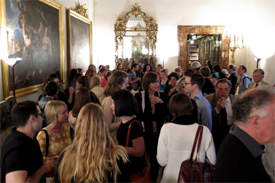
Image: IAS/Kress Lecture 2013, Rome, Fondazione Marco Besso (photograph by Olga Posazhennikova)
Exclusive Promotion from CAA Membership Partner, frieze!
posted by CAA — April 11, 2016
![frieze keyline[3]](https://www.collegeart.org/news/wp-content//frieze-keyline3-242x300.jpg) frieze offers insightful criticism, beautiful design, and opinion pieces from around the world. Including reviews, interviews, city reports, and worldwide listings alongside features on emerging artists and trends as well as fresh perspectives on more established artists – frieze is essential reading for anyone interested in visual culture.
frieze offers insightful criticism, beautiful design, and opinion pieces from around the world. Including reviews, interviews, city reports, and worldwide listings alongside features on emerging artists and trends as well as fresh perspectives on more established artists – frieze is essential reading for anyone interested in visual culture.
Subscribe now and take advantage of a 10% discount for subscribers to the CAA newsletter. Simply go to shopcc.frieze.com and enter the code CAA16 at checkout.
A year’s subscription (8 issues) includes free delivery to your door and unrestricted access to the current issue and archive on frieze.com – 25 years of frieze!
EXCLUSIVE to CAA members:
College Art Association members can receive a 15% discount on tickets to Frieze New York on Thursday, May 5 or Friday, May 6. To redeem, please log into your CAA account and find the promo code in the Member Benefits section. Tickets must be purchased at frieze.com.
Frieze New York
May 5-8, 2016, Randall’s Island Park
The fair brings together more than 200 of the world’s leading galleries to showcase emerging talents together with the most iconic names in contemporary art. Alongside innovative, curated sections, visitors can also enjoy a celebrated series of talks and site-specific artist commissions.
Art Journal Open Seeks Submissions
posted by CAA — April 11, 2016
Art Journal Open, an open-access, independently edited website, seeks Artists’ Projects and Bookshelf submissions. An agile counterpart to the quarterly Art Journal, the website presents artwork, scholarly essays, conversations and interviews, artifacts of materials and process, and news items. The site serves as a provisional, suggestive, and projective archive for contemporary art. Gloria Sutton of Northeastern University serves as web editor for Art Journal Open, which publishes content on a rolling basis.
Artists’ Projects: We welcome submissions from all artists, ranging from those who work in more traditional mediums to those who have a digital and web-based focus. All formats and projects will be considered. Examples of published artist projects can be viewed on our website. Please send a short proposal describing your project, your website URL or images of your recent work, and your contact information to Gloria Sutton at art.journal.website@collegeart.org.
Bookshelf: Launched last year, Art Journal Open Bookshelf asks a simple question: “What are you reading?” Each answer provides a glimpse into the contributor’s personal reading list, from academic publications and artist monographs to novels, memoirs, and travel guides. Contributors to the series have included academics, artists, curators, and librarians. To submit your own Bookshelf to Art Journal Open, send a brief description of what you’re reading and why, a list of the titles (including author, publisher, and year of publication), and a photograph of your books or reading site to art.journal.website@collegeart.org.
CAA at the 2016 National Art Education Association Conference
posted by CAA — March 31, 2016
 Staff members from CAA flew to the windy city to exhibit and meet the attendees at the 2016 National Art Education Association (NAEA) Convention from March 17-19. The NAEA, a CAA Affiliated Society, is the leading professional membership organization exclusively for visual arts educators. Similar to CAA’s own Annual Conference, the NAEA Convention provides professional development services including sessions, workshops, events, and activities aimed at improving visual arts instruction in American schools.
The NAEA Convention was held at the McCormick Place Convention Center and the Hilton Chicago Hotel, where CAA will hold its 108th Annual Conference in February of 2020. In the Exhibit Hall, CAA’s booth was visited by hundreds of NAEA members working and practicing across all areas of arts education. CAA staff Tiffany Dugan, director of programs, and Vivian Woo, marketing and development manager, talked with attendees and provided CAA information including institutional and individual membership brochures; the Code of Best Practices in Fair Use for the Visual Arts and Use Fair Use buttons; and information about the 2017 CAA Annual Conference in New York. Examples of Art Journal and The Art Bulletin were also on hand.
CAA looks forward to reconnecting with NAEA attendees next year in New York. For a limited time only, all NAEA members can receive a $10 discount off membership with CAA. For more information please contact the CAA Membership Department at 212-691-1051, ext. 1.
CAA at Arts Advocacy Day and Humanities Advocacy Day
posted by CAA — March 24, 2016
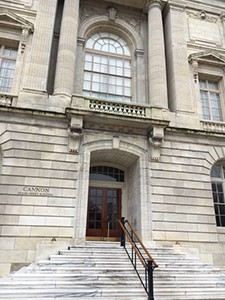
Cannon House, offices of the House of Representatives
CAA had the opportunity this year to attend Arts Advocacy Day, hosted by Americans for the Arts, and Humanities Advocacy Day, hosted by the National Humanities Alliance. One week apart from each other, both events filled Washington, DC with advocates of all ages ready to speak up for the arts and humanities and who were armed with data and statistics.
Arts Advocacy Day, which took place on March 7-8, was headquartered at the OMNI Shoreham Hotel in Washington, DC, just a stone’s throw from the Washington Marriott Wardman Park, where CAA held its 104th Annual Conference in February of this year. The first day of Arts Advocacy Day, now in its 29th year, was jam packed with presentations. Americans for the Arts staff members presented sessions on arts education legislation, such as the recent bipartisan passing of the Every Child Succeeds Act (ESSA), and they presented attendees with dense tables and statistical charts on the economic impact of the arts across the United States. For example, the non-profits arts industry supports 4.13 million jobs in the United States, and the industry contributes a whopping $698 billion annually to the economy. This and many other figures came from the 2016 Congressional Arts Handbook: Facts & Figures at Your Fingertips, which every attendee received. The first day served as foundational preparation for the visits with our local and state representatives the following day.
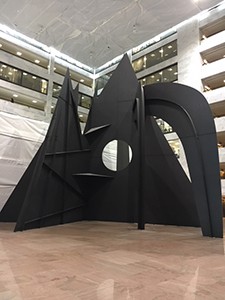
Alexander Calder looming in the Hart Senate Building
March 14-15 marked Humanities Advocacy Day, organized by the National Humanities Alliance. Humanities Advocacy Day, like Arts Advocacy Day, consisted of one day of talks and preparation and one day of Congressional and Senatorial office visits. William Adams, Chairman of the National Endowment for the Humanities, gave a talk on the first day on the NEH’s look toward the future as it shifts its grantmaking structure and adapts to global and domestic changes. The NEH will take on the challenges facing humanities enrollment in higher education and the reduction in humanities and arts programs offered in secondary schools. The NEH will also continue to support work in digital humanities and publishing through a partnership with the Andrew W. Mellon Foundation. Of continued interest to the NEH is increasing access to the humanities through its The Common Good: The Humanities in the Public Square, a program that establishes pathways and means for scholars, educators, and organizations to bring their work into the public sphere.
At lunch, attendees were treated to a presentation by Max Kenner, Executive Director and Founder of the Bard Prison Initiative. BPI offers currently incarcerated individuals the opportunity to obtain a liberal arts college degree from Bard. Since its founding in 1999, the program has grown to become one of the most academically rigorous and successful of its kind.
The National Humanities Alliance scheduled over 200 meetings with Congressman and Congresswomen and Senators for the second day. The New York City delegation, comprised of CAA Director of Programs, Tiffany Dugan, and CAA Director of Communications, Nick Obourn, met with the offices of Congressman Lee Zeldin, Senator Chuck Schumer, and Congresswoman Carolyn Maloney.
caa.reviews Seeks Field Editors
posted by CAA — March 18, 2016
 caa.reviews invites nominations and self-nominations for individuals to join its Council of Field Editors, which commissions reviews within an area of expertise or geographic region, for a term ending June 30, 2019. An online journal, caa.reviews is devoted to reviewing books, museum exhibitions, and projects relevant to art history, visual studies, and the arts.
The journal seeks field editors for books in the following subject areas: early modern Iberian and Latin American art; design history; American art; architecture and urbanism, pre-1800; eighteenth-century art; and Japanese art. The journal also seeks field editors for exhibitions in the following areas: modern and contemporary art; New York and international; and west coast pre-1900. Candidates may be artists, art or design historians, critics, curators, or other professionals in the visual arts; institutional affiliation is not required.
Working with the caa.reviews editor-in-chief, the editorial board, and CAA’s staff editor, each field editor selects content to be reviewed, commissions reviewers, and reviews manuscripts for publication. Field editors for books are expected to keep abreast of newly published and important books and related media in their fields of expertise, and field editors for exhibitions should be aware of current and upcoming exhibitions (and other related projects) in their geographic regions. The Council of Field Editors meets annually at the CAA Annual Conference. Field editors must pay travel and lodging expenses to attend the conference.
Candidates must be current CAA members and should not currently serve on the editorial board of a competitive journal or on another CAA editorial board or committee. Nominators should ascertain their nominee’s willingness to serve before submitting a name; self-nominations are also welcome. Please send a statement describing your interest in and qualifications for appointment, a CV, and your contact information to: caa.reviews Editorial Board, College Art Association, 50 Broadway, 21st Floor, New York, NY 10004; or email the documents to Deidre Thompson, CAA publications assistant. Deadline: April 15, 2016.
Aaron M. Wile, Winner of the James L. Clifford Prize
posted by CAA — March 15, 2016
Aaron M. Wile is the winner of the 2015-16 prize. The Prize is awarded annually by the American Society for Eighteenth-Century Studies to the author of the best article regarding any aspect of eighteenth-century culture. Receiving the award is Wile’s “Watteau, Reverie, and Selfhood” published by College Art Association in The Art Bulletin.
The Clifford Fund was originally established to support an annual prize in honor of James L. Clifford. Clifford founded The Johnsonian News Letter in 1940, was Secretary to the English Institute, twice a Guggenheim Fellow, a Fellow of the Royal Society of Literature, and third President of the American Society for Eighteenth-Century Studies. During his long and energetic life, he produced numerous books, articles, bibliographies, essays, edited collections, editions and, of course, the much beloved, imitated, and quoted Johnsonian News Letter. Accordingly, the Clifford Prize is awarded to the author of the best article on an eighteenth-century subject, interesting to any eighteenth-century specialist, regardless of discipline.
The American Society for Eighteenth-Century Studies is a non-profit, educational group founded to promote the study of all aspects of the eighteenth century. It sponsors conferences, awards, fellowships and prizes, and publishes Eighteenth-Century Studies and Studies in Eighteenth-Century Culture. Requests for information about the Clifford Prize and nominations may be addressed to:
ASECS
PO Box 7867, Wake Forest University
Winston-Salem, NC 27109 USA
Telephone (336) 727-4694
Fax (336) 727-4697
E-mail asecs@wfu.edu
Annual Conference Committee Seeks Members
posted by CAA — March 11, 2016
CAA invites nominations and self-nominations for at-large members of the Annual Conference Committee to serve a three-year term, beginning on May 1, 2016. We welcome all members to participation in the nomination process. Working with the Programs Department staff, this committee selects the sessions and shapes the program of the Annual Conference. The committee ensures that the program will reflect the goals of the association and of the Annual Conference, namely, to make the conference an effective place for intellectual, aesthetic, and professional learning and exchange, and to provide opportunities for participation that are fair, equal, and balanced.
The Annual Conference Committee meets at least two times a year at the call of the vice president for Annual Conference and the committee’s chair. Members must be available throughout May and June to review and select 2017 conference content from the submitted proposals. Please send a 150-word letter of interest and a CV to Katie Apsey, CAA manager of programs. Deadline: April 15, 2016.
Committee on Women in the Arts Picks for March 2016
posted by CAA — March 10, 2016
Each month, CAA’s Committee on Women in the Arts selects the best in feminist art and scholarship. The following exhibitions and events should not be missed. Check the archive of CWA Picks at the bottom of the page, as several museum and gallery shows listed in previous months may still be on view or touring.
March 2016
Lise Haller Baggesen: Mothernism
Contemporary Art Museum for Austin
Laguna Gloria, 3809 West 35th Street, Austin, TX
February 13–Mary 22, 2016
The Gatehouse Gallery at the Betty and Edward Marcus Sculpture Park at Laguna Gloria presents Mothernism by Lise Haller Baggesen, a large-scale installation with a “nod to the bright pop of midcentury Danish interior designer Verner Panton as well as snoezelenrooms, a Dutch therapy technique from the 1970s.” The bright, cozy interior, with disco balls and plush purple carpet, regularly calls back visions from disco culture.
Baggesen describes the work as “a nomadic tent camp audio installation … dedicated to staking out and making speakable the ‘mother-shaped hole in contemporary art discourse.’” Published as a book in 2014, the installation previously came to life an audio-visual presentation in which Baggesen read essays as her alter ego, Queen Leeba, “an amalgam of Donna Summer and a proto-feminist, Scandinavian love goddess.” In this iteration, Mothernism is more like entering a painting, “inviting the viewer into her painting-as-installation, a figure/ground relationship so upended as to become participatory, or relational.”
The exhibition in Austin also contains newly commissioned work, The Mothernist’s Audio Guide to Laguna Gloria, celebrating the history of the Driscoll Villa at Laguna Gloria and the original designer and owner, Clara Driscoll, all through Baggesen’s artistic style, incorporating her knowledge of art history, pop culture, politics, and music.
Tip of Her Tongue: Xandra Ibarra: Nude Laughing, Cassils: The Powers That Be, Shirin Neshat: Possessed
The Broad
221 South Grand Avenue, Los Angeles, CA
April 2, 2016
8:30 PM
Downtown Los Angeles’s new art venue, the Broad, features Tip of Her Tongue, a three-part exhibition by the feminist artists Shirin Neshat, Xandra Ibarra, and Cassils, focusing on language and embodiment. Curated by Jennifer Doyle, professor of English at the University of California, Riverside, and a member of Human Resources Los Angeles, a collectively run art space dedicated to supporting performance and interdisciplinary modes of expression, the program contains a thirteen-minute video, Possessed (2001) by Neshat, and two live performances, Nude Laughing by Ibarra and The Powers That Be by Cassils.
Neshat’s video presents a woman roaming the streets of an Iranian city without her cador. The woman, played by Shohreh Aghdashloo, is ignored until she takes a public platform, where her “private suffering becomes public and political.” In Nude Laughing by Ibarra, the Oakland-based artist’s “engages the skin and skein of race.” Drawing inspiration from John Currin’s painting Laughing Nude, Ibarra herself is nude and encased in a nylon skin cocoon along with “white lady accoutrements … negotiating the simultaneous joys and pains of subjections, abjection, and personhood.” Rounding out the performances, the national premiere of The Powers That Be by Cassils is a collaborative effort with the fight choreographer Mark Steger. In the two-person fight, Cassils is left to spar alone with an invisible force. The performance will be lit by car headlights and performed in the Broad’s parking garage to a score by Kadet Kuhne, played across car stereos.
Tickets to the performances can be purchased on the Broad’s website.
Lecture: Julia Bryan-Wilson on Ruth Asawa and Louise Bourgeois
Berkeley Art Museum and Pacific Film Archive
2155 Center Street, Berkeley, CA
April 1, 2016
12:15 PM
Julia Bryan-Wilson, associate professor of modern and contemporary art at the University of California, Berkeley, and the author of the forthcoming book Art in the Making: From the Studio to Crowdsourcing (with Glenn Adamson), will present a lunchtime talk on Ruth Asawa and Louis Bourgeois, two artists currently on exhibition in Architecture of Life at the Berkeley Art Museum and Pacific Film Archive. Bryan-Wilson’s research interests include feminist and queer art, textile handicraft, and questions of materiality—all germane to different aspects of Asawa’s and Bourgeois’s work.
Architecture of Life, on view through May 29, is the inaugural exhibition in the museum’s new building. “It explores the ways that architecture—as concept, metaphor, and practice—illuminates various aspects of life experience: the nature of the self and psyche, the fundamental structures of reality, and the power of the imagination to reshape our world.” The exhibition has over two hundred works of art in various media, including scientific illustrations and architectural drawings.
Nancy Friedemann-Sánchez: Travelers and Settlers
Museum of Nebraska Art
2401 Central Avenue, Kearney, NE
January 9–April 3, 2016
The Museum of Nebraska Art presents Travelers and Settlers, a solo exhibition by the Colombian-born artist Nancy Friedemann-Sánchez. Curated by Teliza Rodriguez, this engaging and introspective installation is the artist’s exploration of the experience of identity, memory, and gender.
Friedemann-Sánchez’s installation comprises paintings, sculptures, and objects—a mixed-media environment inhabited by family heirlooms alongside carved wooden boats and black mirrorlike panels that hold pearled sconces. Here the artist creates a visual novel narrated in different voices interweaved through a synchronicity of dialogues, passages, punctuations, and silences about hybrid culture and ownership, narratives that portray spiritual and physical transit.
In her project statement the artistwrites, “Anchored in feminism, my art is infused by American and Colombian cultural forms that are dominant or subordinate.” Born in Colombia and having immigrated to the United States as a grown-up, she developed her bilingual art naturally. Travelers and Settlers unfolds in this way: her multinarrative on cultural memory, migration, and the pursuit of the American dream, a bicultural and transcultural experience speaks of difference and opposites.
As Robert Mahoney states in his extensive essay about Friedemann-Sánchez’s project: “As a whole, Travelers & Settlers read as an elegiac litany to sacred space reclaimed from the pushes and pulls of modern history, with the artist acting as guider of souls, urging us to gain a deeper appreciation of the unspoken realities of cultural translation, and, beyond all that, arrive safely again at our common humanity.”
Dafna Maimon: Modern Lives
Lilith Performance Studio
Bragegatan 15, Malmö, Sweden
March 10–12 and 17–19, 2016
Lilith Performance Studio in Malmö presents Modern Lives, a new performance by the Finnish/Israeli artist Dafna Maimon (b. 1982), who lives and works in Berlin. Her work, which includes performance, short film, video, texts, and sculpture, explores and engages with human narratives that challenge stereotypical constructions. Questioning the unclear limits of identity, the self, and the body, her performances expose the economy of affect-based ties, community, and collaboration on a grassroots level.
Modern Lives draws its starting point from the life of Ulrica Maimon, the artist’s mother, who created an alter ego for herself in the early 2000s: Mrs. Gyllendaal Af Berntas. Mrs. Gyllendaal, a 1860s goldsmith’s widow moved into Maimon’s apartment, which has been furnished in the corresponding period style. Throughout the years, Gyllendaal’s biography developed, along with her wardrobe and everyday tasks, inviting family and friends to participate in the roleplay.
For Modern Lives at Lilith Performance Studio, Maimon has built up a full-sized domestic arena for the widow. This performative space becomes a construction site where the “self” can be seen as a multilayered entity, an emotional landscape in motion, a surreal and melancholic world in which its inhabitants echo themselves as prisoners of their own condition. Throughout this piece, the artist fuses her mother’s playful inner fantasies with her own absurdist expression, choreographing and representing several different bodies as one.
Modern Lives is presented as an ongoing a repetitive structure during which audience members are encouraged to visit and stay for as long as they wish.
Maud Sulter: Syrcas
Autograph ABP
Rivington Place, London, EC2A 3BA
January 15–April 2, 2016
Autograph ABP proudly presents Syrcas,an installation of sixteen original photomontages, curated by Mark Sealy, of a seminal body of work created by Maud Sulter (1960–2008). Born in Glasgow of Scots and Ghanaian descent, Sulter was an active feminist in London communities in the early 1980s. She had worked with a women’s education group to program Check It, a groundbreaking two-week show at the Drill Hall that showcased black women’s creativity. Along her influential practice, Sulter continuously explored the presence of Africa in Europe in a variety of media: text, photography, sound, and performance. Her work as artist, writer, and curator questions the lack of representation of black women in the histories of art and photography and critically investigates the complex experiences of the African diaspora in European history and culture over the past six hundred years.
Created during the early 1990s, Syrcas is Sulter’s most intricate and layered body of work. Through the technique of photomontage, this series aims to revive the forgotten history of the genocide of black Europeans during the Holocaust. The installation includes a reproduction of Sulter’s poem “Blood Money.” Written in 1994, the poem was inspired by the German photographer August Sanders’s series of images of Circus Workers (1926–32) and represents a tormenting tale of a young African woman and her family caught up in war, dealing with the constant threat of discrimination, violence, and persecution.
CAA at 2016 The Armory Show
posted by CAA — March 10, 2016
 Last week marked The Armory Show’s annual takeover of New York City, bringing galleries and artists from all over the globe to Piers 92 and 94 on the banks of the Hudson River from March 3 to 6. Packed with exhibitors, artworks, and art enthusiasts, The Amory Show offered extensive visual offerings, alongside special projects and programming. CAA staff visited The Armory, taking in many of the noteworthy displays and activities on site.
An interactive installation hosted by Artsy stood at the entrance to The Armory. The booth was covered by the artist Douglas Coupland’s Slogans for the 21st Century, which also adorned tote bags distributed to visitors. Statements such as “I miss my pre-internet brain,” “You and your selfie are merging,” and “I can feel the money leaving my body” offered wry commentary on the intersection of art, commerce, and technology at a site where these issues merged in a particularly potent way.
Also at the Artsy booth was Deep Face: Comunicate with your future self, a photo booth that created “de-recognition” portraits of visitors. The photo—emailed to participants in a four-frame GIF format—features a black-and-white portrait overlaid with multicolored shapes. Coupland’s deliberate marking of faces aims to disrupt increasingly common facial recognition technologies, which add another layer of complexity to our relationship to the digital age.
Technology and art also merged in many of the artworks on display. The artist Shih Chieh Huang transformed the Ronald Feldman Fine Arts booth into a psychedelic under-the-seascape. In the darkened booth, an electronic jellyfish-like creature moved its tentacles and flashed its light in rhythmic patterns. Made from plastic bags, plastic bottles, highlighters, and other everyday objects, Disphotic Zone merges the artist’s studies of bioluminescent creatures with childhood memories and an interest in the mutability of perception.
 More traditional artistic methods of painting and sculpture were also on view at The Armory. Especially dazzling was Barkley L. Hendricks’ Photo Bloke (2016) on display at the Jack Shainman Gallery booth, a large-scale oil and acrylic painting of a man in an electric pink suit and white sneakers standing before a similarly pink background. Adam Henry’s minimal, rainbow-hued canvases at the Brussels–based Meessen de Clercq’s booth were a delight to witness.
Other highlights included Sislej Xhafa’s sculpture Wyatt and Sky (2016), a life-sized mannequin in a cowboy hat lying face-down on the floor of Blain Southern’s booth with balloons tied tightly around his arms, legs, and torso, and the well-curated installation of works by Lygia Clark, Irma Blank, and Nobuo Sekie at Alison Jacques Gallery. Kapwani Kiwanga’s sculptures made out of steel and sisal fibers were intriguingly tactile.
 This year’s fair also featured a focus on design, tasking designers to create site-specific works that were on displays in Piers 92 and 94. Sung Jang’s MOBI (2015), installed in the entrances to the stairwells connecting the two piers, completely transformed the usually mundane experience of moving between the two areas. In 20 Steps (2015–6) by Studio Drift, a moving installation made from glass tubes, wire, and steel hung suspended over a large lounge area like a breathing exoskeleton.
Beyond the art viewing and booth hopping, The Armory also plans forums, panels, and conversations for its annual visitors. This year’s events included a section dedicated to Focus: African Perspectives—Spotlighting Artistic Practices of Global Contemporaries. Curated by Julia Grosse and Yvette Mutumba, Focus: African Perspectives included galleries from Africa, the work of African and African Diaspora artists, and a two-day symposium that brought together artists, gallerists, curators, and scholars for conversations. Panelists included El Anatsui, Kapwani Kiwanga, Kimberli Gant, Patrick Mudekereza, and others.
 Alongside Focus: African Perspectives was Open Forum, a series of talks on modern and contemporary art, featuring curators, gallerists, artists, writers, and more. The range of topics covered by these panels included Andy Warhol, the role of design in contemporary art, and the future of art.
Especially lively was a conversation between Jerry Saltz, the senior art critic at New York Magazine and a prolific social media user, and Benjamin Genocchio, the executive director of The Armory Show. In “Like, Swipe and Double Tap: Visual Criticism in the Digital Age,” Saltz and Genocchio discussed the power of social media and the ways in which it has changed the evolving field of art criticism as well as the art world at large. Saltz took care to underscore the importance of owning your own critical language, especially in an era when the traditional system of criticism has been disrupted.
Photo Captions
Sislej Xhafa, Wyatt and Sky, 2016, mannequin, helium balloons (artwork © Sislej Xhafa)
Barkley L. Hendricks, detail of Photo Bloke, 2016, oil and acrylic on linen, 72 x 48 in. (artwork © Barkley L. Hendricks)
Sung Jang, installation view of MOBI, 2015, Pier 92 and 94 stairwell entrances (artwork © Sung Jang)
Installation view of Alison Jacques Gallery’s Booth at The Armory, 2016