CAA News Today
Grants, Awards, and Honors
posted by CAA — September 15, 2010
CAA recognizes its members for their professional achievements, be it a grant, fellowship, residency, book prize, honorary degree, or related award.
To learn more about submitting a listing, please see the instructions on the main Member News page.
September 2010

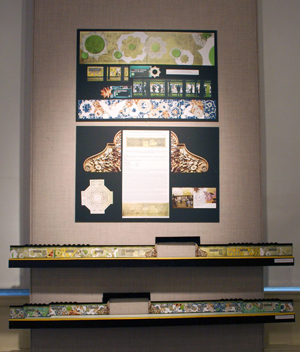 Julia Whitney Barnes, installation view of National Academy Subway Proposal, 2020, at the National Academy Museum’s Edwin Austin Abbey Mural Fellowship exhibition (artwork © Julia Whitney Barnes)
Julia Whitney Barnes, an artist based in Brooklyn, New York, has received a 2010 Edwin Austin Abbey Mural Workshop Fellowship from the National Academy Museum and School of Fine Arts in New York. The workshop, which took place in July 2010, was a unique opportunity for artists to learn how to compete successfully for public mural commissions.

Rachel Epp Buller has received a Fulbright Scholar Grant for 2010–11. The Fulbright, along with a grant from the Gerda Henkel Foundation in Düsseldorf, will fund research for a book on the German artist Alice Lex.
John Casey, a doctoral student at the Graduate Center, City University of New York, has received the Dedalus Foundation’s 2010 Dissertation Fellowship Award for his study, “Picturing Architectural Theory: The Architectural Photobook in Germany, 1910–1945.” The $20,000 fellowship is awarded annually to a PhD candidate at an American university who is working on a dissertation related to modern art and modernism.

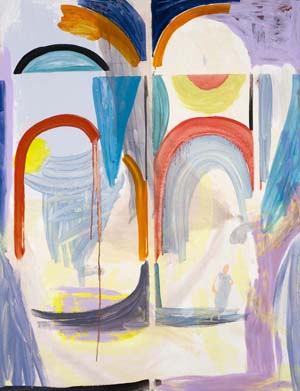 Jackie Gendel, Liliput, 2010, oil on canvas, 44 x 34 in. (artwork © Jackie Gendel)
Jackie Gendel, an artist based in Brooklyn, New York, has received a grant from the Marie Walsh Sharpe Art Foundation’s Space Program for 2010–11, which provides free studios in New York for the creation of new works of art.

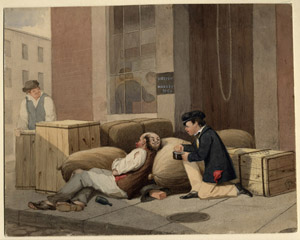 David Claypoole Johnston, Sound Asleep & Wide Awake or Marker & Sleeper, 1855, watercolor, 26 x 32½ cm (artwork in the public domain)
Jennifer A. Greenhill has received a subvention from the Wyeth Foundation for American Art to help support the publication of her book, Playing It Straight: Art and Humor in the Gilded Age, forthcoming from the University of California Press. The book investigates the strategies artists devised to simultaneously conform to and humorously undermine “serious” artistic culture during the late nineteenth century.
Kira Lynn Harris has won a grant from Art Matters, a nonprofit foundation based in New York, for travel to France and Spain to complete a series of large-scale drawings and photographs of the Chapel of Notre Dame du Haut by Le Corbusier, Antoni Gaudi’s Sagrada Família in Barcelona, and George Wyman’s Bradbury Building in Los Angeles. Art Matters supports artists based in the United States whose work focuses on communications and collaborations across national borders.

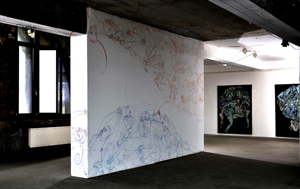 Sol Kjøk, Entre sol et ciel, 2010, graphite and pastel on wall, 9.5 ft. x 18 ft. x 20 in., 2 sides.
Sol Kjøk, an artist based in Brooklyn, New York, has received a 2010 Edwin Austin Abbey Mural Workshop Fellowship from the National Academy Museum and School of Fine Arts in New York. The workshop, which took place in July 2010, was a unique opportunity for artists to learn how to compete successfully for public mural commissions.

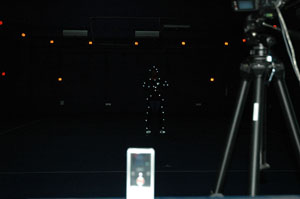 A still from a work-in-progress video by Lucy Raven about motion capture (photograph © Lucy Raven)
Lucy Raven has received funding from Art Matters, a nonprofit foundation based in New York, for research in Chennai, Kerala, and Mumbai, India, for a video project exploring the international outsourcing of three-dimensional animation and visual effects for the creation of American landscapes in Hollywood movies. Art Matters supports artists based in the United States whose work focuses on communications and collaborations across national borders.


The American Council of Learned Societies (ACLS) New Faculty Fellows Program allows recent PhDs in the humanities to take up two-year positions at universities and colleges across the United States, where their particular research and teaching expertise augment departmental offerings. CAA member Christopher R. Lakey, a recent graduate of the University of California, Berkeley, won the fellowship for his dissertation, “Relief in Perspective: Italian Medieval Sculpture and the Rise of Optical Aesthetics.” He has been appointed at Johns Hopkins University in Baltimore, Maryland, for 2010–12.
The Andrew W. Mellon Foundation/ACLS Early Career Fellowships for Recent Doctoral Recipients provide a year’s support for scholars to advance their research following completion of the doctorate. CAA members Richard Patrick Anderson of Columbia University in New York won for “Toward a Socialist Architecture, 1928–1953”; and Meghan C. Doherty of the University of Wisconsin, Madison, won for “Carving Knowledge: Printed Images, Accuracy, and the Early Royal Society of London.”
The Andrew W. Mellon Foundation/ACLS Early Career Fellowship Program awards Dissertation Completion Fellowships, which provide support for young scholars to finish their dissertations; the fellowships are the first part of a program offering funding to scholars at the early stages of their careers. Among the recipients are two CAA members: Ellery Elisabeth Foutch of the University of Pennsylvania in Philadelphia for “Arresting Beauty: The Perfectionist Impulse of Peale’s Butterflies, Heade’s Hummingbirds, Blaschka’s Flowers, and Sandow’s Body”; and Maile S. Hutterer of the Institute of Fine Arts at New York University for “Broken Outlines and Structural Exhibitionism: The Flying Buttress as Aesthetic Choice in Medieval France.”
The Henry Luce Foundation/ACLS Dissertation Fellowships in American Art are awarded to graduate students in any stage of PhD dissertation research or writing for scholarship on a topic in the history of the visual arts of the United States. Although the topic may be historically and/or theoretically grounded, attention to the art object and/or image should be foremost. CAA member recipients are: Matthew K. Bailey of Washington University in St. Louis, Missoufor “Turbulent Bodies: Disruptive Materiality in Modern American Painting, 1880–1930”; Amanda Douberley of the University of Texas at Austin, for “The Corporate Model: Sculpture, Architecture, and the American City, 1946–1975”; Jason Goldman of the University of Southern California in Los Angeles, for “Open Secrets: Publicity, Privacy, and Histories of American Art, 1958–69”; Anna C. Katz of Princeton University in Princeton, New Jersey, for “Hybrid Species: Lee Bontecou’s Sculpture and Works on Paper, 1958–1971”; Rebecca E. Keegan of Duke University in Durham, North Carolina, for “Black Artists, the Problem of Authenticity, and ‘Africa’ in the Twentieth Century”; Edward M. Puchner of Indiana University in Bloomington, for “‘speaking His mind in my mind’: Racialized Theology, Divine Inspiration, and African American Art”; and Katherine Elizabeth Roeder of the University of Delaware in Newark, for “‘Cultivating Dreamfulness’: Fantasy, Longing, and Commodity Culture in the Work of Winsor McCay, 1904–1914.”
The Andy Warhol Foundation for the Visual Arts has announced its 2010 Curatorial Fellowships for Travel and Research. CAA member recipients are: Heather Campbell Coyle of the Delaware Art Museum in Wilmington, for conducting research on an exhibition and publication of the work of Scott Heiser, a fashion photographer from the 1980s whose idiosyncratic body of work has been forgotten since his death in 1993 ($11,000); Kristina Van Dyke of the Menil Collection in Houston, Texas, working with Bisi Silva, to organize an exhibition on contemporary African art with a focus on how technology shapes notions and facilitates expressions of love in Africa ($38,400); and Jonathan Katz of the Tacoma Art Museum in Washington, working with Rock Hushka, to prepare for an exhibition that explores twenty-five years of art made in response to AIDS ($40,000).
Exhibitions Curated by CAA Members
posted by CAA — September 15, 2010
Check out details on recent exhibitions organized by CAA members who are also curators.
To learn more about submitting a listing, please see the instructions on the main Member News page.
September 2010

 Hendrick ter Brugghen, Saint Sebastian Tended by Irene, 1625, oil on canvas, 58 11/16 x 47 in. (149.1 x 119.4 cm). Allen Memorial Art Museum, Oberlin College. R. T. Miller Jr. Fund, 1953.256 (artwork in the public domain)
Andria Derstine, Stephanie Wiles, Eliza Rathbone, and Renée Maurer. Side by Side: Oberlin’s Masterworks at the Phillips. Phillips Collection, Washington, DC, September 11, 2010–January 16, 2011.

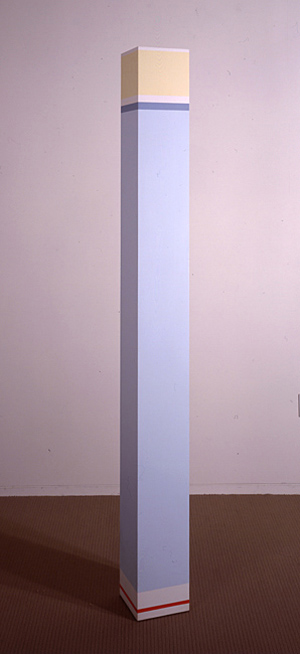 Anne Truitt, Prima, 1978, acrylic on wood, 80½ x 7 7/8 x 8¼ in. Mildred Lane Kemper Art Museum, Washington University in St. Louis. Gift of Dr. and Mrs. Harold Joseph, 1998 (artwork © Anne Truitt)
Meredith Malone. Gesture, Scrape, Combine, Calculate: Postwar Abstraction from the Permanent Collection. Mildred Lane Kemper Art Museum, Washington University in St. Louis, St. Louis, Missouri, August 20–September 20, 2010.

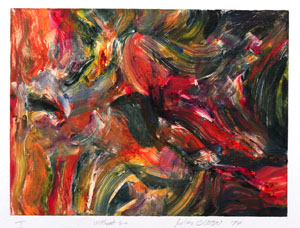 Jules Olitski, Without Sin, 1994, monotype, 18 x 24 in. (artwork © Jules Olitski)
Judith E. Stein. Jules Olitski: An Inside View, A Survey of Prints 1954–2007. Opalka Gallery, Sage Colleges of Albany, Albany, New York, August 30–October 31, 2010.
Books Published by CAA Members
posted by CAA — September 15, 2010
Publishing a book is a major milestone for artists and scholars. Browse a list of recent titles below.
To learn more about submitting a listing, please see the instructions on the main Member News page.
September 2010

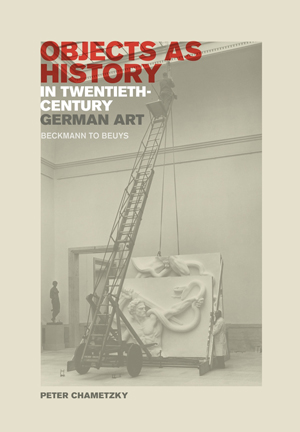
Peter Chametzky. Objects as History in Twentieth-Century German Art: Beckmann to Beuys (Berkeley: University of California Press, 2010).

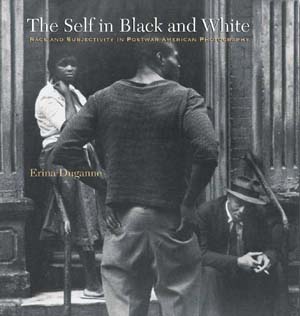
Erina Duganne. The Self in Black and White: Race and Subjectivity in Postwar American Photography (Hanover, NH: Dartmouth College Press, in association with University Press of New England, 2010).


Michele Greet. Beyond National Identity: Pictorial Indigenism as a Modernist Strategy in Andean Art, 1920–1960 (University Park: Pennsylvania State University Press, 2009).

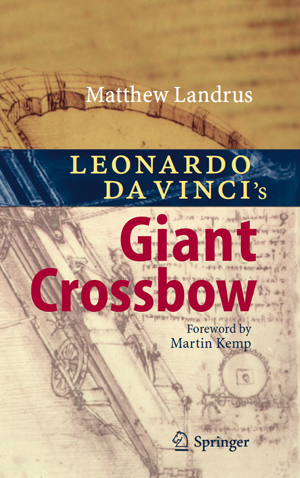
Matthew Landrus. Leonardo da Vinci’s Giant Crossbow (Heidelberg, Germany: Springer, 2010).

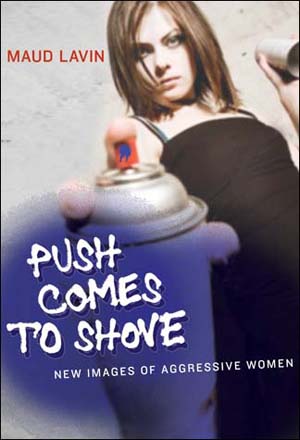
Maud Lavin. Push Comes to Shove: New Images of Aggressive Women (Cambridge, MA: MIT Press, 2010).

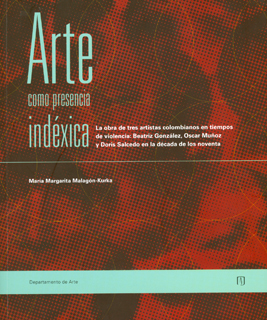
María Margarita Malagòn-Kurka. Arte como presencia indéxica. La obra de tres artistas colombianos en tiempos de violencia: Beatriz González, Oscar Muñoz y Doris Salcedo en la década de los noventa (Bogotá, Columbia: Ediciones Uniandes, 2010).

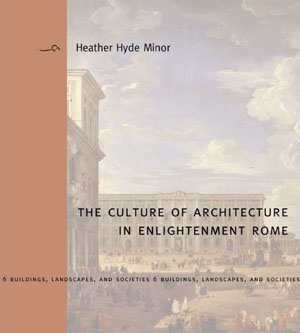
Heather Hyde Minor. The Culture of Architecture in Enlightenment Rome (University Park: Pennsylvania State University Press, 2010).

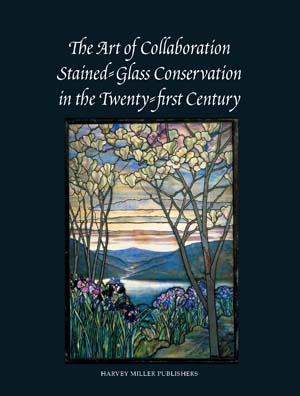
Mary B. Shepard, Lisa Pilosi, and Sebastian Strobl, eds. The Art of Collaboration: Stained-Glass Conservation in the Twenty-First Century (Turnhout, Belgium: Brepols, 2010).


Sandra Sider. Pioneering Quilt Artists, 1960–1980: A New Direction in American Art (New York: Photoart Publishing, 2010).

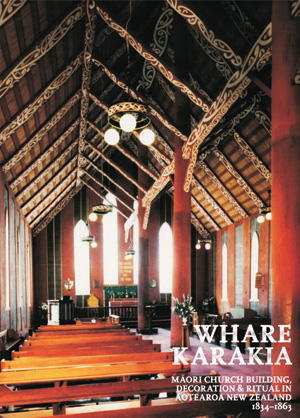
Richard A. Sundt. Whare Karakia: Maori Church Building, Decoration, and Ritual in Aotearoa New Zealand, 1834–1863 (Auckland, New Zealand: Auckland University Press, 2010).


John Willis, with an essay by Kent Nerburn and contributions by the Ogala Lakota people. Views from the Reservation (Chicago: Center for American Places and Columbia College Chicago, 2010).
Apply for a CAA Publication Grant
posted by CAA — September 15, 2010
 CAA is offering two publishing grant opportunities this fall—the Millard Meiss Publication Fund and the Wyeth Foundation for American Art Publication Grant—that support new books in art history. Both grant programs have a fast-approaching deadline of October 1, 2010.
The publisher must submit the application to either or both grant, though only one award can be given per title. Awards are made at the discretion of the jury for each fund and vary according to merit, need, and number of applications. The Wyeth grant will be awarded in late November; the Meiss award will be announced shortly thereafter.
Millard Meiss Publication Fund
CAA awards grants through the Millard Meiss Publication Fund to support book-length scholarly manuscripts in the history of art and related subjects that have been accepted by a publisher on their merits but cannot be published in the most desirable form without a subsidy. For complete guidelines, application forms, a grant description, and past winners, visit www.collegeart.org/meiss or write to nyoffice@collegeart.org. Deadline: October 1, 2010.
Wyeth Foundation for American Art Publication Grant
Thanks to a second generous three-year grant from the Wyeth Foundation for American Art, CAA awards a publication grant to support book-length scholarly manuscripts in the history of American art and related subjects prior to 1970. Books eligible for the Wyeth grant have been accepted by a publisher on merit, but require a subsidy to be published in the most desirable form. For complete guidelines, application forms, a grant description, and past winners, visit www.collegeart.org/wyeth or write to nyoffice@collegeart.org. Deadline: October 1, 2010.
Exhibitor and Advertiser Prospectus for the New York Conference Published
posted by CAA — September 14, 2010
 The Exhibitor and Advertiser Prospectus for the 2011 Annual Conference is now available for download. Featuring essential details for participation in the Book and Trade Fair, the booklet also contains options for sponsorship opportunities and advertisements in conference publications.
The Exhibitor and Advertiser Prospectus will help you reach a core audience of artists, art historians, educators, students, and administrators, who will converge in New York for CAA’s 99th Annual Conference and Centennial Kickoff, taking place February 9–12, 2011. The Book and Trade Fair offers three days of exhibit time and will be centrally located at the Hilton New York, the conference headquarters hotel.
In addition, vital sponsorship packages will allow you to maintain a high profile throughout the conference. Companies and organizations may sponsor specific areas and events, such as Convocation and the Student Lounge, or work with CAA staff to design a custom visibility package. Advertising possibilities include the Conference Program, distributed to over five thousand registrants, and the conference website, seen by thousands more.
The priority deadline for Book and Trade Fair applicants is October 29; the final deadline for applications and payments, and for sponsorships and advertisements, is December 3.
Questions about the Book and Trade Fair? Contact Paul Skiff, CAA assistant director for Annual Conference, at 212-691-1051, ext. 213. For sponsorship and advertising queries, speak to Sara Hines, CAA development and marketing manager, at ext. 216.
Committee on Women in the Arts Picks for September 2010
posted by CAA — September 10, 2010
Each month, CAA’s Committee on Women in the Arts selects the best in feminist art and scholarship. The following conference and four exhibitions should not be missed. Check the CWA Picks archive at the bottom of the page, as several exhibitions listed there are still on view.
September 2010
“Heritage and Hope: Women’s Education in a Global Context”
Bryn Mawr College
101 North Merion Avenue, Bryn Mawr, PA 19010
September 23–25, 2010
As part of its 125th anniversary celebration, Bryn Mawr College is hosting an international conference to celebrate the empowering heritage of women’s education and to chart a course for its future. The conference will examine issues of educational access, equity, and opportunity in secondary schools and universities in the United States and around the world. Session topics will include: “Leveling the Academic Playing Field”; “Enhancing Global Networks,” a discussion of current and future collaborative connections among women’s colleges around the world; and “Partnering for Global Justice,” an exploration of potential partnerships among schools, colleges, and international NGOs to promote women’s rights and educational opportunities.

Pauline Boty, With Love to Jean Paul Belmondo, 1962, oil on canvas, 48 x 59 7/8 in. Collection of Nadia Fakhoury, Paris (artwork © Pauline Boty)
Seductive Subversion: Women Pop Artists, 1958–1968
Sheldon Museum of Art
University of Nebraska, Lincoln, 12th and R Streets, Lincoln, NE 68588
July 30–September 24, 2010
Seductive Subversion: Women Pop Artists, 1958–1968 turns on its head the notion that male artists largely dominated this twentieth-century movement. The first major exhibition of its kind, Seductive Subversion features paintings and sculptures by an international group of artists—including Vija Celmins, Rosalyn Drexler, Niki de Saint Phalle, Joyce Wieland, Marisol, Faith Ringgold, and Martha Rosler—that expand the Pop canon as most know it. Sid Sachs, director of exhibitions at University of the Arts in Philadelphia, where the exhibition originated, will deliver a lecture about the exhibition on September 14 at 5:30 PM in the Sheldon’s Ethel S. Abbott Auditorium.
Catherine Opie: Figure and Landscape
Los Angeles County Museum of Art
5905 Wilshire Boulevard, Los Angeles, CA 90036
July 25–October 17, 2010
Catherine Opie explores issues of masculinity, community, and national identity in her current exhibition at the Los Angeles County Museum of Art. A Southern California–based photographer whose diverse body of work includes images of Alaskan landscapes, challenging self-portraits, and urban street scenes, Opie has visited and documented high school football games, players, and fans in seven states across America since 2007. “The high capture, dramatic tenebrism, vivid colour and density of the landscapes are entirely consonant with commercial sports photography,” wrote Christopher Bedford in Frieze, “but Opie’s insistence on recording the endless passages of tedium and readiness that punctuate the experience of a football game makes these images aniconic and elusive.” A second exhibition at the museum, Manly Pursuits: The Sporting Images of Thomas Eakins, is shown in conjunction with Catherine Opie: Figure and Landscape.

Susie (Sarah) Barstow, Landscape, 1865, oil on canvas, 30 x 22 in. Collection of Elizabeth and Alfred Scott (artwork in the public domain; photograph provided by the Thomas Cole National Historic Site)
Remember the Ladies: Women of the Hudson River School
Thomas Cole National Historical Site
218 Spring Street, Catskill, NY 12414
May 2–October 31, 2010
Focusing on nineteenth-century America, Remember the Ladies: Women of the Hudson River School highlights female artists who were contemporary to figures like Asher Durand and Frederic Edwin Church. Curated by Nancy Siegel and Jennifer Krieger, the exhibition features twenty-five works in painting, photography, and drawing manuals by Julia Hart Beers (sister of William and James Hart), Evelina Mount (niece of William Sidney Mount), Susie Barstow, Eliza Greatorex, Harriet Cany Peale, Josephine Walters, and Sarah and Emily Cole (sister and daughter, respectively, of Thomas Cole).
Experimental Women in Flux
Museum of Modern Art
11 West 53rd Street, New York, NY 10019
August 4–November 8, 2010
Organized by Sheelagh Bevan with David Senior, both of the Museum of Modern Art Library, Experimental Women in Flux focuses on artists’ books, event scores, performance instructions, catalogues, periodicals, and other printed matter from the recently acquired Gilbert and Lila Silverman Fluxus Collection Reference Library. Documents of live, ephemeral, and durational work by such artists and performers as Alison Knowles, Charlotte Moorman, Shigeko Kubota, Yoko Ono, and Simone Forti are included. Presented in conjunction with the museum’s publication of Modern Women: Women Artists at The Museum of Modern Art, the exhibition boasts a full website with images and descriptions, as well as audio selections from Mieko Shiomi’s musical portraits of her Fluxus associates.
Ronald V. Wiedenhoeft: In Memoriam
posted by CAA — September 10, 2010
Renate Wiedenhoeft is president of Saskia Ltd. and Scholars Resource.

Ronald V. Wiedenhoeft
Ronald V. Wiedenhoeft, an art and architectural historian and the principal photographer of the Saskia Archive, died on August 14, 2010, after a lengthy illness. He was 73.
Wiedenhoeft graduated from Cornell University as a civil engineer in 1959 and earned a PhD in art history at Columbia University in 1971. He received numerous scholarships and awards from the National Endowment for the Humanities and the Bavarian State in Germany, and two Fulbright grants. Wiedenhoeft taught at the University of Massachusetts in Amherst, the University of Utah, and, for twenty-one years, the Colorado School of Mines. He was also a visiting professor at the Technical Universities in Vienna and Graz, Austria. His publications include Cities for People: Practical Measures for Improving Urban Environments in 1981, Berlin’s Housing Revolutions: German Reform in the 1920s in 1985, and many articles (in German) on urban planning.
Beginning in 1966, yearly photographic campaigns took us to Europe to document works of art in major art collections. Slides and images from our jointly owned company Saskia Ltd. formed the basis for many visual-resource collections and enhance the teaching of art history for so many students. A special project in the late 1970s to document all monuments in St. Peter’s Cathedral resulted in an exhibition at the Denver Art Museum, among others. All Saskia images will continue to live on in Scholars Resource.
Wiedenhoeft is survived by his second wife, Emily; our three children, Sonja, Sabina, and Kurt; and six grandchildren.
Affiliated Society News for September 2010
posted by CAA — September 09, 2010
American Institute for Conservation of Historic and Artistic Works
The American Institute for Conservation of Historic and Artistic Works (AIC) has partnered with the Smithsonian Institution and the US Committee of the Blue Shield to help recover cultural and historic artifacts damaged by the earthquake in Haiti on January 12, 2010. Since April, volunteer AIC conservators, initially only members of the AIC Collections Emergency Response Team, have been working at the Haiti Cultural Recovery Center (maintained by the Smithsonian) in Port-au-Prince and onsite on wall murals, such as those at the Cathedral of Sainte Trinité. In addition to helping set up conservation labs at the center, conservators have performed assessments and treatments ranging from basic stabilization to more complete aesthetic reintegration. In addition to travel costs for the volunteers, grant support has, to date, enabled the purchase of over $8,000 in supplies and tools. AIC response is made possible through the support of the National Endowment for the Humanities, the National Endowment for the Arts, the Institute of Museum and Library Services, and AIC’s foundation.
Appraisers Association of American
The Appraisers Association of America (AAA) has launched its new website. New features include online registration and payment for courses and programs and an improved “Find an Appraiser” tool. Fall programs for fall 2010, which include study days, lectures, events, and the national conference, have also been announced. To register, AAA members will need to sign in and create a username and password.
Arts Council of the African Studies Association
The fifteenth triennial symposium of the Arts Council of the African Studies Association (ACASA) will be held at the University of California, Los Angeles, March 23–26, 2011. Proposals for papers, panels, and roundtables addressing the theme, “Africa and Its Diasporas in the Marketplace: Cultural Resources and the Global Economy,” are invited. Please read the triennial theme announcement for submission guidelines and information on travel support and stipends.
Association for Latin American Art
The second triennial conference of the Association for Latin American Art (ALAA), called “Origins of State/Origins of Identity,” will be held November 13–14, 2010, at the Los Angeles County Museum of Art in California. The event coincides with the museum’s exhibition, Olmec: Colossal Masterworks from Ancient Mexico, and with Obsidian Mirror-Travels: Refracting Ancient Mexican Art and Archaeology at the Getty Research Institute. Responding to the idea of discovery, the conference is divided into three panels reflecting the main areas of research undertaken by the association’s members: pre-Columbian art and architecture, viceregal and colonial art and architecture, and modern and contemporary Latin American and Latino art and architecture. A PDF of the conference program is available for download.
Association of Academic Museums and Galleries
The Association of Academic Museums and Galleries (AAMG) acknowledges that students are one of the prime constituencies of all our institutions as well as our future colleagues and leaders. AAMG values the student voice and student participation, and to kick off this academic year it is offering free one-year student memberships from August 15 to October 15, 2010. To become a member, please send the required information via an online form, along with a digital copy (Word or PDF) of your unofficial transcript or student ID, to Emily Forsgren. Or, mail the application and copy of your student ID or transcript to: AAMG Membership, Mary and Leigh Block Museum of Art, 40 Arts Circle, Northwestern University, Evanston, IL 60208-2410.
Association of Historians of American Art
The Association of Historians of American Art (AHAA) is offering a travel grant to cover CAA Annual Conference expenses up to $500 for an ABD student of historical art of the United States who will travel to the 2011 meeting in New York to participate in the program. The successful recipient must be enrolled in a graduate program and an AHAA member. Deadline: February 1, 2011.
AHAA is hosting a symposium, called “Current Research in American Art,” to be held at St. Francis College in Brooklyn, New York, October 7–9, 2010. The event is free but attendees must preregister and be AHAA members.
To sustain AHAA’s mission of supporting scholarship, the organization has introduced a new lifetime membership. Dues are $750, of which $730 is tax deductible.
Association of Historians of Nineteenth-Century Art
The Association of Historians of Nineteenth-Century Art (AHNCA) has announced that new and standing members may now pay electronically for their annual membership using Google Checkout.
Foundations in Art: Theory and Education

Foundations in Art: Theory and Education (FATE) is hosting its biannual conference, “ON STREAM,” in partnership with the Mid-America College Art Association, another CAA affiliated society. Held in St. Louis, Missouri, the event will take place March 30–April 2, 2011, at the Ball Park Hilton. The conference will explore connections and question the status quo of how “creativity” is being developed and fostered as we enter the second decade of the third millennium. For more details, please contact Jeff Boshart, conference coordinator.
Historians of British Art
The Historians of British Art (HBA) welcomes Peter Trippi as its new first vice president. Currently editor of Fine Art Connoisseur, he will serve a one-year term before assuming the post of HBA president.
HBA is accepting papers for an upcoming minisession of work by emerging scholars to be held during the HBA business meeting at the CAA Annual Conference in New York, February 9–12, 2011. Current or recent graduate students are invited to submit proposals for consideration. (If an applicant is a PhD recipient, his or her degree must have been earned within the past three years.) Papers may address any topic related to British art, architecture, and visual culture. Presentations or “works in progress” should be limited to fifteen minutes to allow for ample discussion. This minisession is an opportunity for informal presentations of new or ongoing research followed by open discussion. To submit a paper for consideration, send the following items to Colette Crossman, HBA second vice president: (1) a one-page abstract; (2) a CV (limited to two pages); and (3) a brief cover letter explaining interest in the field. Upon selection, presenters are requested to join HBA if they are not current members. Deadline: October 1, 2010; decisions made by November 1.
Historians of Eighteenth-Century Art and Architecture
The Historians of Eighteenth-Century Art and Architecture (HECAA) has announced the recipient of the Mary Vidal Travel Award: Iris Moon, a PhD student at the Massachusetts Institute of Technology in Cambridge. She will conduct research on the French architects Charles Percier and Pierre-François-Léonard Fontaine.
Historians of Islamic Art Association
The Historians of Islamic Art Association (HIAA) will hold its second biennial symposium on the theme of “Objects, Collections and Cultures” at the Freer and Sackler Galleries in Washington, DC. Taking place October 21–23, 2010, the program features an opening address by Julian Raby, director of the Freer and Sackler; thematic sessions with formal presentations; seminar-style workshops on art objects in the museums’ collections; and a roundtable discussion on the arts of the object in Islamic art history today. The complete program and registration information are available online.
HIAA is pleased to welcome Stephennie Mulder as the new editor of its listserv, H-Islamart, and to thank the outgoing editor Christiane Gruber for her years of exemplary service.
Historians of Netherlandish Art
The Historians of Netherlandish Art (HNA) has announced the submission deadline—March 1, 2011—for the Summer 2011 issue of the Journal of Historians of Netherlandish Art: Please consult the journal’s submission guidelines for more information about the process. An open-access, peer-reviewed journal published twice per year, JHNA features articles that focus on art produced in the Netherlands (north and south) during the early modern period (ca. 1400–ca.1750) and in other countries and later periods as they relate to this earlier art. These include studies of painting, sculpture, graphic arts, tapestry, architecture, and decoration, from the perspectives of art history, art conservation, museum studies, historiography, technical studies, and collecting history. Book and exhibition reviews, however, will continue to be published in the HNA Newsletter.
International Association of Art Critics
The United States section of the International Association of Art Critics (AICA USA) launched a new website in mid-August. Designed to be more interactive and more attractive visually, the website will be an active tool for information about members’ professional achievements, such as new books, exhibitions, awards, participations in major conferences, and the like. In addition, AICA USA will publish cyclical reports on important issues related to art criticism.
AICA USA has elected a new president, Marek Bartelik, to serve from May 2010 to May 2012. Bartelik teaches modern and contemporary art at the Cooper Union for the Advancement of Science and Art in New York and is a graduate critic-in-residence at the Maryland Institute College of Art in Baltimore.
International Association of Word and Image Studies
The International Association of Word and Image Studies (IAWIS) seeks submissions for the Max Nänny Prize for the best article in word and image studies. First awarded in 2008, the prize—named in honor of the late Max Nänny, a former IAWIS president—is presented every three years on the occasion of the organization’s triennial conference. Both members and nonmembers may submit already published articles, dated no earlier than three years before the submission deadline. Deadline: October 31, 2010.
IAWIS seeks proposals for papers for its ninth international conference, on the theme of “L’imaginaire/The Imaginary.” The meeting will take place in Montreal, Quebec, August 22–26, 2011. Descriptions of all sessions can be found online. Deadline: October 1, 2010.
International Sculpture Center
The International Sculpture Center (ISC) is celebrating its fiftieth anniversary at the Metropolitan Pavilion in New York on October 22, 2010. The evening’s festivities will include a cocktail reception, entertainment, and an art sale featuring works by Fletcher Benton, Chakaia Booker, Mark di Suvero, John Clement, Carole Feuerman, John Henry, Jun Kaneko, Donald Lipski, Jesús Moroles, Manuel Neri, Tom Otterness, Albert Paley, Joel Perlman, Judy Pfaff, Kenneth Snelson, Stretch, James Surls, Boaz Vaadia, and Mia Westerlund, among others to be announced. Also taking place are a raffle—with top prize being a one-week vacation in Saint Martin—and a Chinese auction with fabulous prizes. Honorary hosts for the evening include di Suvero, Snelson, and Joyce Pomeroy Schwartz. Space is limited. Tickets are $350 per person, and tables are available for $3,000 and $5,000. Cocktails start at 6:00 PM with dinner at 7:30 PM. For questions or more information, please write to events@sculpture.org.
Italian Art Society
The Italian Art Society (IAS) invites proposals for the 2011 Italian Art Society/Kress Foundation Lecture in Italy. The lecture series seeks to promote intellectual exchanges among art historians of North America and the international community of scholars living or working in Italy. The lecture will be held in Florence in late May or early June 2011. The proposed lecture may address any period in Italian art but must relate to the city of Florence or the region of Tuscany; it also may not have been previously published or presented at another conference or venue. Application details are published online. Deadline: January 1, 2011.
Leonardo Education and Art Forum
The Leonardo Education and Art Forum (LEAF), a part of Leonardo/The International Society for the Arts, Sciences, and Technology, hosted a two-part panel on “Grand Challenges in Education” at the Los Angeles ACM SIGGRAPH on July 28, 2010. The participants addressed issues in education in light of new opportunities for participatory and collaborative learning in society. Speakers also responded to a white paper issued by the MacArthur Foundation called “The Future of Learning Institutions in a Digital Age.” Panelists were: David T. Goldberg, Rebecca Allen, Pamela Jennings, Sarah Cunningham, Glenn Entis, and Marc Barr. Discussants were Donna Cox, James Foley, Andy van Dam, and Ellen K. Levy, with remarks by Roger Malina.
LEAF sponsored a meeting and workshop, called “Art-Science – Curricular Models and Best Practices,” at the 2010 International Symposium on Electronic Art on August 27, 2010. Leaders of the workshop, which was coordinated by Edward Shanken, were Jennifer Kanary Nikolov, Jill Scott, and Paul Thomas.
Fran Ilich was selected as the winner of the Media Art Histories (MAH) Leonardo Scholarship for notable contributions to the field. MAH is a collaborative project between Leonardo and the Department for Image Science at Danube University Krems in Austria.
LEAF is sponsoring workshops at the Ars Electronica Festival, taking place September 2–11, 2010, in Linz, Austria.
Pacific Arts Association
The Pacific Arts Association (PAA) convened its tenth international symposium, “Pacific Art in the 21st Century: Museums, New Global Communities, and Future Trends,” from August 9 to 11, 2010, in Rarotonga, Cook Islands. PAA hosted over eighty-three presenters and seventy-five presentations, highlighting issues surrounding the creation, dispersal, possession, repatriation, stewardship, and interpretation of Pacific art in the twenty-first century. The symposium welcomed three keynote speakers: Michelle Hippolite of Te Papa Tongarewa, Museum of New Zealand; Jean-Marc Pambrun of the Museum of Tahiti and Her Islands; and Jonathan Mane-Wheoki of Auckland University. Special exhibitions, artist presentations, and events included Janet Lilo’s TOP16, curated by Ron Brownson; a craft exhibition; Nanette Lela’ulu’s In the House of My Heart; Wrapping the Cook Islands: Tivaivai; and the launch of Art Monthly Australia’s special Pacific issue. Visit the symposium website for a complete list of presenters, abstracts, and schedule of events.
Society for Architectural Historians
The Society of Architectural Historians (SAH) invites CAA members to gather at the Four Seasons in midtown Manhattan next month for conversation about the restaurant’s historical developments. This free event takes place on Saturday, September 25, 2010, at 9:00 PM. The gathering concludes a tour day in which SAH members will have spent studying the work of Richard Kelly, who was responsible for the interior and exterior lighting of the Seagram Building and the Four Seasons. Joining the group will be Belmont Freeman, the restaurant’s current restoration architect, and Dietrich Neumann, the tour leader, past SAH president, and editor of the forthcoming book, The Structure of Light: Richard Kelly and the Illumination of Modern Architecture.
Society for Photographic Education
The Society for Photographic Education (SPE) offers student scholarships to offset the cost of attending its 2011 national conference, titled “Science, Poetry, and the Photographic Image,” to be held March 10–13 in Atlanta, Georgia. A conference fee waiver and a one-year SPE membership are provided in addition to the cash awards.
Ten SPE Awards and the SPE Award for Innovations in Imaging in Honor of Jeannie Pearce feature a $500 travel stipend. The Freestyle Crystal Apple Award for Outstanding Achievement in Black and White Photography is generously sponsored by Freestyle Photographic Supplies and offers a $5,000 cash prize and recognition for the sponsoring faculty member.
Applicants must be SPE student members and current full-time students enrolled at a postsecondary institution as an undergraduate or graduate majoring or concentrating in photography but not graduating before the end of academic year 2010–11. Deadline: November 1, 2010.
Southeastern College Art Conference
From November 9 to 12, 2011, the Southeastern College Art Conference (SECAC) will hold its sixty-seventh annual meeting, hosted by the Savannah College of Art and Design (SCAD) in Georgia. The conference headquarters will be the DeSoto Hilton Hotel, located in the heart of historic Savannah. Featuring extensive panels and sessions for the exchange of ideas and concerns relevant to the practice and study of art, the conference will include the annual awards luncheon and the fourteenth annual members’ exhibition, as well as a rich array of tours, workshops, and evening events. The curator Dan Cameron will jury the SECAC members’ exhibition, to be held at one of SCAD’s premier venues. For more information, contact secac@secollegeart.org or secac2011@scad.edu.
Visual Resources Association
The Visual Resources Association (VRA) 2010 Nancy DeLaurier Award, honoring distinguished achievement in the field of image management, has been given to Murtha Baca and Patricia Harpring for their work on the Getty Vocabulary Program. The program is instrumental to standardizing image cataloging across the cultural-heritage community. Professionals in visual-resources collections, libraries, museums, and archives regularly use three important sources: the Art and Architecture Thesaurus, the Union List of Artist Names, and the Getty Thesaurus of Geographic Names—all developed, sustained, and nurtured, primarily by these two individuals, under the auspices of the Getty Research Institute in Los Angeles, California. Attesting to their ongoing vision of the future is their promotion of a new Cultural Objects Name Authority. The Getty Vocabulary Program not only provides uniform terminology to describe works of art, architecture, material culture, and other associated materials for metadata creation, but it also enhances access to online resources and the knowledge bases on which researchers rely.
New Online Editions of Graduate-Program Directories Coming in Fall 2011
posted by CAA — August 17, 2010
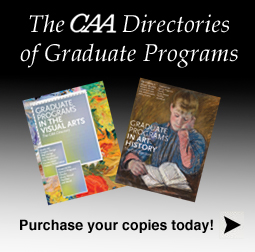 The next editions of CAA’s two directories of graduate programs in the arts will be published in an online format in fall 2011. First printed in December 2008 and January 2009 and still available for purchase, the CAA directories are the most comprehensive source books for graduate education for artists and art scholars, with program information for hundreds of schools, departments, and programs in the United States, Canada, Great Britain, and elsewhere worldwide. Colleges, universities, and independent art schools are all included.
The pricing structure for the 2011 online editions has not yet been determined. Each current volume costs $49.95—$39.95 for CAA members—plus shipping and handling. You may order them online.
Graduate Programs in Art History includes programs in art history and visual studies, museum studies, curatorial studies, arts administration, library science, and related areas. Graduate Programs in the Visual Arts describes programs in studio art, graphic design, digital media, art education, conservation, historic preservation, film production, and more.
For more information, please send an email to directories@collegeart.org.
Committee on Women in the Arts Picks for August 2010
posted by CAA — August 10, 2010
Each month, CAA’s Committee on Women in the Arts selects the best in feminist art and scholarship. The following exhibitions and panel discussion should not be missed. Check the CWA Picks archive at the bottom of the page, as several exhibitions listed there are still on view.
August 2010

Hilla Rebay, photographed by Eugene Hutchinson in her Carnegie Hall studio in 1935. Hilla von Rebay Foundation Archive, Solomon R. Guggenheim Museum Archives, New York (photograph by Eugene Hutchinson and provided by the Solomon R. Guggenheim Museum)
Hilla Rebay: Art Educator
Sackler Center for Arts Education
Solomon R. Guggenheim Museum, 1071 Fifth Avenue, New York, NY 10128
January 29–August 22, 2010
Hilla Rebay (1890–1967) was not only an accomplished artist whose work was exhibited across Europe, but she also served as the first director and curator of the Museum of Non-Objective Painting in New York, which then became the Guggenheim Museum. The exhibition Hilla Rebay: Art Educator, fittingly appearing at the museum she once led, highlights her underrecognized role as an innovative art and museum educator. With missionary zeal, Rebay gave talks in the museum and trained her staff on how to interpret the kind of abstract art the museum presented for diverse audiences. On view in the Sackler Center, the Guggenheim’s branch for arts education, are examples and documentation of her approach to pedagogy.
Women Only: Folk Art by Female Hands
American Folk Art Museum
45 West 53rd Street, New York, NY 10019-5401
April 6–September 19, 2010
Curated by Stacey C. Hollander, Women Only: Folk Art by Female Hands “evokes a girls’ club, a parallel and self-contained art world,” according to Karen Rosenberg in the New York Times. The exhibition, culled from the museum’s permanent collection, features painting, drawing, samplers, quilts, and more by American women of the eighteenth and nineteenth centuries. Artists range from anonymous younger women from colonial and revolutionary times, whose creativity prepared them for life in the home, to the portraitist Deborah Goldsmith, one of the few female painters in the 1800s making a living from her art. The subject matter in Women Only is just as diverse, covering ornamentation and commemoration as well as religion and politics.

“3G Summit: The Future of Girls, Gaming and Gender”
Ellen Stone Belic Institute for the Study of Women and Gender in the Arts and Media
Columbia College Chicago, Media Production Center Soundstage, 1600 South State Street, Chicago, IL 60605
August 12, 2010
Columbia College Chicago hosts a public forum on Thursday, August 12, 6:00–8:00 PM, as part of “3G Summit: The Future of Girls, Gaming and Gender,” a four-day program of workshops and discussions that will connect fifty teenage girls from the Chicago area with game designers and scholars for intensive dialogue, inquiry, game play, and mentorship. Moderated by the college’s Janell Baxter and Brendan Riley, this free panel features five women at the forefront of gaming theory and practice. Through talks and conversation, they will address intersections of gender equity, technology, digital platforms, and more. Speakers are: Mary Flanagan: artist, scholar, and author of Critical Play; Tracy Fullerton: game designer (Cloud, flOw, The Night Journey), writer, and educator (University of Southern California); Jennifer Jenson: scholar of gender and technology (York University) and game designer (Epidemic and Tafelmusik); Erin Robinson: game designer (Puzzle Bots, Little Girl in Underland, Nanobots); and Susana Ruiz: media artist and game designer (Darfur is Dying, Finding Zoe).
Empowering Women: Artisan Cooperatives That Transform Communities
Museum of International Folk Art
706 Camino Lejo, Museum Hill, Santa Fe, NM 87504
July 4, 2010–January 2, 2011
Empowering Women: Artisan Cooperatives That Transform Communities, guest curated by Suzanne K. Seriff, is the inaugural exhibition at the Museum of International Folk Art’s Gallery of Conscience. Visitors can examine weaving, beadwork, painting, baskets, embroidery, and other traditional folk arts from artists and artisans living and working in Africa, South America, and South and Southeast Asia. The new Gallery of Conscience, according to the museum director Marsha Bol, is “devoted to the examination of issues that threaten the survival of the traditional arts, bringing them to the attention of our visitors.” Empowering Women appears in conjunction with the three-day Santa Fe International Folk Art Market, which took place last month.