CAA News Today
Arming Teachers? Here’s What Our Members Think
posted by CAA — April 19, 2018
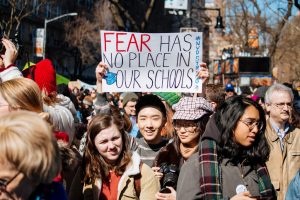
March For Our Lives demonstration, New York City, 2018. Photo: Mathias Wasik/Flickr
In the wake of the Parkland, Florida school shooting in February, President Trump proposed arming teachers as a measure to protect students.
We asked our members what they think about this issue, and got over 150 responses. Here is what they said:
“If teachers in colleges and universities were expected or supposed to be armed, I would leave academia. I don’t want to have to carry a gun to class. I have enough to worry about with teaching content, and creating a strong learning environment, without the added stress of something happening if a weapon were to misfire. Teachers should not be expected to be soldiers on top of being teachers.” — Meghan Bissonnette
“I am a faculty member and would never carry a gun, nor do they belong in a classroom with teachers. I think this is the thinking of a insane person who thinks arming teachers and staff with guns is the answer. I express total OPPOSITION to carrying arms.” — Cianne Fragione
“When I received my terminal degree in design, I never thought terminal would refer to taking someone’s life. I am not a sharp shooter. When a parent sends a child to school there is an assumption that the child will be safe. To put the educator in a policeman’s position doesn’t guarantee success. Outlaw the sale of assault weapons and secure the schools. It’s a much better solution.” — Ferris Crane
“I didn’t pursue my education or career goals with anything remotely like this in mind. We are scholars and educators, not police. The solution to this issue is not guns on campus, but the removal of all assault-type weapons from civilians. They have no place in our society. We also need to find a way to redefine what it means to “act like a man.” Too many innocents have been slaughtered because the shooters felt threatened and dismissed. Art educators won’t necessarily have the answers, but arming us is a risible solution from fools who believe in the tools of death and destruction.” — Bethanie Rayburn
“Teachers should NOT be armed. Their jobs are to educate; putting this burden on them is not fair, on top of the fact that most gun violence is accidental. Teachers and students should be concerned with learning in the classroom while their safety is secure via other means. Perhaps more resource officers on campus, metal detectors, better lockdown procedures and emergency notification systems, etc. More guns will not help the problem.” — Elizabeth Simmons
“I am absolutely against the idea of arming teachers. I would not trust myself or trust any other teacher to carry a gun and use it with poise. The liabilities are endless: is the school or teacher liable if gun goes missing? Who will pay for the insurance costs? If a teacher accidentally shoots a student what is their role in the crime?” — Katrina Chamberlin
“It should be an option for those who already have extensive weapons training or are willing to get it. They also must be aware that when law enforcement arrives, it may not be clear which side they’re on, and they must affirm their awareness of the risks of that situation. Being armed should never be a mandatory part of an educator’s job description, though. Trained professionals who are present exclusively to perform security duties are far more preferable.” — Jill F.
“No guns in school or university classrooms” — Victoria Dickinson
“Arming teachers and professors is a ridiculous idea. Our jobs are to teach, we shouldn’t have have to worry about an armed, troubled individual coming into our schools with a gun in the first place. Background checks need to be made more strict, and certain guns should be taken completely off the market. I can’t believe we even have to have this discussion.” — Margaret J. Schmitz
“Risk Management won’t let faculty climb ladders in my campus, but we are supposed to carry guns? The insurance alone makes this notion impossible to implement, aside from all the obvious reasons. I would refuse.” — Samantha fields
“I think it is ridiculous and a recipe for disaster. Teachers have enough responsibility as it is.” — Kira Jones
“The fewer guns in our schools, the better. The United States can and must change its culture of armed violence, beginning with its teaches and young students.” — Anne Higonnet
“Arming teachers is crazy: more guns does not make for fewer shootings. Think of the horrible accidents that will happen, as children are in spaces with guns and find out their teachers have them.
NO—this is a terrible plan by the NRA and the gun makers, to make their coffers yet more profitable.” — Penny Howell Jolly
“The idea of arming teachers is utter madness. Get rid of the ludicrous number of guns in this country—all of them except for police.” — Jayne Merkel
“Arming teachers is a terrible idea. Having guns in the classroom is antithetical to a productive learning environment and it only opens the possibilities for violence. This idea is so wrong headed that it is unspeakable. I would quit teaching before I would carry a gun at school and I would find a school for my children to attend that banned guns.” — Joni Kinsey Fields
“Making teachers responsible for the armed defense of their pupils is an irrational redefinition of their roles, and bringing more guns into schools is reckless. While it conceivable that an attacker might one day be thwarted by a well-trained and armed teacher, schools will be made less safe every day by the presence of additional guns.” — David Brownlee
“I totally oppose arming teachers. I will never carry a gun in my classroom.” — Jan Arabas
“We need fewer, not more, guns.” — David M. Sokol
“This is an outrageous suggestion by Trump. It is not a teacher’s responsibility to be armed to go to work. It is not their responsibility to shoot or possibly kill someone to protect students. Fighting fire with fire is not the solution here. In order to get guns out of schools we shouldn’t be adding more we should be making them harder to get.” — Corey D’Anna
“I think it is a terrible idea that will just add to the chaos and confusion of an active shooter situation.” — Anonymous
“Teachers go through extensive training to be teachers. They are usually overworked and underpaid. To suggest that a teacher can also act as a security guard and be armed is absurd. This is a scheme by the NRA and others (with Trump being complicit) to push the responsibility for these kinds of tragedies on to the backs of teachers. Never!” — Anne Glaros
“I am opposed to anything that would bring firearms into the classroom environment, where they could intimidate or potentially injure students and teachers. The risks posed by firearms significantly outweigh any argument for arming teachers. The classroom should be an environment defined by safety, consideration, and open debate. Not by weapons that could incidentally or purposefully be used to intimidate or accidentally cause harm.” — Greg Foster-Rice, Associate Professor, Columbia College Chicago
“It’s a horrible, horrifying idea. I do NOT want more guns in school nor do I want to have to use one EVER. An officer with one is fine.” — Kristin Osgood Lamelas
“It is not my duty to be fully trained to assess every situation for a threat and to respond with a weapon. My duty is to the education of my students and their well being. If there is an insistence on having individuals armed at school institutions, then there should be security officers hired specifically for the task. An educator can not be fully committed to their job if they are trying to do the work of two positions at once.
Not only are you threatening a teacher’s focus and ability to respond, but you are also putting the teacher/student relationship at risk. Students may not feel safe in a classroom where an individual in an authoritative position could “retaliate” at them and use lethal force. The same goes for schools that allow firearms to be carried by students (universities). Educators feel threatened that a student could retaliate if they are emotional about the outcome of a grade. Academics and law enforcement should be totally different departments so that there is no potential for legal violations.” — Whitney Bandel
“The more concealed or unconcealed weapons that teachers and/or students have on my campus, the less safe I feel. Surely the number of shootings would be decreased by decreasing the number of available weapons.” — BW-T
“Arming teachers would make no one safer but it would reinforce the insanity of the NRA’s campaign to turn the entire country into an armed camp. I especially share the concern of minority parents that if teachers were armed, school would become more dangerous for their children.” — Alan Wallach
“I strongly oppose arming faculty, as this will only lead to more gun death, especially accidental gun death. This call for guns in school should be taken very seriously. While some may label the call to arm teachers a “politically motivated distraction,” here in Kentucky the bills on the floor of our State Legislature right now (HB210 & SB103) are a deadly reality. These bills would mean that the University of Kentucky, where I work, would no longer be able to restrict guns on campus. A 2008 study showed that 89% of campus police chiefs think that guns on campus make it less safe. In a 20012/23 survey, 94% of faculty said they don’t want guns on campus and 79% of college students said that concealed weapons on campus would make them feel unsafe. However, despite how we at the university feel about guns and our desire for gun restrictions on our campus, we would be beholden to state laws sponsored by the NRA that force guns on our campuses. I am so tired of a small faction of gun fanatics and the greedy gun industry forcing us to live in a society where hundreds of people are killed or injured by guns everyday. ENOUGH IS ENOUGH!!! WE MUST STOP GUN VIOLENCE!!!
My statistics come from:
As an aside, if these bills pass in Kentucky, the university will have to pay for additional security measures on campus. Our budget is already stretched so thin and those funds could be used for scholarships, educational infrastructure, and faculty hires that would support our educational mission.” — Miriam Kienle
“I think you will lose a lot of teachers, as well as students. Most teachers will not be willing to do that. I wouldn’t. I would just teach online. Pretty sad. Anyway, shooters can just go to some other venue, and some may not mind a gunfight. We need to get at the real problem, which is access to guns, especially automated ones. Ban automated weapons. Raise the age limit to buy guns. Make more strict an in-depth background checks. These are the primary problems. This problem has been going on far too long without being fixed and we as Americans are really embarrassing ourselves in that we are more attached to our guns than we are to our children and college students.” — Stacy Berlfein
“The plan is absurd. Teachers are not police officers. Effective gun control laws that include thorough background checks, weapons insurance for gun owners, license renewal standards and banning of all high magazine weapons is a reasonable first step. Other nations do not have these mass shooting problems because they don’t privilege gun owners rights over the pursuit of LIFE, LIBERTY and HAPPINESS.” — Julia Morrisroe
“Absolutely not. Arming teachers would almost certainly lead to more student deaths, and after all, every student has seen their professor struggle to get the projector in the classroom to work – do you want that person to have a gun?” — Lindsay Alberts
“Arming teachers is a terrible idea. We don’t need more guns. I completely disagree with the idea.” — katlin Evans
“We should not be arming teachers. Teachers are hired to teach and that should be their focus, not to be a armed security force.” — Carol Schwartz
“The idea of arming teachers is asinine. It would (1) put an extra burden upon them, (2) not be at all effective, and (3) possibly lead to accidents. I am unequivocally opposed to it.” — Gina McDaniel Tarver
“I do not think teachers should be armed. I think semi-automatic and automatic weaponry has not place in civilian hands. Delay all gun ownership by at least 3 days, and register the owner and the gun. We never know if a sane person will kill, but if they have a gun they can in a heated moment. We are the most violent nation gun-wise. And the most immature in in using and regulating them.” — Phyllis Rosenblatt
“Arming teachers will likely result on more deaths as teachers try both to protect the students and shoot the killer. Police may find it difficult to distinguish between the gun holder who is the killer and the teacher. In short, it’s a bad idea.” — Anita Moskowitz
“Arming teachers is an absolute necessity! “Gun free zones” do not protect people. They only make the people in those areas sitting ducks–defenseless and easy prey for angry cowards. I am sickened by people who will not allow my children and myself and my students to be protected at school in this way. And, stop blaming the NRA for school shootings. CAA MUST advocate for all teaching (grade school and college level) to be allowed to conceal carry!!!” — Stephanie Chapman
“Arming teachers is a truly horrifying, incomprehensible suggestion. As a college teacher and former high school teacher it is glaringly obvious that this move would increase the danger to all parties and deteriorate, probably permanently destroy, the supportive relationship between teachers and students that is imperative for quality (or any) education.” — Darielle Mason
“I teach at a State University in one of the most conservative states in the Union where gun-ownership is ubiquitous. Our campus bans concealed carry – in fact, no one on campus are allowed to have guns. I have no doubt that there are a few secreted in desk drawers, but the policy is no guns. I believe arming teachers – even willing teachers with training – would result in a bloodbath eventually. Even police often shoot the wrong people in a firefight – the idea of encouraging one in a public school with crowds of children around is beyond stupid. Teachers and law makers must veto this ludicrous idea and look for real solutions beginning with banning and confiscating automatic weapons.” — Muffet Jones, Lecturer, Boise State University
“Arming teachers will only raise the level of danger in classrooms, as teachers are not mentally/psychologically infallible, security of the firearm cannot be maintained if said firearm must also be at the ready, and police or others are likely to mistake the armed teacher for the shooter.” — Jaleen Grove
“It is a dangerous proposal for a number of reasons.
- Anyone who points a gun must be prepared to kill. If not, they will risk the weapon being taken and used on them or their students.
- Classroom situations can get tense. There is much empirical evidence that the presence of a firearm actually escalates tensions. So the weapon becomes dangerous to teachers and students outside its use to defend against an armed intruder.
- My job as a teacher is to teach, not provide security. I am trained in emergency procedures and am a certified Black Belt in Taekwondo. This means I can help my students in an active shooter situation. It does not make me temperamentally qualified to use a firearm.
- I asked teenage students in my dojang what they thought about their principal having a gun. They were shocked by the idea, saying he already has anger management issues.
- There is scientific evidence that the more guns there are, the greater the amount of gun violence. Escalation, like any arms race, endangers everyone.” — Anne E. Guernsey Allen
“This is a dreadful idea. The possible consequences are dire. Imagine a teacher firing at an invader but hitting a student instead, whether a hostage or a student who was shoved into or fell into the line of fire. Teachers are not sharpshooters even if they are trained in firearm use. Imagine, too, the rare possibility of a teacher feeling threatened by a student, and then having the teacher fire his/her gun at a young person—something that cannot happen now. The possibility of a teacher being able to shoot an armed invader is small. The teacher’s first job is to save students by leading them to safety, not to take time to pull out a gun from a presumably secure repository.” — Carol Krinsky
“Teachers are not equipped to handle the emotional strain of shooting another human being. We got into this profession to help students develop and to expect them to be the ones responsible for shooting another person is absurd. In addition, having guns in classroom wouldn’t make all students feel safe. There are one that come to the classroom to escape the violence of their homes and having guns their could prove a distraction. Is the plan for the teacher is be locked and loaded? Or will it be stored in a safe in the classroom? Every time there’s a lock down drill, they go through the hallways sweeping for armed students? What would happen if we accidentally shot the wrong student? Also consider the logistics of how the guns would be issued and stored. What about the cost of training them. We struggle with funding just to deliver what is expected of us and the idea that there is money to train, store and arm teacher is ludicrous waste of money. I am against this ill thought out proposal.” — Sarah Merola
“No, I do not want to carry a weapon to class, nor do I want my colleagues or students with weapons on campus. This is an NRA driven idea to obfuscate the real problem and obvious solutions. It only serves to increase sales for gun manufacturers. Teachers in a classroom are not police officers or members of the armed services, nor should we be expected to behave like ones.
The stupidity of this idea is beyond my understanding. No individual needs to own military style weapons. All the data from other countries proves removing them reduces the violence. It may take a generation or two for these weapons to disappear from our society, but that is the real solution. I fear none of this will really change until we remove the money from elections. It’s time to stand for public funded elections.” — Ada Pullini Brown, Professor of Painting & Drawing
“It is dangerous. Just last week a high school student in MA managed to fire a policeman’s pistol in its holster–in the classroom. Teachers, like airline stewards, will be called on to protect students and need to be drilled in emergency procedures. Don’t let us be distracted by this–control access to assault weapons” — Madeline H. Caviness
“A terrible, counterproductive idea. More guns will mean more deaths, including lots of accidental ones.” — Joshua Shannon
“Any suggestion of arming teachers neglects to address the real issue here- the ease and access of anyone to purchase automatic weapons. Until the government takes a stand by passing gun control legislation, this epidemic will continue to worsen.” — Martina Shenal
“I think arming teachers is a dangerous proposal. If there is a shooter and everyone pulls their gun – who is to say a teacher won’t shoot a student by accident? And when the SWAT team arrives, how will they know who is the good guy and who is the bad guy? Law enforcement might target the teacher instead of the attacker.
I would prefer (though I do not advocate) armed security in school buildings over armed teachers – let’s let everyone be experts in their field. I feel like arming teachers follows the contemporary attitude of “everyone’s an artist” or “who needs professional expertise?” trend, when, in reality, not everyone can be properly trained and equipped for every situation, whether that is painting a pleasing picture, or protecting students from an attacker.
School safety should involve in-depth training on a variety of situations: medical, mental health, violence between students, violence against students, non-violent crime, vandalism, etc. Professional security forces will have the time and budget to deal with the possible outcomes and ramifications of all these situations: professors have neither time nor budget to receive this level of training.
The teachers who saved students lives in recent shootings did so by ushering them into back rooms, out of doors, etc. Had they been holding guns they would not have been able grab students and pull them to safe places. Pulling a gun might have hindered their ability to get students out of the way of harm. Teachers are already protecting students WITHOUT using guns- by thinking fast, solving problems and guiding students, as they do every day in the classroom.” — Michelle Paine
“I think that arming teachers would result in more gun violence incidents, an increase in casualties resulting from those, and ultimately a less safe environment for everyone. Guns have no place in civilians hands on schools and campuses. If the President and the NRA are genuine about increasing safety, they should form their recommendations on what our law enforcement professionals and our teachers recommend.” — Emir Bukva
“I can’t think of a worse “solution” to the problem than this. For one thing, how many teachers would want to be armed, or would be capable of being so responsibly. How would law enforcement be able to tell the difference between an armed teacher and a armed assailant? What should be happening is a unified effort to stand up to the NRA (or, really, that portion of the NRA that is actually opposed to any kind of sane gun legislation), Trump, etc., to control or eliminate the circulation of automatic or semi-automatic military-style weapons, and to control gun access more generally speaking in this nation. Responsible gun owners don’t have to fear any of this.” — Bob Haskett
“Our schools need funding for scholarships, for resources, for supplies, for salaries, and for research. We do not need any more money put towards arming ANYONE in this country. I can’t believe I even have to voice my opinion on this issue. I do not want to teach in any environment where a deadly weapon is present. The arming students or faculty or staff will prevent the free expression of thought and expression, and do nothing to protect us.” — Janine Polak
“I am strongly against it because teachers should not have to wield guns if there is a shooter, they are not professionals like law enforcement and it would create a negative atmosphere in the school if teachers or staff have guns.” — Jill Carrington, Professor of Art History, Stephen F. Austin State University, Nacogdoches TX
“No teacher should be required to “protect and serve,” however, if a teacher felt impelled to have a firearm to protect her students, I don’t see a problem as long as students’ families were made aware of it. It is as dangerous as it is safe. If someone is trained and comfortable with a firearm then it can be safer but it can be potentially more dangerous with an unwilling or uncomfortable party. Different communities should have the choice in whether they want firearms implemented into their schools. While guns are a big debate, I cannot think of a more qualified gun owner than an educator who has gone through background checks and loves and cares for the future of our children, but protecting them with a gun should not be a requirement.” — Alyssa Moon
“I think the proposal is not simply ridiculous, but very dangerous. It is evident that is not by adding more weapons that you can solve the problem, but the other way round.” — Matteo Bertelé
“I’ve always wondered how arming teachers could possibly help and tried to imagine for myself a scenario of protection. For it to work, you enter the classroom, pull out the loaded weapon and train it on your students, or available entrances for the entire class. That would be the only way you could catch the determined perpetrator before they caught you. Surely any gun carrier, intent on harm, would take out the armed teacher first to protect her/himself.
Imagine the art history lecturer in a darkened room. Harder to detect entrants, students in the classroom with weapons, and you certainly couldn’t compromise your vigilance with focusing on a slide, to point out salient features of an image. That practice was at the heart of our teaching enterprise, or, perhaps not the NRA tells us.
I vote no.” — Ellen Wiley Todd
“A Disgrace, like everything proposed by this administration and its enabling voters and congressional members, which are gutting our formerly effective government and its institutions. Continue your active protests! Some professional societies shy away from speaking out. I am very glad you and the AHA do not.” — C. M. Pyle (Life Member)
“I absolutely do not want guns in my classroom. I don’t want a gun and I don’t want students carrying guns. The issue is not about hardening our classrooms or schools; the issue is that American culture that is permissive about guns and about violence broadly. “Gun control” should really be replaced with “no guns”; I realize this is a non-starter but more guns in the mix (as in arming people in classrooms and schools) is not the solution.” — Jennifer Germann
“I was hired to teach. If I was interested in carrying a weapon I would be in the military or police work. I live in a state that loves its outdoor sports, including hunting. There are enough guns already in this country. If people understood the politics of academia you don’t want us armed. I’ve sat in too many meetings where tempers flared. There is no reason to have assault weapons. Do you really think a hand gun could stop someone with an assault weapon? Would we really be able to shoot someone that may have taken our class? Instead of arming faculty let’s provide a safe environment where we don’t need to discuss our safety plans in case a shooter arrives in our buildings. Students are anxiety ridden, they live in a country that allows these things. Students stated to me that guns are too much in our culture to do anything about it, and I reminded them that smoking was too, and nowadays it is hard to even find a smoker. We have changed the culture for smoking, we can change gun culture too.” — Diane Bywaters
“We don’t need more guns, we need gun regulation. Teachers need to focus on teaching.” — Satri Pencak
“WE SHOULD ABSOLUTELY NOT ARM TEACHERS. To even entertain the discussion is in some ways to move the “normal” needle that much further to “crazy”. TEACHERS DO ENOUGH. THEY STAND IN FRONT OF BULLETS. DO NOT ASK MORE OF THEM. They are maligned, overworked, underpaid. My partner is a teacher educator and also made the point that to arm particular teachers (teachers of color), would be to ENDANGER THEM MORE in our country, where even being black or brown and being “suspected” of having a weapon on you can get you killed by law enforcement. DO NOT DO THIS. DO EVERYTHING in CAA’s power to stand up IN SOLIDARITY WITH PUBLIC SCHOOL K-12 teachers. Thank you for asking.” — Chris Barnard
“Arming teachers in schools may be the worst, potentially most harmful, disgustingly politically-motived move Trump has made yet and I hope the CAA will join in strong opposition against it.” — Dr. Jan Cavanaugh
“Arming teachers/professors? A misguided notion indeed!!! Proposing that teachers shoulder this burden obfuscates a deeper truth: That putting the attention on arming educators to halt this growing public slaughter of innocents (arguably a horrible consequence of this country’s tsunami of “civil” weaponry) simply ignores a deep and very dangerous social and cultural insanity. Is it not delusional thinking to progressively and systematically diminish support of our mental health AND our educational systems in this country while steadily increasing the number of firearms?! And, where is there ANY evidence to demonstrate that this proposal could possibly lead to greater public safety?!!!” — John R Blosser, Professor of Art Emeritus Goshen College, IN
“No. I do not think this is a good idea at all. We need less guns not more. Why should the message be that things are so dangerous that you have to arm your teachers? That is ridiculous. No to arming teachers. This is the NRA and GOP pushing their agenda once again.” — Tara Spies Smith
“I think this is an awful idea. I will begin looking for another career if if my university allows firearms in our classrooms.” — Carol Magee
“Everything Trump does is ridiculous and dangerous” — Dr. Jean Bundy (38144@alaska.net)
“Arming teachers and school staff is an absurd idea. I totally object to this suggestion. The Congress and the White House should take their obligations of protecting the citizens of our country serious and enact strict gun control.” — Maria Palazzi
“This is obviously a TERRIBLE idea, one put out merely to deflect attention from the reality of the benefits of smart gun control legislation. IF, IF, IF it were true that more guns in the hands of adults in crowded places would make everyone safer, then surely the Republicans in their own 2016 Republican National Convention in Cleveland should have allowed adults to carry guns into their crowded Convention hall, right? In fact, they did NOT allow guns in the main Convention hall, of course!
See Time magazine’s report on this fact: http://time.com/4399500/republican-convention-guns/ . Here is just one relevant quote from the Time article: “Dean Rieck, executive director of the Buckeye Firearms Association, told TIME that in this situation ‘it may not be wise’ to bring firearms along. He added that no serious gun rights group is advocating for that.” So, President Trump, most Republican legislators, and the NRA all now say that they think that it is a good idea to let more guns into public schools, BUT when it comes to their own meetings “no serious gun rights group is advocating for that” at the Republican National Convention itself? Why not? Safety perhaps? Obviously, no one in the Convention hall wanted to deal with a crazy person shooting dozens of people with an assault weapon. The benefits of banning guns at the Republican National Convention hall are as obvious as the benefits of banning guns from public schools.
We ALL need to get serious, like Dean Rieck stated in the Time article. The idea to arm teachers is NOT a serious idea: it is a crazy and TERRIBLE idea.” — Anonymous
“What if a teacher is wounded or killed and a Black student picks up the gun, what if the teacher is Black and the police open the door to her or his room, sees someone they don’t know with a gun aimed at them, it will be a shootout and someone will die, including more than one person. If a student is Black and picks up the gun, the police won’t know whether that person is the shooter or not, that student is likely to lose their life. With each teacher in a room aiming a gun at the door, how can the police know who is a shooter and who is a teacher. I see nothing but violence in this picture. Teachers need to teach and the police have to do their jobs. They need to have stronger security doors at the schools. Each teacher knows his or her students and can meet a lineup of their students in the morning and bring them into the school. All others must go through security at the office. Since Trump and the NRA deem that schools are a target because they are gun free zones, how about congress and the whitehouse. Aren’t they too gun free zones. Why can’t congressional members carry guns, why can’t visitors carry guns. We need to ask congress these questions and the whitehouse too.” — JQTS Smith
“As a former middle and elementary school teacher, now visiting assistant professor, I find this proposal to be alarming, preposterous, and downright terrible. I grew up in west Texas (in a very small town) so grew up with guns. They terrify me — a classmate of mine was accidentally shot and killed by his friends while they were out hunting at the age of 16. I know guns have absolutely no place in our schools. As many military professionals have said, shooting a gun and using it to combat someone who wishes to do you harm are two very different things. It takes years of training and active combat to be able to stand in the face of such terror. Even trained professionals, like the peace officer onsite, refused to confront the shooter within the school. I imagine he’s had more training than many teachers. Teachers should be free to teach and lawmakers should stick to their jobs as well – to make laws to curb gun ownership, especially assault-style rifles, and to support a school environment that is safe for all.” — Victoria
“It’s a terrible idea and I oppose it. As with guns in homes: the likelihood is far higher that a gun on school property will be stolen, used to commit a crime, or misused in a way that will cause an accident, injury, or death than it is the gun will be used to stop a school shooter. And even a well-trained teacher is likely to hurt students and bystanders when trying to use a gun in a chaotic, crowded situation.” — Sarah Miller
“I am a retired teacher living a few miles from Parkland School. Giving guns to teachers is unacceptable. They have enough responsibility already. Never.” — Elaine Abbe
“I hate the idea of militarizing our schools and campuses, it is the complete opposite of what should be done to deal with America’s gun problem.” — Rachel Silberstein
“The very fact that there is even debate about such a ludicrous suggestion demonstrates the depth of rot and insanity in this country and culture. We are doomed.” — Janet Grossman
“Teachers are in the classroom to teach. No way should we be expected to defend our students against an armed attacker bearing an automatic rifle. Schools should arm some of the security guards, after seeing that they are fully trained to use their weapons.” — Mary D. Edwards
“I think that arming teachers is a horrifying idea. The relationship between teachers and students, especially minority students, should be based on trust. A firearm would not only jeopardize that, but it would also create potentially life-threatening situations. It seems to me that the proposal of arming teachers is a way to please NRA by politicians who receive donations from this organization. Arming teachers is not a solution, but it will create more problems.” — Agnieszka Szymanska
“This is insanity. NO.” — Susan Swanson
“NO GUNS IN OUR CLASSROOMS! The same for P-12 schools + colleges and universities. Arming teachers is NOT the answer to the problem of gun violence in our schools. Reducing the number of handguns in America and regulating them is the answer. Look at the rest of the world where there are fewer guns: far fewer incidents of gun violence. The math is easy on that side of the equation. The math falls apart when it comes to Congressional votes.” — Gregory W Shelnutt
“This is a terrible idea. The classroom is a place where all students, teachers, and visitors should feel safe, and the presence of firearms makes the classroom less safe. Whether or not such devices might be used to end attacks, they have the potential to cause grave injury, intentionally or accidentally. Furthermore, the idea that law-abiding citizens should take on the role of vigilantes, or should be asked to make split-second decisions in life-or-death situations, is fundamentally at odds with the kind of society that I want to live in, or that I want my students to live in. Even when police officers – trained law-enforcement professionals – shoot people, the situation is often highly controversial, leading in some cases to rioting and fundamental questions about fairness and justice in our society. Why would we want to ask educators to be in such a position?” — Kathryn Gerry
“Utterly reprehensible idea.” — J Gonzalez
“Terrible idea. It is not just teachers who think it is a bad idea; law enforcement and people with military background also think it is stupid. It is no part of a teacher’s job to be an armed guard and in any case, the evidence is strong that in most cases additional shooters on the scene would be more likely to hit bystanders or get shot by first responders than they would be likely to take out the perpetrator. Many studies have shown that more guns lead to more gun deaths. I am strongly opposed to allowing any weapons on campus except those carried by trained law enforcement personnel. If universities start allowing students and/or faculty to have guns on campus, I am going to quit teaching.” — Anne-Marie Bouche
“Unequivocally a terrible idea to arm teachers and eventually professors too.
- we are all humans and some of our ranks are bound to “lose it” now and and then. What then? If the teacher is armed the consequences would be staggering. The psychological trauma would be exacerbated by the added factor of betrayal by a trusted teacher.
- the risk that if the gun is present in the classroom, on the campus etc. then it goes without saying that there is a risk if it getting into the wrong hands, be it students or otherwise.
- The power balance in the classroom would be detrimental to educating. It essentially would make every interaction about threat assessment. If this rule is enacted, then we will be creating a generation of young people, children who will never feel safe anywhere. One cannot hope to educate in a setting where the focus no longer is teaching and learning.
I am so beyond words, the feeble ones above are my attempt to add to the discourse what my biggest fears are in addition to every argument that is already out there regarding the inappropriateness of this idea of arming teachers. The idea that teachers of color would become instant targets – valid I think. The fact that teachers as a majority are against the idea – logical. The fact that student could get caught in the crossfire and actually could end up accidentally shot by a teacher – imagine the fallout of that?! There is not a single argument that you could present me with that would make arming teachers a good idea. The whole scenario is out of hand!” — Line Bruntse, Associate Professor
“I think it is absurd! The solution is more gun control, not handing out guns. If we had more control over who can purchase guns then we would not need our teachers and librarians to have guns in the classrooms.” — Nicole L
“Absolutely not. Our public safety officers are not even armed. Perhaps we should consider that before a free for all with guns in the classroom.” — Jenny Hanosn
“I was hired as a teacher. Not as a paramilitary.” — Carla Lord
“I do not support teachers being armed in colleges and universities. Statistics demonstrate that when guns are present in an environment, the risk of being injured by the gun increase. Law enforcement officials and combat veterans often explain that even with extensive training active shooter situations are difficult and individuals do not always behave as expected. Instructors with guns could confuse organized responses to active shooter situations and put themselves or their students in danger. Further, they may create a false sense of security. Instructors with guns would raise the chances of accidental injury or death. Guns do not equate safety.” — Kelly Wacker
“Arming teachers/professors is a terrible idea, about the worst I’ve heard in relation to the gun-control issue. We need fewer guns, not more. As a professor, I would not be comfortable carrying a gun to class–it’s ludicrous. More teachers would end up being killed Not to mention that I would have to go through training to learn how to use one. And teachers have enough responsibilities as it is.” — Sarah Mahler Kraaz
“I am opposed to teachers carrying guns in the classroom.” — Margaret Samu
“Arming teachers will increase not decrease risks of gun violence. The only way to end gun violence is to limit gun access. Statistics comparing US gun violence with the rest of the world should suffice as evidence.” — Anonymous
“This is one of the single stupidist ideas I have heard. Ever.
Get rid of the stupid guns, don’t put them in the hands of more untrained, underpaid and overstressed citizens.
Teachers are trained and paid to teach, let them do that. Put the money this would cost into education. How many teachers buy school suppies out of their own money? Will they have to buy guns and ammo too?
Why should teachers have to bear that stress on top everthing they must deal with? Who is to say some teacher wont misuse this power at some point as well? Then what? Who will the guns be put in the hands of next?
The President may fancy himself as a hero who would go into a school during a shooting incident, but really, what is more likely: him saving the day, him getting shot, or him saving himself with a human shield?” — Anonymous
“The notion of arming faculty divides people and diverts attention from regulating and licensing guns, and banning high capacity magazines and assault weapons. Guns are not allowed in the halls of Congress or on board a commercial jetliner, and they certainly do not belong in my lecture hall, seminar room and studio. I lived and taught as a Fulbright Scholar for a year in Australia, and I have never felt safer and more secure. The reason, Australians sensibly regulated weapons after the Port Arthur massacre.” — Timothy Nohe
“This is a terrible idea. The only solution is to block guns from schools, not to add even more.” — Anna Russakoff
“Arming teachers is a horrifying idea, for teachers and for their students. Teachers are partners in our students’ education, not prison guards. Our students need to trust us as their mentors and partners in their education, not fear us as enforcers. This issue is particularly fraught for students and teachers of color. Our schools are not prisons and they never should be seen as such.” — Kristina Arnold
“NO!” — Sara Greenberger Rafferty
“Not only is this proposal a terrible idea given classroom safety concerns (and in assuming most teachers are willing and physically able to use a firearm), it’s reprehensible to expect any educator to take on this responsibility. What kind of ethical and moral territory do we enter when we ask teachers to be burdened with the possibility or obligation of killing one of their students?
We must also recognize the very real power dynamics in many classrooms and schools — with instructors/administrators positioned as unquestionable authoritative and antagonistic figures — and consider how this would only further alienate students in their own educational experiences, or create an environment that cultivates further abuses of power or control.
This proposal is myopic and cruel, and I oppose it in every way.” — Stephanie G.
“When this idea was proposed I thought they were kidding. I thought, “It’s another ridiculous idea from he who has never been in the trenches with the teachers.” Another hair-brained Trump idea. Why in the world would I want to carry a gun? Would I want a teacher next door to have one? No. If there is a deranged student in my classroom and I have a gun—even if I knew how to use one—s/he could disarm me and shoot us all. It’s the most absurd idea this White House has come up with yet. It makes me shudder.” — constance moffatt
“Bad idea” — Karen Wilson
“I strongly believe that the US needs less firearms of every kind, especially in public spaces. Allowing teachers to be armed in classrooms is not the way to prevent mass shootings and the accompanying fatalities. Instead, it would only serve to further normalize the current gun culture which lauds the idea of nearly every citizen carrying a deadly weapon with little to no regulatory oversight.
Teachers are there to help make our children more knowledgeable and inquisitive world citizens, for which they are both poorly paid and supported in many states. We should not expect them to take on the responsibility of protecting our children’s lives against dangerous threats by means of firearms as well. Instead, we should demand that our government enact meaningful gun legislation which protects all citizens, including those who are most vulnerable.” — Teresa Kilmer
“A terrible idea. Guns don’t belong in the classrooms of schools, colleges, or universities, or the grounds of these institutions. Give us gun free zones, secure classrooms, and better mental health services. Give us stronger gun control with universal background checks, 21 as a minimum age, a ban on rapid fire weapons and bump stocks, and no loop holes. Give faculty and teachers the ability to issue an alert that a student is a potential threat so that they will be banned from buying guns. But don’t arm us. That will undermine learning and won’t make anyone safer.” — Emily Kelley
“Please tell me this can’t happen. Guns readily accessible? For persons whose job is to lead children/college students to safety…and whose job is NOT, cannot ever be expected, to have a shoot out in the school corridors. This is nearly as poor an idea as allowing college/university students to carry guns on campus. In re the latter, has no one ever heard of that small, undeveloped lobe until 25? I’m absolutely opposed. NCW” — Nancy Coleman Wolsk, Lexington, KY Emerita, art history Transylvania University
“This is not a good idea.” — Jacquelyn Clinton
“No, teachers should not be armed in colleges or universities or any school. It is yet another a bad idea voiced by an unfiltered and irrational president.” — Kenn Kotara
“This hits home for me, as a Florida resident. Our legislature has just passed genuine gun reform raising the age, adding a waiting period, banning bump stocks, and providing mental health funding. This is a victory against the NRA, and for the students of Stoneman Douglas High School. Nevertheless the bill also includes a provision for a $67 million voluntary school “marshal program” to train and arm “designated personnel on campus.” President Trump says we need to “harden” our schools. That represents a devastating acceptance of violence, and in particular gun violence, as a norm rather than an aberration. I strongly oppose guns in schools. The arming of staff, administrators, librarians, athletic directors, etc. etc. serves only the goals of the NRA, the gun lobby, and gun manufacturers, to sell more guns.” — Karen J. Leader
“Guns in the classroom will only exacerbate the situation. The presence of a gun increases exponentially the likelihood that someone will be shot. With good reason, African American parents fear their children will be shot by pistol-packing teachers. This is a “solution” originating with the NRA and being advanced by right wing politicians. The only real solution is to reduce rather than increase the number of firearms in circulation. We could begin with another ban on the sale of assault rifles.” — Alan Wallach
“This is a terrible idea. As a professor I have so many other things to worry about and having a weapon will not make me or my students safer. It will make us more vulnerable and terrified.” — Dr. Stefanie Snider
“As a contingent faculty member, I already do a tenure-track professor’s job for what barely amounts to a living wage. I refuse to take on additional unpaid labor as a security guard. Our politicians should be granting funding to academics to study gun violence and passing laws to keep guns out of the hands of criminals, not leaving us to fend for ourselves while undercutting our ability to do our jobs at every turn.” — Sarah Beetham
“Arming university and college teachers is a horrible, short-sighted idea to deal with school shootings. It isn’t a real solution, but a twisted attempt to sell more guns. More guns does not equal more safety. I am qualified to teach, not to wield a gun in an emergency situation- I don’t want that responsibility, nor do I think it appropriate to ask it of me. Smarter gun laws are the only solution to this public safety crisis.” — Catharine Wallace
“This is a TERRIBLE idea.” — Linda Kim
“I am against guns in the classroom.” — Victoria Delaney
“Teachers should NOT be armed in schools. All educational institutions should be gun-free. These measures only exacerbate the alienation of minority students (by ethnicity, LGBTQ status, religious beliefs, socioeconomic level, etc.) and could devolve into tragedy. It’s also inadvisable for more citizens in this country to be armed when the police, whose members are supposedly trained to de-escalate situations, suffer from lack of discipline, cool judgement, and problem solving skills.” — Andrea Iaroc
“Everyone should oppose this.” — Alejandra Gimenez-Berger
“If a voluntary program for certifying and training teachers in the effective use of defensive weapons were implemented, it could serve as a deterrent for any would-be shooter. However there are of course drawbacks. If much thought was given to a training program, and not just implemented as a piece of feel good legislation it may have a high rate of success.” — John H
“This is an absolutely horrible idea. No guns should be allowed on any campus except for law enforcement officers.” — Jennifer Shaw
“As a university professor, I am vehemently opposed to the presence of guns on any educational campus, primary school through university. Beyond the folly that arming educators somehow makes the school environment safer is the gross imbalance in power that weapons possession enforces, which is contrary to the open, safe spaces of the classroom and the trust that ideally should exist between teachers and their pupils. I will refuse to carry or use weapons, and I will fight to keep weapons out of my classroom and university campus.” — Allie Terry-Fritsch
“Imagine qualified individuals turned down for a teaching position on account of poor marksmanship.” — Margaret Armbrust
“Armed teachers do not belong in any classroom in the USA” — Faith Pleasanton
“To suggest arming teachers is to concede mass murder with automatic weapons is the new normal. Let’s get rid of the weapons, and it can be done. We pass laws all the time. The number of weapons in circulation is misleading because a large percentage (30%+?) own thirty to seventy weapons each.” — Edward J. Olszewski
“Absolutely not. What a daft idea. It will cause more harm than help. This is not the way to combat the scourge of gun violence that has gripped our nation. I vote NO.” — K. Andrea Rusnock
“I do not think that college/university faculty should be armed. College/universities typically employ security staff who handle security issues.” — Suzanna Simor
“The idea that teachers and professors should/could be armed is a terrible idea. Now retired, I was no longer teaching when the Arkansas legislature, in its wisdom, made concealed carry weapons legal on university campuses. When first proposed ALL campus presidents objected and wanted to opt out. Subsequently, the legislature made carrying permitted weapons not only legal, but uncontested.
More guns make situations more dangerous, not safer. Police no longer know which person with a gun is the criminal.” — Jane Hetherington Brown
“It’s a terrible, terrible idea.” — Martha Dunkelman
“I vehemently oppose to the proposal to arm teachers. It essentially turns our schools into war zones. It naturalizes the presence of guns and teaches our children to combat violence with violence. It will also provide huge revenue for the gun manufacturers and enable NRA to be even more powerful.” — Jocelyn Chen
“NO! I think this is not in the best interest of the educational community. Arming teachers serves only to legitimize guns as an answer to multiple social-economic-mental health issues. The winner of this is the gun industry and their voice in Congress; the NRA. Armed guards, yes; they are what they are. Teachers, teach.” — Roland Salazar Rose
“This is a dangerous proposal that literally brings guns into the classroom by people who will not be, and never be, fully prepared to use them (as deterrents or fatally) against their intended target: their students. Although some educators may have a facility in marksmanship or become certified to handle such a weapon, their primary job is education, not security, and even trained professionals have accidents (like just yesterday in northern California), have their weapons stripped from them by determined attackers, are caught of guard, or actually commit gun violence themselves. Rather than bringing in more guns into the classroom, it makes more sense to make it harder for any gun to enter the school generally — which is to say, the real policy initiatives should be toward making requirements for gun ownership more sensible (age minimums, waiting periods, background checks and national registries, and proof of ability, IE need to prove my ability to drive to get a driver license, but I can buy a gun without ever having shot one before, how is that so?)” — Nicole Scalissi
“A very bad and unconscionable idea!” — Samuel W Kochansky
“Where there are more guns there are more gun deaths. If arming for self protection worked the USA would be the safest country in the world. Toronto Canada, the same size as Chicago had about 60 gun homicides last year. Chicago had over 400. If you compare the rate of murders without guns in Canada and the US the US is slightly higher. The rate of murders with guns is 8 times higher. Americans should give their heads a shake. Arming more people, regardless of the intent, will result in more dead children. Period. And given that half the guns recovered in crime in Canada are smuggled in from the US it will result in more dead Canadian as well as American children. It is ironic that in a country that prides itself in guarding democracy the NRA has bought so many politicians.” — Wendy Cukier
“Arming teachers is a spectacularly bad idea. Schools are spaces of learning, not militarized zones.” — Sheila Crane
“More guns on campus, especially in the hands of those whose everyday business is not to protect others with access to fire arms, is not an effective component of the solution to gun violence on campus.” — Professor Ed Mineck
“Allowing guns in school in any form is such a ridiculous notion it is hard to imagine working in an environment where educators are encouraged to bring guns to work.
The problems that may occur:
1) Mad/Mentally ill/depressed student steals the gun and shoots teacher or other students. How are guns going to be secured/locked up in the classroom?
2) Mad/Mentally ill/depressed teacher shoots the students, other teachers or administration. It happens.
3) Gun is accidentally discharged by teacher or student. My brother-in-law accidentally killed himself with his own gun when he slipped on ice with a loaded gun.
4) A climate of intimidation and fear in the classroom because of the knowledge that the teacher has a gun.
It is not a matter of self defense. Video games have taught kids that a character with a gun is a entity to be challenged. School shooters are not going to be deterred by teachers with guns. They will target teachers with guns and find it a challenge to kill them before the armed teachers kill them. Its a game.
The whole situation is a bigger problem that is not being addressed. There is an increase in mental instability of the students we serve. This has become very apparent at all levels K-12 and college level. Why? and how can we deal with this problem? Art classrooms are in a unique position because students reveal their inner thoughts and the issues they face through the work they produce either orally or visually.
Recently one of my students was so depressed and despondent that I reported it to the college authorities because of my concern of possible suicide. They told me there were walk in hours at the Counseling Center and I told the student she should go there. She told me she had been there many times and as recently as the day before and that it only made her more depressed to talk about her issues. So what do I, as a teacher, do next? I had a graduate student that would occasionally become violent and irrational and “flip out”. We had to call the police a few times in fear of him hurting others or himself. The police talked with him and called a medical professional to adjust his medication but he was right back in school the next day.
My suggestion is NOT to arm teachers but to address the bigger picture:
Kids are being raised in a world of instability, fear and hate. Many are not getting the nurturing and love they need at a young age because of a number of reasons. Many are born with mental illness via genetic heritage. These kids are forced into the mainstream and are often alienated and bullied. Over years of enduring this type of treatment, these individuals become angry and want revenge. Bullying in schools runs rampant and can adversely affect kids’ entire lives. We need strict enforcement of respectful behavior towards one another in the schools. Of course that brings up the issue of good role models which unfortunately our current government does not portray and the trickle down effect is making its way into the classroom.
Anyone that wants to shoot other people, obviously, has emotional/mental illness issues. Deal with the mental instability epidemic and you reduce the possibilities of school shooting and other irrational violence. Deal with the bullying problem and you reduce the angst it creates.
Let’s quit looking for the bandaid to cover up the festering wound. Let’s address the source of the problem.” — Bonnie Mitchell
“I rather move to another country that has sane gun control. Police, military and National Guard have the professional training and the team support to handle guns when necessary if at all. Nobody feels safe today next to an isolated non professional with a gun, specially in urban or areas or mass events. Moreover, the prefrontal cortex, that is, the part of the human brain that deals with judgement, matures on average until age 25: guns need to be as far from schools and Universities as possible. I know it seems like an uphill battle in the US gun porn consumer society, but we need to move guns away from civilian life and all public places, not just music concerts. Guns are either irrelevant as tools for freedom, or obsolete as tools for safety. Guns exacerbate racism also. They only deceive bullies into portraying themselves as sane heroes, which is a dangerous delusion. Education and guns do not mix, and civilized public life is beyond guns. Please CAA, make this statement as clear as possible while we still can.” — Julieta Aguilera
“I am appalled and terrified by the proposal to arm teachers with guns. Guns cause deaths. They should be kept out of people’s hands. All people’s hands. I do not want to read in the news about teachers killing students or students killing teachers or any other scenario that will happen if guns are given to teachers.” — Christina Neilson
“It is ridiculous to arm teachers, who are not experts in firearms and policing. Really the important thing is to regulate guns and get rid of these killing machines. The proposal increases the need for guns, so is very profitable for those businesses who support the NRA. Yes, just what we need is more guns!
However, if we are expected to become armed to protect our campus, we should be trained like undercover police officers and pull an additional overtime salary for doing so—I.e., we should be salaried and should have the pensions and benefits police officers do—this would be very costly as they generally get paid better and retire earlier. You don’t just put guns in the hands of inexperienced individuals and you don’t expand the job description of a full-time employee without due training and compensation.” — Anonymous
“Teachers need to be contemplative, to see all sides of the issue. These qualities do not serve police well.” — Diane Wolfthal
“Arming teachers – ie providing more guns in circulation (!) is not the answer – reducing access to guns in the ANSWER” — Paul Donnelly
“There are so many issues with the idea of academics being armed and expected to assume the responsibility of counter terrorism. I cannot but visualize the repercussions if the few that think this is a good idea are allowed loaded sidearms in the classroom. Schools and Universities of all kinds should remain gun free zones – armed trained guards who’s sole responsibility and attention is to be vigilant and respond in an emergency is rational until the level of available guns in the community drops. No. Just no. Will we next arm every person behind a register? every employee at public events?” — Kathryn Carlyle
“As a professor of art history, a teacher, I would never want to be responsible for a firearm at work. I would feel less safe knowing there was a gun in my classroom. At my job, I am required to be acutely aware of facts, critical thinking, knowing what my students are understanding or confused about, and always thinking about how to present material in a fresh and meaningful way. I am too busy to worry about a gun. Moreover, I would look for another job if I were required to carry a weapon to do this one.” — Anonymous
“I totally agree that the proposal to art teachers is a distraction on the part of NRA. W@e badly need gun control reforms, and I suggest voting in politicians not “purchased” by NRA – who think like you do” — Kyra Belan
“This proposal by 45 is politically motivated and influenced by the gun lobby and not a good idea. I’m against it.” — Bryan Melillo
“Arming teachers is absolutely not the solution to this problem.” — Colleen F.
“We should absolutely NOT arm teachers.” — Colleen F.
“I am a gun owner. Teachers should not be armed in colleges and universities. Carrying guns for self-defense requires ongoing training (even trained experts screw up), it puts a band-aid on the real problems related to gun in the US, and it turns the education profession into a Wild West fantasy with real-life deadly consequences.” — Anonymous
“I would not want to work in a place where teachers could carry firearms. Volatile situations are not helped by additional weapons. I cannot imagine the nightmare combination of panicked students, faculty, and flying bullets. It’s absolutely a ludicrous proposal.” — Laura Crary
“I am strongly AGAINST teachers being armed in colleges and universities. Statistically, firearms cause far more deaths from accidents than from deliberate attacks; students would be far more likely to be maimed or killed by the gun-holding teacher him- or herself than by an armed attacker. It’s unlikely that an instructor with a weapon would be able to engage in a firefight with an attacker to defend a classroom without also injuring students and other bystanders. Even highly-trained soldiers say that a firefight is a chaotic situation–imagine how much more chaotic it would be if the classroom’s “defender” was an amateur with just a few hours of training. Proliferation of deadly weapons will not make students safer.” — Emily Morgan
“The proposal is too misguided and dangerous for words.” — Rachel Zimmerman
“As someone with no special knowledge on this topic besides what I read in the news, it seems to me that while arming teachers may in fact decrease the number of mass-fatality attacks (shall we call them terrorist attacks, no matter who they are committed by?), those attacks are statistically extremely rare and do not account for the majority of gun-related homicides. The majority of gun-related homicides are single or double homicides, the kind which don’t make the front page of the news because they aren’t enough of a spectacle. I am desperately worried that arming teachers would dramatically increase the number of gun-related homicides in schools, whether it ends up increasing, decreasing, or not affecting the number or severity of mass-fatality attacks. I am also desperately worried that arming teachers would dramatically increase the number of accidental gun-related fatalities and injuries. So, in my opinion, there is a minimum to be gained and a great amount to lose by arming teachers.” — Zach Duer
“Not in favor” — Carla Lord
“Ask Gabby Giffords how her Glock helped her defend herself when she was speaking.” — Betsy Schneider
“Guns have only one purpose and that is to kill. If all our educators packed weapons, we would only see a rise in gun related deaths, not a decrease. Since gun related deaths and accidents happen constantly already, we can only expect that with more guns being carried, there will be plenty more deaths and definitely more accidents. No doubt about it.” — Deborah Viles
“It is a terrible idea. I wouldn’t own a gun but if I had one and brought it to school, I would leave it in my purse, locked in a filing cabinet which would be locked in my office on the other side of the building from my classrooms. My fear is that a child or a young person could get ahold of the weapon and wreak havoc.
I believe in much stricter gun control laws.” — Marilyn Murphy
“No guns for teachers.” — Elaine Abbe
“It’s a terrible idea, as the proliferation of weapons increases the consequences of bad judgement.” — Adrean
“Absolutely absurd! I completely oppose this idea.” — Anonymous
“Arming teachers is the stupidest idea I’ve ever heard. This is one of the (many) reasons I now teach ONLINE ONLY!!!” — Roxanne Farrar
“Arming teachers is an absurd idea that will result in more gun deaths, not fewer. Politicians must stop trying to make teachers compensate for politician’s lack of leadership and corruption.” — Andrea Pappas
News from the Art and Academic Worlds
posted by CAA — April 18, 2018

Simulation of the immersive exhibition Gustav Klimt – Atelier des Lumières. © Culturespaces / Nuit de Chine.
The FBI Has Cracked the 30-Year-Old Case of a Stolen Marc Chagall
The robbery of an octogenarian couple was likely an inside job. (artnet News)
7 Tips for Applying to Art School, According to Top Admissions Officers
Admissions officers and professors at six art schools across the US uncover the ins and outs of the application process. (Artsy)
Announcement of the 2018 Pulitzer Prize Winners
The 2018 winners include Jerry Saltz for criticism and Kendrick Lamar for music. (The Pulitzer Prizes)
Can a Wandering Mind Make You Neurotic?
A 2010 study showed that people spent almost half their time thinking about something other than what they were doing. (Nautilus)
Antiquity Gets a Fresh Twist at Revamped Getty Villa
The Getty Villa completes a major overhaul of its collection of Greek, Roman and Etruscan antiquities today. (The Art Newspaper)
Is This the Future—or the End—of Art? A Selfie-Centric Art Space Opens in Paris With a Show of Klimt Projections
The new Atelier des Lumières opened with light installations inspired by Klimt and Schiele. (artnet News)
Affiliated Society News for April 2018
posted by CAA — April 17, 2018
Affiliated Society News shares the new and exciting things CAA’s affiliated organizations are working on including activities, awards, publications, conferences, and exhibitions. For more information on Affiliated Societies, click here.
Society of Historians of Eastern European, Eurasian, and Russian Art and Architecture (SHERA)
Society of Historians of Eastern European, Eurasian, and Russian Art and Architecture (SHERA) is an affiliate organization of CAA and ASEEES and partner organization of SAH; elected Board Officers are Eva Forgacs, President; Karen Kettering, Vice-President / President Elect; Alice Isabella Sullivan, Secretary / Treasurer; Yelena Kalinsky, Listserv Administrator; Corina L. Apostol, News Editor; and Anna P. Sokolina, SHERA-SAH Liaison. During recent elections, SHERA reelected Members-at-Large Hanna Chuchvaha, Nic Iljine, Natalia Kolodzei, and Andrey Shabanov.
Thanks to a generous donation from an anonymous donor, SHERA is offering annually two SHERA Graduate Student Travel Grants of 1,500 USD each. The grant is given for five consecutive years (2017-2021), to help defray travel costs for a graduate student – SHERA member, presenting a paper at the CAA Annual Conference or the ASEEES Annual Convention. Applications will be evaluated based on the academic merit of the paper topic and financial need. SHERA is especially committed to subsidizing a graduate student who is attending the conference for the first time or who has no local institutional resources for travel support. Calls for application will be posted to H-SHERA.
Association of Academic Museums & Galleries (AAMG)
AAMG’s next annual conference will be held June 21-24, 2018, at the Lowe Art Museum (University of Miami).
Our 2018 conference is a partnership with UMAC (University Museums and Collections), a committee of ICOM (International Council of Museums). We encourage members of either organization to join us and explore this year’s theme:
Audacious Ideas: University Museums and Collections as Change-Agents for a Better World
We live in a dangerous, often unstable, and environmentally compromised world. What can academic museums, galleries, and collections do to remedy this situation? If we are dedicated to teaching and training new generations of students, to serving increasingly diverse communities, how do we make a positive difference? How do we know we are making that difference? Let’s share great ideas and pressing concerns and learn and network with our global colleagues
Take a sneak peek at sessions, workshops, and more
Association for Latin American Art
ALAA would like to announce the formation of a new journal for scholars in our field:
Latin American and Latinx Visual Culture
Call for Submissions 2018
Latin American and Latinx Visual Culture
A new journal to be published by University of California Press
Latin American and Latinx Visual Culture (LALVC) is a new quarterly peer-reviewed academic journal published by the University California Press, scheduled for publication in January 2019. The editorial staff is now reviewing submissions.
Focused on Latin American and Latinx visual culture of all time periods — ancient, colonial, modern, and contemporary – LALVC publishes on Mexico, Central America, South America, the Caribbean, and the United States, as well as on communities in diaspora. LALVC considers all aspects of visual expression, including, but not limited to, art history, material culture, architecture, film and media, museum studies, pop culture, fashion, public art and activism. We welcome a range of interdisciplinary methodologies and perspectives. Additionally, the journal seeks to inspire and advance dialogue and debate concerning pedagogical, methodological, and historiographical issues.
We welcome scholarly research articles (10,000 to 12,000 words) written in English, Spanish, or Portuguese, as well as in American indigenous languages. Contact the editors if you are interested in proposing a guest-edited DIALOGUES section or writing a review of a book or exhibition.
To submit your work for review, or for any inquiries, please contact the editorial staff at LALVCsubmissions@ucpress.edu. Please review the journal’s author guidelines prior to submission.
Deadline for submissions to be considered for the first issue is June 1, 2018.
Association for Latin American Art
Fifth Triennial Conference
Chicago, March 8-9, 2019
CALL FOR PAPERS
The World Turned Upside Down:
Arts of Oppression and Resistance in the American Hemisphere
In keeping with these uneasy times, this Triennial welcomes studies of artworks and visual practices that either materialize powers of a presumed establishment or push back against its projected dominance, made or enacted anytime during more than 3000 years of Latin American history. An agent characterized as “radical” is often understood to challenge the fundamental nature of something, be it an established governance framework, broadly accepted social traditions, propagated religious strictures, or other oppressive cultural forces. This conference is interested in the fundamental role that art and architecture has played in both compounding constrictive powers and in giving shape to resistance, whether localized or widespread, subtle or indeed radical.
The committee therefore seeks proposals that offer specific answers to broad questions such as: How has art functioned to secure compliance, to encourage conformity, to intimidate, or to aestheticize state violence? Or in contrast, how do artistic practices demonstrate the will to resist, to protest, or to aggressively revolt? Case studies might use gender as a helpful index for exploring, for instance, visual culture that scaffolds patriarchal structures or works that deliver feminist challenges. Oppression and resistance could alternatively be viewed through the lens of form, perhaps with adherence to stylistic norms that affirm a particular worldview, or by way of notable artistic departures that seek to turn that world upside down. We encourage paper proposals that focus on overlooked and neglected artistic traditions, or offer new interpretations of canonical works of art. Submissions engaging methodologies drawn from decolonial, postcolonial, and critical race studies, as well as intersectional approaches to visual culture, among others, are also welcomed.
To be considered, participants must be members of the Association for Latin American Art. Please submit a CV as well as an abstract of approximately 500 words by Sept. 1, 2018 via e-mail to Delia Cosentino: dcosent1@depaul.edu
American Society for Aesthetics
The American Society for Aesthetics is pleased to announce meetings and conferences in the coming months. Non-members are welcome to attend:
- Conference: The Philosophy of Portraits, Co-sponsored with the University of Maryland, College Park, April 12-14, 2018. At the National Portrait Gallery and the University of Maryland. For on-line registration, complete schedule and list of speakers: http://aesthetics-online.org/events/EventDetails.aspx?id=941280
- ASA Eastern Meeting, Courtyard Marriott, Philadelphia, April 20-21, 2018. For on-line registration and program: http://aesthetics-online.org/events/EventDetails.aspx?id=969935&group=
- ASA Rocky Mountain Division Meeting, Drury Plaza Hotel, Santa Fe, NM, July 6-8, 2018. For on-line registration and program: http://aesthetics-online.org/events/EventDetails.aspx?id=708042&group=
- For the complete list of future ASA conferences and meetings, go to the ASA web site http://aesthetics-online.org, look near the bottom for MEETINGS and click “more”
Association of Art Museum Curators
The Association of Art Museum Curators (AAMC) and AAMC Foundation is honored to present a series of three webinars on research, advances, and issues surrounding the topic of provenance. With the establishment of substantial research databases and resources, great progress has been made in researching artworks that may have been subject to unlawful appropriation during the World War II era. As museums work to make their collections accessible online, there is both the need and potential to extend these advances to other categories of objects. The first webinar will acknowledge the impact of the pioneering work in WWII era research and provide updates on the current status within the field. The second session will offer a review of work currently being undertaken for non-WWII era looting and specifically looking at fields, including but not limited to, African Art, Asian Art and Antiquities. In the final session, we will emphasize the interest and need for progress in collaboration across diverse fields, present information on sharing data, and digitization and resources in communicating knowledge. The three webinars will build from seminar to seminar, but do not require attendance at each one to gain value from an individual session. Scheduled over three Tuesdays this June 2018, registration is available at a purchase of a single session or package of all three. Members and non-members alike can register directly online, with group rate packages available to participate. Access to webinar recordings will also be available for viewing with purchase.The first webinar on June 12 is Advances in WWII Era Research; the second on June 19 is Going Beyond WWII Era Research, June 19, 2018; and the third on June 26 is Sharing Research, Asking New Questions. Register to participate today.
Association of Historians of Nineteenth-Century Art (AHNCA)
The Fifteenth Annual Graduate Student Symposium in the History of Nineteenth-Century Art, co-sponsored by the Association of Historians of Nineteenth-Century Art (AHNCA) and the Dahesh Museum of Art, was held on March 18, 2018, in New York City. Ten doctoral students and candidates from the United States and Europe participated in the symposium, with an excellent array of papers covering a variety of international topics in different media. The Dahesh Museum of Art Prize was presented to Jennifer Pride, Florida State University, for her paper entitled “The Poetics of Demolition: The Pickax and Spectator Motifs in Second Empire Paris.” This prize of $1,000 was generously provided by the Mervat Zahid Cultural Foundation, and also includes with it the opportunity for publication in Nineteenth-Century Art Worldwide.
Historians of Eighteenth-Century Art and Architecture (HECAA)
The Historians of Eighteenth-Century Art and Architecture (HECAA) met in Orlando in late March and awarded Kee IL Choi the Dora Wiebenson prize for his conference paper, “In all things must the ancients be imitated: vases and diplomacy at the Qing court.” We are preparing for our first-ever standalone conference to commemorate the 25th anniversary of the founding of HECAA, Art and Architecture in the Long Eighteenth Century: HECAA at 25, in Dallas Nov. 1-4, 2018. For a complete program, see the conference website at: https://www.smu.edu/Meadows/AreasOfStudy/ArtHistory/Conferences. Our excellent blog, Enfilade, contains news of exhibitions, lectures, and new books in 18th-century art history from around the world; follow it at: enfilade18thc.com.
New Media Caucus
MFA student, America Salomon published a report of her experience at the 2018 CAA Conference on the New Media Caucus’ Hub, a blog-based publishing platform. America was the recipient of the New Media Caucus’s first Judson-Morrissey Excellence in New Media Award, a scholarship awarding $1,100 for a student of color working in the field of new media art to attend the CAA Conference.
Association of Research Institutes in Art History (ARIAH)
ARIAH, a consortium of 27 institutes of advanced research in art history, has elected a new slate of officers to serve three-year terms. They include Martina Droth, Chair, Yale Center for British Art; Amelia Goerlitz, Vice-Chair, Smithsonian American Art Museum; Nan Wolverton, Secretary, American Antiquarian Society; and Cynthia Roman, Treasurer, The Lewis Walpole Library. ARIAH operates several cooperative programs in support of research and scholarly exchange in art history. The Association’s 2017 Digital Development Award for Art History Publishing was presented to Afterall and Journal 18 in support of three projects that will take advantage of new possibilities offered by digital publishing platforms for presenting art historical research. The ARIAH East Asia Fellowship Program, now in its third year, has brought eight scholars from East Asia to ARIAH member institutes for three- to four-month residencies to conduct independent research. The program is supported by The Andrew W. Mellon Foundation, The Getty Foundation, and the Terra Foundation for American Art. ARIAH is grateful to the Kress Foundation for sponsoring an exchange program in 2017 that supported an interchange of expertise between professional staff of ARIAH member institutions and institutions belonging to the International Association of Research Institutes in the History of Art (RIHA). Recipients included a staff member from the Yale Center for British Art (ARIAH member) who traveled to the Courtauld Institute (RIHA member), and a staff member from the Swiss Institute for Art Research at the University of Zürich (RIHA member) who worked at the Getty Research Institute (an ARIAH member). ARIAH held its spring business meeting at the Getty Research Institute in conjunction with the 2018 CAA meeting in Los Angeles, and also sponsored a session entitled “Material Culture and Art History: A State of the Field(s) Panel Discussion,” that was chaired by Catharine Dann Roeber of the Winterthur Museum. ARIAH’s sponsored session at the 2019 CAA meeting will consider the place of artists’ residencies at the art history research institute.
Historians of British Art
On February 22, the Historians of British Art (HBA) held a CAA session entitled “The Image of the American Indian in Nineteenth-Century Britain: New Critical Perspectives.” This session, which was chaired by Michael Hatt (Warwick University) and Martina Droth (Yale Center for British Art), explored the various ways in which native peoples from the United States and Canada and the artifacts of their cultures were represented, portrayed, studied, and collected in Britain in the long nineteenth century. We thank the chairs and the speakers for sharing their research:
- Scott Manning Stevens (Syracuse University), “Resisting the Declension Narrative: The Image of the Iroquois in the Victorian Age”
- Dominic Hardy (Université du Québec à Montréal), “British Satirical Reception of North American Indigenous Performers and Their Work in the 1840s: Methodological Perspectives”
- Emily L. Voelker (Crystal Bridges Museum of American Art), “William Blackmore and Transatlantic Networks of Creation and Dissemination in William Henry Jackson’s Photographs of North American Indians (1877)”
HBA members also visited the Los Angeles County Museum of Art’s Study Center for Photographs and Works on Paper, where curators led a viewing and discussion of highlights from the museum’s collection of British photographs, works on paper, and decorative arts. Finally, at HBA’s annual business meeting, Martina Droth and Sarah Turner of British Art Studies led a discussion on the challenges and opportunities in publishing on British art in the era of transnational, digital, and global art history. Reflecting on the first three years of British Art Studies, forthcoming issues of the online periodical, and directions for the future, the speakers addressed innovations in digital publishing, the importance of Empire histories, and the definition of “British Art” in the current moment.
HBA Members attending CAA Study Session at LACMA, February 22, 2018. Photograph courtesy Courtney Long.
Association of Research Institutes in Art History (ARIAH)
ARIAH, a consortium of 27 institutes of advanced research in art history, has elected a new slate of officers to serve three-year terms. They include Martina Droth, Chair, Yale Center for British Art; Amelia Goerlitz, Vice-Chair, Smithsonian American Art Museum; Nan Wolverton, Secretary, American Antiquarian Society; and Cynthia Roman, Treasurer, The Lewis Walpole Library. ARIAH operates several cooperative programs in support of research and scholarly exchange in art history. The Association’s 2017 Digital Development Award for Art History Publishing was presented to Afterall and Journal 18 in support of three projects that will take advantage of new possibilities offered by digital publishing platforms for presenting art historical research. The ARIAH East Asia Fellowship Program, now in its third year, has brought eight scholars from East Asia to ARIAH member institutes for three- to four-month residencies to conduct independent research. The program is supported by The Andrew W. Mellon Foundation, The Getty Foundation, and the Terra Foundation for American Art. The Samuel H Kress Foundation is supporting an exchange program for facilitating the sharing of expertise between professional staff of ARIAH member institutions and institutions belonging to the International Association of Research Institutes in the History of Art (RIHA). In 2017, recipients included a staff member from the Yale Center for British Art (ARIAH member) who traveled to the Courtauld Institute (RIHA member), and a staff member from the Swiss Institute for Art Research at the University of Zürich (RIHA member) who worked at the Getty Research Institute (ARIAH member). ARIAH held its spring business meeting at the Getty Research Institute in conjunction with the 2018 CAA meeting in Los Angeles, and also sponsored a session entitled “Material Culture and Art History: A State of the Field(s) Panel Discussion,” chaired by Catharine Dann Roeber of the Winterthur Museum. ARIAH’s sponsored session at the 2019 CAA meeting will consider the place of artists’ residencies at the art history research institute.
Community College Professors of Art and Art History (CCPAAH)
The Community College Professors of Art and Art History had a very successful session at this year’s CAA Conference in Los Angeles. Championing the Relevancy of Studio Art and Art History in the Twenty-First Century: Stories of Success and Advocacy was chaired by Walter Meyer, Santa Monica College and Susan Altman, Middlesex County College. Thank you to all of the attendees, and presenters including Brian Seymour, Community College of Philadelphia Broadening the Appeal: Partnering with Local Collections; Shelley Drake Hawks, Middlesex Community College Art Appreciation Through A Transcendental Lens; Kathleen Wentrack, CUNY Queensborough Community College (Art History and Interdisciplinary Learning: A Model for Twenty-First Century Pedagogy; Valerie Taylor, Pasadena City College and Lisa Boutin Vitela, Cerritos College Interdisciplinary Futures: Investigating Renaissance Techniques and Art History; Justine De Young, SUNY Fashion Institute of Technology Rethinking Student Research as Public Scholarship; and Gretchen Batcheller, Cynthia Coburn and Ty Pownall, Pepperdine University Thinking Outside the White Cube: Piloting A Mobile Art Gallery in Los Angeles. All of these were interesting and thought-provoking presentations. The prospectus for next year’s conference will be posted later this spring in the CAA news and on our Facebook page, Community College Professors of Art and Art History. We welcome you to join us at next year’s conference in New York for our business meeting project share and our session, as well as our session at the FATE Conference. Please consider submitting a proposal to present at these sessions. If you want to be more involved, or have questions, please email us at: ccpaah@gmail.com
American Institute for Conservation of Historic and Artistic Works (AIC)
The most recent edition of the Journal of the American Institute for Conservation (JAIC), Vol. 56, No. 3-4, includes a variety of topics of interest to preservation professionals of all specialties, including the visual arts. The articles discuss subjects including the use of EEM Fluorescence Spectroscopy to describe natural organic colorants, the examination and analysis of Dunhuang and Turfan manuscript materials, documentation of objects using infrared and 3D imaging, and the development and testing of Incralac lacquer. Our 2018 special issue will delve into the use of reflectance hyperspectral imaging for the documentation and conservation of 2D artworks.
AIC is a membership organization supporting conservation professionals in preserving cultural heritage in different areas: architecture, book & paper, collection care, electronic media, health and safety issues, objects, paintings, photographic materials, textiles, and wooden artifacts. We produce research and publications, create educational opportunities in the field, and stimulate knowledge exchange with allied professionals. Our latest publication is Platinum and Palladium Photographs: Technical History, Connoisseurship, and Preservation, now available in our store.
One way to achieve our goal of supporting our field is through our annual meeting, where we bring together about 1,300 national and international professionals who gather to share ideas and techniques, discuss furthering the field of conservation through new initiatives, and increasing diversity. Material Matters 2018 is the theme of this year’s meeting, to be hosted in Houston, TX, May 29 through June 2, 2018. Please check out our programming for more details.
FATE (Foundations in Art: Theory and Education) News: http://www.foundations-art.org/
We had a great turnout for our Inclusion and Empathy discussion, as well as our affiliate session “Let’s Dance, But Don’t Call Me Baby: Dialogue, Empathy, and Inclusion in the Classroom and Beyond” at February’s conference in LA. A recording of our discussion will be available soon on FATE’s Positive Space podcast: http://www.foundations-art.org/positive-space-podcast
In addition, recent podcasts include: Episode 27: [ 3.28.18 ] A very honest conversation with David Janssen Jr., MFA Candidate at The University of Idaho. We unpack the privilege of being an educator, millennial haters & the urgent need to avoid becoming lazy by staying passionate about all aspects of being an academic. As a current graduate student, David offers a uniquely fresh perspective about classroom dynamics, with a focus on self reflection and empathy. Episode 26: [ 3.14.18 ] Rethinking creativity & being truly open to opportunities – even if they are unfamiliar & across the globe – marks only the beginning of our thoughtful chat with artist & educator Chris Kienke, Chair of the Foundations Curriculum at the School of Art & Design at the University of Illinois at Urbana-Champaign. Chris outlines how his evolving artistic practice has been informed by places/spaces while teaching abroad in the middle east. In addition, we discuss the state of foundations, advise for emerging educators & the navigating the politics of higher education.
Membership: Starting the 2018/2019 membership period, FATE has made changes to the Individual Membership fees including a new Adjunct Faculty Membership rate for part-time and contingent faculty members: http://www.foundations-art.org/membership
Accepting Proposals for FATE 2019, Deadline: May 18: http://www.foundations-art.org/conferences
The upcoming FATE conference, “Foundations in Flux”, hosted by Columbus College of Art & Design, will be in Columbus, OH, April 4 – 9, 2019. We are seeking proposals for panel discussions and workshop events surrounding the conference theme Foundations in Flux. As foundational learning continues to shift and grow, we educators find ourselves reinventing curricular structures to suit the needs of our first year students. We’re in a state of constant flux as we tackle new methods of technique and concept-based learning styles. At the upcoming FATE Conference, let’s dig into the ways we are engaging this new generation of global citizens — and how we can do that better.
FATE is committed to being inclusive by encouraging participation from a diverse range of voices within underrepresented identities and communities. In addition, we encourage participation from a wide spectrum within the academic community (high school educators, adjuncts, graduate students, art historians, fine artists, designers, faculty representing rural institutions, community colleges, and those teaching advanced courses).
Submit your proposals for chairing a session panel, leading a workshop, or leading a roundtable discussion & CV to FATE2019@CCAD.EDU. Please limit your topic proposals and/or workshop description to 200 words maximum. This submission deadline is Friday, May 18th, 2018.
Design History Society
The Design History Society is committed to supporting the development of research in the field of design history. The Society offers a number of annual grants and wards spread throughout the year and aimed at supporting a variety of research activities, aims and outputs. Together the grants and awards are available to a mixture of members and non-members and have been conceived to encourage innovative and inclusive definitions of design history and its methods and approaches.
DHS Conference Bursary
The Design History Society has a bursary fund to assist DHS Student members whose papers have been accepted for presentation at our annual conference. The Society endeavours to provide bursaries for up to 15 DHS student members presenting at our Conference. Each bursary includes the concessionary rate conference fee, attendance at the gala dinner. Deadline:
More information can be found at: https://www.designhistorysociety.org/awards/student-awards/dhs-conference-bursary
Design Writing Prize
Guest judge for the 2018, Johanna Agerman Ross, Curator at the Victoria & Albert Museum, and founder/director of the quarterly design journal Disegno
In order to encourage, recognise, and support writing that engages audiences in critical and contemporary issues in design writing, the Design History Society initiated a new writing prize in 2017. Running for the second time in 2018, this prize is open to scholars, researchers, critics, practitioners and educators within and outside the Society who demonstrate a commitment to furthering the work of critical debate in design through writing. The aim of the Design Writing Prize, in addition to promoting and celebrating excellent new work, is to advocate writing as a necessary and creative practice for communicating ideas related to design. In this vein, entries that include a variety of modes such as essays, interviews, reviews or editorial commentary are welcome and can either be published works or in manuscript phase. Deadline: 16.00 GMT on 15 June 2018
More information can be found at: https://www.designhistorysociety.org/awards/design-writing-prize
Student Essay Prize
Submissions are invited for the Design History Society Essay Prize, established in 1997 in order to maintain high standards in design history in higher education. Two essay prizes are awarded annually; one to an undergraduate student and the other to a postgraduate (MA or PhD). Deadline: 16.00 GMT on 15 June 2018.
More information can be found at: https://www.designhistorysociety.org/awards/student-awards/essay-prize
Research Travel & Conference Grant
The Research Travel and Conference Grant is awarded by the DHS annually to assist those need to travel to conduct essential research for their design history scholarship or to present new research at key academic conferences. Deadline: 15th May
More information can be found at: https://www.designhistorysociety.org/awards/research-grants/travel-grant
Strategic Research Grant
The Strategic Research Grant expresses the Society’s work to lead the academic commitment to design history research. Founded in 2012 to encourage design history research in non-Western geographies and post-colonial perspectives, as of 2015 the Strategic Research Grant is an annual award. The Grant supports original and significant research in non-Western, post-colonial and other areas, themes and methods that have either been overlooked or underrepresented in the field but are important to its future development. Applicants must be engaged in research leading to a conference paper or published outcome such as a peer-review journal or other academic publication. Deadline: 15th November
More information can be found at: https://www.designhistorysociety.org/awards/research-grants/strategic-travel-award
Research Exhibition Grant
The Research Exhibition Grant is awarded by the DHS annually to assist those engaged in design history research that leads to an exhibition or display. The exhibition or display may be permanent or temporary, and take a physical and/or digital format. Deadline: 15th March
More information can be found at: https://www.designhistorysociety.org/awards/research-grants/exhibition-grant
Research Publication Grant
The Research Publication Grant is awarded by the DHS annually to assist those engaged in design history research with the publication of their research in research-based outputs such as peer-reviewed journal articles or books published by an academic press or museum institution. Deadline: 15th January
More information can be found at: https://www.designhistorysociety.org/awards/research-grants/publishing-grant-1
Student Travel Award
The Student Travel Award is awarded by the DHS annually to encourage and support research activity amongst students in the field of design history. The grant is open to all student members of the society. To be eligible to apply, applicants must be currently enrolled as undergraduate or postgraduate student at any institution and undertaking research in the field of design history of any geography and period.
The Student Travel Award may be used towards the costs incurred for research trips including travel to conferences, accommodation, travel and other research expenses (e.g. photocopying costs, library membership). Deadline: 15th January
More information can be found at: https://www.designhistorysociety.org/awards/student-awards/student-award
Day Symposium Grant
The DHS Day Symposium Grant assists DHS members convene a symposium to discuss and disseminate design history research. The Grant is part of the Society’s aim to promote and support scholarship in the field of design history and to play a role in shaping an inclusive and innovative field. The DHS Day Symposium Grant aims to support high quality, original research activity. No fixed deadline
More information can be found at: https://www.designhistorysociety.org/awards/day-symposium-grant
Outreach and Events Grant
he DHS Outreach Event Grant provides assistance for DHS members to convene a public event to promote design history beyond a traditional academic setting. This Grant is part of the Society’s aim to promote the field of design history and to play a role in shaping inclusive and innovative forums, support activities that offer new perspectives on how design history can engage diverse audiences and contribute to public discourse that reaches wider communities. No fixed deadline
More information can be found at: https://www.designhistorysociety.org/awards/dhs-outreach-and-events-grant
Association for Textual Scholarship (ATSAH)
Members’ Publications
Eliana Carrra, “Un proposito di identificazione per il Ritratto di giovane con libro di Agnolo Bronzino: Benedetto Bsini,” Annali di Critic d’Arte N. 1 (2017):89-115.
Deborah Cibelli, Review of The Early Modern Child in Art and History, edited by Matthew Knox Averette, The Sixteenth Century Journal, XLVII (2016):783-85.
Jennifer Bates Ehlert, “Hylas and the Matinee Girl: John William Waterhouse and the Female Gaze,” Athanor, Vol. 36 (June 2018): 69-76.
Sara N. James, “Wit and Humor in Ugolinodi Prete Ilario’s Life of the Virgin at Orvieto,” Source: Notes in the History of Art vol 36, no.3-4 (Spring/Summer2017):159-67.
Sara N. James, “Review of Tarnya Cooper, Aviva Bunstock, Maurice Howard, and Edward Town, eds. Paintingin Britain 1500-1630: Production, Influences, and Patronage. A British Academy Publication. Oxford, Oxford University Press, 2016, for the Sixteenth Century Journal, XLVIII/1 (Spring2017):249-51.
Robin O’Bryan, “Carnal Desire and Conflicted Sexual Identity in a ‘Dominican’ Chapel” In Images of Sex and Desire in Renaissance Thought and Modern Historiography ed. Angeliki Pollali and Berthold Hub (Routledge, 2017), 40-68.
Robin O’Bryan, “Michelangelo’s Sistine Dwarf”
Source: Notes in the History of Art 36, no. 2 (Winter 2017): 67-77.
Emilie Passignat, ‘’Manière’, ‘maniéré’, ‘maniériste’ : transferts et enjeux théoriques autour d’un terme clé du vocabulaire artistique », in Michèle-Caroline Heck (ed.), Lexicographie artistique : formes, usages et enjeux dans l’Europe moderne (Montpellier, PULM, 2018), 363-376, on-line, doi: 10.26530/OAPEN_644313 .
Emilie Passignat, “Manière”, in Michèle-Caroline Heck (ed.), Lexart. Les mots de la peinture (France, Allemagne, Angleterre, Pays-Bas, 1600-1750) (Montpellier, PULM, 2018), 333-339.
Emilie Passignat,“Maniéré”, in Michèle-Caroline Heck (ed.), Lexart. Les mots de la peinture (France, Allemagne, Angleterre, Pays-Bas, 1600-1750) (Montpellier, PULM, 2018), 340-343.
Liana De Girolami Cheney, “Camillo Camilli’s Imprese for the Academies,” Journal of Literature and Art, Vol. 8 No. 4 (April 2018):598-613
Liana De Girolami Cheney, “Jan Haicksz Steen’s Woman at Her Toilet: “Provocative Innuendos,” Journal of Literature and Art Studies Vol. 7, No. 10, (October 2017): 1-11, doi: 10.17265/2159-5836/2017.10.000
Liana De Girolami Cheney, “Giovanni Antonio Bazzi, Allegories of Love: Emblematic Ardor,” Cultural and Religious Studies, Vol. 5, No. 5, (May 2017): 1-37, doi: 10.17265/2328-2177/2017.05.000
Pacific Arts Association
The Pacific in Europe, Europe and the Pacific Linden-Museum Stuttgart | 26–28 April 2018
The annual PAA-E meeting entitled “The Pacific in Europe, Europe and the Pacific” will be held at the Linden-Museum Stuttgart, State Museum of Ethnology, from 26 until 28 April 2018 to coincide with the exhibition Hawai‘i – Royal Islands in the Pacific (14 October 2017 – 13 May 2018).
The Pacific Arts Association’s XIII International Symposium will be held in Brisbane 25-28 March 2019.
The Pacific Chapter has decided to create a pre-symposium opportunity to visit and learn about the arts of Vanuatu whilst they plan and refine their travel arrangements for next year.
As well as participating in panel discussions about key issues relating to the arts of the Pacific, the Vanuatu conference will be a chance to visit Port Vila, engage with kastom, meet local artists and cultural workers, and experience town and the contemporary arts scene.
In the meantime, if this piques your interest, please contact Karen Stevenson on ks-kf@xtra.co.nz so that she can get a sense of numbers as she and colleagues continue to plan for this.
Association of Historians of American Art
CALL FOR PAPERS
The Association of Historians of American Art Fifth Biennial Symposium
October 4-6, 2018
Minneapolis-St. Paul, Minnesota
AHAA invites proposals for presentations on any aspect of North American art, visual/material culture, and architectural history, broadly construed. We encourage a broad range of proposals, reflecting a diversity of both topics and methodological approaches. Please send: (1) a 250-word abstract, (2) a proposed title, (3) a clear indication of presentation format, and (4) a short c.v. of no more than two pages by Friday, April 13, 2018 to Robert Cozzolino, Jennifer Marshall, and Christina Michelon, AHAA Symposium co-chairs at: ahaa.twincities@gmail.com. Inquiries may also be directed to that email address. http://www.ahaaonline.org/page/2018SymposiumCFP
CALL FOR PAPERS
AHAA sponsored session at CAA
February 13-16, 2019
New York, NY
As an affiliated society of CAA, the Association of Historians of American Art (AHAA) sponsors a session at CAA’s Annual Conference. This year, AHAA is seeking proposals for a one-and-a-half-hour professional session addressing any of the following: new pedagogies, exhibitions, patronage, auctions, and publishing. Please submit a title and short description of the session, along with the proposer’s c.v. and a statement of expertise on the topic proposed to sessions@ahaaonline.org by April 13, 2018.
SECAC
SECAC awards two $5,000 prizes annually: The Artist’s Fellowship, awarded to an individual artist or to a group of artists working together on a specific project, and the William R. Levin Award for Research in the History of Art, an award of an annual total of $5,000 to one or more art historians who are members of the organization. The Artist’s Fellowship entries must be submitted by August 14, 2018; the Levin Award entries must be submitted by August 31, 2018. For more information see: http://www.secacart.org/artists-fellowship and http://www.secacart.org/research-in-art-history.
The 74th Annual SECAC Conference, hosted by the University of Alabama at Birmingham, will be held in Birmingham, Alabama, October 17 through 20, 2018. Events during the conference will include a keynote address by Andrew Freear, Director of Auburn University’s Rural Studio. Freear is a recent Loeb Fellow at Harvard University Graduate School of Design and has designed and built Rural Studio exhibits across the globe including at the Whitney Biennial, the Sao Paulo Biennal, the V&A in London, MoMA NYC, and most recently, the Milan Triennale and the Venice Biennale. A SECAC-only private reception to view the exhibition, Third Space/Shifting Conversations about Contemporary Art will be held at the Birmingham Museum of Art, and the annual SECAC Artist’s Fellowship and Juried [Members] Exhibitions will be on view at UAB’s Abroms-Engel Institute for the Visual Arts. Designed by the world-renowned architect, the late Randall Stout, AEIVA is a center for UAB and the Birmingham community to engage with contemporary art and artists. The 2018 Members Exhibition will be juried by Peter Baldaia, Head of Curatorial Affairs, Huntsville Museum of Art. For more information see: http://www.secacart.org/conference.
Juried Exhibition submission deadline, April 15, 2018: https://secac.secure-platform.com/a/solicitations/home/3
Call for Papers deadline, April 20, 2018: https://secac.secure-platform.com/a/solicitations/home/2
Arts Council of the African Studies Association (ACASA)
This activity report pertains to events held by the Arts Council of the African Studies Association during the 2018 CAA Annual Conference at UCLA.
ACASA held one sponsored panel during the CAA Annual Conference. Titled “Abstraction in Africa: Origins, Meaning, Function” it was organized by Kevin Tervala, a Ph.D. candidate at Harvard University. A session that solicited contributors, it eventually included the following presentations:
- “Abstraction, Extraction, and Transaction in the Carved Doors of Zanzibar”
Janet Purdy, The Pennsylvania State University - “Between Abstraction and Figuration: Corporeal Excess and Uncertainty in Nineteenth-Century Zulu Vessels”
Theresa Sims, University of Illinois at Urbana–Champaign - “Abstraction and Mobility in Northwestern Kenya ”
Kevin Tervala, Harvard University
In addition to the ACASA-sponsored panel, ACASA organized a special event at the Fowler Museum at UCLA in the form of an Open House. The museum offered coffee, tours, and conversations about the exhibitions on view to ACASA members and CAA annual meeting participants: the Fowler’s PST show, Axe Bahia: The Power of Art in an Afro-Brazilian Metropolis, and Bread, Butter, and Power: Paintings by Meleko Mokgosi. It was a great opportunity to visit the museum and mingle with colleagues.
Historians of German, Scandinavian, and Central European Art & Architecture (HGSCEA)
HGSCEA organized another successful set of events at CAA this year in Los Angeles.
The well-attended sponsored session was chaired by Allison Morehead, and examined critical race theory in Scandinavian, Central European, and German art. It comprised four papers: Rebecca Houze considered constructions of ethnicity and national identity in Hungarian design, Pat Berman examined the discourse of whiteness in Norwegian art, Bart Pushaw drew attention to several cases of the representation and repression of race in Scandinavian art, and Kristin Schroeder analyzed the depiction of race and gender in a painting by Christian Schad. HGSCEA was also well represented at the conference more generally. Members presented their research in other sessions, acted as chairs and commentators, and represented organizations and journals. The participation of two early-career scholars, Tomasz Grusiecki and Max Koss, was supported by HGSCEA Travel Stipends.
The annual reception, a catered Mexican dinner at a studio space near the convention center, was attended by about forty members. They saw old friends, made new acquaintances, and learned the results of the 2017 Emerging Scholars Prize. From a large pool of strong submissions, the Board named two articles published last year as the winners: Tomasz Grusiecki, “Foreign as Native: Baltic Amber in Florence,” and Kerry Greaves, “Thirteen Artists in a Tent: Danish Avant-garde Exhibition Practice during World War II.” Morgan Ng received an Honorable Mention for “Toward a Cultural Ecology of Architectural Glass in Early Modern Northern Europe.”
During the business meeting, the Board not only heard reports from the president, treasurer, and website manager, but also discussed the proposals it had received for next year’s session at CAA in New York. All were appealing, but the Board selected the one sent by Kerry Greaves, “Women Artists in Germany, Central Europe, and Scandinavia, 1880-1955.”
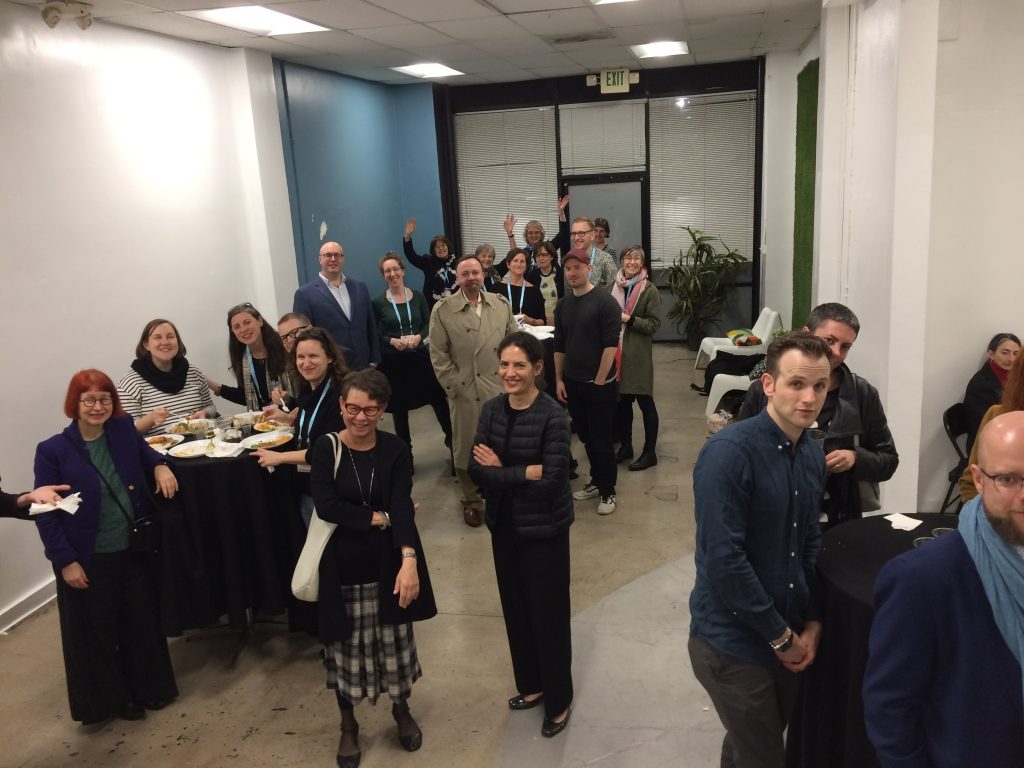
HGSCEA at the CAA Annual Conference in Los Angeles, 2018.
American Society of Hispanic Art Historical Studies (ASHAHS)
The American Society of Hispanic Art Historical Studies (ASHAHS) announced the results of the Eleanor Tufts Award at its business meeting at the 2018 annual conference of the College Art Association. The annual award, established in 1992 to honor Professor Tufts’ contributions to the study of Spanish art, recognizes an outstanding English-language book in the area of Spanish or Portuguese art history. This year the committee chose to give the Eleanor Tufts Award to Oscar E. Vázquez, The End Again: Degeneration and Visual Culture in Modern Spain (University Park, PA: Penn State University Press, 2017). In addition, the jurors selected two books for honorable mention: Ilona Katzew, et al., Painted in Mexico, 1700-1790: Pinxit Mexici (Los Angeles, CA: Los Angeles County Museum of Art; Mexico City: Fomento Cultural Banamex, A.C.; New York, NY: DelMonico Books/Prestel, 2017) and Amanda Wunder, Baroque Seville: Sacred Art in a Century of Crisis (University Park, PA: Penn State University Press, 2017).
Association of Historians of American Art (AHAA)
Preparations are underway for AHAA’s Fifth Biennial Symposium, October 4-6, 2018 in Minneapolis and St. Paul, Minnesota. The goal of this biennial symposium is to represent the most innovative, creative, and rigorous scholarship currently shaping the field of American art. http://www.ahaaonline.org/
The Executive Editors of Panorama: Journal of the Association of Historians of American Art are pleased to announce that The Henry Luce Foundation has awarded the journal a three-year, $45,000 grant to support publication of the journal. This grant supports the position of managing editor, provides professional development in art history and digital humanities, and funds subventions to help authors defray the cost of image reproduction fees.
“The Henry Luce Foundation has been a strong supporter of Panorama since its inception, and we are delighted to announce funding that ensures our financial base through 2020,” said Betsy Boone, an Executive Editor for the journal. “Luce funding has allowed us to professionalize our administrative structure, allowing us to bring cutting-edge scholarship on American art to audiences around the world through our open-access platform.”
The International Art Market Studies Association (TIAMSA)
TIAMSA is offering the following events over the upcoming months:
1) Porto Alegre, Brazil, April 8-10 – ART BEYOND ART: First Symposium on Art Systemic Relations (Goethe Institut, Porto Alegre) – From production to access, the world of visual arts have changed substantially in the last decades, especially considering the performances of agents and institutions which together act in the creation of legitimating structures and in the definition of what art is or is not. However, the logic of production, circulation, legitimization and consumption is also associated with spheres other than those specific to the art world, highlighting the connections inherent in the development of the greater art system. In this sense ART BEYOND ART, the first Symposium on Art Systemic Relations, proposes to debate the transformations in the mode(s) of operation and in the production of contemporary visual art. Essentially transdisciplinary, the event aims to open the dialogue between researchers of Arts, Sociology, Anthropology, Philosophy, Literature, Technology, Sciences and other areas. – This conference is an initiative of TIAMSA Art Market and Collecting – Portugal, Spain and Brazil (TIAMSA AMC_PSB). All further information can be found in the related post and on the Conference Website.
2) TIAMSA’s 2nd Conference will take place in September in Vienna: ART FOR THE PEOPLE? Questioning the Democratization of the Art Market.
2nd Conference
TIAMSA – The International Art Market Studies Association
Vienna, 27-29 September 2018
Apply by April 15, 2018
The art world and the market have traditionally been the domain of the elites and have thrived on exclusivity. However, the art world has arguably become much more democratic in recent years thanks to the digital revolution, the inclusion of emerging economies in the world art market system, and the vastly improved access to art and information. The price histories of works of art can nowadays easily be reconstructed using online databases; the threshold for art buying is significantly lowered by online sales platforms; and new buyers in emerging economies are making the art market much less Western-oriented. Moreover, an ever broader range of artworks in different price categories has put (fine) art within reach of the middle classes across the globe. At the same time, art institutions such as museums are under tremendous pressure to be less exclusive. Some of these democratizing tendencies are of course not new. For instance, publishing houses in Europe started disseminating prints on a massive scale already in the sixteenth century, thereby enabling larger segments of the population to acquire images. Read more here
TIAMSA members receive discounts to our events as well as Art Market Studies related publications from BRILL, Francis & Taylor, Brepols / Harvey Miller.
For more information go to https://www.artmarketstudies.org
Society of Architectural Historians (SAH)
The Society of Architectural Historians is now accepting abstracts for its 72nd Annual International Conference in Providence, Rhode Island, April 24–28. Please submit an abstract no later than 11:59 p.m. CDT on June 5, 2018, to one of the 34 thematic sessions, the Graduate Student Lightning Talks or the Open Sessions. SAH encourages submissions from architectural, landscape, and urban historians; museum curators; preservationists; independent scholars; architects; scholars in related fields; and members of SAH chapters and partner organizations. The thematic sessions have been selected to cover topics across all time periods and architectural styles. If your research topic is not a good fit for one of the thematic sessions, please submit your abstract to the Open Sessions. View the full Call for Papers at www.sah.org/2019.
SAH is now accepting applications for the 2018 SAH/Mellon Author Awards. Funded by a grant from The Andrew W. Mellon Foundation and administered by SAH, the award is designed to provide financial relief to scholars who are publishing their first monograph on the history of the built environment. The purpose of the award is to help defray the high costs of image licensing, reproductions and creation of original drawings and maps for monographs on the history of the built environment. The application deadline is May 31, 2018.
SAH has partnered with the Global Architectural History Teaching Collaborative (GAHTC) to offer Research-to-Teaching Grants and Field Seminar Travel Grants. These new grants are part of the GAHTC’s nearly $500,000 in funding to build new content for its free, digital platform of teaching materials. Learn more at gahtc.org/grants.
International Association for Word and Image Studies (Association Internationale pour l’étude des Rapports entre Texte et Image) (IAWIS/IAERTI)
Call for Participation for 2018 Conference of the International Society for Intermedial Studies
Intermedial Practice and Theory in Comparison
Hangzhou, China, 15-17 November 2018
With the ever-growing proliferation of electronic and other popular media in the more and more networked and “mediatised society,” the diversity and complexity of cultural reproduction and social reconstruction through media underscores now, more than ever, the need to expand Intermedia Studies by incorporating a “planetary” comparative perspective and encouraging voices from subaltern cultures. In recent years, Asian artists like CAI Guoqiang, the “Master of Gunpowder,” have gained international prominence in the intermedia world, and their intermedial practices were often executed and exhibited in various cultural epicentres, e.g., Beijing or New York. However active and interactive such practices are and however broad the audience is, a critical survey of the intermedia theory in cultural comparison is largely missing in previous discussions. We all use media and all media are related, but we might not view media in the same way. Therefore, this conference aims at fostering an interdisciplinary and intercultural conversation on intermedia between scholars, artists and theorists from all domains.
We are seeking panel, paper and round-table contributions that address the theme of the conference: revisiting intermedial practice and theory from a comparative perspective (e.g., past/present, East/West, etc.) to see how artistic, cultural and social practices differ from and interact with each other and how theories evolve in these media constellations locally and globally. We invite proposals for 10- or 20-minute presentations on a broad variety of topics and methodological approaches from disciplines including (but not limited to) Media Studies, Literary Studies, Cultural Studies, Critical Theory, Philosophy, Art History, Visual Arts, Musicology, Theatre and Performance Studies, Rhetoric, Gender and Sexuality Studies, Architecture and Design, Communication, Politics, Religious Studies, and Sociology.
Proposals for papers, pre-constituted panels, or round tables can be submitted by emailing the submission form (downloadable on http://wgyxy.hznu.edu.cn/ISIS2018) as an attachment to SFL@hznu.edu.cn with the subject line “Proposal ISIS2018”. Deadline for submissions is June 15, 2018, and acceptances will be notified by July 15,2018.
Please note that the working language of the conference is English.
Art Libraries Society of North America (ARLIS/NA)
- ARLIS/NA session at CAA in Los Angeles in February
Teams composed of art and design faculty and librarians presented their experiences collaborating with students in the library in a successful session on February 22nd entitled “Engaging the iterative: pedagogical experiments across art and design disciplines.” Chaired by Jennifer Martinez Wormser of the Laguna College of Art + Design; Emilee Mathews, form the University of California, Irvine, the individual presentations included:
COLORientation: Visualizing Color Systems
Xun Chi, Laguna College of Art + Design; Jennifer Martinez Wormser , Laguna College of Art + Design
The Intersection of Influence: Co-teaching the Undergraduate and Graduate Architecture Degree Project and Thesis Preparation Courses
Cathryn Copper, Woodbury University School of Architecture
Engaging the Art World in the Classroom
Bridget R. Cooks, University of California, Irvine; Emilee Mathews, University of California, Irvine
Collaborating, Learning, and Exhibiting
Parme Giuntini, Otis College of Art and Design; Kerri Steinberg, Otis College of Art and Design; Sue Maberry, Otis College of Art and Design
- Awards announced at ARLIS/NA annual conference in New York in February:
The Art Libraries Society of North America (ARLIS/NA) is pleased to announce Kathryn Wayne as the recipient of the 2017 Distinguished Service Award. She is the 27th person to receive the Society’s highest honor. The Distinguished Service Award honors an individual whose exemplary service in art librarianship, visual resources curatorship, or a related field has made an outstanding national or international contribution to art information. Kathryn’s deep and far-reaching contributions to the Society and to the field of art librarianship perfectly embody the accomplishments most valued by the Society.
Kathryn recently retired as head of the Art History/Classics Library at the University of California, Berkeley. She came to UC Berkeley in 1990 as Architecture and Landscape Architecture Librarian at Berkeley’s Environmental Design Library following many years as Architecture Librarian at the University of Arizona.
Two of her notable publications are the seminal reference book Architecture Sourcebook: A Guide to Resources on the Practice of Architecture published by Omnigraphics in 1997, and her contribution to the 33-volume Encyclopedia of Library and Information Sciences published by CRC Press in 2010, for which she wrote the chapter on Art Librarianship.
Despite these impressive professional accomplishments, Kathryn never lost sight of the fundamental role of librarianship at her home institutions. Her dedication to students endured throughout her career. She established an information literacy program at the University of California, Berkeley School of Environmental Design and shared her experience through a subsequent professional presentation on the program. She mentored San Jose State library school students and University of California undergraduate students. One former student wrote, “Kathryn has not only enriched the profession, she has shaped my life.”
The Art Libraries Society of North America (ARLIS/NA) is pleased to announce that the exhibition catalogue for Radical Women: Latin
American Art, 19601985 curated by Cecilia Fajardo Hill and Andrea Giunta, has been awarded the 39th annual George Wittenborn Memorial
Book Award, announced at the ARLIS/NA annual conference in New York in February.
The Art Libraries Society of North America (ARLIS/NA) is pleased to announce that Desire Change: Contemporary Feminist Art in Canada, edited by Heather Davis and co-published in 2017 by McGill-Queens University Press and Mentoring Artists for Women’s Art (MAWA), has been awarded the 27th annual Melva J. Dwyer Award.
Design Incubation
Call for Entries: Communication Design Educators Awards Competition
Design Incubation is accepting entries for the 2018 Educators Awards until May 31, 2018. This international academic awards competition has 4 categories:
• Scholarship: Published Research
• Scholarship: Creative Work (design research, creative production, and/or professional practice)
• Teaching
• Service (departmental, institutional, community)
We are excited to announce an international jury of distinguished design academics.
Jorge Meza Aguilar
Professor of Strategic Design
Provost for Outreach and Collaboration
Universidad Iberoamericana
Mexico City, Mexico
Ruki Ravikumar
Director of Education
Cooper Hewitt, Smithsonian Design Museum
New York, NY
Wendy Siuyi Wong
Professor, Graduate Program Director
Department of Design
York University
Toronto, Canada
Steven McCarthy
Professor of Graphic Design
University of Minnesota
Maria Rogal
Professor of Graphic Design
University of Florida
Use this form to submit your entry online.
For further details, visit the Competition Overview page.
Online form: https://designincubation.com/award-competition-entry/
Call for Entry: https://designincubation.com/call-for-submissions/call-for-entries-communication-design-educators-awards-2018/
Awards overview: https://designincubation.com/educators-awards/
Sarah Krupp and Meghan O’Connor
posted by CAA — April 16, 2018
The weekly CAA Conversations Podcast continues the vibrant discussions initiated at our Annual Conference. Listen in each week as educators explore arts and pedagogy, tackling everything from the day-to-day grind to the big, universal questions of the field.
This week, Sarah Krupp and Meghan O’Connor discuss shifting from a BFA to a BA as faculty.
Sarah Krupp is an Assistant Professor of Sculpture at Wayne State College in Wayne, Nebraska. She teaches 2D & 3D Design, all levels of Sculpture, and sometimes Art Appreciation. Sarah can generally be found coated in a mixture of wood, plaster and metal dust.
Since 2007, Meghan O’Connor has been teaching a combination of foundations and printmaking courses; currently at Wayne State College, one of Meghan’s biggest challenges is removing all the cat hair before discussing craftsmanship with her students.
New in caa.reviews
posted by CAA — April 13, 2018




Lisa Strong writes about Capital Culture: J. Carter Brown, the National Gallery of Art, and the Reinvention of the Museum Experience by Neil Harris. Read the full review at caa.reviews.
Rebecca Zorach explores South Africa: The Art of a Nation edited by John Giblin and Chris Spring. Read the full review at caa.reviews.
Ellen Prokop reviews August L. Mayer y la pintura española: Ribera, Goya, El Greco, Velázquez by Teresa Posada Kubissa. Read the full review at caa.reviews.
Preeti Chopra discusses Architecture and Empire in Jamaica by Louis P. Nelson. Read the full review at caa.reviews.
Beate Pittnauer looks at Zeitspeicher der Fotografie: Zukunftsbilder, 1860–1913 by Katja Müller-Helle. Read the full review at caa.reviews.
Chris Collier examines The Artist as Culture Producer: Living and Sustaining a Creative Life edited by Sharon Louden. Read the full review at caa.reviews.
Sadé Ayorinde reviews No Laughing Matter: Visual Humor in Ideas of Race, Nationality, and Ethnicity edited by Angela Rosenthal, David Bindman, and Adrian W. B. Randolph. Read the full review at caa.reviews.
Jonathan Walley writes about The Off-Screen: An Investigation of the Cinematic Frame by Eyal Peretz. Read the full review at caa.reviews.
Rose Marie San Juan discusses The Bible and the Printed Image in Early Modern England: Little Gidding and the Pursuit of Scriptural Harmony by Michael Gaudio. Read the full review at caa.reviews.
Helena Vilalta explores 1971: A Year in the Life of Color by Darby English. Read the full review at caa.reviews.
RAAMP Chalks It Up
posted by CAA — April 12, 2018
CAA’s RAAMP project is an online repository for resources pertaining to museum professionals at university art collections. One of RAAMP’s newest resources is Descriptive Terminology for Works of Art on Paper, developed in 2014 by the conservation team at the Philadelphia Museum of Art. This document provides “guidelines,” as its subtitle suggests, “for the accurate and consistent description of the materials and techniques of drawings, prints, and collages.” The Terminology was supported by the federally funded agency the Institute of Museum and Library Services (IMLS), which recently partnered with the National Endowment for the Humanities (NEH) to create a Digital Humanities Advancement grant-making program. The Association of Print Scholars, one of CAA’s Affiliated Societies, has promoted this resource as an especially refined and technical manual to characterize the processes of manufacturing an array of works. Its riches include the diversity of drawing media and their distinctions, as in “distinguishing black chalk from graphite and charcoal.” Other areas include the categories of print varieties and their processes, such as relief, intaglio, and planographic prints.
Visit the resource on RAAMP, add your insights on Humanities Commons, and submit your own resources here.
News from the Art and Academic Worlds
posted by CAA — April 11, 2018
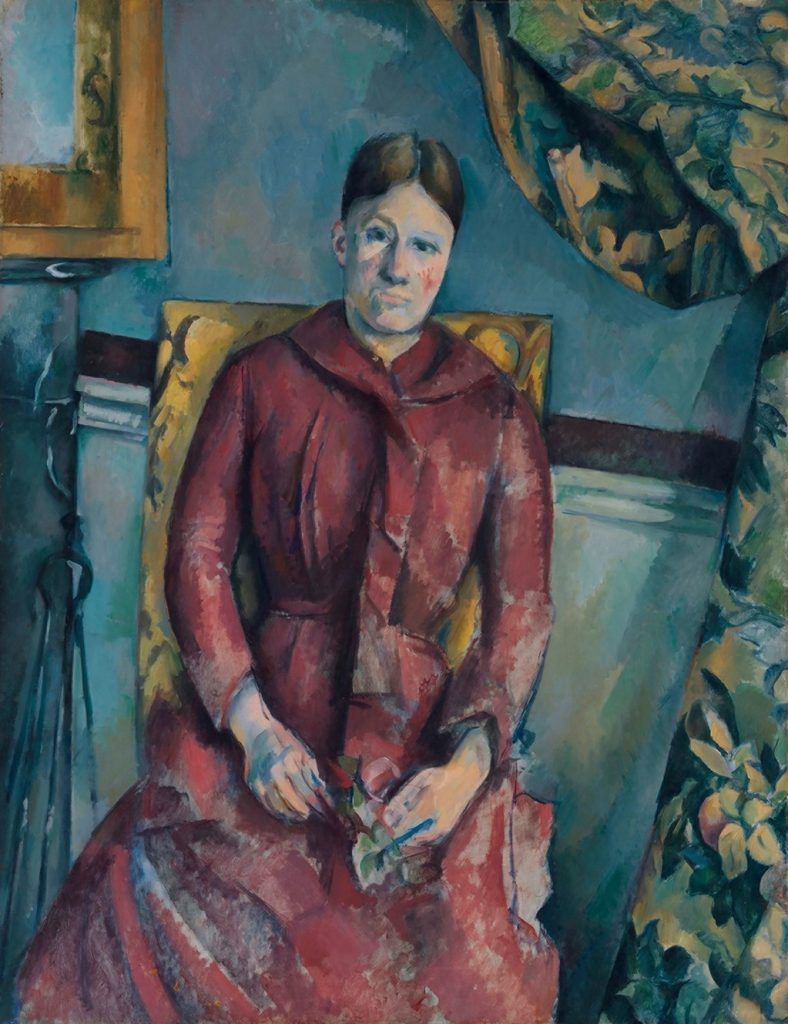
Paul Cézanne, Madame Cézanne in a Red Dress, from 1888–1890. Courtesy Metropolitan Museum of Art
The Met Goes Beyond Its Doors to Pick a Leader Who Bridges Art and Technology
For the first time in 60 years, the Metropolitan Museum of Art has reached beyond its own doors for a new leader. (New York Times)
Frick Collection, With Fourth Expansion Plan, Crosses Its Fingers Again
The garden that upended the museum’s previous attempt to renovate its 1914 Gilded Age mansion is now the centerpiece of its revised design. (New York Times)
US Army Teams Up With Conservators to Preserve Outdoor Art
Art conservators and the Army Research Laboratory are working together to conserve outdoor painted sculpture by Alexander Calder, Louise Nevelson, and Tony Smith. (Hyperallergic)
The Lurchingly Uneven Portraits of Paul Cézanne
In an exhibition at the National Gallery of Art, wonderments consort with clunkers, often on the same canvas. (The New Yorker)
Humanities and science collaboration isn’t well understood, but letting off STEAM is not the answer
The humanities are not just an ethical adjunct to the sciences. (The Conversation)
International Arts Rights Advisors Survey on Online Harassment
As an artist have you been intimidated, trolled, harassed or bullied online? Share your experiences with International Arts Rights Advisors (IARA), a collective of arts and human rights experts, in this anonymous survey. (IARA)
The Most Beautiful College Libraries in America
Celebrate #NationalLibraryWeek with these academic libraries. (Travel + Leisure)
2018 Terra Foundation for American Art International Publication Grant Winners
posted by CAA — April 09, 2018
CAA is pleased to announce the 2018 recipients of the Terra Foundation for American Art International Publication Grant. This program, which provides financial support for the publication of book-length scholarly manuscripts in the history of American art, is made possible by a generous grant from the Terra Foundation for American Art. For this grant, “American art” is defined as art (circa 1500–1980) of what is now the geographic United States.
The seven Terra Foundation grantees for 2018 are:
Buquet, Benoît, Graphics: Art and design graphique aux États-Unis dans les anées 1960 et 1970, Les Presses Universitaires François-Rabelais.
Winner of the International Author Conference Subvention.
Chicago, Judy, Through the Flower—My Struggle as a Woman Artist, translated into French by Sophie Taam, Les Presses du Réel.
Hills, Patricia, Modern Art in the USA: Issues and Controversies of the 20th Century, translated into Chinese by Qiao Hu, Jiangsu Phoenix Fine Arts Publishing.
Mehring, Frank, Riding the Tidal Wave of Modernism: (Trans)National Approaches to the Artwork of Winold Reiss, Deutscher Kunstverlag.
Winner of the International Author Conference Subvention.
Sheehan, Tanya, Study in Black and White: Race, Photography, Humor, Pennsylvania State University Press.
Sutton, Gloria, Stan VanDerBeek’s Movie-Drome: An Experience Machine, translated into French. Preface by Philippe-Alain Michaud. Éditions B2.
Wells, K. L. H., Weaving Modernism: Postwar Tapestry Between Paris and New York, Yale University Press.
The International Author Conference Subventions confer two non-US authors of top-ranked books travel funds and complimentary registration to attend CAA’s 2019 Annual Conference in New York, February 13-16; they also received one-year CAA memberships.
The two author awardees for 2018 are:
- Benoît Buquet
- Frank Mehring
Kelly Murdoch-Kitt and Denielle Emans
posted by CAA — April 09, 2018
The weekly CAA Conversations Podcast continues the vibrant discussions initiated at our Annual Conference. Listen in each week as educators explore arts and pedagogy, tackling everything from the day-to-day grind to the big, universal questions of the field.
This week, Kelly Murdoch-Kitt, assistant professor at University of Michigan’s Stamps School of Art and Design, and Denielle Emans, assistant professor at Virginia Commonwealth University’s campus in Qatar, discuss virtual cross-cultural collaborations.
New in caa.reviews
posted by CAA — April 06, 2018





Kevin Lotery reviews Buon Fresco by Tacita Dean. Read the full review at caa.reviews.
Sarah Schaefer examines No Idols: The Missing Theology of Art by Thomas Crow. Read the full review at caa.reviews.
Rikki Byrd writes about Dandy Lion: The Black Dandy and Street Style by Shantrelle P. Lewis. Read the full review at caa.reviews.
Sybil E. Gohari explores Matisse/Diebenkorn edited by Janet Bishop and Katherine Rothkopf. Read the full review at caa.reviews.
Caitlin Beach looks at Slavery, Geography and Empire in Nineteenth-Century Marine Landscapes of Montreal and Jamaica by Charmaine A. Nelson. Read the full review at caa.reviews.
Charles Snyder writes about Oceans of Love: The Uncontainable Gregory Battcock by Gregory Battcock, edited by Joseph Grigely. Read the full review at caa.reviews.
Tricia Y. Paik discusses Ellsworth Kelly: Catalogue Raisonné of Paintings, Reliefs, and Sculpture, Volume One, 1940–1953 by Yve-Alain Bois. Read the full review at caa.reviews.
Cynthia Colburn reviews Art of Mesopotamia by Zainab Bahrani. Read the full review at caa.reviews.
Elizabeth Childs examines Degas, Impressionism, and the Paris Millinery Trade by Simon Kelly and Esther Bell. Read the full review at caa.reviews.
Natilee Harren explores South of Pico: African American Artists in Los Angeles in the 1960s and 1970s by Kellie Jones. Read the full review at caa.reviews.
Rachel Boate writes about the exhibition Matisse and American Art at the Montclair Art Museum. Read the full review at caa.reviews.
Nadja Rottner discusses the exhibition The Transported Man at the Eli and Edythe Broad Art Museum at Michigan State University. Read the full review at caa.reviews.
Annie Paul considers From San Juan to Paris and Back: Francisco Oller and Caribbean Art in the Era of Impressionism by Edward J. Sullivan. Read the full review at caa.reviews.
Dorota Biczel reviews Cecilia Vicuña: About to Happen by Andrea Andersson, Lucy Lippard, Macarena Gómez-Barris, and Julia Bryan-Wilson. Read the full review at caa.reviews.
Erin Hyde Nolan writes about Camera Orientalis: Reflections on Photography of the Middle East by Ali Behdad. Read the full review at caa.reviews.