
CAA News Today
NEA Awards Stimulus Grant to CAA
posted by Christopher Howard — July 08, 2009
The National Endowment for the Arts (NEA) has awarded $50,000 to CAA as part of the American Recovery and Reinvestment Act. The grant will support the preservation of jobs that are threatened by declines in philanthropic and other support during the current economic downturn.
CAA was among 631 nonprofit organizations, including numerous art museums and organizations nationwide, that received a total of nearly $29.8 million. To read the full list of grantees, please visit the NEA website.
Passed by Congress and signed by President Barack Obama in February 2009, the American Recovery and Reinvestment Act is a $787 billion stimulus bill that provided $50 million to the NEA for distribution to arts groups.
Oregon Passes Bill Supporting Part-Time Professors
posted by Christopher Howard — July 06, 2009
Part-time faculty in the state of Oregon scored a victory late last month, when their state legislature overwhelmingly approved the Oregon Faculty and College Excellence (FACE) Act. The bill will provide access to healthcare insurance to part-time faculty at community colleges and universities through the Oregon Educator’s Benefit Board plan. The bill also requires schools to track and annually report on faculty staffing and salary ratios, to be reviewed by the legislature and governor.
The Senate vote was unanimous: 30-0; the House passed the bill 54 to 1. The FACE Act now goes to Oregon Governor Ted Kulongoski for his signature. Jillian Smith and Rob Wagner from AFT Oregon have the complete story.
Faculty and College Excellence (FACE), a branch of the American Federation of Teachers, is a national campaign that advocates for equity in pay and benefits for contingent faculty members through organizing, legislative advocacy, and collective bargaining. Another goal is to ensure that three-quarters of undergraduate courses are taught by full-time tenure and tenure-track faculty, and that qualified contingent faculty have the opportunity to move into such positions when they become available. The Oregon legislation is the first time that elements of FACE have been adopted by a state.
CAA has 135 individual and 21 institutional members in Oregon.
Oregon Passes Bill Supporting Part-Time Professors
posted by Christopher Howard — July 06, 2009
Part-time faculty in the state of Oregon scored a victory late last month, when their state legislature overwhelmingly approved the Oregon Faculty and College Excellence (FACE) Act. The bill will provide access to healthcare insurance to part-time faculty at community colleges and universities through the Oregon Educator’s Benefit Board plan. The bill also requires schools to track and annually report on faculty staffing and salary ratios, to be reviewed by the legislature and governor.
The Senate vote was unanimous: 30-0; the House passed the bill 54 to 1. The FACE Act now goes to Oregon Governor Ted Kulongoski for his signature. Jillian Smith and Rob Wagner from AFT Oregon have the complete story.
Faculty and College Excellence (FACE), a branch of the American Federation of Teachers, is a national campaign that advocates for equity in pay and benefits for contingent faculty members through organizing, legislative advocacy, and collective bargaining. Another goal is to ensure that three-quarters of undergraduate courses are taught by full-time tenure and tenure-track faculty, and that qualified contingent faculty have the opportunity to move into such positions when they become available. The Oregon legislation is the first time that elements of FACE have been adopted by a state.
CAA has 135 individual and 21 institutional members in Oregon.
House Approves NEA and NEH Budgets
posted by Christopher Howard — June 30, 2009
On June 26, 2009, the US House of Representatives voted to approve HR 2996, a Department of the Interior, Environment, and Related Agencies bill that included significant increases for the budgets of the National Endowment for the Arts (NEA) and the National Endowment for the Humanities (NEH).
Both federal agencies should receive $170 million each for fiscal year 2010, a 9.7 percent increase from their current $155 million allotment. The vote was 254 to 173 in favor of the bill, with six not voting. Included in the bill is an additional $3.7 million for the Kennedy Center for the Performing Arts, raising its FY10 total to $25 million. In addition, the Smithsonian Institution will benefit from $40.8 million more than last year, raising its annual budget to $634.2 million.
The Senate Appropriations Committee’s budget proposal earmarks $161.3 million each for the NEA and NEH—which matches President Obama’s initial budget request of $161.3 million for the arts endowment but is slightly lower than the $171.3 million he asked for the humanities.
CAA encourages you to write to your senators to advocate for NEA and NEH funding. You can do so at the Americans for the Arts E-Advocacy Center—it takes only a couple minutes to draft a letter, based on a template, to mail or email.
House Approves NEA and NEH Budgets
posted by Christopher Howard — June 30, 2009
On June 26, 2009, the US House of Representatives voted to approve HR 2996, a Department of the Interior, Environment, and Related Agencies bill that included significant increases for the budgets of the National Endowment for the Arts (NEA) and the National Endowment for the Humanities (NEH).
Both federal agencies should receive $170 million each for fiscal year 2010, a 9.7 percent increase from their current $155 million allotment. The vote was 254 to 173 in favor of the bill, with six not voting. Included in the bill is an additional $3.7 million for the Kennedy Center for the Performing Arts, raising its FY10 total to $25 million. In addition, the Smithsonian Institution will benefit from $40.8 million more than last year, raising its annual budget to $634.2 million.
The Senate Appropriations Committee’s budget proposal earmarks $161.3 million each for the NEA and NEH—which matches President Obama’s initial budget request of $161.3 million for the arts endowment but is slightly lower than the $171.3 million he asked for the humanities.
CAA encourages you to write to your senators to advocate for NEA and NEH funding. You can do so at the Americans for the Arts E-Advocacy Center—it takes only a couple minutes to draft a letter, based on a template, to mail or email.
CAA Receives Terra Grant for Distinguished Scholar Sessions
posted by Christopher Howard — June 29, 2009
CAA has been awarded a $42,800 grant from the Terra Foundation for American Art to support the Distinguished Scholar Sessions at the 2010 and 2014 Annual Conferences, both of which will take place in Chicago, Illinois. The purpose of the sessions is to celebrate the contributions of distinguished scholars and curators of art through panels that will bring together an honoree and five participants.
The first Distinguished Scholar Session, which took place at the 2001 conference—also held in Chicago—honored James S. Ackerman. Other illustrious past honorees include Svetlana Alpers (2009) Robert L. Herbert (2008), Linda Nochlin (2007), John Szarkowski (2006), Richard Brilliant (2005), James Cahill (2004), Phyllis Pray Bober (2003), and Leo Steinberg (2002).
The Terra Foundation for American Art, based in Chicago, Illinois, is dedicated to promoting the exploration, understanding, and enjoyment of the visual arts of the United States. With financial resources of more than $200 million and an exceptional collection of American art from the Colonial era to 1945, it is one of the world’s leading foundations focused on American art and devotes approximately $9 million annually in support of American-art exhibitions, projects, and research.
Timothy Rub to Direct the Philadelphia Museum of Art
posted by Christopher Howard — June 29, 2009
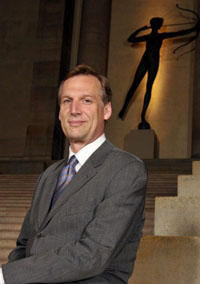 Timothy Rub has been named George D. Widener Director and Chief Executive Officer of the Philadelphia Museum of Art. Rub, who has been director and chief executive officer of the Cleveland Museum of Art in Ohio since 2006, begins work at the Pennsylvania museum in September. The fifty-seven-year-old succeeds Anne d’Harnoncourt, who died on June 1, 2008.
In Cleveland, Rub guided the museum’s comprehensive capital project and fundraising campaign, oversaw the reinstallation of its extensive holdings of European and American art in its renovated 1916 building and new East Wing, and brought to completion the first phase of its seven-year renovation and expansion project designed by the renowned architect Rafael Viñoly. He also initiated a strategic-planning process, managed the development of a touring exhibitions program that sent shows generated from the museum’s collection to Beijing, Tokyo, Seoul, Munich, and a number of venues in Canada and the United States.
A specialist in architecture and modern art, Rub also directed the Cincinnati Art Museum from 2000 to 2006, led the Hood Museum of Art at Dartmouth College in Hanover, New Hampshire, from 1991 to 1999, and was a Ford Foundation Fellow and then curator at the Cooper-Hewitt, National Design Museum, in New York from 1983 to 1987.
At the Hood Museum of Art, his exhibitions and catalogues include The Age of the Marvelous; Goddess and Polis: The Panathenaic Festival in Ancient Athens, and Jose Clemente Orozco in the United States, 1928–1934; in Cincinnati, he produced Petra: Lost City of Stone.
Rub received a bachelor’s degree in art history, cum laude with highest honors, from Middlebury College in Middlebury, Vermont; a master’s degree in art history from the Institute of Fine Arts at New York University; and a master’s degree in public and private management from Yale University.
Photo: Timothy Rub, the George D. Widener Director and Chief Executive Officer of the Philadelphia Museum of Art (photograph by Kelly & Massa and provided by the Philadelphia Museum of Art)
Baruch College Creates Interactive Guide for Teachers Using Copyrighted Materials
posted by Christopher Howard — June 25, 2009
 Baruch College of the City University of New York (CUNY), together with Kognito Solutions, has recently released the Interactive Guide to Using Copyrighted Media in Your Courses. This online tutorial helps college and university faculty determine the appropriate guidelines to follow when using different types of copyrighted media in their courses.
While US copyright law has traditionally allowed for “fair use” for teachers who display and perform copyrighted media during face-to-face teaching, copyright compliancy has become an increasingly complex legal issue as media are increasingly delivered to students online.
Structured as a subway map, the interactive guide asks teachers a series of questions about the nature of the copyrighted works they want to use and how they plan to use them. As each question is answered, users progress through the virtual subway system, learning important copyright rules that apply to their specific situations. At the “final stop,” a list of guidelines for using the copyrighted media is provided.
John Dugan, legal counsel for Baruch College, said, “This guide is a valuable tool that enables faculty to obtain useful, practical advice on copyright issues they may face without confronting the daunting complexities of the copyright law itself.” Baruch’s assistant vice president for technology, Arthur Downing, who initiated the project, said, “We are responding to the needs of academic institutions for a tool that will help and encourage faculty to use media in their courses. This is especially crucial since higher education is increasingly utilizing technology and online delivery components to augment classroom interaction.”
Downing also noted that, while the new learning resource is based on Baruch College and CUNY copyright guidelines, these guidelines are common to many academic institutions and thus applicable for universities across the nation. He further emphasized the need to “continuously enhance this resource with the help of the educational community.”
Other Copyright Resources
Last summer, CAA launched Intellectual Property and the Arts, its own resource for copyright, digital, and intellectual-property issues related to the visual arts. In addition, Information and Library Services at the University of Maryland University College hosts a webpage with a broad range of information on legally using copyrighted materials in classes and on the internet; this information is especially useful for beginners. Reed College also maintains a simpler webpage on using copyrighted materials in academia, with helpful links to information gathered by other schools and organizations.
June Obituaries in the Arts
posted by Christopher Howard — June 22, 2009
CAA recognizes the personal and professional achievements of the following artists, art historians, critics, curators, and collectors in the visual arts:
- Gilbert Alfred Bouchard, a Canadian art critic who wrote for the Edmonton Journal for nearly twenty-five years, has died. He was 47
- Robert Colescott, an American painter who represented the United States at the Venice Biennial in 1997, died on June 4, 2009, in Tucson, Arizona. He was 83
- Louise Deutschman, a curator and director of Waddell Gallery, Alex Rosenberg Gallery, and Sidney Janis Gallery, died on May 10, 2009, at the age of 92
- Ellen D’Oench, a curator for the Davison Art Center and adjunct professor of art at Wesleyan University, died on May 22, 2009, at age 78
- Johnny Donnels, a New Orleans–based photographer, died on March 19, 2009. He was 84
- Arthur Erickson, a modernist Canadian architect who designed many buildings in Vancouver, died on May 20, 2009, at age 84
- Patrick Farrow, a sculptor and gallery owner who was Mia Farrow’s brother, died on June 15, 2009, in Castleton, NH. He was 66
- Ib Geertsen, a Danish abstract painter who was associated with the Konkrete movement, died on June 3, 2009, at age 90
- Frederick Hammersley, a painter who was one of the four Los Angeles–based Abstract Classicists, died on May 31, 2009. He was 90
- William Hemmerling, a Southern folk artist based in Louisiana, died on June 15, 2009, at the age of 66
- Mary Henry, a geometric abstract painter based in the Pacific Northwest, died on May 20, 2009. She was 96
- David Ireland, a sculptor and conceptual artist based in San Francisco, died on May 17, 2009. He was 78
- Pirkle Jones, a California photographer who focused on social activism, died on March 15, 2009, at the age of 95
- Mildred Schiff Lee, an art collector and philanthropist who lived in Palm Beach, FL, died on May 7, 2009. She was 89
- Sam Maloof, a modernist furniture designer and woodworker based in southern California, died on May 21, 2009, at age 93
- Frank Herbert Mason, a painter and longtime instructor at the Art Students League in New York, died on June 16, 2009. He was 87 or 88
- Margaret Mellis, an influential figure in modern British art, died on March 17, 2009, at age 95
- John Michelini, a landscape painter from New Hampshire, died in mid-May 2009, at the age of 43
- Philip Stein, a muralist whose work appears at the Village Vanguard in New York, died on April 27, 2009. He was 90
Read all past obituaries in the arts on the CAA website.
Summer 2009 Art Journal Published
posted by Christopher Howard — June 17, 2009
 The Summer 2009 issue of Art Journal has just been published. It will be mailed to those individual CAA members who elect to receive it, and to all institutional members.
“The marginalization of time-based projects in histories of twentieth-century art is overdetermined,” writes the editor-in-chief Judith F. Rodenbeck in her introduction, “as has long been recognized, by the movement of the human body and, in the case of dance, by gender.” The five essays in the current issue reconsider those margins and offer more inclusive points of view.
Featured in the order of their appearance are: Juliet Bellow, “Fashioning Cléopâtre: Sonia Delaunay’s New Woman”; Nell Andrew, “Living Art: Akarova and the Belgian Avant-Garde”; Kate Elswit, “Accessing Unison in the Age of Its Mechanical Reproducibility”; Janice Ross, “Atomizing Cause and Effect: Ann Halprin’s 1960s Summer Dance Workshops”; and Philip Glahn, “Brechtian Journeys: Yvonne Rainer’s Film as Counterpublic Art.”