
CAA News Today
NEH Funding Request for FY 2010
posted by Christopher Howard — May 20, 2009
“Serious long-term challenges posed by rapid globalization, economic crisis, and threats to our national security require solutions informed by the humanities,” wrote Pauline Yu, president of the American Council of Learned Societies, in a testimony submitted last month to the House of Representations in support of the National Endowment for the Humanities (NEH). Yu called for at least $230 million in funding for the NEH for fiscal year 2010—an increase of $75 million above the present year’s budget. (Download and read Yu’s full testimony to the Appropriations Subcommittee on Interior, Environment, and Related Agencies.)
Earlier this month, however, President Barack Obama’s FY 2010 budget allotted only $171.315 million for the endowment, far short of Yu’s request but $16.315 million more than the current year.
With this proposed increase, the NEH seeks to establish a new grant program, entitled Sustaining Cultural Heritage Collections, which will allow institutions to plan or implement preventative conservation measures that prolong the useful life of humanities collections. The endowment will also reintroduce preservation research and development grants for projects that address major challenges in preserving and maintaining access to humanities collections and resources. And through its We the People program, the NEH will continue to fund humanities projects that strengthen the teaching, study, and understanding of the nation’s history and culture.
Additionally, Obama’s request includes new oversight responsibility for the National Capital Arts and Cultural Affairs program. With the program’s transfer from the US Commission of Fine Arts, the NEH will manage a redesigned program of competitive grants to arts, historical, and cultural institutions in the District of Columbia.
In addition to a general overview of Obama’s NEH budget request, more information is available in the summary and highlights or the detailed budget request of the endowment’s FY 2010 appropriation request. A table with the FY 2010 funding request figures, by division and office with FY 2008 and FY 2009 appropriation amounts, is also available.
See also a brief report on funding for the National Endowment for the Art for FY 2010.
Study Finds Overreliance on Part-Time Faculty in Higher Education
posted by Christopher Howard — May 18, 2009
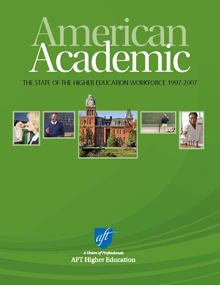 The primary finding of a report released last week by the American Federation of Teachers (AFT), entitled American Academic: The State of the Higher Education Workforce 1997–2007, presents a troubling picture of disinvestment in the higher-education teaching profession—notably, a reduction in the proportion of full-time tenured and tenure-track faculty, and an increased reliance on employing “contingent” faculty and instructors such as part-time faculty, full-time nontenure track faculty, and graduate employees.
An analysis of the most recent ten years of national data finds that the higher-education instructional workforce grew in the past decade, which is not surprising since college enrollments increased during that time by over 3 million. But to meet the needs of a growing student population, colleges and universities overwhelmingly relied on hiring undersupported contingent faculty and instructors. Previous reports have demonstrated the problems created when colleges hire contingent faculty and instructors without fair wages, job security, and professional support. This new report documents that, rather than working to reverse these trends and investing in a more secure higher-education teaching workforce, colleges and universities are expanding their reliance on contingent faculty and instructors.
Among the report’s other key findings:
- From 1997 to 2007, the proportion of full-time tenured and tenure-track faculty members declined from approximately one-third of the instructional staff to slightly more than one-quarter
- The increased reliance on contingent faculty and instructors was found in all sectors of higher education, with the most dramatic increase in community colleges
At the same time, the study notes an increase in the number of professional staff who provide direct student services, such as registrars, counselors, and financial-aid officers. Professional staff grew by 50 percent from 1997 to 2007, and the vast majority of these positions were full-time.
This report is the first in a new series on the higher-education workforce in colleges and universities. Each issue in AFT’s American Academic series will explore different aspects of trends in hiring, compensation, and working conditions among the increasingly diverse higher-education workforce. More higher education data can be found in AFT’s Higher Education Data Center.
The Chronicle of Higher Education and Insider Higher Ed have reported on the report, with extensive comments by readers posted to the latter article.
CAA encourages all colleges and universities to read and uphold its Guidelines for Part-Time Professional Employment, which give recommendations on fair compensation, office and studio space, benefits, and more for part-time workers.
Obama Requests NEA and Arts-Education Budget Increases
posted by Christopher Howard — May 08, 2009
President Barrack Obama has released his budget recommendations for fiscal year 2010, which includes $161.3 million in funding for the National Endowment for the Arts—$6.3 million over the previous year’s budget and the largest increase in fifteen years (about 4 percent). Obama’s administration also requested $38.16 million for the Arts in Education program at the US Department of Education.
CAA encourages you to contact your legislators to voice your support for these increases in arts and cultural funding through the Arts Action Center, sponsored by Americans for the Arts. You can use or modify existing letter templates to tell Congress to support Arts in Education and the National Endowment for the Arts.
Advocacy Days in Washington, DC
posted by Christopher Howard — May 08, 2009
 Andrea Kirsh, an independent art historian based in Philadelphia, Pennsylvania, and a member of the CAA Board of Directors, was one of several CAA delegates who attended Humanities Advocacy Day and Arts Advocacy Day, both of which took place in March 2009 in Washington, DC.
In an article for the forthcoming May issue of CAA News that is also posted online, she writes about her experiences advocating for increased funding for the National Endowment for the Arts and National Endowment for the Humanities, among other government programs and legislation.
Photo: The Grammy-nominated singer-songwriter Josh Groban (center) advocates for the arts with CAA board member Judith Thorpe (left) and Jean Miller at the Congressional Breakfast during Arts Advocacy Day
Advocacy Days in Washington, DC
posted by Christopher Howard — May 07, 2009
Andrea Kirsh, an independent art historian based in Philadelphia, Pennsylvania, and a member of the CAA Board of Directors, was one of several CAA delegates who attended Humanities Advocacy Day and Arts Advocacy Day, both of which took place in March 2009 in Washington, DC.
In an article for the forthcoming May issue of CAA News that is also posted online, she writes about her experiences advocating for increased funding for the National Endowment for the Arts and National Endowment for the Humanities, among other government programs and legislation.
Photo: The Grammy-nominated singer-songwriter Josh Groban (center) advocates for the arts with CAA board member Judith Thorpe (left) and Jean Miller at the Congressional Breakfast during Arts Advocacy Day
Obama Requests NEA and Arts-Education Budget Increases
posted by Christopher Howard — May 07, 2009
President Barrack Obama has released his budget recommendations for fiscal year 2010, which includes $161 million in funding for the National Endowment for the Arts—$11 million over the previous year’s budget and the largest increase in fifteen years. Obama’s administration also requested $38.16 million for the Arts in Education program at the US Department of Education.
CAA encourages you to contact your legislators to voice your support for these increases in arts and cultural funding through the Arts Action Center, sponsored by Americans for the Arts. You can use or modify existing letter templates to tell Congress to support Arts in Education and the National Endowment for the Arts.
Rose Board Responds to Museum Crisis
posted by Christopher Howard — April 24, 2009
The board of overseers at the Rose Art Museum at Brandeis University released a statement yesterday, found here and here, to counter provost Marty Wyngaarden Krauss’s missive from last week about keeping the building open to art exhibitions beyond this summer. Since late January, when the university first announced plans to close the museum and sell its collections, the school administration has backpedaled several times, claiming to transform the museum into an art study and exhibition center (which it already is), to not sell the entire collection, and to continue hosting exhibitions. To which the board responds:
In her letter, Krauss attempted to clarify future plans for the Rose Art Museum once the University closes it on June 30, 2009. Despite the existence of the current Board of Overseers for the museum, Brandeis has named a new committee to “explore future options for the Rose.” In addition, the current position of museum director will be eliminated. According to Jon Lee, chair of the Rose Art Museum’s Board of Overseers, “Without a director or curator, the Rose cannot continue to function as a museum under any meaningful definition. Since the University’s announcement on January 26, 2009 that it would close the museum, membership and Rose Overseer dues, and all donations have ceased or been asked to be returned. This amounts to more than $2.5 million.”
“When the Rose family originally founded the Rose Art Museum, they were very clear about its mission and the integral role it would play as a part of the Brandeis community,” said Meryl Rose, a member of the Rose Art Museum’s Board of Overseers and a relative to the original museum founders. “A museum with a collection and reputation such as the Rose needs a director, and while Krauss’s letter states that the collection will be cared for, it does not erase the fact that the Rose as we know it will cease to exist under the administration’s current plans. The administration is carrying out an elaborate charade, the first step of which is to turn the Rose from a true museum as its founders intended, into something quite different….”
Again, the full statement can be found here and here. Richard Lacayo, art and architectural critic for Time, wrote about Brandeis’s announcement last week and quotes Rose director Michael Rush:
So long as the Rose remains open as a museum, it remains subject to the ethical guidelines of American museum groups that do what they can to discourage the kind of emergency sales that Brandeis is contemplating. But I spoke later with Michael Rush, the director of the Rose, who will soon be gone, along with several other significant Rose staffers. He was skeptical about what the university was doing. “They’re talking about keeping the Rose open,” he said. “But there’s no director, no curator, no education director, no funding stream and no program.”
An update to Lacayo’s report is a message from Jon Lee, Rose board chairman, which notes that Massachusett’s Attorney General office is watching developments closely.
The situation at Brandeis is one of many taking place concerning unusual uses of restricted endowments and related funding. In his article “New Unrest on Campus as Donors Rebel,” John Hechinger of the Wall Street Journal writes, “As schools struggle more than they have in decades to fund their core operations, many are looking to a rich pool of so-called restricted gifts—held in endowments whose donors often provide firm instructions on how their money should be spent.”
Read more of CAA’s coverage of the Rose Art Museum. The museum itself has been keeping a comprehensive log of articles and reviews.
Rose Board Responds to Museum Crisis
posted by Christopher Howard — April 24, 2009
The board of overseers at the Rose Art Museum at Brandeis University released a statement yesterday, found here and here, to counter provost Marty Wyngaarden Krauss’s missive from last week about keeping the building open to art exhibitions beyond this summer. Since late January, when the university first announced plans to close the museum and sell its collections, the school administration has backpedaled several times, claiming to transform the museum into an art study and exhibition center (which it already is), to not sell the entire collection, and to continue hosting exhibitions. To which the board responds:
In her letter, Krauss attempted to clarify future plans for the Rose Art Museum once the University closes it on June 30, 2009. Despite the existence of the current Board of Overseers for the museum, Brandeis has named a new committee to “explore future options for the Rose.” In addition, the current position of museum director will be eliminated. According to Jon Lee, chair of the Rose Art Museum’s Board of Overseers, “Without a director or curator, the Rose cannot continue to function as a museum under any meaningful definition. Since the University’s announcement on January 26, 2009 that it would close the museum, membership and Rose Overseer dues, and all donations have ceased or been asked to be returned. This amounts to more than $2.5 million.”
“When the Rose family originally founded the Rose Art Museum, they were very clear about its mission and the integral role it would play as a part of the Brandeis community,” said Meryl Rose, a member of the Rose Art Museum’s Board of Overseers and a relative to the original museum founders. “A museum with a collection and reputation such as the Rose needs a director, and while Krauss’s letter states that the collection will be cared for, it does not erase the fact that the Rose as we know it will cease to exist under the administration’s current plans. The administration is carrying out an elaborate charade, the first step of which is to turn the Rose from a true museum as its founders intended, into something quite different….”
Again, the full statement can be found here and here. Richard Lacayo, art and architectural critic for Time, wrote about Brandeis’s announcement last week and quotes Rose director Michael Rush:
So long as the Rose remains open as a museum, it remains subject to the ethical guidelines of American museum groups that do what they can to discourage the kind of emergency sales that Brandeis is contemplating. But I spoke later with Michael Rush, the director of the Rose, who will soon be gone, along with several other significant Rose staffers. He was skeptical about what the university was doing. “They’re talking about keeping the Rose open,” he said. “But there’s no director, no curator, no education director, no funding stream and no program.”
An update to Lacayo’s report is a message from Jon Lee, Rose board chairman, which notes that Massachusett’s Attorney General office is watching developments closely. Relatedly, Art in America has published an interview with Meryl Rose, in which potential legal action is briefly discussed.
The situation at Brandeis is one of many taking place concerning unusual uses of restricted endowments and related funding. In his article “New Unrest on Campus as Donors Rebel,” John Hechinger of the Wall Street Journal writes, “As schools struggle more than they have in decades to fund their core operations, many are looking to a rich pool of so-called restricted gifts—held in endowments whose donors often provide firm instructions on how their money should be spent.”
Read more of CAA’s coverage of the Rose Art Museum. The museum itself has been keeping a comprehensive log of articles and reviews.
Artist-Museum Partnership Act Introduced in House and Senate
posted by Christopher Howard — April 22, 2009
The Artist-Museum Partnership Act of 2009, legislation introduced in both houses of Congress, would allow a fair-market-value tax deduction for charitable contributions of literary, musical, artistic, or scholarly compositions to collecting institutions such as museums, libraries, and archives. At present, a donating artist, writer, or composer can only deduct the cost of materials used to create the work, which is not a fair incentive to donate and also hurts the missions of public and nonprofit institutions nationwide to increase public access to these unique creations.
The sponsors of the bill—Senators Patrick Leahy (D-VT) and Robert Bennett (R-UT) for S 405 and Representatives John Lewis (D-GA) and Todd Platts (R-PA) for HR 1126—hope that past enthusiasm for such legislation will grow in the current 111th Congress. Although similar Senate bills have passed five times in previous years, the House version of the bill in the 110th Congress had 111 cosponsors. Now that a new Congress is underway, more cosponsors are needed to help advance the bill.
The American Association of Museums has worked with the Association of Art Museum Directors to provide a draft letter that you can use to encourage your federal lawmakers to cosponsor the bill. With your help, this important legislation for both artists and institutions can move forward.
ARTIST-MUSEUM PARTNERSHIP ACT INTRODUCED IN HOUSE AND SENATE
posted by Christopher Howard — April 22, 2009
The Artist-Museum Partnership Act of 2009, legislation introduced in both houses of Congress, would allow a fair-market-value tax deduction for charitable contributions of literary, musical, artistic, or scholarly compositions to collecting institutions such as museums, libraries, and archives. At present, a donating artist, writer, or composer can only deduct the cost of materials used to create the work, which is not a fair incentive to donate and also hurts the missions of public and nonprofit institutions nationwide to increase public access to these unique creations.
The sponsors of the bill—Senators Patrick Leahy (D-VT) and Robert Bennett (R-UT) for S 405 and Representatives John Lewis (D-GA) and Todd Platts (R-PA) for HR 1126—hope that past enthusiasm for such legislation will grow in the current 111th Congress. Although similar Senate bills have passed five times in previous years, the House version of the bill in the 110th Congress had 111 cosponsors. Now that a new Congress is underway, more cosponsors are needed to help advance the bill.
The American Association of Museums has worked with the Association of Art Museum Directors to provide a draft letter that you can use to encourage your federal lawmakers to cosponsor the bill. With your help, this important legislation for both artists and institutions can move forward.