
CAA News Today
In the Media Lounge: Uncommon/Commons
posted by Christopher Howard — January 28, 2014
 This year’s Media Lounge at the Annual Conference will present Uncommon/Commons, a hybrid media art and research project conceived by the interdisciplinary artist Jenny Marketou and realized with the assistance of Nathanael Bassett, a media researcher and producer.
The goal of the collective project is to invite artists, researchers, writers, scholars, and activists to unpack ambiguous vocabularies and new forms for representation in contemporary art. The participants will all respond to those forms by using social media, public conversations, workshops, and video screenings and by creating hybrid and real events—with the aim to engage public discourse as a social sculpture—that underline not only points of commonality among disciplines but also differences. The artists and curators hope that Uncommon/Commons will be an opportunity to connect Chicago’s artists, activists, academics, and grassroots groups to engender conversations and connections that are important to our civic landscape.
As part of ARTspace, Uncommon/Commons will take place February 12–15, 2014, in the Hilton Chicago’s Joliet Room during the CAA Annual Conference. This is the first year in which the Media Lounge has its own dedicated space with a full program of events. If you cannot attend the conference, watch the Uncommon/Commons live stream and follow the activities on Twitter.
 Uncommon/Commons will be an incubator for sharing skills and knowledge, responding to themes of the commons and “communing.” One highlight of the event will be a series of workshops whose topics include: “Environmental Justice: A Civic Science for the Public Realm,” facilitated by Liz Barry; “Wages for Facebook,” led by Laurel Ptak; “Autonets Convergence Chicago: Hackathon for Technologists and Antiviolence Activists,” organized by Micha Cardenas; and “Public Offering and COMMON CAPTURE: Keyhole Excavations in Media Archeology,” spearheaded by Alexis Bhagat.
Uncommon/Commons will also feature two programs of film and video screenings, titled “We refuse their fabulous lies” and “Invalid data – dreaming through the gaps.” A public discussion between the screenings’ two curators, Jenny Marketou and Abina Manning, director of Video Data Bank at the School of the Art Institute of Chicago, will take place after the programs, followed by Q&A with the audience. Additional one-time screenings in the Media Lounge will include Oliver Ressler’s Take The Square, Rania and Raed Rafei’s 974, and Marketou’s Looking Out of My Window.
Image Captions
First: Rosa Barba (Germany/Sweden), Outwardly from Earth’s Center, 2007.
Second: Workshop during the XFR STN project at the New Museum of Contemporary Art in New York in 2013 (photograph by Tara Hart and provided by the New Museum).
Conference Hotel Reservations at the Palmer House
posted by Nia Page — January 24, 2014
If you are planning to attend CAA’s 102nd Annual Conference in Chicago, taking place February 12–15, 2014, and have not yet made your hotel reservations, CAA is offering discounted room rates for conference attendees. While the Hilton Chicago is sold, out, CAA has arranged an overflow block of discounted rooms at the Palmer House.
It is strongly encouraged that you book your stay at one of the official conference hotels. CAA commits to a block of rooms at these hotels on behalf of its members and has a financial obligation to fill those blocks. Please help us to avoid potential penalties and control costs for future events by staying at the official conference hotels.
Palmer House
17 East Monroe Street
Chicago, IL 60603 (Map)
312-726-7500
Reservations: 877-865-5321

Overflow Block
CAA has setup an overflow block of discounted rooms at the Palmer House. Please use the group code “CAO” to receive the special discount.
| Discount Rates: | |
| Single | $149 |
| Double | $149 |
| Triple | $179 |
| Quad | $209 |

Student Block
A discounted block of rooms has also been set aside at this hotel exclusively for students. A VALID STUDENT IDENTIFICATION CARD WILL BE REQUIRED AT CHECK IN.
| Student Rates: | |
| Single | $120 |
| Double | $120 |
| Additional Person: | $30 each |
Directions to Hilton Chicago
The Palmer House is about a fifteen minute walk to the Hilton Chicago. As an alternative, take the #6 bus at State and Monroe Streets five stops to Balbo and Michigan. Walk east on Balbo to Michigan. Or, take the red line at Monroe-Red (State and Monroe Streets) two stops to Harrison. Walk one block south to Balbo, then east on Balbo to Michigan.
Join a Live Video Chat and Q&A about CAA’s Annual Conference
posted by CAA — January 23, 2014
Join CAA this Monday for a live video chat and Q&A about the upcoming Annual Conference in Chicago.
WHEN: Monday, January 27, 2014, 3:00 PM (EST)
WHERE: RSVP and watch online here
Want to learn the ins and outs of CAA’s 102nd Annual Conference in advance so you can make the most of the four-day event? Join us online this Monday for a live, interactive Google+ Hangout to get practical tips and advice, as well as answers to all your questions! Whether you’re a job seeker, a first-time attendee, or still trying to decide whether to attend, this event will be a valuable resource for anyone hoping to learn more about the Chicago conference.
In addition to covering the basics of how to register and navigate the conference, this Hangout will cover many frequently asked questions, including:
- How do I choose among the hundreds of great sessions and events?
- What resources are available for students and emerging professionals?
- What’s the best way to make new professional contacts?
- What is the dress code? What do I need to bring with me?
- What are this year’s “can’t miss” events and sessions?
- How can the free mobile app and social media enhance my experience?
Submit your questions in advance to conferenceqs@collegeart.org or on Twitter with the hashtag #CAAConferenceQ.
The presenters will be:
- Emmanuel Lemakis, Director of Programs, CAA
- Lauren Stark, Manager of Programs and Archivist, CAA
- Paul B. Jaskot, Professor, Art History, DePaul University; Past President, CAA
- Jacqueline Francis, Professor, Visual and Critical Studies, Painting and Drawing, California College of the Arts; Vice President for Annual Conference, CAA
- Sabina Ott, Professor, Fine Art, Columbia College Chicago; Board of Directors, CAA
- Laurel O. Peterson, Doctoral Candidate, History of Art, Yale University
Not free on Monday? Don’t worry! The conversation will be archived on CAA’s YouTube page, where you can also watch our last Hangout on CAA’s publishing grant program.
Recipients of the 2014 Awards for Distinction
posted by Christopher Howard — January 13, 2014
CAA has announced the recipients of the 2014 Awards for Distinction, which honor the outstanding achievements and accomplishments of individual artists, art historians, authors, conservators, curators, and critics whose efforts transcend their individual disciplines and contribute to the profession as a whole and to the world at large.
CAA will formally recognize the honorees at a special awards ceremony to be held during Convocation at the 102nd Annual Conference in Chicago, on Wednesday evening, February 12, 2014, 5:30–7:00 PM. Led by Anne Collins Goodyear, president of the CAA Board of Directors, the awards ceremony will take place in the Hilton Chicago’s Grand Ballroom. Convocation and the awards ceremony are free and open to the public. The Hilton Chicago is located at 720 South Michigan Avenue, Chicago, IL 60605.
The 2014 Annual Conference—presenting scholarly sessions, panel discussions, career-development workshops, art exhibitions, a Book and Trade Fair, and more—is the largest gathering of artists, scholars, students, and arts professionals in the United States.
Yvonne Rainer, Distinguished Artist Award for Lifetime Achievement
Yvonne Rainer has been instrumental in the movement to merge the visual arts with dance, performance, and filmmaking. As a founder of the Judson Dance Theater (1962) and of the improvisational group Grand Union (1970), Rainer choreographed major dance works for many decades. She has also produced films that have been hailed globally, and her videos have dissolved the barriers between art forms and revealed a new unified vision of the arts. The author of four books and recipient of prestigious fellowships, Rainer was a longtime professor at the University of California, Irvine, where her prodigious talent and innovation has greatly influenced numerous generations of creative people.
John Berger, Distinguished Lifetime Achievement Award for Writing on Art
Over a career spanning some sixty years, John Berger has considered the visual image from the point of view of a painter, an art critic, a filmmaker, a novelist, a poet, and a human being, with the act of writing as central and significant to his many endeavors. His interdisciplinary approach has allowed him to expand exposition and argument into a more episodic, often lyrical form of writing that juxtaposes imagery—both photographic and drawn—with language that is clear, rooted in acute observation, and personal and passionate. Throughout his career Berger has invested himself in the idea of looking, of seeing past convention and rhetoric, to find a truth that resonates both historically and in the present, and to find words that in their analytical and storytelling cogency refuse subservience to the power of images. Radical in his politics, he has always stressed that art and writing are about relationships, that in their workings they illuminate how we connect with one another and with the world.
Kay Rosen, Artist Award for Distinguished Body of Work
Kay Rosen uses words and letters to examine the ways in which language structures knowledge—particularly an awareness of self and place. She first gained prominence in the 1980s alongside more pointedly feminist artists such as Nancy Dwyer, Jenny Holzer, and Barbara Kruger, all of whom used language to address issues of gender and power. Rosen’s art, however, is less concerned with enlisting words as a tool for political messaging than with demonstrating what language can do on its own, through its structure and letters, which the artist thinks of as “body parts.” For Rosen, language can subvert verbal systems of power and offer alternative ways of reading and constructing meaning without being filtered through the intentional voice of the artist. In her work, as seen in her recent exhibition Kay Rosen at Contemporary Art Gallery in Vancouver, British Columbia (June 28–November 3, 2013), viewers encounter language as an object to be seen as well as a text to be read—at once, a page, a sign, an object, and a painting.
Margaretta M. Lovell and W. J. T. Mitchell, Distinguished Teaching of Art History Award
Margaretta M. Lovell is the Jay D. McEvoy Professor of the History of Art at the University of California, Berkeley, where she has worked since 1981. In addition to her great accomplishments as a scholar of American art, Lovell has taught and mentored generations of students who are full of praise for her extraordinary selflessness, generosity, and dedication. Her creativity and imagination as a teacher and scholar are well matched by her open-minded approach to intellectual and professional issues, free of the binding orthodoxies of theory and political cant, which is regarded as a most welcome breath of fresh air. Lovell deals with students and colleagues with a sense of humanity and idealism, but her approach to mentoring is guided equally by firm grasp of the realities that young people face when moving forward in the field, which she has addressed through myriad imaginative solutions, including an innovative pedagogy seminar that has become her trademark.
W. J. T. Mitchell is not only a distinguished voice in contemporary discourse on the history and theory of art, but he is also a beloved teacher at the University of Chicago, where he is Gaylord Donnelley Distinguished Service Professor of English and Art History. His students praise him for the openness of intellectual inquiry that he nurtures both in and outside the classroom. Many speak of the lasting impact that a simple teaching device of his had on them, called a “show and tell” (a short critical analysis of a manmade object from our daily life), in which the forms of critical thinking come alive as exploratory and experimental process. Mitchell’s classes transcend disciplinary singularity, shining forth with an ecumenical approach to learning that makes the study of images accessible to students in many fields. Unpretentious and deeply humane, Mitchell has carried forward his genuine and inspirational spirit of inquiry and love of knowledge to his students across the spectrum of art history and visual culture.
Reni Gower, Distinguished Teaching of Art Award
Reni Gower is a professor of art at Virginia Commonwealth University in Richmond, where she has taught since 1981. Her dedicated instruction in painting includes complex material processes and innovative approaches and safe practices with encaustic that are widely disseminated through her instructional website and videos. Gower has also been a sought-after leader and national authority in professional practices; her Senior Seminar course has been widely modeled at other institutions. In addition, Gower has maintained a rich art career and developed an extensive body of work with an exemplary exhibition record of sustained quality. Her students and colleagues speak highly and enthusiastically of her influence in the classroom, where she challenges her students to push beyond familiar solutions and be open to experimenting with new technologies and formats.
Lorraine O’Grady, Distinguished Feminist Award
CAA recognizes Lorraine O’Grady for her considerable and important service to the feminist art community, especially in her determined efforts to underscore discrimination and bias through her performance art, photo-based work, writing, teaching, and activism. O’Grady has worked to expand the political content of art, persistently returning to a complicated place that she describes as “where the personal intersects with the historic and cultural.” As part of a small group of women of color in the Women’s Action Coalition, she has used this platform to accentuate the involvement of black women artists in contemporary culture and the perpetual disregard for their contributions. Essays such as “Olympia’s Maid: Reclaiming Black Female Subjectivity” (1992) demonstrate her powerful voice in robustly considering the disinterest in the black female. In the 1990s O’Grady turned to the visual investigations of miscegenation, and in the last decade her art has continued to challenge the marginalization of racially and socioeconomically hybridized artists.
Yukio Lippit, Charles Rufus Morey Book Award
In Painting of the Realm: The Kano House of Painters in 17th-Century Japan (Seattle: University of Washington Press, 2012), Yukio Lippit pursues three questions: What is the nature of artistic production before the advent of the category of art? What was the status of the artist as a social entity and discursive category prior to the transplantation of the European concept of the artist in the late nineteenth century? And what constitutes the “Japaneseness” of painting prior to the consolidation of the nation-state? Focusing on the Kano House of painters over the course of the seventeenth century, Lippit develops answers to these questions by eschewing more conventional methodological approaches and exploring instead a sequence of strategies employed by artists within the Kano House, or operating in tension with it, that helped to formalize a canon for painting conceived as a discrete field of practice with an identifiable national character.
Jeff L. Rosenheim, Alfred H. Barr Jr. Award
Jeff L. Rosenheim’s catalogue for the exhibition Photography and the American Civil War (New York: Metropolitan Museum of Art, 2013) is not only a major contribution to American art history, but also an equally important addition to Civil War studies and to the historiography of the United States in general. While Rosenheim clearly explains the technical aspects of photographic processes and convincingly addresses the formal and aesthetic contributions of photography to art history, he also tells a fascinating story about how photography developed as a viable art form in this country. Matching the breadth and quality of the magisterial exhibition, the catalogue masterfully chronicles the Civil War itself, seen, literally, through the eyes of the photographers and presented in the guise of the people who experienced it directly, including those who did not survive it.
Peter C. Sturman and Susan S. Tai, Alfred H. Barr Jr. Award for Smaller Museums, Libraries, Collections, and Exhibitions
Peter C. Sturman and Susan S. Tai’s exhibition catalogue The Artful Recluse: Painting, Poetry, and Politics in Seventeenth-Century China (Santa Barbara, CA: Santa Barbara Museum of Art; New York: Delmonico/Prestel, 2012) presents a probing study of how the painting, calligraphy, and poetry of the “artist recluse” intersected during the Ming-Qing Cataclysm. Entering the seemingly inaccessible physical and mental worlds of the mountain hermit and mist-covered huts of the recluse, The Artful Recluse dispels the notion that such material is inherently obscure and impenetrable to all but the learned scholar. Sturman, Tai, and other contributing authors step beyond well-worn notions of the timeless qualities of this figure in Chinese art and press deep into the tumultuous social, historic, and political context of the Ming-Qing era, revealing in particular the contradictions of artists who disengage from a world that they recognized was in rapid change while engaging it directly with their art and inviting others of a similar reclusive mindset to respond and engage.
Sascha Scott, Arthur Kingsley Porter Prize
Sascha Scott’s article “Awa Tsireh and the Art of Subtle Resistance,” published in the December 2013 issue of The Art Bulletin, ambitiously walks a fine line between the demands of scholarship and the ethics of exploitation. Using the example of Awa Tsireh’s work from the early twentieth century, Scott shows that Pueblo paintings promoted and displayed by Anglos as authentically Native American in fact withheld cultural knowledge, while also offering a new framework for the study of modern Pueblo paintings that restores agency to the artists who made them. In addition, the author elucidates the balance Awa Tsireh found between two philosophical systems of knowledge—an Anglo one that seeks to share knowledge versus a Native American one that aims to control it—and convincingly identifies the artistic methods of evasion, misdirection, coding, and masking as subtly resisting Anglo regimes.
T. J. Demos, Frank Jewett Mather Award
T. J. Demos’s The Migrant Image: The Art and Politics of Documentary during Global Crisis (Durham, NC: Duke University Press, 2013) eloquently analyzes contemporary art that engages the current political reality of continual humanitarian crises while maintaining an open-ended appeal to the imagination. Writing politically and polemically, he offers well-articulated studies of works by artists such as Ursula Biemann, Emily Jacir, Lamia Joreige, Steve McQueen, the Otolith Group, Ahlam Shibli, and Hito Steyerl that take us deep into a South African gold mine, Palestinian refugee camps, Guantanamo Bay, Beirut, Baghdad, Gujarat, and the Sahara, and along other political, economic, and artistic borders. Through a series of incisive readings Demos builds a compelling case for the significance of current artistic practices that employ nontraditional documentary strategies (for which he identifies appropriate precedents) to “construct imaginative possibilities that await potential realization … to mobilize energy that will help bring about reinvented possibilities.”
Glenn Wharton, CAA/Heritage Preservation Award for Distinction in Scholarship and Conservation
The work of Glenn Wharton, an outstanding archaeological conservator, a sensitive conservator of outdoor sculpture, and a leader in the conservation of contemporary art and time-based art, has brought about a major shift in the ethics and approaches to his discipline. After serving as editor of the journal Field Notes: Practical Guides for Archaeological Conservation and Site Preservation, he devoted almost three years of research for the conservation of the monumental painted brass statue of King Kamehameha I in Honolulu, conducting the treatment as a public event in which community input influenced technical decisions. The project became the subject of Wharton’s PhD dissertation and a well-received monograph, and his subsequent publications and lectures on the treatment of the Kamehameha monument have changed the way conservators preserve sensitive cultural objects. In 2006, he took up two positions: one as conservator for time-based art at the Museum of Modern Art in New York; and the second as a faculty member in New York University’s museum-studies program. In that same year he founded the International Network for the Conservation of Contemporary Art – North America and served as its executive director until 2010. Wharton’s career has been distinguished by unceasing growth and commitment to thoroughness, as demonstrated in his rigorous publications, in the dissemination of his work, and, perhaps most important, in his exceptional generosity and dedication to teaching.
Art Journal Award
Jeanne Dunning’s “Tom Thumb, the New Oedipus,” published in the Winter 2013 issue of Art Journal, creatively and cleverly melds aspects of narrative storytelling, visual research, and textual analysis to cast new light on the enduring value of psychoanalytic models through a close reading of the folk-tale character Tom Thumb. It does so with humor and clarity, and is at once a pleasure to read and a careful prod to the imagination. The pairing of the text with the veritable archive of Tom Thumb imagery supports and illustrates the artist’s thesis; it also encourages the reader to creatively speculate about the place and importance of the visual details within these images. In this, the piece provides an excellent model of the best artist projects imaginable for a print publication.
Morey and Barr Award Finalists
CAA recognizes the 2014 finalists for the Charles Rufus Morey Book Award and the Alfred H. Barr Jr. Award for their distinctive achievements:
Morey Finalists
- Jacqueline E. Jung, The Gothic Screen: Space, Sculpture, and Community in the Cathedrals of France and Germany, ca. 1200–1400 (New York: Cambridge University Press, 2013)
- Joan Kee, Contemporary Korean Art: Tansaekhwa and the Urgency of Method (Minneapolis: University of Minnesota Press, 2013)
- Cynthia Robinson, Imagining the Passion in a Multiconfessional Castile: The Virgin, Christ, Devotions, and Images in the Fourteenth and Fifteenth Centuries (University Park: Pennsylvania State University Press, 2013)
Barr Finalist
- Jean-Louis Cohen, Le Corbusier: An Atlas of Modern Landscapes (New York: Museum of Modern Art, 2013)
Barr Award for Smaller Museums, Libraries, Collections, and Exhibitions
- Colin G. Calloway, ed., Ledger Narratives: The Plains Indian Drawings of the Lansburgh Collection at Dartmouth College (Norman: University of Oklahoma Press, in cooperation with the Hood Museum of Art, Dartmouth College, 2012)
Contact
For more information on the 2014 Awards for Distinction, please contact Emmanuel Lemakis, CAA director of programs. Visit the Awards section of the CAA website to read about past recipients.
Career Services Guide for the 2014 Annual Conference
posted by Lauren Stark — January 09, 2014
The January 21 and 28 issues of CAA News gave the incorrect URL for the Career Services Guide for the 2015 Annual Conference in New York. Please click here to download and read that document.
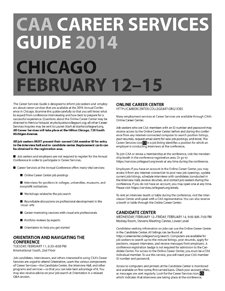 CAA has designed the Career Services Guide to inform job seekers and employers about placement activities at the 2014 Annual Conference in Chicago. The publication, available as a PDF, will help you navigate Career Services events and provides answers to frequently asked questions. Study this guide carefully so that you will know what to expect from conference interviewing and how best to prepare for a successful experience.
Job candidates can review the basics of the conference employment search. Read about the Candidate Center, your home base at the conference, as well as Orientation, an introduction to Career Services where you can ask questions. In addition, learn more about the Online Career Center, where you can search for position listings, post application materials, and arrange interviews. The publication includes tips for improving your CV, portfolio, and supplemental application materials.
Employers will find details in the guide for renting interview booths and tables as well as recommendations for posting jobs and conducting interviews at the conference. You can begin preparations now for Career Services through the Online Career Center or onsite at the Interviewer Center.
Printed copies of the Career Services Guide will be distributed onsite at Orientation and in the Candidate Center. All conference Career Services will take place at the Hilton Chicago. For more information about job searching, professional-development workshops, and more, visit the Career Services section of the conference website.
Call for Testimonials for “Academic Porn”
posted by Christopher Howard — January 07, 2014
In academia, it is well known that politics among colleagues, institutions, and committees are rarely, if ever, spoken about publicly. Instead, an artist-educator and/or art historian is left alone to navigate what sometimes may be murky, dangerous waters in order to avoid getting eaten by the lurking academic sharks.
At the 2014 Annual Conference in Chicago, ARTspace will host an interactive, American Idol–like event titled “Academic Porn: Revealing the Politics in Academia” on Thursday, February 13, 2:30–5:00 PM. Focusing on difficult and uncomfortable circumstances that commonly arise in institutional environments, the four panelists will address dilemmas in academic politics, acting as “judges” adjudicating—and hopefully resolving—these issues.
In advance of this event, the organizers of “Academic Porn” need your testimonials. Feel free to anonymously (or not!) share situations that you or your colleagues have experienced. The panel’s moderator, Sharon Louden, will be reading these testimonials out loud, with a live Twitter feed and audience participation enthusiastically welcomed. Please send your testimonials directly to her at sharon.louden@gmail.com.
Jessica Stockholder Is CAA’s Convocation Speaker
posted by Christopher Howard — December 17, 2013
 The artist Jessica Stockholder will deliver the keynote address during Convocation at the 2014 Annual Conference in Chicago. The event will take place on Wednesday evening, February 12 from 5:30 to 7:00 PM in Hilton Chicago’s Grand Ballroom.
Free and open to the public, Convocation will also include the presentation of CAA’s 2014 Awards for Distinction, overseen by Anne Collins Goodyear, codirector of the Bowdoin College Museum of Art and president of the CAA Board of Directors.
An internationally exhibiting artist whose work has transformed the traditional conception of sculpture, Stockholder creates genre-defying multimedia installation pieces composed of commercially produced objects and referencing the bold, vibrant colors of painting. She is also an educator who spent twelve years at Yale University’s School of Art in New Haven, Connecticut, most recently as director of graduate studies in sculpture. Stockholder joined the University of Chicago in 2011 as professor in the Department of Visual Arts, which she also leads as chair. Stockholder said the university’s lively intellectual atmosphere, as well as the building of the Reva and David Logan Center for the Arts, were key factors in her decision to join the faculty.
Stockholder works at the intersection of painting and sculpture, often incorporating the architecture in which her work has been conceived, blanketing the floor, scaling walls and ceiling, and spilling out of windows, through doors, and into the surrounding landscape. Her work is energetic, cacophonous, idiosyncratic, and formal—tempering chaos with control. She orchestrates an intersection of pictorial and physical experience, probing how meaning derives from physicality. Best known for her temporary site-specific installations, Stockholder has created work that has been discussed in relationship to the works of Robert Rauschenberg, Kurt Schwitters, Henri Matisse, and Paul Cézanne, as well as artists of the Cubist and Minimalist traditions.
Stockholder’s work has been shown in top museums, including the Dia Art Foundation, the Whitney Museum of American Art, the Aldrich Contemporary Art Museum, and the Weatherspoon Art Museum in the United States, and the Centre Georges Pompidou and the Museo Nacional Centro de Arte Reina Sofía in Europe. She has also participated in numerous important group exhibitions, such as SITE Santa Fe, the Whitney Biennial, and the Venice Biennale. The Renaissance Society at the University of Chicago exhibited her installation Skin Toned Garden Mapping in 1991. In North America, Stockholder is represented by Mitchell-Innes & Nash in New York, 1301PE Gallery in Los Angeles, California, and Barbara Edwards Contemporary in Toronto, Ontario, and Calgary, Alberta. Barbara Edwards is currently showing new sculpture and work on paper in the Calgary gallery, on view through February 1, 2014.
Stockholder studied art at the University of Victoria in British Columbia in 1982 and earned an MFA from Yale University in 1985. Both Emily Carr College of Art and Columbia College Chicago have awarded her honorary doctorate degrees, in 2010 and 2013 respectively. In 2007, she received the Lucelia Artist Award from the Smithsonian American Art Museum. Before that Stockholder won a National Endowment for the Arts grant for sculpture in 1988 and a John Simon Guggenheim Fellowship in 1996.
Watch
102nd Annual Members’ Business Meeting
posted by Vanessa Jalet — December 16, 2013
102nd Annual Members’ Business Meeting
College Art Association, February 14, 2014
AGENDA
The 102nd Annual Meeting of the members of the College Art Association will be held on Friday, February 14, 2014 from 5:30 to 7:00 p.m. (CST) in the International South Ballroom, 2nd Floor of the Hilton Chicago, 720 South Michigan Avenue, Chicago, Illinois 60605. CAA’s President, Anne Collins Goodyear, will preside.
- Call to Order: Anne Collins Goodyear, CAA President
- Approval of Minutes of Annual Members’ Business Meeting, February 15, 2013 [ACTION ITEM] – See Minutes at http://www.collegeart.org/pdf/2013AnnBusMin.pdf
- President’s Report: Anne Collins Goodyear
- Financial Report: Teresa Lopez, Chief Financial Officer
- caa.reviews 15th Anniversary Project, Bernini: Sculpting in Clay: Sheryl Reiss, caa.reviews Editor in Chief
- The Future of CAA: An Open Discussion of CAA’s 2015-2020 Strategic Plan
- Old Business
- New Business
- Election of New Directors: Anne Collins Goodyear
- Membership Vote on Amendment to the By-laws: Anne Collins Goodyear
Amendment to Article III: Membership and Affiliation of the Association’s By-laws. To review the amendment proposed by the Board to the membership, visit http://www.collegeart.org/pdf/caa_by-laws_amendment_2-2014.pdf
Please join us for a champagne reception immediately following the Annual Meeting
Proxies
If you are unable to attend the Annual Meeting, please complete a proxy online to appoint the individuals named thereon to (i) vote, in their discretion, on such matters as may properly come before the Annual Meeting; and (ii) to vote in any and all adjournments thereof. CAA Members will be notified by email when the online proxy, and the ability to cast votes for directors, will be available, which will be in early January 2014. A proxy and vote must be received no later than 5:00 p.m.(CST) on Friday, February 14, 2014.
Next Meeting
The 103rd Annual Meeting of the College Art Association will take place on Friday, February 13, 2015 in New York, New York.
December 2, 2013
Deadline for Conference Mentoring Sessions Extended
posted by Lauren Stark — December 13, 2013
The deadline for applications to participate in CAA’s two conference mentoring sessions—the Artists’ Portfolio Review or Career Development Mentoring—has been extended to Friday, January 17, 2014.
As a CAA member, you have access to a diverse range of mentors at Career Services during the 102nd Annual Conference, taking place February 12–15, 2014, in Chicago. All emerging, midcareer, and even advanced art professionals can benefit from one-on-one discussions with dedicated mentors about artists’ portfolios, career-management skills, and professional strategies.
You may enroll in either the Artists’ Portfolio Review or Career Development Mentoring—please choose one. Participants are chosen by a lottery of applications received by the deadline; all applicants are notified of their scheduled date and time slot by email in early 2014. Both sessions are offered free of charge. Conference registration, while encouraged, is not necessary to participate. All applicants must be current CAA members.
Artists’ Portfolio Review
The Artists’ Portfolio Review offers CAA members the opportunity to have digital images or DVDs of their work reviewed by artists, critics, curators, and educators in personal twenty-minute consultations. Whenever possible, CAA matches artists and mentors based on medium or discipline. You may bring battery-powered laptops; wireless internet, however, is not available in the room. Sessions are filled by appointment only and are scheduled for Thursday, February 13, and Friday, February 14, 2014, 8:00 AM–NOON and 1:00–5:00 PM each day.
To apply, download and complete the Career Development Enrollment Form or fill out the paper form in the 2014 Conference Information and Registration booklet, which will be mailed to all individual and institutional CAA members in October 2013. Send the completed form by email to Lauren Stark, CAA manager of programs; by fax to 212-627-2381; or by mail to: Artists’ Portfolio Review, College Art Association, 50 Broadway, 21st Floor, New York, NY 10004. Deadline extended: January 17, 2014.
Career Development Mentoring
Artists, art historians, art educators, and museum professionals at all stages of their careers may apply for one-on-one consultations with veterans in their fields. Through personal twenty-minute consultations, Career Development Mentoring offers a unique opportunity for participants to receive candid advice on how to conduct a thorough job search; present cover letters, CVs, and digital images; and prepare for interviews. Whenever possible, CAA matches participants and mentors based on medium or discipline. Sessions are filled by appointment only and are scheduled for Thursday, February 13, and Friday, February 14, 2014, 8:00 AM–NOON and 1:00–5:00 PM each day.
To apply, download and complete the Career Development Enrollment Form or fill out the paper form in the 2014 Conference Information and Registration booklet, which will be mailed to all individual and institutional CAA members in October 2013. Send the completed form by email to Lauren Stark, CAA manager of programs; by fax to 212-627-2381; or by mail to: Career Development Mentoring, College Art Association, 50 Broadway, 21st Floor, New York, NY 10004. Deadline extended: January 17, 2014.
Projectionists and Room Monitors in Chicago
posted by Lauren Stark — November 20, 2013
CAA is no longer taking applications for projectionists and room monitors.
Working as a projectionist or room monitor at the 102nd Annual Conference, taking place February 12–15, 2014, in Chicago, is a great way to save on conference expenses. All candidates must be US citizens or permanent US residents. CAA encourages students and emerging professionals—especially those in the Chicago area—to apply for service.
Projectionists
CAA seeks applications for projectionists for conference program sessions. Successful applicants are paid $12 per hour and receive complimentary conference registration. Projectionists are required to work a minimum of four 2½-hour program sessions, from Wednesday, February 12 to Saturday, February 15; they must also attend a training meeting on Wednesday morning at 7:30 AM. Projectionists must be familiar with digital projectors. Please send a brief letter of interest to Lauren Stark, CAA manager of programs.
Room Monitors
CAA needs room monitors for two Career Services mentoring programs (the Artists’ Portfolio Review and Career Development Mentoring), several offsite sessions, and other conference events, to be held from Wednesday, February 12 to Saturday, February 15; they must also attend a training meeting on Thursday morning at 7:30 AM. Successful candidates are paid $12 per hour and receive complimentary conference registration. Room monitors are required to work a minimum of eight hours, checking in participants and facilitating the work of the mentors. Please send a brief letter of interest to Lauren Stark, CAA manager of programs.