CAA News Today
Exhibitor and Advertiser Prospectus for the 2013 Annual Conference
posted by CAA — August 10, 2012
 The Exhibitor and Advertiser Prospectus for the 2013 Annual Conference in New York is now available for download. Featuring essential details for participation in the Book and Trade Fair, the booklet also contains options for sponsorship opportunities and advertisements in conference publications and on the conference website.
The Exhibitor and Advertiser Prospectus will help you reach a core audience of artists, art historians, educators, students, and administrators, who will converge in New York for CAA’s 101st Annual Conference, taking place February 13–16, 2013. With three days of exhibit time, the Book and Trade Fair will be centrally located at the Hilton New York, where most programs sessions and special events take place. CAA offers several options for booths and tables that can help you to connect with conference attendees in person.
In addition, sponsorship packages will allow you to maintain a high profile throughout the conference. Companies, organizations, and publishers may choose one of four visibility packages, sponsor specific areas and events such as the Student and Emerging Professionals Lounge, or work with CAA staff to design a custom package. Advertising possibilities include the Conference Program, distributed to over six thousand registrants, and the conference website, seen by thousands more.
The priority deadline for Book and Trade Fair applications has been extended to Friday, November 16, 2012; the final deadline for all applications and full payments, and for sponsorships and advertisements in the Conference Program, is Friday, December 7, 2012.
Questions about the 2013 Book and Trade Fair? Please contact Paul Skiff, CAA assistant director for Annual Conference, at 212-392-4412. For sponsorship and advertising queries, speak to Helen Bayer, CAA marketing and communications associate, at 212-392-4426.
Travel Grants to Attend the 2013 Annual Conference in New York
posted by Lauren Stark — August 02, 2012
 CAA offers Annual Conference Travel Grants to graduate students in art history and studio art and to international artists and scholars. In addition, the Getty Foundation has funded the second year of a program that enables twenty applicants from outside the United States to attend the 2013 Annual Conference in New York. Applicants may apply for more than one grant but can only receive a single award.
CAA Graduate Student Conference Travel Grant
CAA will award a limited number of $250 Graduate Student Conference Travel Grants to advanced PhD and MFA graduate students as partial reimbursement of travel expenses to attend the 101st Annual Conference, taking place February 13–16, 2013, in New York. To qualify for the grant, students must be current CAA members. Successful applicants will also receive a complimentary conference registration. Deadline: September 14, 2012.
CAA International Member Conference Travel Grant
CAA will award a limited number of $500 International Member Conference Travel Grants to artists and scholars from outside the United States as partial reimbursement of travel expenses to attend the 101st Annual Conference, taking place February 13–16, 2013, in New York. To qualify for the grant, applicants must be current CAA members. Successful applicants will also receive a complimentary conference registration. Deadline: September 14, 2012.
CAA International Travel Grant Program
The CAA International Travel Grant Program, generously supported by the Getty Foundation, provides funding to twenty art historians, museum curators, and artists who teach art history to attend the 101st Annual Conference, taking place February 13–16, 2013, in New York. The grant covers travel expenses, hotel accommodations, per diems, conference registrations, and one-year CAA memberships. For 2013, CAA will offer preconference meetings on February 11 and 12 for grant recipients to present and discuss their common professional interests and issues. Applicants do not need to be CAA members. Deadline extended: August 24, 2012.
Donate to the Annual Conference Travel Grants
CAA’s Annual Conference Travel Grants are funded solely by donations from CAA members—please contribute today. Charitable contributions are 100 percent tax deductible. CAA extends a warm thanks to those members who made voluntary contributions to this fund during the past twelve months.
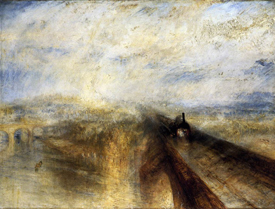
Image: Joseph Mallord William Turner, Rain, Steam and Speed—The Great Western Railway, 1844, oil on canvas, 35⅞ x 49 in. National Gallery, London (artwork in the public domain)
Propose a Session for the 2014 Annual Conference in Chicago
posted by Lauren Stark — June 26, 2012
 CAA invites individual members to propose a session for the 102nd Annual Conference, taking place February 12–15, 2014, in Chicago, Illinois. Proposals should cover the breadth of current thought and research in visual art, art and architectural history, theory and criticism, pedagogical issues, museum and curatorial practice, conservation, and developments in technology. For full details on the submission process for the conference, please review the information published on the Chair a 2014 Annual Conference Session webpage.
The Annual Conference Committee welcomes session proposals from established artists and scholars, along with those from younger scholars, emerging and midcareer artists, and graduate students. Particularly welcome are proposals that highlight interdisciplinary work. Artists are especially encouraged to propose sessions appropriate to dialogue and information exchange relevant to artists.
The submission process for the 2014 conference is now open. In order to submit a proposal, you must be a current CAA member. Deadline extended: September 14, 2012; no late applications are accepted.
Image: Georges Seurat, A Sunday on La Grande Jatte — 1884, 1884–86, oil on canvas, 81¾ x 121¼ in. Art Institute of Chicago (artwork in the public domain)
Apply to the CAA International Travel Grant Program
posted by Janet Landay, Program Manager, Fair Use Initiative — June 01, 2012
The deadline has been extended to Friday, August 24, 2012.
CAA invites individuals to apply to the International Travel Grant Program, generously supported by the Getty Foundation. This program provides funding to twenty art historians, museum curators, and artists who teach art history to attend the 101st Annual Conference, taking place February 13–16, 2013, in New York. The grant covers travel expenses, hotel accommodations, per diems, conference registrations, and one-year CAA memberships. For 2013, CAA will offer preconference meetings on February 11 and 12 for grant recipients to present and discuss their common professional interests and issues.
The goal of the program is to increase international participation in CAA and to diversify the organization’s membership (presently seventy-two countries are represented). CAA also wishes to familiarize international participants with the submission process for conference sessions and to expand their professional network in the visual arts. As they did this year, members of CAA’s International Committee and the National Committee for the History of Art have agreed to host the participants in 2013.
Are You Eligible?
Applicants must be practicing art historians who teach at a university or work as a curator in a museum, or artists who teach art history. They must have a good working knowledge of English and be available to participate in CAA events from February 11 to 17, 2013. Applicants must be able to obtain a travel visa to visit the United States for the duration of the conference. Professionals from developing countries or from nations underrepresented in CAA’s membership are especially encouraged to apply. Applicants do not need to be CAA members. This grant program is not open to graduate students or to those participating in the 2013 conference as chairs, speakers, or discussants.
How to Apply
Please review the application specifications and complete the application form. If you have questions about the process, please email Janet Landay, project director of the CAA International Travel Grant Program.
Applications should include:
- A completed application form
- A two-page version of the applicant’s CV
- A letter of recommendation from the chair, dean, or director of the applicant’s school, department, or museum
Please send all application materials as Word or PDF files to Janet Landay, project director of the CAA International Travel Grant Program.
All application materials must be received by Friday, August 24, 2012. CAA will notify applicants on Monday, October 1, 2012.
Getty Foundation to Fund a Second Year of CAA’s International Travel Grant Program
posted by Christopher Howard — May 23, 2012
For the second year in a row, the Getty Foundation has awarded a major grant to CAA that will enable twenty international professionals to attend the 101st Annual Conference, taking place February 13–16, 2013, in New York. With the Getty grant, CAA will continue its International Travel Grant Program, providing funds to art historians, artists who teach art history, and museum curators for travel expenses, hotel accommodations, per diems, conference registrations, and one-year CAA memberships.
The goal of the project is to increase international participation in CAA and to diversify the organization’s membership (presently seventy-two countries are represented). CAA also wishes to familiarize international participants with the submission process for conference sessions and to expand their professional network in the visual arts. As they did last year, members of CAA’s International Committee and the National Committee for the History of Art have agreed to host the participants.
For the program’s second year, CAA will offer preconference meetings on February 11 and 12 for grant recipients to present and discuss their common professional interests and issues.
The application process for 2013 grants will open shortly. Professionals from developing countries or from nations underrepresented in CAA’s membership are especially encouraged to apply. A jury assembled by CAA will select the twenty grant recipients. The deadline for applications will be August 15, 2012.
NEA Awards $20,000 Grant to CAA for ARTspace
posted by Nia Page — May 01, 2012
 CAA has received a $20,000 grant from the National Endowment for the Arts (NEA) to support the next ARTspace, taking place during the 101st Annual Conference in New York, February 13–16, 2013.
The grant, which is the NEA’s fourth consecutive award to CAA for ARTspace programming, will help fund, among other things, ARTexchange, a popular open-portfolio event for artists, as well as [Meta] Mentors programming, which has covered topics such as do-it-yourself curatorial and exhibition practices, international networks for artists, and assistance with grants, taxes, and promotion.
Designed to engage CAA’s artist members and the general public, ARTspace offers program sessions free of charge and includes diverse activities such the Annual Artists’ Interviews, screenings of film, video, and multimedia works, live performances, and papers and presentations that facilitate a conversational yet professional exchange of ideas and practices. Held at each conference since 2001, ARTspace is intended to reflect the current state of the visual arts and arts education.
Image: Art in Odd Places and Performance Exchange sponsored performances outside the Los Angeles Convention Center as part of ARTspace’s Art in the Public Realm, a daylong event at the 2012 Annual Conference (photograph by Bradley Marks)
Report on the CAA International Travel Grant Program
posted by Janet Landay, Program Manager, Fair Use Initiative — April 18, 2012
 Janet Landay is project manager of the CAA International Travel Grant Program.
Last February, twenty art historians and curators from eighteen countries around the world attended the 2012 Annual Conference in Los Angeles through the CAA International Travel Grant Program, a new initiative that was generously funded by the Getty Foundation. For many grant recipients, this visit was their first to the United States, and for most of them it was their first time at the CAA conference.
By coincidence, on the conference’s opening day, the Los Angeles Convention Center held two swearing-in ceremonies for twenty thousand new citizens and their guests, welcoming people from several nations to the US. Indeed, the CAA group felt like a miniature United Nations, and it was equally moving to see colleagues arrive at the conference from countries around the world. Participants included: Ganna Rudyck (Ukraine), Irena Kossowska (Poland), Pavlina Morganová (Czech Republic), Dóra Sallay and Gyöngyvér Horváth (Hungary), Cristian Nae (Romania), Daniel Premerl (Croatia), Malvina Rousseva (Bulgaria), Salam Atta Sabri (Iraq), Angela Harutyunyan (Lebanon), Nadhra Shahbaz Naeem Khan (Pakistan), Parul Pandya Dhar (India), Jageth Weerasinghe (Sri Lanka), Shao-Chien Tseng (Taiwan), Olabisi Silva (Nigeria), Didier Houenoude (Benin), Jean Celestin Ky (Burkina Faso), Federico Freschi and Judy Peter (South Africa), and Rosa Gabriella de Castro Gonçalves (Brazil). Read more about the recipients, their home institutions, and their areas of interest.
 The purpose of this initiative was to encourage greater participation from countries not well represented at CAA’s Annual Conference in order to bring a more diverse and global perspective to the study of art history. The Getty travel-grant participants, as they became known, were selected by a jury of CAA members from among 150 applicants based on three general criteria: all had to be professors of art history, artists who teach art history, or museum curators with advanced degrees in art or art history; they had to work in a country where art history is an emerging discipline; and they needed to explain how attending the conference would significantly support or strengthen their work.
To welcome the participants and to ensure that they got the most out of the conference’s abundant offerings, members of CAA’s International Committee and representatives from the National Committee for the History of Art (NCHA) volunteered to act as hosts. CAA warmly thanks these members for their service as hosts: Ann Albritton, Frederick M. Asher (NCHA chair), Kathryn Brown, Nicola M. Courtright, Diane Derr, Stephanie Dickey, Thomas W. Gaehtgens, Paul B. Jaskot, Geraldine A. Johnson, Jennifer Milam (International Committee chair), Steven Nelson, Nada Shabout, and Beth A. Steffel.
 This wonderful aspect of the program revolved around informal dinners, lunches, and drinks, in which both participants and hosts could trade stories and share information about the ins and outs of practicing art history in their respective countries. Two roundtable meetings brought everyone together to meet CAA staff, providing opportunities for assessment and reflection on the various aspects of the conference program. Equally stimulating were the friendships made among the participants, as they learned about each other and discovered shared interests and challenges. Now, nearly two months later, a number of grant recipients have already begun to collaborate on research and teaching projects, with ambitious plans in the works.
In the coming months, CAA will publish online interviews with several participants and report on their collaborative work as it unfolds. Stay tuned to future issues of CAA News for these special announcements.
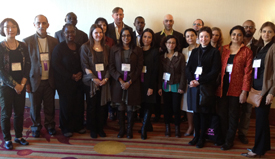
Top image: Participants in the CAA International Travel Grant Programs (from left): Shao-Chien Tseng, Salam Atta Sabri, Olabisi Silva, Jean Celestin Ky, Pavlina Morganová, Dóra Sallay, Federico Freschi, Judy Peter, Didier Houenoude, Rosa Gabriella de Castro Gonçalves, Daniel Premerl, Angela Harutyunyan, Malvina Rousseva, Cristian Nae, Ganna Rudyck, Irena Kossowska, Parul Pandya Dhar, Jageth Weerasinghe, and Nadhra Shahbaz Naeem Khan; Gyöngyvér Horváth is not pictured (photograph by Katie Underwood and provided by the Getty Foundation)
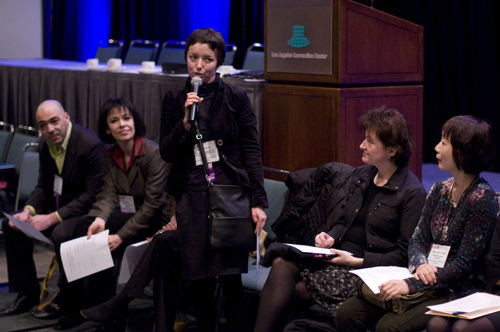
Middle image: Ganna Rudyck from Ukraine introduces herself to fellow grant recipients (photograph by Bradley Marks)
Bottom image: Among the grant recipients were (from left): Shao-Chien Tseng from Taiwan, Didier Houenoude from Benin, and Jean Celestin Ky from Burkina Faso (photograph by Bradley Marks)
Strengthening Partnerships with CAA’s Affiliated Societies
posted by Christopher Howard — April 09, 2012
The following report was written by Barbara Nesin, president of the CAA Board of Directors, and Judith Thorpe, also a board member.
The third annual meeting of CAA’s affiliated societies was held during the 100th Annual Conference in Los Angeles on Saturday, February 25, 2012. Twenty representatives from the affiliates joined the CAA president, Barbara Nesin, and members of the Board of Directors to review the accomplishments of the past year and to discuss future directions.
Nesin took this opportunity to announce the formation of a Task Force on Affiliated Societies, approved by the board at its October 2011 meeting. Starting in May 2012, the task force will develop recommendations about the best means of working together to achieve common goals and objectives. She thanked Judith Thorpe, a CAA board member, for leading that effort and for assembling a team of committed board members to serve on the task force. Thorpe reviewed the highlights of CAA’s 2010–2015 Strategic Plan that specifically call for affiliated-society engagement, especially through enhanced communications, advocacy, and membership. Nesin also thanked Jean Miller, another CAA board member, for her preliminary research on which the task force can build. The task force will likely conduct a membership survey before making its recommendations.
Nesin also noted the contributions of the affiliates to the Los Angeles conference. There were twenty-three major affiliate-sponsored sessions reviewed and selected by the Annual Conference Committee, in addition to over seventy special sessions and business meetings providing many opportunities for all CAA members to become familiar with the work of the affiliate organizations.
Nesin encouraged greater collaboration between CAA and the affiliates in the future to include activities beyond the conference, currently the center of affiliate activities. With this in mind, a spreadsheet of all affiliated-society conferences and meetings throughout the year was distributed so that CAA board members could plan to attend more of these events. This year CAA participated in the Southeastern College Art Conference, the annual meeting for the Mid-America College Art Association, and the Society for Photographic Education national conference. CAA staff has also increased communications with affiliated-society representatives by making use of the affiliate listserv and by inviting input on a variety of topics. By the same token, Nesin encouraged the affiliates to nominate their members for service on CAA’s committees and board. Those in attendance had the opportunity to ask questions and to share suggestions.
The homepage for the main CAA website was enhanced with an Affiliated Societies tab on the horizontal navigation bar that links directly to the Directory of Affiliated Societies. Each affiliated-society listing contains a link to its own website. Nesin pointed out the importance of keeping the contact information for each organization up to date to be sure that information goes to the right person, who is in turn responsible for sharing information with the leadership and/or members of his or her organization. To keep the directory current, CAA annually seeks updates and solicits announcements and news from the groups every two months; these items appear in the Affiliated Society News section of the CAA website, which is promoted through CAA News.
CAA’s seventy-five affiliated societies, covering a wide range of disciplines, are essential partners in the fulfillment of the organization’s mission to promote the visual arts and their understanding through committed practice and intellectual engagement.
Audio Recordings from the 2012 Annual Conference
posted by Christopher Howard — April 02, 2012
 The 2012 Annual Conference in Los Angeles boasted an incredibly diverse array of sessions. Audio recordings for eighty-three of the panels—including “Picturing Urban Space in Central Europe since 1839,” “Oleg Grabar’s Impact on the Practice and History of Art,” and the two-part “Mobile Art: The Aesthetics of Mobile Network Culture in Place Making”—are now available for sale.
A set of MP3 audio recordings from the Los Angeles conference is available for $199.95 as a DVD-ROM. Individual sessions, available only as downloads, are $24.95 each. Please visit Conference Media to view the list of sessions and to order.
The full range of art history is represented in sessions such as “Exceeding the Limits of Ancient Rome,” “Narrative in Gothic Art,” and “The Interconnected Tenth Century.” Several sessions focus on art and design in the conference city, including “Finish Fetish Sculpture from Los Angeles 1960s–70s: Conservation Dilemmas” and “Pacific Standard Time and Chicano Art: A New Los Angeles Art History.” Topics about contemporary art range from “Flagging: Aesthetic Tactics and Queer Signification” and “Momentum: Women/Art/Technology” to “Conceptual Art as Comedic Practice” and “Toward a Rock and Roll History of Contemporary Art.”
CAA also recorded two popular Centennial sessions: “Seeing Is Doing, Doing Is Teaching,” chaired by Michael Ned Holte, and “‘Reclaiming’ the Studio as a Site of Production,” led by Patty Wickman. Both curators and museum educators will be especially interested in “Live Forever: Performance Art in the Changing Museum Culture” and “‘Your Labels Make Me Feel Stupid’: Museum Labels as Art-Historical Practice.”
Whether you took part in, attended, or missed a particular conference session, these recordings are a must-have for your library, research, or teaching. Listen to them while walking across campus, while driving in your car or using public transportation, or while relaxing in your home.
In addition to the Los Angeles sessions, you can also purchase recordings from the past six conferences: New York (2011), Chicago (2010), Los Angeles (2009), Dallas–Fort Worth (2008), New York (2007), and Boston (2006). See CAA’s Conference Audio section or visit Conference Media for details.
Thanks to Conference Supporters and the Annual Conference Committee
posted by Emmanuel Lemakis — April 02, 2012
CAA extends special thanks to the supporters of the 100th Annual Conference and Centennial Celebration in Los Angeles. The Getty Foundation awarded CAA a generous grant to support the attendance and participation of twenty international art historians. The National Endowment for the Arts renewed its support of ARTspace, which is organized by CAA’s Services to Artists Committee and includes programming designed by artists for artists. CAA is grateful to the Broad Foundation for providing funding for complimentary Wi-Fi for the Student and Emerging Professionals Lounge and to the Samuel H. Kress Foundation for granting travel fellowships for international conference participants. CAA would also like to thank Art in America, the official media sponsor, and American Airlines, the official conference airline, for their contributions.
This year’s Book and Trade Fair supporters were: Blick Art Materials at the Partner level and ARTstor, Intellect Books, Prestel Publishing, and Rizzoli International Publications at the Sponsor level. The Los Angeles County Museum of Art generously hosted the Centennial Reception, and Pearson presented a $1,000 prize to the recipients of the 2012 Distinguished Teaching of Art and Art History Awards. CAA is also grateful for support from the Westin Bonaventure Hotel and Suites and from Art Platform—Los Angeles.
CAA extends special thanks to the Annual Conference Committee, whose members were responsible for the 2012 program: Sue Gollifer, University of Brighton and vice president for Annual Conference (chair); Sharon Matt Atkins, Brooklyn Museum; Peter Barnett, Metropolitan Museum of Art; Brian Bishop, Framingham State University; Connie Cortez, Texas Tech University; Ken Gonzales-Day, Scripps College; and Sabina Ott, Columbia College Chicago. Regional representatives for the committee were: Stephanie Barron, Los Angeles County Museum of Art; and Margaret Lazzari, University of Southern California.
CAA is grateful to Jacki Apple of the Art Center College of Design and chair of the Services to Artists Committee for programming ARTspace and the Media Lounge, as well as all volunteers and staff members who made the conference possible.