
CAA News Today
Wi-Fi at the Annual Conference
posted by Christopher Howard — February 02, 2011
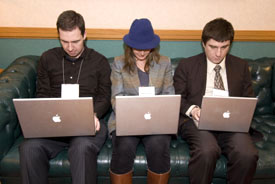 Connecting to the internet at the CAA Annual Conference is essential, whether you are searching for a job, contacting friends in New York, or communicating with your school or institution back home. From the conference hotels to the ever-reliable Starbucks, CAA has researched the various ways to get Wi-Fi quickly, easily, and at low or no cost. The information below may be subject to change but should be reliable.
Hilton New York
The Hilton New York offers three types of wireless internet service to its guests and thus has three prices: $14.99 per twenty-four hours for a 1 MB download speed; $16.99 for 2 MB; and $18.99 for 4 MB. The Hilton also allows nonguests to log onto its network in the lobby areas on a pay-per-use basis, at $5.99 an hour. No connection speed is specified. Users must pay by credit card upon opening a browser on their laptop. For full details in advance, please contact the Hilton, not CAA. While onsite, ask a hotel representative from the concierge or check-in desk for more information.
Sheraton New York
The Sheraton New York is generously offering free internet access—both in rooms and in the lobby—to all guests who are attending the conference. When you check in, tell the hotel representative that you are here for CAA and need an access code. The Sheraton also provides free wireless connection to anyone inside the hotel—you need not be a guest (so be nice). To gain access, simply request the log-in information from the check-in desk, as you cannot automatically connect just by opening a browser. For full details in advance, please contact the Sheraton, not CAA. While onsite, ask a hotel representative from the concierge or check-in desk for more information.
The Sheraton has graciously extended its special room-reservation rates for CAA conference attendees to February 6, 2011. To reserve a room by phone, call 800-325-3535 and mention “College Art Association Annual Conference.” Please be sure to request a confirmation number, email, or fax.
Park Central Hotel
The Park Central Hotel, the conference hotel for students, charges $15 a day for a wireless connection that can be used by guests throughout the building. For full details in advance, please contact the Park Central, not CAA. While onsite, ask a hotel representative at the concierge or check-in desk for more information.
SEP Lounge
Thanks to a generous contribution from the Courtauld Institute of Art, the SEP Lounge provides free wireless internet during its opening hours: Wednesday–Friday, 9:00 AM–8:00 PM; and Saturday, 9:00 AM–5:00 PM. The lounge is located on Concourse B, Concourse Level, Hilton New York.
Hosted by CAA’s Student and Emerging Professionals Committee, the SEP Lounge is a space that allows its constituents to convene and converse freely, away from the conference hustle and bustle. On several days, the committee will present special interactive programming, where you can practice your interviewing skills, talk candidly about completing your thesis or dissertation, or get advice on what to do after earning your degree.
Candidate Center
As part of the conference’s Career Services, the Candidate Center—located in Concourse A, Concourse Level, Hilton New York—houses a bank of computers that CAA members may use only for the Online Career Center. No other internet use is allowed. Hours are Wednesday, February 9–Friday, February 11, 9:00 AM–7:00 PM. You must have a CAA membership card to enter the Candidate Center.
Starbucks
Bottoms up, coffee drinkers! A smallish Starbucks—located directly across the street from the Hilton, at the northeast corner of Avenue of the Americas (Sixth Avenue) and West Fifty-third Street—offers free wireless internet to its guests. No special password is needed—just connect when you open a browser. This location may be closed on Saturday and Sunday, according to the company. Another Starbucks a few blocks north, on Sixth Avenue between West Fifty-sixth and Fifty-seventh, has free access according to the company, but this is unconfirmed (meaning I did not enter the store and ask).
Other Area Hot Spots
OpenWiFiSpots, which calls itself a comprehensive directory of free wireless hot spots, lists eighty-two free sources near the Hilton in midtown Manhattan, including hotels, cafés, and restaurants. This website, however, includes the Hilton, which we know is not free.
Revised on February 4, 2011.
Book Signings for The Eye, the Hand, the Mind at the CAA Conference
posted by Christopher Howard — February 02, 2011
 Attendees of the 99th Annual Conference and Centennial Kickoff will have three opportunities to meet Susan Ball, CAA executive director emerita, as well as many of the fifteen contributors to The Eye, the Hand, the Mind: 100 Years of the College Art Association, the newly published book that surveys the impressive history of the organization from 1911 to the present.
After Convocation, Ball and others will sign copies of the book at a table in the foyer outside the East Ballroom, 3rd Floor, Hilton New York. This year’s Convocation, which takes place on Wednesday, February 9, 5:30–7:00 PM, features a keynote address by the pioneering eco-artists Newton and Helen Mayer Harrison that you will not want to miss.
In the Book and Trade Fair, Rutgers University Press will host two author signings on Thursday and Friday afternoons, at a time to be announced. CAA encourages you to stop by the press’s booth (#604) near the front entrance of the Americas I Ballroom and say hello to Ball and the other authors.
The impressive 330-page book, published by CAA and Rutgers University Press, celebrates the beginning of CAA’s Centennial year. In honor of this milestone, Rutgers will offer a 50 percent discount on any other press title that is purchased during the conference when you buy a copy of The Eye, The Hand, The Mind at the booth.
Centennial Reception at the Metropolitan Museum of Art
posted by Emmanuel Lemakis — January 27, 2011
 Come one, come all! Renowned for its glamorous parties, the Metropolitan Museum of Art will be hosting the CAA Centennial Reception during the 2011 Annual Conference in New York. Join your friends and colleagues, fellow conference attendees, and special guests for an unforgettable evening that will celebrate the beginning of CAA’s Centennial year.
The reception will take place on Thursday evening, February 10, 7:30–9:00 PM, in the magnificent spaces of the Great Hall and the Temple of Dendur, and the passage of Egyptian art between them. It immediately follows the presentation of CAA’s 2011 Awards for Distinction in the Grace Rainey Rogers Auditorium. Wine, beer, soft drinks, and hors d’oeuvre will be served. The Met Store will be open too, making available its excellent inventory of gift items in addition to its superb collection of art monographs, catalogues, and books. CAA is grateful to Thomas Campbell, director of the Metropolitan, for generously opening the museum for this special occasion.
A $35 ticket is required for admission. Although online sales have ended, you may pick up a ticket at the Events Tickets booth in the Registration Area at the Hilton New York, 2nd Floor Promenade. CAA will not be selling tickets at the museum. The awards presentation, however, is free and open to the public.
The Metropolitan Museum of Art is located at 1000 Fifth Avenue at 82nd Street on Manhattan’s Upper East Side. To attend the reception, climb the stairs and walk through the main museum entrance. To attend the awards ceremony, taking place 6:00–7:30 PM, enter the auditorium through the 83rd Street entrance.
Conference attendees may also visit the museum free of charge during the week just by showing their registrant badges.
2011 Regional MFA Exhibition at Hunter College
posted by Christopher Howard — January 25, 2011
 Graduate students currently enrolled in MFA programs at twenty schools within one hundred miles of New York will participate in the College Art Association New York Area MFA Exhibition, on view February 9–April 9, 2011, at the spacious Hunter College/Times Square Gallery. Held concurrently with the 99th Annual Conference and Centennial Kickoff in New York, the exhibition marks the seventh time that Hunter College will host this expansive survey exhibition.
An opening reception for the artists, their professors, and CAA conference attendees will take place on Friday evening, February 11, 6:00–9:00 PM. Free and open to the public, the Hunter College/Times Square Gallery is located at 450 West 41st Street, between Ninth and Tenth Avenues—a short walk or cab ride from the Hilton New York. Regular gallery hours are Tuesday–Saturday, 1:00–6:00 PM. CAA is also sponsoring the College Art Association Regional BFA Exhibition, which opens on the same evening at the New York Center for Art and Media Studies (NYCAMS).
RSVP to the exhibition on Facebook.
Participating Schools
Participating institutions are: Bard College, Milton Avery Graduate School of the Arts; Long Island University, C.W. Post Campus; Montclair State University; New Jersey City University; New York Academy of Art; Parsons the New School for Design; Pratt Institute; Rutgers University, Mason Gross School of the Arts; School of Visual Arts; Temple University, Tyler School of Art; University of Connecticut, Storrs; and Yale University, Yale School of Art.
In addition, five art departments in the City University of New York system are participating: Brooklyn College; City College of New York; Hunter College; Herbert H. Lehman College; and Queens College.
Two art departments and one school in the State University of New York system are also sending artists: Purchase College, School of Art and Design; State University of New York, New Paltz; and Stony Brook University.
Hunter College Art Galleries
The Hunter MFA CAA Curatorial Committee comprises three MA students in the art-history program—Sophia Marisa Lucas, Valentina Spalten, and Annie Wischmeyer—and three MFA alumni who are adjunct faculty in the Department of Art: Selena Kimball, Eric Lee, and Nicole Tschampel.
On view at Hunter’s second space, the Bertha and Karl Leubsdorf Art Gallery, is Objects of Devotion and Desire: Medieval Relic to Contemporary Art, organized by Cynthia Hahn, professor of art history at Hunter, with the assistance of MA and MFA students from Hunter and PhD students from the Graduate Center. The exhibition sets up a dialogue between five medieval reliquaries from the Metropolitan Museum of Art and works by postwar artists such as Christian Boltanski, Hannah Wilke, and Joseph Beuys, and by contemporary practitioners Gayil Nalls, Nate Larson, and Jeffrey Mongrain, among others. Hahn also includes examples of early photography in the mix.
The Leubsdorf Gallery is located in the West Lobby at Hunter College, on the southwest corner of East 68th Street and Lexington Avenue; no admission fee is required. The exhibition dates are January 27–April 30, 2011.
Abstracts 2011 Available for Download
posted by Emmanuel Lemakis — January 20, 2011
 Registrants for the 2011 Annual Conference in New York can now download Abstracts 2011. This publication, available as a PDF, summarizes the contents of hundreds of papers and talks that will be presented in program sessions.
Reading the abstracts in advance can help you plan your daily schedule at the conference. Program sessions are alphabetized by the chair’s last name and appear in the contents pages. An index in the back of the publication names the speakers. Alternatively, use your Adobe Reader to conduct a keyword search for terms relevant to your interests.
After registrants log into their CAA account, they can click the “Abstracts” image in the middle of the screen to download the PDF (1.5 MB). Abstracts 2011 is part of the registration package; there is no cost for paid or complimentary registrants.
Conference attendees who purchase single-time slot tickets, or those who want Abstracts 2011 but are not coming to New York, may attain the document for a charge: $30 for CAA members, $35 for nonmembers. Abstracts 2011 will remain on the CAA website for download or sale through July 31, 2011.
Beginning with the 2010 conference in Chicago, CAA offers its Abstracts exclusively as a PDF download. Past issues of the printed publication from 1999 to 2009 are also available. The cost per copy is $30 for CAA members and $35 for nonmembers. For more information and to order, please contact Roberta Lawson, CAA office coordinator.
Career Services Guide for the Annual Conference in New York
posted by Emmanuel Lemakis — January 12, 2011
 The Career Services Guide is designed to inform job seekers and employers about career services at the 2011 Annual Conference in New York. The publication, which will help you navigate Career Services events and provides answers to frequently asked questions, is available now as a PDF. Study this guide carefully so that you will know what to expect from conference interviewing and how best to prepare for a successful experience.
Job candidates can review the basics of the conference employment search. Read about Orientation, the introduction to Career Services where you can ask questions, and the Candidate Center, your home base at the conference. Also, learn more about the Online Career Center, where you can search for position listings, post application materials, and arrange interviews. The guide includes tips for improving your CV, portfolio, and supplemental application materials.
Employers will find details in the guide for renting interview booths or tables as well as recommendations for posting jobs and conducting interviews at the conference. You can begin preparations now for Career Services through the Online Career Center or onsite at the Interviewer Center.
The Career Services Guide will also be handed out at Orientation and in the Candidate Center. All conference Career Services will take place at the Hilton New York. For more information about job searching, professional-development workshops, and more, visit the Career Services section of the conference website.
New Book on the History of CAA: The Eye, the Hand, the Mind
posted by Christopher Howard — January 07, 2011
Edited by Susan Ball, executive director emerita, The Eye, the Hand, the Mind: 100 Years of the College Art Association surveys the impressive history of the organization from 1911 to the present. The 330-page hardcover book, published jointly by CAA and Rutgers University Press, can be ordered now ($29.95); it will also be available at the upcoming Annual Conference in New York—just in time for CAA’s Centennial Kickoff.
CAA was founded with a single stated purpose: “to promote art interests in all divisions of American colleges and universities.” From this humble yet ambitious origin, Ball has organized her book thematically instead of chronologically, with sixteen “purposes” from the CAA By-laws that are covered in twelve chapters. Written by artists and scholars who have worked closely with the organization over the last few decades, The Eye, the Hand, the Mind offers not a comprehensive history but rather a presentation of memorable highlights that tells the complex, contentious story of a venerable organization.
The Eye, the Hand, the Mind reviews familiar aspects of CAA. Craig Houser negotiates the long history of CAA’s dynamic publications program, which began in 1913 with the first issue of The Art Bulletin, and Julia A. Sienkewicz chronicles the evolution of the celebrated Annual Conference. Less known is CAA’s traveling-exhibition program in the 1930s, uncovered by Cristin Tierney. More recently, Ellen K. Levy explores how CAA has similarly supported presentations of artwork by its members, both students and professionals. Other authors investigate myriad other topics: developments in pedagogy and curriculum; political involvements and advocacy work; visual resources, libraries, and issues of copyright; professional support and career development; partnerships with museums and their associations; relationships to other learned societies in the humanities; governance structure and diversity matters; and much more. In the conclusion, Paul B. Jaskot anticipates the future of the organization as it enters its next one hundred years.
Ball, who served as CAA executive director from 1986 to 2006, is now director of programs at the New York Foundation for the Arts. In addition to organizing the book project, she wrote the introduction and contributed a chapter on the founding of CAA, administrative and financial matters, and the organization’s larger role in the visual arts.
The renowned artist Faith Ringgold has generously allowed the use of her lithograph, The Sunflower Quilting Bee at Arles (1996), for the book’s cover. She created the work, published by the Rutgers Center for Innovative Print and Paper (now the Brodsky Center for Innovative Editions), as a benefit print to support CAA’s Professional Development Fellowship Program. Ringgold will be honored this year with CAA’s Distinguished Feminist Award.
Events at the Annual Conference
At the Annual Conference, CAA and Rutgers University Press are planning several events to promote The Eye, the Hand, the Mind. Judith K. Brodsky will operate a table outside Convocation, to be held at the Hilton New York on Wednesday evening, February 9, 2011, in the East Ballroom, Third Floor. Book signings with many of the contributors will take place in CAA’s Book and Trade Fair, also at the Hilton, on Thursday and Friday afternoons, February 10–11. Please check back later this month for more details on these events and more.
Table of Contents
Below is a list of the fifteen authors and their chapter titles:
- Susan Ball, “Introduction”
- Steven C. Wheatley, “The Learned Society Enterprise”
- Susan Ball, “The Beginnings: “Art for higher education, and higher education for Artists”
- Cristin Tierney, “A Stimulating Prospect: CAA’s Traveling Exhibition Program, 1929–1937”
- Barry Pritzker, “Cooperative Relationships with Museums”
- Craig Houser, “The Changing Face of Scholarly Publishing: CAA’s Publications Program”
- Julia A. Sienkewicz, “United the Arts and the Academy: A History of the CAA Annual Conference”
- Ofelia Garcia, “Mentoring the Profession: Career Development and Support”
- Ellen K. Levy, “Art in an Academic Setting: Contemporary CAA Exhibitions”
- Matthew Israel, “CAA, Pedagogy, and Curriculum: A Historical Effect, An Unparalleled Wealth of Ideas”
- Christine L. Sundt, “Visual Resources for the Arts”
- Judith K. Brodsky, Mary D. Garrard, and Ferris Olin, “Governance and Diversity”
- Karen J. Leader, “CAA Advocacy: The Nexus of Art and Politics”
- Paul B. Jaskot, “Conclusion: The Next 100 Years”
The book also includes four appendices that list CAA’s sixteen purposes, past presidents of the Board of Directors, volunteer and staff administrators, and the editors from the publications program.
CAA Announces the Recipients of the 2011 Awards for Distinction
posted by Christopher Howard — January 05, 2011
CAA has announced the recipients of the 2011 Awards for Distinction, which honor the outstanding achievements and accomplishments of individual artists, art historians, authors, conservators, curators, and critics whose efforts transcend their individual disciplines and contribute to the profession as a whole and to the world at large.
CAA will formally recognize the honorees at a special ceremony to be held during the 99th Annual Conference in New York, on Thursday evening, February 10, 2011, 6:00–7:30 PM, at the Metropolitan Museum of Art. Led by Barbara Nesin, president of the CAA Board of Directors, the ceremony will take place in the Grace Rainey Rogers Auditorium (use the 83rd Street entrance) and precede the Centennial Reception in the museum’s Great Hall and Temple of Dendur (7:30–9:00 PM). In connection with CAA’s one-hundredth anniversary, past recipients of each award will introduce the winners of the same award, bringing past and present together. The awards ceremony is free and open to the public; tickets for the reception are $35. RSVP to the event on Facebook.
In addition, Nesin, will formally introduce the five recipients of CAA’s 2010–11 Professional-Development Fellowships in the Visual Arts: Alma Leiva, Sheryl Oring, Brittany Ransom, Mina T. Son, and Amanda Valdez. This fellowship program awards grants to outstanding MFA students who are nearing graduation. She will also has also recognized five additional artists who have received honorable mentions: Maria Antelman, Caetlynn Booth, Gregory Hayes, Ashley Lyon, and Georgia Wall.
The 2011 Annual Conference—presenting scholarly sessions, panel discussions, career-development workshops, art exhibitions, a Book and Trade Fair, and more—is the largest gathering of artists, art historians, students, and arts professionals in the United States.
Distinguished Artist Award for Lifetime Achievement
Lynda Benglis
For more than forty years, Lynda Benglis has challenged prevailing views about the nature and function of art, producing sculpture, painting, video, photography, and installation that demonstrate extraordinary breadth and invention. She models the life of an artist lived according to the rhythm of her own creativity and curiosity, rather than to the beat of fashion or the market and its enormous but inconstant rewards. Benglis’s career inspires younger artists, not because she was a star as a young artist, or because she has now begun to be recognized as a major artist at a later date. Her work has been and continues to be an ever-shifting monument to the body in motion, as she herself continues to change and grow as an artist. Her retrospective exhibition, Lynda Benglis, opens at the New Museum of Contemporary Art in New York on February 9.
Artist Award for Distinguished Body of Work
John Baldessari
Few artists of the postwar era are so influential—or so elusive of definition—as John Baldessari, who has made extraordinary contributions in such wide-ranging registers as Conceptualism, appropriation, and art education. This seeming paradox—in which the artist at once towers over contemporary art and often slips through its cracks (while also prompting his students to seek new alternatives)—no doubt arises, at least in part, from his subtle wit. This year’s retrospective exhibition, John Baldessari: Pure Beauty, which opened at Tate Modern in London, appeared at the Los Angeles County Museum of Art, and ends its tour at the Metropolitan Museum of Art in New York (on January 9), firmly establishes his preeminence over the course of five decades of artistic production.
Distinguished Lifetime Achievement Award for Writing on Art
Mieke Bal
The protean career of Mieke Bal, Royal Academy of Arts and Sciences Professor at the University of Amsterdam, has traversed many fields in the humanities. Emerging as a brilliant biblical scholar with path-breaking books that explored the gendered nature of Old Testament narratives, Bal became a star in literary criticism with the English translation of her 1977 book Narratology (1985). Ever curious and creative, her interests then migrated to art history, where she rapidly challenged established methodological conventions with Reading Rembrandt: Beyond the Word Image Opposition (1991) and Quoting Caravaggio: Contemporary Art, Preposterous History (1999)—not to mention her well-known essay “Semiotics and Art History,” coauthored with Norman Bryson and published in The Art Bulletin (1991). Applying philosophical principles to an enterprise too often obsessed with empirical “evidence,” Bal provocatively rethinks the status of artistic authorship, the nature of the text/image relationship, the structure of text/context relationships, and the character of historical time.
Frank Jewett Mather Award
Luis Camnitzer
Luis Camnitzer has translated his tricultural perspective—born in Germany, raised and educated in Uruguay, and a participant in the New York art world—into a tripled practice. As an artist, teacher, and critic, he has lucidly addressed the aesthetic, social, and political conundrums of our times with firm but low-key authority. His latest collection of writings, On Art, Artists, Latin America, and Other Utopias (Austin: University of Texas Press, 2009), speaks incisively to issues of cultural displacement, transnational aesthetics, and the peripheral condition of contemporary art. Written originally for international art journals, exhibition catalogues, and academic conferences, the essays, which date from 1969 to 2007, assume a universal address, and Camnitzer’s intricate perception, laced with humor and irony but not dependent on them, allows him reasoned closeness to, and passionate distance from, his myriad topics.
Distinguished Feminist Award
Faith Ringgold
Faith Ringgold has been a forceful voice for feminism, successfully and gracefully encapsulating crucial issues of race despite the often-contentious relationship between gender and race in enfranchisement movements over the last four decades. Her work not only captures the strength of black women in fighting slavery, oppression, and sexual exploitation, but it also chronicles the dreams of black women who sought to transcend circumstance and find a brighter future. Ringgold’s American People paintings (1963–67) and Black Light series (begun in 1967) sought to examine how traditional color values could be modified for black subjects. From there she explored traditions of “women’s work” in fabric, first in collaboration with her late mother and then in her Story Quilts, which have become her signature statement. As a committed activist, Ringgold was a founder of Women, Students, and Artists for Black Liberation and a cofounder and member of Where We At, a collaborative of black women artists in the 1970s and 1980s.
Distinguished Teaching of Art Award
William Itter
William Itter’s gifted teaching approach, dedication to the instruction of freshman students, and curricular innovations in foundations have had a momentous, immeasurable impact on art pedagogy for more than fifty years. During his tenure as director of the Fundamentals Studio Program at Indiana University in Bloomington, which he joined in 1969, Itter has mentored several generations of graduate students with insight and commitment, turning them into great artists and teachers from a time when the MFA degree was in its infancy to the present day. In a unique pedagogical approach, he has regularly and generously shared his museum-quality collection of ceramics, textiles, baskets, and sculpture with his students as pedagogical tools to help them understand how visual languages have manifested across cultures and times. Now professor emeritus of fine arts, Itter continues to exhibit his own painting and drawing in prestigious venues nationwide.
Distinguished Teaching of Art History Award
Patricia Hills
An active, gifted teacher, faithful mentor, and valued colleague, Patricia Hills has maintained a prodigious career, producing scholarship that has profoundly shaped the history of American art and visual culture. Her textbook Modern Art in the USA: Issues and Controversies of the Twentieth Century (2001) has become standard reading in the field, and her work on Jacob Lawrence, Alice Neel, Stuart Davis, John Singer Sargent, and Eastman Johnson is highly esteemed. As professor of art history at Boston University, she is a creative, active, and engaged classroom leader who has developed an innovative style of teaching that emphasizes intellectual role-playing and demonstrates striking methodological openness. Hills’s admirable commitment to the time-demanding aspects of pedagogy, such as her rigorous attention to student writing and her ability to combine that investment with a remarkable publication record, are a model for students and teachers across the discipline.
Charles Rufus Morey Book Award
Molly Emma Aitken
Informed by history, connoisseurship, and contemporary artistic practice, Molly Emma Aitken’s The Intelligence of Tradition in Rajput Court Painting (New Haven: Yale University Press, 2010) is an original contribution to the history of South Asian art. Aitken’s closely argued yet accessible account overturns long-held assumptions regarding the conservatism of Rajasthani miniatures, revealing the subtle yet powerful dynamism that animates this tradition. She acknowledges that the “enormous red-tipped eyes, narrow skulls, and squat or strangely arching bodies” of the figures depicted in these works can seem formulaic or alienating, but these images cannot be understood as mere repetitions of moribund conventions. Instead, Aitken shows that these court paintings were intended to elicit emotional states from the viewer, a conclusion she reaches through an innovative application of formal analysis and social history.
CAA announced the shortlist on December 15, 2010.
Alfred H. Barr, Jr., Award
Darielle Mason, ed.
Darielle Mason’s Kantha: The Embroidered Quilts of Bengal from the Jill and Sheldon Bonovitz Collection and the Stella Kramrisch Collection of the Philadelphia Museum of Art (Philadelphia: Philadelphia Museum of Art, 2009) constitutes a model of how to make a catalogue about specific collections that far outreaches the task of honoring the collectors in question. Offering acute insights into an important region and an understudied medium, the book not only celebrates a lively vernacular textile tradition but also accords, for the first time, a comprehensive, sensitive treatment to this form of women’s domestic, creative, and social expression. In a series of richly grounded, engagingly written essays, Mason and her collaborators—Pika Ghosh, Katherine Hacker, Anne Peranteau, and Niaz Zaman—locate Kantha in wider sociocultural, historical, political, economic, and religious currents while tackling issues sometimes avoided in such studies, such as matters surrounding the quiltmakers’ agency.
CAA announced the shortlist on December 15, 2010.
Alfred H. Barr, Jr., Award for Smaller Museums, Libraries, and Collections
Yasufumi Nakamori
Yasufumi Nakamori’s Katsura: Picturing Modernism in Japanese Architecture; Photographs by Ishimoto Yasuhiro (Houston: Museum of Fine Arts, 2010) revisits a book of photographs of an elegant imperial villa in Kyoto, a seventeenth-century structure that interestingly foreshadows Western modernist design. While this errand may sound obscurantist to some, the author has a profoundly fascinating story to tell. It emerges that the architect Tange Kenzō (with Walter Gropius, who authored the original Herbert Bayer–designed book from 1960) extensively altered the vision of Ishimoto, a fledgling photographer, by drastically cropping the images to better align them with Bauhaus aesthetics, and to reinforce his own position in postwar Japanese debates on the relation of the modern to tradition. In this astutely, impeccably produced catalogue, Nakamori importantly rehabilitates Ishimoto’s initial vision of Katsura, reproducing his original, perfectly stunning photographs.
Arthur Kingsley Porter Prize
Ross Barrett
In “Rioting Refigured: George Henry Hall and the Picturing of American Political Violence,” published in the September 2010 issue of The Art Bulletin, Ross Barrett recovers the history of the artist and a landmark painting of an American laborer. Rooting his analysis in close observation, the author enlivens a work that could easily be dismissed as little more than an academic study of a male model. Calling attention to the title Hall gave his 1858 painting (The Dead Rabbit, a term New Yorkers applied to a street rowdy), to bruises on the man’s torso, and to the brick clutched in his right hand, Barrett identifies the figure as a working class, Irish immigrant. Barrett calls on an arsenal of resources—history, biography, iconography, pedagogical practices in the academy, reports and illustrations in the popular press, theories of the body and spectatorship, and ancillary images of the male athlete in mid-nineteenth-century America—to build a clear and convincing case for reading class conflict and civil disorder in this material body.
Art Journal Award
Kirsten Swenson, Janet Kraynak, Paul Monty Paret, and Emily Eliza Scott
Organized by Kirsten Swenson for the forthcoming Winter 2010 issue of Art Journal, “Land Use in Contemporary Art” is an impressive, useful, and theoretically significant series of articles on a new genre of aesthetic practices. Presented with relevant introductions and histories, the contributions address social, economic, and conceptual issues on Land Use, which has attributes related to but occasionally outside what is usually considered art. Especially impressive are the differences among the texts, particularly in the authors’ descriptions of their values and approaches, which range from self-conscious nonjudgementalism to explicit activism. (CAA members will receive the Winter 2010 Art Journal later this month.)
CAA/Heritage Preservation Award for Distinction in Scholarship and Conservation
Joyce Hill Stoner
Based at the University of Delaware’s Art Conservation Department, Joyce Hill Stoner is a highly respected scholar, a dynamic, beloved professor, and a meticulous conservator of paintings. As director of the doctoral program in preservation studies, which developed from the first art-conversation program in the United States that she founded at her school in 1990, she has developed an interdisciplinary focus on art history and conservation. In the words of one nominator: “Three decades ago the prospect of conservation as a scholarly discipline was, at best, nascent if not merely notional. Since that time conservation scholarship has come to embody inquiries that include the investigation of an artist’s materials and techniques, the documentation of a contemporary artist’s ideas and intentions, the history of conservation, and the development of new techniques in the conservation of art, to name but a few. Stoner has contributed essential research in each of these areas and has thereby fundamentally shaped the discipline.”
Contact
For more information on the 2011 Awards for Distinction, please contact Emmanuel Lemakis, CAA director of programs. Visit the Awards section of the CAA website to read about past recipients. The Metropolitan Museum of Art is located at 1000 Fifth Avenue, New York, NY 10028.
Updated on January 27 and February 3, 2011.
Centennial Booklet Offers Space for Salutatory Announcements
posted by CAA — December 15, 2010
CAA encourages schools, departments, museums, libraries, and art institutions to place a salutatory announcement in the Centennial Booklet, which will be distributed at Convocation, taking place on Wednesday, February 9, 5:30–7:00 PM, during the 2011 Annual Conference. Held in the East Ballroom at the Hilton New York, Convocation is free and open to the public.
The Centennial Booklet will contain the list of speakers for Convocation, which include Jim Leach, chairman of the National Endowment for the Humanities, and Kate Levin, commissioner of the New York City Department of Cultural Affairs. The publication will also include a short profile of the Convocation speakers, the visionary ecoartists Newton and Helen Mayer Harrison, and citations for the recipients of the special Centennial Awards, which recognize a handful of distinguished leaders who have vigorously and tirelessly supported the visual arts for many years (names to be announced soon). CAA will also present a Centennial Statement and acknowledge the many donors who have supported the organization this year.
Contributors have three options for their announcements: quarter, half, and full pages; the affordable prices are $250, $400, and $750 respectively. Please download the Centennial Booklet advertising form for full details. For more information on helping celebrate CAA’s past, present, and future, please contact Sara Hines, CAA development and marketing manager, at 212-691-1051, ext. 216. Deadline: January 3, 2011.
Two Back-to-Back Conference Sessions on Intellectual Property
posted by Christopher Howard — December 14, 2010
CAA will highlight intellectual property and copyright in two back-to-back sessions at the 2011 Annual Conference. First, CAA’s Committee on Intellectual Property will host an informal, participatory session on the rapidly changing world of copyright as it affects the work of contemporary artists and scholars. A second panel, part of the regular conference program, will trace the evolution of intellectual property since ancient times. Both sessions will take place on Friday, February 11, 2011, at the Hilton New York, the conference headquarters hotel. The first will be held in Petit Trianon, Third Floor (12:30–2:00 PM); and the second moves to Gramercy A, Second Floor (2:30–5:00 PM).
For the committee-sponsored “Copyright, CAA, and the Next Century,” the session cochairs—Ken Cavalier, an art historian and lawyer based in British Columbia, and Christine Sundt, editor of Visual Resources: An International Journal of Documentation—will facilitate discussion about today’s critical issues. Open to the public, the session allows attendees to speak freely on issues they think CAA should address, or that are starting to brew regarding copyright in the United States and Canada. Cavalier and Jeffrey Cunard, CAA’s counsel, will serve as legal experts and guides, and committee members will be on hand to answer questions. CAA is especially interested in how it can improve coverage of intellectual-property issues on its website, in its conference sessions, and in outreach efforts, as well as how the organization can define its leadership role (and work with other groups) to advocate copyright legislation that benefits the artistic community.
For the program session, “Intellectual Property in the Visual Arts, Antiquity through Early Modern,” Beth Holman, an independent scholar and the session’s chair, will shift the focus from print and print privileges to shed light on other strategies of asserting and protecting intellectual property. Kristen Seaman of Kennesaw State University will talk about “Ancient Greek Theories of Authorship and the Creation of Art History,” and Giancarla Periti of the University of Toronto will speak on “Authorship and Early Modern Manuscript Collections of Antiquarian Artifacts.” Moving forward chronologically, C. Jean Campbell of Emory University will discuss “Working Knowledge: Ownership and the Representation of Inventive Capacity in Early Renaissance Art,” and Alexandra Hoare of the Center for Advanced Study in the Visual Arts will address “‘Né tocchi mai da nessuno’: Salvator Rosa’s Contribution to Seventeenth-Century Concepts of Intellectual Property.” Ken Cavalier will serve as the session’s discussant.