
CAA News Today
Committee on Women in the Arts Picks for March 2015
posted by CAA — March 10, 2015
Each month, CAA’s Committee on Women in the Arts selects the best in feminist art and scholarship. The following exhibitions and events should not be missed. Check the archive of CWA Picks at the bottom of the page, as several museum and gallery shows listed in previous months may still be on view or touring.
March 2015
Poetry and Exile
British Museum
Gallery 34, Great Russell Street, London
WC1B 3DG United Kingdom
October 1, 2014–March 1, 2015
Housed within the Islamic World Galleries, Poetry and Exile displays a series of works by artists of the Middle East and North Africa recently acquired by the British Museum. This small but powerful exhibition explores the effects of exile through the eyes of four women artists:Ipek Duben, Mireille Kassar, Mona Saudi, and Canan Tolon.
Tolon’s series ofink and graphite drawings, titled Futur Imparfait, is a memoir fromher exile from Istanbul to France, where she spent a decade in hospital as a result of contracting polio as a child. In the series Tolon portrays an exile not only from home, but also from her own body. Duben’s book Refugee belies the helplessness and terror suffered by people forced to flee their homeland with images on delicate gauze pages and using childlike embroidery that depicts the crossing of borders. The Istanbul-born Duben has been making books and installations that focus on identity, domestic violence, and the worldwide forced migration of the twentieth century.
The Jordanian artist Saudi combines the evocative verses of the Palestinian poet Mahmoud Darwish with drawings, while the Lebanese-born Kassar developed a series of drawings inspired by the Persian poem The Conference of the Birds. Here, Kassar conjures a story of exile from her own family history. Originally from Mosul and Mardin—present day Iraq and Turkey—her ancestors fled the Ottoman massacres of minorities during the late-nineteenth and early twentieth century.
Sophie Calle: For the Last and First Time
Musée d’art contemporain de Montréal
185, rue Sainte-Catherine Ouest, Montréal, Québec H2X 3X5 Canada
February 5–May 10, 2015
The Musée d’art contemporain de Montréal presents For the Last and First Time,a two-part exhibition by Sophie Calle (b. Paris, 1953), one of the most important conceptualists artists of her generation. The exhibition comprises two successive projects developed in Istanbul, The Last Image (2010) and Voir la mer (2011). Calle’s poetic investigation of beauty, blindness, and the sea reflects on visual and emotional relationships with the concept of beautythrough an insightful look at both the loss of one’s eyesight, through the particular mental images of blind people, and at the discovery of beauty and the sublime for the first time.
The Last Image isan installation of a series of photographs, tinged with melancholy and accompanied by texts and the soothing sound of waves. For this project, the artist spoke to blind people who had lost their sight suddenly, asking them to recall and describe the last thing they saw. Later on, while in Istanbul, Calle met many people that, in a city surrounded by water, had never seen the sea. For Voir la mer, a series of captivating first encounters with the sea, she filmed fifteen people from different ages looking at the sea for the first time in their lives.
Aware of the impossibility of re-creating the first glance, these series of digital films were in this case created with the assistant of a filmmaker. Calle found most meaningful to remain herself at the back of the viewers, waiting to observe their glances when they turn around after seeing the sea for the first time in their lives. As the artist recalls: “I went with each person individually, such as this man in his thirties. Before we arrived I made him cover his eyes. Once we were safely by the sea, I instructed him to take away his hands and look at it. Then, when he was ready—for some it was five minutes and for others fifteen—he had to turn to me and let me look at those eyes that had just seen the sea.”
Through presenting together The Last Image and Voir la mer, the exhibition opens a moving dialogue among memory, sight, beauty, and the sea. As often in the development of Calle’s projects, The Last Image and Voir la mer derive from an earlier series, The Blind, developed in 1986, in which the artist asked blind people to describe the notion of beauty for them. One of them had answered: “The most beautiful thing I have ever seen is the sea, the endless sea.”
Calle has developed a “polyphonic” art dealing with photography, writing, video, and performance. Throughout four decades of creative practice, she has produced extraordinary, audacious works that draw on her own history as well as that of others. Through a poetic, sincere, and intimate approach, Calle invites us to break through the boundaries between private and public life, creating and recording moments of startling truth, tinged with notions of loss, absence, and desire.
Doris Salcedo
Museum of Contemporary Art, Chicago
220 East Chicago Ave, Chicago, IL 60611
February 21–May 24, 2015
The Museum of Contemporary Art, Chicago, presents the first retrospective of the thirty-year career of the renowned Colombian artist Doris Salcedo, whose work, although deeply rooted in her country’s social and political landscape, investigates human conflict manifested in different parts of the world. Salcedo (b. 1958), who lives and works in Bogotá, transforms ordinary and domestic objects (such as chairs, tables) into alternative memorials to the painful absence that embodied a traumatic loss of human life. In this process, the artist grounds her art in rigorous fieldwork, which involves extensive interviews with people who have experienced loss and trauma in their everyday lives due to political violence. She has been increasingly noted for her large-scale installations and architectural interventions. Between them, her work Shibboleth, a 167-meter-long crack in the turbine floor, developed as a commission for the Tate Modern Unilever Projects in 2007, raised questions of borders, racial hatred, and exclusion. Through a laborious and seemingly healing art-making process, Salcedo creates sculptures and installation that explore the indescribable wounds of violence as a universal phenomenon through a subtle, poetic, yet devastatingly powerful visual language.
Salcedo’s retrospective at the museum begins with a selection of her earliest works, many of which are exhibited together en masse for the first time since 1998: sculptures made with concrete-filled doors, tables, armoires, chairs. Other major installations include La Casa Viuda (1993–95), Unland (1995–98), Atrabiliarios (1992–2004), A Flor de Piel (2014), and Disremembered (2014). It also presents the American debut of Salcedo’s major work Plegaria Muda (2008–10), an expansive installation of tables, inverted one atop another, while individual blades of grass grow through the holes in their surfaces. Responding once again to acts of violence, its contemplative stillness evokes associations of a collective burial site. This piece was inspired by a three-year-long research of gang violence at the ghettoes of southeastern Los Angeles, as well as by the 2008 discovery that members of the Colombian Army had been killing innocent civilians and dressing their corpses in guerrilla uniforms to claim government bounties. As Salcedo points out, speaking about modern, war-torn societies, “we have lost our ability to mourn…. I want my work to play the role of funeral oration, honoring this life.”
The Museum of Contemporary Art, Chicago, is producing a short film documenting Salcedo’s site-specific and ephemeral installations and a 250-page publication featuring an overview of the artist’s career by leading scholars and curators. The exhibition travels to the Solomon R. Guggenheim Museum in New York, where it will be seen June 26–October 14, 2015.
Body Talk: Feminism, Sexuality, and the Body in the Work of Six African Women Artists
WIELS, Contemporary Art Centre
Avenue Van Volxemlaan 354, 1190 Brussels, Belgium
February 14–May 3, 2015
WIELS Contemporary Art Center in Brussels presents Body Talks, an exhibition along a series of conversations and performances that address issues feminism, sexuality, and the body in the work of six African women artists. Curated by Koyo Kouoh and assisted by Eva Barois De Caevel from the RAW Material Company in Dakar, the exhibition explores the body as the subject of reflection and medium of artistic practice, as in the case of the “confrontational” performances of the South African artist Tracey Rose.
The spread of artistic practices to international networks, along with the critical resonance of a specifically African (and black) feminism, have given shape to the development of a black feminist art. Referencing to historical and political figures, black feminist art depicts bodies that continue a tradition of activism and freedom of speech. Bringing together the work of a generation of women artists from Africa active since the late 1990s, this group exhibition challenges pervasive fantasies and inequalities relating to women’s bodies and sexuality. While in the work of the selected artists the body manifests itself, as a model, support, subject, or/and object, the project as a whole attempts to define and articulate notions of feminism and sexuality in the work of women artists whose body serves as a tool, a representation, or a research field.
Exhibiting artists, from diverse regions of the continent and the diaspora, are: Zoulikha Bouabdellah (Algeria/France, b. 1977); Marcia Kure (Nigeria, b. 1970); Miriam Syowia Kyambi (Kenya, b. 1979); Valérie Oka (Cote d’Ivoire, b. 1967); Tracey Rose (South Africa, b. 1974); and Billie Zangewa (Malawi/Zimbawe, b. 1973).
Between the presented projects: Kure evokes Saartjie Baartman, “the Hottentot Venus,” who was born in what is now South Africa but taken to Europe in the early nineteenth century to be put on show. As the curator explains, “Baartman has really become a point of departure for thinking about the African woman’s body.”
Bouabdellah—who was at the center of a recent dispute about self-censorship for her Silence piece, an installation composed of prayer mats on which she had arranged high-heeled shoes—presents a series of collages for which she has cut famous paintings depicting women’s bodies into Eastern motifs. Oka presented two performances at the opening reflecting on the sexual clichés inherited from the period of slavery and colonization that stigmatize the black body and the idea that the African woman is allegedly more sensual and better at sex.
Rediscovering, reintegrating, and reinterpreting the body, this exhibition presents the response of a generation of African women artists that challenge stereotypes of the notion “black” sexuality and feminism through diverse means of dialoguing with—and experienced from—the own body.
Maryland to Murano: Neckpieces and Sculptures by Joyce J. Scott
Museum of Art and Design
2 Columbus Circle, New York, NY 10019
September 30, 2014–March 15, 2015
The Museum of Art and Design in New York presents Maryland to Murano: Neckpieces and Sculptures by Joyce J. Scott, which bringstogether neckpieces and blown-glass sculptures by the renowned “Queen of Beadwork” for the first time. Provocative and confrontational, Scott’s exuberant beaded sculptural forms and neckpieces address contentious political and social issues such as gender, race, and class struggle.
Maryland to Murano examines Scott’s ever-evolving techniques and continued exploration of provocative narratives through her commitment to craft. The show also highlights Scott’s range in both form and content in a extensive body of work created in her workshop in Baltimore, Maryland, and in her recent glass sculptures made at the Berengo Studio on Murano Island in Venice, Italy.
Scott (b. Baltimore, 1948) is a descendant of African Americans, Native Americans, and Scots. She received her first art lessons at home watching her mother—the renowned fiber artist Elizabeth Talford Scott—using unconventional techniques of embroidery and appliqué in creating her quilts. Scott’s creative process is deeply rooted in her ethnic and family heritage: three generations of storytellers, quilters, basket makers, and shapers of wood, metal, and clay.
Through the interplay between these two bodies of work, as well as a documentary video, the exhibition not only reveals the range of Scott’s technique and skill and the complex relationship she has shaped among adornment, content and methodology, but it also expresses her commentary on issues affecting contemporary society in an effort to elicit awareness and response. As the artist states: “It’s important to me to use art in a manner that incites people to look and then carry something home—even it it’s subliminal—that might make a change in them.” Scott’s thought-provoking, portable beaded pieces are certainly inciting us to be carried either way.
Committee on Women in the Arts Picks for the 2015 Annual Conference
posted by CAA — February 10, 2015
Each month, CAA’s Committee on Women in the Arts selects the best in feminist art and scholarship. The following exhibitions and events should not be missed. Check the archive of CWA Picks at the bottom of the page, as several museum and gallery shows listed in previous months may still be on view or touring.
2015 Annual Conference in New York
The CWA Picks for the New York conference are dedicated to Kalliopi Minioudaki for her tremendous efforts in working on the Picks during her tenure on the CWA (2012–15). You will be missed!

Cover of the catalogue for Judith Scott: Bound and Unbound
Judith Scott: Bound and Unbound
Brooklyn Museum
Elizabeth A. Sackler Center for Feminist Art, Fourth Floor, 200 Eastern Parkway, Brooklyn, NY 11238
October 24, 2014–March 29, 2015
Bringing together sculptures and works on paper that span the eighteen years of her career, this much awaited exhibition is the first survey of Judith Scott’s work that Matthew Higgs has described as “one of the most important bodies of work—‘insider’ or ‘outsider’—produced anywhere and under any circumstances in the past twenty years.”
Judith and her twin sister Joyce were born in Columbus, Ohio. Judith was diagnosed with Down syndrome, and considered retarded due to learning difficulties caused from undiagnosed deafness. At the age of eight she was tragically separated from her sister and spent the next thirty-five years of her life as ward in Dickensian institutions for the disabled and the discarded. Her art production begun after Joyce decided to become Judith’s legal guardian and introduced her to a visionary studio art program, the Creative Growth Art Center.
Judith Scott developed a unique and idiosyncratic method to produce a body of work of remarkable originality and visual complexity. Often working for weeks or months on individual pieces, she begun by pilfering and assembling together all sorts of objects; she then enveloped and intertwined them with miscellaneous threads, twines, strings, ropes, fibers, somewhat protecting and concealing their core. As the art historian Lucienne Peiry says, her unconventional textile sculptures “are endowed with an intens
e power of expression: they resemble giant multicolored cocoons and … are evocative of magical fetishes” holding a special connection to life and death. Moreover, although it does not appear that her work was directed by intention “these sculptures conceal a secret that their author always took great care to hide…. There is no doubt but that the sculptures themselves play an essential role in embodying the physical presence—that of ‘the other twin’—throughout the feverish act of creation. Judith Scott’s approach thus involved a process that may seem paradoxical because, on one hand, it consisted of dissimulating and concealing, and on the other hand, of growing and shaping…The emotional and physical reunion with her sister led Judith Scott to recover an identity, and then to develop an intimate experience at a fantasy level where she sublimated the tearing apart of which she was a victim.”
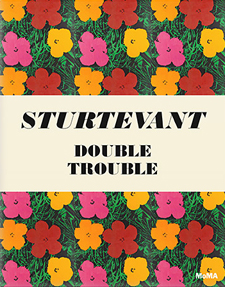
Cover of the catalogue for Sturtevant: Double Trouble
Sturtevant: Double Trouble
Museum of Modern Art
11 West 53rd Street, New York, NY 10009
November 9, 2014–February 22, 2015
Elaine Sturtevant (American, 1924–2014) began “repeating” the works of her contemporaries in 1964, using some of the most iconic artworks of her generation as a source and catalyst for the exploration of originality, authorship, and the interior structures of art and image culture. Beginning with her versions of works by Jasper Johns and Andy Warhol, she initially turned the visual logic of Pop art back on itself, probing uncomfortably at the workings of art history in real time. Yet her chameleonlike embrace of other artists’ art has also resulted in her being largely overlooked in the history of postwar American art. As a woman making versions of the work of better-known male artists, she has passed almost unnoticed through the hierarchies of midcentury modernism and postmodernism, at once absent from these histories while nevertheless articulating their structures.
Far more than copies, her versions, for instance, of Johns’s flags, Warhol’s flowers, and Joseph Beuys’s fat chairs are studies in the action of art that expose aspects of its making, circulation, and canonization. Working primarily in video since 2000, the artist remained deeply engaged with the politics of image production and reception, using stock footage from Hollywood films, television, and advertising to point to the exhaustion built into much of postwar cultural production.
This exhibition is the first comprehensive survey in America of Sturtevant’s fifty-year career and the only institutional presentation of her work organized in the United States since her solo show at the Everson Museum of Art in 1973. Rather than taking the form of a traditional retrospective, the exhibition offers a historical overview of her work from a contemporary vantage point, interspersing more recent video pieces among key artworks from all periods of her career.
Marisol: Self-Portrait Looking at The Last Supper
Metropolitan Museum of Art
Lila Acheson Wallace Wing for Modern and Contemporary Art, Design, and Architecture, Gallery 909, 1000 Fifth Avenue, New York, NY 10028
October 8, 2014–April 5, 2015
For the first time in nearly thirty years, Marisol’s monumental sculptural assemblage, Self-Portrait Looking at The Last Supper, has been on view at the Metropolitan Museum of Art, complementing the retrospective celebration of the renowned yet understudied sculptor by her recent retrospective that travelled to El Museo del Barrio this fall.
Inspired by Leonardo’s monumental fresco, Marisol (Maria Sol Escobar, b. 1930) faithfully rendered the painting’s composition into three dimensions to create this 30-foot-long installation. The biblical scene depicts Christ and his Apostles at the Passover meal, with each disciple reacting to the announcement by Jesus that one of them would betray him. The work is primarily carved from wood, with a rough, sketchy technique that includes painted and drawn elements. Marisol is particularly skillful at joining seemingly incompatible components. In fact, the seated figures are neither fully rounded nor consistently flat, oscillating between two and three dimensions. The artist chiseled the central figure of Christ from a block of salvaged New York City brownstone. Christ’s physical solidity and ashen, serene appearance contrast with the blackened, twisted figure of Judas to provide the composition’s emotional tension. In Marisol’s sculptural version of the Last Supper, a novel figure is added opposite the tableau. It portrays the artist contemplating the scene and with a hieratic presence that shares visual affinities with the stocky, solemn figures of Precolumbian sculpture.
Plastic Age: IN/OUT: Banners and Sculptures by Barbara Madsen
New York Public Library
Mid-Manhattan Library, Corner Room, 455 Fifth Avenue, New York, NY 10016
February 3–May 21, 2015
Barbara Madsen’s work is a hybrid practice between photography, print, and sculpture. Her banners, a series of photographs of inanimate plastic objects occupy the windows of the Corner Room on Fifth Avenue and 40th Street. Madsen’s sculptures facing Fifth Avenue are architectural plywood structures, jutting walls, boxed, minimal, acute—stacked on top of each other. The angled surfaces are covered with photographs of objects that have been consumed and discarded. Vibrant color plays a central tenant in her cast of objects: the child’s crimson fireman’s ladder; a lime-colored dome from a hair drier; and cobalt, yellow, scarlet plastic remnants of toys. Within the complex shadows and highlights of the images, dust and flaws are naked—the invisible becomes visible. Madsen is an artist and associate professor in the Mason Gross School of the Arts at Rutgers University known for her work in photography, prints, sculpture, and installation.
E. E. Smith: The Ballad of Delia
Kim Foster Gallery
529 West 20th Street, New York, NY 10011
January 8–February 14, 2015
The Ballad of Delia is an installation of new photo-based oil prints by E. E. Smith. This piece is part of a series in which Smith uses song forms as the point of departure for her work. The Ballad of Delia consists of ten panels of varying sizes that tell the story of Delia Greene’s murder, an account best known from covers by Johnny Cash and Bob Dylan. Like the singers, and especially the now-forgotten songwriters, Smith takes liberties with the telling of the tale, presenting various details and asking the viewer to fill in the story.
Each panel represents a clue to this murder mystery, yet stylistically they differ. The lush landscape harkens back to the evocative paintings of Albert Pinkham Ryder, drawing us into the location of the crime. Other images are shockingly explicit: the menacing axe and thick footprints allude to police photographic evidence, while the male silhouette suggests a mug shot. And the hand holding a teacup (the victim perhaps?) makes reference to film stills.
In contrast to the songs—and most likely any contemporaneous news accounts—Smith deliberately dispenses with a time-dependent linear narrative, opting instead to display several moments simultaneously. The effect is not so much “the truth” about a murder but “a truth” told without words. The trope of the murder-mystery in American culture is ubiquitous, and Smith’s iteration in The Ballad of Delia makes a compelling episode.
Louise Nevelson: Collage and Assemblage
Pace Gallery
534 West 25th Street, New York, NY 1001
January 24–February 28, 2015
Pace Gallery presents an exhibition of Louise Nevelson’s rarely seen collages, accompanied by a catalogue by Germano Celant. Nevelson began producing collages in the mid-1950s, inspired by her longstanding interest in Cubism and a correspondence with Jean Arp. Prompting her remark “the way I think is collage,” collage signifies an important aspect of her work.
The exhibition features the artist’s earliest collages, produced along her monochromatic black, gold, and white sculptures, by using scraps of wood and metal collected from the streets outside of her Little Italy studio. The show also includes examples of her later unpainted assemblages that manifest a departure from her monochromatic work, while continuing to prove the centrality of collage in her practice. Among the last works of her life, two large-scale, black wall reliefs, including Spring Street (1984), which was installed in Nevelson’s home from its completion until her death, are also part of this exhibition.
Nevelson (b. 1899 Kiev; d. 1988, New York) emigrated from czarist Russia as a child and grew up in Rockland, Maine. As an adult she returned to Europe, where she studied with Hans Hoffmann. Upon her return to the United States, she served as Diego Rivera’s assistant and later as an art instructor in the Works Progress Administration. In 1941, Nevelson had her first solo exhibition and, in 1946, was included for the first time in the Whitney Annual exhibition, which she would participate in eleven more times. The artist exhibited her first all-black sculptures in the mid-1950s. Although she worked in white and gold and later with painted steel, her developments in the 1950s sustained her work throughout the rest of her life. Considered today as one of America’s most significant artists, Nevelson has been the subject of one-artist exhibitions and retrospectives at numerous institutions in the US, and her work is found in many prominent museums and public collections worldwide.
Yael Bartana
Petzel Gallery
456 West 18th Street, New York, NY 10011
January 8–February 14, 2015
Petzel Gallery is pleased to announce a new exhibition by the Israeli artist Yael Bartana (b. 1970, Kfar-Yehezkel, Israel) that debuts her latest two films: Inferno and True Finn. This will be the gallery’s second solo show with the artist.
Bartana studied at the Bezalel Academy of Arts and Design in Jerusalem, the School of Visual Arts in New York, and the Rijksakademie in Amsterdam. She has had several solo exhibitions held at various international venues and in New York. Bartana was Poland’s choice for the 2011 Venice Biennale, where she was the first non-Polish citizen to represent the country. Bartana’s photography, film, and sound works investigate society, spirituality, and politics. Her films, film installations, and photographs challenge the national consciousness that is propagated by her native country of Israel. Homeland, return, and belonging are the central questions that she explores. Her investigation includes ceremonies, public rituals and social diversions that are intended to reaffirm the collective identity of countries. Working outside the country, Bartana observes it from a critical distance. Her early films were primarily registrations in which aesthetic interventions, including soundtracks, slowing the image, and specific camera perspectives, played a role.
In Inferno, Bartana films the inauguration of a grand temple, the destruction of it, and the worship of its debris. The starting point is the construction of a replica of Solomon’s Temple in São Paulo by an evangelical neo-Pentecostal church called the Universal Church of the Kingdom of God (UCKG). The temple is built with stones imported from Israel, as UCKG intends to bring part of the Holy Land to São Paulo, thus inverting the traditional path taken by pilgrims who would leave Brazil for the Holy Land. The film’s conflation of place, history, and belief allows Bartana to weave connections between the complex realities of São Paulo and Jerusalem. Shot and edited with stylistic references to Hollywood action epics, her film employs what she refers to as “historical pre-enactment,” a methodology that commingles fact and fiction, and prophesies and histories. Using this powerful cinematic language, Inferno combines histories of antiquity in the Middle East with Brazil’s contemporary hybrid culture.
True Finn is a documentary-style film asking eight people from Finland one simple question: who is a true Finn? Bartana’s objective with True Finn, produced in connection of Finland’s Pro Arte Foundation, was to create and record a utopian moment that would yield an answer to this question. As a result of an open call, eight Finnish residents of different ethnic, religious, and political background came to live together for seven days in a house in the countryside. Life, discussions, and specifically designed assignments were filmed, with the edited material forming the core of the artwork and allowing True Finn to probe questions about identity, nationhood, and belonging.
Diana Thater: Science, Fiction
David Zwirner
533 West 19th Street, New York, NY 10011
January 8–February 21, 2015
David Zwirner presents new work by Diana Thater in the form of a new type of installation that involves an enclosed video projection, ceiling screen, and light, as well as two new video walls. Thater is one of the most important video artists working today. Since the early 1990s, she has created a wide range of film, video, and installation-based works whose sculptural forms engage spatial perception in physical and conceptual terms. Her work pushes the boundaries of how new-media art is displayed. Through a combination of the temporal qualities of video and the architectural dimension of its installation, Thater’s work explores the artifice of its own production and its capacity to construct perception about the world through its image. Natural diversity, wildlife, and conservation have been persistent themes in the artist’s work. While her in-depth studies of ecosystems and animal behavior propose observation as a kind of understanding in itself, her ethical position is implicit in the work, providing subtly political views of the sublime.
In Science, Fiction, Thater focuses on the dung beetle and the intricate navigation system it deploys in disposing balls of animal excrement, its main source of nutrition. Recent studies have revealed that the species uses the Milky Way to orientate itself at night, currently the only insect known to do so. Thater’s video projection appears at once abstract and particular, juxtaposing the sophistication of the small insects’ navigation systems with the close-up views of their earthy setting in a meditative fusion of macro and micro realms. Deploying a new type of installation, Thater presents the footage on a screen attached to the ceiling, projected from within a closed-off, freestanding box. Mirroring the setup of the scientific experiment with the dung beetles, the white square further references the Light and Space movement in California in the 1960s. The exhibition is illuminated by soft blue lights, creating an environment that mimics the evening sky, while the walls of the box themselves are lit from below, which offers the illusion of levitation. Also on view are two video walls showing the Milky Way, respectively titled Sidereus Nuncius and The Starry Messenger.
Born in 1962 in San Francisco, Thater lives and works in Los Angeles. She studied art history at New York University before receiving her MFA from the Art Center College of Design in Pasadena, California. Over the past decade, her work has been the subject of solo exhibitions at prominent institutions worldwide, and she is the recipient of many awards. In fall 2015, the Los Angeles County Museum of Art will host a midcareer survey of her work, which will coincide with an installation at the Aspen Art Museum in Colorado.
Araya Rasdjarmrearnsook
SculptureCenter
44-19 Purves Street, Long Island City, NY 11101
January 25–March 30, 2015
SculptureCenter presents Araya Rasdjarmrearnsook, the Thai artist’s first retrospective in the United States. The exhibition, which brings together over twenty artworks spanning over a decade of the artist’s career, includes video, sculpture, and photography, presenting significant highlights as well as works that have rarely been viewed in the US. As such the show features The Class and Conversation series, for which Rasdjarmrearnsook conducts discussions with corpses, and the video Village and Elsewhere: Artemisia Gentileschi’s Judith Beheading Holofernes; Jeff Koons’ Untitled, and Thai Villagers (2011), in which a Buddhist monk leads a comical conversation about these two Western paintings in a temple. A more recent group of works featured focuses on the status of dogs in Thai culture and beyond. SculptureCenter will also include works produced specifically for this exhibition.
Rasdjarmrearnsook is one of the leading visual artists working in Southeast Asia. She is based in the northern city of Chiang Mai in Thailand, where she teaches in the Faculty of Fine Arts at Chiang Mai University. Rasdjarmrearnsook is internationally known for videos and installations that profoundly explore aspects of human experience and understanding, often touching on taboo topics such as death and insanity. In 2005 she represented Thailand in the Venice Biennale. Working with psychologically rich materials, she considers a wide range of subjects that have existed in marginal spaces, including women, the deceased, the insane, and animals. She creates complex narratives that confront societal structures of power and pedagogy. Concerned with systems of language and communication, Rasdjarmrearnsook attempts to converse with subjects who don’t speak in languages that are comprehended by or even acknowledged by mainstream society.
Looking Back: The 9th White Columns Annual
White Columns
320 West 13th Street, New York, NY 10014
January 13–February 21, 2015
Not an exhibition of women artists, this year’s White Columns Annual is curated by an all women’s curatorial collective, Cleopatra’s. Founded in 2008, Cleopatra’s works collaboratively with artists and cultural producers to create projects that forge new networks and dialogues among individuals, art practices, and institutions. These projects are realized in their flagship noncommercial storefront in Greenpoint, Brooklyn. From 2011 to 2012 the collective also operated a satellite art space in Berlin, Germany. Further investigations also occur in the form of offsite public programs, events, and printed publications, encompassing various fields and locales. The aim of Cleopatra’s is to present work and advance ideas informed by both individual and collective perspectives, and to disseminate that work and those ideas among a broad and diverse audience. Current and founding members of the Cleopatra’s are Erin Somerville, Colleen Grennan, Bridget Finn, and Bridget Donahue.
Samara Golden: The Flat Side of the Knife
MoMA PS1
22-25 Jackson Avenue, Long Island City, NY 11101
October 26, 2014–August 30, 2015
MoMA PS1 presents Samara Golden’s first solo museum exhibition and her largest installation to date: The Flat Side of the Knife. The Los Angeles–based Golden (American, b. 1973) creates immersive installations that explore what the artist calls the “sixth dimension,” where a multiple pasts, presents, and futures coexist. Golden’s multilayered installation fills the double-height of MoMA PS1’s Duplex Gallery with staircases, beds, couches, lamps, musical instruments, video, and sound. The Flat Side of the Knife combines physical with illusory spaces. Some appear only in mirrors, reflecting what the artist refers to as “layers of consciousness,” akin to psychological and hallucinatory spaces in the mind. Her use of mirrors in conjunction with sculptural elements made from a silvery insulation board allows the illusion of space to expand in multiple directions, suggesting imaginary spaces, such as adjacent rooms that do not exist in reality.
Golden received her MFA from Columbia University and has exhibited her work at the Museum of Contemporary Art, Los Angeles; SculptureCenter in New York; Night Gallery in Los Angeles; CANADA in New York; Cardi Black Box in Milan; Loyal Gallery in Stockholm; and Galerie Crevecoeur in Paris. Most recently, her work was featured in the Hammer Museum’s biennial, Made in L.A., in 2014.
Anne Imhof: DEAL
MoMA PS1
22-25 Jackson Avenue, Long Island City, NY 11101
January 31–March 9, 2015
MoMA PS1 presents DEAL, Anne Imhof’s inaugural solo project in the United States, which consists of a two-day performance followed by an exhibition. The project, conceived specifically for the museum, revolves around the structures of illegal street transactions that are underpinned by strict rules and codes while functioning beyond words and juridical regulations. Along the opening performances, nine performers will enact highly complex and abstract movements, evoking power relations, secret codes, and unspoken rules that underlie daily human interactions. Here, tasks and patterns are unceasingly repeated over an entire day and progressively shift as they push toward a point of collapse. The exhibition expands on the same formal interrogations and ideas through diverse media such as drawing, video, sculpture, painting, and a variation of the initial performance, SOTSB for DEAL, which repeats every Sunday during museum hours.
Imhof (German, b. 1978) was trained as a visual artist and considers the different media as integral to the process for creating images that gradually emerge in time. Live events, their documentation, objects, and props—Imhof believes that each component in a body of work is interrelated and of equal relevance, contributing to the creation of a visual image that is perpetually in process, highly precarious, and in a constant verge of dissolution.
Chitra Ganesh: Eyes of Time
Brooklyn Museum
Elizabeth A. Sackler Center for Feminist Art, Herstory Gallery, Fourth Floor, 200 Eastern Parkway, Brooklyn, NY 11238
December 12, 2014–July 12, 2015
The Herstory Gallery at the Brooklyn Museum is hosting Eyes of Time, an exhibition by the Brooklyn-based artist Chitra Ganesh that explores ideas of femininity, empowerment, and multiplicity. Her drawing, installation, text-based work, and collaborations suggest and excavate buried narratives typically absent from official canons of history, literature, and art. For more than a decade, Ganesh has used the iconography of mythology, literature, and popular culture to bring to light feminist and queer narratives.
For Eyes of Time, the artist draws inspiration from the museum’s encyclopedic collection to create a site-specific multimedia installation at the gallery. Eyes of Time focus on the portrayal of female power and plurality based on Kali—the Hindu goddess of destruction and rebirth—as well as other figures from Judy Chicago’s The Dinner Party as point of departure. Tales of Amnesia (2002)—a zine inspired by Indian comic books acquired by the museum—is also on view.
As stated about her creative practice, “by layering disparate materials and visual languages, Ganesh asks her viewers to ‘seek and consider new narratives of sexuality and power.’ In this process the body becomes a site of transgression and transformation, both social and psychic, doubled, dismembered and continually exceeding its limits.”
TENDREL – Interconnections
Tibet House
22 West 15th Street, New York, NY 10011
January 2–March 2, 2015
TENDREL – Interconnections is an exhibition by artists who are linked to and inspired by the life work of Jetsunma Tenzin Palmo, the first Western woman to become a Buddhist nun. Diverse yet interconnected, the themes investigated by the artists include Tibet and its culture, Buddhism, women, spiritual life, meditation, and activism. Works consist of photographs of nomads and nunneries in Tibet that provide profound insight and stark contrast to the social cultural changes of the Tibetan community, and art based on Buddhist and meditative iconography that explores the practice of visualization in painting, sculpture, drawing, and detailed stained-glass artistry. Among those presenting works are these artists: Diane Barker, Caterina De Re, Mary DeVincentis, Maxine Henryson, Heather Kessinger, Chrysanne Stathacos, Tsunma Jamyang Donma/Yulokod Studios, and Kate Temple.
Art in the First Person Lecture Series
School of Visual Arts
Various Locations in Manhattan
February 3–17, 2015
The School of Visual Arts presents the spring 2015 lineup of its Art in the First Person lecture series, jointly presented by the following departments: MA Curatorial Practice, MPS Digital Photography, BFA Fine Arts, MFA Fine Arts and BFA Visual and Critical Studies. All events are free and open to the public. The lecture series includes:
- Amy Smith-Stewart, independent curator and art advisor, on Tuesday, February 3, 6:00 PM
- Lumi Tan, curator at the Kitchen, on Tuesday, February 10, 6:00 PM
- Kira Pollack, director of photography at Time, on Tuesday, February 10, 7:00 PM
- Judith Page, artist, on Tuesday, February 17, 6:00 PM
Collective Creativity: Collaboration and Collectives in Feminist Art Practice
Feminist Art Project
Museum of Arts and Design, 2 Columbus Circle, New York, NY 10019
February 14, 2015
Committee on Women in the Arts Picks for February 2015
posted by CAA — February 10, 2015
Each month, CAA’s Committee on Women in the Arts selects the best in feminist art and scholarship. The following exhibitions and events should not be missed. Check the archive of CWA Picks at the bottom of the page, as several museum and gallery shows listed in previous months may still be on view or touring.
February 2015
The February CWA Picks are dedicated to Kalliopi Minioudaki for her tremendous efforts in working on the Picks during her tenure on the CWA (2012–15). You will be missed!
Poetry and Exile
British Museum
Gallery 34, Great Russell Street, London
WC1B 3DG United Kingdom
October 1, 2014–March 1, 2015
Housed within the Islamic World Galleries, Poetry and Exile displays a series of works by artists of the Middle East and North Africa recently acquired by the British Museum. This small but powerful exhibition explores the effects of exile through the eyes of four women artists:Ipek Duben, Mireille Kassar, Mona Saudi, and Canan Tolon.
Tolon’s series ofink and graphite drawings, titled Futur Imparfait, is a memoir fromher exile from Istanbul to France, where she spent a decade in hospital as a result of contracting polio as a child. In the series Tolon portrays an exile not only from home, but also from her own body. Duben’s book Refugee belies the helplessness and terror suffered by people forced to flee their homeland with images on delicate gauze pages and using childlike embroidery that depicts the crossing of borders. The Istanbul-born Duben has been making books and installations that focus on identity, domestic violence, and the worldwide forced migration of the twentieth century.
The Jordanian artist Saudi combines the evocative verses of the Palestinian poet Mahmoud Darwish with drawings, while the Lebanese-born Kassar developed a series of drawings inspired by the Persian poem The Conference of the Birds. Here, Kassar conjures a story of exile from her own family history. Originally from Mosul and Mardin—present day Iraq and Turkey—her ancestors fled the Ottoman massacres of minorities during the late-nineteenth and early twentieth century.

Zoe Strauss, Drying Money, Mississippi Gulf Coast, Mid September, 2005 (artwork © Zoe Strauss)
Zoe Strauss: Sea Change
Cantor Fitzgerald Gallery
Haverford College, Whitehead Campus Center, 370 Lancaster Avenue, Haverford, PA 19041
January 23–March 6, 2015
Cantor Fitzgerald Gallery presents Sea Change, an exhibition of photographs, vinyl prints, and projected images by Zoe Strauss. Throughout this project, the celebrated Philadelphia photographer traces the aftermath of Hurricane Katrina in 2005, the BP Deepwater Horizon oil spill in southern Louisiana in 2010, and Hurricane Sandy in 2012: three ecological disasters that have changed America’s landscape.
With little formal training as a photographer or artist, Strauss (b. Philadelphia, 1970) uses photography as the most direct means of representing her chosen subjects. Her images, often both disturbing and touching, are focused mainly on American working-class experience. She founded the Philadelphia Public Art Project in 1995 with the aim of exhibiting art in nontraditional venues in order to give the citizens of Philadelphia access to art in their everyday lives. She now refers to this initiative as an “epic narrative” of her own neighborhood that reflects the beauty and struggle of everyday life.
True to her creative statement, Strauss captures the fast and slow tragedies of global warming through the portrayal of an irreparable damage and the hope of mending. Flattened sceneries and architectural remains stand alongside graffiti and signs including encouraging pleas, words that express the despair of a sudden displacement as much as the hope to return and belong, again. Sea Change is accompanied by a publication designed by Random Embassy.
Otobong Nkanga: Tracing Confessions
Museum Folkwang
Museumsplatz 1, 45128 Essen, Germany
January 23–May 18, 2015
Museum Folkwang presents Tracing Confessions, a two-part project created by Otobong Nkanga (born Nigeria, 1974). Based in the museum collection, Nkanga explores issues of identity and relationships between objects and people. As part of the Kunststiftung NRW’s project 25/25/25, Nkanga invited members of the museum’s staff to be photographed with selected pieces from this collection. During the month of January, the resulting photographs will be distributed as billboards throughout the city. Bringing the museum to the public space, the piece aims to connect with Essen residents in their everyday lives. This public intervention is presented along an installation designed specifically for the museum. Unveiling shared stories between objects and people, Tracing Confessions interrogates the origin of the museum artifacts, and in that their potential of shaping identities.
Trained in the converging traditions of performance and live arts, Nkanga leads an intensive research-based artistic practice. Her heterogeneous and multidisciplinary practice includes drawing, photography, installation, and performance art. Her sensitive observation on social and topographical changes in the environment, and on the concept of diaspora, examines the regional and cultural complexities that are embedded in these experiences. Using her own and others’ body and voice, Nkanga proves that the subjects of her projects are to be a lived and truly embodied experience. Through language and visual and physical narratives, her work invites viewers to engage in a dialogue that reflects on identity, memory, and perception.
Carolee Schneemann: Infinity Kisses
Merchant House
Herengracht 254, 1016BV, Amsterdam, the Netherlands
January 22–April 12 2015
The Merchant House in Amsterdam presents Carolee Schneemann: Infinity Kisses, an exhibition of works on paper, photographs, and a video by the renowned American multimedia artist. The exhibition pivots on a site-specific installation of the video Infinity Kisses-The Movie (2008), first shown in Amsterdam. The show is also accompanied with a fully illustrated catalogue with an essay by Kalliopi Minioudaki.
The experiential body—yet not only her own naked one, as this exhibition argues—has been paramount in Carolee Schneemann’s multifariously radical politics and idiosyncratic poetics. Focusing on the photographic series (2004) and video (2008) that sensually portray the morning kisses given to Schneemann by her cats, Cluny and Vesper, this exhibition foregrounds the radical centrality of the cat in her work—as lifelong companion and a symbol of what patriarchal culture represses and dismisses, namely female sexuality. Returning Schneemann’s legendary yet controversial interspecies “kisses” to a house that variously evokes her own—due to the fact that the Merchant House is located in a historic canal house that reminds the artist of her home in Springtown, New York, itself central in her production—this exhibition highlights the domesticity that characterizes the poetics of intimacy inherent in a great part of her work.
In contrast to the ecstatic bodies of Infinity Kisses, the accompanying works in the exhibition juxtapose gruesomely violated or caged feline bodies with news images of global atrocities. Sampling the gestural painterliness and collage aesthetics that underpin much of her work, these prints hint at the darker role the body plays in Schneemann’s sorrowful diagnosis of the malaises of modernity and patriarchy, of Western civilization, and of the current stage of the society of spectacle. An extraordinary example of her conceptual feminist poetics, Unexpectedly Research (1992) illuminates the research and “double knowledge” that underpin not only Schneemann’s feminist critique of the suppression of the sacred feminine, but also its radical bodily retrieval by the artist.

Janet Biggs, production still from Can’t Find My Way Home, 2015, four-channel video, high-definition video installation with sound, 8:35 min. (artwork © Janet Biggs)
Janet Biggs: Echo of the Unknown
Blaffer Art Museum
University of Houston,
120 Fine Arts Building, Houston, TX 77204-4018
January 17–March 21, 2015
Janet Biggs: Echo of the Unknown is part of the Science Spring at the Blaffer Art Museum. Organized by the independent curator Janet Phelps, this multidisciplinary exhibition combines video, sound, and objects to explore the role of memory in the construction of identity. Drawing from the artist’s personal memories of the effects of Alzheimer’s on various family members, stories of public figures coping with the disease, and research conducted with neurologists and geoscientists, Echo of the Unknown raises fundamental questions about how we become—and how we lose our sense of—who we are.
Works in the exhibition include Can’t Find My Way Home, a four-channel video installation inspired by memories of the artist’s grandfather, an avid mineral collector who could recall the most difficult names of mineral species yet not his own as he succumbed to the disease. This piece juxtaposes documentation of neurological research conducted in New York and Houston laboratories with footage shot in the crystal cavern below the Merkers salt mine in Germany, itself a potent metaphor for the brain and its sites of memory.
The video installation The Persistence of Hope focuses on the solace Biggs’s uncle found in his residual memory of birds. Only after his death Biggs discovered her uncle’s peculiar ritualized attempt to sustain beauty and hold onto life as he felt it fade away by gathering hummingbirds and placing them in his freezer. Alternating imagery of gravity-defying hummingbirds with footage shot in the Arctic and in laboratories where human brain cells are preserved in freezers for neurological research, The Persistence of Hope paints a tender picture of life caught between hope and futility.
Breathing without Air follows an aging mineral collector as he searches for the perfect specimen at a trade show, where he eventually loses his way among the many aisles of vendors and displays. All three pieces share a soundscape based on Glen Campbell’s 1968 song “Wichita Lineman.” Comprising scores based loosely on Campbell’s tune by various composers, Biggs’s Wichita Lineman is a haunting sonic homage to the tenacity of Campbell who, upon his diagnosis with Alzheimer’s, decided to continue to tour for as long as he could.
An ambitious series of lectures, gallery talks and panel discussions accompanies the exhibition throughout its duration, enhancing the exhibition’s role as a catalyst for cross-disciplinary learning.
Lynn Hershman Leeson: Civic Radar
ZKM | Karlsruhe
Lorenzstraße 19, 76135 Karlsruhe, Germany
December 13, 2014–April 6, 2015
Lynn Hershman Leeson has been mining body art and new media for more than forty years. Her cutting-edge work has run a broad gamut that ranges from the feminist performance Roberta Breitmore, for which she lived a double life as herself and an alter ego for most of the 1970s, to a series of science-fiction films starring Tilda Swinton. Acknowledged for her feminist politics, Hershman Leeson chronicled the feminist movement in the 2011 documentary Women Art Revolution. Yet her contributions to technologically sophisticated art have been widely understudied. Conversely, Lynn Hershman Leeson: Civic Radar, the first comprehensive retrospective of her work in a museum and especially in Germany, not only overviews all the creative phases of her work, bringing together rarely shown early works like her 1960s wax and burned sculptures along with masterful highlights, but it also strives to acknowledge her pioneering role as an innovative and influential new-media artist.
As such Civic Radar brings together works that exemplify Hershman Leeson’s multimedia investigation of identity and various modes of surveillance, such as Lorna (1983/84), one of the first interactive projects on videodisc, and Teknolust (2002), which addresses cyberidentity, artificial intelligence, cloning, and the decoupling of sexuality and human reproduction. The exhibition also include recent works that use robots, mass-communication media such as smart-phones, and the latest scientific developments in the field of genetics and regenerative medicine, including three-dimensional bioprinters that create human body parts.
Hershman Leeson received a bachelor of science in museum administration and art at Case Western Reserve University in Cleveland and a master of arts in art criticism at San Francisco State University. From 1993 through 2004 she was professor of electronic arts at the University of California, Davis. From 2004 through 2010 Hershman Leeson held the Andrew D. White Chair at Cornell University in Ithaca. In 2007 the artist assumed charge of the San Francisco Art Institute’s Film Department. Over the years, she has received numerous awards, including the Siemens Medienkunst Preis in 1995 and the Prix Ars Electronica (Golden Nica) in 1995.
Committee on Women in the Arts Picks for January 2015
posted by CAA — January 10, 2015
Each month, CAA’s Committee on Women in the Arts selects the best in feminist art and scholarship. The following exhibitions and events should not be missed. Check the archive of CWA Picks at the bottom of the page, as several museum and gallery shows listed in previous months may still be on view or touring.
January 2015
Nicole Miller at Artists’ Film International
Ballroom Marfa
108 East San Antonio Street, Marfa, TX 79843
November 22, 2014–February 22, 2015
Ballroom Marfa is presenting two recent videos by Nicole Miller, as a highlighted artist participating at the Artists’ Film International. This project means a collection of artists’ film, video and animation from around the world that has been coorganized with Whitechapel Gallery in London.
Miller (b. 1982; Tucson, Arizona) lives and works in Los Angeles. Her films and installations explore the transformative capabilities of the moving image to reconstruct interpretations of self and culture. Through storytelling, self-representation and self-presentation become a narrative in search for the reconstitution of physical and psychic manifestations of loss. Her videos often focus on the interplay between preconception and reality in terms of African American identity, as in the case of The Conductor (2009), presented earlier this year at the High Line Art Program.
In this occasion, Ballroom Marfa is presenting two recent projects by Miller. In David (2012) we can observe the fragmented image of the profile of a man that the artist encountered by chance on the street. Here, he narrates the events that lead to the amputation of his left arm whilst his right limb is reflected in a mirror—a rehabilitation technique that helps patients deal with the painful symptoms of a phantom limb. Death of a School (2014) is a predominantly silent four-channel video that meditates on the events of a soon to be shutdown school in Tucson, which is Miller’s hometown. Presented together, Miller’s films become powerful narratives that carry the possibility of reconstitution of lost histories and identities.
Johanna Calle: Indicios
Casas Reigner
Calle 70A # 7-41, Bogotá, Colombia
October 2, 2014–January 30, 2015
Casas Riegner presents Indicios (Signs), an exhibition that gathers Johanna Calle’s most representative works produced between 1990 and 2014. Seeking to examine closely the visual language that has characterized her work for more than two decades, the exhibition includes a selection of projects in which different processes developed by the artist are juxtaposed. In each series of work, Calle exposes her approach to the creative process, where she also unveils a sense of unsettledness and curiosity.
Featuring her conceptual research and creative use of unconventional materials, the display includes Calle’s assemblages, signs, and phonetic representations of indigenous languages, photographic drawings made on vintage analogue photographs, and the intervention of archives and documents that are part of different research projects. For the documentation-based installation Hermanas Figueiredo (2013–14), Calle reconstructed a story as a gesture of redemption to the Brazilian sisters that devoted their life to a scientific research around the life of butterflies in the first half of the twentieth century. However, they have lost the legal battle with a recognized Brazilian professor who was hired to catalogue their collection and had deliberately chosen to wrongly assign its authorship and ownership. The case was dismissed and labeled as exhaustive and rigorous maniac women’s work.
Calle holds a BFA from Universidad de Los Andes en Bogotá and an MFA from Chelsea College of Arts in London, England. Her projects Perímetros I and Perímetros II were included at the thirty-first Bienal de São Paulo, Brazil in 2014.
Donna Sharrett: Love Songs
Pavel Zoubok Gallery
531 West 26th Street, New York, NY 10001
January 8–February 7, 2015
Pavel Zoubok Gallery presents Love Songs, a solo exhibition of new work by Donna Sharrett, including two of her largest—yet humanly scaled—works to date, framed by Sampling, a related group show curated by Dara Meyers-Kingsley.
With a variety of needlework techniques, Sharrett creates painstakingly wrought concentric assemblages sewn together from a potent and personal material lexicon consisting of donated or inherited jewelry, clothing, and buttons; hair, bone beads, dirt, and guitar strings. Passed down from a congenial and ancestral sorority of craftswomen and fiber artists, Sharrett’s techniques instill in each piece cross-cultural references to life, death, and rebirth. Addressing the shared human ability and desire to remember, her works transcend the confines of economic, religious and cultural boundaries.They instead evoke “life as it is lived and remembered—a notion of lineage that is not always linear and narrative but sometimes acts more like a spiral—a growing flower that rises from the earth and whose seeds scatter to become the next crop.”
Sharrett (b. Philadelphia, 1958) is the recipient of two fellowships from the New York Foundation for the Arts as well as notable residencies and grants from Smack Mellon, the Bronx Museum and the Millay Colony for the Arts Residency. Her work has been widely exhibited, including a solo exhibition at the Everson Museum in Syracuse, New York, and group exhibitions at the Museum of Arts and Design in New York; the Bellevue Arts Museum in Bellevue, Washington; the University of Rochester in Rochester, New York; and Marianne Boesky Gallery in New York. Her work is represented in the collections of the Museum of Contemporary Arts and Design in New York; the United States Embassy in Valletta, Malta; the Hebrew Home for the Aged in New York; and J. P. Morgan Chase in New York. A full-color catalogue will accompany the exhibition.
Cameron: Songs for the Witch Woman
MOCA Pacific Design Center
8687 Melrose Avenue, West Hollywood, CA 90069
October 11, 2014–January 18, 2015
Cameron: Songs for the Witch Woman is the first survey of Cameron’s work since 1989 and explores the artist’s role as a seminal figure within Los Angeles’s midcentury counterculture, her unique melding of surrealism and mysticism, and her unwavering commitment to live her life as art. “Navigating between disciplines and traditions of poetry, cinema, visual arts, and spirituality; Cameron has opened many doors that continue to intrigue and inspire generations of artists,” while “her hallucinated vision … embodies an aspect of modernity that deeply doubts and defies cartesian logic at a moment in history when these values have shown their own limitations,” as stated by MOCA’s director, Philippe Vergne.
Born in Belle Plaine, Iowa, Cameron (Marjorie Cameron Parsons Kimmel) (1922–1995) emerged as an artist, performer, poet, and occult practitioner in Los Angeles, uniquely bridging the city’s flourishing spiritual and art worlds at midcentury. She arrived in Los Angeles by way of the Second World War, where she drew maps and labored in a photographic unit for the United States Navy. A visionary painter and unparalleled draftsman best known today for her paintings and drawings of human and fantastical figures, she spend her last days in West Hollywood largely unrecognized. Cameron’s frenetic, delicate renderings of mythological figures reveal a singular attention to line and the idea of spiritual metamorphosis, evoking the surrealism and symbolism of the French poets. She is closely associated with Beat artists such as Wallace Berman, George Herms, and Dennis Hopper, the filmmakers Kenneth Anger and Curtis Harrington, and the occultist Aleister Crowley, while she was mentor to younger artists and poets such as David Meltzer and Aya (Tarlow). Cameron’s artwork appeared in the first issue of Berman’s celebrated journal Semina (1955–64) and has also been included in group exhibitions at the Whitney Museum of American Art in New York, the J. Paul Getty Museum in Los Angeles, the Martin-Gropius Bau in Berlin, the Pasadena Museum of California Art, the Centre Pompidou in Paris, and the Los Angeles Municipal Art Gallery in 1989.
Comprised of nearly one hundred artworks and ephemeral artifacts, the exhibition includes pieces formerly thought to be lost, ranging from early paintings to drawings, sketchbooks, and poetry from her late years, as well as ephemera and correspondence with individuals such as her husband Jack Parsons (1914–1952), a rocket pioneer and a founder of the Jet Propulsion Laboratory, and the renowned mythologist Joseph Campbell. The exhibition brings to life the recently published book titled Songs for the Witch Woman that features a series of poems written by Parsons alongside illustrations drawn by Cameron that echo the intimate themes of their turbulent love story.
In conjunction with the exhibition, the Cameron Parsons Foundation is producing an eighty-eight-page catalogue with approximately seventy-five full-color illustrations.
Sylvie Blocher: S’inventeur autrement
Mudam Luxemburg
Musée d’Art Moderne Grand-Duc Jean 3, Park Dräi Eechelen L-1499 Luxembourg-Kirchberg
August 11, 2014–May 25, 2015
Since the early 1990s, the French artist Sylvie Blocher has built up a body of video work that takes the human as its material, in all its fragility, unpredictability, and yet full presence. She engages with a poetics of relation, emancipation, the questioning of identities, the writing of history, the permeability of the masculine/feminine border, and codes of representation in a world under control. Created in different geographic regions, her works are based on exchange: they often involve the participation of lay people, who are invited to present themselves in a completely new fashion before the camera, as the artist “shares her authority with her models” to create what she calls Living Pictures.
This solo exhibition at Mudam Luxembourg revolves around an ambitious project titled Dreams Have a Language, which combines a participative work, a video installation, and the production of a movie. As envisioned by the artist, the show was meant to be “the story of an event at a museum in Luxembourg in which the visitors will not be content to look politely at the works, but decide impulsively to experience leaving the world for a few minutes, in a journey filmed and broadcast, a story of fragmented, floating bodies. Then a movie, the start of another story.”
During the first weeks of the exhibition, the museum’s Grand Hall became a fully active film studio that centered on the operation of a flying machine twelve meters tall. Through the placement of an ad in various media, Blocher invited the public to visit the museum, to leave the ground for a few minutes, and to “rethink the world.” “Shooting conditions: allow one hour and present yourself at Mudam with an idea to change the world. It might be poetic, political, aesthetic, emotional, revolutionary, scientific, architectural, educational, financial, culinary, sonic, etc.” Forming the content for a video installation at the center of the exhibition, the pictures of the suspended bodies will be the starting point for a movie created with the Luxembourg director Donato Rotunno, to be released in spring 2015. By combining a documentary approach with fictional writing, the movie will offer “an assemblage of words, gestures and moments that will open up an imaginary universe, an expectancy, a suspense.”
A survey of the artist’s work is also presented in two of the museum’s galleries, where video installations and drawings sample key themes of Blocher’s work: the sharing of responsibility, the question of politics, identity, dreams, and utopia. By using music to give new life to important speeches and manifestos made in contemporary history (by Angela Davis, Édouard Glissant, and Barack Obama, among others), the five videos that form the series Speeches (2009–12), which are part of the Mudam Collection, engage with the political dimension of the imagination, individual and collective. Other works, such as the diptych Change the Scenario (Conversation with Bruce Nauman) (2013) and the three videos recently created by Blocher in Texas, tackle historic and racial aspects in the construction of the individual. Placed at the entrance to each gallery, a series of drawings that the artist has made every day for a year, based on the front page of the newspaper Libération, emphasizes the passages between the personal and the political initiated by her practice.
Committee on Women in the Arts Picks for December 2014
posted by CAA — December 10, 2014
Each month, CAA’s Committee on Women in the Arts selects the best in feminist art and scholarship. The following exhibitions and events should not be missed. Check the archive of CWA Picks at the bottom of the page, as several museum and gallery shows listed in previous months may still be on view or touring.
December 2014
Suzanne Lacy: Gender Agendas
Museo Pecci Milano
Ripa di Porta Ticinese 113, Milan, Italy
November 14, 2014–January 6, 2015
The Milan Pecci Museum is presenting a Suzanne Lacy’s Gender Agendas. This retrospective exhibition launches a whole new line of investigation at the the Centre for Contemporary Art Luigi Pecci that has been dedicated to the pioneering work in the arts developed internationally in the sixties, seventies, and eighties. Born in California in 1945 and based in Los Angeles, Lacy is an influential artist, educator, and writer. She is known as one of the pioneer artists blending Conceptual and Performance art with social commitment in the early seventies in Los Angeles. Her approach to researching and making follows her questioning the relationship of “service” to “activism,” and of both to “art practice.” Her diverse approach to this investigation stretches from explorations of the body and intimate reflections to the production of large and lengthy public demonstrations involving dozens of artists and thousands of spectators.
Gender Agendas presents, for the first time in Europe, a large series of Lacy’s projects that follow a constant of her artistic development: the investigation of the female condition. From a more intimately approach to a strong political and civic one, Lacy explores the power of art as a useful and effective tool for social struggle and for the promotion of progressive ideas, digging in this way into the meanings of the hundreds of anonymous female and working-class performers who would have no access to the communication systems otherwise. Sexual exploitation, violence, media representation of the aging woman, and social issues ranging from racism to the conditions of labor and class may have been provocative and avant-garde in the seventies and eighties, but are still deeply relevant today.
Through the curatorial approach of Lacy’s retrospective exhibition, Fabio Cavallucci and Megan Steinman, propose a readaptation of some of her most important works, including Prostitution Notes (1974); Three Weeks in May (1977); In Mourning and In Rage (1977); The Crystal Quilt (1985–87); and Full Circle (1994); as well as one of her most recent projects, Storying Rape (2012), a discussion among significant personalities in the media, activists, and politicians in an attempt to find a new cultural narrative that describes sexual violence.
Birgit Jurgenssen
Fergus McCaffrey
514 West 26th Street, New York, NY 10001
November 6–December 20 2014
For the second exhibition of Birgit Jurgenssen, Fergus McCaffrey brings together a large group of her photographic works in combination with a number of sculptures in order to underscore the variety and complexity of her work.
Highly experimental, Jurgenssen’s photographic work is exemplified by her Stoff-arbeiten (Fabric Works), which were created from the late 1980s to the early 1990s. The “fabric works” consist of photographic prints mounted on canvases that have been screwed to iron frames made by the artist, giving a highly sculptural character to their combinations. Thin, translucent fabrics such as gauze are stretched over the surface, veiling and slightly obscuring the images. The photographs themselves are created through a range of processes, including photograms, solarization, and multiple exposures. The juxtaposition of hard-welded iron frames and delicate textile emphasizes their materiality and draws a direct relationship to Jürgenssen’s sculptural works.
The exhibition also includes works that Jurgenssen referred to as “painted” photography. These large format photograms were created by manipulating sheets of photo paper in developer and fixing baths and by pouring photo chemicals directly over the paper. The resulting marbled and dripped images were then exposed to light and fixed, after which the surfaces were scratched, creating gestural drawings over the “painted” photographic surfaces.
Born and educated in Vienna, Jürgenssen (1949–2003) died prematurely at the age of 54. Her studio practice encompassed drawing, performance, photography, and sculpture, through which she compellingly combined classically refined draftsmanship, mixed media, and experimental photo techniques. She is best known for her connection to the Austrian feminist movement of the 1970s. Equally important is her engagement with Surrealism and her concern for materials and processes.
Cover of the catalogue for Sturtevant: Double Trouble
Sturtevant: Double Trouble
Museum of Modern Art
Special Exhibitions Gallery, Third Floor; and Sue and Edgar Wachenheim III Painting and Sculpture Gallery, Gallery 5, Fifth Floor, 11 West 53rd Street, New York, NY 10009
November 9, 2014–February 22, 2015
Elaine Sturtevant (American, 1924–2014) began “repeating” the works of her contemporaries in 1964, using some of the most iconic artworks of her generation as a source and catalyst for the exploration of originality, authorship, and the interior structures of art and image culture. Beginning with her versions of works by Jasper Johns and Andy Warhol, she initially turned the visual logic of Pop art back on itself, probing uncomfortably at the workings of art history in real time. Yet her chameleonlike embrace of other artists’ art has also resulted in her being largely overlooked in the history of postwar American art. As a woman making versions of the work of better-known male artists, she has passed almost unnoticed through the hierarchies of midcentury modernism and postmodernism, at once absent from these histories while nevertheless articulating their structures.
Far more than copies, her versions, for instance, of Johns’s flags, Warhol’s flowers, and Joseph Beuys’s fat chairs are studies in the action of art that expose aspects of its making, circulation, and canonization. Working primarily in video since 2000, the artist remained deeply engaged with the politics of image production and reception, using stock footage from Hollywood films, television, and advertising to point to the exhaustion built into much of postwar cultural production.
This exhibition is the first comprehensive survey in America of Sturtevant’s fifty-year career and the only institutional presentation of her work organized in the United States since her solo show at the Everson Museum of Art in 1973. Rather than taking the form of a traditional retrospective, the exhibition offers a historical overview of her work from a contemporary vantage point, interspersing more recent video pieces among key artworks from all periods of her career.
Michelle Stuart: Silent Movies
Leslie Tonkonow: Art Works and Projects
535 West 22nd Street, Sixth Floor, New York, NY 10011
November 1–December 20, 2014
Michelle Stuart (American, b. 1933) became internationally known in the 1970s for innovative works that synthesize Land art, drawing, and sculpture, as well as her pioneering use of natural materials in sculpture, painting, and drawing. Since 2011 photography has been her primary medium, although present in her work both literally and conceptually since the 1970s. Devising a highly personal and original method of photographic manipulation, Stuart conveys the impression of deeply felt images seen through time and layers of consciousness. It is “a combination of fact and fiction, truth and lies—and lies that tell the truth,” as put by the artist.
The exhibition at Leslie Tonkonow comprises photographs drawn from Stuart’s vast archive of analogue and digital photographs taken for almost half a century. Stuart activates their aesthetic and storytelling potential by arranging them in gridlike groups or occasionally altering them. Each work is composed of between seven and seventy separate images, digitally printed on 8½ x 11 inch sheets of archival paper. Both painterly and cinematic in their rhythmic visual arrangement, the works in this exhibition amount to meditations on the nature of memory.
As dreamlike recollections of her past, these works continue her lifelong artistic engagement with specific locations, while affirming the significance of place as a unique source of memory. “Memories are silent until we either articulate them in words on paper or depict them visually,” as put by the artist herself. Two years ago, in Palimpsests, her first solo show of exclusively photographic works, Stuart expressed thoughts on war, the cosmos, the passing of time, and on form itself. The compositions in Silent Movies, all created since then, present universal themes with deeply personal associations that contain keys to momentous events and evoke times and places in a manner that is both specific and archetypical. With abundant literary, cinematic, and historical references, these works do not merely address memories, but, as put in the press release, the very process of recall itself.
Committee on Women in the Arts Picks for November 2014
posted by CAA — November 10, 2014
Each month, CAA’s Committee on Women in the Arts selects the best in feminist art and scholarship. The following exhibitions and events should not be missed. Check the archive of CWA Picks at the bottom of the page, as several museum and gallery shows listed in previous months may still be on view or touring.
November 2014
Ciara Phillips: Turner Prize Nominee
Tate Britain
Millbank, London SW1P 4RG, United Kingdom
September 30, 2014–January 4, 2015
Ciara Phillips has been nominated for the Turner Prize 2014. The nomination was based on her solo exhibition presented at the Showroom, London. Workshop was an installation made up of multiple screen prints on newsprint and large-scale works on cotton set as a two-month temporary print studio within the gallery space over the course of the exhibition. Along this project, Phillips collaborated with invited artists, designers, and local women’s groups to produce new screen prints. Guests contributed to Workshop their diverse knowledge and experiences of working collectively. These collaborations initiated conversations and actions that aren’t contained within specific disciplines of art, community action, design, or activism, leaving the workshop/exhibition structure open for development as the project progresses.
By making prints in these new collaborative groupings, Phillips explores the potential of “making together” as a way of negotiating ideas and generating discussions around experimental and wider uses of print. Her long-term commitment to collaborative production underpins her expansive printing practice that makes use of screen printing, wall drawing, and photography to create context-specific installations.
Phillips (born in Canada, 1976) lives and works in Glasgow. She acknowledges having been inspired by Corita Kent in her collaborative approach to art practice. Corita Kent (a.k.a. Sister Mary Corita, 1918–1986) was a pioneering artist, educator, and activist who reinterpreted the advertising slogans and imagery of 1960s consumer culture.
A piece to be highlighted from the exhibition is New Things to Be Discussed (2014), a circular booth installation including screen prints on paper and audio recording based on her conversations with fellow artists and with Justice for Domestic Workers, a self-organized group of migrant domestic workers who work in private houses in the United Kingdom. Engagements and discussions among J4DW, artists, curators, and curatorial projects have sought to address making domestic work visible in British society and the employment of artistic and aesthetic strategies to this end.
Someday Is Now: The Art of Corita Kent
Artis—Naples, Baker Museum
5833 Pelican Bay Boulevard, Naples, FL 34108
September 27, 2014–January 4, 2015
The Baker Museum presents Someday Is Now: The Art of Corita Kent. Corita Kent (Iowa, 1918–Boston, 1986), also known as Sister Mary Corita, was a pioneering Los Angeles–based artist, designer, educator, and activist. She has experimented in printmaking, producing a groundbreaking body of work that combines faith, activism, and teaching with messages of acceptance and hope. Through vibrant, Pop-inspired prints, Corita posed philosophical questions about racism, war, poverty, and religion through work that has been described as saucy, funny, and yet deeply devotional.
Mixing street signs, scripture, poetry, philosophy, advertising, and pop-song lyrics, Corita developed her own version of Pop art. Exploring printmaking as a collaborative and popular medium to communicate with the world, her bright and bold imagery, along provocative texts drawn from a range of secular and religious sources, were widely disseminated as billboards, book jackets, illustrations, and posters.
As a Sister of the Immaculate Heart of Mary, Corita taught at the Art Department at Immaculate Heart College from 1947 through 1968. She lectured extensively and appeared on television and radio talk shows across the country and on the cover of Newsweek in 1967. As an educator, Corita inspired her students and international artists for many generations (See Ciara Phillips at Turner Prize 2014) to discover new ways of experiencing the world and search for revelations in the everyday. Sister Mary Corita left her order in 1968 and was thereafter known as Corita Kent. She continued to make art, producing prints and carrying out many commissions. In 1985 Kent designed the celebrated Love stamp for the US Postal Service.
Her passionate creative practice made us aware that she walked a bumpy road after the Vatican criticized her work has been infected by “radical feminism.” Corita believed that “women’s liberation is the liberation of the feminine in the man and the masculine in the woman.”
22 Women: A Project by Alfredo Jaar
SKMU Sørlandets Kunstmuseum
Skippergata 24B, Kristiansand, Norway
October 10, 2014–February 15, 2015
SKMU Sørlandets Kunstmuseum presents 22 Women, a project by Alfredo Jaar (b. 1956, Santiago de Chile) that casts light on brave activists women who, despite being active in the world today, remain unknown to the wider public.
Jaar is an international artist, architect, and filmmaker whose work explores art’s possibilities for conveying perceptions and interpretations of real historical events and situations. His uncompromising, innovative, and captivating large installations explore and discuss themes such as war, corruption, social injustice, and imbalances in global power structures. Reacting to specific events in real life, Jaar examines and reflects on the position that art can and should have in a global social debate for sharing opinions in ways that mass media and politics cannot.
Jaar’s 22 Women follows Three Women (2010), a project that cast light on Graça Machel, Ela Bhatt, and Aung San Suu Kyi. The new installation means the first iteration of Jaar’s ongoing project that aims to shine light on the life and work of at least one hundred remarkable women. Here, twenty-two minuscule portraits are illuminated by a multitude of light projectors. Spotlighting on the portraits of 22 Women, Jaar acknowledge their invisibility, while their stories are told in a separate booklet accompanying the exhibition. Amira Hass (Israel/Palestine), Bertha Oliva (Honduras), Camila Vallejo (Chile), Hawa Abdi (Somalia), Jenni Williams (Zimbabwe), Kalpona Akhter (Bangladesh), Lina Ben Mhenni (Tunisia), Lydia Cacho (Mexico), Mahnaz Mohammadi (Iran), Malalai Joya (Afghanistan), Mathilde Muhindo (Democratic Republic of the Congo), Nawal El Saadawi (Egypt), Ni Yulan (China), Olayinka Koso-Thomas (Nigeria/Sierra Leone), Razan Zaitouneh (Syria), Sandra Gomes Melo (Brazil), Susan Burton (United States), Svetlana Gannushkina (Russia), Ta Phong Tan (Vietnam), Tetyana Chornovol (Ukraine), Vandana Shiva (India), and Zainab Alkhawaja (Bahrain) are outstandingly achieved women whose crucial work is underrecognized, suppressed, or ignored. Jaar’s project aims to pay homage to these women who are models of resistance that fight human-rights violations, sexual violence, censorship, ethnic persecution, and social injustice.
Jaar’s 22 Women is following up on a series of exhibitions at SKMU that focus on women, equality, and women rights, looking critically at the museum collection and how it represents women.
Judith Lauand: Brazilian Modernist, 1950s–2000s
Driscoll Babcock Galleries
525 West 25th Street, New York, NY 10001
October 23–December 20, 2014
Judith Lauand:Brazilian Modernist, 1950s–2000s is the first New York solo exhibition of one of the most celebrated—and yet overlooked in North America—Brazilian artists of the postwar era. Lauand developed her formative career in São Paulo, alongside prolific debates and investigations into the critical definitions of the planar surface and abstraction, and is justifiably known as the “first lady of Concretism.” Seeking to illuminate and establish Lauand’s critical significance as a pioneer of modernism and qualifying as a mini survey, this exhibition brings together over thirty works that span the critical periods of Lauand’s career from the 1950s to 2007; it is accompanied a fully illustrated book by the curator of the show, the art historian Aliza Edelman, that investigates the artist’s prolific achievements in postwar abstraction, geometry, and feminism.
As put by Edelman, Lauand’s “modernist geometric abstractions actively unhinge the rational and seemingly impersonal grid of Concretism. Her objective, mathematical, and precise constructions—primary components of Arte Concreta—introduced new geometries aligned with contemporary ideas on space, time, and matter. Lauand was the only female artist invited to join Grupo Ruptura, an artist group initially formed in São Paulo in 1952, and her successful demonstration of postwar Concretism led in the following decades to further experimentations, with figural and popular representation, assemblage, and optical color contrasts. Thus, Lauand successfully negotiated the development of Brazilian avant-garde tendencies after World War II—including the influence and reception of Pop art and New Figuration in the 1960s and 1970s, as well as the political disruption initiated during the military dictatorship—continually buttressing Concretism’s critical ideas while formulating her own meaningful intersections with notions of rupture.”
Works from her early groundbreaking work in the exhibition include Concreto 88, Acervo 186 (1957), a gouache on paper that evokes the photographically inspired architectural façades in Geraldo de Barros’s Fotoformas (Photoforms) and exemplifies the way in which “horizontal bands across shifting chains that link positive and negative space rupture the Concrete grid with rhythmic motion and the perception of subtle contradictions.” Conversely, Sem título (Untitled) (2007) illustrates the diverse ways in which Lauand continues exploring her geometric systems of the 1960s by reworking her principle set of shapes and networks and using color to expand her vision of infinite constructions and her exploration of the endless permutations of structure.
Lauand had her first solo exhibition after being a gallery monitor in the second Bienal de São Paulo in 1953–54. She has participated in significant group shows, including the III Bienal de São Paulo in 1955; the I Exposição Nacional de Arte Concreta (First National Exhibition of Concrete Art) in 1956; and the international retrospective on Concretism, Konkrete Kunst: 50 Jahre Entwicklung (Concrete Art: 50 Years of Development), organized by Max Bill in Zurich in 1960. A recipient of multiple prestigious awards and an exhibitor in numerous editions of the Bienal de São Paulo, as well as the Salão Nacional de Arte Moderna, Lauand was the subject of a major retrospective, Judith Lauand: Experiências (Judith Lauand: Experiences), at the Museu de Arte Moderna de São Paulo in 2011.
Aikaterini Gegisian: Is This Why I Cannot Tell Lies?
Tintype
107 Essex Road, London N1 2SL United Kingdom
November 19–December 13, 2014
Is This Why I Cannot Tell Lies? is the first solo exhibition in London of work by the multimedia Greek Armenian artist Aikaterini Gegisian. Although she is better known for her films, including the recent Pink City (2014), filmed in Yerevan and exploring gendered divisions in the experience of the city, this exhibition brings together new samples of her extensive collage practice along with photographs and a sound installation based on a dream diary and a textbook on how to become a male escort.
Gegisian’s work is largely concerned with challenging received notions of cultural and sexual identity, as manifested in her multifaceted and ongoing investigation of the identity of Ottoman Woman. Formally structured around the idea of movement and the cinematic device of the jump cut, the collages featured in this show are assembled from heterogeneous material, such as Soviet and Western photo albums and magazines, and feature incongruous images, such as female gymnasts and space missions, scientific illustrations of Eisenstein’s theory of relativity, flower patterns, and home interiors. As such, the works reflect upon female sexuality by referencing a set of spaces in which ideological and gender conflicts are played out, from the outer space to the female body, from the natural world to the space of dream. Repossessing photographic representations of female gymnasts that foreground the highly disciplined form of their activity, and juxtaposing them with photographs of space rockets, scientific illustrations, botanical imagery, and pornographic material, Gegisian conjurs the radical potential of the jump cut in order to suggest the possibility of transformation. She negotiates contrasting ideologies that have restricted female imagination to ignite release from conventional narratives and eventually questions how women are positioned—literally and symbolically—in the space of the future by deconstructing and articulating female sexuality.
Represented byKalfayan Galleriesin Greece, Gegisianstudied at the University of Brighton and Chelsea College of Art and Design and holds a PhD from the University of Westminster in London (2014). She is currently visiting research scholar-artist at the University of Pennsylvania in Philadelphia. She has participated in numerous group shows—the most recent include Re-Tracing the Land at NARS Foundation in Brooklyn (2014); Visualising the Ottoman City at Peltz Gallery at Birkbeck College in London (2014); and Sensible Action at Vladikafkaz Fine Arts Museum in North Ossetia, Russia (2013)—and in international residencies in Russia, Armenia, Egypt, and Turkey. Gegesian’s films have been screened in several film festivals around the world, and her work is represented in public collections, such as the National Centre of Contemporary Art (North Ossetia), the State Museum of Contemporary Art (Thessaloniki), and the Macedonian Museum of Contemporary Art, as well as in many private collections in Greece.
Sonia Delaunay: Les Couleurs de l’Abstraction
Musée d’art de la ville de Paris
11 avenue du Président Wilson, 75116 Paris, France
October 17 2014–February 22 2015
Highlighting the agelessness of Sonia Delaunay’s work that, while always of its time, remains fresh and relevant in its formal explorations and quest for a synthesis of the arts even today, this touring survey (curated by Anne Montfort et Cécile Godefroy) is surprisingly the first major retrospective of the artist in Paris since 1967. Bringing together three re-created environments and over four hundred works that include paintings, wall decorations, gouaches, prints, fashion items, and textiles, Les Couleurs de l’Abstraction traces the artist’s evolution since the beginning of the twentieth century to the late 1970s.
As aptly put in the press release, while her husband Robert Delaunay was busy conceptualizing abstraction as a universal language, Sonia was testing it out in painting, posters, garments, bookbinding, and household items, and collaborating with the poet Blaise Cendrars on the artist’s book Prose of the Trans-Siberian and of Little Jehanne of France. Her Spanish and Portuguese years during the First World War saw her first ventures into theater and commercial fashion design in Madrid before her return to Paris in the 1920s. The following decade brought a pared-down abstraction in the International Style that harmonized with the architecture of the time, as in the big mural decorations for the Air Transport Pavilion at the International Exhibition of Art and Technology in Modern Life, on view here for the first time since 1937. Her role as a “go-between” for the pioneers of abstraction and the postwar generation is pointed out through her contributions to the Salons des Réalités Nouvelles, her involvement in various architecture projects, and her exhibitions at the Denise René Gallery in Paris. After the war her painting underwent a profound renewal, culminating in the late 1960s in an intensely poetic form of abstraction. Her formal and technical gifts found expression in monumental paintings, mosaics, carpets, and tapestries, and her late work was marked by the albums of etchings she produced for Editions Artcurial.
It is by exploring her work in the applied arts, her distinctive place in Europe’s avant-garde movements, and her idiosyncratic approach to color (which relates to her childhood in Russia and art study in Germany) that this exhibition promises to effect a rigorous and lasting reassessment of Delaunay’s major and pioneering role as an abstractionist.
Women in Visual Arts 1960–1980: Their Contribution to the Greek Avant-Garde
ISET
9a Valaoritou Street, 106 71 Athens, Greece
October 16, 2014–January 10, 2015
The contemporary Greek art institute ISET presents the exhibition Women in Visual Arts 1960–1980: Their Contribution to the Greek Avant-Garde. Assessing the contributions of female artists in the formation of various avant-garde manifestations in Greece, this exhibition is remarkable for its focus on female artists in a country where gender and feminism have not yet played an important role in the discourse of art.
Curated by Charis Canelopoulou and accompanied by an in-depth catalogue, the exhibition claims the marginalized importance of female artists in various avant-garde experimentations that took place in Greece during the military junta and the tumultuous period that followed it. While castigating the secondary place female artists have played in the historiography of Greek art as “women artists,” it sheds new light on the work of a great assortment of artists whose diverse practices—which range from feminist performance to political Pop, Minimalism to multimedia and conceptual practices—variously contributed to the formation of a multifaceted postwar Greek avant-garde scene and its politics.
The included artists are: Celeste Polycroniadi, Eleni Zerva, Nausica Pastra, Sosso Houtopoulou-Kontaratou, Alex Mylona, Ioanna Spiteris-Veropoulou, Chrysa Romanos, Bia Davou, Niki Kanagini, Aspa Stassinopoulou, Celia Daskopoulou, Rena Papaspyrou, Maria Karavela, Vasso Kyriaki, Opy Zouni, Diohandi, and Leda Papaconstantinou.
A nonprofit civil company, ISET was founded in February 2009 by the senior partners of Nees Morfes Art Gallery, in collaboration with art professionals and consultants (such as artists and art historians). ISET’s main objective is to collect and preserve a comprehensive archive of contemporary Greek art (1945 to the present). It’s archival database was originally based on the archives of the Nees Morfes and Desmos art galleries and is being complemented and enriched continuously with archival material generously donated by public and private institutions, artists, art historians, and individuals.
Committee on Women in the Arts Picks for October 2014
posted by CAA — October 10, 2014
Each month, CAA’s Committee on Women in the Arts selects the best in feminist art and scholarship. The following exhibitions and events should not be missed. Check the archive of CWA Picks at the bottom of the page, as several museum and gallery shows listed in previous months may still be on view or touring.
October 2014
Cover of the catalogue for Judith Scott: Bound and Unbound
Judith Scott: Bound and Unbound
Brooklyn Museum
Elizabeth A. Sackler Center for Feminist Art, Fourth Floor, 200 Eastern Parkway, Brooklyn, NY 11238
October 24, 2014–March 29, 2015
Bringing together sculptures and works on paper that span the eighteen years of her career, this much-awaited exhibition is the first survey of Judith Scott’s work that Matthew Higgs has described as “one of the most important bodies of work—‘insider’ or ‘outsider’—produced anywhere and under any circumstances in the past twenty years.”
Judith and her twin sister Joyce were born in Columbus Ohio. Judith was diagnosed with Down syndrome and considered retarded due to learning difficulties caused from undiagnosed deafness. At the age of eight she was tragically separated from her sister and spent the next thirty-five years of her life as ward in Dickensian institutions for the disabled and the discarded. Her art production began after Joyce decided to become Judith’s legal guardian and introduced her to a visionary studio-art program, the Creative Growth Art Center.
Judith Scott developed a unique and idiosyncratic method to produce a body of work of remarkable originality and visual complexity. Often working for weeks or months on individual pieces, she begun by pilfering and assembling together all sorts of objects; she then enveloped and intertwined them with miscellaneous threads, twines, strings, ropes, and fibers, somewhat protecting and concealing their core. As the art historian Lucienne Peiry says, her unconventional textile sculptures “are endowed with an intense power of expression: they resemble giant multicolored cocoons and … are evocative of magical fetishes” holding a special connection to life and death. Moreover, although it does not appear that her work was directed by intention, “these sculptures conceal a secret that their author always took great care to hide…. There is no doubt but that the sculptures themselves play an essential role in embodying the physical presence—that of ‘the other twin’—throughout the feverish act of creation. Judith Scott’s approach thus involved a process that may seem paradoxical because, on one hand, it consisted of dissimulating and concealing, and on the other hand, of growing and shaping…. The emotional and physical reunion with her sister led Judith Scott to recover an identity, and then to develop an intimate experience at a fantasy level where she sublimated the tearing apart of which she was a victim.”
Marlene Dumas: The Image as Burden
Stedelijk Museum
Museumplein 10, Amsterdam, the Netherlands
September 6, 2014–January 4, 2015
Closely examining key themes and motifs that Marlene Dumas has developed throughout her career, Marlene Dumas: The Image as Burden is the first major solo exhibition of her work in the Netherlands in twenty years. It is also the most comprehensive retrospective survey of her work in Europe to date. The title of the exhibition derives from the work The Image as Burden (1993) and refers to the conflict between the painterly gesture and the illusion of the painted image. The exhibition brings together almost two hundred drawings and paintings from private and museum collections throughout the world.
Dumas was born in Cape Town, South Africa, in 1953 and moved to Amsterdam after her studies at the Ateliers ‘63 in Haarlem. Today she is considered one of the most significant and influential painters. While often inspired by images found in newspapers and magazines, she has been renewing the meaning of painting in an era dominated by visual culture. Believing that the endless stream of photographic images that bombards us every day influences how we see each other and the world around us, she redresses this onslaught by focusing on the psychological, social, and political aspects of the image. Her intense, emotionally charged paintings and drawings address existentialist themes and often reference art-historical motifs and current political issues.
In addition to her most important and iconic works, the exhibition presents lesser-known paintings and drawings, including many works never before seen in the Netherlands, and a selection of her most recent paintings. While paying special attention to her early Amsterdam production (1976–82), the Stedelijk presentation features a number of exclusive highlights, such as a gallery devoted to drawings that have come straight from her studio, which have rarely been on public view, and the one-hundred-piece series Models from the collection of the Van Abbemuseum.
Niki de Saint Phalle
Grand Palais Galeries Nationales
Paris, France
September 17–February 2, 2015
Curated by Camille Morineau for the Grand Palais and traveling to the Guggenheim Museum in Bilbao, this is a major retrospective of the work of Niki de Saint Phalle, one of the most popular and innovative artists of the previous century. Mapping the opposing and often conflicting forces of eros and thanatos, creation and destruction, joie de vivre and trauma, feminity and masculinity, that underpin her production and illuminating key aspects of her poetics and multifaceted politics, the exhibition brings together an incredible assortment of her prolific oeuvre in all the media that she worked—paintings, assemblages, sculptures, works on paper, films, theater settings, illustrated books, etc.
Already by the early 1960s de Saint Phalle had an unusually successful international career for a female artist of her time. Propelled by the outrageousness of her shooting events as well as the joie de vivre of her signature Nanas, her fame quickly transcended not only national borders but continents, often providing rare inspiration to other female artists as manifested by her inclusion, by Mona Gorovitz in a 1965 essay in São Paolo that highlighted the achievements of women artists. While honored with major museum shows, retrospectives, including a museum dedicated to her in Japan, both posthumously and while still living, the complexities of de Saint Phalle’s contribution to international postwar avant-garde and their diverse politics, including the feminism underpinning her work, have not yet been fully examined or appreciated. Her recent inclusion in the Museum of Modern Art’s sixties rooms acknowledges finally her place in postwar Neodada and Pop scene; yet the failure of this exhibition to be hosted in an American institution proves the ongoing resistance to embrace de Saint Phalle as a great artist rather than a beautiful woman or just the partner of Jean Tinguely, an exotic outsider, a commercially successful irrelevance, a naïve colorist or essentialist. Illuminating lesser-known bodies of works with feminist effects, such as her series Devouring Mothers, and accompanied with a catalogue that brings together leading scholars of postwar art, de Saint Phalle and feminist art—such as Amelia Jones and Sarah Wilson, in thorough investigation of all periods and aspects of her work, including her life and writings, the exhibition offers a serious reassessment of de Saint Phalle’s work and its importance.
De Saint Phalle was born in France to an upper-class family of aristocratic and Catholic Franco-American origins and raised in New York. Although educated for the “marriage market,” and briefly modeling, she turned decisively to art upon a nervous breakdown while leading an unconventional family life in France. In the early 1960s she left her children to devote herself to art, eventually joining Tinguely to an extraordinary creative partnership that outlived their relationship. In 1961 she was the only female artist accepted in the circle of New Realism in Paris for her shooting paintings, themselves a groundbreaking performative and participatory form of painting by gun, but the politics of her work were also welcomed as example of the Figuration Narrative. Around 1963 she rediscovered herself as a sculptor, channeling the protofeminist underpinnings of her multifaceted rebellion against patriarchal power to a critical investigation of the stereotypical role of the feminine in Western society as well as an empowering and celebratory reenvisioning of it through the grotesque and joyous bodies of her now signature Nanas. Complementing her own critical contemplation on maternity and motherhood, her pioneering film Daddy in 1973 (in collaboration with Peter Whiteread) debunked patriarchal power, daringly addressing and revenging a repressed childhood trauma, her violation by her father, that she would later continue to address in autobiographic writings. In interviews of the early 1960s, de Saint Phalle, however, was always describing one major driving dream of her practice since her first encounter of the work of Gaudí and Facteur Cheval: to make joyous sculpture gardens. Since the 1970s she indeed channeled her energy in making her dream a reality, with a true belief in the life-changing democratic power of joy-giving public art. Her magnum opus, The Tarot Garden (1978–98), is the ultimate proof of the ambition and vision, monumentality and complexities of her architectural sculptural oeuvre, but so are many homes, playgrounds, public fountains, and sculptural complexes around the world that unfold central themes of her mythopoetic imagination and its politics.
Mika Tajima: Total Body Conditioning
Art in General
79 Walker Street, New York, NY 10013
September 13–October 25, 2014
Art in General presents Total Body Conditioning,a new commission by the New York–based artist Mika Tajima. Invoking technologies developed to control and affect the body, the exhibition is presented as three scenes: display, work, and fitness. Each scene in the exhibition outlines bodily experiences in different time and space. Contexts change, while the human body consistently becomes a target of power, where individual practices of freedom are intertwined with modes of domination.
Born in Los Angeles in 1975, Tajima use sculpture, painting, video, music, and performance to investigate how material objects define the action and engagement of the performing subject in a constructed space.
Exhibited works include hot-tub painting, reverse spray enameled in saturated gradient colors. Created specifically for the exhibition, these objects are ergonomically molded to the human form, emphasizing how the body is articulated in relation to an object. Tajima will also present a new group of works from her Furniture Art series. This consist of spray-enameled transparent paintings that are subtitled based on diverse geographic locations that draw on the psychological and geographic associations produced by the affective names of industrial colors and paints.
In addition, the exhibition features Negative Entropy‖, a new series of abstract acoustic-woven textile portraits resulted from recordings at a Toyota car factory in Japan and a server collocation center. The recordings were translated into image files and later interpreted by a weaving designer into a tangible fabric. Many of the works in the exhibition are set to shifting lighting and sound sequences, among them, a sound collaboration between New Humans, a group with which Tajima has collaborated before.
Disobedient Objects
Victoria and Albert Museum
Cromwell Road, London SW7 2RL United Kingdom
July 26, 2014–February 1, 2015
The Victoria and Albert Museum presents Disobedient Objects, a pioneering exhibition that investigates the powerful role of objects in movements for social change. Focusing on the period from the late 1970s until now, a time of constant technological development and political challenges, the exhibition demonstrates how political activism drives toward a collective creativity that challenges standard definitions of art and design. Evidencing arts of rebellion from around the world, the object are mostly produced by “nonprofessional” makers that work collaboratively with limited and accessible resources, resulting in effective responses to complex situations.
Since many of the artifacts were loaned directly from activist groups, the objects exhibited were hardly ever seen in a museum before. This exhibition provides a unique opportunity to observe these Disobedient Objects within a contextual background that includes newspaper cuttings, how-to guides, interviews, and footage of the objects in action, along with the makers’ statement explaining how and why the objects were created.
The exhibition is organized in several sections, including the introduction of the design of activist objects in relation to four ways of effecting social change: direct action, speaking out, making worlds, and solidarity. From a tableau of three puppets used in protests against the first Gulf War by the politically radical United States–based Bread and Puppet Theater, to simple pamphlets, to hand-painted placards by gay-rights activists, to banners used in conjunction with social media—solidarity can be demonstrated by even the smallest objects.
The final part of the exhibition maps out every “visual” protest since 1979. The case studies include an installation of masks and posters by the Guerrilla Girls, the anti–death penalty Tiki-Love Truck by the artist Carrie Reichardt, and a project by the Barbie Liberation Organization, responsible for switching the voice boxes on hundred of toys, including talking GI Joe and Barbie dolls, a project that sparked a widespread discussion about gender stereotypes.
Katie Paterson: Future Library
Oslo, Norway
The Berlin-based artist Katie Paterson launched Future Library, her new public artwork that will unfold over the next one hundred years in the city of Oslo, Norway. From 2014 to 2114, Paterson, along the leading publishers and editors from Future Library Trust, will invite one writer every year to contribute a new text to a growing collection of the as-yet unpublished and unread manuscripts. The Future Library project has received its foundations as a gift from the City of Oslo: a forest in Nordmarka. There, Paterson planted one thousand new trees in May 2014. These trees will be cut down in 2114 in order to provide the paper on which the commissioned texts along a century will be printed as an anthology of books. Currently, Future Library exists as a limited-edition “certificate” print that entitles the holder to a copy of the anthology in 2114, an anthology of stories that will only be read beyond the lifetime of certificate holders, writers, and the artist herself.
Paterson (b. 1981, Glasgow) is known for her conceptually driven works that make use of sophisticated technologies. Her poetic installations evidence her philosophical engagements between people and their natural environment, an engagement that derives from an intensive and sensitive research and collaboration with specialists as diverse as astronomers, geneticists, nanotechnologists, and fireworks.
Paterson has named the prizewinning author, poet, essayist, and literary critic Margaret Atwood as the first writer to contribute to Future Library. Atwood has begun writing the first text that will be handed over at a special event to be held in May 2015. While the forest shows the slow growth of the trees and the library, inch by inch, year by year, Paterson’s work engages with the landscape, as a physical entity and as an idea. As Atwood stated when invited to be part of this endeavor: “This project, at least, believes the human race will still be around in a hundred years!”—a hopeful sense of reality that stands beyond the purely visible.
Committee on Women in the Arts Picks for September 2014
posted by CAA — September 10, 2014
Each month, CAA’s Committee on Women in the Arts selects the best in feminist art and scholarship. The following exhibitions and events should not be missed. Check the archive of CWA Picks at the bottom of the page, as several museum and gallery shows listed in previous months may still be on view or touring.
September 2014

Simone Forti, Crescent Roll in an unknown venue in New York, 1979, gelatin silver print, (photograph © Nathaniel Tileston)
Thinking with the Body: A Retrospective in Motion
Museum der Moderne Salzburg
Mönchsberg 32, 5020 Salzburg, Austria
July 18–November 9, 2014
Museum der Moderne Salzburg presents the first comprehensive retrospective of the significant work of the “movement artist” Simone Forti (b. 1935, Florence). The program for Thinking with the Body: A Retrospective in Motion includes numerous performances, many of them presented in live enactments, as well as an exhibition of the artist’s sculpture, drawing, work with holograms and sound, and video that demonstrates her strikingly broad creative practice.
A choreographer, dancer, artist, and writer, Forti figured prominently in postmodern dance and Minimal art. She has been engaged with kinesthetic awareness and composition, dedicating herself to experimentation and improvisation. Her artistic projects include collaborations with other artists, such as the musicians Charlemagne Palestine and Peter Van Riper. In the early 1960s, together with dancers including Steve Paxton and Yvonne Rainer, Forti introduced movements from everyday life, revolutionizing the idea of dance and performance art. When living near the zoo in Rome in the late 1960s, she began to develop performance pieces based on the movements of animals. Forti also explored working with minimalist objects made of simple materials. In her most recent works, the News Animations, she includes spoken words in her dance, evidencing her ongoing interest in incorporating current events into movement. Through these works, the artist states that physicality and the language relationship to thought are pretty basic to us.
During the duration of the exhibition, students at the Salzburg Experimental Academy of Dance will enact Forti’s famous Dance Constructions (1960–61) and other performance pieces in the galleries and in public spaces.
Annette Messager: Motion/Emotion
Museum of Contemporary Art Australia
140 George Street, The Rocks, Sydney, NSW 2000, Australia
July 24–October 26, 2014
The Museum of Contemporary Art Australia celebrates the work of the internationally renowned French artist Annette Messager with the artist’s first retrospective in Australia. Messager’s diverse practice encompass drawing, artist’s books, photography, sculpture, and installation and is characterized by her modest choice of materials (clothing, stuffed toys, yarn, etc.), images culled from pop culture, a multifaceted toying with language, and the underpinning centrality of the body.
As put by the curator of the show, Rachel Kent, “since her debut in the Paris art scene in 1971–72, Messager has created an eccentric menagerie of creatures” whose often hybrid nature captures the “complexity of life as well as the mythologies, superstitions, and vanities that underpin it—the shadowy ‘other’ within us all. From her earliest works exploring concepts of the feminine, to works of the 1980s that explore hybrid beings or ‘chimeras,’ to later works featuring dismembered soft toys, unraveled woolen sweaters, and hand-stitched limbs and organs, the body remains central, while identity is destabilized.”
Featuring works from the early 1970s to the present, including her large kinetic installations, Annette Messager: Motion/Emotion reflects a crucial duality—motion and emotion—that underpins the artist’s practice and infatuation with what she describes as the fantastic in everyday life, rather than in the imagination. While motion is central to Messager’s recent works—whether employing mechanical elements, complex inflating mechanisms, household objects, or the movement of the spectator—it is by “probing the body from outside and within” that Messager’s work reveals “the keen interest in humanity and fragile, emotional core” that this exhibition seeks to highlight.
Ewa Partum: Installations and Provocations
Limerick City Gallery of Art
Carnegie Building, Pery Square, Limerick, Ireland
July 17–September 14, 2014
Limerick City Gallery of Art presents the first exhibition of Ewa Partum’s work in Ireland, examining notions of gestural and symbolic “public place.” Defining the essence of her work through the tautology of “the act of thought” and the “act of art,” Partum (b. 1945, Grodzisk Mazowiecki) belongs to the first generation of the Polish conceptual avant-garde and is a pioneer of feminist art. Embedded in the mail-art tradition, concrete poetry, and performance, and with a language-oriented conceptual spine, her work, since the mid 1960s, has variously and provocatively touched upon such issues as the notion of public space, the situation of women, female subjectivity, and the Polish political context. She was the first woman artist to encroach upon public space in the nude in Poland, publicly making a value statement about being a female artist, basing her art and its vocabulary on her specific experience as a woman, and connecting her artistic gestures with political statements and a visible presence in the public. Her work includes actions, objects, photography, films that she herself calls “tautological cinema,” visual poetry performances, and mail art.
For a long time the reception of Partum’s work was hampered by East–West division, and following the imposition of martial law in Poland she left her country to live in Berlin (since 1983). Her 2006 retrospective in Gdansk and her inclusion in Wack! Art and the Feminist Revolution (2007–8) have marked her recent international acknowledgment as one of the leading figures of feminist and conceptual avant-garde in Poland and beyond.
Three Person Show: Tamar Ettun, Monika Sziladi, Aimee Burg
Bosi Contemporary
48 Orchard Street, New York, NY 10002
September 17–October 18, 2014
Curated by Naomi Lev, this exhibition explores the distinct role of object-human relationship as manifested in the work of three New York–based artists: Tamar Ettun, Monika Sziladi, and Aimee Burg, all 2010 graduates of the Yale MFA program but of diverse cultural origins and practices.
Incorporating repetitive and meditative tasks using metaphoric objects from everyday life, Burg’s installation revolves around the notion of rituals and the suspension of time. Her recycling of mundane objects of everyday rituals renders them archeological artifacts that preserve ancient ceremonial events. The installation’s dynamic presence plays with the relevance of “time” by bringing the past into a science fiction–like future.
In her recent series of works, Ettun explores the concept of “neuron mirroring.” Originally defined as “mirror neuron,” the term refers to a neuron that fires both when an animal acts and when the animal observes the same action performed by another. Her sculptures, video, and onsite installation are a reflection of a longer process, which traces the correspondence between objects and bodies, as well as sculptures and movement. As she often states, in her works the body becomes sculptural and the objects become performative.
Through a photographic process Sziladi creates unique digital collages that are constructed from scenes she shoots at events, conventions, and meet-ups of various subcultures that communicate through social networks. In her most recent series, Prisoners of Our Own Device, she enhances moments of the complex physical and psychological exchange we develop with objects, garments, architecture, devices, or other people with which we surround ourselves.
Reflections on the Aftermath: Lydda Airport
Bristol Museum and Art Gallery
Queen’s Road, Bristol BS8 1RL, United Kingdom
July 26, 2014–January 4, 2015
The Bristol Museum and Art Gallery, in partnership with Arnolfini, presents Lydda Airport by the Palestinian artist Emily Jacir (b. Bethlehem, 1970), as part of the program “Reflections on the Aftermath: Global to Local.” Through a subtle and delicate narrative set in an airport built in Palestine in 1936 by the British Mandate, Jacir considers politics, place, and history. While this haunting film was shown previously in New York (2009) and at the Sharjah Biennial (2010), its screening in the United Kingdom in the context of a program that reflects on the impact of the First World War around the globe becomes particularly meaningful.
Lydda Airport, an important stop along the empire route for the British government, is shown under construction and deserted except for the figure of Jacir and the main character, Hannibal, one of the largest passenger planes in the world at the time, that disappeared in 1940 over the Gulf of Oman on its way to Sharjah. The film also invokes the story of Amelia Earhart, the pioneering pilot who crossed the Atlantic Ocean on her own in 1932 and disappeared over the Pacific in her journey around the world in 1937.
Jacir—an artist known for her historical narratives through photography, film, installation, social intervention, writing, and sound—wrote, directed, performed, and created the soundtrack for this film. The animation was created using archive footage from the Library of Congress as well as original aerial photographs taken by Geoffrey Grierson. The exhibition also includes the artist’s re-creation of the original proposed model of the airport, a solid representation that contrasts with the fragile narrative of a film that exacerbates the experience of absence and disappearance.
Geta Brătescu / MATRIX 254
Berkeley Art Museum and Pacific Film Archive
University of California, Woo Hon Fai Hall, 2626 Bancroft Way, Berkeley, CA 94720
July 25–September 28, 2014
Organized by Apsara DiQuinzio, MATRIX 254 features the first solo exhibition in an American museum of the Romanian artist Geta Brătescu (b. 1926, Ploesti). Brătescu is a central figure in postwar Romanian art. With a practice that spans a wide range of media, such as illustration, graphic design, drawing, video, textiles, performance, installation, photography, and printmaking, the artist defines herself as a natural drawer. In her own words: “For me, the line is the essence. Drawing is the foundation of my language. I draw with a pencil, I draw with scissors … with anything.”
Having maintained a rigorous and mostly secluded studio practice that continues into the present, Brătescu exhibited regularly in Romania throughout her career. She has chosen to remain in Romania during the Communist times, and she feels it was the right choice. However, due primarily to Communist totalitarian regime (1967–89) and the subsequent political isolation of the country, Brătescu’s work was little known to international audiences until fairly recently.
In this context, MATRIX 254 presents a focused selection of the artists’ key works made between 1974 and 2000, in which the space of Brătescu’s studio assumes an essential position within the artist’s oeuvre. In her early video The Studio (1978), we can see the artist creating inside this intimate room surrounded by her artworks, an environment that captures the playful, experimental, and feminine (as she defines it) approach that characterizes her practice, making also evident her frequent use of role playing and self-portraiture.
Committee on Women in the Arts Picks for August 2014
posted by CAA — August 10, 2014
Each month, CAA’s Committee on Women in the Arts selects the best in feminist art and scholarship. The following exhibitions and events should not be missed. Check the archive of CWA Picks at the bottom of the page, as several museum and gallery shows listed in previous months may still be on view or touring.
August 2014
Carolee Schneemann: History Works
Museo de Arte Contemporáneo de Castilla y León
Avenida de los Reyes Leoneses, 24, 24008, León, Spain
July 19–December 7, 2014
Carolee Schneemann is one of the most important artists to have emerged from the experimental avant-garde scene of New York in the early 1960s. Though finally acknowledged as a pioneer of feminist and performance art—an acknowledgement that had been for years unduly marred by her controversial, for many, use of her beautiful nude body—it is fair to say that the breadth and depth of her multiform contributions to the radical advancement of postwar art, including painting, film, performance, and multimedia installation, remains unstudied and unfathomed.
Redressing the uneven visibility of Schneemann’s work throughout her career by illuminating the diversity of its content, politics, and practices, Carolee Schneemann: History Works focuses on the constant engagement of her work with contemporary history while illuminating both the pacifist politics that complement her feminism and the critical ways in which Schneemann’s diverse and intricate engagement of print and TV images of death and crisis from the 1960s to today resists apathetic image consumption by seeking the active participation of the viewer. Mediated actuality offered a counterfoil for the sensate awakening proposed by Schneemann’s use of the body in art, already in 1963, with her kinetic theater group performance Newspaper Event in New York’s Judson Theater. It was her participation in the antiwar movement, however, that triggered her first use of media images (of war and death) in the mid-sixties, something that continues to characterize her collage aesthetic and multimedia practice. In 1965, for instance, Schneemann made a stunning “visual and sonic threnody,” the film-collage Viet Flakes in which appropriated images of the war in Vietnam were zoomed in and out under a collaged soundtrack composed by James Tenney. Two years later, in New York, the film was at the heart of her “kinetic theater” yet multimedia performance Snows (1967)—its scene of death and abandonment abstractly mimed by the performers—presented during Angry Arts Week: Artists against the Vietnam War. Performances of Snows and Night Crawlers, on the fringe of Expo 67 in Montreal, marked a high point in her political experiments in Kinetic Theatre and Expanded Cinema, during which film was extended beyond the screen to include collage and other forms of art.
Carolee Schneemann: History Works retraces the artist’s creations from the early performance Meat Joy to works contesting military interventions in Vietnam and the 1980s conflicts in Lebanon, concluding with recent pieces, several of which are being shown for the first time in Europe, including multimedia collages that variously echo the visual labyrinth of catastrophe in which we are plunged. Among them is the poignant photomontage Terminal Velocity, a monumental photographic montage that stands out as representative of a new form of historical painting, while also breaking another corporal taboo, that of the dead body, as put by Annable Teneze. With this work Schneemann records a real event while infusing a hard note of humanity across five columns of close-ups showing bodies falling from the World Trade Center towers on September 11, 2001. A hard-hitting creation based on a key moment in our current world, Terminal Velocity questions the effectiveness and the distortions of the media coverage of such tragic events, a question raised in such subsequent video installation works as More Wrong Things (2001) or Precarious (2009), in which spectators are submerged in a torrent of projected images and reflections.
Curated by Anabelle Teneze and begun last year at the Rochechouart Museum of Contemporary Art, which in 2012 bought Terminal Velocity, is accompanied by a fully illustrated catalogue with fresh views on the intersection of her art with history, feminism, and the empire of image, called Then and Now. Carolee Schneemann. Oeuvres d’Histoire, edited by Teneze and copublished with Analogues Éditions.
Carol Rama
Nottingham Contemporary
Weekday Cross, Nottingham, NG1 2GB, United Kingdom
July 19–September 28, 2014
Nottingham Contemporary presents a solo exhibition by Carol Rama, curated by Irene Aristizabal. Rama is an Italian self-taught artist born in 1918 in Turin, where she still lives. The expressiveness of Rama’s work means a direct result of the personal tragedies in her life. At age fifteen, Rama began her “vulgar” drawings as a form of healing when her mother was admitted to a psychiatric clinic. These psychosexual images based on her witnessing of female patients wandering the wards half naked were presented in her first exhibition in Turin in 1945. The exhibition was shut down, as her work was considered too radical for the Fascist-dominated Italy she grew up in. She didn’t receive international attention until the end of the 1990s, and her extensive career was recognized with the Golden Lion for Lifetime Achievement at the Venice Biennale in 2003.
Her autobiographical, explicitly female approach mirrors that of other artists of her time, such as Louise Bourgeois. In the 1960s, Rama began to use psychologically charged objects in her work, including doll’s eyes and animal claws, which led to her celebrated works with bicycle tires in the 1970s. Rama mentioned that rubber stimulated her more than all the other materials. She was attracted to the sensual, fleshlike quality of rubber and was interested in its character and temperament that suggest a feeling of unease. But her working with rubber refers once again to personal memories: Rama’s father owned a bicycle factory that failed. He committed suicide when he was declared bankrupt in 1942. The artist states that these works express the sadness she feels at his loss, a sadness that will never pass.
The exhibition features over fifty works and a contextual program that includes presentations of Shut Up, Actually Talk, a radical feminist freak-show by the Italian performance artist Chiara Fumai, and Inside Carol Rama, a selection from a series of ninety photographs taken by Bepi Ghiotti over the last two years in Rama’s legendary studio-home.
Annette Wehrmann: We’re Watching TV Because We Can’t Afford a Revolution
Badischer Kunstverein
Waldstraße 3, 76133, Karlsruhe, Germany
July 11–September 7, 2014
Badischer Kunstverein presents an extensive solo exhibition dedicated to Annette Wehrmann (1961–2010), curated by Ort des Gegen e.V. and Anja Casser. Ort des Gegen e.V. was founded in Hamburg in 2011 to preserve the artistic estate of the late artist. Wehrmann lived and worked in Hamburg. Throughout her diverse practice, she has developed a unique artistic position. Somewhere between sculpture and intervention, Werhmann fused conceptual and performance art methods with the language of the Situationist International, feminism, and science fiction. Her oeuvre, a distinctive mix of anarchic prose, dry humor, and intellectual discourse, reflects the political development, the daily life, and the art scene of the 1990s. Wehrmann had an important position in her generation and what became the art scene of post-Wall Berlin.
Werhmann’s drawings, sculptures, installations, performances, videos, and texts speak to the reader about the life of an artist for whom every observation becomes material for her work. Voicing her unease about the world, Wehrmann underlined an independent creative position that not only inscribed in her art, but also in her life.
Under the title We’re Watching TV Because We Can’t Afford a Revolution, this exhibition brings together a range of the artist’s individual pieces and series of works, including the sculptural works Fußbälle/Kugeln (1991) and her photographic series Blumensprengungen (1991–95), in which the artist literally exploded a number of flowerbeds arranged in urban locations, and UFO architectures. These assemblages of cheap materials, influenced by feminist science-fiction literature, are given a central role in the exhibition. They were described by the artist as a “retreat into oneself” and a “desire for a better, different life.”
Roni Horn: Everything was sleeping as if the universe were a mistake
Fundació Joan Miró
Parc de Montjuïc, 08038, Barcelona, Spain
June 20–September 28, 2014
Fundació Joan Miró and Obra Social “la Caixa” present Everything was sleeping as if the universe were a mistake, a solo exhibition by Roni Horn (b. 1955, New York) conceived by the artist herself. Borrowing the title from Fernando Pessoa’s The Book of Disquiet, the exhibition explores the different media, major themes, formats, and approaches that Horn has used over the past twenty years. Through this huge installation comprised of sculptural works, photographic series, working drawings, and a floor piece, Horn intends to offer an overall experience. The works selected represent a compendium of the elements that underpin the creative process of the American sculptor, installation artist, draughtsman, photographer and writer: people, the landscape, light, words, water, presence, glass, faces, change, forms, series, spaces, the appearance of the self, and time.
The show includes text-oriented sculptural installation from the White Dickinson series; the photographic series You are the Weather, Part 2, which explores the essence of water as well as questions of human identity and appearance; Still Water (The River Thames, for Example) and Dead Owl; as well as a series of self-portraits a.k.a. and Her, Her, Her and Her, a voyeuristic mosaic composed with individual photographs taken in a women’s locker rooms at a 1928 Icelandic indoor swimming-pool complex. Here, Horn uses repetition to examine the relationship between individual and collective identity and to create an endless labyrinth of gazes and disenchanted desire.
The exhibition also includes Horn’s recent work Untitled as the centerpiece of the overall installation, four videos about her work, and a floor piece entitled Rings of Lispector (Água Viva) that combines drawing and literary quotes. Since drawing has been an essential aspect of Horn’s creative practice over the last thirty years, the exhibition includes a room set aside for working drawings.
Feminine Futures: Avant-Garde Female Artists in the Fields of Performance and Dance
Le Consortium
37 rue de Longvic, 21000, Dijon, France
June 21–September 28, 2014
The Consortium Art Center presents the exhibition Feminine Futures, an illuminating survey of radical experimentation with dance and performance by female avant-garde artists from 1870 to 1970—itself a potent and understudied prelude of feminist and performance art. Curated by the artist and curator Andrien Sina and first staged in the context of 2009 Performa in New York, Feminine Futures, in its latest iteration in France, comprises more than six hundred items—an incredible collection of photographs, letters, drawings, manifestos, programs, and first editions that sheds light on the unexplored gendered margins of twentieth-century avant-gardes in which overlooked origins of body art and interdisciplinary vanguard art practices seem to lie. “The history of the early-twentieth-century female avant-gardes, concerned with the body, dance, or performance, was forged independently of dominant artistic movements,” says the curator of the exhibition, as “the female figure, sublimated and idealized through the literary fantasies of Symbolists or hysterical due to the earliest ‘psychopathological’ investigations, gave way to an unequalled degree of expressiveness and freedom.” “The appropriation by women of their own modernity and the invention of multiple hypotheses as regards the Future Woman,” he continues, “open up new perspectives, suggesting a radical transcendence of the fine arts disciplines via actions where the body was seen in itself as a fully fledged work of art.”
Unveiling hidden “minor practices” in the margins of the most well-known artistic movements, or overlooked signs of dissidence lurking into known works of art, including manifestos within manifestos and singular heterotopias within larger isotopias, the exhibition illuminates the “multiple origins of modernity in unexplored areas of ephemeral action” as well as the affinities amidst a great assortment of female artists who “lived their avant-garde experiments as a response to deep forces rooted in the psychology of desire and the reconstruction of a myth of the feminine” that subverted its previous subservience and sought their political empowerment. A great example of the many brought to light in this exhibition is “the manifesto of lust” by Valentine de Saint Poine—the first and only woman to be part of the executive board of the Futurist movement—whose promulgation of “feminine action” barely fit the traditional art categories (poetry, painting, sculpture, and music) of the male protagonists of Futurism. Advocating that “we must turn lust into a work of art” since “the flesh creates as the spirit creates,” Feminine Futures stands for an artistic and political attitude of greater impact than the production of objects, distinguishing itself from the feminism of the times by “introducing an emancipated equivalent in the artistic arena where highly visible strategies of provocation and paradigm shifts are required.”
Artists in the exhibition include: Loïe Fuller (1862–1928), Isadora Duncan (1877–1927), Anna Duncan (Anna Dentzler, 1894–1980), Valentine de Saint-Point (1875–1953), Ruth St. Denis (1878–1968), Gertrude Hoffman (1871–1966), Anna Pavlova (1881–1931), Vera Petrovna Fokina (1886–1958), Ida Rubinstein (1888–1960), Désirée Lubowska, Milada Mladova (b. 1921), Roshanara (Olive Craddock) 1894–1926), Jia Ruskaja (Evgenija Borisenko) (1902–1970), Giannina Censi (1913–1995), Evan Burrows Fontaine (1898–1984), Mary Wigman (1886–1973), Gret Palucca (1902–1993), Grete Wiesenthal (1885–1970), Hedwig Hagemann (Valeska Gert) (1892–1978), Vera Skoronel (1906–1932), Clotilde von Derp (1892–1974), Niddy Impekoven (1904–2002), Gisa Geert (1900–1991), Sent M’Ahesa (Else von Carlberg) 1883–1970), Katherine Cornell (1893–1974), Leni Riefenstahl (1902–2003), Tashamira (Vera Milcinovic) (1904–1995), Tilly Losch (1903–1975), Margaret Morris (1891–1980), Nini Theilade (b. 1915), Yvonne Georgi (1903–1975), Maja Lex (1906–1986), Martha Graham (1894–1991), Doris Humphrey (1895–1958), Hanya Holm (1893–1992), Ruth Page (1899–1991), Myra Kinch (1904–1981), Gertrude Lippincott (1913–1996), and others.
Committee on Women in the Arts Picks for July 2014
posted by CAA — July 10, 2014
Each month, CAA’s Committee on Women in the Arts selects the best in feminist art and scholarship. The following exhibitions and events should not be missed. Check the archive of CWA Picks at the bottom of the page, as several museum and gallery shows listed in previous months may still be on view or touring.
July 2014
Vlasta Delimar: This Is I
Museum of Contemporary Art
Avenija Dubrovnik 17,
10 000, Zagreb, Croatia
May 15–August 24, 2014
The Museum of Contemporary Art in Zagreb presents the first retrospective exhibition of Vlasta Delimar, one of the most significant multimedia and performance Croatian artists to have emerged from the postconceptualist scene in former Yugoslavia and Croatia in the 1970s. Controversial for her nudity—the excessiveness of the female body in a patriarchal society like Croatia rather than the shock of her nakedness in and of itself—Delimar has systematically and consistently used her body since the 1970s, along with artists such as Tomislav Gotovac and Antonio Lauer, as a radical means to extend the limits of visual art and freedom, and to express herself. “The complexity of a personality cannot be expressed without the physical, nor without the spiritual. Giving oneself means that there is no holding back,” says the artist, who denies that her work is underpinned by femaleness or feminist politics, part and parcel with her polemic disassociation from any ideology. Delimar, however, has used her body in performances to examine the status of woman as a social and creative being, often in her multiple roles as housewife, mother, artist, lover, and aging woman, while in performances with other artists, including her ex-partner Zelijko Herman, she has examined the relationship between male and female.
Along with works that span the past thirty-five years of her career, the artist is taking part in the exhibition with two performances: Invitation to Socialize and My Temporary Home. The latter originates from a 1980s series of works called “communications,” in which the artist turned her attention to her audience and its emotions. As a continuation of this practice and presented on a mobile stage, and on a different location each day, Invitation to Socialize has the artist, accompanied by her guests, talking about her art and the development of the artist-audience relationship over the last thirty years. Evoking the diaristic aspect of her work, My Temporary Home is a work in progress, the construction of the artist’s temporary working and living space within the museum for the duration of the exhibition as a personal space exposed and shared with the audience.
Marisol: Sculptures and Works on Paper
Memphis Brooks Museum of Art
1934 Poplar Avenue, Memphis, TN 38104
June 14–September 7, 2014
Memphis Brooks Museum of Art presents a much-awaited survey of the life and work of Marisol, one of the rare female stars of the sixties art scene in New York—the first girl with glamor, as once called by Andy Warhol, whose 1964 exhibition at Stable Gallery drew more than two thousand visitors per day. Best known for her stints of silence, or silent masquerades at the Club with which, as Carolee Schneemann remembers, she castigated the masculinism of the Abstract Expressionist world, and for her obsessive use of casts of her face and other body parts in sculptures that articulate feminist masquerades of femininity, Marisol is indeed one of the most important yet still understudied sculptors to emerge in late 1950s New York as much for the innovativeness of her multimedia assemblage sculptures (that combined painting, drawing, collage, traditional sculpting techniques, and found objects) as for the broad spectrum of her personal and political concerns that underpin her thematography, including its humor.
Born Maria Sol Escobar to Venezuelan parents in Paris, Marisol took her first art lessons in Los Angeles, where she had moved with her father when she was sixteen years old, upon the death of her mother in 1941. In 1949 she moved to Paris to study art at the École des Beaux-Arts. Disappointed by the institution’s conservatism, Marisol moved to New York in 1950 to study painting at the Art Students League, becoming a student of Hans Hoffmann and a member of the Abstract Expressionist and Beat circles before she decidedly turned to sculpture, or better yet its idiosyncratic reinvention that she begun in 1953.
Inspired by Marisol’s mixed-media sculpture The Family, which was commissioned by the Brooks Museum in 1969, and in hopes of reestablishing Marisol as a major figure in postwar American art, the exhibition brings together diverse works that range in date from 1955 to 1998 and elucidate Marisol’s artistic evolution, both in terms of subject matter and materials by including examples of the various media Marisol used (bronze casting, wood carving, assemblage, plaster casts, terracotta, drawing, and printmaking) as well as the many themes and subjects she considered. Among the themes explored in the exhibition and the accompanying catalogue are Marisol’s diverse influences (Neo-Dada, Surrealism, American and Latin American folk art, Precolumbian art, etc.); her relationship to postwar art and cultural movements (Pop, Minimalism, and feminism); her experimentation with materials; her extensive use of portraiture; her politically charged sculptures; and her identity as a female artist who was born in Paris of Venezuelan parents and lived most of her life in New York City.
After Our Bodies Meet: From Resistance to Potentiality
Leslie Lohman Museum of Gay and Lesbian Art
26 Wooster Street, New York, NY 10013
June 5–August 3, 2014
Part of the All Out Arts Fresh Fruit Festival and curated by Alexis Heller, the exhibition After Our Bodies Meet: From Resistance to Potentiality surveys the legacy of feminist art on the diverse ways contemporary transcultural queer artists represent the body to challenge past and present forms of oppression and envision a queer future. Bridging these historic and contemporary endeavors the exhibition honors the pioneers of gender-conscious art and highlights the evolution and plurality of feminist art in light of representations of queer bodies that subvert any binary understanding of gender. Featuring works that unsettle the mythologies and ideals surrounding lesbian and transgender bodies and foreground queer bodies obscured by invisibility by Laura Aguilar, Cathy Cade, Heather Cassils, Tee A. Corinne, Chitra Ganesh, Allyson Mitchell, Zanele Muholi, Catherine Opie, Sophia Wallace, and Chris E. Vargas, After Our Bodies Meet demonstrates how feminist artists have repositioned the political potential of activism into art, allowing critiques of the past to provide space for imagining new queer possibilities, while showcasing a diversity of practices and concerns.
Seeking to document and empower the burgeoning lesbian feminist community, for instance, works by Corinne and Cade emphasize the female body’s capacity for love, agency, and pleasure outside the heterosexual imagination. The South African artist and “visual activist” Muholi also preserves marginalized histories, bringing attention to underrepresented populations of black lesbian and transgender individuals, as well as the targeted violence that threatens their existence. For her ongoing series Faces and Phases, Muholi’s photographic portraits archive the diversity and resilience of her black queer community in South Africa and abroad, while Isilumo siyaluma (2006–11), a series of kaleidoscopic digital collages of menstrual blood stains, memorializes the rape and murder of black lesbians in South Africa. Cassils’s performance Becoming an Image (2012) also evokes the brutalization of queer bodies, as the artist’s mixed-martial-arts blows are imprinted onto a 1,500-pound block of clay. Wallace’s ongoing mixed-media project CLITERACY exposes the irony of society’s obsession with and ignorance of female sexuality. Inspired by Indian comic books, Hindu mythology, and American science fiction, Ganesh makes digital collages that draw from disparate materials and cultural sources to offer alternate narratives of female sexuality and power.
Teresa Margolles: La búsqueda
Migros Museum für Gegenwartskunst
Limmatstrasse 270, CH-8005, Zürich, Switzerland
May 24–August 17, 2014
The Migros Museum of Zurich presents La Busqueda, a display of work by the Mexican artist Teresa Margolles. This exhibition is the first institutional solo exhibition in Switzerland by the 2012 Prince Claus Laureate. Dealing with themes such as social exclusion, violence, and death, Margolles (b. 1963, Culiacán) addresses Ciudad Juárez as a place of crime. The artist examines the extreme violence in this northern Mexican border city where a mysterious series of female homicides has been ongoing since the early 1990s. Through a minimalist approach, Margolles’s works focus on how traces of these brutal crimes shape people’s everyday lives.
Since the early 1990s, Margolles has worked in the forensic medicine department of an autopsy facility in Mexico City, to which anonymous victims of violent crime are brought on a daily basis. By translating such vestiges into an exhibition space, the artist develops interplay between charged architectural fragments and displaced sounds within a grim realism. The mostly sculptural exhibition, curated by Rafael Gygax, includes two powerful installations/interventions—La busqueda (The Search) from 2014 and Mesa y dos bancos (Table and Two Benches) from 2013—that bring into this exhibition space sound, materials, and tragic remains from the Mexican border of Ciudad Juarez. Through her works, Margolles investigate how current events affect individual lives, evidencing the impermanence of things, humans and their relationships, while also suggests the urgency to develop new paths toward a concrete form of solidarity.
Chicago in L.A.: Judy Chicago’s Early Work, 1963–74
Brooklyn Museum
Elizabeth A. Sackler Center for Feminist Art, Herstory Gallery, 200 Eastern Parkway, Brooklyn, NY 11238-6052
April 4–September 28, 2014
Surrounding Judy Chicago’s iconic installation The Dinner Party at the Elizabeth A. Sackler Center for Feminist Art is the exhibition Chicago in L.A.: Judy Chicago’s Early Work, 1963–74, a comprehensive survey of the artist’s innovative explorations of painting, sculpture, and environmental performance that make up a less-familiar but highly significant body of early works.
When living in Los Angeles, Chicago was a participant in Finish Fetish. The growing industrialization of the West Coast influenced many artists to produce objects that were completely handcrafted and yet, with bright colors and high-gloss form of Minimalism, seemed to be machine-made. Chicago in L.A. includes approximately sixty paintings and sculptures made with sprayed acrylic lacquer, objects, drawings, prints, photographs, videos, and documentation of performances that span from 1963 to 1974, affirming the artist’s importance as a pioneer in the Californian art scene.
A series called The Rejection Quintet may serve as a meaningful introduction to The Dinner Party. In this series, Chicago exposes explicit vulvar drawings along an emotional handwritten journal of rejection and self-acceptance. Encouraged by her friend, the feminist art critic Lucy R. Lippard, Chicago dealt with her continuing frustration with trying to address female experience while seeking recognition and respect from male colleagues. Most significantly, The Rejection Quintet, within the rich and complex oeuvre of Chicago, invites viewers to reexamine The Dinner Party as a work that emerged from decades of artistic experimentation, not only technically and aesthetically, but also within the making and raising of a feminist community.
A Voice of One’s Own: On Women’s Fight for Suffrage and Human Recognition
Malmö Konstmuseum
Malmöhusvägen 6, 201 24, Malmö, Sweden
June 6–September 7, 2014
This summer, Malmö Konstmuseum and Moderna Museet Malmö have collaborated to present A Voice of One’s Own: On Women’s Fight for Suffrage and Human Recognition, a celebration of women’ fight and achievements for suffrage and a gender-equal society that was central to the women’s own manifestation at the Baltic Exhibition in Malmö a hundred years ago. In the summer of 1914, visitors came to see an art-and-industry fair that portrayed an upbeat view of future and progress. The fair also featured the Swedish Women’s Exhibition, where discussions were held not only about the situation of Swedish women, but also with the participation of several national women’s organizations. The term “feminist” came into use in Europe in the 1890s, as the women’s movement became more organized through discussion and debate clubs. Women artists’ work was exhibited, and women authors’ books were available in the library. Then, women’ voting was an urgent issue. Society was on the threshold of radical change and the Nordic countries were among the first to implement votes for women.
The exhibition includes the participation of Petra Bauer, Catti Brandelius, Kajsa Dahlberg, Nathalie Djurberg and Hans Berg, Roxy Farhat in collaboration with Shaza Albatal, and Grand Domestic Revolution Library/Casco. Some artists have looked back in history at the reform process that promoted women’s political, economic, and social rights since the local event in 1914, while others have focused in examining current issues relating the insertion for women in today’s society. Organized by Marika Reterswärd, Cecilia Widenheim, and Joa Ljungber, A Voice of One’s Own evidences current feminist discussions and is permeated by methods and strategies of organization that women communities have developed for a century toward a claim for their share of the public sphere.