
CAA News Today
Report on the CAA International Travel Grant Program
posted by Janet Landay, Program Manager, Fair Use Initiative — April 18, 2012
 Janet Landay is project manager of the CAA International Travel Grant Program.
Last February, twenty art historians and curators from eighteen countries around the world attended the 2012 Annual Conference in Los Angeles through the CAA International Travel Grant Program, a new initiative that was generously funded by the Getty Foundation. For many grant recipients, this visit was their first to the United States, and for most of them it was their first time at the CAA conference.
By coincidence, on the conference’s opening day, the Los Angeles Convention Center held two swearing-in ceremonies for twenty thousand new citizens and their guests, welcoming people from several nations to the US. Indeed, the CAA group felt like a miniature United Nations, and it was equally moving to see colleagues arrive at the conference from countries around the world. Participants included: Ganna Rudyck (Ukraine), Irena Kossowska (Poland), Pavlina Morganová (Czech Republic), Dóra Sallay and Gyöngyvér Horváth (Hungary), Cristian Nae (Romania), Daniel Premerl (Croatia), Malvina Rousseva (Bulgaria), Salam Atta Sabri (Iraq), Angela Harutyunyan (Lebanon), Nadhra Shahbaz Naeem Khan (Pakistan), Parul Pandya Dhar (India), Jageth Weerasinghe (Sri Lanka), Shao-Chien Tseng (Taiwan), Olabisi Silva (Nigeria), Didier Houenoude (Benin), Jean Celestin Ky (Burkina Faso), Federico Freschi and Judy Peter (South Africa), and Rosa Gabriella de Castro Gonçalves (Brazil). Read more about the recipients, their home institutions, and their areas of interest.
 The purpose of this initiative was to encourage greater participation from countries not well represented at CAA’s Annual Conference in order to bring a more diverse and global perspective to the study of art history. The Getty travel-grant participants, as they became known, were selected by a jury of CAA members from among 150 applicants based on three general criteria: all had to be professors of art history, artists who teach art history, or museum curators with advanced degrees in art or art history; they had to work in a country where art history is an emerging discipline; and they needed to explain how attending the conference would significantly support or strengthen their work.
To welcome the participants and to ensure that they got the most out of the conference’s abundant offerings, members of CAA’s International Committee and representatives from the National Committee for the History of Art (NCHA) volunteered to act as hosts. CAA warmly thanks these members for their service as hosts: Ann Albritton, Frederick M. Asher (NCHA chair), Kathryn Brown, Nicola M. Courtright, Diane Derr, Stephanie Dickey, Thomas W. Gaehtgens, Paul B. Jaskot, Geraldine A. Johnson, Jennifer Milam (International Committee chair), Steven Nelson, Nada Shabout, and Beth A. Steffel.
 This wonderful aspect of the program revolved around informal dinners, lunches, and drinks, in which both participants and hosts could trade stories and share information about the ins and outs of practicing art history in their respective countries. Two roundtable meetings brought everyone together to meet CAA staff, providing opportunities for assessment and reflection on the various aspects of the conference program. Equally stimulating were the friendships made among the participants, as they learned about each other and discovered shared interests and challenges. Now, nearly two months later, a number of grant recipients have already begun to collaborate on research and teaching projects, with ambitious plans in the works.
In the coming months, CAA will publish online interviews with several participants and report on their collaborative work as it unfolds. Stay tuned to future issues of CAA News for these special announcements.
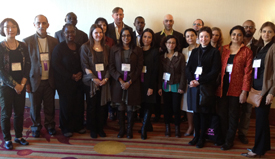
Top image: Participants in the CAA International Travel Grant Programs (from left): Shao-Chien Tseng, Salam Atta Sabri, Olabisi Silva, Jean Celestin Ky, Pavlina Morganová, Dóra Sallay, Federico Freschi, Judy Peter, Didier Houenoude, Rosa Gabriella de Castro Gonçalves, Daniel Premerl, Angela Harutyunyan, Malvina Rousseva, Cristian Nae, Ganna Rudyck, Irena Kossowska, Parul Pandya Dhar, Jageth Weerasinghe, and Nadhra Shahbaz Naeem Khan; Gyöngyvér Horváth is not pictured (photograph by Katie Underwood and provided by the Getty Foundation)
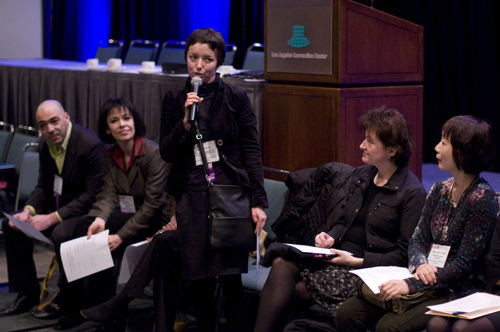
Middle image: Ganna Rudyck from Ukraine introduces herself to fellow grant recipients (photograph by Bradley Marks)
Bottom image: Among the grant recipients were (from left): Shao-Chien Tseng from Taiwan, Didier Houenoude from Benin, and Jean Celestin Ky from Burkina Faso (photograph by Bradley Marks)
CAA Names the Recipients of the Getty-Funded International Travel Grants
posted by Christopher Howard — January 23, 2012
CAA has awarded travel grants to twenty art historians and artists from around the world who will convene in Los Angeles to attend and participate in the 100th Annual Conference, taking place February 22–25, 2012. The CAA International Travel Grant Program was made possible by a generous grant from the Getty Foundation.
At the conference, the twenty recipients will participate in mentoring activities and other events planned in connection with the grant. Members of CAA’s International Committee have agreed to host the participants, and the National Committee for the History of Art will also lend support to the program.
This travel-grant program is intended to familiarize international professionals with the Annual Conference program, including the session participation process. CAA accepted applications from art historians, artists who teach art history, and art historians who are museum curators; those from developing countries or from nations not well represented in CAA’s membership were especially encouraged to apply. In late 2011, a jury of CAA members selected the final twenty awardees, whose names, home institutions, and primary areas of scholarly and professional interest are as follows:
- Salam Atta Sabri, Director, National Museum of Modern Art, Baghdad, Iraq. Atta Sabri conducts research on missing works of art from Iraq and is also a ceramic artist
- Parul Pandya Dhar, Associate Professor, Department of History, University of Delhi, Delhi, India. Dhar focuses on the history of Indian art and architecture to 1300 CE, cultural interactions in South and Southeast Asia, the visual arts and visual archives as sources of history, performing arts, and the historiography of Indian art
- Federico Freschi, Associate Professor, History of Art, Wits School of Arts, University of Witwatersrand, Johannesburg, South Africa. Freschi’s work explores South African modern art and architecture and postcolonial identity politics
- Rosa Gabriella de Castro Gonçalves, Professor of Art Theory and Aesthetics, Universidade Federal da Bahia, Salvador, Brazil. Gonçalves is interested in the role of modernism in recent debates in art theory
- Angela Harutyunyan, Assistant Professor, Department of Fine Arts and Art History, American University of Beirut, Beirut, Lebanon. Harutyunyan is interested in methodologies of reading and historicizing contemporary art and studies the political aesthetics of the Armenian avant-garde
- Gyöngyvér Horváth, Assistant Professor of Art History, Moholy-Nagy University of Art and Design, Budapest, Hungary. Horváth studies the historiography of narrative painting
- Didier Houenoude, Assistant Professor, Université d’Abomey-Calavi, Cotonou, Benin. Houenoude teaches art history and drawing and closely follows contemporary art in Benin
- Nadhra Shahbaz Naeem Khan, Visiting Faculty, Department of Humanities and Social Sciences, Lahore University of Management Sciences, Lahore, Pakistan. Khan’s work focuses on Sikh art and architecture
- Irena Kossowska, Professor of Art History, Nicolaus Copernicus University, Toruń, Poland. Kossowska works on national identity in Central Europe as reflected in the visual arts and also researches nineteenth- and twentieth-century European art
- Jean Celestin Ky, Professor of Art History, University of Ouagadougou, Ouagadougou, Burkina Faso. Celestin researches African art and works with the National Museum of Burkina Faso in conserving and promoting contemporary art
- Pavlína Morganová, Researcher and Professor, Academy of Fine Arts, Prague, Czech Republic. Morganová works on contemporary art
- Cristian Nae, PhD Lecturer, Department of Art History and Theory, Faculty of Fine Arts, George Enescu University of Arts, Iaşi, Romania. Nae examines post–World War II art history, critical theory, hermeneutics, and cultural studies
- Judy Peter, Lecturer, Faculty of Art, Design, and Architecture, and Head, Department of Jewellery Design and Manufacture, University of Johannesburg, Johannesburg, South Africa. Peter works in art history, theory, cultural and postcolonial studies, the history of jewellery. She is also interested in curriculum development in the context of a neoliberal South Africa
- Daniel Premerl, Research Associate, Institute of Art History, Zagreb, Croatia. Premerl is interested in Renaissance and Baroque art and art-historical methodology
- Malvina Rousseva, Professor, Institute of Art Studies, Bulgarian Academy of Sciences, Sofia, Bulgaria. Rousseva pursues research in archaeology, Thracian tombs and temples, interdisciplinary studies, architectural history, cultural and visual studies, and philosophy
- Ganna Rudyk, Deputy Director General of Research, Bohdan and Varvara Khanenko Museum of Arts, Kyiv, Ukraine. Rudyk is a specialist in Islamic art who presents Islamic and generally non-Western art to broad publics
- Dóra Sallay, Curator of Italian Painting, Museum of Fine Arts, Budapest, Hungary. Sallay works with thirteenth- to sixteenth-century Italian art, in particular Sienese painting, the history of collecting and museums, and the history of the reception of Gothic and Renaissance painting
- Olabisi Silva, Director, Centre for Contemporary Art, Lagos, Nigeria. Silva is working on the first roaming African art academy, placing equal emphasis on artistic practice, art history, critical thinking, and curatorial practice
- Shao-Chien Tseng, Associate Professor of Art History, Graduate Institute of Art Studies, National Central University, Jhongli City, Taiwan. A specialist in nineteenth-century French art, Tseng is interested in modern art and natural history, landscape painting and photography, and postcolonialism and Taiwanese art
- Jagath Weerasinghe, Director and Professor, Postgraduate Institute of Archaeology, Colombo, Sri Lanka. Trained in fine arts, archeology, and conservation, Weerasinghe recently established his country’s first graduate program in art history, which will offer postgraduate diplomas and master of arts degrees in art history, focusing primarily on Asian art
CAA hopes that this travel grant will not only increase international participation in the organization’s activities, but will also expand international networking and the exchange of ideas. The Getty Foundation grant allows CAA to expand greatly the participation of international colleagues beyond its regular program of Annual Conference Travel Grants for graduate students and international artists and scholars.
Travel Grants to Attend the 2012 Annual Conference in Los Angeles
posted by Lauren Stark — July 13, 2011
 CAA offers Annual Conference Travel Grants to graduate students in art history and studio art and to international artists and scholars. In addition, the Getty Foundation has funded a one-year program that will enable twenty applicants from outside the United States to attend the 2012 Annual Conference in Los Angeles. Applicants may apply for more than one grant but can only receive a single award.
CAA Graduate Student Conference Travel Grant
CAA will award a limited number of $150 Graduate Student Conference Travel Grants to advanced PhD and MFA graduate students as partial reimbursement of travel expenses to attend the 100th Annual Conference in Los Angeles, taking place February 22–25, 2012. To qualify for the grant, students must be current CAA members. Successful applicants will also receive a complimentary conference registration. Deadline: September 23, 2011.
CAA International Member Conference Travel Grant
CAA will award a limited number of $300 International Member Conference Travel Grants to artists and scholars from outside the United States as partial reimbursement of travel expenses to attend the 100th Annual Conference in Los Angeles, taking place February 22–25, 2012. To qualify for the grant, applicants must be current CAA members. Successful applicants will also receive a complimentary conference registration. Deadline: September 23, 2011.
CAA International Travel Grant Program
Through the new CAA International Travel Grant Program, generously funded by the Getty Foundation, CAA will provide funds to twenty applicants that fully cover travel, lodging, and meal costs to attend the 100th Annual Conference in Los Angeles, taking place February 22–25, 2012. Recipients will also receive conference registration and a one-year CAA membership. Applicants may be art historians, artists who teach art history, and art historians who are museum curators. Those from developing countries or from nations not well represented in CAA’s membership are especially encouraged to apply. Deadline: September 23, 2011.
Donate to the Annual Conference Travel Grants
CAA’s Annual Conference Travel Grants are funded solely by donations from CAA members—please contribute today. Charitable contributions are 100 percent tax deductible. CAA extends a warm thanks to those members who made voluntary contributions to this fund in 2010.
Image: Joseph Mallord William Turner, Rain, Steam and Speed—The Great Western Railway, 1844, oil on canvas, 35⅞ x 49 in. National Gallery, London (artwork in the public domain)
CAA Receives Getty Grant to Fund International Conference Travel
posted by Emmanuel Lemakis — May 16, 2011
The Getty Foundation has awarded a $100,000 grant to CAA in support of international travel for twenty applicants to attend the 100th Annual Conference and Centennial Celebration, taking place February 22–25, 2012, in Los Angeles. Through the new CAA International Travel Grant Program, CAA will provide funds for travel expenses, hotel accommodations, per diems, and conference registrations. Recipients will also receive one-year CAA memberships. Applicants may be art historians, artists who teach art history, and art historians who are museum curators; those from developing countries or from nations not well represented in CAA’s membership are especially encouraged to apply.
The goal of the project is to increase international participation in CAA and to diversify the organization’s membership (presently sixty-five countries are represented). CAA also wishes to familiarize international participants with the submission process for conference sessions and to expand their professional network in the visual arts. Members of CAA’s International Committee have agreed to host the participants, and the National Committee for the History of Art will also lend support to the program.
CAA will publish an official call for grant applications on its website on Friday, July 8, 2011; the program will also be publicized in CAA News. A jury will select the twenty grant recipients.