CAA News Today
Institutional News
posted by CAA — April 17, 2015
Read about the latest news from institutional members.
Institutional News is published every two months: in February, April, June, August, October, and December. To learn more about submitting a listing, please follow the instructions on the main Member News page.
April 2015

The Baltimore Museum of Art in Maryland has received a $300,000 grant from the Henry Luce Fund in American Art to help support the exhibition Matisse/Diebenkorn and its catalogue.
The Bowdoin College Museum of Art in Brunswick, Maine, has accepted a $150,000 grant from the Henry Luce Fund in American Art in support of the exhibition This Is a Portrait If I Say So: Reimagining Representation in American Art and its catalogue.
The Sterling and Francine Clark Art Institute in Williamstown, Massachusetts, has accepted a $15 million gift from Felda and Dena Hardymon to support campus expansion and programs. In recognition of the donation, the institute’s board decided to name the director’s position after the couple.
The Huntington Library, Art Collections, and Botanical Gardens in San Marino, California, has received a $200,000 grant from the Henry Luce Fund in American Art. The institution will use the funds to reinstall and publish on its collection of American art.
The Museum of Modern Art in New York has earmarked a $350,000 grant from the Henry Luce Fund in American Art for the exhibition Donald Judd and its accompanying catalogue.
The New York Studio School in Manhattan has accepted a $30,000 grant from the Henry Luce Fund in American Art to help digitize part of its lecture program archive.
The Smithsonian American Art Museum in Washington, DC, has won a two-year $275,000 grant from the Henry Luce Fund in American Art to reinstall and reinterpret the Renwick Gallery’s American craft and decorative art collection.
The Walker Art Center in Minneapolis, Minneapolis has received a $200,000 grant from the Henry Luce Fund in American Art to help produce the exhibition International Pop and its catalogue.
The Yale University Art Gallery in New Haven, Connecticut, has won a three-year grant of $1.5 million from the Henry Luce Fund in American Art. The museum will use the funds for the open storage of its American art collection and archives in the new West Campus Collection Studies Center.
Grants, Awards, and Honors
posted by CAA — April 15, 2015
CAA recognizes its members for their professional achievements, be it a grant, fellowship, residency, book prize, honorary degree, or related award.
Grants, Awards, and Honors is published every two months: in February, April, June, August, October, and December. To learn more about submitting a listing, please follow the instructions on the main Member News page.
April 2015
Molly Emma Aitken-Zaidi, an independent scholar, has accepted a 2014 Summer Stipend from the National Endowment for the Humanities. Her project is entitled “The Connoisseurship of Longing and India’s Mughal Emperors during the 16th and 17th Centuries.”
Patricia Blessing, international and scholarship program officer for the Stanford Humanities Center at Stanford University in California, has won the 2014 H. Allen Brooks Travelling Fellowship from the Society of Architectural Historians.
Kirsten Pai Buick, associate professor of art history at the University of New Mexico in Albuquerque, has been named the 2015 recipient of the David C. Driskell Prize by the High Museum of Art.
Jennifer Cohen, a doctoral candidate in the Department of Art History at the University of Chicago in Illinois, has been selected to be a visiting scholar at the Smithsonian Institution’s Archives of American Art by the Dedalus Foundation to conduct new research on Robert Motherwell and his contemporaries in honor of Motherwell’s centenary.
Shlomit Dror, a curator based in Jersey City, New Jersey, has completed a curatorial residency with the Brooklyn-based organization Residency Unlimited. Her residency term was February to April 2015.

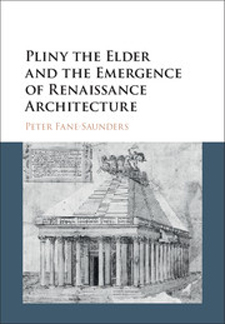
Peter Fane-Saunders has received a 2014 SAH/Mellon Author Award from the Society for Architectural Historians for Pliny the Elder and the Emergence of Renaissance Architecture, his forthcoming book from Cambridge University Press.
Gregory Gilbert from the Department of Art and Art History at Knox College in Galesburg, Illinois, has been selected as a visiting scholar at the Smithsonian Institution’s Archives of American Art by the Dedalus Foundation to conduct new research on Robert Motherwell and his contemporaries in honor of Motherwell’s centenary.
Alice Ming Wai Jim, associate professor and graduate-program director in the Department of Art History at Concordia University in Montreal, Quebec, has been named the recipient of the Artexte Prize for Research in Contemporary Art.

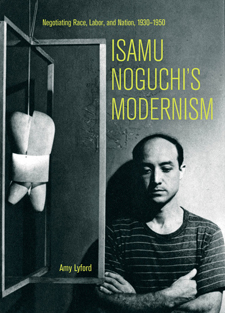
Amy Lyford, professor of art history and associate dean of arts and humanities at Occidental College in Los Angeles, California, has won the Smithsonian American Art Museum’s 2015 Charles C. Eldredge Prize for her book Isamu Noguchi’s Modernism: Negotiating Race, Labor, and Nation, 1930–1950.

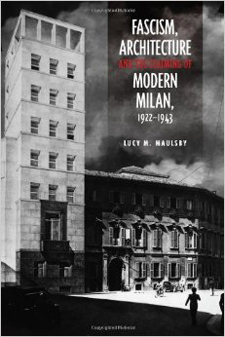
Lucy M. Maulsby has accepted a 2014 SAH/Mellon Author Award from the Society for Architectural Historians for her book Fascism, Architecture, and the Claiming of Modern Milan, 1922–1943, published the University of Toronto Press in 2014.
Kent Minturn from the Department of Art History and Archaeology at Columbia University in New York has been named a visiting scholar at the Archives of American Art by the Dedalus Foundation to conduct new research on Robert Motherwell and his contemporaries in honor of Motherwell’s centenary.
Adele Edelen Nelson of Temple University in Philadelphia, Pennsylvania, has received a 2014 Summer Stipend from the National Endowment for the Humanities. Her project is entitled “The Emergence of Abstract Art in Postwar Brazil.”

 Tanya Sheehan
Tanya Sheehan, associate professor in the Department of Art at Colby College in Waterville, Maine, has been awarded the 2014 Patricia and Phillip Frost Essay Award for her article, “Confronting Taboo: Photography and the Art of Jacob Lawrence,” which appeared in the fall 2014 issue of the journal American Art.
Christina Weyl, a doctoral candidate at Rutgers University in New Brunswick, New Jersey, has received the 2014 Archives of American Art Graduate Research Essay Prize, funded by the Dedalus Foundation, for her online essay, “Networks of Abstraction: Postwar Printmaking and Women Artists of Atelier 17.”
Exhibitions Curated by CAA Members
posted by CAA — April 15, 2015
Check out details on recent shows organized by CAA members who are also curators.
Exhibitions Curated by CAA Members is published every two months: in February, April, June, August, October, and December. To learn more about submitting a listing, please follow the instructions on the main Member News page.
April 2015
Mike Bullock and Linda Aubry Bullock. Lagan. Fourth Wall Space, Vox Populi, Philadelphia, Pennsylvania, April 3–26, 2015.
N. Elizabeth Schlatter and Kenta Murakami. The Life in the Land: Art by Anna Líndal and Erling Sjovold. University of Richmond Museums, Richmond, Virginia, February 19–April 26, 2015.
Jennifer Tyburczy. Irreverent: A Celebration of Censorship. Leslie-Lohman Museum of Gay and Lesbian Art, New York, February 13–May 3, 2015.
Charlotte Vignon. Coypel’s Don Quixote Tapestries: Illustrating a Spanish Novel in Eighteenth-Century France. Frick Collection, New York, February 25–May 17, 2015.
Books Published by CAA Members
posted by CAA — April 15, 2015
Publishing a book is a major milestone for artists and scholars—browse a list of recent titles below.
Books Published by CAA Members appears every two months: in February, April, June, August, October, and December. To learn more about submitting a listing, please follow the instructions on the main Member News page.
April 2015


David Bethune. Wynwood: Street Art of Miami (Miami: Bethune, 2015).

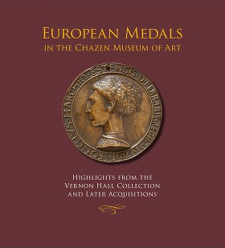
Maria F. P. Saffiotti Dale, ed. European Medals in the Chazen Museum of Art: Highlights from the Vernon Hall Collection and Later Acquisitions (Madison, WI: Chazen Museum of Art, in association with the American Numismatic Society, 2014).

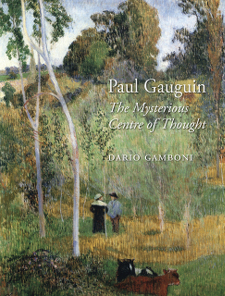
Dario Gamboni. Paul Gauguin: The Mysterious Centre of Thought (London: Reaktion, 2014).


Patricia Eichenbaum Karetzky. Chinese Religious Art (Lanham, MD: Lexington Books, 2014).


Sarah Krawcheck. Extreme Dessert Makeovers: Gluten Free and Beyond (Createspace.com, 2014).

Victor Margolin. World History of Design, 2 vols. (London: Bloomsbury, 2015).

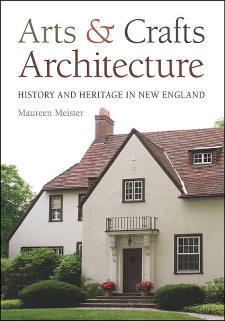
Maureen Meister. Arts and Crafts Architecture: History and Heritage in New England (Hanover, NH: University Press of New England, 2014).

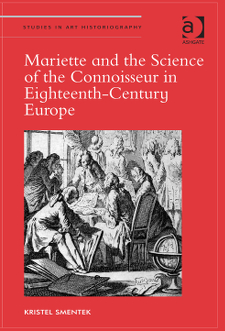
Kristel Smentek. Mariette and the Science of the Connoisseur in Eighteenth-Century Europe (Burlington VT: Ashgate, 2014).
Committee on Women in the Arts Picks for April 2015
posted by CAA — April 10, 2015
Each month, CAA’s Committee on Women in the Arts selects the best in feminist art and scholarship. The following exhibitions and events should not be missed. Check the archive of CWA Picks at the bottom of the page, as several museum and gallery shows listed in previous months may still be on view or touring.
April 2015
Nina Bunjavec: Out of the Fatherland
Art Gallery of Ontario
317 Dundas Street West, Toronto, Ontario, Canada M5T 1G4
December 13, 2014–summer 2015
The Canadian graphic novelist Nina Bunjevac, in her work Fatherland, explores the influence of extremism and ideologies on her own family and personal history. Now on view at the Art Gallery of Ontario, Out of the Fatherland is a selection of drawings from Bunjevac’s tale of the patriarch of her family—a member of the radical nationalist group Freedom for Serbian Fatherland—as told through the memories of her mother, sister, and grandmother, among other relatives. In the painstakingly detailed panels Bunjevac reflects on her mother’s flight from her husband back to Yugoslavia with her two daughters in 1975, the history and political climate of Yugoslavia, and the death of her father while assembling a bomb in a Toronto garage two years later. Bunjevac was three at the time of her father’s death.
The graphic novel, as Bunjevac explains, is two parts in order to reflect the “duality presented in the book: maternal – paternal, nationalist – communist, old country – new country.” At times drawing directly from childhood photographs, the artist said it resembled detective work, where she would scan images, and through enlarging them discover hidden history. During an NPR interview Bunjevac revealed how an overexposed photograph of her grandmother, who was in an abusive relationship, once darkened, exposed a black eye, and subsequently the photographers desire to mask it. Bunjevac takes these frozen records of violence and forced smiles, and with her pen reveals sociopolitical issues at play on both a personal and national stage while maintaining her role as the neutral narrator. Fatherland follows Bunjevac’s debut graphic novel, Heartless (2012), which features Zorka, a depressed, alcoholic, chain-smoking antiheroine.
Lori Vrba: The Moth Wing Diaries
Daylight Project Space
121 West Margaret Lane, Hillsborough, NC 27278
March 27–May 22, 2015
The photographer Lori Vrba describes her work as “reeking Southern woman.” In her new exhibition at Daylight Project Space, and in her forthcoming book The Moth Wing Diaries (published by Daylight Books), Vrba edited photographs from four projects—Drunken Poet’s Dream, Piano Farm, Safekeeping, and My Grace Is Sufficient—into a monograph that addresses “themes of memory, providence, revival and dreams … [exploring a] sense of conflict and ultimate peace with the Southern terrain.”
Vrba’s work oscillates between dreamlike scenes and reflections of innocence and confrontational moments. In the photograph Orchid from My Grace is Sufficient, a woman stands naked, the frame dipping only so far as to expose a partial breast. She clenches an orchid in her hand. The model’s face and identity is obscured by what appears to be a sheer silken fabric, keeping the viewer from knowing her.
Vrba’s work has been compared to that of Sally Mann, a comparison, Vrba says, that almost made her cry. She admires and is influenced by Mann, but while both often photograph their children, the difference between the two artists, Vrba explains, is that her own work is entirely autobiographical. The landscapes she choses, either the Southern rolling hills or the body landscapes of her human models, is a means to explore internal tensions via her visual sensitivities and ultimately her femininity, intimacy, and vulnerability. Working in a traditional darkroom, Vrba has a love of printmaking that is reflected in the rich warmth and sultriness of her toned images. Unapologetic about her style, Vrba writes, “my work is inherently feminine … and has a traditionally beautiful aesthetic without apology.”
A larger selection of photographs from The Moth Wing Diaries will be on view at the Catherine Courturier Gallery in Houston, Texas, in June.
Cat Del Buono: Voices
Museum of Contemporary Art, North Miami
Joan Lehman Building, 770 NE 125th Street, North Miami, FL 33161
April 14–19, 2015 (panel discussion on April 18 at 4:00 PM)
The Miami artist Cat Del Buono is bringing her video installation Voices to the Museum of Contemporary Art in North Miami for a short exhibition and panel discussion. Voices, created with a New Works Grant from Baang & Burne Contemporary, is a multichannel video installation focusing on domestic violence. Each small video monitor exposes only the lips of an anonymous domestic violence survivor as she recounts her personal experience of abuse for the unknown audience. Upon entry into the installation each voice is heard simultaneously, creating a “symphony of unrecognizable words.” Not until the viewer stands intimately close to a single monitor does the story of that woman become clear.
Filmed in Miami, New York, Connecticut, Los Angeles, Washington, DC, and Chicago, Voices brings stories from women of all ages and ethnicities to the viewer. “As a society, we must not allow the epidemic of domestic violence and those who are affected by it to remain an invisible and inaudible crowd of statistics,” Del Buono said in an exhibition statement.
Del Buono has a history of work aimed at raising awareness on women’s issues, as well as body image. In her work Beauty Box, during Art Basel Miami Beach in 2014, Del Buono and the Refemme team invited women and men into their “medical” tent to receive individualize beauty consultations. Instead of prescribing ways to improve, participants were complimented as part of the project’s “social interruption.”
Voices will cap its short stay at MoCA North Miami with a panel discussion moderated by Bonnie Berman of WLRNand featuring a victim’s advocate from the Lodge Miami, an abuse survivor, and Adrienne Von Lates from MoCA.
Anicka Yi: You Can Call Me F
The Kitchen
512 West 19th Street, New York, NY 10011
March 5–April 11, 2015
The Kitchen’s gallery is transformed into a forensic laboratory in which Anicka Yi’s You Can Call Me F proposes a parallel between society’s increasing paranoia—private and public—regarding hygiene and contagion with the longstanding patriarchal fear of feminism and strength of female networks.
During 2014–15, Yi (b. Seoul, 1971) has been developing new projects as a visiting artist at MIT Center for Art, Science, and Technology (CAST). For You Can Call Me F, the New York–based artist gathered biological information from one hundred women in order to cultivate the idea of the female figure as a viral pathogen that suffers external attempts to be both contained and neutralized.
Following her trilogy Divorce, Denial,and Death, in which Yi privileged scent, memory, and other aspects of the “avisual” over physical components, You Can Call Me F is based in the visual language of quarantine tents, a context that allows a translucent view, at the same time that intends to protect the fragile ecosystems within. Yi’s feminist approach focuses in the impact of the politics and subjectivities of smell on our empathic understanding of each other.
Curated by Lumi Tan, the project was possible by collaborative efforts from a hundred contributing women—some listed at the exhibition, some anonymous donors—as well as scientist and researchers, including: Tal Danino, MIT postdoc in synthetic biology; the biologist Patrick Hickey; and the provision of scent analysis and formulation by Air Variable, a scent fabrication company founded in 2014 by Sean Raspet that focuses exclusively on olfactory and chemistry-related art and design projects.
Camille Henrot: The Pale Fox
Westfälischer Kunstverein
Rothenburg 30, 48143 Münster, Germany
February 21–May 10, 2015
Westfälischer Kunstverein presents The Pale Fox, the first large-scale solo exhibition in Germany by the New York–based French artist Camille Henrot (b. 1978). This traveling exhibition (Münster, London, Copenhagen, and Paris) has been coproduced by four European institutions and was ranked by the Guardian as among the ten best art shows of the year.
The Pale Fox is borrowed character from an anthropological study, published by Griaule and Dieterlen in 1965, that reflects on the incorporation of several different cultures, as well as astronomical, mathematical, and philosophical systems of thought and beliefs in the West African Dogon tribe’s mythology. In this system, the character of the Pale Fox represents disorder and chaos not only as a transgression but also as a necessary condition for creativity. Based in a cycle from which accumulation and excess become productive again, and her interest in disorder as a fertile foundational principle for creative practice and formulation of knowledge, Henrot understands the fox as a potential model for our primitive selves, as well as a symptom of our digital age in which humans driven by curiosity and impatience.
Populating a highly constructed and meditative environment with images and objects, Henrot conceived this installation as a sort of a domestic atmosphere in which she orders and arranges more than four hundred photographs, bronze sculptures, books, watercolors, and drawings that were bought on eBay, borrowed from museums, or found or produced by Henrot. In the artist’s words, there is “an excess of principles” in The Pale Fox, a pathological and almost erotic “cataloguing psychosis” that allows the potential for disorder to return. Through this compulsive superimposition, the artist intends to make sense of our shared desire to understand the world intimately through the objects that surround us. A video produced by a seemingly hidden camera at the exhibition opening evidences audience engagement toward personal reconstructions of the multilayered environment of narratives.
Channa Horwitz: Counting in Eight, Moving by Color
KW Institute for Contemporary Art
Auguststrasse 69, 10117 Berlin, Germany
March 15–May 25, 2015
The KW Institute for Contemporary Art in Berlin presents Counting in Eight, Moving by Color, the first comprehensive solo exhibition of Channa Horwitz (1932–2013). Many of the works on view, including a selection of construction drawings and documentary materials have never been shown before. The exhibition features representative works from all phases of Horwitz’s career, providing an introduction to her oeuvre and insight into key series of her creative process, such as the Language Series, Sonakinatography, Rhythms,and Structures. Some of her central works were reconstructed based on the plans that the artist made herself for her own future.
Departing from a system of notation based on the number eight, Horwitz developed a visual language in the late 1960s that achieved freedom based in the restriction to a few simple rules. Searching for a simple yet universal language, she created variations of complex systems resembling musical scores that allow movements to be visualized by means of color schemes and graphic scales. Since then, each of her works has been based on the numbers one through eight, while each number is assigned an specific color code, in this way designing structures that translate spatial-temporal relations into drawings, paintings, and multimedia sculptures.
The comprehensive exhibition at KW retraces the development that led Horwitz from figurative painting to conceptual abstraction, linking her creative practice to her contemporary minimal and conceptual artists. The display includes a large number of the compositions from “Sonakinatography” (her new term combining the Greek words for “sound,” “movement,” and “writing/recording”), which are perhaps the artist’s most well-known works to date. Despite her creative commitment, Horwitz lived and worked in complete seclusion from the midsixties until the 2000s, and her work was rarely exhibited. She seemed to have just begun her artistic career when she passed away at the age of 81. Sadly Horwitz did not live to see the overwhelming international recognition that her oeuvre gained at the last Venice Biennale.
Committee on Women in the Arts Picks for March 2015
posted by CAA — March 10, 2015
Each month, CAA’s Committee on Women in the Arts selects the best in feminist art and scholarship. The following exhibitions and events should not be missed. Check the archive of CWA Picks at the bottom of the page, as several museum and gallery shows listed in previous months may still be on view or touring.
March 2015
Poetry and Exile
British Museum
Gallery 34, Great Russell Street, London
WC1B 3DG United Kingdom
October 1, 2014–March 1, 2015
Housed within the Islamic World Galleries, Poetry and Exile displays a series of works by artists of the Middle East and North Africa recently acquired by the British Museum. This small but powerful exhibition explores the effects of exile through the eyes of four women artists:Ipek Duben, Mireille Kassar, Mona Saudi, and Canan Tolon.
Tolon’s series ofink and graphite drawings, titled Futur Imparfait, is a memoir fromher exile from Istanbul to France, where she spent a decade in hospital as a result of contracting polio as a child. In the series Tolon portrays an exile not only from home, but also from her own body. Duben’s book Refugee belies the helplessness and terror suffered by people forced to flee their homeland with images on delicate gauze pages and using childlike embroidery that depicts the crossing of borders. The Istanbul-born Duben has been making books and installations that focus on identity, domestic violence, and the worldwide forced migration of the twentieth century.
The Jordanian artist Saudi combines the evocative verses of the Palestinian poet Mahmoud Darwish with drawings, while the Lebanese-born Kassar developed a series of drawings inspired by the Persian poem The Conference of the Birds. Here, Kassar conjures a story of exile from her own family history. Originally from Mosul and Mardin—present day Iraq and Turkey—her ancestors fled the Ottoman massacres of minorities during the late-nineteenth and early twentieth century.
Sophie Calle: For the Last and First Time
Musée d’art contemporain de Montréal
185, rue Sainte-Catherine Ouest, Montréal, Québec H2X 3X5 Canada
February 5–May 10, 2015
The Musée d’art contemporain de Montréal presents For the Last and First Time,a two-part exhibition by Sophie Calle (b. Paris, 1953), one of the most important conceptualists artists of her generation. The exhibition comprises two successive projects developed in Istanbul, The Last Image (2010) and Voir la mer (2011). Calle’s poetic investigation of beauty, blindness, and the sea reflects on visual and emotional relationships with the concept of beautythrough an insightful look at both the loss of one’s eyesight, through the particular mental images of blind people, and at the discovery of beauty and the sublime for the first time.
The Last Image isan installation of a series of photographs, tinged with melancholy and accompanied by texts and the soothing sound of waves. For this project, the artist spoke to blind people who had lost their sight suddenly, asking them to recall and describe the last thing they saw. Later on, while in Istanbul, Calle met many people that, in a city surrounded by water, had never seen the sea. For Voir la mer, a series of captivating first encounters with the sea, she filmed fifteen people from different ages looking at the sea for the first time in their lives.
Aware of the impossibility of re-creating the first glance, these series of digital films were in this case created with the assistant of a filmmaker. Calle found most meaningful to remain herself at the back of the viewers, waiting to observe their glances when they turn around after seeing the sea for the first time in their lives. As the artist recalls: “I went with each person individually, such as this man in his thirties. Before we arrived I made him cover his eyes. Once we were safely by the sea, I instructed him to take away his hands and look at it. Then, when he was ready—for some it was five minutes and for others fifteen—he had to turn to me and let me look at those eyes that had just seen the sea.”
Through presenting together The Last Image and Voir la mer, the exhibition opens a moving dialogue among memory, sight, beauty, and the sea. As often in the development of Calle’s projects, The Last Image and Voir la mer derive from an earlier series, The Blind, developed in 1986, in which the artist asked blind people to describe the notion of beauty for them. One of them had answered: “The most beautiful thing I have ever seen is the sea, the endless sea.”
Calle has developed a “polyphonic” art dealing with photography, writing, video, and performance. Throughout four decades of creative practice, she has produced extraordinary, audacious works that draw on her own history as well as that of others. Through a poetic, sincere, and intimate approach, Calle invites us to break through the boundaries between private and public life, creating and recording moments of startling truth, tinged with notions of loss, absence, and desire.
Doris Salcedo
Museum of Contemporary Art, Chicago
220 East Chicago Ave, Chicago, IL 60611
February 21–May 24, 2015
The Museum of Contemporary Art, Chicago, presents the first retrospective of the thirty-year career of the renowned Colombian artist Doris Salcedo, whose work, although deeply rooted in her country’s social and political landscape, investigates human conflict manifested in different parts of the world. Salcedo (b. 1958), who lives and works in Bogotá, transforms ordinary and domestic objects (such as chairs, tables) into alternative memorials to the painful absence that embodied a traumatic loss of human life. In this process, the artist grounds her art in rigorous fieldwork, which involves extensive interviews with people who have experienced loss and trauma in their everyday lives due to political violence. She has been increasingly noted for her large-scale installations and architectural interventions. Between them, her work Shibboleth, a 167-meter-long crack in the turbine floor, developed as a commission for the Tate Modern Unilever Projects in 2007, raised questions of borders, racial hatred, and exclusion. Through a laborious and seemingly healing art-making process, Salcedo creates sculptures and installation that explore the indescribable wounds of violence as a universal phenomenon through a subtle, poetic, yet devastatingly powerful visual language.
Salcedo’s retrospective at the museum begins with a selection of her earliest works, many of which are exhibited together en masse for the first time since 1998: sculptures made with concrete-filled doors, tables, armoires, chairs. Other major installations include La Casa Viuda (1993–95), Unland (1995–98), Atrabiliarios (1992–2004), A Flor de Piel (2014), and Disremembered (2014). It also presents the American debut of Salcedo’s major work Plegaria Muda (2008–10), an expansive installation of tables, inverted one atop another, while individual blades of grass grow through the holes in their surfaces. Responding once again to acts of violence, its contemplative stillness evokes associations of a collective burial site. This piece was inspired by a three-year-long research of gang violence at the ghettoes of southeastern Los Angeles, as well as by the 2008 discovery that members of the Colombian Army had been killing innocent civilians and dressing their corpses in guerrilla uniforms to claim government bounties. As Salcedo points out, speaking about modern, war-torn societies, “we have lost our ability to mourn…. I want my work to play the role of funeral oration, honoring this life.”
The Museum of Contemporary Art, Chicago, is producing a short film documenting Salcedo’s site-specific and ephemeral installations and a 250-page publication featuring an overview of the artist’s career by leading scholars and curators. The exhibition travels to the Solomon R. Guggenheim Museum in New York, where it will be seen June 26–October 14, 2015.
Body Talk: Feminism, Sexuality, and the Body in the Work of Six African Women Artists
WIELS, Contemporary Art Centre
Avenue Van Volxemlaan 354, 1190 Brussels, Belgium
February 14–May 3, 2015
WIELS Contemporary Art Center in Brussels presents Body Talks, an exhibition along a series of conversations and performances that address issues feminism, sexuality, and the body in the work of six African women artists. Curated by Koyo Kouoh and assisted by Eva Barois De Caevel from the RAW Material Company in Dakar, the exhibition explores the body as the subject of reflection and medium of artistic practice, as in the case of the “confrontational” performances of the South African artist Tracey Rose.
The spread of artistic practices to international networks, along with the critical resonance of a specifically African (and black) feminism, have given shape to the development of a black feminist art. Referencing to historical and political figures, black feminist art depicts bodies that continue a tradition of activism and freedom of speech. Bringing together the work of a generation of women artists from Africa active since the late 1990s, this group exhibition challenges pervasive fantasies and inequalities relating to women’s bodies and sexuality. While in the work of the selected artists the body manifests itself, as a model, support, subject, or/and object, the project as a whole attempts to define and articulate notions of feminism and sexuality in the work of women artists whose body serves as a tool, a representation, or a research field.
Exhibiting artists, from diverse regions of the continent and the diaspora, are: Zoulikha Bouabdellah (Algeria/France, b. 1977); Marcia Kure (Nigeria, b. 1970); Miriam Syowia Kyambi (Kenya, b. 1979); Valérie Oka (Cote d’Ivoire, b. 1967); Tracey Rose (South Africa, b. 1974); and Billie Zangewa (Malawi/Zimbawe, b. 1973).
Between the presented projects: Kure evokes Saartjie Baartman, “the Hottentot Venus,” who was born in what is now South Africa but taken to Europe in the early nineteenth century to be put on show. As the curator explains, “Baartman has really become a point of departure for thinking about the African woman’s body.”
Bouabdellah—who was at the center of a recent dispute about self-censorship for her Silence piece, an installation composed of prayer mats on which she had arranged high-heeled shoes—presents a series of collages for which she has cut famous paintings depicting women’s bodies into Eastern motifs. Oka presented two performances at the opening reflecting on the sexual clichés inherited from the period of slavery and colonization that stigmatize the black body and the idea that the African woman is allegedly more sensual and better at sex.
Rediscovering, reintegrating, and reinterpreting the body, this exhibition presents the response of a generation of African women artists that challenge stereotypes of the notion “black” sexuality and feminism through diverse means of dialoguing with—and experienced from—the own body.
Maryland to Murano: Neckpieces and Sculptures by Joyce J. Scott
Museum of Art and Design
2 Columbus Circle, New York, NY 10019
September 30, 2014–March 15, 2015
The Museum of Art and Design in New York presents Maryland to Murano: Neckpieces and Sculptures by Joyce J. Scott, which bringstogether neckpieces and blown-glass sculptures by the renowned “Queen of Beadwork” for the first time. Provocative and confrontational, Scott’s exuberant beaded sculptural forms and neckpieces address contentious political and social issues such as gender, race, and class struggle.
Maryland to Murano examines Scott’s ever-evolving techniques and continued exploration of provocative narratives through her commitment to craft. The show also highlights Scott’s range in both form and content in a extensive body of work created in her workshop in Baltimore, Maryland, and in her recent glass sculptures made at the Berengo Studio on Murano Island in Venice, Italy.
Scott (b. Baltimore, 1948) is a descendant of African Americans, Native Americans, and Scots. She received her first art lessons at home watching her mother—the renowned fiber artist Elizabeth Talford Scott—using unconventional techniques of embroidery and appliqué in creating her quilts. Scott’s creative process is deeply rooted in her ethnic and family heritage: three generations of storytellers, quilters, basket makers, and shapers of wood, metal, and clay.
Through the interplay between these two bodies of work, as well as a documentary video, the exhibition not only reveals the range of Scott’s technique and skill and the complex relationship she has shaped among adornment, content and methodology, but it also expresses her commentary on issues affecting contemporary society in an effort to elicit awareness and response. As the artist states: “It’s important to me to use art in a manner that incites people to look and then carry something home—even it it’s subliminal—that might make a change in them.” Scott’s thought-provoking, portable beaded pieces are certainly inciting us to be carried either way.
Solo Exhibitions by Artist Members
posted by CAA — February 22, 2015
Solo Exhibitions by Artist Members
See when and where CAA members are exhibiting their art, and view images of their work.
Solo Exhibitions by Artist Members is published every two months: in February, April, June, August, October, and December. To learn more about submitting a listing, please follow the instructions on the main Member News page.
February 2015
Abroad

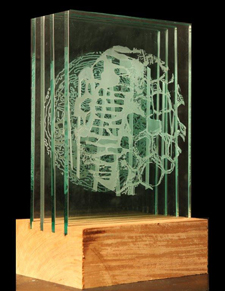 Lea Kannar-Lichtenberger, Glimpse Beyond, 2014, sandblasted glass panels in PNG Rosewood (artwork © Lea Kannar-Lichtenberger)
Lea Kannar-Lichtenberger. Community Gallery, Hazelhurst Regional Gallery and Arts Centre, Gymea, New South Wales, Australia, March 7–17, 2015. Colliding Worlds. Bio-art.
Mid-Atlantic

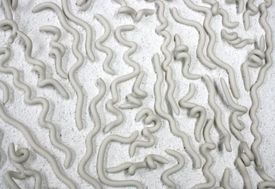 Lorrie Fredette, ceiling detail of Proper Limits, 2015, porcelain, 8 ft. 1 in. x 17 ft. 10½ in. x 18 ft. 3½ in. (artwork © Lorrie Fredette)
Lorrie Fredette. Visual Art Center of New Jersey, Summit, New Jersey, February 8–May 31, 2015. Proper Limits. Installation.
Midwest
Michael Aurbach. Main Galleries, Tarble Arts Center, Eastern Illinois University, Charleston, Illinois, January 16–February 18, 2015. Michael Aurbach Sculpture: Three Decades after Eastern. Sculpture.
Joan Marie Kelly. Richard D. Baron ’64 Art Gallery, Oberlin College, Oberlin, Ohio, November 21, 2014–January 2, 2015. Historical Indian Archetypes of Masculinity and Femininity: The Kotha and The Akhara.
Angela Piehl. North Gallery, Oklahoma State Capitol, Oklahoma City, Oklahoma, December 8, 2014–February 1, 2015. Stillwater. Drawing.

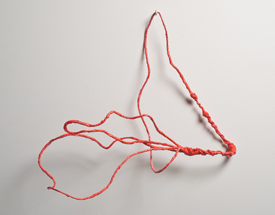 Robert Schatz, Lotus, 2014, jute twine, alphatic resin, kozo paper, and acrylic, 14 x 8 x 19½ in. (artwork © Robert Schatz)
Robert Schatz. Sheldon Museum of Art, University of Nebraska, Lincoln, Nebraska, January 16–April 26, 2015. A New Line of Thinking. Sculpture and work on paper.
Northeast

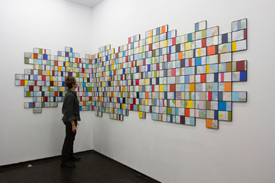 Nayda Collazo-Llorens, installation view of Geo Dis/connect, 2014, wall installation with found maps, 360 framed images (4 x 6 in. each), overall dimensions approximately 5 x 16 ft. (artwork © Nayda Collazo-Llorens)
Nayda Collazo-Llorens. LMAKprojects, New York, October 17–December 21, 2014. Dis/connect. Wall installation, drawing, and work on canvas.
Josette Urso. Main Window Project Space, One Main Street, Brooklyn, New York, February 5–March 29, 2015. High Five.

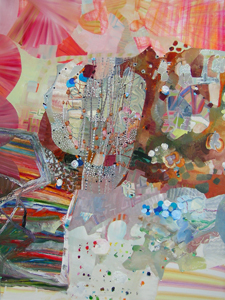 Josette Urso, Jujube, 2015, oil on canvas, 48 x 36 in. (artwork © Josette Urso)
Josette Urso. Market Fine Arts, New York, March 19–April 18, 2015. Treehouse. Painting.
West
Martin Gantman. Los Angeles Center for Digital Art, Los Angeles, California, January 8–February 28, 2015. Inconsequential Intersections.
People in the News
posted by CAA — February 17, 2015
People in the News lists new hires, positions, and promotions in three sections: Academe, Museums and Galleries, and Organizations and Publications.
The section is published every two months: in February, April, June, August, October, and December. To learn more about submitting a listing, please follow the instructions on the main Member News page.
February 2015
Academe

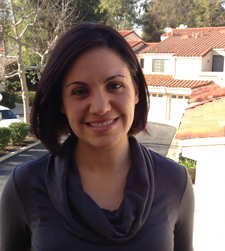 Hala Auji
Hala Auji has been appointed assistant professor of Islamic art in the Department of Fine Arts and Art History at the American University of Beirut in Lebanon.
Museums and Galleries
Denise Allen has left the Frick Collection in New York for the Metropolitan Museum of Art, also in New York, where she is curator of European sculpture and decorative arts.
Elissa Auther, associate professor of contemporary art and director of the art-history and museum-studies program at the University of Colorado in Colorado Springs, has joined the Museum of Arts and Design in New York as the inaugural Wingate Research Curator. She will hold a joint appointment at the Bard Graduate Center, in collaboration with the Center for Craft, Creativity, and Design.
Robert C. Hobbs, Rhoda Thalhimer Endowed Chair at Virginia Commonwealth University in Richmond and visiting professor at Yale University in New Haven, Connecticut, has been inducted as a trustee of the Wadsworth Atheneum Museum of Art in Hartford, Connecticut.
Organizations and Publications
Dena Muller has been appointed executive director of the Cue Art Foundation in New York. Previously she had served the New York Foundation for the Arts as director of new initiatives.
Institutional News
posted by CAA — February 17, 2015
Read about the latest news from institutional members.
Institutional News is published every two months: in February, April, June, August, October, and December. To learn more about submitting a listing, please follow the instructions on the main Member News page.
February 2015
The Sterling and Francine Clark Art Institute in Williamstown, Massachusetts, has won the 2014 Apollo Award for Museum Opening of the Year. The award is given annually by the art magazine Apollo.
The Minneapolis Institute of Arts in Minnesota has accepted an $8 million gift from the Duncan and Nivin MacMillan Foundation to endow the director and president’s position.
The Princeton University Art Museum in Princeton, New Jersey, has won the 2014 Frances Smyth-Ravenal Prize for Excellence in Publication Design from the American Alliance of Museums for its catalogue of the exhibition New Jersey as Non-Site.
Yale University Press in New Haven, Connecticut, has received an $840,000 grant from the Andrew W. Mellon Foundation to establish a new electronic portal on which curated and customizable art and architectural-history content will be made available to consumers and institutions.
Grants, Awards, and Honors
posted by CAA — February 15, 2015
CAA recognizes its members for their professional achievements, be it a grant, fellowship, residency, book prize, honorary degree, or related award.
Grants, Awards, and Honors is published every two months: in February, April, June, August, October, and December. To learn more about submitting a listing, please follow the instructions on the main Member News page.
February 2015
Kate Palmer Albers, assistant professor in the Art History Division of the School of Art at the University of Arizona in Tempe, has received a 2014 award from the Arts Writers Grants program, funded by Creative Capital and the Andy Warhol Foundation for the Visual Arts. The grant will fund a new blog, Project K: Photography and Art in the Age of Social Media.
Luke Armitstead, an artist based in Madison, Wisconsin, has received a Clowes Fund Fellowship to support a residency at the Vermont Studio Center in Johnson.

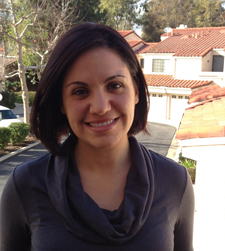 Hala Auji
Hala Auji, assistant professor at the American University of Beirut in Lebanon, received a 2014 Honorable Mention Malcolm H. Kerr Dissertation Award in the Humanities from the Middle East Studies Association for her dissertation, “Between Script and Print: Exploring Publications of the American Syria Mission and the Nascent Press in the Arab World, 1834–1860,” which completed under the direction of Nancy Um at Binghamton University, State University of New York.
Elissa Auther, Wingate Research Curator for the Museum of Arts and Design and the Bard Graduate Center in New York, has received a 2014 award from the Arts Writers Grants program, funded by Creative Capital and the Andy Warhol Foundation for the Visual Arts. The grant will support her article, “Senga Nengudi: The Performing Body.”
Rachelle Beaudoin, a video and performance artist based in Peterborough, New Hampshire, has earned a Clowes Fund Fellowship for a residency at the Vermont Studio Center in Johnson.
Maurice Berger, research professor and chief curator for the Center for Art, Design, and Visual Culture at the University of Maryland in Baltimore County, has received a 2014 award in short-form writing from the Arts Writers Grants program, funded by Creative Capital and the Andy Warhol Foundation for the Visual Arts.

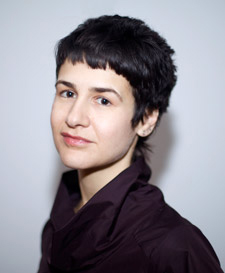 Kaira M. Cabañas
Kaira M. Cabañas, an art historian based in Rio de Janiero, Brazil, has won a 2014 award from the Arts Writers Grants program, funded by Creative Capital and the Andy Warhol Foundation for the Visual Arts. Her book project is called Expressive Restraint: Modern Art and Madness in Brazil and Beyond.
Abigail DeVille, an artist based in the Bronx, New York, has been awarded a 2015 grant in the visual-arts category from Creative Capital. DeVille will work on The Bronx: History of Now, a series of one hundred site-specific sculptural installations constructed from found objects, fragments of histories, and community narratives.

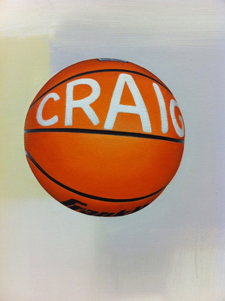 Craig Drennen, detail of HELLO CRAIG, 2014, oil and alkyd on canvas, 52 x 40 in. (artwork © Craig Drennen)
Craig Drennen, assistant professor of drawing and painting at Georgia State University in Atlanta, has received a 2014 grant from the foundation Art Matters.
Angela Ellsworth, an artist based in Phoenix, Arizona, who works in drawing, sculpture, installation, video, and performance, has won a 2014 Art Matters grant.
Ryan Gallant, a sculptor based in Grass Valley, California, has received fellowship for a residency at the Vermont Studio Center in Johnson, Vermont.

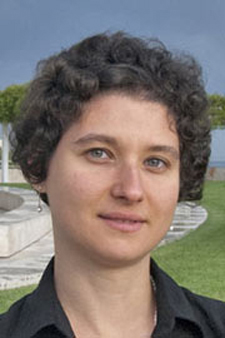 Ksenya Gurshtein
Ksenya Gurshtein, an art historian based in Washington, DC, has accepted a 2014 National Endowment for the Humanities Fellowship for her project, “Conceptual Art in Eastern Europe in the 1960s and 1970s.”
Jeffrey Hamburger, Kuno Francke Professor of German Art and Culture at Harvard University in Cambridge, Massachusetts, has accepted a 2014 National Endowment for the Humanities Fellowship for his project, “Berthold of Nuremberg’s 13th-Century Reconfiguration of Hrabanus Maurus’s 9th-Century Treatise on the Cross.”
Michelle Handelman, an artist based in Brooklyn, New York, who works in video, performance, and photography, has accepted a 2014 grant from the foundation Art Matters.

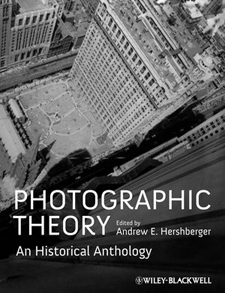
Andrew E. Hershberger, associate professor of contemporary art history and chair of the Division of Art History at Bowling Green State University in Bowling Green, Ohio, has won a 2015 Insight Award from the Society for Photographic Education for his book Photographic Theory: An Historical Anthology.
Suzanne Hudson, assistant professor of art history at the University of Southern California in Los Angeles, has received a 2014 award from the Arts Writers Grants program, funded by Creative Capital and the Andy Warhol Foundation for the Visual Arts. Her book project is titled Better for the Making: Art, Therapy, Process.

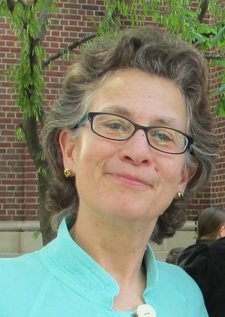 Sharon Irish
Sharon Irish, an art and architectural historian at the University of Illinois in Urbana-Champaign, has won a 2014 award from the Arts Writers Grants program, funded by Creative Capital and the Andy Warhol Foundation for the Visual Arts. The grant will support her book project, Stephen Willats in the Yew Kay.
Janet Koplos, an art critic and historian based in Saint Paul, Minnesota, has received a 2014 award from the Arts Writers Grants program, funded by Creative Capital and the Andy Warhol Foundation for the Visual Arts. The grant will help sustain her book project, The Loyal Opposition: The Life and Times of Chicago’s Controversial New Art Examiner.

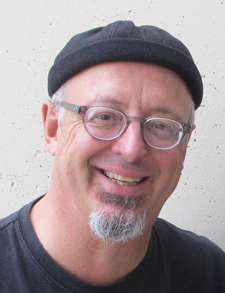 Beauvais Lyons
Beauvais Lyons, Chancellor’s Professor at the University of Tennessee in Knoxville, has been selected for a 2014 Individual Artist Award by the Santo Foundation, based in Saint Louis, Missouri. The award comes with a $5,000 prize.
Leah Montalto, an artist based in New York, has received a grant from the New York City Department of Cultural Affairs via the 2015 Queens Arts Fund, part of the Greater New York Arts Development Fund for Individual Artists. Montalto will work on a new series of paintings, titled The Arc of Triumph.
Lorraine O’Grady, a New York–based artist and writer, has been awarded a 2015 grant in the visual-arts category from Creative Capital. The funds will support MBN – 30 Years Later, in which the artist’s performance persona Mlle Bourgeoise Noire transforms into a new avatar who protests a money-driven art world to restore the cultural purpose it has lost.
John Pollini, professor of art history and history the University of Southern California in Los Angeles has accepted a 2014 National Endowment for the Humanities Fellowship for his project, “Destruction, Mutiliation, and Repurposing of Classical Images in Late Antiquity.”

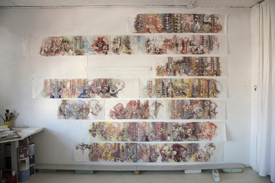 View of Elizabeth Riggle’s studio
Elizabeth Riggle, an artist based in Brooklyn, New York, has earned a residency at the Yaddo Foundation in Saratoga Springs, New York, for winter/spring 2015.
David Shannon-Lier, a photographer based in Phoenix, Arizona, has won a Vermont Studio Center Fellowship for a residency at the center in Johnson, Vermont.
Andrew Wasserman, assistant professor of art and architecture history at Louisiana Tech University in Ruston, has received a 2014 award from the Arts Writers Grants program, funded by Creative Capital and the Andy Warhol Foundation for the Visual Arts. The prize will support his book project, Bang! We’re All Dead! The Places of Nuclear Fear in 1980s America.
Yatta Zoker, an artist based in Houston, Texas, has accepted a $4,000 Catalyst Grant from the Idea Fund for The LDR Project, a series of three collaborative art-making workshops and a sponsorship for one expatriate or immigrant student at the University of Houston to reunite with their loved ones during summer break.