
CAA News Today
Letter from Melbourne: An Exhibition at the Victorian College of the Arts Tackles Contested Lands and Landscape
posted Apr 27, 2017
We live in a world in which deeply contested perceptions of time and place coexist on lands shared by diverse populations. The unresolved politics of land that confront Indigenous cultures in Australia are a prime example of how such contestations continue to play out in a postcolonial context. Such tensions are particularly apparent when contrasting radically divergent artistic and historical representations of landscape. Australia is a vast and ancient continental landmass upon which a little over two centuries of colonization has savagely interrupted 50,000 years of continuous human culture expressed through over 500 distinct collective nominations. Presence, an ambitious exhibition curated by David Sequeira in the Margaret Lawrence Gallery at the Victorian College of the Arts (VCA), University of Melbourne (March 3–April 1, 2017), entered this seemingly inexpressible contestation with a curatorial strategy that provisionally marked out something of the possibility of aggregating these radically disparate understandings. As this text will attempt to demonstrate, Sequeira, in bringing otherwise ineffably distinct representations of the Australian landscape together, implicitly suggested that violently incompatible senses of time and place might indeed share space—and possibly even begin to communicate with one another.
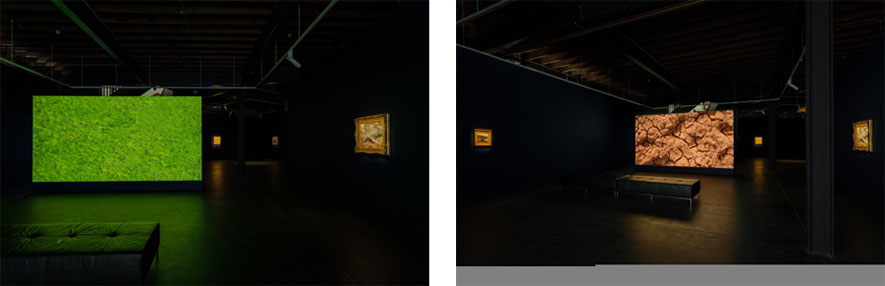
Figures 1 and 2 show the gallery installation with Michael Riley’s film presented in the center. The two images from the film depict different contemporary perspectives of a land occupied by Indigenous cultures for tens of thousands of years. The smaller paintings installed on the perimeter wall are by well-known Australian artists who are all alumni of the Victorian College of the Arts upon the occasion of its 150-year celebration (see Figures 3–8 below).
Upon entering the dramatically darkened gallery, the viewer encountered a series of small uncaptioned spot-lit paintings by some of the VCA’s most distinguished alumni. These works appeared to be floating like a constellation of celestial objects around a large moving image projection at the center of the exhibition space. Sequeira strategically positioned Empire, a film by the late Indigenous Australian artist Michael Riley, at the heart of this carefully considered installation of historical and contemporary landscape paintings.
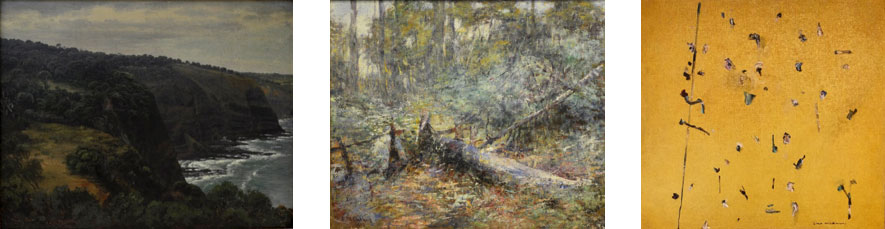
Figure 3: Eugene Von Guérard, From below the Lighthouse, Cape Shanck, Victoria, 1873, oil on paper on board, 9.7 x 12.4 in. (photograph provided by the Wilbow Collection)
Figure 4: Frederick McCubbin, At Macedon, 1913, oil on canvas 20.4 x 24.1 in. (photograph provided by the Wilbow Collection)
Figure 5: Fred Williams, Hillside III, 1968, oil on canvas, 24 x 26 in. (photograph provided by the Heidi Victoria Collection)
Contextualizing work by Eugene Von Guerard, Frederic McCubbin, Fred Williams, Clarice Beckett, Louise Hearman, and Rick Amor with that of Riley, Sequeira seductively stipulated that the viewer become mindful of Indigenous understandings of landscape that existed for 50,000 years prior to the VCA’s own 150-year history.
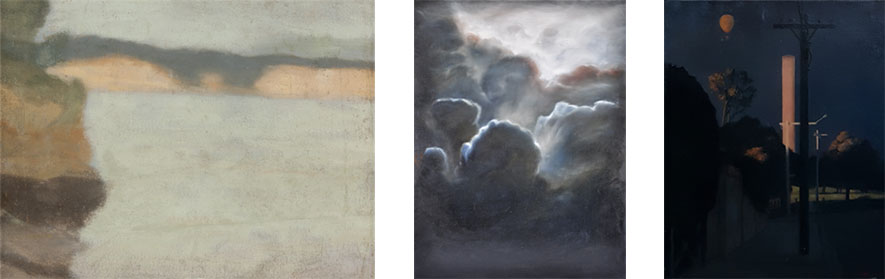
Figure 6: Clarice Beckett, Half Moon Bay, undated, oil on board, 11.2 x 15 in. (photograph provided by Rosalind Hollinrake and Niagara Galleries)
Figure 7: Louise Hearman, Untitled #480, 1997, undated, oil on composition board, 27 x 21 in. (photograph provided by the Wilbow Collection)
Figure 8: Rick Amor, Summer Morning Lucerne Crescent Alphington, 2012, oil on canvas, 20.1 x 15.9 in., Courtesy the artist and Niagara Galleries.
Not inconsequentially, Riley was not a VCA alumnus. This was a brave and deliberate curatorial gesture on the part of Sequeira to mark the occasion of the institution’s 150-year celebrations: “For most of its 150-year history, the Victorian College of the Arts ignored Indigenous Australian culture and art practices. I wanted the large-scale projection (including its soundtrack) by Indigenous artist Michael Riley to be the filter through which the other works of art are perceived.”[1]
Significantly, the deliberately modestly sized selection of paintings orbiting Riley’s intermittently expansive and forensic visual meditation upon the impact of colonialism and Christian missionary activities on Australian Aboriginal land and culture, were subsequently drawn inward to perform in concert with the deeply melancholic musical score by composer Antony Partos and performed by the Tasmanian Symphony Orchestra that accompanied Riley’s filmic essay. Sound is clearly an important part of Sequeira’s matrix of considerations. Considered together with the lighting design, we can see why Sequeira describes a “multi-sensory approach” as “critical in the process of generating new [historical] resonances.” Already an ode to the simultaneous expansiveness and minutiae of Australian landscape, once experienced on a big screen at the center of Sequeira’s installation, Empire commanded a hitherto unconsummated presence (especially when considered in comparison with earlier broadcast and exhibition presentations).
It was clear that none of these works had ever been exhibited like this before. Consequently, one of the most marked features of this exhibition was the conspicuous visibility of Sequeira’s curatorial voice. Moreover, it was not a stretch to reimagine this poetic exploration of new possibilities in selection and display as an installation by an artist rather than the work of a curator. Here, networks of relations marked between very different artistic materializations and senses of placemaking clearly instantiated the space of the exhibition itself as medium. In demonstrating profound new ways in which very different conceptions of landscape might sing together, and by extension, how accepted lineages of art history might in turn learn to incorporate understandings of Indigenous Australian art and culture, Sequeira created a work of art that far exceeded a sum of its parts. Although Sequeira understands his responsibilities to these histories “as part of a bigger commitment as an artist,” he also recognizes that curatorship demands very particular responsibilities. Despite the fact that we might reimagine the exhibition as an installation by Sequeira the artist, Sequeira the curator nevertheless understood that this would invariably “reflect a different style of authorship.” Interestingly, he appeared at once emboldened and troubled when asked to consider the exhibition as an installation by him as an artist. Clearly, Sequeira necessitates that these activities remain ontologically separate—for as Ruth Noack put it in 2015—just as “the other of the artist as curator is the curator,” it is also apparent that “the other of the curator as artist is the artist.”[2]
Importantly, Sequeira sees his “own subjectivity is a departure point for the exploration of other histories.” As a “middle-aged gay Indian born Australian man,” he sees his “subjectivity as an access to the disclosure of new understandings of art and art history.” For Sequeira, “creating opportunities for the revelation of new or previously undistinguished facets of history is integral to this process.” In order to facilitate this process, he first considers “selection and display strategies used in the construction mainstream histories” and then begins to develop alternative formats that suggest “new resonances within both individual works of art and a group as a whole.” When asked to imagine this exhibition as the first in a series, and that its next instantiation might be in the United States, Sequeira excitedly described one possible scenario:
the compelling video work of Mohawk artist Alan Michelson could be a potent context for re thinking American landscape painting. For example, set within a suite of small historic and contemporary landscape paintings by artists such as Thomas Cole, Josephine Chamberlin Ellis, Frederick Church, Georgia O’Keefe [sic], Alma Thomas, Andrew Wyeth, Michelson’s large scale projection (on a screen of turkey feathers), Mesprat, 2001 could expand the understandings of consumerism, spirituality, the sublime, environmentalism and ownership associated with considerations of landscape.
From exhibitions to nation states, delineations of place are destined to be dynamic and temporary. Unlike space, which possesses abstract physical and formal properties, the value of place is socially constructed. Against a backdrop of inevitable change, art performs both a mnemonic and a transitive role. This role is perhaps most apparent when art is experienced as a dynamic constellation of elements rather than as ossified objects. Although the idea of landscape is central to the sense of being in Australia, it can clearly evoke complex and unresolved historical and political tensions. Artists that deal with landscape as subject are by default connected to these tensions. The island continent of Australia is at once a timeless geological formation and a historically layered series of cultural projections. For a mere blip in historical time, a new nation has been superimposed over an ancient geological formation and accompanying appropriated nations. Landscape, like painting, is a register of gestures enacted upon a surface. Marks, together with conspicuous omissions and evacuations, can imply both desolation and new possibilities. Painting, like film, is a fertile ground upon which to stage a dynamic play between registers of information and space for the imagination to flourish. By suggesting new possibilities through the poetic play of disparate representations of landscape, and at the same time reminding the viewer that full comprehension is impossible, Sequeira has created an evocative vehicle with which to reimagine absence and presence.
[1] David Sequeira, email conversation with the author, March 31, 2017. All subsequent quotations by Sequeira are from email conversations that took place between March 31 and April 3, 2017.
[2] Ruth Noack, “The Curator as Artist?” (symposium presentation, Central Saint Martins, London, November 10, 2012). See http://afterall.org/online/artist-as-curator-symposium-curator-as-artist-by-ruth-noack/.
News from the Art and Academic Worlds
posted Apr 26, 2017
Each week CAA News summarizes eight articles, published around the web, that CAA members may find interesting and useful in their professional and creative lives.
A Letter to Soon-to-Be Art School Graduates
You’re about to begin your career as artists. At this defining moment of transition, I’d like to offer five pieces of advice that I wish someone had shared with me when I graduated art school. (Read more from CERF+.)
Help Desk: Recommendations for References
I am often torn when applying for jobs, residencies, and grants when it comes to references. Is it better to list the names of people you do not know well but carry more name recognition, or to list the names of lesser-known people you know well and would give you a good reference? (Read more from Daily Serving.)
How Galleries Support Their Artists
Galleries have multiple roles, both visible and invisible: to incubate and support their artists, often by going above and beyond the normal work of putting on shows, promoting their artists, and selling the works; and to providing services such as financial management or book publishing, to help their artists focus more fully on their work. (Read more from Artsy.)
Group Shows Bring Together Works by Black Women Artists
Nearly forty years ago, CAA’s National Women’s Caucus for Art planned an exhibition featuring works by “Afro-American” women artists. Cocurated by Emily Martin and Tritobia Benjamin of Howard University, the show was to be presented at the 1979 Annual Conference in Washington, DC. (Read more from Culture Type.)
The Kids Are Right
Is it inherently misguided to suggest some speech ought to be restricted not by law but by informal rules? Is the space in the discourse that liberalism has granted to bigots emboldened by the Trump era a real problem or not? (Read more from Slate.)
Critique vs. Harassment
The visual arts sometimes involve painful critiques of student work, but the University of Central Florida has warned a well-known professor that he crossed the line into harassment with some salty comments allegedly directed at a female student in an advanced painting class. (Read more from Inside Higher Ed.)
To Depoliticize Art, Trump Has to Do More Than End Federal Endowments
Shut up and go fund yourself. That’s President Trump’s message to arts organizations in his proposal for eliminating the NEA and NEH. CAA is not amused. Declaring “complete and total opposition” to the proposal, it offers toolkits to members to arm them for a fight. (Read more from the Federalist.)
Congressman to Appeal Removal of Art Showing Cops as Pigs, Citing Free Speech
A Missouri congressman is appealing a judge’s ruling in a long-simmering dispute involving a 19-year-old’s painting that shows policemen as pigs. The work was on display at the US Capitol as part of a student art competition and has outraged Republican Congressmen and the conservative media, who have branded the work “anti-police.” (Read more from Artnet News.)
Art Professors of America Interview
posted Apr 25, 2017
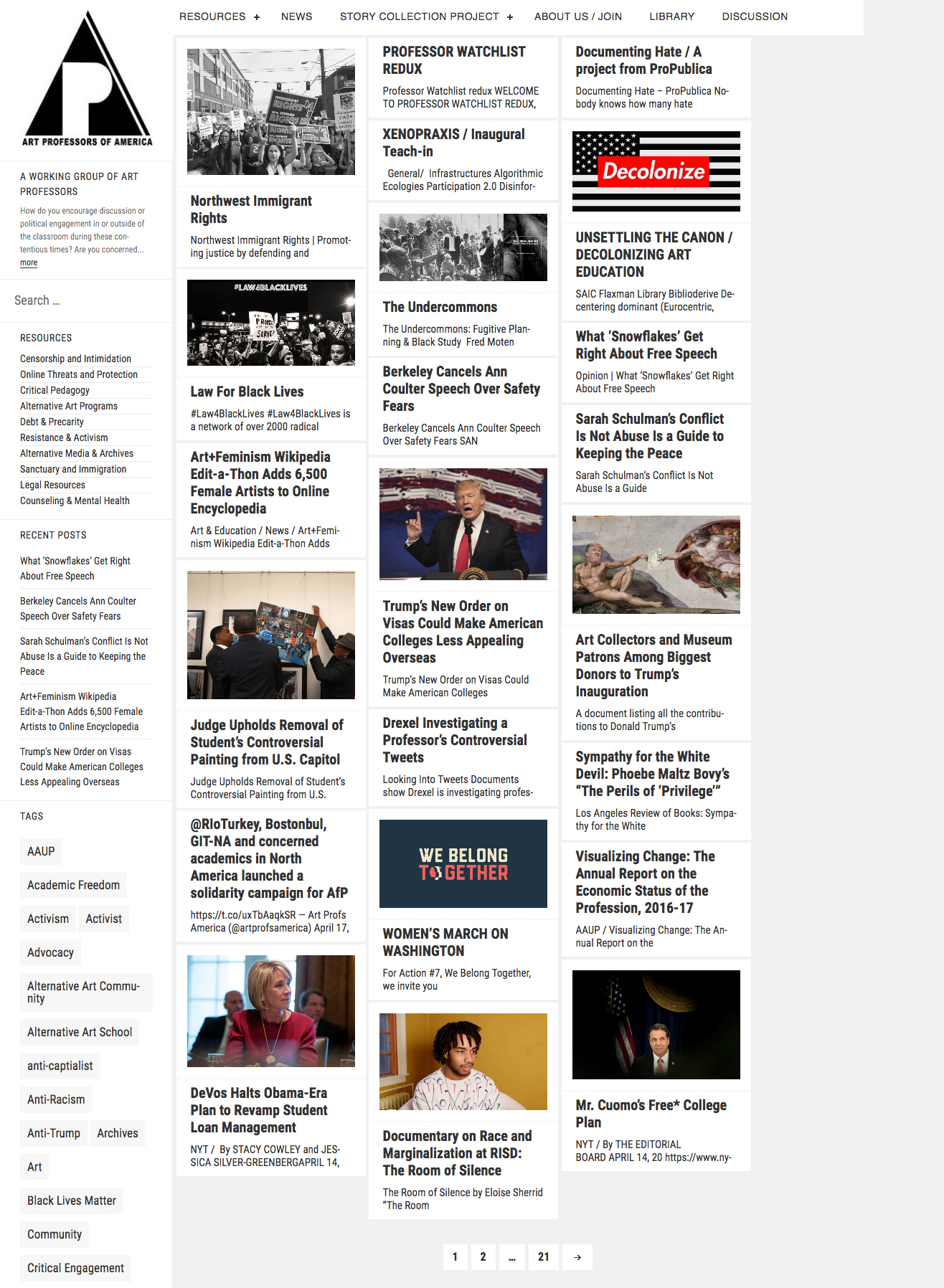 CAA recently corresponded with Marc Handelman, an artist and assistant professor of visual arts for the Mason Gross School of the Arts at Rutgers University in New Brunswick, New Jersey, about a new grassroots organization concerned with advocacy issues, called the Art Professors of America.
When and why did the Art Professors of America form? What are its goals?
A couple of dozen art professors from several schools in the Northeast came together in the wake of the election initially to discuss how we might respond to a right-wing campaign to blacklist liberal and progressive faculty by smearing them as un-American. Simultaneously, many of us were seeing a troubling uptick both of threats and attacks on Latino, Muslim, and LGBTQ students, and of anti-Semitism on campuses. Some of us were also experiencing increased feelings of anxiety and self-censorship. Most of all, we felt the urgency and need of being together and sharing our experiences as artists and educators and citizens. We decided to meet every two weeks in New York and continue the conversation. Because colleagues from around the country reached out to be part of the dialogue, we started an email group that now represents professors in well over a dozen states. We are currently working on expanding this network to all fifty states, welcoming art professors of all ranks and teaching status, including TAs and those between positions. Our primary goal right now is to be a platform that connects people nationally and shares critical information. Our latest project was the launch of our website that features news related to education in our political climate and a critical resource page.
What is the purpose of the advocacy resource APA is building?
There are many potential and actual threats that faculty are facing increasingly. Some of these issues begin at the state level, where funding for classes or entire programs are being cut due to their political content. Other issues range from online harassment to deceptively progressive legislation for free-speech protection on campus. Meanwhile, higher education in general continues to foster crippling student debt as institutions struggle to deal with increasing demands for greater diversity, inclusion, and equity. The resource page we launched and continue to build on modestly attempts to provide critical information and tools to help us deal with some of these problems, from distributing information about student loans for undocumented students to debt models in art education. Other items provide online security protocol and consent laws for recording in classrooms. Some of the categories include Censorship and Intimidation, Critical Pedagogy, Alternative Art Programs, Debt and Precarity, Sanctuary and Immigration, and Legal Resources, among others.
Where do the resources come from?
Nearly all of the content already exists online in some form, from other organizations and studies. Populating the website was an extensive three-month process of collecting information and links and aggregating them in these categories. We have been so grateful to other working groups and colleagues for sharing their resources as well.
What are the most urgent issues confronting art professors in the United States today?
Clearly we don’t assume to speak for every program. But in the immediate context, the travel ban and ICE deportations may have the most immediate effects on our students, faculty, and visiting artists. Academic freedom has been under various levels of threat for a long time, and it remains to be seen how deeply and broadly new threats develop. But economic precarity and inequality remain the most pressing structural issue in education both for art schools and the larger university system. This affects part-time adjuncts who, already underpaid, are increasingly asked to do things such as decrease their course loads so as not to trigger contingent benefits, the end of tenured lines, and students who suffer under crippling debt or have no access to higher education at all. Critical and progressive curricula can’t make up for the undergirded issues of access, which are directly tied to geography, race, and class.
Under this current political regime, arts faculty may actually have a greater deal of security than professors and departments researching and teaching social justice, antiracism, and climate change. We need to continually find ways to support our colleagues in other fields.
How can CAA members get involved?
We welcome new arts-affiliated adjuncts, TAs, and professors into our organization and dialogue—the more voices represented, the better. Members will have access to group documents and files, as well as The Story Collection Project, which shares and archives testimonials and stories about what is happening in different corners of our campuses and in classrooms across the country. Meanwhile, the Art Profs America website, offering news, links, and resources, is live and available to anyone online. Please feel free to share with other colleagues as well. You can visit us, or join at http://artprofsamerica.com.
To request to join the discussion, please visit https://groups.google.com/d/forum/art-profs-america. You may also follow APA on Twitter.
Staff Interview: Fernando Zelaya
posted Apr 24, 2017
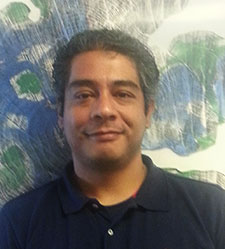 The next in a series of interviews with staff members is a conversation with Fernando Zelaya, CAA controller.
How long have you worked at CAA?
I have been at CAA since December 2012—four years, four months.
What do you do at CAA?
I am the controller, in the Finance Department.
What does CAA mean to you?
CAA to me is a medium for all art scholars to come together and be a part of a community. It’s also a place to share with each other, and to teach each other.
Can you talk about one of your favorite member moments?
Since I interact with members mostly at the conference, I’ll tell one story here and add another in the conference question later on. My favorite member moment was when I helped an elderly member who reminded me of my grandmother. She had such vigor and enthusiasm and seemed genuinely happy to be at the conference. That made my day.
What do you like best about the arts and working in the arts?
What I like best is meeting and working with artists. In my daily life and my earlier years, I had never interacted with artists. Now, having worked for the Dia Art Foundation as well as CAA, I have learned to appreciate art more than I used to, because now I better understand the meaning behind the art.
Do you have a favorite moment from the Annual Conference?
Once at registration I was berated by a flustered member who was late to a session and wanted to get his ticket quicker than was possible. The nice moment came when he returned to my booth after the session was over and gave me a sincere apology.
People interested in art can sometimes rebuff things like sports. But you’re interested in sports like soccer and baseball. Do you see a conflict?
I think that art and sports have more in common than people think. Both require years of hard work to perfect, and both need a combination of grace and power to achieve the objective of the piece (in art) or to score (in a game). It takes grace to stop a soccer ball or save a shot coming toward you at fifty to sixty miles per hour, or to hit a baseball with a bat when both objects are about three inches wide. That kind of skill, to me, is just as beautiful as a stroke of a brush or a poem that can draw a tear or bring about a smile.
You’re also interested in science fiction. Are there any new television shows or movies that have piqued your interest?
Science fiction is my favorite type of television show or movie. My favorite is Doctor Who, because of its sheer brilliance and how it has evolved over the last fifty-three years. The series even survived being off the air, only living in print and audio for almost ten years. The best new show I have seen this year is The Man in the High Castle, which takes us to a world where the Axis powers won WWII and have divided the United States among them. I am also a big fan of the Marvel and DC movies. I love these types of shows or movies because it is fun to immerse myself for a couple of hours—okay, maybe more than a couple—and go somewhere magical or even quite insane.
New in caa.reviews
posted Apr 21, 2017
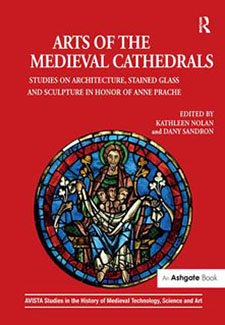 Evelyn Staudinger reviews Arts of the Medieval Cathedrals: Studies on Architecture, Stained Glass and Sculpture in Honor of Anne Prache, edited by Kathleen Nolan and Dany Sandron. The essays “honor the Sorbonne professor’s rich contributions to medieval art and architecture.” Covering a wide variety of topics, “the editors and authors have done a fine job celebrating Prache’s great intellectual acumen, diplomatic gifts, and warmth as a human being, while leaving behind erudite ‘memories’ and a wealth of new ideas.” Read the full review at caa.reviews.
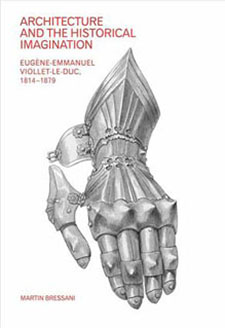 Jessica Basciano examines Architecture and the Historical Imagination: Eugène-Emmanuel Viollet-le-Duc, 1814–1879 by Martin Bressani. Viollet-le-Duc is “the nineteenth-century French architect, restorer, and theorist whose numerous and diverse activities continue to enthrall and perplex historians.” Although the “book’s complex arguments could be made clearer by offering more straightforward exposition,” “Bressani’s intellectual biography stands out in the landscape of Viollet-le-Duc studies because it offers a unified narrative based on the distinctive premise that the architect was motivated consistently by a form of pathological mourning.” Read the full review at caa.reviews.
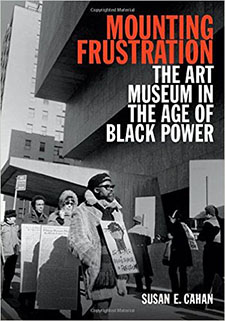 Anne Monahan reads Mounting Frustration: The Art Museum in the Age of Black Power by Susan E. Cahan. Framing her review with a discussion of recent police shootings of unarmed African American males and subsequent artists’ responses, Monahan presents Cahan’s “finely grained history of the New York art establishment’s attempts circa 1970 to reckon with African American representation.” Utilizing “close readings of archival documents, interviews, and secondary sources,” Cahan shows how demands by activists “conditioned the museums’ exhibition and hiring practices for decades thereafter.” Read the full review at caa.reviews.
Presentation on Fair Use at UCLA
posted Apr 19, 2017
CAA is hosting “Fair Use and the Visual Arts,” a presentation and panel discussion led by Peter Jaszi, Professor, Washington College of Law, American University, on Friday, May 5, 2017. The event will focus on the College Art Association’s Code of Best Practices in Fair Use for the Visual Arts and will take place at the UCLA Library from 10:00 AM to 2:00 PM. Lunch will be served.
Come join the conversation! Please RSVP to give us your lunch preferences, and when you do, please share your specific Fair Use questions so our presenters can break it down for you.
For more information: https://www.library.ucla.edu/events/code-best-practices-fair-use-visual-arts.
This event is made possible by a grant from the Andrew W. Mellon Foundation.
News from the Art and Academic Worlds
posted Apr 19, 2017
Each week CAA News summarizes eight articles, published around the web, that CAA members may find interesting and useful in their professional and creative lives.
The More Things Change
Pay for full-time faculty members rose 2.6 percent this academic year over last, according to “Visualizing Change,” the American Association of University Professors’ Annual Report on the Economic Status of the Profession. But professors shouldn’t get too excited: adjusted for inflation, that amounts to just 0.5 percent. (Read more from Inside Higher Ed.)
A New Site Is Helping High-Quality Creatives Find Work—and Get Paid
Easle is a freshly launched online platform that aims to connect high-quality creatives with reliable clients across the globe. Through an algorithm, the site helps match creatives with jobs that are well suited to their skills and then facilitates the logistics of paperwork and payment. (Read more from Artsy.)
A Syllabus for Making Work about Race as a White Artist in America
Many white-identified students, artists, and art workers feel stuck in that racial construct. They are nervous to tread into any conversation about race and avoid the question. But what about those who identify as white and still want to make works rich with social and historical narrative? (Read more from Hyperallergic.)
Donated Slides from the Met Get a Second Life
It is definitely a digital-age question: What to do with old-fashioned color slides of all-but-forgotten visits to see Grandma or department store Santas? Year after year, they lie in their boxes on a shelf, no longer looked at. The Metropolitan Museum of Art faced the same question on a much larger scale. It had thousands of 35mm slides, showing everything from close-ups of Manets and Monets to wide-angle shots of the galleries. (Read more from the New York Times.)
Designed for Social Change
Though “spatial justice” is often thought of as an enterprise in the public realm, like the construction of parks and community centers, it’s not as frequently addressed in the private realm. Because housing is essential to well-being, the architect Dana McKinney hopes to eventually create spaces that promote not just equality, but equity. (Read more from the Harvard Gazette.)
Bringing Respect to the Craft Artist
Giving lesser-known artists visibility is key to the mission of the Craft and Folk Art Museum, says executive director Suzanne Isken, whose institution has an annual operating budget of about $730,000. Which is why a $25,000 grant from the NEA has been so crucial for the Los Angeles museum to stage its current exhibition, Chapters: Book Arts in Southern California. (Read more from the Los Angeles Times.)
Publishers and Open-Resource Advocates Square Off on the Future of Course Content
At a friendly yet spirited debate last month over the pros and cons of open educational resources, publishers and open-access advocates agreed on at least one thing—the “old” textbook market is broken. But that’s pretty much where the common ground ended. (Read more from the Chronicle of Higher Education.)
Pedagogic Approaches to Teaching with Art in the Sciences
When dealing with courses in the hard and life sciences, we approach engagement with art differently. Founded on the types of interactions with the collection that STEM faculty tend to request and on the recent pedagogic emphasis on active, inquiry-based learning that also touches on the creative aspects of science, we distinguish four kinds of interactions with art: skill-building, thematic, problem-based, and dispositional. (Read more from Art History Teaching Resources.)
New in caa.reviews
posted Apr 14, 2017
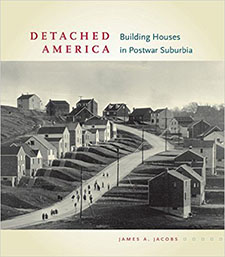 Ryan Donovan Purcell reviews Houses for a New World: Builders and Buyers in American Suburbs, 1945–1965 by Barbara Miller Lane and Detached America: Building Houses in Postwar Suburbia by James A. Jacobs. These two studies “examine the development of suburban communities through the lens of architectural history, and yield fresh insight into the origins of ubiquitous suburban housing forms.” Read the full review at caa.reviews.
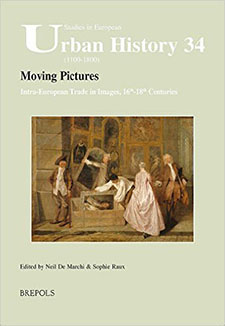 Thijs Weststeijn reads Moving Pictures: Intra-European Trade in Images, 16th–18th Centuries, edited by Neil De Marchi and Sophie Raux, and European within Reach: Netherlandish Travellers on the Grant Tour and Beyond (1585–1750) by Gerrit Verhoeven. The two books “happily complement each other in mapping different dimensions of early modern artistic exchange, mostly from the Low Countries to Italy.” Read the full review at caa.reviews.
 Amanda V. Gannaway examines Vernon James Knight Jr.’s Iconographic Method in New World Prehistory. Addressing a “lack of methodological rigor” in the study of the ancient Americas, the author “proposes a method for iconographic analysis.” The book is “novel not by reinvention but by taking on the daunting task of bringing relevant literature from two disciplines into dialogue with each other.” Read the full review at caa.reviews.
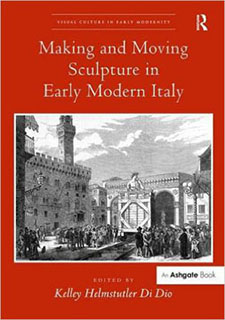 Francesco Freddolini discusses Making and Moving Sculpture in Early Modern Italy, edited by Kelley Helmstutler Di Dio. The collection of ten essays marks “an important addition to the growing field of studies on the mobility and materiality of sculpture,” focusing on the “process, techniques, and technologies” that shed “light on the many decisions made by sculptors during their creative process.” Read the full review at caa.reviews.
The Art Bulletin Redesign
posted Apr 13, 2017
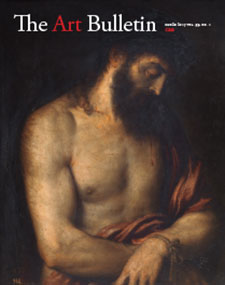 A few weeks ago we unveiled a new website design at CAA and today we present another new change. This time, it’s arriving to your mailbox. If you are a subscriber of The Art Bulletin, you may notice that the March 2017 issue looks different. Thanks to the hard work of Nina Athanassoglou-Kallmyer, editor-in-chief of the publication; designer Katy Homans; the Art Bulletin Editorial Board; copublisher Taylor & Francis; and CAA publications staff, the newly redesigned Art Bulletin has arrived. It was a project almost two years in the making and we owe a great thanks to the Samuel H. Kress Foundation for financially supporting the project.
Founded in 1913, The Art Bulletin remains one of the most respected publications for peer-reviewed scholarly articles and critical reviews in all areas and periods of the history of art. The redesign updates the publication for contemporary readers with a full-bleed cover, single-column page layout that emphasizes legibility, and a more flexible format for featuring larger article images.
We hope you enjoy the new look of The Art Bulletin.
To read digital issues of The Art Bulletin or Art Journal, visit Taylor & Francis online.
CAA Members Win NEH Summer Stipends
posted Apr 13, 2017
 On March 29, the National Endowment for the Humanities (NEH) announced funding for 208 humanities projects totaling $21.7 million. These grants include programs that support international collaboration, engage students in interdisciplinary courses, and help veterans.
Among the recipients are the following CAA members, all of whom received a $6,000 Summer Stipend to work on their various research projects:
- Marie-Stéphanie Delamaire of the Winterthur Museum, Garden, and Library in Winterthur, Delaware, for “Diderot and d’Alembert’s Encyclopedia and the Color Printing Revolution: A Translation and Critical Study”
- Jennifer Germann of Ithaca College in Ithaca, New York, for “A Study of the Portrait of Dido Elizabeth Belle and Lady Elizabeth Murray, an 18th-century British Artwork”
- Laura Morowitz of Wagner College in Staten Island, New York, for “Art Exhibitions in Vienna, Austria, during the Nazi Occupation”
- Allie Terry-Fritsch from Bowling Green State University in Bowling Green, Ohio, for “Cosimo de’Medici, Fra Angelico, and the Public Library of San Marco”
- Anne Verplanck of Pennsylvania State University in Harrisburg for “The Business of Art: Transforming the Graphic Arts in an Age of Mechanical Reproduction”
These awards come just weeks after President Donald J. Trump’s administration released a budget proposal calling for the elimination of the NEH, the National Endowment for the Arts, the Department of Education’s international education programs, the Institute for Museums and Library Services, and the Woodrow Wilson International Center for Scholars.
Our attention now turns to Congress, which can fund these programs despite the administration’s proposals. We have been heartened that these programs—which have been supported by presidents of both parties—have seen growing support in Congress in recent years. Indeed, over the past two years, the Republican-controlled Congresses have supported increases for the NEH.