CAA News Today
A Fair Use Code Changes Practice in the Visual Arts: The Numbers
posted Aug 04, 2016
How much difference has the release of the College Art Association’s Code of Best Practices in Fair Use for the Visual Arts made so far? Even a few months after the release in February 2015, there was significant change in the field’s practice.
A survey of more than two thousand members of the College Art Association, starting seven months after the launch of the Code and winding up in January 2016, was analyzed by American University faculty and graduate students. Here’s what we know:
By and large, and as expected, patterns documented in a 2013 survey remained in place in the few months after the CAA Code was launched. The great majority of visual arts professionals still default to permissions, even though they have some experience of fair use when permissions processes fail. That choice is often costly. About a third of the respondents continue to report problems with avoiding projects, abandoning existing projects, and serious delays of more than three months, because of permissions.
But as well, we saw some real changes.
- The Code spurred a significant group of people to try fair use for the first time. Some 11% of those who have employed fair use did so for the first time after the Code came out.
- The Code spurred institutions to revise their policies. More than half—57%–of respondents who reported some institutional policy change said it had happened after the Code was released.
- Editors reported the largest amount of change, of any occupational group. This reflects the fact that several institutions publicly announced a change in policy, including the College Art Association. CAA’s author agreement now encourages a default to fair use where in line with the Code.
These changes, which occurred after only months of experience with the Code, happened because of widespread and networked knowledge.
o Two-thirds of respondents said they had heard of the Code before they took the survey.
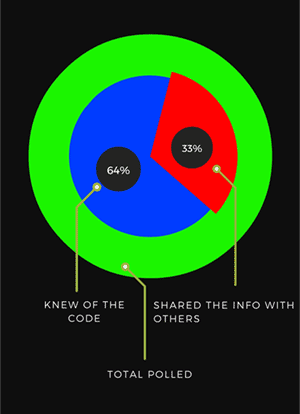
o Most heard from multiple sources, but CAA was the most common source, whether through the conference, a newsletter or the website.
o A third of those who had heard about it had shared the news with someone else—a gesture that shows trust in the information, and confidence that it will be useful.
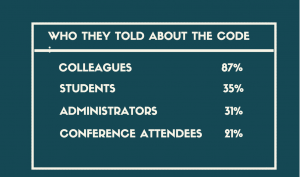
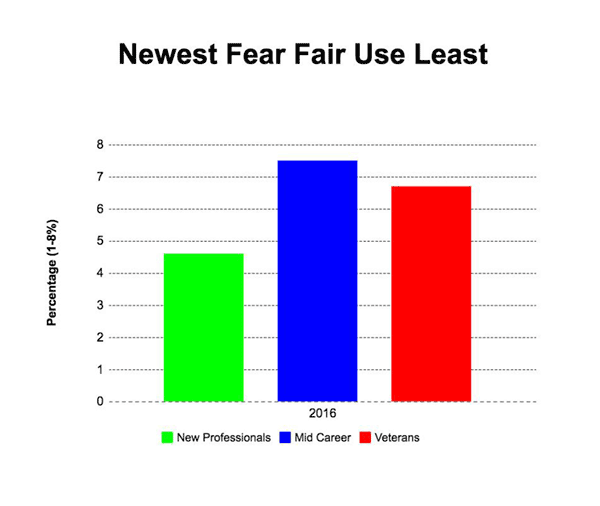
o Mid-career and veteran members of the field were much more likely to have heard about it than the newer entrants.
This is only the beginning, though. There’s still a lot to do.
- More than a fifth of respondents said they simply did not know whether fair use was valuable or not in their work. For a tool so fundamental to the functioning of the field, that is an alarming information gap.
- Only half of those who had heard about the Code went on to use it in the months after its release.
The survey results provide some next steps:
- Knowledge matters. The more confident and grounded respondents are in their understanding of fair use, the more likely they are to use it. So sharing your knowledge about the Code is crucial.
- Veteran leadership matters. Newer entrants to the field are less likely to have heard about the Code or to have experience with fair use.
- It’s worthwhile investing in the newest entrants. Although they were less familiar with the Code or fair use, they were the most likely to recognize that fair use is valuable to their work. They also are the most likely, they say, to change behavior with greater confidence in their knowledge.
- Institutions are really important in changing practices–to set terms, spread the word, and by publicly announcing their decisions to give confidence to others.
- Higher education is particularly important, especially for those, like artists, who may not be consistently working within institutions as they develop their careers. Universities, colleges, and art schools can educate the next generation about the new normal.
For more information about the Code, including informational videos, infographics, and frequently asked questions, visit the Fair Use page on the CAA website.
Originally published by the Center for Media and Social Impact in the School of Communication at American University.
News from the Art and Academic Worlds
posted Aug 03, 2016
Each week CAA News publishes summaries of eight articles, published around the web, that CAA members may find interesting and useful in their professional and creative lives.
A Prized Stettheimer Painting, Sold under the Radar by a University
When Fisk University, the historically black school in Nashville, tried to sell two paintings several years ago from its storied Alfred Stieglitz art collection, a firestorm erupted. A drawn-out legal challenge ended in a compromise that allowed the school to share its collection with Crystal Bridges. What was not revealed at the time—and has only recently come to light—is that before the agreement was completed, the university’s president quietly sold two other paintings owned by Fisk. (Read more from the New York Times.)
Artiquette: Ten Mistakes Not to Make While Promoting Your Art
How do you make it in the art world? It’s a magical formula that involves, talent, drive, grit, and the ability to promote oneself. Unfortunately, talking up your own artwork, projects, and ideas can be a delicate balancing act. To help you walk that line, Artnet News has rounded up a list of mistakes to avoid in self-promotion. (Read more from Artnet News.)
Sharon Louden: Consultants, Careers, and Community
I frequently get pitches from art consultants who offer help securing exhibitions, grants, and publicity. I often wonder if their services are helpful, or whether the consultants are taking advantage of vulnerable underrecognized artists, so I contacted my friend and colleague Sharon Louden, a successful artist who gives professional-development webinars and lectures about sustaining a creative life. (Read more from Two Coats of Paint.)
Talking Art and Tech in Bay Area Living Rooms
The all-purpose status of the living room made it the ideal site for a series of events initiated two years ago by the artists Liat Berdugo and Elia Vargas. The duo used the living rooms of Bay Area artists and cultural producers to host monthly public conversations—on new media, digital art, creative works in progress, and artistic practices—that were attended by friends and strangers. (Read more from Rhizome.)
The Syllabus as a Contract
Whatever the professor’s intention, when students see a due date on the syllabus, they often assume that the assignment is due via online submission by midnight on that date. Technology has forced professors to be extremely specific on these details or else face inevitable challenges from students. It’s precisely when such challenges arise that professors and students look to the syllabus as a contract. (Read more from the Chronicle of Higher Education.)
Are Acrylics as Durable as Oils?
If oil paint had to sell itself to the marketplace as a new medium, it would have a difficult time—especially because its list of problems would include yellowing, cracking, wrinkling, flaking, embrittlement, hydrolysis, fatty-acid crystallization, and protuberances and delamination caused by metallic soaps. This is not to say acrylics do not have their own challenges as well! (Read more from Just Paint.)
Why Books Are the Perfect Way to Spread Art to the Masses
Art is expensive, often ludicrously so. For many art lovers, books are the most viable means of supporting artists and beginning an art collection of their own. Carolyn Schoerner is the mind behind Books For All Press, a nonprofit publisher working with artists living with mental illness and developmental disabilities. (Read more from the Huffington Post.)
For Scholarly Communications, Double-Dipping Is Double the Fun
Since commerce is inherently evil—and commerce connected to the academy even more so—it must be an exceedingly dastardly deed for a publisher to engage in double-dipping, in which the same content finds one audience in institutions and another among the authors who create it, sometimes in violation of an author’s contract. So how does double-dipping work? (Read more from the Scholarly Kitchen.)
AVIS Is CAA’s Featured Member Partner For August
posted Aug 02, 2016
 Did you know that as a CAA member, you can save up to 25% off Avis base rates when making a reservation with Avis Worldwide Discount?
As you plan your get away for the last month of summer, make sure you get the most out of your car rental options! Special discounts are available on a wide selection of vehicles from eco-friendly and fuel-efficient compacts and hybrids to stylish premium and luxury sedans.
The Avis Budget Group, Inc. is a leading global provider of vehicle rental services, both through its Avis and Budget brands, which have more than 11,000 rental locations in approximately 180 countries around the world.
Visit the special Avis page for CAA members to learn more about your benefits. And don’t miss the Avis discounts offered during the Annual Conference!
Members of CAA’s new Committee on Design
posted Aug 01, 2016
In 2015 CAA established a Task Force on Design charged with suggesting positions the organization might adopt toward design, design studies, designers, design educators, historians, and theorists. In early 2016 the CAA Board of Directors announced it would replace the Task Force with a new Committee on Design to be among CAA’s ten standing Professional Interests, Practices, and Standards Committees.
Jim Hopfensperger, CAA’s VP for Committees, is pleased to announce the following members who will constitute the inaugural Committee on Design:
Audrey Bennett, Rensselaer Polytechnic Institute
Holly Cline, Chair, Radford University
Federico Freschi, University of Johannesburg
Chris Garvin, University of Georgia
Matthew Gaynor, Kansas State University
Elizabeth Guffey, State University of New York at Purchase
David Howarth, Zayed University, Dubai
Zach Kaiser, Michigan State University
Sarah Lawrence, Parsons School of Design
Yelena McLane, Florida State University
Victoria Pass, Salisbury University
David Raizman, Drexel University
Bess Williamson, School of the Art Institute of Chicago
Dan Wong, New York City College of Technology, CUNY
The Committee on Design will promote and advance issues in design practice, design history/theory/criticism, and design education through advocacy, engagement, and a commitment to the diversity of practices and practitioners. The committee will further support discussion and action in these areas to stimulate intellectual curiosity and advance skills that enrich the individual and society.
CAA is grateful to these dedicated members who will work to advance the interests of all design disciplines through their service to CAA.
caa.reviews Publishes 2015 Dissertation List
posted Aug 01, 2016
 caa.reviews has published the authors and titles of doctoral dissertations in art history and visual studies—both completed and in progress—from American and Canadian institutions for calendar year 2015. You may browse by listing date or by subject matter. Each entry identifies the student’s name, dissertation title, school, and advisor. Once a year, each institution granting the PhD in art history and/or visual studies submits dissertation titles to CAA for publication.
New in caa.reviews
posted Jul 29, 2016
Geoffrey Symcox examines A Kingdom of Images: French Prints in the Age of Louis XIV, 1660–1715, a joint exhibition and companion volume by the Getty Research Institute and Bibliothèque nationale de France. He commends the organizers for “mobilizing the rich resources” of these institutions “to display a series of images otherwise inaccessible to the general public, creating a visual feast of images that illuminates a critical moment in the history of printmaking.” Read the full review at caa.reviews.
Jason Hill takes a look at the exhibition and accompanying catalogue Things beyond Resemblance: James Welling Photographs, organized by the Brandywine River Museum of Art. The featured photographic series is “an homage” to the painter Andrew Wyeth, eliciting “deeply inquisitive expressions (or, better, material accretions) of admiration for an important if counterintuitive artistic influence.” Read the full review at caa.reviews.
George R. Goldner reviews Italian Master Drawings from the Princeton University Art Museum, “a hybrid publication” composed of ninety-five entries on select artworks and an appendix of drawings acquired by the museum since 1977. Despite criticisms, Goldner finds it “a worthwhile publication that brings the best of Princeton’s Italian drawings to a wider audience.” Read the full review at caa.reviews.
Delinda Collier critiques Double Desire: Transculturation and Indigenous Contemporary Art, a collection of fifteen essays edited by Ian McLean that address the marginalization of Aboriginal artists. The volume “is led by postcolonial theory’s focus on the author over the artwork,” though the reviewer is left wondering “how much of the discussion was useful in increasing agency and opportunities for the artists.” Read the full review at caa.reviews.
Caa.reviews publishes over 150 reviews each year. Founded in 1998, the site publishes timely scholarly and critical reviews of studies and projects in all areas and periods of art history, visual studies, and the fine arts, providing peer review for the disciplines served by the College Art Association. Publications and projects reviewed include books, articles, exhibitions, conferences, digital scholarship, and other works as appropriate. Read more reviews at caa.reviews.
A Radical Change: An Interview with Irving Sandler
posted Jul 29, 2016
The art critic and historian Irving Sandler was a regular contributor to ARTnews and other magazines in the 1950s and 1960s. He is best known for The Triumph of American Painting: A History of Abstract Expressionism (London: Pall Mall, 1970) and its follow-up, The New York School: The Painters and Sculptors of the Fifties (New York: Harper and Row, 1978). Born in New York in 1925, Sandler turned 91 years old on July 22.
He and his wife, Lucy Freedman Sandler, a historian of medieval art and an accomplished author in her own right, are CAA life members. Both scholars have a long involvement with CAA spanning several decades: Lucy served as president of the Board of Directors from 1981 to 1984 and organized the 1978 Annual Conference with her husband. Both have spoken many times at the conference; they have organized and moderated numerous panels and sessions as well. In addition, Irving was part of a group of CAA members who introduced a new format to Art Journal, back in 1979.
Sandler’s second book of memoirs, Swept Up by Art (Brooklyn: Rail Editions, 2015), follows his first, A Sweeper-Up after Artists (New York: Thames and Hudson, 2003). Christopher Howard, CAA managing editor, visited Sandler in May 2016 at his New York apartment to talk about his recent book and about his involvement with CAA over the years.
CAA: Let’s start with Art Journal. In the late 1970s you and a handful of others—Anne Coffin Hansen, Ellen Lanyon, George Sadek—got together to reinvent the publication.
Irving Sandler: That is pretty much it. We took the journal, which had become pretty moribund—it was sort of run by an old guard—and we turned it into something much more interesting by doing thematic issues, and also getting interesting editors to do it. It’s still working more or less that way.
Yes, it is. Editors have three-year terms—but they get a longer time span to take it over. You even produced one of those early issues, in Winter 1980, yourself.
Yes, I did. This issue was, to my knowledge, was the first issue on modernism and postmodernism, indicating the change that had been taking place in art, and in the art world as well. That was a very good issue.
You and your wife first joined CAA in 1954. How has the teaching of art and art history changed over the last sixty years?
Well, one of the things—the primary thing I believe—that’s changed would be the introduction of contemporary art into curricula. That simply wasn’t done. In places like the Institute of Fine Arts, you couldn’t write a dissertation on an artist who wasn’t dead for a century. And suddenly, not only do you have contemporary art, but the primary emphasis, in our art-history programs now, is on the contemporary. That’s a radical change to the entire approach to art.
A Radical Change: An Interview with Irving Sandler
posted Jul 28, 2016
The art critic and historian Irving Sandler was a regular contributor to ARTnews and other magazines in the 1950s and 1960s. He is best known for The Triumph of American Painting: A History of Abstract Expressionism (London: Pall Mall, 1970) and its follow-up, The New York School: The Painters and Sculptors of the Fifties (New York: Harper and Row, 1978). Born in New York in 1925, Sandler turned 91 years old on July 22.
He and his wife, Lucy Freedman Sandler, a historian of medieval art and an accomplished author in her own right, are CAA life members. Both scholars have a long involvement with CAA spanning several decades: Lucy served as president of the Board of Directors from 1981 to 1984 and organized the 1978 Annual Conference with her husband. Both have spoken many times at the conference; they have organized and moderated numerous panels and sessions as well. In addition, Irving was part of a group of CAA members who introduced a new format to Art Journal, back in 1979.
Sandler’s second book of memoirs, Swept Up by Art (Brooklyn: Rail Editions, 2015), follows his first, A Sweeper-Up after Artists (New York: Thames and Hudson, 2003). CAA visited Sandler in May 2016 at his New York apartment to talk about his recent book and about his involvement with CAA over the years.
CAA: Let’s start with Art Journal. In the late 1970s you and a handful of others—Anne Coffin Hansen, Ellen Lanyon, George Sadek—got together to reinvent the publication.
Irving Sandler: That is pretty much it. We took the journal, which had become pretty moribund—it was sort of run by an old guard—and we turned it into something much more interesting by doing thematic issues, and also getting interesting editors to do it. It’s still working more or less that way.
Yes, it is. Editors have three-year terms—but they get a longer time span to take it over. You even produced one of those early issues, in Winter 1980, yourself.
Yes, I did. This issue was, to my knowledge, was the first issue on modernism and postmodernism, indicating the change that had been taking place in art, and in the art world as well. That was a very good issue.
You and your wife first joined CAA in 1954. How has the teaching of art and art history changed over the last sixty years?
Well, one of the things—the primary thing I believe—that’s changed would be the introduction of contemporary art into curricula. That simply wasn’t done. In places like the Institute of Fine Arts, you couldn’t write a dissertation on an artist who wasn’t dead for a century. And suddenly, not only do you have contemporary art, but the primary emphasis, in our art-history programs now, is on the contemporary. That’s a radical change to the entire approach to art.
News from the Art and Academic Worlds
posted Jul 27, 2016
Each week CAA News publishes summaries of eight articles, published around the web, that CAA members may find interesting and useful in their professional and creative lives.
Great Colleges to Work For 2016
The annual “Great Colleges to Work For” survey was administered between March 14 and April 15. All survey-related content in this issue, including college presidents’ statements about what makes their institution a great place to work, was provided by ModernThink, which drew institutional data from the colleges and the US Department of Education. (Read more from the Chronicle of Higher Education.)
Should Colleges Really Eliminate the College Lecture?
Despite the increased emphasis in recent years on improving professors’ teaching skills, such training often focuses on incorporating technology or flipping the classroom, rather than on how to give a traditional college lecture. It’s also in part why the lecture—a mainstay of any introductory undergraduate course—is endangered. (Read more from the Atlantic.)
What Learning People Really Think about Lecturing
Is there really a war on lecturing going on across higher education? Do learning professionals want to kill the lecture? Read Christine Gross-Loh’s “Should Colleges Really Eliminate the College Lecture?” and you would be forgiven in thinking that there is and that we do. The problem is that her description of the current climate bears little resemblance to reality. (Read more from Inside Higher Ed.)
These Four Technologies May Finally Put an End to Art Forgery
Like method actors and bearded brewmasters, the best art forgers are obsessed with authenticity. But thanks to a handful of new authentication technologies, even history’s most painstaking efforts wouldn’t stump today’s art sleuths. (Read more from Artsy.)
How the Rich Are Hurting the Museums They Fund
For museum executives, the dirty secret of expansions has been that they are often motivated by the need to have some exciting new thing to rally board members and interest potential patrons. These institutions depend heavily on rich people to fund them. Those rich people like to pay for flashy new buildings; no one wants to donate to boring old museum upkeep. (Read more from the New York Times.)
Supporting Transgender Students in the Classroom
As the higher-education community continues to work to create a more inclusive learning environment, the needs of gender-variant students are too often overlooked. This article outlines a few ways faculty can create an atmosphere that supports trans-identified and gender-nonconforming students. (Read more from Faculty Focus.)
The Way We Publish Now
All signs point toward an open-access future for scholarship. The pressure from funders as well as from academic authors to publish openly is growing. So is the convergence of the affordances of open web–enabled publishing with the present-day means of scholarly conversation, much of it online. (Read more from Inside Higher Ed.)
How to Resign
Leaving an academic job is different than vacating a nonacademic one. A professor can’t just give two weeks’ notice and walk out the door. I’ve submitted my share of resignation letters and watched others leave their posts, so I’ve gleaned a few tips on how to depart a faculty position gracefully. (Read more from Vitae.)
For CAA Members Only: 3 Exclusive Offers from frieze!
posted Jul 26, 2016
For a limited time only, CAA members can take advantage of three exclusive offers from frieze, the leading magazine in contemporary art and culture. As a CAA member, you can select between a free issue when you subscribe by August 9th, free shipping when you pre-order a copy of Frieze Masters, or discounted Frieze Masters tickets taking place this fall in London! Please see below for details:
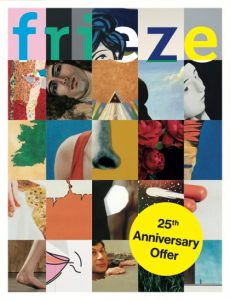 Subscription Offer:
Insightful, intelligent, and exquisitely designed, frieze is the leading magazine in contemporary art and culture. frieze profiles emerging artists and highlights new currents in art practice as well as offering a fresh perspective on more established artists.
In celebration of frieze‘s 25th anniversary we are offering the first issue free to CAA members when purchasing a subscription! (9 issues for the price of 8). All subscriptions will be started with the September issue, which will be published with three different covers, all special commissions by Sarah Cwynar, Chris Ofili and Rosemarie Trockel. You can select which cover you would like to receive (or we can surprise you)!
If you decide to cancel your subscription before your second copy is dispatched (for any reason), we will offer you a full refund.
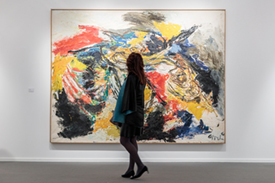 Frieze Masters Magazine Offer:
Frieze Masters Magazine is an annual publication that looks at the art of the past through the lens of the present. Issue 5 includes features on Caravaggio and Hieronymus Bosch. The issue also focuses on the medieval women who painted illuminated manuscripts, Henry James‘s fascination with women looking at classical sculpture and Sigmund Freud‘s preoccupation with Michelangelo. Again, this year, Frieze Masters also includes ‘Artist’s Artists’, for which contemporary artists are invited to discuss a work of art from the past that has influenced them. This year’s respondents include Francesco Clement, Cao Fei, Nancy Grossman, Heather Phillipson, and Fiona Rae, among many others.
Issue 5 is published on 5 September and we are offering CAA members the opportunity to pre-order their copy and receive free shipping on their order.
Frieze Masters London Offer:
Discover several thousand years of art history in a unique contemporary context at Frieze Masters in London (6-9 October 2016). CAA members can enjoy an exclusive offer of 25% off One-Day weekday tickets. Simply purchase tickets and enter code CAA16 at checkout.