CAA News Today
A Tactile Art Journal
posted Jul 25, 2016
 The Summer 2016 issue of Art Journal must be touched to be believed—though there is plenty to enjoy visually as well. For a project by the renowned artist Harmony Hammond, the covers of the journal have been given a waxy coating to help convey the nature of her intensely tactile paintings and prints, featured in a twenty-page portfolio of images. In an accompanying text, Hammond relates the impact on her work of a 2001 censorship incident in San Francisco.
In essays in the journal, Amanda Jane Graham takes a close look at the interweaving of domestic and performing spaces in Trisha Brown’s 1975 dance Locus; Mechtild Widrich explores the effects on the urban fabric of the new-old National Gallery of Singapore, created from a colonial-era court building; and Dan Adler traces the idea of an all-pervasive Apparatus in 1980s and 1990s works by the German photographer Thomas Ruff.
In the Reviews section, Chris Taylor examines James Crump’s film Troublemakers: The Story of Land Art; Joseph L. Underwood reviews Chika Okeke-Agulu’s book Postcolonial Modernism; Charissa N. Terranova looks at the Walker Art Center exhibition and the catalogue Hippie Modernism; and an annotated bibliography by Audra Wolowiec explores the poetics of sound and language.
New in caa.reviews
posted Jul 22, 2016
Leisa Rundquist reviews the exhibition and catalogue for When the Curtain Never Comes Down: Performance Art and the Alter Ego. Curated by Valérie Rousseau for the American Folk Art Museum, the exhibition successfully opens up “new discussions on objects and related performative actions of artists referred to as ‘self-taught’ and ‘art brut.’” Read the full review at caa.reviews.
Marcela Guerrero examines the catalogue for Nancy Hoffman’s exhibition Who More Sci-Fi Than Us? Contemporary Art from the Caribbean. Four region-based essays and an interview “examine the complexity of Caribbean art through the metaphor of science fiction,” though a lack of “intra-island links” leaves readers “somewhat empty handed.” Read the full review at caa.reviews.
Mia L. Bagneris takes a look at the monograph Lynette Yiadom-Boakye. The book includes contributions by Jennifer Higgie, Donatien Grau, and Naomi Beckwith, but the abundance of illustrations of the painter Yiadom-Boakye’s “compelling, portrait-style pictures of black figures” makes it a “celebration of the artist’s oeuvre rather than a critical engagement with it.” Read the full review at caa.reviews.
Caa.reviews publishes over 150 reviews each year. Founded in 1998, the site publishes timely scholarly and critical reviews of studies and projects in all areas and periods of art history, visual studies, and the fine arts, providing peer review for the disciplines served by the College Art Association. Publications and projects reviewed include books, articles, exhibitions, conferences, digital scholarship, and other works as appropriate. Read more reviews at caa.reviews.
The Samuel H. Kress Foundation Funds Redesign of The Art Bulletin
posted Jul 21, 2016
The College Art Association is pleased to announce a grant from the Samuel H. Kress Foundation to support a redesign of The Art Bulletin. CAA, the journal’s editors-in-chief, and its editorial boards have maintained unwavering attention to the quality of the journal’s scholarship for more than one hundred years of publication. Through the generosity of the Kress Foundation, the visual character of the print journal will gain a more contemporary and reader-friendly format, incorporating changes in the presentation of images and text, and an open, inviting look. CAA’s copublisher, Taylor & Francis, is also keen to assist with logistics and production support.
The first issue of The Art Bulletin slated for the new format is March 2017. The redesign is spearheaded by Nina Athanassoglou-Kallmyer, the new editor-in-chief of The Art Bulletin, who joined its editorial board in July. As she notes, “The journal not only represents our discipline and our professional association, but, even more, our wish to offer our members high-quality scholarship, a public platform, and a public profile that will earn them the recognition they merit on an international level.” Kallmyer is working closely with the journal’s editorial board, which identified key design elements during the course of several meetings, as well as with CAA staff.
CAA remains firm in its commitment to excellent scholarship in the print and online versions of its flagship journal, and is grateful to the Kress Foundation for making the redesign of the journal possible.
News from the Art and Academic Worlds
posted Jul 20, 2016
Each week CAA News publishes summaries of eight articles, published around the web, that CAA members may find interesting and useful in their professional and creative lives.
Life beyond Art School: What Next, Where Next, and How to Make It Happen
A recent symposium held in Glasgow and organized jointly by Glasgow School of Art and Q-Art saw fine-art staff, students, and industry professionals examine the role of art schools and how they prepare students for life after university. Laura Campbell reports on the issues raised and the possible solutions. (Read more from a-n.)
Black Bodies, White Cubes: The Problem with Contemporary Art’s Appropriation of Race
As new political movements like Black Lives Matter have gained influence, social practice has risen in stature and popularity. But a new wave of contemporary work influenced by racial injustices is decidedly more sensational. Artists have made systemic racism look sexy; galleries have made it desirable for collectors. (Read more from ARTnews.)
Who’s Going to Fix My Broken Art?
I shipped a ceramic sculpture across the country to a gallery for an important group show, and they said it was broken when they unpacked it—as in, shattered to pieces. I spent an absurd amount of time and money packing it up so that nothing would break. Is it wrong to ask the gallery to pay for the damage? (Read more from Burnaway.)
The Library of Last Resort
Responsibility for restoring the Library of Congress’s digital mandate has fallen to Carla Hayden. The job she has before her is to prepare the library to serve another century of US citizens that has become most accustomed to consuming information on the internet. (Read more from N+1.)
Rethinking Knowledge in the Internet Age
The internet started out as an assured tool for generating a well-informed citizenry. Over the past fifteen years, that optimism has given way to cynicism and fear—we have taught our children that the net is a swamp of lies spun by idiots and true believers and polluted by commercial entities whose sole aim is to have us click to the next ad-riddled page. (Read more from the Los Angeles Review of Books.)
Why Doing Something as Dull as Copyright Registration Gives You Stronger Rights
Like all things legal, copyright registration is boring and costs money—a standard electronic application costs $55. This is why the task tends to sit at the bottom of the never-ending to-do list that many creators make but never get through. (Read more from the Copyright Alliance.)
New Measures Initiated to Remedy the Surprising Pitfalls of Collecting Video Art
What are you actually buying when you purchase a work of video art? The answer isn’t quite what the uninitiated might expect. The tricky nature of video art has proven to be an unpleasant surprise for collectors in the past. (Read more from Artsy.)
Why Most Academics Will Always Be Bad Writers
For at least a generation, academics have elaborately and publicly denounced the ponderous pedantry of academic prose. So why haven’t these ponderous pedants improved, already? The critics would say the ponderous pedants are doing it on purpose. (Read more from the Chronicle of Higher Education.)
Committee on Women in the Arts Picks July 2016
posted Jul 16, 2016
Each month, CAA’s Committee on Women in the Arts selects the best in feminist art and scholarship. The following exhibitions and events should not be missed. Check the archive of CWA Picks at the bottom of the page, as several museum and gallery shows listed in previous months may still be on view or touring.
July 2016
Rebecca Warren: The Main Feeling
Dallas Museum of Art
Hoffman Galleries, 1717 North Harwood, Dallas, TX
March 13–July 17, 2016 (and on permanent display in the Eagle Family Plaza)
The Dallas Museum of Art presents the British artist Rebecca Warren’s sculpture exhibition, The Main Feeling, featuring work from a pivotal phase in the artist’s practice with her shift to increasingly abstract forms. The display of works from 2003 to today shows Warren’s transition in materials from clay, to steel, and then to bronze. In conjunction with the exhibition, the museum unveiled Warren’s newly commissioned sculpture, Pas de Deux (Plaza Monument) (2016), which is installed in the museum’s Eagle Family Plaza, a new space for contemporary art and outdoor programming.
“The title Pas de Deux refers to the dynamic, fluctuating relationship between art history’s most persistent binaries: male/female, high/low, old/new, Dionysus/Apollo, classic/grotesque.” The sculpture consists of two bronze biomorphic forms, each more than fourteen feet tall and hand painted by the artist. “Warren is known for challenging Western sculptural traditions through her distinctive female nudes. She uses an earthy, unfinished look, and her figures often have exaggerated physical characteristics, such as very large breasts or buttocks. Warren’s figures challenge our ideas about what sculptures should be or look like, and they provide a wry commentary on the ways that so many male artists have distorted women’s bodies.”
This exhibition marks Warren as among one of the first living female artists to have commissioned work permanently installed at an entrance of an American museum.
Randy 2010–2013
Anthology release
Online
The new publication by Capricious Press, Randy 2010–2013, collects three-hundred-plus pages of this queer/feminist zine into one anthology. The undertaking includes over one hundred interviews, conversations, and works that were featured in Randy from 2010 to 2013. Begun by the artist A. K. Burns and the publisher Sophie Morner, the experimental zine is described by Burns as “an intentionally irregular trans-feminist project celebrating the politics of art, sexuality and aesthetics.”
The zine brings together underrepresented voices in an intergenerational dialogue “as a means to examine multiple perspectives on queer identity and gender.” The anthology includes an extensive list of voices, including these artists: niv Acosta, Jess Arndt, Meriem= Bennani, Sadie Benning, Elizabeth Bethea, Ramdasha Bikceem, Cass Bird, Dana Bishop-Root, Pauline Boudry, boychild, Kathe Burkhart, Nao Bustamante, Jibz Cameron, Silvia Casalino, Christelle de Castro, Leidy Churchman, Jon Davies, Hayden Dunham, Celeste Dupuy-Spencer, Nicole Eisenman, Edie Fake, Corrine Fitzpatrick, Daphne Fitzpatrick, Shannon Funchess, Mariah Garnett, Luke Gilford, Julia Gillard, Jules Gimbrone, Reina Gossett, Goodyn Green, Gordon Hall, Harmony Hammond, Onya Hogan-Finlay, Emily Hope, Katherine Hubbard, Amber Ibarreche, Mariana Juliano, Stanya Kahn, Sarah Forbes Keough, Pozsi B Kolor, Adam Krause, Lisa Lenarz, Katerina Llanes, Amos Mac, Lee Maida, India Salvor Menuez, Lessa Millet, MPA, Ulrike Müller, Sheila Pepe, Litia Perta, Cassie Peterson, Isaac Preiss, R.H Quaytman, Jen Rosenblit, Colin Self, Mel Shimkovitz, Amy Sillman, Tuesday Smillie, Jazmin Venus Soto, Matthew Stone, Ginger Brooks Takahashi, Lanka Tattersall, Wu Tsang, Scott Valentine, Leilah Weinraub, Hanna Wilde, Martha Wilson, Io Tillett Wright, Geo Wyeth, and Yes! Association/Föreningen Ja!

Boushra Almutawakel, Untitled, from the series The Hijab, 2001, chromogenic print, 47¼ x 39⅜ in. (artwork © Boushra Almutawakel)
She Who Tells a Story: Women Photographers from Iran and the Arab World
National Museum of Women in the Arts
1250 New York Ave NW, Washington, DC
April 8–July 31, 2016
Gallery Talk: July 27, 2016, 12:00–12:30 PM
The National Museum of Women in the Arts presents She Who Tells a Story: Women Photographers from Iran and the Arab World. The landmark exhibition contains more than eighty photographs and video installations of the people, landscapes, and cultures of Iran and the Arab world as seen through the lens of female photographers. The title, derived from the Arabic word rawiya, is also the name of a photography collective of women, based in the Middle East and founded in 2009.
The exhibition “refutes the conventional idea that Arab and Iranian women are oppressed or powerless, illuminating the fact that women are creating some of the most significant photographic work in the region today.” It features artists working in a range of genres from portraiture to documentary to staged narratives. “Each artist in She Who Tells a Story offers a vision of the world as she has witnessed. The photographers’ images invite viewers to reconsider their own preconceptions about the nature of politics, family, and personal identity in the Middle East.”
In conjunction with the exhibition, the museum will host a gallery talk with the chief curator Kathyn Wat, focused on selected works on display. The event will take place on July 27, 2016.
Mona Hatoum
TATE Modern
Millbank, London SW1P 4RG, UK
May 4–August 21, 2016
TATE Modern presents a comprehensive exploration into thirty-five years of Mona Hatoum’s work in Britain. Born into a Palestinian family in Beirut in 1952, Hatoum has lived and worked in London since 1975. From her early performance and video works to her sculpture and large-scale installation, this artist creates a challenging vision of our world, exposing its contradictions and complexities. Juxtaposition of opposites, her work engages us in conflicting emotions of desire and revulsion, fear and fascination.
From her intimate traveling notebooks to large installations such as Homebound, Interior/Exterior Landscape, Hatoum’s survey takes visitors on a journey from her early drawings and documentation of performances to her most recent project throughout a series of encounters with the body and the world, confrontations that are at once intimate and global, personal and political. Through little drawings incorporating nail-pairings, sewing, and urine stains, and through records of performances that were self-exposing and abject, the artist balance the disjunctions between the grand statement and the whisper.
Throughout her distinguished career, Hatoum has questioned and explored themes of themes of home, displacement, and self, provoking strong psychological and emotional responses. In celebration of her internationally acclaimed work, the School of the Museum of Fine Arts, Boston, has recently honored Hatoum with the Medal Award for her commitment to a work that challenges us to rethink a world fractured by conflict and imagine new forms of connections.
Bouchra Khalili: The Mapping Journey Project
Museum of Modern Art
11 West 53rd Street, New York, NY 10019
April 9–October 10, 2016
The Museum of Modern Art is presenting the Mapping Journey Project (2008–11), a video installation by the Moroccan-French artist Bouchra Khalili. Eight individual screens are installed throughout the museum’s Marron Atrium, exposing the stories of individuals who have been forced to travel illegally by political and economic circumstances and whose journeys have taken them throughout the Mediterranean uncertain path.
Khalili (b. 1975) has encountered her subjects accidentally, in transit hubs across Europe, North Africa, and the Middle East. Following an initial meeting, the artist invited each person to narrate his or her journey and trace it in thick permanent marker on a geopolitical map of the region. While their faces remain unseen, the videos feature each subject’ voice and hands sketching of their singular trajectory across the map. The formal elements chosen by the artists to narrate the stories are pared to necessities: a paper map of the world; a hand holding a marker, drawing lines on the map across oceans and borders; a voice of a man or a woman telling, voices in a first-person from the experience of illegal immigrants from the Middle East or Africa to Europe in search of a better life.
Witnessing the path of each subject, a complex portraiture of the network of migration emerges. Shown together, the videos function as an alternative geopolitical map defined by the precarious lives of stateless people. Khalili’s work takes on the challenge of developing critical and ethical approaches to questions of citizenship, community, and political agency. The Mapping Journey Project was acquired by MoMA, and the exhibition was possible by the Modern Women’s Fund.
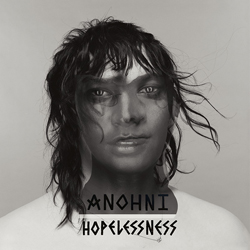
Anohni: Hopelessness
Album launch and Performance tour
Hopelessness is the new album by the singer, songwriter, visual artist, and activist Anohni. Formerly known as Antony Hegarty (from Antony and the Johnsons), she decided a few years ago to utterly transform the sound and message of her music. She not only renamed herself with what she calls her “spirit name,” but also embarked on a new artistic course. “Subjugation of women and of the Earth are one and the same,” “Kill the mother and appropriate her power.” Anohni expressed as talking about the foundations of Hopelessness. This relentlessly political album and utterly emotional performance is a testimony of her process.
Here, Anohni’s voice is as beautiful and deep as ever bringing drone warfare, environmental catastrophe, government surveillance and capital punishment, the personal is political, as radical feminists used to say. The album includes “Four Degrees,” a single released to coincide with the Paris climate conference, and is a stunning meditation on our complicity in global warming. During the performance, twenty women artists and activists such as Shirin Neshat, Lorraine O’Grady, and Nola Ngalangka Taylor joined her in spirit throughout the performance. Their projected moving lip synching portraits seem to embrace Anohni’s voice on stage.
In 2013, Anohni spent ten days living with the Martu of Parnngurr in the Western Australian Desert, and she has since campaigned against a proposed uranium mine on their ancestral land. In early June, she joined her Martu friends Nola and Curtis Taylor on a 180-kilometer protest walk from their remote community to the site of Mitsubishi and Cameco’s proposed open-cart uranium mine in the Western Australian Desert.
Hopelessness was launched at Park Avenue Armory in New York on May 18 and 19, followed by an international tour.
Affiliated Society News for July 2016
posted Jul 15, 2016
American Council for Southern Asian Art
The American Council for Southern Asian Art (ACSAA), along with the University of Michigan History of Art Visual Resources Collections and the Center for Art and Archaeology (CA&A) of the American Institute of Indian Studies in Gurgaon, India, is pleased to announce that over 12,000 low-resolution images (suitable for PowerPoint presentations), known collectively as the ACSAA Digital Images, are now newly available for free direct downloading for noncommercial, educational, and scholarly purposes through the Virtual Museum of Images and Sounds (VMIS). Funded by India’s Ministry of Culture, VMIS was recently created by using the image and sound archives of the CA&A and the Archives and Research Center for Ethnomusicology (ARCE)—the two centers of the AIIS.
The ACSAA Digital Images were first distributed under the aegis of the ACSAA Color Slide Project, a nonprofit initiative administered through the former Asian Art Archives of the University of Michigan that from 1974 through 2006 provided high-quality original and duplicate 35mm color slides of the art and architecture of India and greater South Asia, Southeast Asia, and Indonesia, as well as the Himalayan regions, to individuals and institutions around the world for teaching and research purposes. With this new iteration, the original project’s educational intentions have not only been maintained, but have now been expanded to make the images available on an even wider scale and without fee. The user simply needs to register (free of charge) on the VMIS website before the images can be downloaded (free of charge).
Arts Council of the African Studies Association
News from the Arts Council of the African Studies Association (ACASA) includes a call for nominations for the new ACASA Curatorial Awards, coming soon. The spring 2016 Newsletter has been published (available to subscribers only).
ACASA is also sponsoring two panels at the upcoming annual meetings of the African Studies Association and the College Art Association. At the African Studies Association annual meeting, to be held December 1–3, 2016, in Washington, DC, the group will present “Shattering Single Stories in the Labeling and Presentation of Historical Arts of Africa.” The cochairs are Susan Elizabeth Gagliardi of Emory University and Yaëlle Biro from the Metropolitan Museum of Art’s Department of the Arts of Africa, Oceania, and the Americas. The participants are: Silvia Forni, Royal Ontario Museum; Kathryn Gunsch, Museum of Fine Arts, Boston; Nanina Guyer, Hans Himmelheber Photographic Archives, Museum Rietberg Zurich; and Matthew Francis Rarey, Oberlin College. The discussant is Karen E. Milbourne from the Smithsonian Institution’s National Museum of African Art.
The deadline for the call for submissions to the ACASA-sponsored panel at CAA’s next Annual Conference, taking place February 15–18, 2017, in New York, is August 30, 2016. Titled “Flesh,” the session will be chaired by Shannen Hill of the Baltimore Museum of Art.
The call for submissions and the full panel description will be listed on CAA website on July 1. By August 30, interested parties should send a CV and abstract of no more than 500 words to Shannen Hill. All parties will be notified of the outcome by September 15.
Foundations in Art: Theory and Education
Foundations in Art: Theory and Education (FATE) has announced that the call for papers for its 2017 biennial conference, “To the Core and Beyond,” is now open.
Italian Art Society
In May, the Italian Art Society (IAS) sponsored two sessions titled “New Perspectives on Medieval Rome” at the International Congress on Medieval Studies in Kalamazoo, Michigan. Marius Hauknes (Johns Hopkins University) and Alison Locke Perchuk (California State University, Channel Islands) organized the panels. In August, IAS will sponsor two sessions at the Sixteenth Century Society and Conference (SCSC) meeting in Bruges, Belgium: “Co-petition: Testing the Boundaries of Cooperation and Competition,” organized by Alexis Culotta (American Academy of Art, Chicago); and “The Holy Republic of Venice,” organized by Allison Sherman (Queen’s University) and Eveline Baseggio Omiccioli (Fashion Institute of Technology, State University of New York). An IAS Conference Travel Grant for Emerging Scholars has been awarded to Tenley Bick (doctoral candidate, University of California, Los Angeles) to support travel to the recent meeting of the American Association for Italian Studies in Baton Rouge, Louisiana. IAS/Kress International Conference Travel Grants have been awarded to Alexis Culotta and Giada Damen (Morgan Library and Museum) to support travel to SCSC in Bruges. The seventh annual IAS/Kress Lecture took place on June 1 at the Villa I Tatti in Florence. An audience of nearly eighty listened raptly to the paper presented by Megan Holmes (University of Michigan), “New Perspectives on the Reception of Florentine Panel Painting: Interpreting Scratch Marks.”
National Council of Arts Administrators
The forty-fourth National Council of Arts Administrators (NCAA) annual gathering, “The Great Untapped: Unlocking Assets through Alliances,” will convene September 28–October 1, 2016, in Philadelphia, Pennsylvania. Please join NCAA at Temple University’s Tyler School of Art for a discussion considering how institutions are now challenged to reconcile their own particular histories with the development of experiential curricula that connect students to an infinitely expanding world. How does one honor deep institutional history while cultivating alliances with other scholarly and cultural traditions? How can we foster alliances with outside communities as equal partners, and move away from an aesthetics of display to an ethics of care and deep understanding? We invite current and aspiring art department chairs, directors, and deans to attend. Visit the website to learn more about the conference and to join NCAA
Public Art Dialogue
Public Art Dialogue (PAD) has news. The winter 2016 issue of the Public Art Dialogue Newsletter features an interview by Jennifer K. Favorite with Kirk Savage, the recipient of the 2016 PAD award for achievement in public art. Marissa Lerer contributed an essay, “Built and Open Walls,” on public art in Washington, DC. There are several forthcoming special issues of PAD: Public Art Dialogue. The first is “Higher Ed: College Campuses and Public Art,” which will be edited by Monika Burczyk (submission deadline: September 1, 2016). Cher Krause Knight and Harriet F. Senie are serving as coeditors for an open issue (submission deadline: March 1, 2017). A third issue will feature guest editors Silvia Bottinelli and Margherita d’Ayala Valva; the theme will be “Food as Activism in Contemporary Public Art” (submission deadline: June 1, 2017). For more information, see http://publicartdialogue.org/journal/submissions.
SECAC
SECAC’s annual meeting will be held October 19–22, 2016, in Roanoke, Virginia, with Virginia Tech serving as host. Kevin Concannon, director of the School of Visual Arts and professor of art history at Virginia Tech, will serve as conference director. Sessions will take place at the official conference hotel, the Hotel Roanoke and Conference Center. The Hotel Roanoke, added to the National Register of Historic Places in 1996, is in the heart of the city’s vibrant downtown and within easy walking distance of the Taubman Museum of Art, the Harrison Museum of African American Culture, and the O. Winston Link Museum, as well as many restaurants and bars. The conference schedule will be posted in early July on the SECAC website.
Excursions to Virginia Tech and Hollins University on Thursday and Friday evening include the 2015 Artist’s Fellowship exhibition opening, the 2016 SECAC Juried Exhibition, and the keynote speaker Lynn Hershman Leeson, who will present in the Moss Arts Center’s spectacular Snohetta-designed theater at Virginia Tech.
The last issue of the Southeastern College Art Conference Review has been published. The 2016 edition will be renamed Art Inquiries.
The deadline for the $5,000 SECAC 2016 Artist’s Fellowship is August 1, 2016. For application details, visit www.secacart.org/artists-fellowship.
Visual Resources Association
The Visual Resources Association (VRA) held its third joint conference with Art Libraries Society of North America (ARLIS/NA) in Seattle, Washington, this past March. The event offered an engaging and diverse program from ninety-five submitted paper or session proposals, resulting in thirty-nine sessions; fifteen submitted workshop proposals, resulting in six workshops; fifty-five submitted poster proposals, resulting in forty posters, and eleven SIG/SUG meetings. Topics included digital humanities, visual literacy, geospatial and visualization projects, image rights and reproductions, new technologies, museum education, environmental design, makerspaces, ebook publishing, materials education and research, diversity, RDF and LOD, crowdsourcing, cataloging, archives, visualization, and open access.
Key officers at the conference included VRA vice president for conference program, Chris Strasbaugh, as coordinator of the program and schedule in collaboration with Program Committee cochairs Dan McClure (ARLIS/NA), Denise Hattwig (ARLIS/NA), and Mar González Palacios (AASL, ARLIS/NA); VRA Education Committee cochairs Beth Wodnick Haas, Ryan Brubacher, and Marsha Taichman, who contributed toward programming; and the many presenters, instructors, and moderators who offered such timely, relevant, and forward-thinking content. The collaborative perspectives and working relationships of these individuals and many others set the tone for all conference planning and arrangements.
VRA honored Ann Whiteside with its Distinguished Service Award (she was also the recipient of the same award from ARLIS/NA) and conferred its Nancy DeLaurier Award to VRA Core 4.0 cocreators Kevin Esmé Cowles, Janice Eklund, Benjamin Kessler, and Trish Rose-Sandler. Sarah Bergmann, a design thinker and the founder of the Pollinator Pathway, spoke during convocation and shared perspectives on how the plight of the honey bee inspired her to consider symbiotic relationships and the importance of building pathways to support these relationships. While Bergmann’s consideration of bees inspired her to connect city dwellers to existing green spaces, her work inspired attendees to think about the benefits that might be realized when building connections across disciplines and professional organizations.
New in caa.reviews
posted Jul 15, 2016
Rachel Middleman visits Earth Machines at the Yerba Buena Center for the Arts. Featuring an international roster of artists, the exhibition reveals how “the local Silicon Valley high-tech industry propels a cycle of innovation and consumption that threatens to outstrip our ability to understand and manage its global, social, and environmental consequences.” Read the full review at caa.reviews.
Martha Lucy examines Gustave Caillebotte: The Painter’s Eye, an exhibition co-organized by the National Gallery of Art and the Kimbell Art Museum. Focusing on fifty canvases produced between 1875 and the early 1880s, the curators tease out “the unusual terms of Caillebotte’s modernity” and his relationship to Impressionism. Read the full review at caa.reviews.
Blair French reviews Billy Apple®: The Artist Has to Live Like Everybody Else, “one of the most significant survey exhibitions ever accorded a living New Zealand artist.” Hosted by the Auckland Art Gallery, the show gives “institutional and public recognition” to the “extraordinarily complex and comprehensive individual practice” of the Pop-Conceptual artist Billy Apple. Read the full review at caa.reviews.
Noriko Murai looks at Edwardian London through Japanese Eyes: The Art and Writings of Yoshio Markino, 1897–1915 by William S. Rodner. The first English-language scholarly monograph on Yoshio Makino, or “Markino,” a Japanese illustrator who lived in London during the early twentieth century, the book provides a “detailed and engaging account of Markino’s most productive years.” Read the full review at caa.reviews.
Caa.reviews publishes over 150 reviews each year. Founded in 1998, the site publishes timely scholarly and critical reviews of studies and projects in all areas and periods of art history, visual studies, and the fine arts, providing peer review for the disciplines served by the College Art Association. Publications and projects reviewed include books, articles, exhibitions, conferences, digital scholarship, and other works as appropriate. Read more reviews at caa.reviews.
Apply for a 2016 Wyeth Foundation Publishing Grant
posted Jul 14, 2016
CAA is accepting applications for the 2016 Wyeth Foundation for American Art Publication Grant program. Thanks to generous funding from the Wyeth Foundation for American Art, CAA awards publishing grants once a year to support book-length scholarly manuscripts in the history of American art and related subjects. For purposes of this program, “American art” is defined as art created in the United States, Canada, and Mexico. Books eligible for the Wyeth Grant have been accepted by a publisher on their merits but cannot be published in the most desirable form without a subsidy.
The publisher, not the author, must submit the application. Awards are made at the discretion of the jury and vary according to merit, need, and number of applications. Awardees are announced six to eight weeks after the deadline. For complete guidelines, application forms, and a grant description, please visit the Wyeth section of the CAA website. Deadline: September 15, 2016.
News from the Art and Academic Worlds
posted Jul 13, 2016
Each week CAA News publishes summaries of eight articles, published around the web, that CAA members may find interesting and useful in their professional and creative lives.
Academic Libraries and the Textbook Taboo: Time to Get Over It?
Librarians have allowed an unfortunate limitation of the print world to shape not only their behaviors but also their philosophy, to the point that many of us perceive excluding textbooks as a defining value of librarianship—not a service we regretfully forego because it’s not feasible, but a service we forego because “That’s not who we are as librarians.” (Read more from the Scholarly Kitchen.)
Textbooks in Academic Libraries: The Publisher’s Case
There is no precise and inarguable definition of a college textbook. Even the lines that define “college” are blurry: Do we mean elite, private schools like Harvard and Stanford; four-year state institutions; community colleges; the for-profit world; or MOOCs? The “college textbook,” in other words, is a slippery concept, and it is important to know exactly what someone means when uttering it. (Read more from the Scholarly Kitchen.)
When College Students Need Food Pantries More Than Textbooks
As a more racially and socioeconomically diverse body of students pursues college in the United States, schools find themselves responding to more requests to stock food pantries and hand out vouchers for supplies at campus bookstores. (Read more from the Atlantic.)
How the Art World Responded to AIDS
How artists grappled—and continue to grapple—with the epidemic is the focus of Art AIDS America, an exhibition at the Bronx Museum of the Arts. In some 120 works by close to one hundred artists, the show captures the rage, anguish, and overwhelming sense of loss that accompanied the epidemic at its height, along with the activism it sparked and its continuing reverberation through the culture. (Read more from the Wall Street Journal.)
The State: A Friend Indeed to Artists in Need?
Createquity imagines that a healthy arts ecosystem is one in which opportunities to make one’s living as an artist are distributed equitably across socioeconomic levels. Unfortunately, this is not the case in many Western countries, where research indicates that people of lesser means are not as equipped to take on the risk involved in pursuing a career in the arts. (Read more from Createquity.)
Wonders and Blunders: What Makes a Great Museum?
What makes a museum building successful? Until the arrival of Frank Gehry’s Guggenheim in Bilbao in 1997, this question may have exclusively focused on the best environments in which to view art. But the Guggenheim’s phenomenal success, which allowed the Basque government to recoup the construction costs within three years, moved the debate on to issues of branding and statement architecture. (Read more from the Art Newspaper.)
Five Time-Saving Strategies for the Flipped Classroom
I often hear comments like “The flipped classroom takes too much time,” “I don’t have time to devise so many new teaching strategies,” “It takes too much time to record and edit videos,” or “I don’t have time to cover everything on the syllabus.” I also hear “I tried to flip my class, but it was exhausting; so I quit.” If these comments sound familiar, it might be helpful to create margins in your flipped classroom. (Read more from Faculty Focus.)
Real Estate for the 1 Percent, with Art for the Masses
Richard Serra, a stickler about the differences between art and architecture, once described most public sculpture in urban architectural settings as “displaced, homeless, overblown objects that say, ‘We represent modern art.’” In twentieth-century New York, residential and commercial developments tended to marry architecture and art with that kind of ambivalence, if they married them at all: lobbies with a few pretty, unremarkable paintings; courtyards with pleasant design pieces; or plop art by sculptors whose work rarely showed up in the museums around town. (Read more from the New York Times.)
In the June 2016 Art Bulletin
posted Jul 12, 2016
 A grotesquely anthropomorphic hound standing on powerful back legs and blowing a stylized trumpet graces the cover of the June 2016 issue of The Art Bulletin. The etching is one of two dozen similar works by the early seventeenth-century artist Christopher Jamnitzer that Madeleine C. Viljoen explores in relation to early modern cosmography. The June issue also presents the first publication of an extraordinary eleventh-century enamel cup from a nomad’s grave in Ukraine, which Warren T. Woodfin examines in the context of other Middle Byzantine works with secular imagery. In addition, the issue features essays by David Young Kim on the multiple functions served by the carpets in Lorenzo Lotto’s paintings, and by Jean H. Duffy on issues of genre and perception in Jean Dubuffet’s mixed-genre spectacle Coucou Bazar. Shao Yiyang’s “Whither Art History?” essay reflects on the flourishing of art history in contemporary China.
The reviews section, with a theme of “Cosmopolitan Art Worlds,” includes six reviews of recent books on art in Renaissance Italy, late nineteenth-century Shanghai, turn-of-the-century Paris, modern India, contemporary Brazil and Japan, and twentieth-century Nigeria.
CAA sends print copies of The Art Bulletin to all institutional members and to those individuals who choose to receive the journal as a benefit of membership. The digital version at Taylor & Francis Online is currently available to all CAA individual members regardless of their subscription choice.
In the next issue of the quarterly journal, to be published in September, essays will consider Kongo visual and cultural practices in contemporary art, twelfth-century Chinese paintings of Buddhist rituals, the nineteenth-century perception of Watteau’s Pierrot character as forlorn, a brush-and-ink painting collectively created in the early People’s Republic of China, and intersections of global politics and imaging in the site-specific art of Walter De Maria. Four reviews will be presented under the rubric “Urban Images, Memories, and Fragments.”