CAA News Today
Affiliated Society News for May 2015
posted May 09, 2015
American Society for Aesthetics
The American Society for Aesthetics (ASA), an association for aesthetics, criticism, and theory of the arts, will mark the twenty-fifth anniversary of the founding of the ASA Feminist Caucus Committee with a full day of workshop discussions, followed by a celebratory reception, on Saturday, November 14, 2015. The Feminist Caucus Committee anniversary is part of the annual ASA conference, to be held November 11–14 at the Desoto Hilton in Savannah, Georgia. Noted scholars will discuss the evolution and contributions of feminist scholarship within philosophical aesthetics and the history of the ASA and its publication, The Journal of Aesthetics and Art Criticism. Topics will include: “Forty Years of Feminist Scholarship in Aesthetics,” “The Influence—Hidden or Otherwise—of Feminist Scholarship in Aesthetics,” and “Feminist Pedagogy and Curricula in Aesthetics.” For more information, please visit http://www.aesthetics-online.org/feminist/ or contact Peg Brand.
American Society of Hispanic Art Historical Studies
The American Society of Hispanic Art Historical Studies (ASHAHS) announced an award at its business meeting at the CAA Annual Conference in February 2015. The Eleanor Tufts Book Award, which recognizes an outstanding English-language publication in the area of Spanish or Portuguese art history, went to Glaire D. Anderson for The Islamic Villa in Early Medieval Iberia: Architecture and Court Culture in Umayyad Córdoba (Burlington, VT: Ashgate, 2013).
Art Libraries Society of North America
The Art Libraries Society of North America (ARLIS) met in Fort Worth, Texas, from March 19 through 23, 2015, for its forty-third annual conference. The conference’s theme, “New Frontiers on the Old Frontier,” allowed members to explore current and emergent interests in the art and visual-information profession. The society awarded the George M. Wittenborn Memorial Book Award to Arthur K. Wheelock Jr. of the National Gallery of Art for Dutch Paintings of the Seventeenth Century. The ARLIS/NA Distinguished Service Award was given to Daniel A. Starr, deputy chief librarian at the Metropolitan Museum of Art.
Read about incoming members of the executive board.
Association for Modern and Contemporary Art of the Arab World, Iran, and Turkey
The Association for Modern and Contemporary Art of the Arab World, Iran, and Turkey (AMCA) has awarded the 2015 Rhonda A. Saad Prize for Best Graduate Paper in Modern and Contemporary Arab Art to Christopher Barrie for “Myth and Mythology on the Nile: The Surrealism of Georges Henein and ‘Abd al-Hadi al-Gazar.” Barrie is a master’s degree student in Middle East politics at the School of Oriental and African Studies at the University of London. His paper analyzes the treatment of myth in the poetry of Henein and the visual art of al-Gazzar. The paper challenges understandings of al-Gazzar’s “Contemporary Art Group” as the first example of a purportedly authentic national Egyptian art and instead looks to analyze the dialogical interpenetration of the cosmopolitan and the local in al-Gazzar’s work.
Association of Academic Museums and Galleries
Save the date for next annual conference of the Association of Academic Museums and Galleries (AAMG) in Washington, DC: the weekend of May 20, 2016.
AAMG is in the process of compiling standards and documentation for Best Practices for University Museums and Collections. Once compiled, this can serve as a companion guide for accreditation as well as a resource for working within a parent institution. Please contact Barbara Rothermel, director of the Daura Gallery and assistant professor of museum studies at Lynchburg College, directly with documents, suggestions, or comments about practices with which you are most concerned.
Information about the AAMG Summer Leadership Seminar 2016 (rolling deadlines) is coming soon. Questions about the leadership seminar can be directed to David Robertson.
Association of Historians of Nineteenth-Century Art
During its 2015 Annual Conference, CAA presented Petra ten-Doesschate Chu, past president of the Association of Historians of Nineteenth-Century Art (AHNCA), board member at large, and managing editor of Nineteenth-Century Art Worldwide, with its 2015 Distinguished Teaching of Art History Award. Chu also received a certificate of appreciation from AHNCA’s membership for her organizational leadership and for the establishment of Nineteenth-Century Art Worldwide. Also at the CAA conference, AHNCA sponsored a two-part session entitled “What Is Realism?”and a shorter session on “Future Directions in Nineteenth-Century Art”; both were well attended. AHNCA’s major session for CAA’s 2016 conference will be “Between the Covers: The Question of Albums in the Nineteenth Century.”
During the AHNCA business meeting, Yvonne Weisberg extended her term as treasurer, but her successor must be in place by February 2016. Thus the organization now seeks nominations for the position; please send these via email to Peter Trippi, AHNCA president. Caterina Pierre also agreed to continue as newsletter editor.
AHNCA’s recent and upcoming activities include attending a Mellon lecture by Penelope Curtis, director of Tate Britain, at the Yale Center for British Art (April 23); a tour of the Pennsylvania Academy of the Fine Arts exhibition about artists’ gardens, with the curator Anna O. Marley (April 25); a tour of Sotheby’s nineteenth-century European art sale, with the expert Seth Armitage (May 1); and a visit to the Lowe Art Museum at the University of Miami with the museum’s director, Jill Deupi (May 12).
Historians of Islamic Art Association
The Historians of Islamic Art Association (HIAA) has announced the winners of its recent grant and essay competitions. Anna McSweeney, a senior teaching fellow in Islamic art and archaeology at SOAS, received a Grabar Fellowship to complete the research for her book, The Alhambra Cupola at the Museum für Islamische Kunst, Berlin.Natalia Di Pietrantonio, a doctoral candidate at Cornell University, was awarded a Grabar Travel Grant to deliver a paper at the 2015 Association of Art Historians conference at the University of East Anglia. Sugata Ray, assistant professor of art history at the University of California, Berkeley, received the 2014 Margaret B. Ševčenko Prize for his essay, “Shangri La: The Archive-Museum and the Spatial Topologies of Islamic Art History.” The Grabar Grants and Fellowships Program, which supports the scholarly activity and professional development of graduate students and postdoctoral scholars in Islamic art, was established in memory of Professor Oleg Grabar. The Ševčenko Prize, awarded annually for the best unpublished article written by a young scholar on any aspect of Islamic visual culture, honors the memory of Margaret Ševčenko, the longtime managing editor of Muqarnas: An Annual on the Visual Cultures of the Islamic World.
International Center of Medieval Art
The International Center of Medieval Art (ICMA) will present sessions and receptions at the fiftieth International Congress on Medieval Studies, to be held May 14–17, 2015, at Western Michigan University in Kalamazoo. Sessions presented by the organization include the “Cross in Medieval Art,” “Moving Women, Moving Objects,” and “Super Medieval! Visual Representations of ‘Medieval Superheroes.’” This last session is sponsored by the organization’s student committee. Two receptions are planned, one for all members and another for students.
International Sculpture Center
The International Sculpture Center will host the twenty-fifth International Sculpture Conference, “New Frontiers in Sculpture,” to be held November 4–7, 2015, in Phoenix, Arizona. The conference will feature panel discussions at Phoenix Art Museum and Arizona State University; special programming at Bollinger Atelier; optional trips to James Turrell’s Skyspaces and Cosanti, among others; gallery hops, the annual ISC members’ littleSCULPTURE show; and much more. Registration opens in June. For more information and to join the mailing list for updates, please visit www.sculpture.org/az2015.
Italian Art Society
The Italian Art Society (IAS) has announced information regarding the sixth annual IAS/Kress Lecture in Italy: Nino Zchomelidse of Johns Hopkins University will present her paper “Scena Sacra Scena–Tribuna Civica: Il ruolo dell’ambone nella Campania medievale” on May 20, 2015. The lecture will take place in the Dipartimento degli studi umanistici of the Università degli Studi di Napoli Federico II. The Emerging Scholars Committee of IAS has inaugurated a new mentoring program that will match established scholars with graduate students and junior scholars with similar interests.
On May 15, IAS will host three linked sessions on the topic “Civic Foundation Legends in Italian Art” at the 2015 International Congress on Medieval Studies, to be held at Western Michigan University in Kalamazoo. IAS will also sponsor a long session titled “Beyond Texts and Academies: Rethinking the Education of the Early Modern Italian Artist” at the next CAA Annual Conference, taking place February 3–6, 2016, in Washington, DC.
The deadline for IAS/KRESS travel grants for scholars undertaking transoceanic travel to the annual meeting of the Sixteenth Century Society and Conference in Vancouver is May 20, 2015. Please consider writing for the IASblog on any topic related to Italian art from prehistory to the present.
IAS has announced its new executive board: Sheryl E. Reiss, president; Anne Leader, executive vice president; Frances Gage, vice president for program coordination; Martha Dunkelman, treasurer and membership coordinator; and Sean Roberts, secretary.
Mid-America College Art Association
The School of Art in the College of Design, Art, Architecture, and Planning (DAAP) at the University of Cincinnati will host the biennial conference of the Mid-America College Art Association (MACAA), October 26–28, 2016. This follows the 2014 conference, “Mash Up,” which was hosted by the University of Texas at San Antonio. Jeffrey Adams, current MACAA president, and Kate Bonansinga, director of DAAP’s School of Art and site coordinator, are working with the MACAA board and DAAP faculty to develop ideas for sessions for the conference and a potential theme. Since the 1930s MACAA has provided a forum for artists/teachers of America to discuss and debate the issues of our profession, to share ideas and information of mutual benefit, and to affirm the friendships and collegiality that bind us together. The College of Design, Architecture, Art, and Planning at the University of Cincinnati has as its primary mission the creation of a better visual and design environment. Through excellence in educational programs, research, creative works, and service to the community, the faculty, the students, and administrative officers of DAAP are dedicated to achieve this mission.
National Art Education Association
The National Art Education Association (NAEA) invites you to participate in Summer Vision, joining a professional learning community and spending four days in America’s heartland or the nation’s capital exploring art, architecture, nature, and the museum as a work of art!
New Media Caucus
The New Media Caucus (NMC) has reported the results of its recent elections. The new board members are: Nadav Assor, assistant professor, Connecticut College; Rachel Clarke, associate professor, California State University, Sacramento; Renate Ferro, visiting assistant professor of art, Cornell University; Meredith Hoy, assistant professor, Arizona State University; Patrick Lichty, assistant professor, Columbia College Chicago; Jessye McDowell, assistant professor of art and exhibitions and lectures coordinator, Auburn University; Carlos Rosas, associate professor, Pennsylvania State University; Daniel Temkin, independent artist; and Stephanie Tripp, associate professor of communication, University of Tampa.
The newly elected officers are: Jim Jeffers, treasurer, assistant professor, Indian River State College; A. Bill Miller, chair, Communication Committee, assistant professor, University of Wisconsin, Whitewater; and Joyce Rudinsky, chair, Events Committee, associate professor, University of North Carolina.
These artists and scholars will be joining the following: Vagner Whitehead, president, associate professor, Oakland University; Mat Rappaport, secretary, associate professor, Columbia College Chicago; Pat Badani, editor-in-chief of Media-N Journal, independent artist and scholar; Victoria Bradbury, researcher at CRUMB, Sunderland, United Kingdom; Mina Cheon, interdisciplinary professor, Maryland Institute College of Art; Kevin Hamilton, associate professor, University of Illinois, Urbana-Champaign; Barbara Rauch, associate professor, Ontario College of Art and Design University, Toronto; Josua Selman, president, Artist Organized Art; and Jessica Westbrook, assistant professor, School of the Art Institute of Chicago.
Pacific Arts Association
The Pacific Arts Association-Europe conference will be held July 2–4, 2015, at the Museo de América in Madrid, Spain. The presentation of papers is open to any topic within the theme of “Recent Research in Pacific Arts.” Presentations can be either thirty minutes (twenty to twenty-five minutes of talk, five to ten minutes of discussion) or ten-minute reports on current exhibition projects or work in progress in museums or galleries. For more information, please contact adama@adamaamerica.com.
Pacific Arts Association-Pacific is calling for interest in its 2015 conference on “Trading Traditions: The Role of Art in the Pacific’s Expansive Exchange Networks,” to be held at the Fa’onelua Conference Centre in Nuku’alofa, Tonga, September 30–October 4, 2015. The conference theme examines the role art has played in the exchange of objects, peoples, technologies, and ideologies in the prehistoric, historic, or modern Pacific. It is not limited to “physical” exchanges but also addresses complex social, economic, and political arrangements and interactions among interconnected systems, structures, and peoples. For further information, please write to Karen Stevenson.
Public Art Dialogue
Public Art Dialogue (PAD) sponsored two sessions at CAA’s 2015 Annual Conference in New York. “Museums and Public Art: Coexistence or Collaboration,” chaired by Harriet Senie and Cher Krause Knight, featured papers by Kasia Ozga (“False Advertising? Public Art and Monographic Exhibitions”),Glenn Wallace (“‘Western Exposure’: The Contemporary Art Museum, Public Art, and the Global City”),Andrew Wasserman (“Sites of Counter Culture: Navigating a Future Bowery”), and Carole Anne Meehan(“Raising Expectations for the Public Sphere”). The artist Norie Sato chaired a second session, “Student Debt, Real Estate, and the Arts”; participating in the panel were Tom Finkelpearl, commissioner of New York City’s Department of Cultural Affairs and the artists Caroline Woolard and Paul Ramirez Jonas. Finkelpearl received the 2015 PAD award for achievement in the field of public art. This award recognizes an individual whose contributions have influenced public art practice.
Society for Photographic Education
Each spring, the Society for Photographic Education (SPE) hosts a forum for the presentation of artistic work and research to a community of peers. SPE has announced the call for proposals for “Constructed Realities,” the fifty-third national conference, to be held March 10–13, 2016, in Las Vegas, Nevada. SPE is accepting proposals for the 2016 conference with a submission deadline of June 1, 2015. Topics are not required to be theme-based and may include but are not limited to: image-making, history, contemporary theory and criticism, new technologies, effects of media and culture, educational issues, and funding. SPE membership is required to submit, and proposals are peer reviewed.
The presentation formats are:
- Graduate Student: short presentation of your own artistic work and a brief introduction to your graduate program
- Imagemaker: presentation of your own artistic work (photography, film, video, performance, installation, multidisciplinary approaches)
- Lecture: presentation of a historical topic, theory, or another artist’s work
- Panel: group led by a moderator to discuss a chosen topic
- Teaching: presentations, workshops, demos that address educational issues, including teaching resources and strategies; curricula to serve diverse artists and changing student populations; seeking promotion and tenure; avoiding burnout; and professional exchange
Please www.spenational.org for information on SPE membership and full proposal guidelines.
Society for the Study of Early Modern Women
The Society for the Study of Early Modern Women (SSEMW) has announced the following awards for 2014 at its annual meeting, held during the Sixteenth Century Society and Conference in New Orleans, Louisiana, last October:
- Best Book: Melinda S. Zook, Protestantism, Politics, and Women in Britain, 1660–1714 (Palgrave Macmillan, 2013)
- Honorable Mention: George McClure, Parlour Games and the Public Life of Women in Renaissance Italy (University of Toronto Press, 2013)
- Josephine Roberts Award for a Scholarly Edition: Barbara Torelli Benedetti, Partenia, a Pastoral Play, ed. and trans. Lisa Sampson and Barbara Burgess-Van Aken (Toronto, 2013)
- Best article: Diane Wolfthal, “Household Help: Early Modern Portraits of Female Servants,” Early Modern Women: An Interdisciplinary Journal 8 (2013): 5–52
- Best collaborative project: Noelia S. Cirnigliaro and John Beusterien, eds., Touching the Ground: Women’s Footwear in the Early Modern Hispanic World 14.2 (2013). Special issue of the Journal of Spanish Cultural Studies
- Honorable Mention: Anne J. Cruz and Maria Galli Stampino, eds., Early Modern Habsburg Women: Transnational Contexts, Cultural Conflicts, Dynastic Continuities (Burlington, VT: Ashgate, 2013)
- Best Translation: Pere Torrellas and Juan de Flores, Three Spanish Querelle Texts: “Grisel and Mirabella,” “The Slander against Women,” and “The Defense of Ladies against Slanderers,” ed. and trans. Emily Francomano (Toronto, 2013)
- Best Teaching Edition: Valerie Worth-Stylianou, ed. and trans., Pregnancy and Birth in Early Modern France: Treatises by Caring Physicians and Surgeons (1581–1625) (Toronto: Centre for Reformation and Renaissance Studies, 2013)
- Best Digital Scholarship, New Media, and Art Project: Caroline Bowden, principal investigator, 2012–13; James Kelly, project manager, 2012–13; along with Jan Broadway, David Horne, Katherine Keats-Rohan, and Michael Questier, coinvestigator and principal investigator, 2008–11), Who were the Nuns: A Prosopographical study of the English convents in exile 1600–1800
Society of Architectural Historians
The Society of Architectural Historians (SAH) is accepting abstracts for its sixty-ninth annual international conference in Pasadena and Los Angeles, California, April 6–10, 2016. Please submit abstracts by June 9, 2015, for one of the thirty-eight thematic sessions, the Graduate Student Lightning Talks, or the open sessions. The thematic sessions have been selected to cover topics across all time periods and architectural styles. SAH encourages submissions from architectural, landscape, and urban historians; museum curators; preservationists; independent scholars; architects; and members of SAH chapters and partner organizations.
SAH is accepting applications for the 2015 H. Allen Brooks Travelling Fellowship. The prestigious $50,000 fellowship allows a recent graduate or emerging scholar to study by travel for one year. The deadline to apply is October 1, 2015.
Registration is open for the 2015 SAH Field Seminar, “Architecture in the Rio de la Plata Basin: Between Tradition and Cosmopolitanism.” The seminar features a customized itinerary and includes visits to sites not open to the general public, supplemental lectures, and a significant educational component designed to enhance your experience of the region’s built environment.
Society of Historians of Eastern European, Eurasian and Russian Art and Architecture
The Society of Historians of Eastern European, Eurasian and Russian Art and Architecture (SHERA) seeks proposals of papers for its sponsored 2½-hour session, “Exploring Native Traditions in Eastern Europe, Russia, and Eurasia,” at CAA’s 2016 Annual Conference in Washington, DC. Within a broad historical and geographical framework of the region, which assimilated and reacted to a succession of cultures from Greek, Roman, and Byzantine to Mongol, Ottoman, and Soviet, the session seeks to balance the significance of international contacts and the experiences of artists who worked primarily in their native land. Artists expressed regional identities through distinctive themes and motifs in every art form; some made use of traditional techniques and designs, or represented provincial spaces, distinct ethnicities, and social customs. Papers may focus on individual artists or on broader institutional contexts that affected evolving concepts of regionalism and nationalism. The discussions might also address contemporary tensions surrounding regional and national identity. Interested contributors should see CAA’s 2016 Call for Participation and send proposals with other required materials to the session’s chair, Alison Hilton. The deadline for proposals is May 8, 2015.
Southeastern College Art Conference
The application for the 2015 Southeastern College Art Conference (SECAC) Artist’s Fellowship, which carries a $5,000 award, is August 1, 2015.
New directors to the Board of Directors were elected in February:
- Alabama: Wendy Deschene, Auburn University
- Kentucky: Boris Zakic, Georgetown College
- Louisiana: Jill Chancey, Nicholls State University
- North Carolina: Lawrence Jenkens, University of North Carolina at Greensboro
The new issue of the Southeastern College Art Conference Review (vol. 16, no. 4, 2014) is now available.
The next four conferences will take place:
- October 21–24, 2015: Pittsburgh, Pennsylvania
- October 19–22, 2016: Virginia Tech with Hollins University, in Roanoke, Virginia
- October 25–28, 2017: Columbus College of Art and Design, in Columbus, Ohio
- October 17–20, 2018: University of Alabama in Birmingham
Visual Resources Association
The Visual Resources Association (VRA) honored the recipients of the organization’s highest honors at a members and awards dinner on March 12, 2015, during the VRA’s thirty-third annual conference in Denver, Colorado. Maureen Burns of IMAGinED Consulting received the Distinguished Service Award for her contributions to visual resources and image management. Comments from Burns’s nominators and a description of her engagement with visual-resources advocacy, service to the profession, and long-term involvement with VRA and the VRA Foundation throughout her career can be found online. VRA presented the Nancy DeLaurier Award for distinguished achievement to the editors of Cataloging Cultural Objects (Chicago: American Library Association, 2006). The editors are: Murtha Baca, head of the Getty Digital Art History Access Program; Patricia Harpring, managing editor of the Getty Vocabulary Program; Eliza Lanzi, director of digital strategies and services at Smith College; Linda McRae, retired director of the Visual Resources Library at the University of South Florida; and Ann Baird Whiteside, librarian and assistant dean for information resources for the Graduate School of Design at Harvard University. The Nancy DeLaurier Award nomination and acceptance remarks by Patricia Harpring are available online. VRA publishes images and information about the awards presentation on its website.
Committee on Diversity Practices highlights for May/June 2015
posted May 09, 2015
CDP Highlights
The CAA Committee on Diversity Practices highlights exhibitions, events, and activities that support the development of global perspectives on art and visual culture and deepen our appreciation of political and cultural heterogeneity as educational and professional values. Current highlights are listed below; browse past highlights through links at the bottom of this page.
May/June 2015
Kahlil Joseph: Double Conscience
Museum of Contemporary Art
Los Angeles, California
March 20, 2015–August 16, 2015
“Kahlil Joseph: Double Conscience is MOCA’s presentation of Kahlil Joseph’s m.A.A.d, a double screen projection that is a lush portrait of contemporary Los Angeles. The camera sinuously glides through predominantly African American neighborhoods, pausing to capture quotidian moments—driving in a car, a marching band, the barbershop—that are suffused with creativity, joy, and sadness. The split screen divides the viewer’s attention, and alludes to the history of auteur cinema—a form of filmmaking pioneered by French director Jean Luc Godard—which sacrificed linear narrative for experimentation with the formal and political possibilities of filmmaking. m.A.A.d extends this tradition of formal experimentation by crossing the wires of music videos, amateur film footage, and moments of magical realism. The two-part projection may also slyly evoke philosopher W.E.B. Dubois’s early twentieth century concept of “double consciousness,” a psychological description of Black life in America. The film’s verbally dense and thick booming soundtrack, provided by hip-hop artist Kendrick Lamar, adds yet another layer to this prismatic account of contemporary life in Los Angeles.” (http://www.moca.org/museum/exhibitiondetail.php?&id=503)
More information: http://www.moca.org
UNDER THE MEXICAN SKY: Gabriel Figueroa—Art and Film
Museo El Barrio
New York, New York
March 4, 2015–June 27, 2015
“From the early 1930s through the early 1980s, the Mexican cinematographer Gabriel Figueroa (1907–1997) helped forge an evocative and enduring image of Mexico. Among the most important cinematographers of the Golden Age of Mexican Cinema, Figueroa worked with leading directors from Mexico, the United States and Europe, traversing a wide range of genres while maintaining his distinctive and vivid visual style.
In the 1930s, Figueroa was part of a vibrant community of artists in many media, including Diego Rivera, Jose Clemente Orozco, Edward Weston and Manuel Alvarez Bravo, who sought to convey the country’s transformation following the trauma of the Mexican Revolution. Later, he adapted his approach to the very different sensibilities of directors Luis Buñuel and John Huston, among others. Figueroa spoke of creating una imágen mexicana, a Mexican image. His films are an essential part of the network of appropriations, exchanges and reinterpretations that formed Mexican visual identity and visual culture in the mid-twentieth century and beyond.
The exhibition features film clips, paintings by Diego Rivera, Jose Clemente Orozco, Manuel Rodriguez Lozano and José Chavez Morado, photographs, prints, posters and documents, many of which are drawn from Figueroa’s archive, the Televisa Foundation collection, the collections of the Museo de la Estampa and the Museo Nacional in Mexico. In addition, the exhibition includes work by other artists and filmmakers from the period such as Luis Buñuel, Sergei Eisenstein, Edward Weston, and Tina Modotti that draw from the vast inventory of distinctly Mexican imagery associated with Figueroa’s cinematography or were heavily influenced by his vision.” (http://www.elmuseo.org/under-the-mexican-sky/)
More information: http://www.elmuseo.org
Imagining New Worlds: Wilfredo Lam, Jose Parla, Fahamu Pecou
High Museum of Art
Atlanta, Georgia
February 14, 2015–May 24, 2015
“Imagining New Worlds traces the lengthy career of Wifredo Lam (1902-1982), perhaps best remembered as a member of the Surrealist group in the 1940s. Born in Cuba to a Chinese father and mother of African and Spanish descent, Lam gave expression to his multiracial and cultural ancestry through a signature hybrid style of painting that blended Surrealism, magical realism, modernism, and postmodernism. The exhibition begins with the academic work made while studying painting in Madrid, and includes the fantastical mid-century canvases that incorporate figures from the syncretic religion Santéria. His work is informed by a cross-cultural fusion of influences such as Afro-Cuban symbolism and Negritude, a movement that rejected the French colonial framing of African identity.” (http://www.high.org/Art/Exhibitions/Imagining-New-Worlds.aspx)
More information: http://www.high.org
Kehinde Wiley: A New Republic
Brooklyn Museum of Art
Brooklyn, New York
February 20, 2015–May 24, 2015
“The works presented in Kehinde Wiley: A New Republicraise questions about race, gender, and the politics of representation by portraying contemporary African American men and women using the conventions of traditional European portraiture. The exhibition includes an overview of the artist’s prolific fourteen-year career and features sixty paintings and sculptures.
Wiley’s signature portraits of everyday men and women riff on specific paintings by Old Masters, replacing the European aristocrats depicted in those paintings with contemporary black subjects, drawing attention to the absence of African Americans from historical and cultural narratives. The subjects in Wiley’s paintings often wear sneakers, hoodies, and baseball caps, gear associated with hip-hop culture, and are set against contrasting ornate decorative backgrounds that evoke earlier eras and a range of cultures. Through the process of “street casting,” Wiley invites individuals, often strangers he encounters on the street, to sit for portraits. In this collaborative process, the model chooses a reproduction of a painting from a book and reenacts the pose of the painting’s figure. By inviting the subjects to select a work of art, Wiley gives them a measure of control over the way they’re portrayed. The exhibition includes a selection of Wiley’s World Stagepaintings, begun in 2006, in which he takes his street casting process to other countries, widening the scope of his collaboration. Kehinde Wiley: A New Republic is organized by Eugenie Tsai, John and Barbara Vogelstein Curator of Contemporary Art, Brooklyn Museum. A fully illustrated catalogue published by the Brooklyn Museum and DelMonico Books • Prestel accompanies the exhibition.” (http://www.brooklynmuseum.org/exhibitions/kehinde_wiley_new_republic/)
More information: http://www.brooklynmuseum.org/home.php
Diego Rivera and Frida Kahlo in Detroit
Detroit Institute of Arts
Detroit, Michigan
March 15, 2015–July 12, 2015
“Diego Rivera and Frida Kahlo were an explosive couple. He carried a pistol. She carried a flask. He romanticized Detroit. She rejected it. But what they shared was a belief in communism, a thirst for tequila and a passion for each other. Discover how they left their mark on Detroit. And how Detroit left its mark on their art. Exclusively on view at the Detroit Institute of Arts, Diego Rivera and Frida Kahlo in Detroit brings together nearly 70 works of art that depict the evolution of these two extraordinary artists’ careers, including eight of Rivera’s epic preparatory drawings for the Detroit Industry murals and 23 pieces by Kahlo, whose work has never before been shown at the DIA.” (http://www.dia.org/calendar/event.aspx?id=4608&iid=)
More information: http://www.dia.org
NEA Awards Seventh Consecutive Grant for ARTspace
posted May 08, 2015

CAA has been awarded a $15,000 grant from the National Endowment for the Arts (NEA) to support the next installment of ARTspace, taking place during the 2016 Annual Conference in Washington, DC. Spearheaded by CAA’s Services to Artists Committee, ARTspace is a forum for programming designed by artists for artists that is among the most vital and exciting aspects of the conference. Held at each Annual Conference since 2001, ARTspace is intended to reflect the current state of the visual arts and arts education.
ARTspace offers free program sessions and includes diverse activities such as the Annual Distinguished Artists’ Interviews (most recently with William Pope.L and Ursula von Rydingsvard in New York in February 2015); screenings of film, video, and multimedia works; live performances; and papers and presentations that facilitate a conversational yet professional exchange of ideas and practices designed to engage CAA’s artist members as well as the general public.
The grant, which is the NEA’s seventh consecutive award to CAA for ARTspace, will help fund programs such as ARTexchange, the popular open-portfolio exhibition for artists; the Distinguished Artists’ Interviews; and the Media Lounge, a space dedicated to curated programs of film, video, and multimedia work. ARTspace programming at the 2015 conference in New York included panels that explored the shifting landscape of the field, from “Surveillance as Art Practice” and “Art Collectives and the Contemporary World” to “Balancing Act: Art, Family, and Other Distractions” and “Imagining an Alternative School of Art.” You can explore all of the 2015 ARTspace programming on the conference website.
CAA’s 104th Annual Conference will take place February 3–6, 2016, in Washington, DC. Through grants to thousands of nonprofits each year, the NEA promotes opportunities for people in communities across America to experience the arts and exercise their creativity.
Image Caption
Jenny Schlenzka of MoMA PS 1 interviews the artist William Pope.L during ARTspace at the 2015 Annual Conference in New York (photograph by Bradley Marks)
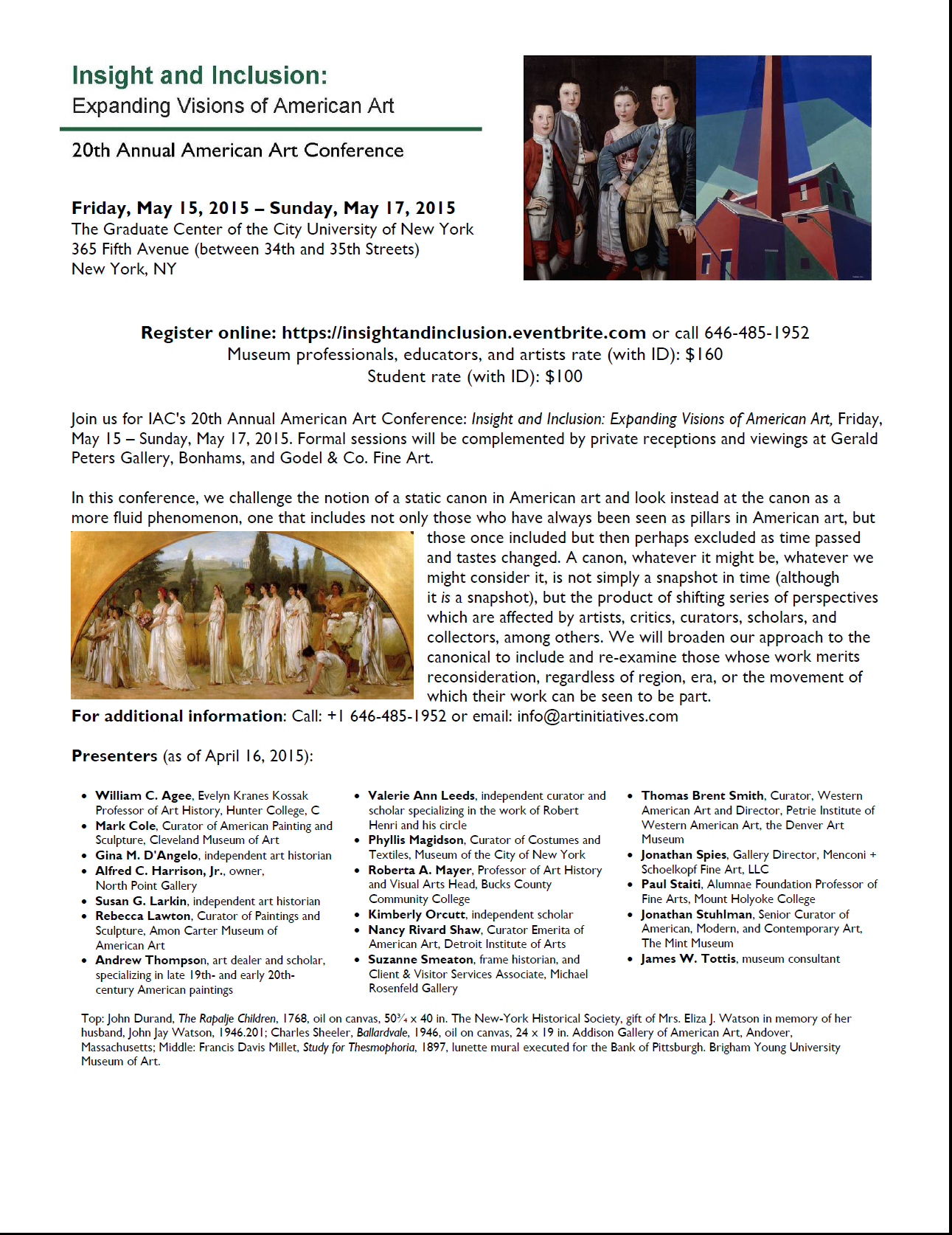
Insight and Inclusion: Expanding Visions of American Art
posted May 07, 2015
Initiatives in Art and Culture will present “Insight and Inclusion: Expanding Visions of American Art,” a conference on American art to be held May 15–17, 2015, at the Graduate Center, City University of New York.
News from the Art and Academic Worlds
posted May 06, 2015
Each week CAA News publishes summaries of eight articles, published around the web, that CAA members may find interesting and useful in their professional and creative lives.
QS World University Rankings by Subject 2015: Art and Design
Discover the world’s top universities for art and design, with the QS World University Rankings by Subject 2015. The rankings highlight the world’s top universities in thirty-six individual subjects, based on academic reputation, employer reputation, and research impact. (Read more from Top Universities.)
How to Get On with Artists, Handle Mergers, and Avoid Lawsuits
Museums collaborate with artists on projects such as exhibitions, artist residencies, commissions, and acquisitions. What should the contracts for these arrangements cover? When a museum commissions a work of art, it generally gets rights of first refusal to buy the work, to be credited in exhibitions, and to apply the commission fee to the purchase price, said John Thomas, a New York–based lawyer. (Read more from the Art Newspaper.)
Four Questions to Answer before Commissioning an Artist
A successful commission, like any transaction, depends on both parties. The artist must deliver the work to spec, and the collector, once engaged, must step back and let the artist create. This duality adds a layer of complexity to the already nuanced arena of art collecting. Here are four questions to answer before commissioning an artist to create an original work of art. (Read more from Forbes.)
What Is Being Learned from MOOCs? New Report Takes Stock
The hype around the free online courses called MOOCs has drawn millions of students, who are all essentially part of a teaching experiment of unprecedented scale. These days, researchers are increasingly checking in on that experiment. A new report, released last week, seeks to answer the question “Where is research on massive open online courses headed?” (Read more from Wired Campus.)
Recognizing Complicity
Here is where my description of T. J. Clark’s project in Farewell to an Idea ends and questions about its premises arise. If we understand modernism only through those works that despised it, those artists whose output stood in a negative or negating relation to it, then do we provide ourselves with an adequate assessment of what occurred and what role fine art has played in its complicities? What alternative is there to the consensual narratives that propose that the function of aesthetic work is the power and legitimacy of critique? (Read more from the Los Angeles Review of Books.)
The Object as Subject
The books in Bloomsbury Academic’s series Object Lessons are small-formatted volumes, well designed and well packaged, under 150 pages; they fit easily into the palm. They not only discuss everyday objects but they are handsome objects in their own right, which bespeaks their place in the current zeitgeist. They look like things one might want to collect and showcase. In their subject matter and their presentation they tap a fascination with objects, which is hardly new, but seems to be intensifying. Why? (Read more from the Chronicle Review.)
The Trouble with Collaboration
A few weeks ago, I terminated an eight-year-old collaboration with someone who had once been my professor. I was the lead author on the paper, having done all of the writing and analyses. My one-time professor was second author—he’d promised that with his edits and his name on the paper, we would get it in a top journal. Unfortunately, I finished a draft four years ago, and I’ve been waiting … and waiting … and waiting for his input ever since. (Read more from Vitae.)
Museums in Europe and US Draw Up Rescue Plans for Ravaged Sites in Iraq
European and American museums that preserve and display Assyrian artifacts from the ancient royal cities under attack by Islamic State are working to help their Iraqi colleagues prepare for a day when the sites are liberated. A coalition of the willing exists, but it remains to be seen whether institutions will coordinate their efforts. (Read more from the Art Newspaper.)
Fair Use in the Visual Arts: Detroit Happenings
posted May 06, 2015
The visual arts community is already putting the Code of Best Practices in Fair Use for the Visual Arts to work in Detroit. At a late-April meeting at the Cranbrook Art Museum, speakers showed fair use can enable work in five areas.
After a presentation on the Code by Janet Landay of the College Art Association and myself, a panel of experts explained why fair use matters to them:
Publishing. At Wayne State University Press, explained its director Jane Hoehner, fair use is essential to publishing work on film studies, one of the press’ major lines. Until now, the Society for Cinema and Media Studies code of best practices in fair use has been useful, but this new code opens more opportunities. The press does not depend on fair use for covers of the books, which function more like advertisements and are much harder to justify as a transformative use because of that.
Teaching. Diana Y. Ng, who teaches art history at University of Michigan-Dearborn, was pleased to see that current practice in her department agrees generally with the field’s consensus on using teaching materials. Fairly-used materials are, among other things, limited both to a particular course and to the students, teachers and staff in that course, and images are used at an appropriate resolution for teaching.
Art. Mark Newport, Artist-in-Residence and Head of the fiber department at the Cranbrook Academy of Art, recalled an earlier project in which he created an artwork incorporating a DC Comics character. His rationale for doing so fell squarely within the Code of Best Practices in Fair Use for the Visual Arts. But when DC Comics sent a letter asking him if he would like to license the work, he found himself having to take sole responsibility for his copyright choice. He hopes that the Code would provide guidance for institutions on what level of risk is involved in a fair use decision, since working within a field consensus generally significantly lowers the risk. “As an artist, I think you should use your fair use rights,” he said, “and be a problem for anyone who believes you should not.”
Collections. At the Henry Ford Museum, Nardina Mein, who manages the archives and library at the Benson Ford Research Center there, a number of policies encourage access to archival materials. Her museum provides digital access to some collections, and “the Code will help us tremendously with this work, especially in cases where we cannot find the copyright holders.”
Museums. Terry Segal, a registrar for the Detroit Institute of Arts, sees fair use as a way of expanding access and also streamlining work. She took heart from the simplicity of CAA’s fair use code. As someone who has spent a lot of time granting and getting permissions, she found the fact that fair use is so simple to execute heartening. “When we’re using fair use, we don’t have to worry about what all the rights in the piece are,” she noted.
Librarians, museum staff, scholars, artists, and teachers at the event seized upon copies of the Code to share with their colleagues. We look forward to stories of how the Code was received and used; stay in touch at nyoffice@colleageart.org.
Fair Use in the Visual Arts: The News Spreads
posted May 06, 2015
Since the Code of Best Practices in Fair Use for the Visual Arts launched in February, it has begun conversations in libraries, museums, archives, editorial offices, and classrooms. (Need a refresher on that code? Check out this video!) Now, it’s picking up fans.
The Society of Architectural Historians (SAH) and the Association of College and Research Libraries (ACRL) have just endorsed the Code and other organizations have also expressed their enthusiasm. The Association of Art Museum Directors (AAMD) sent a letter of support to CAA in February, as has the American Alliance of Museums (AAM), which also posted it on their resource page.
The Code’s facilitators have been busy with workshops and presentations at the San Francisco Art Institute, the Art Libraries Society of America annual conference in Dallas, a meeting of the Legal Issues in Museum Administration in Washington, D.C., the University of Chicago and Western Illinois University among others. The College Art Association has also sponsored several webinars, including a five-part series that continues into May.
If you’re interested in hosting an event on fair use in the visual arts, contact nyoffice@collegeart.org.
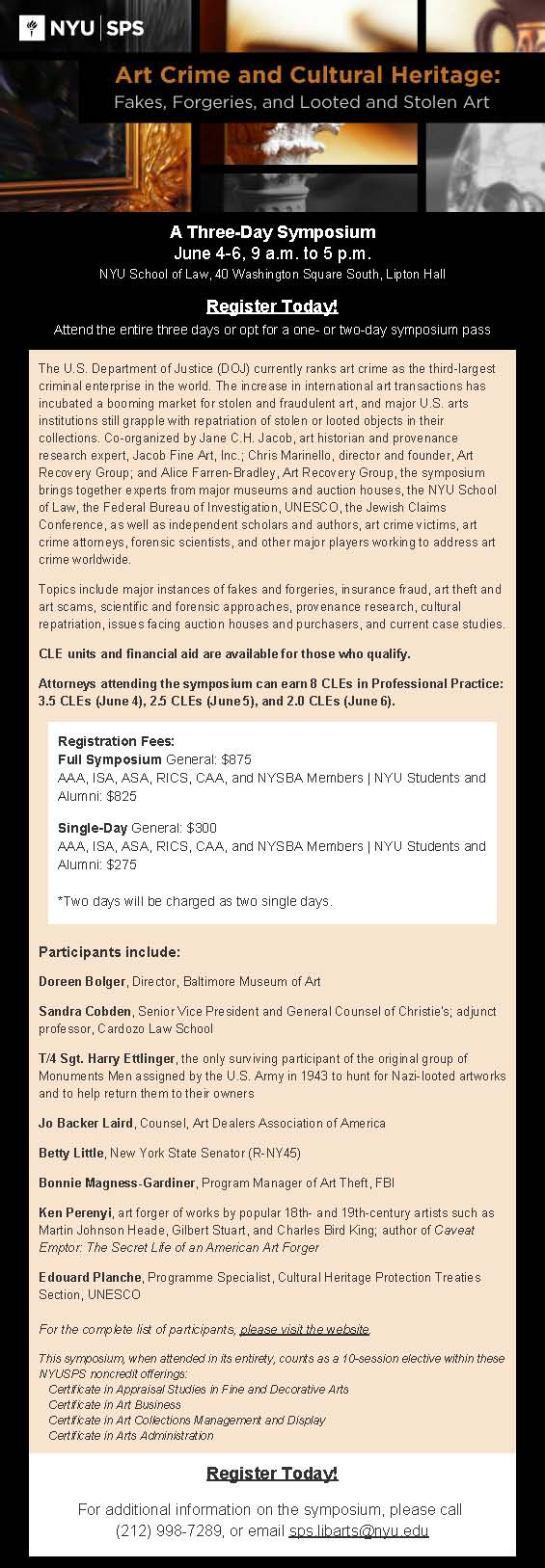
Art Crime and Cultural Heritage: Fakes, Forgeries, and Looted and Stolen Art
posted May 05, 2015
Artists’ Royalties Act Introduced by Nadler
posted Apr 29, 2015
Congressman Jerrold Nadler has reintroduced a revised bill, The American Royalties Too Act 2015, to provide royalties to visual artists whose work is resold and valued at over $5,000.
H. R. 1881
To amend title 17, United States Code, to secure the rights of visual artists to copyright, to provide for resale royalties, and for other purposes.
IN THE HOUSE OF REPRESENTATIVES
April 16, 2015
Mr. Nadler (for himself, Ms. Slaughter, Ms. Chu of California, Ms. Jackson Lee, Mr. Engel, Ms. Meng, Mr. Deutch, Ms. Schakowsky, and Mr. Pocan) introduced the following bill; which was referred to the Committee on the Judiciary
A BILL
To amend title 17, United States Code, to secure the rights of visual artists to copyright, to provide for resale royalties, and for other purposes.
Be it enacted by the Senate and House of Representatives of the United States of America in Congress assembled,
SECTION 1. Short title.
This Act may be cited as the “American Royalties Too Act of 2015”.
SEC. 2. Definitions.
Section 101 of title 17, United States Code, is amended—
(1) by inserting after the definition of “architectural work” the following:
(2) by inserting after the definition of “Pictorial, graphic, and sculptural works” the following:
(3) by inserting after the definition of “registration” the following:
(4) in the definition of “work of visual art”, by striking “A ‘work of visual art’ is—” and all that follows through “by the author.” and inserting the following: “A ‘work of visual art’ is a painting, drawing, print, sculpture, or photograph, existing either in the original embodiment or in a limited edition of 200 copies or fewer that bear the signature or other identifying mark of the author and are consecutively numbered by the author, or, in the case of a sculpture, in multiple cast, carved, or fabricated sculptures of 200 or fewer that are consecutively numbered by the author and bear the signature or other identifying mark of the author.”.
SEC. 3. Exclusive rights.
Section 106 of title 17, United States Code, is amended—
(1) by inserting “(a) In general.—” before “Subject to sections 107 through 122”;
(2) in paragraph (5), by striking “and” at the end;
(3) in paragraph (6), by striking the period at the end and inserting “; and”; and
(4) by adding at the end the following:
“(7) in the case of a work of visual art, to collect a royalty for the work if the work is sold by a person other than the author of the work for a price of not less than $5,000 as the result of an auction.
“(b) Collection of royalty.—
“(1) IN GENERAL.—The collection of a royalty under subsection (a)(7) shall be conducted in accordance with this subsection.
“(2) CALCULATION OF ROYALTY.—
“(A) IN GENERAL.—The royalty shall be an amount equal to the lesser of—
“(i) 5 percent of the price paid for the work of visual art; or
“(ii) $35,000.
“(B) ADJUSTMENT OF AMOUNT.—In 2016 and each year thereafter, the dollar amount described in subparagraph (A)(ii) shall be increased by an amount equal to the product of—
“(i) that dollar amount; and
“(ii) the cost-of-living adjustment determined under section 1(f)(3) of the Internal Revenue Code of 1986 for the year, determined by substituting ‘calender year 2016’ for ‘calendar year 1992’ in subparagraph (B) thereof.
“(3) COLLECTION OF ROYALTY.—
“(A) COLLECTION.—Not later than 90 days after the date on which the auction occurs, the entity that conducts the auction shall—
“(i) collect the royalty; and
“(ii) pay the royalty to a visual artists’ copyright collecting society.
“(B) DISTRIBUTION.—Not fewer than 4 times each year, the visual artists’ copyright collecting society shall distribute to the author or his or her successor as copyright owner an amount equal to the difference between—
“(i) the net royalty attributable to the sales of the author; and
“(ii) the reasonable administrative expenses of the collecting society as determined by regulations issued under section 701(b)(5).
“(4) FAILURE TO PAY ROYALTY.—Failure to pay a royalty provided for under this subsection shall—
“(A) constitute an infringement of copyright; and
“(B) be subject to—
“(i) the payment of statutory damages under section 504(c); and
“(ii) liability for payment of the full royalty due.
“(5) RIGHT TO COLLECT ROYALTY.—The right to collect a royalty under this subsection may not be sold, assigned, or waived except as provided in section 201.
“(6) ELIGIBILITY TO RECEIVE ROYALTY PAYMENT.—The royalty shall be paid to—
“(A) any author of a work of visual art—
“(i) who is a citizen of or domiciled in the United States;
“(ii) who is a citizen of or domiciled in a country that provides resale royalty rights; or
“(iii) whose work of visual art is first created in the United States or in a country that provides resale royalty rights; or
“(B) the successor as copyright owner of an author described in subparagraph (A).”.
SEC. 4. Notice of copyright.
Section 401 of title 17, United States Code, is amended by adding at the end the following:
“(e) Non-Applicability to works of visual art.—The provisions of this section shall not apply to a work of visual art.”.
SEC. 5. Copyright office.
Section 701(b) of title 17, United States Code, is amended by—
(1) redesignating paragraph (5) as paragraph (6); and
(2) inserting after paragraph (4) the following:
“(5) Issue regulations governing visual artists’ copyright collecting societies described in section 106, that—
“(A) establish a process by which an entity is determined to be and designated as a visual artists’ copyright collecting society, that—
“(i) requires that a visual artists’ copyright collecting society authorized to administer royalty collections and distributions under this title shall—
“(I) have prior experience in licensing the copyrights of authors of works of visual art in the United States; or
“(II) have been authorized by not fewer than 10,000 authors of works of visual art, either directly or through reciprocal agreements with foreign collecting societies, to license the rights granted under section 106; and
“(ii) prohibits an entity from being designated as a visual artists’ copyright collecting society if, during a period of not less than 5 years that begins after the date on which the entity is designated as a visual artists’ copyright collecting society, the entity does not distribute directly to each author, or to the successor as copyright owner of each author, the amount of the royalties required to be distributed under section 106(b)(3)(B);
“(B) determine a reasonable amount of administrative expenses that a visual artists’ copyright collecting society may deduct from the royalties payable to an author of a work of visual art under section 106(b)(3); and
“(C) establish a process by which—
“(i) not less frequently than annually, a visual artists’ copyright collecting society may request from any entity that conducts auctions a list of each work of visual art sold in those auctions that is by an author represented by the collecting society; and
“(ii) an author of a work of visual art may obtain from a visual artists’ copyright collecting society any information requested by the collecting society under clause (i) that relates to a sale of a work of visual art by the author, including the amount of any royalty paid to the collecting society on behalf of the author.”.
SEC. 6. Study required.
Not later than 5 years after the date of enactment of this Act, the Register of Copyrights shall—
(1) conduct a study on—
(A) the effects, if any, of the implementation of this Act, and the amendments made by this Act, on the art market in the United States; and
(B) whether the provisions of this Act, and the amendments made by this Act, should be expanded to cover dealers, galleries, or other professionals engaged in the sale of works of visual art; and
(2) submit to the Committee on the Judiciary of the Senate and the Committee on the Judiciary of the House of Representatives a report on the study described in paragraph (1), including any recommendations for legislation.
SEC. 7. Effective date.
This Act and the amendments made by this Act shall take effect on the date that is 1 year after the date of enactment of this Act.
News from the Art and Academic Worlds
posted Apr 29, 2015
Each week CAA News publishes summaries of eight articles, published around the web, that CAA members may find interesting and useful in their professional and creative lives.
Next Practices in Digital
Next Practices in Digital and Technology comprises forty-one examples of recent and ongoing digital initiatives designed by AAMD member museums. From social media and mobile apps, to in-gallery interpretation and behind-the-scenes collections management, Next Practices in Digital and Technology explores the ways museums are using technology to advance accessibility, scholarship, education, and audience engagement. (Read more from the Association of Art Museum Directors.)
Dear Artists, Stop Turning in Bad Grant Applications (Part 1)
Show of hands—how many of you who’ve applied for a grant or fellowship have turned in your application on the deadline day, right before the post office closed or the website shut down, after dashing off an unspellchecked artist’s statement and recruiting friends to write your reference letters the night before? (Read more from GrantSpace.)
Dear Artists, Stop Turning in Bad Grant Applications (Part 2)
When panelists are reading through the material, this is the only impression we have of you. Often, the judging is blind and sourced from out of town. If not, and a panelist has a conflict of interest, they have to state that up front and inform the organization and withdraw themselves from the conversation about your work. So, typically your work will be reviewed and assessed by strangers. (Read more from GrantSpace.)
Time to Change the Rules of Negotiation
It is job-offer season, and lately I’ve received an inordinate number of inquiries related to “negotiating while female.” In addition to the normal jitters that come with going back and forth on an offer, it seems lots of women have heard about the Nazareth College case and read the research that suggests they must play into gender stereotypes in order to secure competitive deals. For example, they have been told that they should make requests on behalf of others rather than themselves so as not to seem pushy or aggressive. (Read more from Vitae.)
Should Art Respond to Science? On This Evidence, the Answer Is Simple: No Way
Physics—it really does your head in. That seems to be the less-than-enlightening message the Japanese visual artist and composer Ryoji Ikeda took from a residency at CERN in Geneva. Ikeda’s installation Supersymmetry, staged in the darkened uppermost level of a multistory car park, is apparently what you get when you introduce an artist to the world’s most advanced particle research institute and its renowned Large Hadron Collider: a lot of sound and light, signifying nothing. (Read more from the Guardian.)
Competing or Complementing: Art Loss Databases Proliferate
Stolen art seems to be ubiquitous and difficult to track. It is relatively easy to ship and sell around the world, and can remain easily hidden for decades. The owner faces the conflict of wanting to publicize the loss widely, while also keeping their personal lives private. The development of databases to record losses was first preceded by newsletter alerts of stolen art that proliferated in the arts community to halt sales with questionable provenance. (Read more from the Center for Art Law.)
Three Quarters of New Collectors Buy Art Online for Investment, Study Finds
Collectors who buy art online are increasingly doing it for investment, according to a report released by the fine-art insurance company Hiscox. As many as 63 percent are driven by the value potential of works of art, with 75 percent of new buyers saying they buy art for investment. However, 93 percent of respondents say they collect for passion. Robert Read, the head of fine art at Hiscox, says rapid growth in the contemporary art market, coupled with a lack of options in other markets, is enticing people to “get on the art ladder.” (Read more from the Art Newspaper.)
Tax Break Used by Investors in Flipping Art Faces Scrutiny
Introduced in the 1920s to ease the tax burden of farmers who wanted to swap property, it soon became a tool for real-estate investors flipping, say, office buildings for shopping malls. Now, this little-known provision in the tax code, known as a like-kind exchange, has become a popular tactic for a new niche of investors: buyers of high-end art who want to put off—and sometimes completely avoid—federal taxes when upgrading their Diebenkorns for Rothkos. (Read more from the New York Times.)