CAA News Today
CAA Publishes Fair Use Issues Report
posted Jan 29, 2014
 CAA is pleased to announce the publication of Copyright, Permissions and Fair Use among Visual Artists and the Academic and Museum Visual Arts Communities: An Issues Report. Endorsed by CAA’s Board of Directors on January 24, 2014, the report is now available on CAA’s website (here) and will also be distributed in printed form at the upcoming Annual Conference in Chicago. The report was written by Patricia Aufderheide and Peter Jaszi, professors of communications and law, respectively, at American University; and graduate fellows Bryan Bello and Tijana Milosevic. Aufderheide and Jaszi are the project’s lead researchers and two of its principal investigators. Their report summarizes 100 interviews of art historians, artists, museum curators, editors and publishers describing issues related to the use of third-party images in creative and scholarly work. The research was further informed by a CAA membership survey on fair use and a review of relevant literature and legal precedents.
This issues report reveals a situation in which uncertainty about copyright law and the availability of fair use, particularly in the digital era, has made many practitioners risk-averse, too often abandoning or distorting projects due to real or perceived challenges in using copyrighted materials. The report was read by the project’s Principal Investigators, Project Advisors, and members of the CAA Task Force on Fair Use, its Committee on Intellectual Property, and a Community Practices Advisory Committee. A full list of these individuals appears as an appendix in the report.
By identifying key concerns, the Issues Report makes an important contribution toward addressing questions related to the use of copyrighted materials and the understanding of fair use principles. It represents an important step in CAA’s work to develop and disseminate a Code of Best Practices for Fair Use in the Creation and Curation of Artworks and Scholarly Publishing in the Visual Arts. Over the coming year, CAA will host small group discussions in five cities (Chicago, Dallas, Los Angeles, New York and Washington, D.C.) among visual arts professionals, guided by Professors Aufderheide and Jaszi, to identify areas of consensus in how fair use can be employed. These deliberations will undergird the development of a code of best practices, which will be reviewed by the project’s Principal Investigators, Project Advisors, members of the CAA Task Force on Fair Use, its Committee on Intellectual Property, and a Legal Advisory Committee. Once finalized, it will be presented to the CAA Board of Directors for approval and widely disseminated.
During CAA’s 102nd Annual Conference in Chicago (February 12–15, 2014), Aufderheide and Jaszi will discuss this project publicly with Anne Collins Goodyear, CAA president; Jeffrey Cunard, co-chair of CAA’s Task Force on Fair Use; Christine Sundt, chair of CAA’s Committee on Intellectual Property (CIP), and Paul Catanese, associate chair and associate professor in the Department of Interdisciplinary Arts at Columbia College and chair of CAA’s New Media Caucus. The session will take place on Saturday, February 15, from 12:30 to 2:00 p.m. at the Hilton Chicago.
CAA’s Fair Use Initiative is supported by a major grant from the Andrew W. Mellon Foundation. It also received generous preliminary funding from the Samuel H. Kress Foundation.
News from the Art and Academic Worlds
posted Jan 29, 2014
Each week CAA News publishes summaries of eight articles, published around the web, that CAA members may find interesting and useful in their professional and creative lives.
Snyder Pledges $350 Million to Save Detroit Pensions and DIA Artwork, but Hurdles Remain
A settlement of Detroit’s bankruptcy that would protect city retirees and the Detroit Institute of Arts’s collection appeared closer after Michigan governor Rick Snyder pledged $350 million to a growing rescue fund designed to bring all the major parties together in a grand resolution. US Bankruptcy Judge Steven Rhodes also put his weight behind a grand bargain, saying in a separate hearing that he might not allow DIA artwork ever to be sold to satisfy city debts. (Read more from the Detroit Free Press.)
Where Are the Girls? Jemima Kirke on Women in Art
Jemima Kirke of television show Girls discusses how women have always made art, even if they’ve been absent from the history books and gallery walls. This short film made by the Tate investigates the role of women as makers, not just muses—from Lee Miller to the Guerrilla Girls. (Read more from the Guardian.)
Congress Takes Note
It’s time for Congress to pay attention to the abuse of adjunct faculty members, and the way their poor working conditions impact not only them but also their students, says a new report from the House Education and the Workforce Committee. While the report largely endorses previous studies on the subject, “The Just-In-Time Professor” document marks the first time Congress has so formally acknowledged a situation that adjunct activists have long deemed exploitative. (Read more from Inside Higher Ed.)
Class Divide on Campus: Adjunct Professors Fight for Better Pay and Benefits
Marcia Newfield and Rosalind Petchesky are both professors at the City University of New York. They both have advanced degrees. They both have been teaching for decades and are in their seventies. But there’s a big difference between the two: Petchesky is a distinguished professor, and Newfield is an adjunct. That means Newfield makes a fraction of what Petchesky makes. (Read more from NBC News.)
Why Buy the Cow? An Open Letter to the Full-Time Faculty of American Colleges and Universities
It is Saturday night, and as I write this, my young son sleeps; there is a stack of at least 140 papers stuffed into my Jane Eyre tote bag—the seams that cinch the handles to the bag are loosening, and will probably rip before I administer my last final in December. I bought it just this August, but as an adjunct professor this semester, I’m teaching twenty-two credits at three separate colleges. (Read more from I Will Start This Blog. I Mean It!)
Smartphones in the Classroom? Let Students Decide
Should students be allowed to use personal technology in the classroom? That’s a contentious issue for many instructors, myself included. Concerns about distraction—web surfing, Facebook checking, Scrabble playing—may prompt instructors to adopt policies that ban students from using laptops, tablets, and smartphones in class. Understandably so. (Read more from Vitae.)
The Myth of the Tortured Artist
No one blinked an eye when John Malkovich stooped to do Transformers 2. Jimi Hendrix’s reputation as a rock god hasn’t suffered for having been a session guitarist for the Isley Brothers. If your child opened a lemonade stand on the sidewalk you’d probably praise his enterprising spirit. So why is it so odious to some in the art world when an artist tries to make a little coin for himself? (Read more from the Daily Beast.)
The Fate of Sculptures at Museums around the World
Neil MacGregor and Thomas Campbell, the directors, respectively, of the British Museum and the Metropolitan Museum of Art, will now be able to make arrangements for the first two stops in the planned international tour of plum Burrell Collection works to help raise £45 million to repair and refurbish the Burrell Collection building, the roof of which has been left leaking for decades. The desultory nondebate took place during an international spate of damaged sculptures. (Read more from ArtWatch UK.)
In the Media Lounge: Uncommon/Commons
posted Jan 28, 2014
 This year’s Media Lounge at the Annual Conference will present Uncommon/Commons, a hybrid media art and research project conceived by the interdisciplinary artist Jenny Marketou and realized with the assistance of Nathanael Bassett, a media researcher and producer.
The goal of the collective project is to invite artists, researchers, writers, scholars, and activists to unpack ambiguous vocabularies and new forms for representation in contemporary art. The participants will all respond to those forms by using social media, public conversations, workshops, and video screenings and by creating hybrid and real events—with the aim to engage public discourse as a social sculpture—that underline not only points of commonality among disciplines but also differences. The artists and curators hope that Uncommon/Commons will be an opportunity to connect Chicago’s artists, activists, academics, and grassroots groups to engender conversations and connections that are important to our civic landscape.
As part of ARTspace, Uncommon/Commons will take place February 12–15, 2014, in the Hilton Chicago’s Joliet Room during the CAA Annual Conference. This is the first year in which the Media Lounge has its own dedicated space with a full program of events. If you cannot attend the conference, watch the Uncommon/Commons live stream and follow the activities on Twitter.
 Uncommon/Commons will be an incubator for sharing skills and knowledge, responding to themes of the commons and “communing.” One highlight of the event will be a series of workshops whose topics include: “Environmental Justice: A Civic Science for the Public Realm,” facilitated by Liz Barry; “Wages for Facebook,” led by Laurel Ptak; “Autonets Convergence Chicago: Hackathon for Technologists and Antiviolence Activists,” organized by Micha Cardenas; and “Public Offering and COMMON CAPTURE: Keyhole Excavations in Media Archeology,” spearheaded by Alexis Bhagat.
Uncommon/Commons will also feature two programs of film and video screenings, titled “We refuse their fabulous lies” and “Invalid data – dreaming through the gaps.” A public discussion between the screenings’ two curators, Jenny Marketou and Abina Manning, director of Video Data Bank at the School of the Art Institute of Chicago, will take place after the programs, followed by Q&A with the audience. Additional one-time screenings in the Media Lounge will include Oliver Ressler’s Take The Square, Rania and Raed Rafei’s 974, and Marketou’s Looking Out of My Window.
Image Captions
First: Rosa Barba (Germany/Sweden), Outwardly from Earth’s Center, 2007.
Second: Workshop during the XFR STN project at the New Museum of Contemporary Art in New York in 2013 (photograph by Tara Hart and provided by the New Museum).
Digital Media Art Preservation Project Questionnaire
posted Jan 24, 2014
CAA invites members to participate in a digital media art preservation project currently underway at Cornell University in Ithaca, New York. This project aims to develop scalable preservation strategies for complex, interactive, born-digital media artworks using the collections of Cornell’s Rose Goldsen Archive of New Media Art as a test bed.
In developing a preservation framework that will address the needs of the broadest range of archive users, Cornell seeks the input of artists, researchers, educators, curators, and others who work with interactive digital artworks and artifacts. Would you please take a few minutes to respond to this questionnaire about your practices? Depending on your responses, the survey should take approximately ten to twenty-five minutes to complete.
Information about questionnaire results will be published and made available to the broader media archives community. Read more about this preservation initiative here or contact Madeleine Casad, associate curator and Rose Goldsen Archive of New Media Art Curator for Digital Scholarship for the Cornell University Library, for more information.
Conference Hotel Reservations at the Palmer House
posted Jan 24, 2014
If you are planning to attend CAA’s 102nd Annual Conference in Chicago, taking place February 12–15, 2014, and have not yet made your hotel reservations, CAA is offering discounted room rates for conference attendees. While the Hilton Chicago is sold, out, CAA has arranged an overflow block of discounted rooms at the Palmer House.
It is strongly encouraged that you book your stay at one of the official conference hotels. CAA commits to a block of rooms at these hotels on behalf of its members and has a financial obligation to fill those blocks. Please help us to avoid potential penalties and control costs for future events by staying at the official conference hotels.
Palmer House
17 East Monroe Street
Chicago, IL 60603 (Map)
312-726-7500
Reservations: 877-865-5321

Overflow Block
CAA has setup an overflow block of discounted rooms at the Palmer House. Please use the group code “CAO” to receive the special discount.
| Discount Rates: | |
| Single | $149 |
| Double | $149 |
| Triple | $179 |
| Quad | $209 |

Student Block
A discounted block of rooms has also been set aside at this hotel exclusively for students. A VALID STUDENT IDENTIFICATION CARD WILL BE REQUIRED AT CHECK IN.
| Student Rates: | |
| Single | $120 |
| Double | $120 |
| Additional Person: | $30 each |
Directions to Hilton Chicago
The Palmer House is about a fifteen minute walk to the Hilton Chicago. As an alternative, take the #6 bus at State and Monroe Streets five stops to Balbo and Michigan. Walk east on Balbo to Michigan. Or, take the red line at Monroe-Red (State and Monroe Streets) two stops to Harrison. Walk one block south to Balbo, then east on Balbo to Michigan.
Join a Live Video Chat and Q&A about CAA’s Annual Conference
posted Jan 23, 2014
Join CAA this Monday for a live video chat and Q&A about the upcoming Annual Conference in Chicago.
WHEN: Monday, January 27, 2014, 3:00 PM (EST)
WHERE: RSVP and watch online here
Want to learn the ins and outs of CAA’s 102nd Annual Conference in advance so you can make the most of the four-day event? Join us online this Monday for a live, interactive Google+ Hangout to get practical tips and advice, as well as answers to all your questions! Whether you’re a job seeker, a first-time attendee, or still trying to decide whether to attend, this event will be a valuable resource for anyone hoping to learn more about the Chicago conference.
In addition to covering the basics of how to register and navigate the conference, this Hangout will cover many frequently asked questions, including:
- How do I choose among the hundreds of great sessions and events?
- What resources are available for students and emerging professionals?
- What’s the best way to make new professional contacts?
- What is the dress code? What do I need to bring with me?
- What are this year’s “can’t miss” events and sessions?
- How can the free mobile app and social media enhance my experience?
Submit your questions in advance to conferenceqs@collegeart.org or on Twitter with the hashtag #CAAConferenceQ.
The presenters will be:
- Emmanuel Lemakis, Director of Programs, CAA
- Lauren Stark, Manager of Programs and Archivist, CAA
- Paul B. Jaskot, Professor, Art History, DePaul University; Past President, CAA
- Jacqueline Francis, Professor, Visual and Critical Studies, Painting and Drawing, California College of the Arts; Vice President for Annual Conference, CAA
- Sabina Ott, Professor, Fine Art, Columbia College Chicago; Board of Directors, CAA
- Laurel O. Peterson, Doctoral Candidate, History of Art, Yale University
Not free on Monday? Don’t worry! The conversation will be archived on CAA’s YouTube page, where you can also watch our last Hangout on CAA’s publishing grant program.
News from the Art and Academic Worlds
posted Jan 22, 2014
Each week CAA News publishes summaries of eight articles, published around the web, that CAA members may find interesting and useful in their professional and creative lives.
Twelve Things You Should Never Say to an Artist
One of the hardest parts of being an artist is courting the seemingly endless barrage of awkward, inappropriate, and downright rude comments hurled your way. Whether it’s an intended compliment or an ignorant gaffe, some statements about l’arte are better left unsaid. Thus we’ve compiled an unofficial guide outlining what you definitely, positively should not say to an artist, whether friend or foe. (Read more from the Huffington Post.)
Teaching Students How To See
“A college is a great context for getting at the things that are life changing and transformative about art,” says Ian Berry, director of the Frances Young Tang Teaching Museum and Art Gallery at Skidmore College in Saratoga Springs, New York. “You’re working with undergraduates who are figuring out who they’re going to be, learning how to be critical consumers of information, deciding what kind of tribe they’re going to land in.” Berry has dedicated his entire career to the fertile ground of college museums. (Read more from ARTnews.)
Bringing the Museum into the Art-History Classroom
Most art-history instructors include a museum visit or two in the semester schedule. But what if a museum or gallery visit is difficult to arrange, depending upon the geographic location of the college or university, the class size, or the time the class is offered? Even though I have access to numerous museums because I teach in New York City, I found that some of these challenges prohibited my students in engaging with the museum in what I considered to be a meaningful way. (Read more from Art History Teaching Resources.)
Thousands of Years of Visual Culture Made Free through Wellcome Images
Wellcome Library has announced that over 100,000 high-resolution images—including manuscripts, paintings, etchings, early photography, and advertisements—are now freely available through Wellcome Images. Drawn from vast historical holdings, the images are being released under the Creative Commons Attribution (CC-BY) license, which means that they can be used for commercial or personal purposes, with an acknowledgement of the original source, free of charge. (Read more from the Wellcome Library.)
DIA May Be Asked to Ante Up $100 Million to Break Free from City
Detroit’s emergency manager Kevyn Orr met with Detroit Institute of Arts leaders for the first time last week and told them they may have to make a substantial contribution to a fund that would provide hundreds of millions for city pensioners and protect DIA art from being sold as part of the city’s bankruptcy, according to a person familiar with Orr’s plans. Orr did not push for a specific figure, but the city believes $100 million over twenty years “is a number the DIA can get to,” the source said. Museum leaders said that figure was “completely unfeasible.” (Read more from the Detroit Free Press.)
Agreement Reached in Plagiarism Row between Artists
A wall-sized, black-and-white checkerboard work by Tobias Rehberger, commissioned by the Berlin national library but concealed for almost year because of a complaint brought by the British Op art painter Bridget Riley, will again go on show. The piece was at the center of a legal row between Rehberger and Riley, who said it plagiarized her painting Movement of Squares (1961) and demanded it be removed from display in the library’s reading room. Rehberger argued that the checkerboard pattern was part of the public domain. (Read more from the Art Newspaper.)
The Odds Are Never in Your Favor
The academic job market is a process that necessitates failure. Your application materials will end up in the slush pile at dozens of departments, regardless of how well suited you are for the position or how carefully you tailor your materials. Outstanding candidates can easily fail to find a position. And that’s why, when I can’t quite convey that grim reality, I tell my family and friends that if they want to know what the job market is like for PhDs, they should read (or watch) The Hunger Games. (Read more from the Chronicle of Higher Education.)
Crowded Out of Ivory Tower, Adjuncts See a Life Less Lofty
His students call him “Prof,” and in the classroom James D. Hoff looks like any other English professor. He is sandy-haired and bearded, with a passion for modern American poetry, and has published essays on Ezra Pound and Laura Riding and is able to forget his worries amid the joys of helping young people discover the power of literature. But his anxieties always come back. At night, he sometimes lies sleepless in the dark, wondering how long he will be able to afford the academic life. (Read more from the New York Times.)
Joseph Anthony “Joe” Gatto: In Memoriam
posted Jan 17, 2014
Joseph Anthony “Joe” Gatto, a noted jewelry artist and the founding visual-art dean of the Los Angeles County High School for the Arts, died on November 13, 2013. He was 78 years old.
Born on December 22, 1934, in Pueblo, Colorado, Gatto was the son of immigrants. His father was a shoveler in the steel industry, and his mother was a garment worker. The family moved west, and Gatto attended Fairfax High School in Los Angeles, California, where he aspired to attend college. He worked bagging groceries, studied, and lettered in four sports. After military service at Fort Lewis, Washington, he attended California State University, Los Angeles, and Pepperdine University in Malibu, where he earned a bachelor’s and master’s degrees in art and education. Gatto was the first in his family to graduate from college and earn advanced degrees.
An award-winning jewelry artist, painter, photographer, and author of several books on teaching art, Gatto cofounded the Los Angeles County High School for the Arts (LACHSA), where he was visual-arts dean from 1985 to 2002. He was a recipient of the California “Bravo” Teacher of the Year Award and was honored at the White House by both Presidents Ronald Reagan and George W. Bush. Always active in his church and community, Gatto supported the parish and school at Our Mother of Good Counsel Church and participated in local politics. In 2004 he fulfilled a lifelong dream, serving as delegate to the Democratic National Convention.

Joe Gatto, Nesting Bird 3, gold, coral, pearl, and found objects (artwork © Joe Gatto)
After retiring from LACHSA, Gatto continued to teach figure drawing and art-education courses at Art Center College of Design in Pasadena, California. He exhibited and gained national acclaim for his finely crafted art jewelry shown under his brand Wear Art Now. A dedicated father and grandfather, avid gardener, collector, and world traveler, Gatto lived life to its fullest while he nurtured the creative lives of others.
Gatto is survived by brothers Don and Frank, his daughter Nicole and her husband Mark, his son Mike and his wife Danielle, his daughter Mariann and her fiancé Eric, his grandchildren Damian, Elliana, and Evangelina, and his former wife Isolde, plus countless cousins, admiring students, and loving friends.
Memorial services were held on November 22, 2013, in Los Angeles, with hundreds in attendance. The Los Angeles Police Department is continuing its investigation into Gatto’s untimely death. Donations in his memory can be made to one of his favorite charities: (1) Historic Italian Hall Foundation, 125 Paseo De la Plaza, Suite 400, Los Angeles, CA 90012; (2) Los Angeles Community Garden Council, 4470 West Sunset Boulevard, No. 381, Los Angeles, CA 90027; or (3) Tuition Magician, Joe Gatto Arts Scholarship, 4470 West Sunset Boulevard, PMB 378, Los Angeles, CA 90027.
Donald F. McCallum: In Memoriam
posted Jan 17, 2014
Sherry Fowler is associate professor of Japanese art history at the University of Kansas. She earned her doctorate from the University of California, Los Angeles, in 1994.

Donald F. McCallum
Donald F. McCallum, a celebrated art historian and treasured teacher, passed away peacefully in his home on October 23, 2013, after battling sudden metastatic prostate cancer. He was 74 years old.
McCallum had a long distinguished career as a scholar of Japanese art history, over seven years of which were spent doing research and fieldwork in Japan. In June 2013, he retired from his position as professor in the Department of Art History at the University of California, Los Angeles (UCLA). He was a beloved teacher known for his serious commitment to education alongside a sharp sense of humor. Born in Vancouver, British Columbia, on May 23, 1939, McCallum earned his PhD at the Institute of Fine Arts, New York University, and his AB at University of California, Berkeley.
He began teaching at UCLA in 1969 and served as chair of its Department of Art History, interim director for the UCLA Center for Japanese Studies, director of the University of California Tokyo Study Center, Toyota Visiting Professor at the University of Michigan, Franklin D. Murphy Lecturer at the University of Kansas, and Hooker Distinguished Visiting Professor at McMaster University. His numerous awards include fellowships from the International Research Center for Japanese Studies in Kyoto, the Metropolitan Center for Far Eastern Art, the Japanese Society for the Promotion of Science, the Korean Cultural Service, the Japan Foundation, and the John D. Rockefeller III Fund.
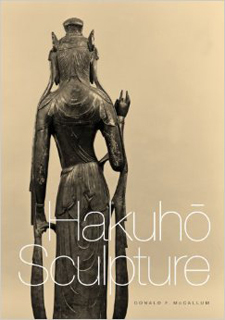
Donald F. McCallum, Hakuhō Sculpture (2012)
McCallum’s research on Japanese art had a wide breadth, but his main area was Japanese Buddhist art in which he published three books: Hakuhō Sculpture (Seattle: University of Washington Press, 2012); The Four Great Temples: Buddhist Archaeology, Architecture, and Icons of Seventh-Century Japan (Honolulu: University of Hawai‘i Press, 2009); and Zenkoji and Its Icon: A Study in Medieval Japanese Religious Art (Princeton: Princeton University Press, 1994). His interests expanded to Korean art, modern Japanese art, and even tattoos, as exemplified in his articles “Korean Influence on Early Japanese Buddhist Sculpture,” in Korean Culture (1982); “Three Taisho Artists: Yorozu Tetsugoro, Koide Narashige, and Kishida Ryusei,” in Paris in Japan: The Japanese Encounter with European Painting (1987); and “Historical and Cultural Dimensions of the Tattoo in Japan,” in Marks of Civilization: Artistic Transformations of the Human Body (1988). In addition to his books, McCallum’s published articles and book reviews that number over seventy will continue to have a significant impact on the field for years to come.
As a dedicated teacher at UCLA for forty-four years, McCallum shared his passion and knowledge with thousands of students and patiently served as dissertation advisor to eleven graduate students. His rigorous training style and strong, personal commitment toward his students, even after they started their own professional careers, was instrumental toward enabling some to become leaders in Japanese art history. Among them are tenured faculty members at Yale University, Portland State University, the University of Kansas, the University of Regina, Taiwan National Central University, California State Polytechnic University in Pomona, and the University of Maryland. Aside from helping his own graduate students, McCallum enthusiastically and generously supported nearly the entire next generation of younger scholars in Japanese art history with great encouragement and by writing thoroughly researched letters of support for tenure and promotion.
McCallum will be dearly missed by many, both in and outside academia. He is survived by his wife Toshiko, his son Kenneth and his daughter-in-law Takayo, his daughter Sumako and his son-in-law James Turner, and his grandchildren Ella Sachiko and Jackson James Turner. Anyone who has ever talked with him or heard him lecture knows how devoted he was to his family and was more than likely treated to many humorous tales about his cherished grandchildren.
The Donald F. McCallum Memorial Fund has been established to support the Department of Art History and the UCLA Terasaki Center for Japanese Studies. Memorial gifts to support the fund can be made out to the UCLA Foundation and sent to: Alexa Almazán, UCLA College Development, Division of Humanities, 1309 Murphy Hall, Box 951413, Los Angeles, CA 90095-1413.