CAA News Today
Affiliated Society News for September 2014
posted Sep 09, 2014
The American Council for Southern Asian Art (ACSAA) has announced the results of its recent election. Serving for the term September 1, 2014 to August 31, 2018: Deepali Dewan, president; Alka Patel, vice president; John Henry Rice, treasurer; Yael Rice, officer; Melodi Rod-ari, Bulletin editor (reappointed); and Emma Natalya Stein, graduate-student representative (term September 1, 2014–August 31, 2016; via lottery). They will join continuing board members, whose terms run through August 31, 2016: Catherine Becker, secretary; Molly Aitken, officer; Lisa Owen, officer; and Cathleen Cummings, webmaster. Many thanks to the outgoing board members: Stephen Markel, president; Deborah Hutton, treasurer; John Cort, officer; and Rashmi Viswanathan, graduate-student representative.
Arts Council of the African Studies Association
The Arts Council of the African Studies Association (ACASA) held its sixteenth triennial symposium on African art, chaired by Kevin Dumouchelle and Gary van Wyk, at the Brooklyn Museum in New York from March 19 to 22, 2014. This was the largest ACASA gathering to date, with over 450 attendees from four continents. The South African artist and activist Kim Berman delivered a dynamic keynote address. Amidst the success of this year’s symposium, planning is underway for the next triennial, which will take place at the University of Ghana in Legon in August 2017. ACASA is also generating a sustained presence at international scholarly events, including the European Conference on African Studies (ECAS).
Several ACASA board members completed their terms this spring, with special thanks to John Peffer, Steven Nelson, and Kinsey Katchka for their dedicated service. ACASA welcomes four new board members: Silvia Forni, Eric Appau Asante, Boureima Diamitani, and Sidney Kasfir, and an incoming president, Dominique Malaquais.
Congratulations to: Jean Borgatti and Henry Drewal, recipients of the ACASA Leadership Award; the Roy Sieber Dissertation Award winner Amanda Rogers; and Arnold Rubin Book Award winners Allen Roberts (single author) and Marla Berns, Richard Fardon, and Sidney Littlefield Kasfir (multiauthored volume). The honorable mentions are: Peter Probst, Gitti Salami, and Monica Blackmun Visonà.
Community College Professors of Art and Art History
The Community College Professors of Art and Art History (CCPAAH) will host two sessions at conferences next year. “Foundations Flipped? Active Learning in Art History and the Studio” will be the topic of a 2015 session at the CAA Annual Conference in New York. Join CCPAAH for this session and its business meeting, which will be a “Project Exchange” that offers a chance to share best practices and ideas to use in your studio and art-history classes. The second session, “Beyond Good, Bad, and ‘I Like It’: A New Take on Critique,” will be presented at next year’s Foundations in Art: Theory and Education (FATE) conference in Indianapolis, Indiana. The organization seeks additional presenters for the CAA session. Please email the group at ccpaah@gmail.com if you are interested in presenting or if you have questions. You can also like CCPAAH’s Facebook page.
Historians of Islamic Art Association

The Historians of Islamic Art Association (HIAA) is pleased to announce Ashley Dimmig as its most recent Grabar Travel Grant recipient. Dimmig is a doctoral student in the History of Art Department at the University of Michigan in Ann Arbor. Her work focuses on Persian and Turkish early modern and modern visual culture, with an emphasis on textile arts.
Established in memory of Professor Oleg Grabar, the Grabar Travel Grant competition is open to doctoral candidates who have been invited or accepted as participants in a scholarly conference or other professional meeting. These grants are intended to encourage and further the professional development of graduate students in all areas of the history of Islamic art, architecture, and archaeology. For more information on the Grabar Travel Grants and the related Grabar Postdoctoral Fellowships, please visit the above link.
International Association of Art Critics
The International Association of Art Critics (AICA-USA) announced the results of the general membership election for board members at its annual meeting, held at Artists Space Books and Talks in New York on June 11, 2014. Three existing board members—Phong Bui, Christopher French, and Barbara MacAdam—had their terms renewed for three years, and two new board members, Alexandra Anderson and Jane Farver, were elected to serve three-year terms. The board chose its officers at a subsequent meeting: Barbara MacAdam is president; Norman Kleeblatt is vice president for membership; Jill Conner is treasurer; and Josephine Gear is secretary. All officers have two-year terms.
International Sculpture Center
The International Sculpture Center (ISC) returns ten years later to the culturally vibrant city of New Orleans for the twenty-fourth International Sculpture Conference: Sculpture, Culture, and Community, to be held October 1–4, 2014. This conference will feature panel discussions, keynote speakers Alice Aycock and Fairfax Dorn, ARTSlams, optional tours, networking events, and workshops. The event will also explore how sculpture and the arts can rejuvenate communities and economies. Registration is open now and includes admission to all panels, the keynote speakers, the opening reception at the Ogden Museum of Southern Art, a gallery hop at the Art for Arts’ Sake street party, the littleSCULPTURE show, Friday Nights at NOMA, ARTSlams, and networking events, among other activities. Registrants may also sign up for optional tours and workshops, for which additional fees may apply. The conference is hosted in collaboration with the Contemporary Arts Center New Orleans, Creative Alliance of New Orleans, New Orleans Arts District, New Orleans Museum of Art, Ogden Museum of Southern Art, Renaissance New Orleans Arts Hotel, and Sculpture for New Orleans.
National Council of Arts Administrators
The forty-second annual meeting of the National Council of Arts Administrators (NCAA) convenes September 24–26, 2014, in Nashville, Tennessee. The event will be hosted by Vanderbilt University. The world is the new studio. Artists are involved in ever-expanding production involving constituents beyond the art world and marketplace. As educational institutions, how do we respond to this massive shift in artistic attitude? Is there a balance between standard nineteenth- and twentieth-century production and new twenty-first-century practice centered on global and social interconnectedness? This conference investigates art’s expanding field by exploring influences of globalization, art education and integrated practice. Participants will consider their role as educators of creativity, how they influence their institutions, and their effect upon local and world communities. Speakers include: Pablo Helguera, author and director of adult and academic programs in the Education Department of the Museum of Modern Art; Richard Lloyd, author of Neo-Bohemia: Art and Commerce in the Post Industrial City; David Owens, author of Creative People Must Be Stopped! Six Ways We Stop Innovation (without Even Trying); and Steven Tepper, author of Not Here, Not Now, Not That! Protest over Art and Culture in America. Visit http://www.vanderbilt.edu/arts/ncaa/ for more information.
Society for Photographic Education

The Society for Photographic Education (SPE) offers student member scholarships to offset the cost of attending the SPE national conference, taking place March 12–15, 2015, in New Orleans, Louisiana. Each award includes a $550 travel stipend, a conference fee waiver, and a complimentary one-year SPE membership. For more information, visit the SPE website. Application deadline is November 1, 2014, at 11:59 PM EST.
Society of Architectural Historians
The Society of Architectural Historians (SAH) is accepting applications for the 2014 H. Allen Brooks Travelling Fellowship. The prestigious fellowship of $50,000 will allow a recent graduate or emerging scholar to study by travel for one year. The fellowship is not for the purpose of doing research for an advanced degree. Instead, it is intended to allow the recipient to see and experience architecture and landscapes firsthand, to think about his or her profession deeply, and to acquire knowledge useful for his or her future work and contribution to society. The deadline is October 1, 2014. For details and to apply, visit the website.
Save the date for the 2014 SAH Awards Gala: Saturday, November 8, 6:00–9:00 PM at the Fortnightly of Chicago. The gala’s theme is “A Foundation for Preservation,” honoring those individuals who initiated early preservation work in Chicago and continue to support and encourage preservation. The winners and their award categories include: Ben Weese, Fellow of the American Institute of Architects (Preservation Advocacy); Tim Samuelson (Stewardship of the Built Environment); Robert Furhoff (Architectural Conservation); Wilbert Hasbrouck, Fellow of the American Institute of Architects, and Marilyn Hasbrouck (Architectural Media); and Toni Preckwinkle (Conservation of the Natural Environment). The gala benefits SAH’s educational mission and restoration of the Charnley-Persky House.
Society of Historians of Eastern European, Eurasian, and Russian Art and Architecture
The Society of Historians of Eastern European, Eurasian, and Russian Art and Architecture (SHERA) is delighted to welcome the Art History Department of the European University at St. Petersburg as a new institutional member. The department’s special area of interest is the history of cultural contacts between Russia and Europe. SHERA’s officers look forward to working with Dean Ilia Doronchenkov on collaborative projects that will bring together scholars working on areas of mutual interest.
SHERA’s News Blog continues to be a source of information on events and opportunities for scholars working on art and architecture of any period from Eastern Europe and the former Soviet Union. Be sure to keep up with the news by going to SHERA’s website and clicking on News.
Committee on Diversity Practices highlights for September/October 2014
posted Sep 09, 2014
Each month, CAA’s Committee on Diversity Practices highlights a number of exhibitions, events, and activities that support the development of global perspectives on art and visual culture and deepen our appreciation of political and cultural heterogeneity as educational and professional values.
September/October 2014
Whitfield Lovell: Deep River
Telfair Museums, Jepson Center for the Arts
Savannah, Georgia
August 15, 2014‒February 1, 2015
“Artist Whitfield Lovell is internationally renowned for his thought-provoking portraits and signature tableaux. In this exhibition, Lovell utilizes sculpture, video, drawing, sound, and music to create an environment that fully engages our senses and emotions. His art pays tribute to the lives of anonymous African Americans and is universal in its exploration of passage, memory, and the search for freedom.”
National Conference of Artists, New Orleans Chapter 21st Anniversary Exhibition
Southern University
Visual Arts Gallery, Frank Hayden Hall
Baton Rouge, Louisiana
October 9‒November 15, 2014
The art on display will feature pieces by the New Orleans Chapter of the National Conference of Artists. Admission is free.
The National Conference of Artists organizes chapters to preserve, promote, and develop African-American culture and creative forces. The conference was granted charter in 1991.
My Generation: Young Chinese Artists
Museum of Fine Arts
St. Petersburg, Florida
June 7 –September 28, 2014
This is the first U.S. exhibition to focus solely on the new post-Mao generation of Chinese artists, who work in a variety of media and address issues of alienation, self-definition, cynicism, and rebellion. Almost all of the artists are products of the One-Child Policy and have been brought up in a country with a high-powered market economy. These artists have grown up in an international milieu, liberated from stereotypes of an east-west dichotomy. They speak volumes about China, a society that has undergone rapid industrialization and globalization in the past two decades. As such, this exhibition is a window on to this new China with new technologies, exhibition strategies, and reinvention of traditional practices that reflect the impact that rapid development has had on these artists’ lives.
My Generation is curated by Barbara Pollack, and is co-presented in two venues simultaneously through a unique collaboration with the Tampa Museum of Art.
Mel Chin: Confucius
Social Science CLASS Gallery
Savannah State University
Savannah, GA
September 1, 2014 ‒October 31, 2014
For more information about Mel Chin’s work, please see http://www.melchin.org/.
2016 Conference Session Proposals Due by September 12
posted Sep 09, 2014
The CAA 104th Annual Conference will take place February 3–6, 2016, in Washington, DC. The Annual Conference Committee invites session proposals that cover the breadth of current thought and research in art, art and architectural history, theory and criticism, pedagogical issues, museum and curatorial practice, conservation, and developments in technology. Deadline: Friday, September 12, 2014.
In order to submit a proposal, you must be a current CAA member. For full details on the submission process for the conference, please review the information published below.
Open Formats
This category encourages experimental and alternative formats that transcend the traditional panel, with presentations whose content extends to serve the areas of contemporary issues, studio art, historical studies, and educational and professional practices. Proposals may experiment with session hierarchies, length, technology, and modes of participation. Open Formats are the only sessions that may be preformed, with participants chosen in advance by session chairs. These sessions require advance planning by the chair.
Historical Studies
This category broadly embraces all art-historical proposals up to the third quarter of the twentieth century. Historical Studies session proposals may not be submitted as preformed panels with a list of speakers.
Contemporary Issues/Studio Art
This category is intended for studio-art proposals, as well as those concerned with contemporary art and theory, criticism, and visual culture. Contemporary Issues/Studio Art session proposals may not be submitted as preformed panels with a list of speakers.
Educational and Professional Practices
This category pertains to session proposals that develop along more practical lines and address the educational and professional concerns of CAA members as teachers, practicing artists and critics, or museum curators. Educational and Professional Practices session proposals may not be submitted as preformed panels with a list of speakers.
Affiliated Societies
Each CAA affiliated society may submit one proposal that follows the guidelines outlined b elow. A letter of support from the society or committee must accompany the submission. The Annual Conference Committee considers it, along with the other submissions, on the basis of merit.
Committees
Each CAA committee may submit one proposal that follows the guidelines outlined below. A letter of support from the society or committee must accompany the submission. The Annual Conference Committee considers it, along with the other submissions, on the basis of merit.
Proposal Submission Guidelines
All session proposals are completed and submitted online; paper forms and postal mailings are not required. Prospective chairs must include the following in their proposal:
- The Annual Conference Committee considers proposals from individual CAA members only. Once selected, session chairs must remain current members through 2016. No one may chair a session more than once in a three-year period. (That is, individuals who chaired sessions in 2014 or 2015 may not chair a session in 2016.) The committee seeks topics that have not been addressed in recent conferences or areas that have traditionally been underrepresented as well as formats that explore new modes of dialogue
- A completed session proposal made through an online database
- If you have prior approval from a CAA affiliated society or committee to submit an application for a sponsored session, an official letter of support from the society or committee uploaded as a PDF or Word file. If you are not submitting an application for a sponsored session, please skip this step
- Your CV and, if applicable, the CV of your cochair; no more than two pages in length each, uploaded as a PDF or Word file (both CVs in one document)
The committee makes its selection solely on the basis of merit. Where proposals overlap, CAA reserves the right to select the most considered version or, in some cases, to suggest a fusion of two or more versions from among the proposals submitted. The submission process must be completed online. Deadline: Friday, September 12, 2014.
General Proposal Information
The process of fashioning the conference is a delicate balancing act. The 2016 program is shaped by four broad submission categories: Open Formats, Historical Studies, Contemporary Issues/Studio Art, and Educational and Professional Practices. Also included in the mix are sessions by CAA’s affiliated societies and committees.
The Annual Conference Committee welcomes session proposals from established artists and scholars, along with those from younger scholars, emerging and midcareer artists, and graduate students. Particularly welcome are proposals that highlight interdisciplinary work. Artists are especially encouraged to propose sessions appropriate to dialogue and information exchange relevant to artists.
Sessions selected by the Annual Conference Committee for the 2016 conference are considered regular program sessions; that is, they are 2½-hours long, are scheduled during the eight regular program time slots during the four days of the conference, and require a conference badge for admission. With the exception of the Open Formats category, CAA session proposals may not be submitted as preformed panels with a list of speakers. Proposals for papers for the 2016 conference are solicited through the 2016 Call for Participation, to be published in March 2015.
Contact
For more information about session proposals for the 2016 Annual Conference in Washington, DC, please contact Lauren Stark, CAA manager of programs, at 212-392-4405.
American Philological Association Becomes the Society for Classical Studies
posted Sep 08, 2014
The following message was sent as an attachment to an email from Adam D. Blistein, executive director of the Society for Classical Studies, on Friday, September 5, 2014.
Letter about Our New Name
Dear Colleague:
I am writing to let you know that the American Philological Association, founded in 1869 and the principal learned society for Classics scholars in North America, has changed its name to the Society for Classical Studies (SCS). We have also unveiled the new logo that appears on this letterhead and will soon launch a new web site. These changes culminate a decade-long process of re-examining the role of the Society in the 21st century, with the goal of better promoting and serving a growing interest in Classical antiquity on the part of students and teachers at all levels as well as the general public.
For centuries the cultures of ancient Greece and Rome have inspired creativity, contemplation, scholarship, and teaching both inside and outside of the academy. While we continue to serve our original academic mission, we also want to take advantage of new technologies which make it easier to share the insights and pleasures of studying Classical antiquity with the widest possible audience. A new name is critical to this expanded mission. A philological focus is at the core of much scholarship on Greek and Latin texts, and we will continue to take an active role in projects like the Digital Latin Library that represent excellent philology in the 21st Century. However, we recognize that the term is no longer widely understood and therefore can be a barrier to communication with a broader public. Especially now, when it is so important for us to advocate for the study of Classics and, indeed, of all the humanities, we must strive for clarity in the transmission of our message.
We recently completed a successful capital campaign which raised an unprecedented $3.2 million to provide essential resources for Classics teachers and scholars and to share our appreciation for Classical antiquity as broadly as possible. The name of the Campaign (From Gatekeeper to Gateway: The Campaign for Classics in the 21st Century) reflected this ambition. Donors from both inside and outside of our membership supported this effort because they shared our belief that knowledge of Classics is a valuable component of education, attracts broad interest, and has much to contribute to contemporary society. Our new web site is the next step in responding to this interest. It will add features targeted to a variety of audiences, improve its accessibility to different types of users, and facilitate communications that support the Society’s goal to be the public face of Classics in North America.
It is a special privilege to be guiding the Society as we take this significant step and establish a new level of leadership in Classical Studies. The SCS looks forward to continuing to work with you to encourage the study of Classics and of all humanistic disciplines.
Very truly yours,
Kathryn Gutzwiller
President
News from the Art and Academic Worlds
posted Sep 03, 2014
Each week CAA News publishes summaries of eight articles, published around the web, that CAA members may find interesting and useful in their professional and creative lives.
Who’s Getting Tenure-Track Jobs? It’s Time to Find Out
As the academic labor market turns grimmer and tenure-track professorships become scarcer, it’s hard not to wonder: Who’s getting hired to the desperately coveted positions that remain? It’s a question with serious implications, both for the academy and for the hordes of job-seeking scholars. Yet it’s been over a decade since anyone made much of an effort to come up with an answer—to find the names of the fortunate and talented few, across disciplines, and put them all in one place. (Read more from Vitae.)
What They Never Told You about Consigning Your Art
Art consignment agreements are deceptively simple. This essay goes behind that simplicity to raise issues for art owners that are not fully addressed—or only imperfectly so—by the text of the usual agreement. Rescission by the auction house (undoing the sale long after the auction) is one of these issues. There are others. (Read more from Spencer’s Art Law Journal.)
Court Sides with University of Missouri in Fight over Teacher-Prep Syllabi
A state appeals court has ruled that the University of Missouri system does not have to release course syllabi, as they are the intellectual property of the faculty and therefore exempt from the state’s open-records law, the Columbia Daily Tribune reports. The decision, handed down last week, is the latest chapter in a bid by the National Council on Teacher Quality to rank teacher-preparation programs by obtaining course syllabi and other materials from institutions nationwide. (Read more from the Chronicle of Higher Education.)
The Upside of Art School
Art school is an easy and enjoyable target for satire and jokes. Most everyone I know has had some of the kind of experiences that fall into the way art school is usually portrayed—I’ve even brought a list of those bad stories to Daniel Clowes, and a couple from my wife Linda were in the movie Art School Confidential. But I also had a many good experiences in art school, some with caring teachers who shared insights that have made a lasting impact on me. (Read more from the Huffington Post.)
Fate of Detroit’s Art Hangs in the Balance as Bankruptcy Trial Begins
This week a bankruptcy trial to determine the future of the city of Detroit began after more than a year of negotiations—and the fate of the Detroit Institute of Arts hangs in the balance. The resolution of the largest municipal bankruptcy in US history is likely to set precedents for other struggling cities. At the center of the conflict is whether a bankrupt city can avoid selling any valuable asset, including its art collection. (Read more from the Art Newspaper.)
Academics and Archaeologists Fight to Save Syria’s Artifacts
The upheavals and conflicts sweeping the Middle East in recent years have caused untold human suffering and have resulted in deep losses to the heritage of the region. Scholars can do little to stop the fighting and looting, but they have created blogs, websites, Facebook pages, and Twitter accounts to monitor the destruction and raise awareness about it. By sharing excavation records, scholars outside the Middle East have helped their counterparts in the Arab world to compile online lists of missing or stolen objects. (Read more from the New York Times.)
The Elusiveness of Stolen Art
Earlier this month thieves made off with a giant Renaissance masterpiece: a 10 x 6 feet piece painted by Guercino in 1639 and worth over $8 million. Whoever took the painting didn’t have to do much; the security alarm on the church wasn’t working, and according to the Telegraph the church that housed the painting didn’t have the money to get it fixed. Once a work of art leaves a museum or church, the chances of getting it back are extraordinarily slim. (Read more from the Atlantic.)
Should I Explain Why I’m Leaving?
I just finished my second year in my position as an assistant professor, and I’m going back on the market next year. My university is broke, and I have been very productive and outperformed my current position. Do I mention that in my cover letter? I like my colleagues and get along well with everyone, so I don’t want people reading my letter to think I’m leaving because I am hard to work with. So do I explain why I want to leave? (Read more from Vitae.)
New Publication Grants for Manuscripts on American Art
posted Sep 03, 2014
 The Terra Foundation for American Art has awarded CAA a major, three-year grant to administer an annual grant program to support book-length scholarly manuscripts in the history of American art. The Terra Foundation for American Art International Publication Grant will award funds of up to $15,000 for books that examine American art in an international context, increase awareness of American art internationally through publication outside the United States, allow wider audiences to access important texts through translation, and/or result from international collaboration. The program is designed to offset image acquisition and translation costs, however other editing and production expenses will be considered.
The publication grants will support publications that make significant contributions to the field in three award categories: grants to US publishers for manuscripts that consider American art in an international context, grants to non-US publishers for books on topics in American art, and grants for the translation of books on topics in American art to or from English. In addition to the publication grants, the program will support the creation of an international network of American art scholars by providing two non-US authors whose books are funded through the grant program with travel stipends and complimentary registration to attend CAA’s Annual Conference.
Grant guidelines, detailed eligibility requirements, and application instructions are available on the CAA website. For this grant program, “American art” is defined as art (circa 1500–1980) of what is now the geographic United States. Letters of inquiry should be submitted to CAA no later than October 15, 2014. Applicants whose projects fall within the guidelines and successfully fulfill the mission of the grant program will be invited to submit full applications, due December 15, 2014. The first round of award winners will be announced in April 2015.
About CAA
CAA is dedicated to providing professional services and resources for artists, art historians, and students in the visual arts. CAA serves as an advocate and a resource for individuals and institutions nationally and internationally by offering forums to discuss the latest developments in the visual arts and art history through its Annual Conference, publications, exhibitions, website, and other programs, services, and events. CAA focuses on a wide range of advocacy issues, including education in the arts, freedom of expression, intellectual-property rights, cultural heritage and preservation, workforce topics in universities and museums, and access to networked information technologies. Representing its members’ professional needs since 1911, CAA is committed to the highest professional and ethical standards of scholarship, creativity, criticism, and teaching.
About the Terra Foundation
 The Terra Foundation for American Art is dedicated to fostering exploration, understanding, and enjoyment of the visual arts of the United States for national and international audiences. Recognizing the importance of experiencing original works of art, the foundation provides opportunities for interaction and study, beginning with the presentation and growth of its own art collection in Chicago. To further cross-cultural dialogue on American art, the foundation supports and collaborates on innovative exhibitions, research, and educational programs. Implicit in such activities is the belief that art has the potential both to distinguish cultures and to unite them.
Contact
For more information please contact Hillary Bliss, CAA development and marketing manager, at hbliss@collegeart.org or 212-392-4436. For more information on applying to the Terra Foundation for American Art International Publication Grant, please contact Betty Leigh Hutcheson, CAA director of publications, at bhutcheson@collegeart.org or 212-392-4417.
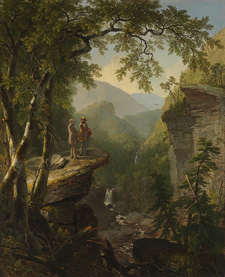
Image: Asher B. Durand, Kindred Spirits, 1849, oil on canvas, 44 x 36 in. (artwork in the public domain)
Provenance Research in American Institutions
posted Aug 28, 2014
Rowman & Littlefield is pleased to announce the release of Volume 10, Number 3 of Collections: A Journal for Museum and Archives Professionals, a focused issue dedicated to the subject of provenance research in American institutions. Guest-Edited by Jane C. Milosch, Lynn H. Nicholas, and Megan M. Fontanella, the issue draws attention to current research in the field by highlighting key resources and initiatives, case studies from collections throughout the United States, and perspectives on unprovenanced cultural property and Nazi-era claims.
\Bringing together the expertise of independent scholars and professionals who are affiliated with American institutions, this issue aims to foster dialogue among museums, archives, and research centers and to broaden the accessibility of information. The collection of articles opens with a Foreword by Megan M. Fontanella and an introduction by Lynn H. Nicholas. A closer look at resources and initiatives is offered in the following articles: “Provenance: Not the Problem (The Solution): Smithsonian Provenance Research Initiative” by Jane C. Milosch; “Princes, Dukes, and Counts: Pedigrees and Problems in the Kress Collection” by Nancy H. Yeide; “The ‘German Sales 1930–1945’ Database Project” by Christian Huemer; and Laurie A. Stein’s “’Everyone Brings a Piece to the Puzzle’: Conversations with Elaine Rosenberg and Reflections on Provenance Research among The Paul Rosenberg Archives.” Case studies include: “Navigating the Gray Area: Pechstein’s Girl Combing Her Hair, the Littmann Collection, and the Limits of Evidence” by Catherine Herbert; “Researching the Wertheim Collection at the Harvard Art Museums” by Elizabeth M. Rudy; “One Painting Concealed Behind Another: Picasso’s La Douleur (1903) and Guitar, Gas-Jet, and Bottle (1913)” by Christel Hollevoet-Force; “The Eugene Garbáty Collection of European Art” by Victoria Reed; and Dorota Chudzicka’s “’In Love at First Sight Completely, Hopelessly, and Forever with Chinese Art’: The Eugene and Agnes Meyer Collection of Chinese Art at the Freer Gallery of Art.” Perspectives on legal claims include Gary Vikan’s “Provenance Research and Unprovenanced Cultural Property” and Stephen W. Clark’s “Nazi-Era Claims and Art Museums: The American Perspective”.
This impressive group of articles is valuable to art historians, curators, and myriad others whose work addresses provenance. The collection showcases thoughtful, methodical and meticulous research related to individual owners and to individual works and collections of art. It serves as a touchstone for provenance research in American Institutions. Journal Editor Juilee Decker stated, “It is particularly exciting to see this issue of Collections appear in print. This focused issue takes the lead in proactive press regarding the continuous efforts of provenance research at American institutions. Building on the recent interest surrounding ‘The Monuments Men,’ this journal forms part of the epilogue to an unfinished story of provenance that both pre- and post-dates the Second World War, providing insight into the challenging, exciting and ongoing work of provenance researchers that continues to be integral to museums worldwide.”
“The value of this focused issue on provenance research in American institutions,” remarks guest editor and Director of the Smithsonian Provenance Research Initiative Jane C. Milosch, is that it “brings together scholars and researchers to share their incredible work and to initiate important discussions for the future. While the greatest focus and challenge of provenance research remains sifting through immense amounts of paper and digital archival materials, communication and collaboration are essential to effective provenance research and to sharing with and educating others on how specialized and time-consuming provenance research is with its often inconclusive results and on-going nature.”
Published by AltaMira Press (an imprint of Roman & Littlefield), Collections: A Journal for Museum and Archives Professionals is a multidisciplinary journal for all aspects of handling, preserving, researching, interpreting, and organizing collections. To purchase Volume 10, Number 3 (Summer 2014) focusing on “Provenance Research in American Institutions” call 1.800.273.2223 or send an email to: journals@rowman.com with “Issue 10.03” in the subject line. Further information about the journal may be obtained online: https://rowman.com/Page/Journals.
News from the Art and Academic Worlds
posted Aug 27, 2014
Each week CAA News publishes summaries of eight articles, published around the web, that CAA members may find interesting and useful in their professional and creative lives.
From the Archives: The First Week of the Academic Term
The ProfHacker archives are full of useful ideas, tools, and advice relevant to the first week of a new academic semester or quarter. In addition to the posts highlighted below, you may want to check out some previous From the archives posts on New Semester, New Year, Creating Syllabi, and Grading. (Read more from ProfHacker.)
Sabbatical Planning
A sabbatical was finally mine, but now what? I read as much as I could find, and contacted colleagues who had recently ended their sabbaticals for advice. Their accumulated advice roughly fell into the familiar set of questions, albeit in a different order: the Why, What, Who, Where, How and When of sabbatical. (Read more from Inside Higher Ed.)
Ethics for Dealers: Deaccessioning
If someone helps another person commit a crime, he’s an accessory to the illegal act and probably guilty of an infraction. What about an ethical violation? The question is becoming increasingly relevant in the art world as the Delaware Art Museum deaccessions works of art to pay off its debt and, as first conceived, built up its endowment. (Read more from Art Antiques Design.)
Getty Thesaurus of Geographic Names Released as Linked Open Data
The Getty Thesaurus of Geographic Names is a resource of over 2 million names of current and historical places, including cities, archaeological sites, nations, and physical features. It focuses mainly on places relevant to art, architecture, archaeology, art conservation, and related fields. (Read more from Getty Iris.)
The Free and Antifree
For a young writer who hopes to produce literature, the greatest difference between now and twenty years ago may be that now she expects to get paid. Twenty years ago, art and commerce appeared to be opposing forces. The more you were paid for your work, the more likely you were to be a hack. (Read more from N+1.)
More Hospitals Use the Healing Powers of Art
Researchers are learning more about the precise ways paintings and other works of art help patients and families in the healing process. With studies showing a direct link between the content of images and the brain’s reaction to pain, stress, and anxiety, hospitals are considering and choosing artworks based on the evidence and giving it a higher priority than merely decoration for sterile rooms and corridors. (Read more from the Wall Street Journal.)
I Used to Be a Good Teacher
I spent five years on the tenure track. Now I’m an adjunct, and the move has affected my teaching in ways I didn’t anticipate. I’m not the teacher I once was, largely thanks to the lack of support I receive as an adjunct. Sadly, my students suffer the loss. (Read more from Vitae.)
The Invention of the “Snapshot” Changed the Way We Viewed the World
The age of everyday camera drones has arrived—bringing strange new forms of photography—and they’re causing new privacy panics. How will society change when anyone can spy from above? We can find some clues by looking at the last great shift in photography: the rise of the personal camera and the birth of the “snapshot.” It was a moment that changed the way we recorded the world. (Read more from Smithsonian Magazine.)
Mentors Needed for the 2015 Annual Conference
posted Aug 26, 2014
 For the 103rd Annual Conference, taking place February 11–14, 2015, in New York, CAA seeks established professionals in the visual arts to volunteer as mentors for two Career Services programs: the Artists’ Portfolio Review and Career Development Mentoring. Participating as a mentor is an excellent way to serve the field and to assist the professional growth of the next generation of artists and scholars.
Art historians and studio artists must be tenured; critics, museum educators, and curators must have five years’ experience. Curators and educators must be currently employed by a museum or university gallery.
Artists’ Portfolio Review
CAA seeks artists, critics, curators, and educators to serve in the Artists’ Portfolio Review. In this program, mentors review and provide feedback on digital images or DVDs of work by artist members in personal twenty-minute consultations. Whenever possible, CAA matches artists and mentors based on medium or discipline. Mentors provide an important service to artists, enabling them to receive professional criticism of their work.
Interested candidates must be current CAA members and prepared to give five successive twenty-minute critiques in a two-hour period on one of the two days of the review: Thursday, February 12, and Friday, February 13, 2015, 8:00 AM–NOON and 1:00–5:00 PM each day. Conference registration, while encouraged, is not required to be a mentor. Please send a brief letter of interest and your CV to Lauren Stark, CAA manager of programs. Deadline extended: January 9, 2015.
Career Development Mentoring
CAA seeks mentors from all areas of studio art, art history, art education, film and video, graphic design, the museum professions, and other related fields to serve in Career Development Mentoring. In this program, mentors give valuable advice to emerging and midcareer professionals, reviewing cover letters, CVs, digital images, and other pertinent job-search materials in personal twenty-minute consultations. Whenever possible, CAA matches participants and mentors based on medium or discipline.
Interested candidates must be current CAA members and prepared to give five successive twenty-minute critiques in a two-hour period on one of the two days of the review: Thursday, February 12, and Friday, February 13, 2015, 8:00 AM–NOON and 1:00–5:00 PM each day. Conference registration, while encouraged, is not required to be a mentor. Please send a brief letter of interest and your CV to Lauren Stark, CAA manager of programs. Deadline extended: January 9, 2015.
Career Development Mentoring is not intended as a screening process by institutions seeking new hires. CAA does not accept applications from individuals whose departments are conducting a faculty search in the field in which they are mentoring. Mentors should not be attending the conference as candidates for positions in the same field in which mentees may be applying.
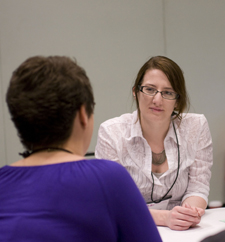
Image: A mentoring session at the 2012 Annual Conference in Los Angeles (photograph by Bradley Marks)
Projectionists and Room Monitors for the 2015 Annual Conference
posted Aug 25, 2014
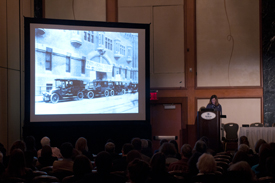 CAA has filled all the positions for room monitors but is still seeking projectionists.
Working as a projectionist or room monitor at CAA’s 103rd Annual Conference, taking place February 11–14, 2015, in New York, is a great way to save on conference expenses. All candidates must be US citizens or permanent US residents. CAA encourages students and emerging professionals—especially those in the New York area—to apply for service.
Projectionists
CAA seeks applications for projectionists for conference program sessions. Successful applicants are paid $12 per hour and receive complimentary conference registration. Projectionists are required to work a minimum of four 2½-hour program sessions, from Wednesday, February 11 to Saturday, February 14; they must also attend a training meeting on Wednesday morning at 7:30 AM. Projectionists must be familiar with digital projectors. Please send a brief letter of interest to Lauren Stark, CAA manager of programs and archivist. Deadline extended: December 1, 2014.
Room Monitors
CAA needs room monitors for two Career Services mentoring programs (the Artists’ Portfolio Review and Career Development Mentoring), several offsite sessions, and other conference events, to be held from Wednesday, February 11 to Saturday, February 14; they must also attend a training meeting on Thursday morning at 7:30 AM. Successful candidates are paid $12 per hour and receive complimentary conference registration. Room monitors are required to work a minimum of eight hours, checking in participants and facilitating the work of the mentors. Please send a brief letter of interest to Lauren Stark, CAA manager of programs and archivist. No more room monitors are needed.
Image: A 2013 Annual Conference session (photograph by Bradley Marks)