CAA News Today
Grants, Awards, and Honors
posted Dec 15, 2013
CAA recognizes its members for their professional achievements, be it a grant, fellowship, residency, book prize, honorary degree, or related award.
Grants, Awards, and Honors is published every two months: in February, April, June, August, October, and December. To learn more about submitting a listing, please follow the instructions on the main Member News page.
December 2013

Karen Barzman from Harvard University’s Center for Italian Renaissance Studies in Cambridge, Massachusetts, has been appointed visiting professor at Villa I Tatti in Florence, Italy, for the fall 2013 semester. She will work on a book project called “The Limits of Identity: Venice, Dalmatia, and the Representations of Difference.”
Elisabeth Agro, Nancy M. McNeil Associate Curator of American Modern and Contemporary Crafts and Decorative Arts for the Philadelphia Museum of Art in Pennsylvania, has accepted a 2013 award from the Craft Research Fund by the Center for Craft, Creativity, and Design, based in Asheville, North Carolina. The $7,000 in funds will help expand, envision, and prototype innovative structures for disseminating craft knowledge and fostering scholarly social networking through her project with Namita Gupta Wiggers, called Critical Craft Forum.
Sonya Clark, chair of craft/material studies in the School of the Arts at Virginia Commonwealth University in Richmond, has received a 2013 award from the Craft Research Fund by the Center for Craft, Creativity, and Design, based in Asheville, North Carolina. The $14,955 award will support Clark’s The Hair Craft Project, which investigates the relationship between textile arts and the craftsmanship of contemporary African American hair braiders within the localized intercultural context of Richmond.
Jessica Cochran, curator of exhibitions and acting assistant director of the Center for Book and Paper Arts at Columbia College Chicago in Illinois, and Melissa Potter, associate professor in the Interdisciplinary Arts Department at Columbia College Chicago, have been named 2013 Craft Research Fund recipients by the Center for Craft, Creativity, and Design, based in Asheville, North Carolina. Their $7,642 award will support research for Social Paper, an exhibition and its accompanying catalogue charting the evolution of the art of hand papermaking in relation to the discourse on socially engaged art, with special attention to craft, labor, community, and site-specificity.
William L. Coleman, a PhD candidate in the history of art at the University of California, Berkeley, has been awarded the second annual Sir Denis Mahon Essay Prize for unpublished work on an early modern topic by a scholar under 30. The award comes with a £1,000 prize and the invitation to present the winning project, “‘To live in accord with nature’: Rubens’s Houses and the Construction of Neostoic Leisure,” as a lecture at the Ashmolean Museum in Oxford, England.
Jane Fine has completed an artist’s residency at the Sam and Adele Golden Foundation for the Arts. She was at the foundation’s studio center in Berlin, New York, from September 15 to October 12, 2013.
Lindsay Henry, a doctoral student in the Institute of Fine Arts at New York University, has been accepted as a participant in the 2014 Art & Law Program, a semester-long seminar series to he held in New York that has a theoretical and philosophical focus on the effects of law and jurisprudence on cultural production and reception.
Michael Iauch, an artist based in Durham, North Carolina, has been named a 2013–14 recipient of the Franklin Furnace Fund. Since 1985 the fund has helped artists to prepare major works of performance art.
Sue Johnson, professor of art at St. Mary’s College of Maryland in St. Mary’s City, has been awarded two residency fellowships in 2014: one for the Frans Masereel Centrum in Kasterlee, Belgium, and the other for the Tyrone Guthrie Centre in Annaghmakerrig, Ireland.
Thomas DaCosta Kaufmann, Frederick Marquand Professor of Art and Archaeology at Princeton University in Princeton, New Jersey, has received a doctor honoris causa in art history from Masaryk University in Brno, Czech Republic.
Joyce Yu-Jean Lee, an artist who lives and works in Baltimore, Maryland, has received a 2013–14 award from the Franklin Furnace Fund. Since 1985 the fund has helped artists to prepare major works of performance art.
Elizabeth Perrill, assistant professor of art history at the University of North Carolina, Greensboro, has accepted a 2013 award from the Craft Research Fund, administered by the Center for Craft, Creativity, and Design, based in Asheville, North Carolina. She will work on “Burnished by History: The Legacies of Maria Martinez and Nesta Nala in Dialogue,” a scholarly article and companion artists’ interview focused on the legacies of two ceramists, Maria Marinez from the United States and Nasta Nala from South Africa.

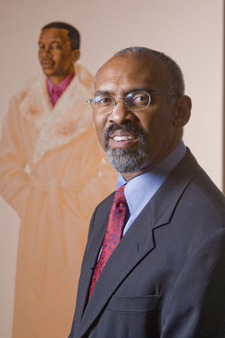 Richard J. Powell
Richard J. Powell, John Spencer Bassett Professor of Art and Art History at Duke University in Durham, North Carolina, has been awarded the Smithsonian Institution’s Lawrence A. Fleischman Award for Scholarly Excellence in the Field of American Art History.
Marion Wilson has completed an artist’s residency at the Sam and Adele Golden Foundation for the Arts. She was at the foundation’s studio center in Berlin, New York, from September 15 to October 12, 2013.
Alice Pixley Young has participated in a 2013 residency at the Jentel Artist Residency Program, located in Banner, Wyoming.
Exhibitions Curated by CAA Members
posted Dec 15, 2013
Exhibitions Curated by CAA Members
Check out details on recent shows organized by CAA members who are also curators.
Exhibitions Curated by CAA Members is published every two months: in February, April, June, August, October, and December. To learn more about submitting a listing, please follow the instructions on the main Member News page.
December 2013

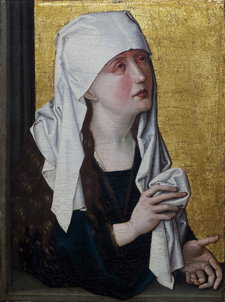 Master of the Stötteritz Altar, Mother of Sorrows, ca. 1480, oil on panel, 8¾ x 6½ in. Gift of Mrs. Clifford G. Schultz in memory of Mr. Clifford G. Schultz, AG.1984.1.1 (artwork in the public domain)
David S. Areford. The Art of Empathy: The Cummer “Mother of Sorrows” in Context. Cummer Museum of Art and Gardens, Jacksonville, Florida, November 26, 2013–February 16, 2014.

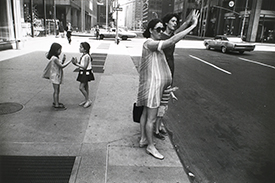 Rineke Dijkstra, Castricum aan Zee, The Netherlands, June 1992, 1992 (printed 2005), chromogenic print, 43¼ x 50 3/8 in. (artwork © Rineke Dijkstra; photograph provided by the artist and Marian Goodman Gallery, New York)
Donna Gustafson and Susan Sidlauskas. Striking Resemblance: The Changing Art of Portraiture. Zimmerli Art Museum, Rutgers University, New Brunswick, New Jersey, January 25–July 13, 2014.

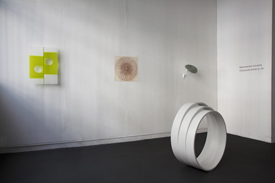 Installation view of Raisonnement circulaire. On wall from left: Mary Schiliro, Circuitous Dip, 2012, acrylic on Mylar, 25½ x 18 in. (artwork © Mary Schiliro); Mary Judge, Exotic Hex Series S10/1, 2005, powdered pigment on paper, 20 x 20 in. (artwork © Mary Judge); David Henderson, Glorieux, 2012, fiberglass and paint, 33 x 26 x 38 cm (artwork © David Henderson). On floor: Nathalie Delasalle, Force Majeure, 2011, marbre de synthèse, 90 x 90 x 40 cm (artwork © Nathalie Delasalle).
Daniel G. Hill. Raisonnement circulaire (Circular Reasoning). ParisCONCRET, Paris, France, June 16–July 7, 2012
Andrea Kantrowitz. Tracing Experience: Morgan O’Hara, Bill Sayles, Josette Urso, and Jen Wright. Macy Gallery, Teachers College, Columbia University, New York, October 7–November 1, 2013.

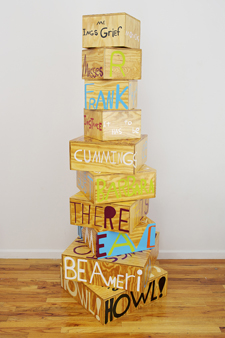 Samuel Jablon, Poet Sculpture, 2013, enamel on plywood, variable dimensions (artwork © Samuel Jablon)
 Katarina Lanfranco. Poetry Slam: damali abrams, Jessica Campbell, Samuel Jablon, and Mwamba-Salim Wilson. Rhombus Space, Brooklyn, New York, September 20–October 13, 2013.

 Jason Peters, Untitled, silver ink on black paper, 11 x 11 x 6½ in. (artwork © Jason Peters)
Katarina Lanfranco. Fine Lines: Helen Dennis, Nils Folke Anderson, Jason Peters, and Ann Stewart. Rhombus Space, Brooklyn, New York, October 18–November 17, 2013.
Katarina Lanfranco and MaDora Frey. A-Side/B-Side: Helen Dennis, Nils Folke Anderson, Jason Peters, and Ann Stewart. Rhombus Space, Brooklyn, New York, December 13, 2013–January 19, 2014.

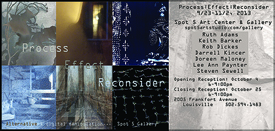 Invitation card for Process : Effect : Reconsider
Lee Ann Paynter. Process : Effect : Reconsider. Spot 5 Art Center and Gallery, Louisville, Kentucky, September 23–November 2, 2013.

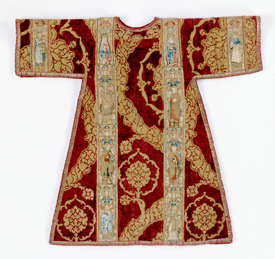 Dalmatic, Anonymous, Italian, ca. 1450–75, Orphreys, embroidery, silk, and metallic thread on linen plain weave, velvet, 104.1 x 111.8 cm. Detroit Institute of Arts, Gift of Mr. and Mrs. Edgar B. Whitcomb. Acc. no. 37.56 (artwork in the public domain)
Perri Lee Roberts. The Material of Culture: Medals and Textiles from the Ulrich A. Middeldorf Collection. Georgia Museum of Art, University of Georgia, Athens, Georgia, October 26, 2013–January 12, 2014.
Books Published by CAA Members
posted Dec 15, 2013
Publishing a book is a major milestone for artists and scholars—browse a list of recent titles below.
Books Published by CAA Members appears every two months: in February, April, June, August, October, and December. To learn more about submitting a listing, please follow the instructions on the main Member News page.
December 2013

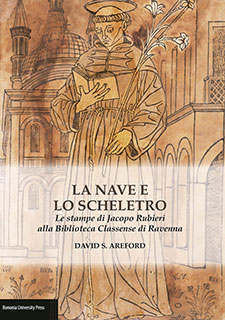
David S. Areford. The Art of Empathy: The Mother of Sorrows in Northern Renaissance Art and Devotion (London: D. Giles, 2013).

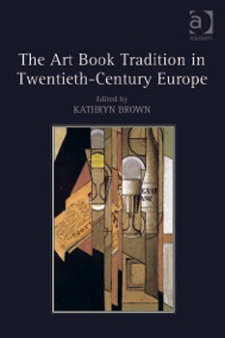
Kathryn Brown, ed. The Art Book Tradition in Twentieth-Century Europe (Burlington, VT: Ashgate, 2013).

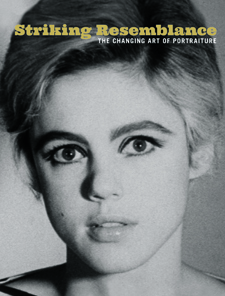
Donna Gustafson and Susan Sidlauskas. Striking Resemblance: The Changing Art of Portraiture (New York: DelMonico/Prestel; New Brunswick, NJ: Zimmerli Art Museum, Rutgers University, 2014).

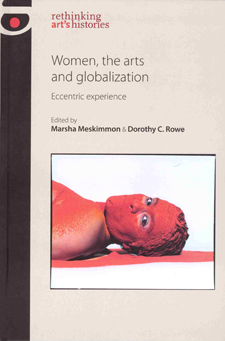
Marsha Meskimmon and Dorothy C. Rowe, eds. Women, the Arts, and Globalization: Eccentric Experience (Manchester, UK: Manchester University Press, 2013).

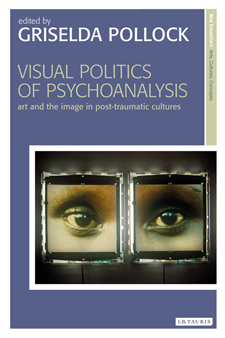
Griselda Pollock, ed. Visual Politics of Psychoanalysis: Art in Post-Traumatic Cultures (London: I. B. Tauris, 2013).

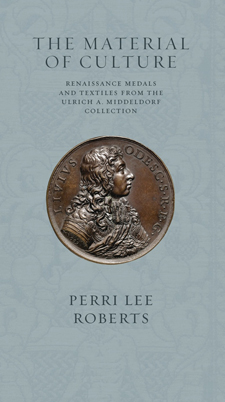
Perri Lee Roberts. The Material of Culture: Medals and Textiles from the Ulrich A. Middeldorf Collection (Athens: Georgia Museum of Art, University of Georgia, 2013).

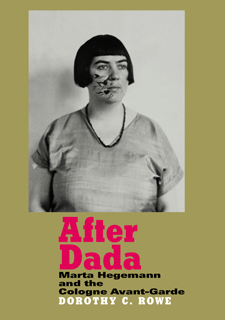
Dorothy C. Rowe. After Dada: Marta Hegemann and the Cologne Avant-Garde (Manchester, UK: Manchester University Press, 2013).

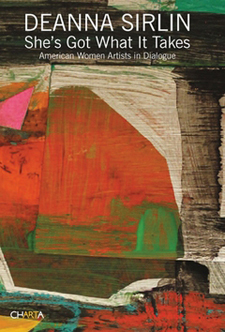
Deanna Sirlin. She’s Got What It Takes: American Women Artists in Dialogue (Milan, Italy: Charta, 2013).

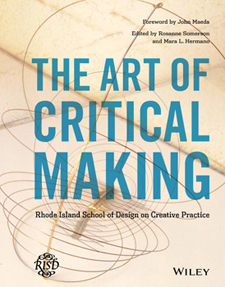
Rosanne Somerson and Mara Hermano, eds. The Art of Critical Making: Rhode Island School of Design on Creative Practice (Hoboken, NJ: Wiley, 2013).

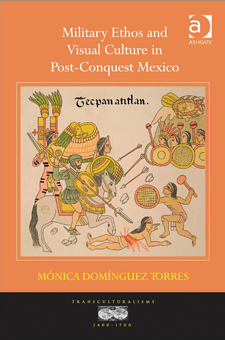
Mónica Domínguez Torres. Military Ethos and Visual Culture in Post-Conquest Mexico (Burlington, VT: Ashgate, 2013).

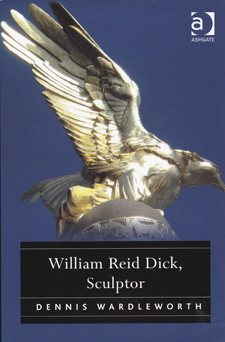
Dennis Wardleworth. William Reid Dick, Sculptor (Burlington, VT: Ashgate, 2013).
Deadline for Conference Mentoring Sessions Extended
posted Dec 13, 2013
The deadline for applications to participate in CAA’s two conference mentoring sessions—the Artists’ Portfolio Review or Career Development Mentoring—has been extended to Friday, January 17, 2014.
As a CAA member, you have access to a diverse range of mentors at Career Services during the 102nd Annual Conference, taking place February 12–15, 2014, in Chicago. All emerging, midcareer, and even advanced art professionals can benefit from one-on-one discussions with dedicated mentors about artists’ portfolios, career-management skills, and professional strategies.
You may enroll in either the Artists’ Portfolio Review or Career Development Mentoring—please choose one. Participants are chosen by a lottery of applications received by the deadline; all applicants are notified of their scheduled date and time slot by email in early 2014. Both sessions are offered free of charge. Conference registration, while encouraged, is not necessary to participate. All applicants must be current CAA members.
Artists’ Portfolio Review
The Artists’ Portfolio Review offers CAA members the opportunity to have digital images or DVDs of their work reviewed by artists, critics, curators, and educators in personal twenty-minute consultations. Whenever possible, CAA matches artists and mentors based on medium or discipline. You may bring battery-powered laptops; wireless internet, however, is not available in the room. Sessions are filled by appointment only and are scheduled for Thursday, February 13, and Friday, February 14, 2014, 8:00 AM–NOON and 1:00–5:00 PM each day.
To apply, download and complete the Career Development Enrollment Form or fill out the paper form in the 2014 Conference Information and Registration booklet, which will be mailed to all individual and institutional CAA members in October 2013. Send the completed form by email to Lauren Stark, CAA manager of programs; by fax to 212-627-2381; or by mail to: Artists’ Portfolio Review, College Art Association, 50 Broadway, 21st Floor, New York, NY 10004. Deadline extended: January 17, 2014.
Career Development Mentoring
Artists, art historians, art educators, and museum professionals at all stages of their careers may apply for one-on-one consultations with veterans in their fields. Through personal twenty-minute consultations, Career Development Mentoring offers a unique opportunity for participants to receive candid advice on how to conduct a thorough job search; present cover letters, CVs, and digital images; and prepare for interviews. Whenever possible, CAA matches participants and mentors based on medium or discipline. Sessions are filled by appointment only and are scheduled for Thursday, February 13, and Friday, February 14, 2014, 8:00 AM–NOON and 1:00–5:00 PM each day.
To apply, download and complete the Career Development Enrollment Form or fill out the paper form in the 2014 Conference Information and Registration booklet, which will be mailed to all individual and institutional CAA members in October 2013. Send the completed form by email to Lauren Stark, CAA manager of programs; by fax to 212-627-2381; or by mail to: Career Development Mentoring, College Art Association, 50 Broadway, 21st Floor, New York, NY 10004. Deadline extended: January 17, 2014.
Copyright Office Releases New Report on Resale Royalties
posted Dec 13, 2013
 The U.S. Copyright Office today publicly released a report on the issue of resale royalties for visual artists, or the “droit de suite.” The report was requested by Congressman Jerrold Nadler and Senator Herb Kohl in 2012, and is an adjunct to the Office’s 1992 report on the same topic. Some seventy countries have enacted resale royalty provisions in their laws, over thirty of them since 1992, including the United Kingdom, which is home to one of the world’s most significant art markets.
The Copyright Office has concluded that certain visual artists may operate at a disadvantage under the copyright law relative to authors of other types of creative works. Contrary to its 1992 report, the Office is supportive of further congressional exploration of a resale royalty at this time. It also supports exploration of alternative or complementary options that may take into account the broader context of art industry norms and art market practices, for example, voluntary initiatives or best practices for transactions and financial provisions involving artworks. The report reflects the diversity of public comments received by the Office over the past year, and makes a number of observations and recommendations that Congress may wish to consider in its deliberations.
The full report is available at http://www.copyright.gov/docs/resaleroyalty/usco-resaleroyalty.pdf
Letter Urging Secretary John Kerry to Restore Funding for Title VIII
posted Dec 12, 2013
Anne Collins Goodyear, president of CAA’s Board of Directors, and Linda Downs, the organization’s executive director, signed the following letter. You may wish to view a list of programs that have been eliminated by the government that have been supported by Title VIII: http://aseees.org/new/title8-alert.php.
Letter Urging Secretary John Kerry to Restore Funding for Title VIII
December 11, 2013
The Honorable John Kerry
Secretary of State
United States Department of State
2201 C Street NW
Washington, DC 20520
Dear Secretary Kerry:
The undersigned individuals and organizations share with the Department of State the fundamental goal of creating a peaceful, secure, and prosperous global future. To achieve such an end in an increasingly complex world, the U.S. needs accurate analyses by well-trained specialists both in and outside the government.
For the region of Russia, Eastern Europe, and Central Asia, the Department of State has for thirty years trained future leaders and scholars through the Research and Training for Eastern Europe and the New Independent States of the Former Soviet Union Act (PL 90-164, Title VIII). Title VIII has played a significant part in the education of many prominent American policymakers and specialists in the region, including former Secretaries of State Madeleine Albright and Condoleezza Rice, and US Ambassador to Russia Michael McFaul. We are writing to you today to urge you to restore funding for the Title VIII program and to include funding for the Title VIII program as part of your fiscal year 2015 budget request.
Title VIII programs in fiscal year 2012 were administered by the Bureau of Intelligence and Research and supported by the Department of State at a level of $3.5 million. Despite its low cost, Title VIII is a program that continues to have a significant impact on the analytic and diplomatic capacities of the Department of State and on the research base in the academic sector.
At stake are programs that support policy-relevant research, advanced language training, and a specialized information clearing house and reference service related to countries in Central Asia and the Caucasus, Russia and Eastern Europe. A remarkably high percentage of US university faculty who teach about Eastern Europe and Eurasia, State Department specialists on the region, and think tank analysts who advise policymakers have conducted their field work and research and obtained advanced language proficiency thanks to programs funded by Title VIII.
Although the Department of State solicited applications for a fiscal year 2013 Title VIII program, the Department in September announced the cancellation of the program for fiscal year 2013 because it did not receive appropriations. We believe the discontinuation of this program is short-sighted and not in the national and public interest. We urge you to use existing authority to continue to fund this program under the administration of the Bureau of Intelligence and Research at least at the current funding level of $3.5 million for fiscal years 2013 and 2014. We also ask that you include at least that level of funding within the fiscal year 2015 budget request for the Title VIII program.
Title VIII is a small but impactful program that has directly supported several generations of policymakers, diplomats and scholars and indirectly supported their thousands of students and the people who depend on their analyses to make the right business, humanitarian, and foreign policy decisions about a crucial region of the world.
We respectfully draw your attention to this issue and strongly urge that the Department of State immediately take steps to restore funding for the Title VIII program.
Sincerely,
Diane P. Koenker
President, Association for Slavic, East European, and Eurasian Studies
Professor of History, University of Illinois, Urbana-Champaign
Stephen E. Hanson
Vice President, Association for Slavic, East European, and Eurasian Studies
Vice Provost for International Affairs, College of William and Mary
Lynda Park
Executive Director, Association for Slavic, East European, and Eurasian Studies
Ambassador John Beyrle (Ret.)
Former U.S. Ambassador to Russia and Bulgaria
Ambassador James F. Collins (Ret.)
Former U.S. Ambassador to Russia
Ambassador Jack Matlock (Ret.)
Former U.S. Ambassador to the Soviet Union
Ambassador Richard Miles (Ret.)
Former U.S. Ambassador to Azerbaijan, Bulgaria, and Georgia
Ambassador Thomas W. Simons, Jr. (Ret.)
Former U.S. Ambassador to Poland
Mary Thompson-Jones
Senior Foreign Service Officer (Ret.)
Michael M. Crow
President, Arizona State University
Robert A. Easter
President, University of Illinois, Urbana-Champaign
Michael McCarry
Executive Director, Alliance for International Educational and Cultural Exchange
John R. Fitzmier
Executive Director, American Academy of Religion
Edward Liebow
Executive Director, American Anthropological Association
Thomas Seifrid
President, American Association of Teachers of Slavic and East European Languages
Vitaly Chernetsky
President, American Association for Ukrainian Studies
Alexander J. Beecroft
Secretary-Treasurer, American Comparative Literature Association
Pauline Yu
President, American Council of Learned Societies
Dan Davidson
President, American Councils for International Education: ACTR/ACCELS
James Grossman
Executive Director, American Historical Association
Jonathan Rodgers
Secretary-Treasurer, American Oriental Society
Steven Rathgeb Smith
Executive Director, American Political Science Association
Douglas Richardson
Executive Director, Association for American Geographers
Cynthia Werner
President, Central Eurasian Studies Society
Anne Collins Goodyear
President, College Art Association
Linda Downs
Executive Director, College Art Association
David A. Berry
Executive Director, Community College Humanities Association
Melissa Feinberg
President, Czechoslovak Studies Association
Emese Ivan
President, Hungarian Studies Association
Ambassador W. Robert Pearson (Ret.)
President, IREX
William P. Rivers
Executive Director, Joint National Committee for Language-National Council on Language and International Studies; Chair, ASTM F43 Committee on Language Services and Products
Amy W. Newhall
Executive Director, Middle East Studies Association
David P. Patton
President, National Council for Eurasian and East European Research
Stephen Kidd
Executive Director, National Humanities Alliance
Ira Katznelson
President, Social Science Research Council
Pauline Saliga
Executive Director, Society of Architectural Historians
Kevork B. Bardakjian
President, Society for Armenian Studies
James Castonguay
Treasurer, Society for Cinema and Media Studies
Irina Livezeanu
President, Society for Romanian Studies
Olga M. Mladenova
President, South East European Studies Association
Laura Adams
Director of the Program on Central Asia and Caucasus, Harvard University
Stephen K. Batalden
Director, Melikian Center: Russian, Eurasian, & East European Studies, Arizona State University
David Cooper
Director of the Russian, East European, and Eurasian Center, University of Illinois, Urbana-Champaign
Victor Friedman
Director, Center for East European, Russian, and Eurasian Studies, University of Chicago
Robert M. Hayden
Director, Russian & East European Studies, University of Pittsburgh
Yoshiko M. Herrera
Director, Center for Russia, East Europe and Central Asia, and Co-Director, International Institute, University of Wisconsin-Madison
Gail Kligman
Director, Center for European and Eurasian Studies, UCLA
Terry Martin
Director, Davis Center for Russian and Eurasian Studies, Harvard University
Scott Radnitz
Director, Ellison Center for Russian, East European, and Central Asian Studies, University of Washington
Also Signed are ASEEES Board and Past Presidents
Mark R. Beissinger, Princeton University
Marianna Tax Choldin, University of Illinois at Urbana-Champaign
Katerina Clark, Yale University
Megan Dixon, College of Idaho
Zsuzsa Gille, University of Illinois, Urbana-Champaign
Bruce Grant, New York University
Beth Holmgren, Duke University
Adeeb Khalid, Carleton College
Judith Deutsch Kornblatt, University of Wisconsin
Gail Lapidus, Stanford University
Susan Linz, Michigan State University
Harriet L. Murav, University of Illinois, Urbana-Champaign
Mieke Meurs, American University
Norman Naimark, Stanford University
Joan Neuberger, University of Texas at Austin
Janice T. Pilch, Rutgers University Libraries
David L. Ransel, Indiana University
Irina Reyfman, Columbia University
Douglas Rogers, Yale University
William Rosenberg, University of Michigan
Jane Sharp, Rutgers, The State University of New Jersey
Olga Shevchenko, Williams College
Valeria Sobol, University of Illinois, Urbana-Champaign
Ronald Suny, University of Michigan
William Taubman, Amherst College
Katherine Verdery, CUNY Graduate Center
Mark L. von Hagen, Arizona State University
Leslie Waters, College of William and Mary
Robert Weinberg, Swarthmore College
cc: Ambassador William Burns, Deputy Secretary of State, Office of the Deputy Secretary Daniel Rubinstein, Acting Assistant Secretary for Bureau of Intelligence and Research (INR) Ambassador Victoria Nuland, Assistant Secretary for Bureau of European and Eurasian Affairs
(EUR/FO)
News from the Art and Academic Worlds
posted Dec 11, 2013
Each week CAA News publishes summaries of eight articles, published around the web, that CAA members may find interesting and useful in their professional and creative lives.
Want to Help DIA Art and Detroit Pensions? Now You Can
Inspired by the philanthropist A. Paul Schaap’s $5 million pledge, a local foundation said it created a fund so the public can contribute tax-deductible money to help protect the Detroit Institute of Arts’ collection and city pensions. The Free Press also confirmed that DIA has joined federally mediated talks—which include leaders from at least ten national and local charitable foundations—to create a $500 million fund that could be leveraged for the same dual purpose of shielding the art collection and lessening pension cuts. (Read more from the Detroit Free Press.)
Don’t Loot Detroit’s Art Museum to Pay the City’s Creditors
Last week a federal judge ruled that Detroit was eligible to enter Chapter 9 bankruptcy—the largest municipal bankruptcy in American history. That same day, we got a price tag for how much the collection of the threatened Detroit Institute of Arts, one of the country’s oldest and best museums, is likely worth. For months, salivating creditors have circled the museum while the institution has tried to keep them at bay. Now, for better and for worse, we have a price tag. (Read more from the Guardian.)
Fate of Detroit Hangs in the Balance
With a ruling by a federal judge last week that Detroit is eligible to enter bankruptcy, the fate of the city’s art collection—one of the finest in the country—now moves front and center in the legal battle over the city’s future. But the judge, Steven W. Rhodes, questioned for the first time the push by some of the city’s largest creditors to sell paintings and sculpture from the Detroit Institute of Arts. While he did not say specifically that the art should be spared, Judge Rhodes, in a brief mention of DIA by name, said that such a sale would not have helped Detroit avoid bankruptcy. (Read more from the New York Times.)
Invisible No Longer
In 1993 the book The Invisible Faculty commanded the attention of college officials from around the country, seizing on what was then a fast-growing but barely examined trend reshaping the higher-education landscape: the burgeoning role of adjunct, part-time professors being hired as college administrators scoured budgets for ways to cut costs. Two decades later, adjuncts—also called contingent faculty—are no longer invisible. They are squarely in the media spotlight, pushed there by the Affordable Care Act. (Read more from Community College Week.)
Street Artists Go to Court to Protect Their Work
A legal battle between a group of artists and the owners of 5Pointz, the Long Island City graffiti complex, has challenged the way street art is viewed as an ephemeral medium. The case, which the lawyer representing the artists says is not over despite the murals being whitewashed last month, is the first to examine whether authorized graffiti is protected under United States law. (Read more from the Art Newspaper.)
The Latest Leonardo Debate
The discovery of a previously unknown painting by Leonardo never fails to stir up the experts, the press, and the public. After all, only fifteen to twenty paintings—finished and unfinished—are generally attributed to him. In early October, the Italian newspaper Corriere della Sera reported the existence of a painting closely resembling Leonardo’s colored chalk and pastel drawing of the noblewoman Isabella d’Este in the Louvre. (Read more from ARTnews.)
The Overexposed Museum
For some time, art museums have been expending considerable amounts of energy and other resources on a broad campaign of public engagement designed to establish a stronger bond between themselves and the public, and thus cement the museum’s place as an essential—even indispensable—component of public life. Social media promotes their programs and addresses the public in other ways, crowdsourcing guides them in their acquisition and exhibition decisions, and crowdfunding helps pay for them. So far this campaign seems to be paying dividends. (Read more from the New Criterion.)
Inside the Box
In the United States we are raised to appreciate the accomplishments of inventors and thinkers—creative people whose ideas have transformed our world. We celebrate the famously imaginative, the greatest artists and innovators from van Gogh to Steve Jobs. Viewing the world creatively is supposed to be an asset, even a virtue. It’s all a lie: most people don’t actually like creativity. Studies confirm what many creative people have suspected all along: people are biased against creative thinking, despite all of their insistence otherwise. (Read more from Slate.)
Committee on Women in the Arts Picks for December 2013
posted Dec 10, 2013
Each month, CAA’s Committee on Women in the Arts selects the best in feminist art and scholarship. The following exhibitions and events should not be missed. Check the archive of CWA Picks at the bottom of the page, as several museum and gallery shows listed in previous months may still be on view or touring.
December 2013

Installation view of Harmony Hammond’s work at Alexander Gray Associates (artworks © Harmony Hammond)
Harmony Hammond
Alexander Gray Associates
508 West 26th Street, No. 215, New York, NY 10001
October 23–December 7, 2013
The first one-person exhibition of work by Harmony Hammond in New York since the 1990s at Alexander Gray Associates is a must-see minisurvey and a reminder that a retrospective of this feminist- and queer-art pioneer, activist, writer, and cofounder of A.I.R. Gallery and Heresies in the city where she began her career in the late 1960s, before moving to New Mexico in the 1980s, is still overdue.
In one of her statements Hammond reminisces that: “the post-modern focus on representation, contributed to an inaccurate reading of the creative climate in New York during the late 1960s and ’70s, a period of interdisciplinary experimentation that resulted in work both conceptual and abstract. Artists moved between the disciplines ignoring, crossing, dissolving boundaries. Abstract painting, especially that coming out of post-minimal concerns of materials and process, was central to the experimentation…. Feminism brought a gendered content to this way of working. I moved to New York’s Lower East Side, and then to the corner of Spring and West Broadway in early fall 1969. It was a period of civil rights and antiwar activism, the gay liberation movement, the second wave feminist movement, and the birth of feminist art. I was influenced by and contributed to early feminist art projects. I painted on blankets, curtains, and bedspreads recycled from women friends, literally putting my life in my art. Rag strips dipped in paint and attached to the painting surface hung down like three-dimensional brushstrokes, their weight altering the painting rectangle. Eventually the rags took over and activated the painting field…. This led to the series Bags, and the slightly larger than life-size Presences. These new pieces could be touched, retouched, repaired, and, like women’s lives, reconfigured. In 1973, I created a series of six floor paintings made out of knit fabric my daughter and I picked from dumpsters. Strips of fabric were braided according to traditional braided rug techniques, but slightly larger and thicker in scale, coiled, stitched to a heavy cloth backing, and partially painted with acrylic paint—the ‘braided rug’ literally and metaphorically becoming ‘the support’ for the painting. The Floorpieces occupied and negotiated a space between painting (off the wall) and sculpture (nearly flat). Placed directly on the floor they called into question assumptions about the ‘place’ of painting.”
Focusing on her longstanding commitment to process-based abstraction, the exhibition includes paintings and works on paper from the past five decades, with a focus on recent paintings and sculptures, allowing a fresh consideration of the way activist concerns and queer identity is inscribed in her work.
Martha Wilson: Staging the Self
Mary H. Dana Women Artist Series at the Douglass Library Galleries
Rutgers University, 8 Chapel Drive, New Brunswick, NJ 08901
October 21, 2013–January 31, 2014
Named the 2013–14 Estelle Lebowitz Visiting Artist in Residence for the Mary H. Dana Women Artist Series, Martha Wilson is the honorary subject of the exhibition Martha Wilson: Staging the Self, organized by the founding directors of the Institute for Women and Art at Rutgers University, Judith K. Brodsky and Ferris Olin, and featuring primarily early work, namely Wilson’s famed photo-text series A portfolio of models.
Born in 1947, Wilson is a pioneering feminist artist and gallery director, belatedly recognized for her innovative photographic and video works that explore her female subjectivity through roleplaying, costume transformations, “invasions” of other people’s personae and the “camera’s presence.” She began making these works in the early 1970s while in Halifax, Nova Scotia, and further developed her practice after moving to New York in 1974. Two years later Wilson founded and continues to direct Franklin Furnace, an artist-run space that champions the exploration, promotion, and preservation of artist’s books, video, and installation, online, and performance art, “challenging institutional norms, the roles artists play within society, and expectations about what constitutes acceptable art mediums.” As a performance artist she founded and collaborated with Disband, the all-girl conceptual punk band of women artists who couldn’t play any instruments; she also impersonated political figures such as Alexander M. Haig Jr., Nancy Reagan, Barbara Bush, and Tipper Gore.
Wilson has been described by the New York Times critic Holland Cotter as one of “the half-dozen most important people for art in downtown Manhattan in the 1970s” and was championed early in her career by pioneering critics such Lucy R. Lippard. Yet while prefiguring notions of gender performativity as theorized by Judith Butler and explored by Cindy Sherman, Wilson’s prefeminist strategies of masquerade were marginalized, and her use of her own body often caused her to be written out of the history of Conceptual art, an area in which she radically intervened during the 1970s from the perspective of a woman. Tellingly, Wilson had her first solo exhibition in New York at Mitchell Algus Gallery, Martha Wilson: Photo/Text Works, 1971–74, only in 2008.

Isa Genzken. Disco Soon (Ground Zero), 2008, synthetic polymer paint on plastic, cardboard, mirror, spray paint, metal, fabric, hose lights, mirror foil, printed sticker, wood blocks, fiberboard, and casters, 86 1/4 x 80 11/16 x 64 15/16 in. Carlos and Rosa de la Cruz Collection (artwork © Isa Genzken; photograph provided by the artist and Galerie Buchholz, Cologne/Berlin)
Isa Genzken: Retrospective
Museum of Modern Art
11 West 53rd Street, New York, NY 10019
November 23, 2013–March 10, 2014
Isa Genzken: Retrospective is the first comprehensive retrospective of the German multimedia artist in an American museum and the largest survey of her work to date. Surprisingly embraced by MoMA, Genzken has been both a controversial and an influential figure in German art of the past thirty years, appreciated mostly outside her country and known as much for her work as for her marriage with Gerhardt Richter, her Nazi family background, and her self-destructive lifestyle (due to mental illness and alcoholism). Capitalizing idiosyncratically on found objects and collage, this exhibition features Genzken’s small- and installation- scale works that have helped to redefine contemporary assemblage. The artist, however, has worked in many media over the past forty years, including painting, photography, collage, drawing, artist’s books, film, and public sculpture. She begun in the 1970s with geometric curved sculptures from wood whose often-ellipsoid shape could reference the theosophic investigations of her grandfather. The cement sculptures she initiated in the 1980s remain an incredibly powerful chapter of her work and interweave her constant interest in architecture with the “metaphors of vulnerability” that play a central role in her art making, according to the Der Spiegel critic Ulrike Knöfel. Bringing almost 150 objects shown in the United States for the first time, this retrospective offers a thorough introduction to the artist’s work, as well as to the role of “minimalism and trash, neon and despair” in it, as the same critic observes. After its run at MoMA, the show will travel to museums in Dallas and Chicago.
KIMSOOJA: Unfolding
Vancouver Art Gallery
750 Hornby Street, Vancouver, British Columbia,
Canada V6Z 2H7
October 11, 2013–January 26, 2014
Constantly addressing issues of the displaced self and conditions of humanity, Kimsooja “experiments with various media through immobility and non-doing that inverts the notion of the artist as the predominant actor and maker.”
Born in Daegu, Korea, Kimsooja is based in New York, Paris, and Seoul and came to international fame in the 1990s following a P.S.1 residency in New York. This period paved the way for some of her most signature pieces: Bottari, Cities on the Move—2727km Bottari Truck, and A Needle Woman, shown in numerous exhibitions and biennales around the world. Bottari Truck consisted of a truck loaded with bottari, the Korean word for bundle, which traveled throughout Korea for eleven days. Replaced by bags in modern society, as the artist has recently said, “Bottari is the most flexible container in which we carry the minimized valuable things and its use is universal through history. We keep precious things, mostly in dangerous zones of our life, such as war, migration, exile, separation or a move where urgency take places. Anyone can make Bottari…. however, I’ve been intentionally wrapping it with used or abandoned Korean bedcovers that were made for newly married couples with symbols and embroideries and mostly wrapping used clothing inside—that has significant meanings and questions on life. In other words, the Bottari I wrap is an object that contains husks of our body wrapped with a fabric that is the place of birth, love, dream, suffering and death—a frame of life. While Bottari wraps bodies and souls, containing past, present, and future, a Bottari truck is rather a process than a product, or rather oscillating between the process and the object that is a social sculpture. It represents an abstraction of personage, an abstraction of society and history, and that of time and memory. It is a loaded self, a loaded others, a loaded history, a loaded in-between. Bottari Truck is a processing object throughout space and time, locating and dislocating ourselves to the place where we came from, and where we are going. I find Bottari as a womb and a tomb, globe and universe, and Bottari Truck is a bundle of bundle of bundle folding and unfolding our mind and geography, time and space.”
Following the Bottari Truck project, Kimsooja started a video performance called A Needle Woman, showing the artist from the back standing in the middle of main thoroughfares in various cities throughout the world. This work further developed the concept of sewing toward abstraction, bringing together people, nature, cultures, and civilizations.
As a broad survey that includes early textile-based pieces from the 1980s to large site-specific installations as Bottari Truck and videos, this exhibition highlights works that address notions of time, memory, and displacement in the face of change and social flux, and of the relationship between the human body and the material world.
CAA Offers Access to JSTOR for Members
posted Dec 10, 2013
 JPASS, a new JSTOR access plan for individuals, is ideal for CAA members who want individual access to JSTOR’s rich archival collections. It is especially valuable for individuals without institutional access; faculty members at institutions with limited access to JSTOR; and adjuncts with irregular access to library resources. Regardless of your professional affiliation, JPASS serves as your personal library card to the expansive selection of journals on JSTOR.
As part of your CAA membership, you may purchase a one-year JPASS access plan for $99—a 50 percent discount on the listed rate!
JPASS includes unlimited reading and up to 120 article downloads—not only to The Art Bulletin and Art Journal but also to more than 1,500 humanities, social science, and science journals in the JSTOR archival collections, including the Burlington Magazine, Design Issues, Gesta, the Journal of African Cultural Studies, Muqarnas, and October.
CAA invites you to review the JPASS collections at http://jpass.jstor.org/collections, where you can view all the journal titles and date ranges that are available to JPASS subscribers, as well as filter titles by subject to help you discover publications of interest to you.
Dedicated support personnel for JPASS are available Monday–Friday, 8:30 AM–5:30 PM EDT. You can also get real-time support via Twitter: @JSTORSupport. Here are other ways to learn more:
- Email: service@jstor.org
- Phone (toll free): 888-388-3574 (option 2)
- JPASS FAQs: http://jpass.jstor.org/faq
- JPASS web form: http://bit.ly/1940drP
To use your member discount to sign up for JPASS, log into your CAA account and click the Member Benefits link on the left and then refer to the JPASS instructions which includes the JSTOR custom link. This will admit you to the JPASS purchase website for CAA members.
JSTOR provides access to the complete back runs of CAA’s journals and preserves them in a long-term archive. Users may search, browse, view, and print full-text, high-resolution PDFs of articles from The Art Bulletin (published since 1913) and Art Journal (published since 1929). Coverage in JSTOR includes the journals’ previous titles from their first issues through 2010. Because of a moving wall that changes annually, the most recent three years (2011–13) are not yet available.
The Art Bulletin and Art Journal are available through JSTOR’s Arts & Sciences III Collection. Users at participating institutions can gain access to these two journals through their institutions—contact your librarian to find out if you are eligible and, if so, how to access the journals. In a separate benefit, CAA offers online access to back issues of its two print publications for CAA members unaffiliated with an institution for $20 a year through a special arrangement with JSTOR. Please contact CAA’s Member Services if you have questions about this benefit.
You can review the tables of contents for The Art Bulletin (1996–present) on the CAA website and for Art Journal (1998–present) on its own website.
CWA Picks for December 2013
posted Dec 05, 2013
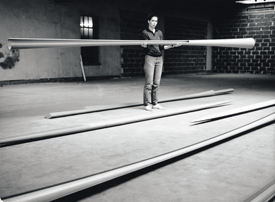 Each month CAA’s Committee on Women in the Arts produces a curated list, called CWA Picks, of recommended exhibitions and events related to feminist art and scholarship in North America and around the world.
The CWA Picks for December 2013 consist of four important survey exhibitions of work by Isa Genzken at the Museum of Modern Art and Harmony Hammond at Alexander Gray Associates in New York, by Martha Wilson at Rutgers University in New Brunswick, New Jersey, and by Kimsooja in Vancouver, British Columbia.
Check the archive of CWA Picks at the bottom of the page, as several museum and gallery shows listed in previous months may still be on view or touring.
Image Caption
Isa Genzken in her studio, 1982 (photograph provided by the artist and Galerie Buchholz, Cologne/Berlin).