
CAA News Today
Grants, Awards, and Honors
posted Aug 15, 2013
CAA recognizes its members for their professional achievements, be it a grant, fellowship, residency, book prize, honorary degree, or related award.
Grants, Awards, and Honors is published every two months: in February, April, June, August, October, and December. To learn more about submitting a listing, please follow the instructions on the main Member News page.
August 2013

Joseph Ackley, a PhD candidate in art history at New York University’s Institute of Fine Arts, has been awarded a research grant for his participation in the Mellon Research Initiative conference, “Art History and the Art of Deception,” taking place in October 2013.

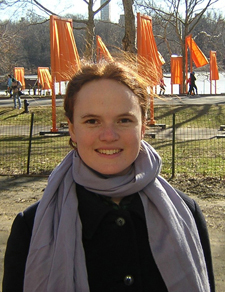 Sarah Archino
Sarah Archino, a teaching fellow in the Department of Art at Millsaps College in Jackson Mississippi, who earned her doctorate in art history from the Graduate Center, City University of New York, has accepted a 2013–15 postdoctoral teaching fellowship at the Institut National d’Histoire de l’Art in Paris, France, from the Terra Foundation for American Art.
Chris Barnard, an artist based in Los Angeles, California, has spent the month of June 2013 in residency at the Vermont Studio Center in Johnson, Vermont.
Julia Whitney Barnes, an artist based in Brooklyn, New York, has received a commission to create a permanent glass-mosaic installation, titled Coloridas Historias de México, for the Brooklyn School of Inquiry.

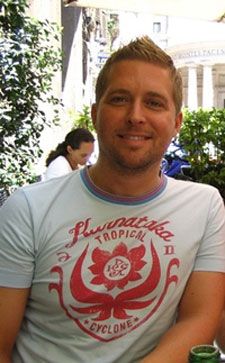 Sinclair Bell
Sinclair Bell, associate professor of art history at Northern Illinois University in DeKalb, has been awarded a Howard Fellowship from the Howard Foundation at Brown University for 2013–14 to complete a monograph on chariot racing in ancient Rome.
Sarah Berkeley has been named a resident artist by the Artists’ Cooperative Residency and Exhibitions (ACRE) in Steuben, Wisconsin. Berkeley’s collaborator, Regin Igloria, will join her during the summer 2013 program.
Wendy Bellion, associate professor in the Department of Art History at the University of Delaware in Newark, has received an eight-week visiting professorship at the Institut National d’Histoire de l’Art in Paris, France, for spring 2015.

 Steven Bleicher, Jennifer Wen Ma, and Zheng Jianwei, Nature and Man in Rhapsody of Light at the Water Cube, 2013
Steven Bleicher has been awarded a commission to produce a public art project, called Nature and Man in Rhapsody of Light at the Water Cube, in Beijing, China. His collaborators for the work were the artist Jennifer Wen Ma and the lighting designer Zheng Jianwei. Bleicher was the color specialist.

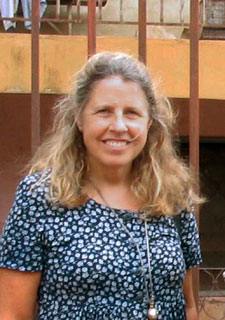 Suzanne Preston Blier
Suzanne Preston Blier, Allen Whitehill Clowes Professor of Fine Arts and Professor of African and African American Studies in the Department of Art and Architecture at Harvard University in Cambridge, Massachusetts, has been named a 2013–14 Getty scholar by the Getty Research Institute in Los Angeles, California. She will work on a project entitled “By Sea, Sand, and River: Africa and the West, a History in Art (1300–1800).”
Michele Brody, an artist based in New York, has completed the Emmanuel College Artist in Residence Program, where she worked with three other artists on a class called “Contemporary Art and Artistic Practice.”
Larry Busbea has won a 2013 Grant to Individuals in the category of research from the Graham Foundation for Advanced Studies in the Fine Arts, based in Chicago, Illinois. His project is called “The Responsive Environment: Aesthetics, Design, and Ecology in the 1970s.”
Katherine Bussard, Peter C. Bunnell Curator of Photography at the Princeton University Art Museum in Princeton, New Jersey, has earned a 2013 Grant to Individuals in the publication category from the Graham Foundation for Advanced Studies in the Fine Arts. Her publication is called Unfamiliar Streets: Photographs by Richard Avedon, Charles Moore, Martha Rosler, and Philip-Lorca diCorcia.

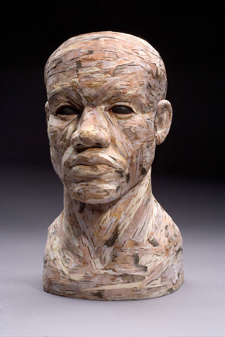 Kimberly Callas, Birch Bark Breathing (artwork © Kimberly Callas)
Kimberly Callas, an artist based in Brooks, Maine, has received a Puffin Foundation Grant for her sculptural project Portraits of the Ecological Self. The project includes ten hand-sculpted, life-size portraits that combine a detailed likeness of an individual with natural materials chosen to reveal the unique bond an individual has with nature.
Luis M. Castañeda has won a 2013 Grant to Individuals in the publication category from the Graham Foundation for Advanced Studies in the Fine Arts, based in Chicago, Illinois. His book is called The Exhibitionist State: Image Economies of the Mexican “Miracle.”
Sheila Crane has won a 2013 Grant to Individuals in the category of research from the Graham Foundation for Advanced Studies in the Fine Arts, based in Chicago, Illinois. Her project is called “Inventing Informality.”


Florina Hernandez Capistrano-Baker, a consultant for the Ayala Museum in Makati City, Philippines, has been named a 2013–14 Getty scholar by the Getty Research Institute in Los Angeles, California. Her project is called “Routes of Exchange: Tenth–Thirteenth Century Gold from Butuan and Links to the Indian Ocean and Mediterranean Trade Network.”
Grace Chuang, a doctoral student in art history at New York University’s Institute of Fine Arts, has received the 2013–14 IFA/Centre Allemand Fellowship in Paris, France.
William Coleman, a doctoral student in the History of Art Department at the University of California, Berkeley, has been appointed a 2013–14 predoctoral fellow at the Smithsonian American Art Museum in Washington, DC. He will continue work on “Thomas Cole’s Buildings: Architecture in Painting and Practice in the Early Republic.”
Erin Corrales-Diaz, a PhD student in the Art Department at the University of North Carolina, Chapel Hill, has been named Joe and Wanda Corn Predoctoral Fellow at the Smithsonian American Art Museum in Washington, DC. Her research involves “Remembering the Veteran: Disability, Trauma, and the American Civil War, 1861–1915.”
Vanessa Frances Rhiannon Crosby, a PhD candidate in the Department of Religious Studies at Northwestern University in Evanston, Illinois, has been named a 2013–14 predoctoral fellow by the Getty Research Institute in Los Angeles, California. She will work on “Foreign Goods and Trans-Regional Identities: Commemoration as Cross Cultural Encounter.”
John J. Curley, assistant professor in the Department of Art at Wake Forest University in Winston Salem, North Carolina, has received a publication grant from the Terra Foundation for American Art for his book A Conspiracy of Images: Andy Warhol, Gerhard Richter, and Cold War Visuality, forthcoming from Yale University Press.
Melissa Dabakis, professor of art history at Kenyon College in Gambier, Ohio, has been appointed Terra Foundation Senior Fellow in American Art for 2013 at the Smithsonian American Art Museum in Washington, DC. She will work on “A Cultural History of Italo-American Relations, 1760–1900.”
Melissa Dabakis, professor of art history at Kenyon College in Gambier, Ohio, has received a publication grant from the Terra Foundation for American Art for her book The American Corinnes: Women Sculptors and the Eternal City, 1850–1876, forthcoming from Pennsylvania State University Press.
Chanchal Dadlani, assistant professor of art history in the Department of Art at Wake Forest University in Winston-Salem, North Carolina, has been awarded a 2013–14 National Endowment for the Humanities Fellowship by the Getty Research Institute in Los Angeles, California. Her project is titled “Art and Epistemology between Early Modern India and France: The Collection of Jean-Baptiste Gentil.”
Andrew Demirjian, an artist based in Palisades Park, New Jersey, has been awarded a 2013 New Jersey Individual Artist’s Fellowship in the media/digital art category from the New Jersey State Council on the Arts.
Laura DeVito, a student in the MFA program in collaborative design at Pacific Northwest College of Art in Portland, Oregon, has completed a 2013 Spring Break Residency with Signal Fire in the deserts of Southern California.
Barbara Diener has accepted a residency for summer 2013 at the Artists’ Cooperative Residency and Exhibitions (ACRE), based in Steuben, Wisconsin.
Rob Duarte has been awarded a summer 2013 residency at the Artists’ Cooperative Residency and Exhibitions (ACRE), based in Steuben, Wisconsin.

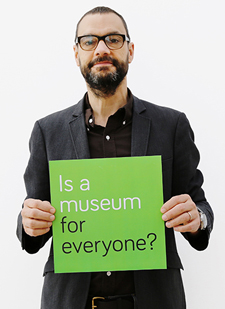 Sam Durant (photograph by Sarah Waldorf and © J. Paul Getty Trust)
Sam Durant, an artist based in Los Angeles, California, has been selected to participate in the 2013 Getty Artists Program, administered by the Education Department at the J. Paul Getty Museum in Los Angeles.
Kara Fiedorek, a doctoral student in art history in the Institute of Fine Arts at New York University, has accepted a research grant for her upcoming participation in a Mellon Research Initiative conference, “Art History and the Art of Deception,” scheduled for October 4–5, 2013.
Coco Fusco, an interdisciplinary artist and writer based in Brooklyn, New York, has completed a May–June 2013 residency at the Atlantic Center for the Arts in New Smyrna Beach, Florida.
Ken Gonzales-Day, an artist and the chair of the Art Department at Scripps College in Claremont, California, has accepted a 2013 summer residency at the Terra Residency Program in Giverny, France. He will work on a project called Absence, Stasis, and Other Non-Decisive Moments.
Ellery Foutch, who completed her PhD in the History of Art Department at the University of Pennsylvania in Philadelphia, has earned a 2013–15 postdoctoral teaching fellowship at the Courtauld Institute of Art in London, England, with help from the Terra Foundation for American Art.
Carl Fuldner, a doctoral student in the Department of Art History at the University of Chicago in Illinois, has been appointed a 2013–14 predoctoral fellow at the Smithsonian American Art Museum in Washington, DC. His dissertation examines “Evolving Photography: Naturalism and American Pictorialism, 1890–1917.”
Christine Eva Göttler, a professor and chair of the Institut für Kunstgeschichte at Universität in Bern, Switzerland, has been named a 2013–14 Getty scholar by the Getty Research Institute in Los Angeles, California. She will work on “Inventing Newness: Art, Local History, and ‘World Knowledge’ in Early Modern Antwerp (Mid-Sixteenth to Mid-Seventeenth Centuries).”
Jennifer Greenhill, associate professor of art history in the School of Art and Design at the University of Illinois, Urbana-Champaign, has been awarded an eight-week visiting professorship at the Institut National d’Histoire de l’Art in Paris, France, for spring 2014, thanks to the Terra Foundation for American Art.
Kenneth Haltman, H. Russell Pitman Professor of Art History in the School of Art and Art History at the University of Oklahoma in Norman, has accepted a visiting professorship in the John F. Kennedy Institute at Freie Universität in Berlin, Germany, for spring–summer 2014, with assistance from the Terra Foundation for American Art.
Adam Han, an MFA student in fiber and material studies at the School of the Art Institute of Chicago in Illinois, has been chosen as a 2013 Windgate Museum Intern by the Center for Craft, Creativity, and Design. He will contribute to a digital exhibition at the Smithsonian Institution’s Archives of American Art in Washington, DC, that tells the story of studio craft in the United States through primary-source material.
Mazie Harris, a doctoral student in the Department of the History of Art and Architecture at Brown University in Providence, Rhode Island, has accepted a fellowship to attend the 2013 Terra Summer Residency in Giverny, France. She will work on “The Portraits and Proprietary Claims of New York Photography Studios on Broadway 1853–1884.”
Andrew Hemingway, emeritus professor of history of art in the Department of History of Art at University College London in England, has accepted a visiting professorship in the John F. Kennedy Institute at Freie Universität in Berlin, Germany, for fall–winter 2013, courtesy the Terra Foundation of American Art.
Christopher Heuer, assistant professor in the Department of Art History and Archaeology at Princeton University in Princeton, New Jersey, has accepted a 2013 Grant to Individuals in the category of public program from the Graham Foundation for Advanced Studies in the Fine Arts. He will work on a project called “7 March 1965” with his collaborators, Abbey Dubin and Matthew Jesse Jackson, in a collective called Our Literal Speed.

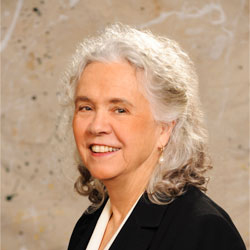 Patricia Hills (photograph by Michael Hamilton)
Patricia Hills, professor in the Department of History of Art and Architecture at Boston University in Massachusetts, has been selected as a guest lecturer for 2013 at the Terra Summer Residency in Giverny, France. She will present “Whatever Happened to the ‘New Art History’? Reflections on Theoretical and Methodological Approaches since the 1970s.

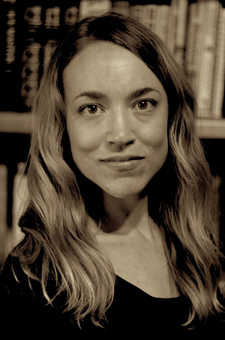 Jessica L. Horton
Jessica L. Horton, an independent scholar who earned her doctorate in the Graduate Program in Visual and Cultural Studies at the University of Rochester in Rochester, New York, has been appointed a 2013–14 postdoctoral fellow at the Smithsonian American Art Museum in Washington, DC. She will work on “Diplomatic Choreographies: The Travels of Native American Dance Paintings during the Cold War.”
Kellie Jones, associate professor in the Department of Art History and Archaeology at Columbia University in New York, has been named a senior scholar for the 2013 Terra Summer Residency in Giverny, France. Her project is titled “Crisscrossing the World: Los Angeles Artists and the Global Imagination, 1960–1980.”
Wendy Katz, an associate professor in the Department of Art and Art History at the University of Nebraska in Lincoln, has been appointed a 2013–14 senior fellow at the Smithsonian American Art Museum in Washington, DC. Her project is “The Politics of Art Criticism in the Penny Press, 1833–61.”
Miri Kim, a PhD student in the Department of Art and Archaeology at Princeton University in Princeton, New Jersey, has accepted a fellowship to attend the 2013 Terra Summer Residency in Giverny, France. She will work on “‘Right Matter in the Right Place’: The Paintings of Albert Pinkham Ryder.”
Kristina Renee Kleutghen, assistant professor in the Department of Art History and Archaeology at Washington University in Saint Louis, Missouri, has been awarded a 2013–14 National Endowment for the Humanities fellowship by the Getty Research Institute in Los Angeles, California. She will continue her work on “Visions of the West: Rediscovering Eighteenth-Century Chinese Perspective Prints and Viewing Devices.”
Marina Kliger, a PhD student in art history in the Institute of Fine Arts at New York University, has accepted a nine-week summer internship at the National Gallery of Art in Washington, DC. She will catalogue and digitize rare French and Belgian reproductive prints.

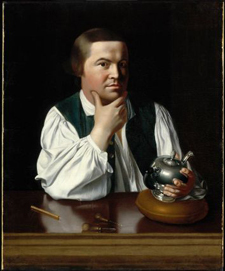 John Singleton Copley, Paul Revere, 1678, oil on canvas, 35⅛ x 28½ in. Museum of Fine Arts, Boston (artwork in the public domain)L. Horton
Ethan W. Lasser, Margaret S. Winthrop Associate Curator of American Art at the Harvard Art Museums in Cambridge, Massachusetts, has received the ninth annual Patricia and Phillip Frost Essay Award from the editorial board of the journal American Art, published by the Smithsonian American Art Museum, based in Washington, DC. His article, “Selling Silver: The Business of Copley’s Paul Revere,” appeared in the Fall 2012 issue of the journal.
Dimitrios Latsis, a PhD candidate in the School of Art and Art History at the University of Iowa in Iowa City, has been named Committee on Institutional Cooperation–Smithsonian Predoctoral Fellow by the Smithsonian American Art Museum in Washington, DC. In a position jointly hosted with the National Museum of American History, Latsis will research “Nature, Nation, Narrative: The Discourse of Landscape in Pre–World War II American Cinema.”
Tirza T. Latimer, chair of the Graduate Program in Visual and Critical Studies at California College of the Arts in Oakland, has been appointed a guest lecturer at the 2013 Terra Summer Residency in Giverny, France. She will give a talk on “The Making of Modernism’s Origin Myths.”
Craig Lee, a doctoral candidate in the Department of Art History at the University of Delaware in Newark, has taken a nine-week summer internship at the National Gallery of Art in Washington, DC. He will review files, construction plans, and progress photographs to produce materials showing the development and evolution of the museum’s master facilities plan projects.

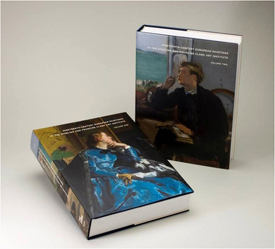
Sara Lees, along with her coauthors Richard Tand and Sandra L. Webber, has won the thirty-third annual George Wittenborn Memorial Book Award from the Art Libraries Society of North America. Their publication is called Nineteenth-Century European Paintings at the Sterling and Francine Clark Art Institute (Williamstown, MA: Sterling and Francine Clark Art Institute, 2012).
Lihong Liu, who recently earned her doctorate in art history from the Institute of Fine Arts at New York University, has received a 2013–14 postdoctoral fellowship from the Getty Research Institute in Los Angeles, California. She will work on “Artistic Exchange between China and Europe during the Eighteenth Century.”
Michael Lobel, professor of art history at Purchase College, State University of New York, in Purchase, New York, has received a 2012–13 Chancellor’s Award for Excellence from his institution. The award recognizes his work in the category of scholarship and creative activities.
Stéphane Loire, chief curator in the Paintings Department at the Musée du Louvre in Paris, France, has been named a 2013–14 museum guest scholar by the Getty Research Institute in Los Angeles, California. His host at the J. Paul Getty Museum will be the Department of Paintings.
Joe Madura, a doctorial student in the Art History Department at Emory University in Atlanta, Georgia, has been appointed a 2013–14 predoctoral fellow at the Smithsonian American Art Museum in Washington, DC. His dissertation topic is “Revising Minimal Art in the AIDS Crisis, 1984–98.”
Christopher Manzione, an artist based in Vernon, New Jersey, has been awarded a 2013 New Jersey Individual Artist’s Fellowship in the category of media/digital art from the New Jersey State Council on the Arts.

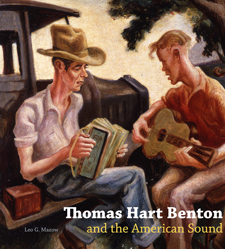
Lee Mazow, associate professor of art history in the Department of Art at the University of Arkansas in Fayetteville, has been awarded the twenty-fifth annual Charles C. Eldredge Prize for Distinguished Scholarship in American Art from the Smithsonian American Art Museum, based in Washington, DC. The prize recognizes his latest book, Thomas Hart Benton and the American Sound (University Park: Pennsylvania State University Press, 2012).
Kori Newkirk, an artist based in Los Angeles, California, has won a 2013 fellowship from the Fellows of Contemporary Art. The award comes with a $10,000 prize.
Laura Hart Newlon has accepted a residency at the Artists’ Cooperative Residency and Exhibitions (ACRE) in Steuben, Wisconsin. Newlon’s collaborator, Kate O’Neill, will join her at the summer 2013 program.
Kasia Ozga has been awarded a summer 2013 residency at the Artists’ Cooperative Residency and Exhibitions (ACRE), based in Steuben, Wisconsin.
Laure Poupard, a doctoral student at Université Paris IV—Sorbonne in Paris, France, has earned a research travel grant to the United States from the Terra Foundation for American Art. He/she will work on “The Artistic Sources of Propaganda Photographs: Official Photographic Exhibitions in America, 1935–1946.”
Meha Priyadarshini, a doctoral candidate in the Department of History at Columbia University in New York, has been named a 2013–14 predoctoral fellow by the Getty Research Institute in Los Angeles, California, to work on “From Jingdezhen to Puebla: Cultural and Artistic Exchange across the Pacific.”
Jennifer Quick, a graduate student in the Department of History of Art and Architecture at Harvard University in Cambridge, Massachusetts, has been accepted the 2013 Phillip and Patricia Frost Predoctoral Fellowship at the Smithsonian American Art Museum in Washington, DC. Her project is called “The Dynamics of Deskilling: Ed Ruscha 1956–70.”
Leslie Reinhardt, an independent scholar based in Maryland, has been appointed a 2013–14 senior fellow at the Smithsonian American Art Museum in Washington, DC. She will explore “Copley’s Death of Major Peirson” in a joint position with the National Portrait Gallery
Steve Rowell, an artist, curator, and researchers, has won a 2013 Grant to Individuals in the film category from the Graham Foundation for Advanced Studies in the Fine Arts. His project is called Parallelograms.
Casey Ruble, an artist based in Clinton, New Jersey, has been awarded a 2013 New Jersey Individual Artist’s Fellowship for her works on paper from the New Jersey State Council on the Arts.
Sofia Sanabrais, an independent scholar based in Los Angeles, California, has been named a 2013–14 Getty scholar by the Getty Research Institute in Los Angeles. Her research project is called “The Globalization of Taste: The Influence of Asia on Artistic Production in Colonial Latin America.”
Emily Schlemowitz, an MA student in art history at Hunter College, City University of New York, has been selected as a 2013 Windgate Museum Intern by the Center for Craft, Creativity, and Design. She will work closely with curatorial and exhibitions staff at the John Michael Kohler Arts Center in Sheboygan, Wisconsin, to assist with research in preparation for the 2014 Arts/Industry exhibition and publication.
Ileana Selejan, a PhD student in art history in the Institute of Fine Arts at New York University, has been awarded a research grant to participate in a Mellon Research Initiative conference, “Art History and the Art of Deception,” that will take place October 4–5, 2013.
Yoshiaki Shimizu, Frederick Marquand Professor of Art and Archaeology (emeritus) at Princeton University in Princeton, New Jersey, has been named a 2013–14 guest scholar by the Getty Research Institute in Los Angeles, California. His topic is “Transmission and Transformation: The China–Japan Interface in Arts and Other Things.”
Elizabeth Simmons, a graduate student on the PhD curatorial track in the Department of Art History at the University of Delaware in Newark, has accepted a nine-week summer internship at the National Gallery of Art in Washington, DC. She will assist in updating collections records according to recent catalogues raisonnés and other art-historical research.
Xiao Situ, a PhD student in the Department of the History of Art at Yale University in New Haven, Connecticut, has accepted a 2013–14 predoctoral fellowship from the Wyeth Foundation for American Art. Situ will continue research and writing for “Emily Dickinson’s Window Culture, 1830–86” at the Smithsonian American Art Museum in Washington, DC.

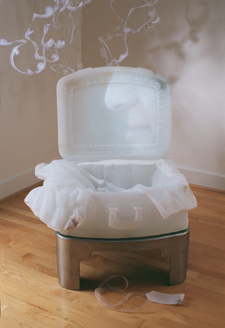 Marie Sivak, Lacing Atropos: Pneuma, carved alabaster, video, stainless steel, silk organza, and salt, 40 x 30 x 27 in. (artwork © Marie Sivak; photograph by Bill Bachhuber)
Marie M. Sivak, an artist based in Portland, Oregon, has received the 2013 Margo Harris Hammerschlag Direct Carving Award, which comes with a $10,000 prize.
Deborah Stratman, an artist and filmmaker based in Chicago, Illinois, has won a 2013 Grant to Individuals in the exhibition category from the Graham Foundation for Advanced Studies in the Fine Arts. Her project is titled Subsurface Voids.
Edward J. Sullivan, Helen Gould Sheppard Professor in the History of Art at New York University’s Institute of Fine Arts, has received a publication grant from the Terra Foundation for American Art. His book, forthcoming from Yale University Press, is called From San Juan to Paris and Back: Francisco Oller, Caribbean Artist in the Age of Impressionism.
Tina Tahir, an artist based in Chicago, Illinois, has been selected a winner of the 2013 ARTslanT Prize for her mixed-media sculpture Thirty (2012).
Ellen Tani, a doctoral candidate in the Department of Art and Art History at Stanford University in Stanford, California, has received a 2013–15 predoctoral dissertation fellowship from the Carter Woodson Institute for African and African-American Studies at the University of Virginia in Charlottesville. Her dissertation is entitled “Black Conceptualism and the Atmospheric Turn, 1968–2008.”
Alex Taylor a doctoral student in the Department of History of Art at Oxford University in Oxford, England, has accepted a fellowship to attend the 2013 Terra Summer Residency in Giverny, France. She will work on Forms of Persuasion: Art and Corporate Enterprise in the 1960s.”
Nancy Um, associate professor in the Department of Art History at Binghamton University, State University of New York, in Binghamton, New York, has been named a 2013–14 Getty scholar by the Getty Research Institute in Los Angeles, California. Um will continue working on “The Material World of the Overseas Merchant in Yemen: Ceremonies, Gifts, and the Social Protocols of Trade, 1700-1750.”
Luis Vargas-Santiago, a graduate student in the Department of Art and Art History at the University of Texas at Austin, has been named Terra Foundation Predoctoral Fellow in American Art for 2013–14 by the Smithsonian American Art Museum in Washington, DC. His dissertation is called “The Diaspora of Emiliano Zapata: From the Mexican Revolution to the American Imagination.”
Charlene Villaseñor-Black, associate professor in the Department of Art History at the University of California, Los Angeles, has been named a 2013–14 Getty scholar by the Getty Research Institute in Los Angeles, California. She is researching “Itinerant Artists in the Global Early Modern World.”
Emily Warner, a PhD candidate in the History of Art Department at the University of Pennsylvania in Philadelphia, has accepted a 2013–14 predoctoral fellowship from the Smithsonian American Art Museum in Washington, DC. Her dissertation is entitled “Crafting the Abstract Environment: The Abstract Mural in New York, 1935–60.”
Sarah Warren, assistant professor of art history at Purchase College, State University of New York, in Purchase, New York, has been named James Renwick Senior Fellow in American Craft at the Smithsonian American Art Museum in Washington, DC. The name of her research project is “Craft between Modernism and Counterculture: Rhinebeck and the Studio Craft Movement.”
Spencer Wigmore, a doctoral student in the Department of Art History at the University of Delaware in Newark, has taken a nine-week summer internship at the National Gallery of Art in Washington, DC. He will assist in research and organization for a forthcoming exhibition on nineteenth-century American landscape photography.
Tatsiana Zhurauliova, a PhD candidate in the Department of the History of Art at Yale University in New Haven, Connecticut, has accepted a 2013 fellowship for the Terra Summer Residency in Giverny, France. She will work on “Arcadia Americana: American Landscape in the Art of Arshile Gorky, Pavel Tchelitchew, and Yasuo Kuniyoshi during World War II.”
Claire Zimmerman, assistant professor of art history and architecture at the University of Michigan in Ann Arbor, has won a 2013 Grant to Individuals for a publication from the Graham Foundation for Advanced Studies in the Fine Arts, based in Chicago, Illinois. Her book project is called Photographic Modern Architecture.
Exhibitions Curated by CAA Members
posted Aug 15, 2013
Check out details on recent shows organized by CAA members who are also curators.
Exhibitions Curated by CAA Members is published every two months: in February, April, June, August, October, and December. To learn more about submitting a listing, please follow the instructions on the main Member News page.
August 2013
David Anfam, Clyfford Still: Memory, Myth, and Magic. Clyfford Still Museum, Denver, Colorado, May 24–September 29, 2013.
Reni Gower. Radiant: Contemporary Encaustic. Slocumb Galleries, Eastern Tennessee State University, Johnson City, Tennessee, August 19–September 20, 2013.
Reni Gower. Shadow and Light. Tinney Contemporary, Nashville, Tennessee, May 18–June 29, 2013.

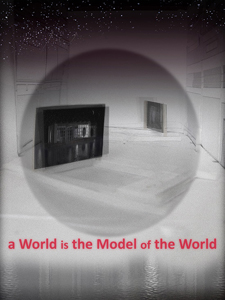 Invitation card for Yam Lau: A World Is a Model of the World
Alice Ming Wai Jim. Yam Lau: A World Is a Model of the World. Darling Foundry, Montreal, Quebec, Canada, June 6–August 25, 2013.
Aaron Krach and Courtney Childress. No Name. On Stellar Rays, New York, June 20–July 31, 2013.

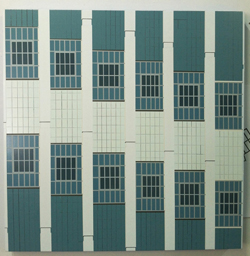 Daniel Rich, Zelle, 2013, acrylic on board, 29 x 29 in. (artwork © Daniel Rich)
Birgit Rathsmann. October 18, 1977. Klemens Gasser and Tanja Grunert, New York, June 20–July 19, 2013.
Books Published by CAA Members
posted Aug 15, 2013
Publishing a book is a major milestone for artists and scholars—browse a list of recent titles below.
Books Published by CAA Members appears every two months: in February, April, June, August, October, and December. To learn more about submitting a listing, please follow the instructions on the main Member News page.
August 2013

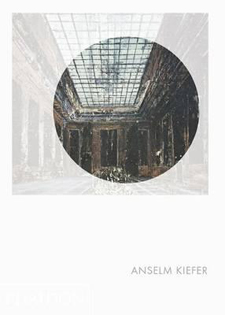
Matthew Biro. Anselm Kiefer (New York: Phaidon, 2013).

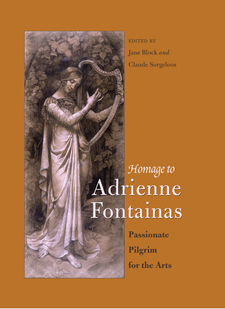
Jane Block and Claude Sorgeloos, eds. Homage to Adrienne Fontainas: Passionate Pilgrim for the Arts (New York: Peter Lang, 2013).

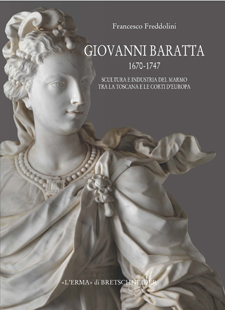
Francesco Freddolini. Giovanni Baratta 1670–1747: Scultura e industria del marmo tra la Toscana e le corti d’Europa (Rome: L’Erma di Bretschneider, 2013).

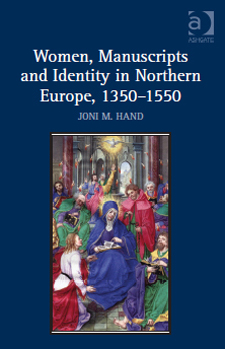
Joni M. Hand. Women, Manuscripts, and Identity in Northern Europe, 1350–1550 (Burlington, VT: Ashgate, 2013).

Katie Grace McGowan, ed. Post-Industrial Complex (Detroit: Museum of Contemporary Art Detroit, 2013).

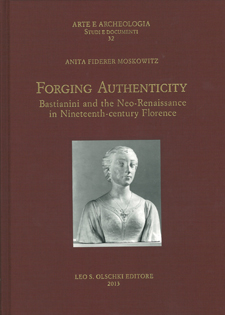
Anita Fiderer Moskowitz. Forging Authenticity: Giovanni Bastianini and the Neo-Renaissance in Nineteenth-Century Florence(Florence: Leo S. Olschki, 2013).

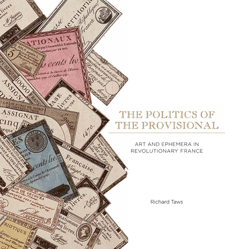
Richard Taws. The Politics of the Provisional: Art and Ephemera in Revolutionary France (University Park: Pennsylvania State University Press, 2013).


Xin Wu. Patricia Johanson and the Re-Invention of Public Environmental Art, 1958–2010 (Burlington, VT: Ashgate, 2013).
News from the Art and Academic Worlds
posted Aug 14, 2013
Each week CAA News publishes summaries of eight articles, published around the web, that CAA members may find interesting and useful in their professional and creative lives.
Florence Tomb Opened in Quest to Find “Mona Lisa”
Scientists in the Italian city of Florence have opened a tomb to extract DNA they hope will identify the model for Leonardo da Vinci’s Mona Lisa. The tomb contains the family of Lisa Gherardini, a silk merchant’s wife who is believed to have sat for the artist. It is hoped that DNA will help to identify her from three skeletons found last year in a nearby convent. (Read more from BBC News.)
Open Content: An Idea Whose Time Has Come
The Getty has become an even more engaged digital citizen, one that shares its collections, research, and knowledge more openly than ever before. The institution has launched the Open Content Program to share—freely and without restriction—as many of its digital resources as possible. The program’s initial focus is to make available all images of public-domain artworks in the Getty’s collections. (Read more in the Getty Iris.)
Judge Upholds Artist’s Right to Photograph Unsuspecting Neighbors
New York’s Supreme Court has decided that the photographer Arne Svenson was within his rights to display and advertise a series of photographs he took of his neighbors without their permission. In May, a couple sued Svenson for violating their privacy after recognizing their young children in two of the images. The judge dismissed the suit, writing that the family’s right to privacy “yields to an artist’s protections under the First Amendment in the circumstances presented here.” (Read more in the Art Newspaper.)
What’s a Blog Post Worth?
Which ultimately does more good: an article or monograph that is read by twenty or thirty people in a narrow field, or a blog post on a topic of interest to many (such as grading standards or tenure requirements) that is read by 200,000? What if the post spurs hundreds of comments, is debated publicly in faculty lounges and classrooms, and gets picked up by newspapers and websites across the country—in other words, it helps to shape the national debate over some hot-button issue? (Read more in the Chronicle of Higher Education.)
A Mentoring Manifesto
“Transformative,” “career-changing,” and “life-altering”: are these words that tenure-track faculty members in your department use to describe the mentoring they receive? In this final column in the series on “How to Mentor New Faculty,” I want to lay out the biggest lessons that my department has learned about mentoring and encourage you to imagine how they might apply to your campus environment. (Read more from Inside Higher Ed.)
A Page from Our Handbook: Writing about Your Work
Many of the materials you produce on behalf of your work—from artist’s statements to media releases to proposals to simple emails—involve a good bit of writing. In some cases you are writing about a project or series that you haven’t yet made. What you need to know in a nutshell is this: writing about your work is essential, but you can find a way to make it great, useful, more fun, and easier. (Read more from Creative Capital.)
The Utility of Bad Art
The father of consumer choice theory, Alfred Marshall, believed that the more of something you have the less of it you want: a phenomenon economists call diminishing marginal utility. However this was only taken to be the case for an individual at one point in time, not over his entire life. Addiction could prompt us to learn to like something if we consume more of it. The more we listen to good music, the more we want to buy. Modern economists are more skeptical about our aesthetic judgment. (Read more in the Economist.)
Ten of the Most Expensive Artworks on Amazon Art
Amazon has embarked on what might be its classiest endeavor yet: a fine-arts marketplace. Yes, the internet’s behemoth middleman is working with more than 150 galleries and 4,500 artists to offer a wide variety of paintings, photographs, and mixed-media masterpieces to online shopping addicts everywhere. While critics have been quick to comment on the strange partnership between a giant internet marketplace and the insular fine-arts world, this gallery experiment could have a positive impact. (Read more in the Huffington Post.)
caa.reviews Publishes Multimedia Project on Bernini Exhibition
posted Aug 13, 2013
Celebrating its fifteenth anniversary as a born-digital journal this fall, caa.reviews continues its exploration of the scholarly review medium through “Exhibitions Close Up—Bernini: Sculpting in Clay.” This multimedia, open-access project focuses on the recent exhibition that assembles over forty small terra-cotta models made by the Baroque sculptor Gian Lorenzo Bernini to visualize large sculptures. The project was made possible through a grant to CAA from the Alliance for Networking Visual Culture.
Conceived by Sheryl Reiss, editor-in-chief of caa.reviews, and broadened through discussion with the journal’s editorial board, the project explores the Bernini exhibition in several ways. It provides a traditional scholarly review of the presentation at both its venues—the Metropolitan Museum of Art in New York and the Kimbell Art Museum in Fort Worth, Texas—and a review by the sculptor Denise Pelletier. Central to the project is a video walk-through at the Kimbell that juxtaposes close views of Bernini’s terra-cotta models with physical movement within the gallery spaces and around the objects on display, giving the viewer a close approximation of visiting the exhibition in person. The project—which also includes a bibliography, previously published essays on and reviews of Bernini’s work and methods from The Art Bulletin and caa.reviews, additional educational videos about the artist’s work, the Kimbell floor plan of the exhibition, comparative illustrations showing completed pieces, and an interview with C. D. Dickerson, curator of European art at the Kimbell—provides a comprehensive resource for Bernini’s oeuvre and influence as well as an in-depth look at an important monographic exhibition.
The Alliance for Networking Visual Culture (ANVC) developed the Scalar digital authoring platform with support from the Andrew W. Mellon Foundation and the National Endowment for the Humanities. The Art Bulletin also used this platform for an anniversary project launched in February 2013, called “Publishing The Art Bulletin: Past, Present, and Future,” that was developed by Thelma Thomas, (then) chair of the Art Bulletin Editorial Board and associate professor at the Institute of Fine Arts, New York University. Additional projects using the Scalar platform can be viewed on the ANVC website.
The minimum browser requirements for “Exhibitions Close Up—Bernini: Sculpting in Clay” are Internet Explorer 9.0, Firefox 4.0, Chrome 7.0, and Safari 5.0.
August 2013 Picks from CAA’s Committee on Women in the Arts
posted Aug 12, 2013
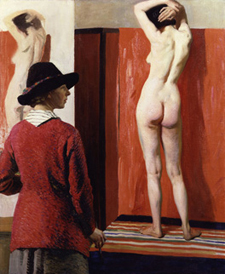 Each month, CAA’s Committee on Women in the Arts produces a curated list, called CWA Picks, of recommended exhibitions and events related to feminist art and scholarship in North America and around the world.
The CWA Picks for August 2013 consist of several excellent exhibitions of women artists in Europe and the United States: Linder Sterling in Hanover, Germany; Elaine Sturtevant and Dame Laura Knight in London, England; and Josephine Meckseper in Southampton, New York. Also included are two important group shows: Mother Armenia in Yerevan, Armenia, and Autorotratti in Bologna, Italy.
Check the archive of CWA Picks at the bottom of the page, as several museum and gallery shows listed in previous months may still be on view or touring.
Image Caption
Dame Laura Knight, Self Portrait, 1913. National Portrait Gallery (artwork © Estate of Dame Laura Knight DBE RA).
Committee on Women in the Arts Picks for July 2013
posted Aug 10, 2013
Each month, CAA’s Committee on Women in the Arts selects the best in feminist art and scholarship. The following exhibitions and events should not be missed. Check the archive of CWA Picks at the bottom of the page, as several museum and gallery shows listed in previous months may still be on view or touring.
August 2013

Linder’s artwork for the Buzzcocks’ first single, “Orgasm Addict”
Linder: Woman/Object
Kestnergesellscahft Hanover
Goseriede 11, 30159 Hanover, Germany
June 7–August 4, 2013
The first major survey in Germany of the oeuvre of a leading protagonist of the late-1970s punk scene, Linder: Woman/Object brings together more than two hundred selections that capture the diversity of an artistic practice that cuts across music, dance, and fashion and transcends all types of visual media, from collage and photography to video and performance. The exhibition also highlights the feminist politics that underpin the artist’s work and self-staging.
Linder Sterling—known simply as Linder—was born in Liverpool as Linda Mulvey in 1954. By the end of the 1970s, she had become a key figure in the culturally explosive period of punk and postpunk, developing her art alongside bands such as the Buzzcocks, Magazine, Joy Division, and the Smiths. One of her best-known works is the cover of the Buzzcocks’ single “Orgasm Addict,” which shows a naked woman with grinning mouths on her breasts and an iron replacing her head. In 1978 Linder cofounded the postpunk group Ludus, whose singer she remained until the band split up in 1983. She caused a furor in 1982 by appearing—a quarter of a century before Lady Gaga—in a dress made of scraps of poultry. Linder’s work has become internationally known in recent years through presentations at important institutions such as the Institute of Contemporary Arts and Tate, both in London, and with a solo exhibition at MoMA PS1 in New York.

Mother Armenia
Armenian Center for Contemporary Experimental Art
1/3 Pavstos Biuzand Boulevard, Yerevan, Armenia
July 3–August 17, 2013
Organized by the 4Plus Documentary Center in Armenia and curated by Svetlana Bachevanova, this exhibition brings together the work of ten female documentary photographers: Mery Aghakhanyan, Sara Anjargolian, Nazik Armenakyan, Anush Babajanyan, Knar Babayan, Anahit Hayrapetyan, Hasmik Hayrapetyan, Piruza Khalapyan, Inna Mkhitaryan, and Nelli Shishmanyan. Addressing the role of women in modern Armenia as well as broader social injustices, their work captures several aspects of Armenian life from a female point of view that remains rarely voiced in the region. “Women in Armenia still battle to establish a career,” the curator says. “Women are still expected to be full time mothers and housekeepers. But these ten documentarians broke the rules and found a way to pursue careers and create powerful bodies of work.”

Installation view of Sturtevant: LEAPS JUMPS AND BUMPS at the Serpentine Gallery (photograph © 2013 Jerry Hardman-Jones)
Sturtevant: LEAPS JUMPS AND BUMPS
Serpentine Gallery
Kensington Gardens, London, W2 3XA, United Kingdom
June 28–August 26, 2013
The first solo exhibition of Sturtevant in a public institution in the United Kingdom, LEAPS JUMPS AND BUMPS showcases work created since the 1970s by this Paris-based American artist, illuminating her groundbreaking exploration of the relationship between repetition and difference while demonstrating the wide variety of media she has embraced. The exhibition includes a large-scale video work, Finite Infinite (2010), and a piece comprising garlands of light bulbs, Gonzalez-Torres Untitled (America) from 2004, that is a later version of a work shown at the Serpentine Gallery in 2000 in the Félix González-Torres exhibition.
Autoritratti: Iscrizioni del femminile nell’arte italiana contemporanea
Museo d’Arte Moderna di Bologna
Via Don Giovanni Minzoni 14, 40121, Bologna, Italy
May 12–September 1, 2013
Autoritratti features old and new works—including some made specifically for the show—by a large number of female Italian artists. Exploring inscriptions of difference in contemporary Italian art, this exhibition, first proposed initially by Uliana Zanetti, is part of an inter- and extramuseum collective initiative that is investigating the role of gender in the work of contemporary women artists in a country in which second-wave feminism was not influential in the arts. That said, the positions and practices of several women artists clearly demonstrate intriguing negotiations of gender difference.
The title of the show merges references to two important feminist thinkers: the British Griselda Pollock and the Italian Carla Lonzi. The artists in the show are: Alessandra Andrini, Paola Anziché, Marion Baruch, Valentina Berardinone, Enrica Borghi, Anna Valeria Borsari, Chiara Camoni, Annalisa Cattani, Alice Cattaneo, Daniela Comani, Daniela De Lorenzo, Marta Dell’Angelo, Elisabetta Di Maggio, Silvia Giambrone, goldiechiari, Alice Guareschi, Maria Lai, Christiane Löhr, Claudia Losi, Anna Maria Maiolino, Eva Marisaldi, Sabrina Mezzaqui, Marzia Migliora, Ottonella Mocellin and Nicola Pellegrini, Maria Morganti, Margherita Morgantin, Liliana Moro, Chiara Pergola, Letizia Renzini, Moira Ricci, Mili Romano, Anna Rossi, Elisa Sighicelli, Alessandra Spranzi, Grazia Toderi, Sabrina Torelli, Traslochi Emotivi, Tatiana Trouvé, Marcella Vanzo, and Grazia Varisco.

Dame Laura Knight, Ruby Loftus Screwing a Breech-ring, 1943. Imperial War Museum, London (artwork © Estate of Dame Laura Knight DBE RA)
Laura Knight: Portraits
National Portrait Gallery
Saint Martin’s Place, London, WC2H 0HE, United Kingdom
July 11–October 13, 2013
With over thirty portraits, this exhibition revisits the work and exceptionally successful career (for a woman of her time) of Dame Laura Knight, among the most popular British artists of twentieth century and the first official female member of the Royal Academy of Arts (since 1936). Knight studied art at the Notthingham Art School, encouraged by her mother, an amateur artist herself, who is remembered setting such ambitious goal for her daughter by saying “one day you will be elected in the Academy.” Knight eventually became so successful that she was featured as a role model in books for careers aimed at women in England.
Knight rejected modernism but focused on capturing modern life and culture through portraiture. She was recognized for her commissioned work as an official war painter, creating propagandistic portraits of female factory workers and heroines of wartime bravery. Yet it is her portraits of theater, ballet, and circus performers, English gypsies, and the segregated black patients of Baltimore’s Johns Hopkins Memorial Hospital that illuminate the diversity of the works’ backgrounds, vividness of their style, and the immersive method of their production.
Platform: Josephine Meckseper
Parrish Art Museum
279 Montauk Highway, Water Mill, NY 11976
July 4–October 14, 2013
Josephine Meckseper is known for the cool, seductive conflation of art objects and commodities in her installations, films, and photographs that unmask the political implications of consumer culture. As this year’s Platform guest at the Parrish, she has responded to the museum’s site, using it as “a perfect display platform” that resonates with the use of commercial displays and everyday items in her work. Two vitrines near the museum’s entrance, containing original sculptures and mass-produced objects, introduce visitors to Meckseper’s signature approach, while other works referencing automobile culture engage the museum’s collection and the world outside it. Alluding to both Jean-Luc Godard’s driving-centric film Weekend and the nearby car dealerships, Sabotage Auto Assembly Line to Slow It Down (2009) incorporates car tires, a conveyer belt, two of the artist’s videos on stacked monitors, and mirrored tiles that cinematically reflect the vehicles in transit along Montauk Highway. With its prominent Jeep insignia, Crow (2011) is placed adjacent to John Chamberlain’s crushed car sculpture
News from the Art and Academic Worlds
posted Aug 07, 2013
Each week CAA News publishes summaries of eight articles, published around the web, that CAA members may find interesting and useful in their professional and creative lives.
The Young Wellesley Professor Who Invented Contemporary Art
When you think of the cities that helped define cutting-edge art in the twentieth century, you think of Paris, New York, maybe Berlin. In the standard histories, Boston plays a decidedly background role, with the city’s gatekeepers ensuring that the wild works by artists like Picasso, Braque, or Mondrian didn’t soil their elegant private and public collections. “Boston is very dead so far as contemporary art is concerned,” complained a young Wellesley art-history instructor, Alfred Barr Jr., writing to a friend and gallery owner in New York in 1926, well after modernism had caught fire elsewhere. (Read more in the Boston Globe.)
How to Build a Digital Humanities Took in a Week
Twelve scholars convened at the George Mason University last week to build a web application for the digital humanities as part of the “One Week | One Tool” challenge, sponsored by the National Endowment for the Humanities. The participants—who included web developers, faculty members, museum professionals, undergraduate and graduate students, and a high-school librarian—spent five days brainstorming, designing, and developing their tool. (Read more in the Chronicle of Higher Education.)
Arts Majors Jump Ahead of Tech Grads in Landing Jobs
Here’s a surprise for college students: recent graduates with technology degrees are having a tougher time finding a job than their peers in the arts. The unemployment rate for recent grads with a degree in information systems is more than double that of drama and theater majors, at 14.7 percent vs. 6.4 percent, according to a recent Georgetown University study. Even for computer science majors, the jobless rate for recent grads nears 9 percent. (Read more in USA Today.)
Protecting Detroit’s Artwork Is a Job for Detroit
By now, everybody knows that the city of Detroit has finally filed for bankruptcy—and everybody in the art world knows that its museum, the Detroit Institute of Arts, is in deep trouble. Here’s why: Detroit owes roughly $18 billion that it doesn’t have. The sixty-thousand-plus works of art in the permanent collection are owned by the city, not the museum (as is normally the case). According to the Detroit Free Press, the thirty-eight most important pieces have a market value of about $2.5 billion. What next? (Read more in the Wall Street Journal.)
Only the Artists Can Save the Arts Critics
How do you put a price on thought? How do you price an opinion? How do you even price the creative thought that the opinion was formed on? How do you do this in a culture—I think that’s the right word—where people are used not only to getting opinion for nothing, but expect good information for nothing as well? (Read more in the Guardian.)
Caveat Emptor: An Art Exhibit Made Entirely of Forgeries Confiscated by the FBI
Upon entering Caveat Emptor you will likely recognize the exhibition’s work with confidence. Iconic pieces made famous by art legends such as Chagall, Warhol, Gauguin, and de Kooning adorn the walls, and yet, you probably haven’t heard of a single artist showing. That’s right, Caveat Emptor, which translates to “let the buyer beware,” is composed entirely of forgeries that have been confiscated by the Federal Bureau of Investigation. (Read more in the Huffington Post.)
The Hole in Our Collective Memory: How Copyright Made Midcentury Books Vanish
Last year I wrote about research being done by Paul J. Heald at the University of Illinois, based on software that crawled Amazon for a random selection of books. At the time, his results were only preliminary, but they were nevertheless startling: there were as many books available from the 1910s as there were from the 2000s. The number of books from the 1850s was double the number available from the 1950s. Why? Copyright protections—which cover titles published in 1923 and after—had squashed the market for books from the mid-twentieth century, keeping those titles off shelves and out of the hands of the reading public. (Read more in the Atlantic.)
Did You Hear That? It Was Art
Nothing? Listen again. Note the sound of your computer’s fan amid distant sirens. Hear your spouse in the next room, playing the Bowie channel on Spotify while chatting on the phone with your mother-in-law. Farther off, a TV is tuned to the news and a stereo plays Bach, while a mouse skitters inside a wall. And know that every one of those sounds can now be the subject of art, just as every vision we see and imagine, from fruit in a bowl to the color of light to melting clocks, has been grist for painting and sculpture and photos. (Read more in the New York Times.)
Brief Message to CAA Members on Health Insurance
posted Aug 07, 2013
As we all know, the health-insurance industry is undergoing significant change due to the Patient Protection and Affordable Care Act (PPACA), signed into law in March 2010. The New York Life Insurance Company recently informed CAA that it will no longer offer catastrophic healthcare coverage previously available to CAA members. CAA investigated the possibility of offering members health insurance through another company but found this is no longer an option to associations whose members reside in different states.
Here’s the good news: PPACA includes comprehensive reform that is designed to provide affordable health coverage for all individuals. The average premium for individuals who purchase coverage directly today (i.e., they do not receive coverage through their employer) is expected to decline significantly.
Individuals can purchase medical insurance on or after January 1, 2014 without regard to health status and/or limitations because of preexisting conditions or impairment. Purchases for health coverage may be made through the Health Insurance Marketplace, state insurance exchanges, or the federal insurance exchange. Open enrollment for the exchanges starts on October 1, 2013, and ends on March 31, 2014.
Information on insurance plans state-by-state and how the insurance exchanges will work may be obtained at www.healthcare.gov or by calling 800-318-2596, twenty-four hours a day, seven days a week.
Anitra Haendel: In Memoriam
posted Aug 05, 2013
CAA staff mourns the loss of its dear friend and colleague, Anita Haendel. Anitra was CAA’s office services and purchasing coordinator (2004–10) and brightened the lives of all of us every day with her presence and her work. She received her BA from Brown University and an MFA from the California Institute of the Arts (CalArts) in 2012.
Projekt Papier Interview
Watch Anitra Haendel’s video interview with Projekt Papier, posted in 2012.