CAA News Today
Apply for a Publishing Grant from the Millard Meiss Publication Fund
posted Feb 27, 2014
 CAA is accepting applications for spring 2014 grants through the Millard Meiss Publication Fund. Thanks to a generous bequest by the late art historian Millard Meiss, the twice-yearly program supports book-length scholarly manuscripts in any period of the history of art, visual studies, and related subjects that have been accepted by a publisher on their merits but cannot be published in the most desirable form without a subsidy.
The publisher, rather than the author, must submit the application to CAA. Awards are made at the discretion of the jury and vary according to merit, need, and number of applications. Awardees are announced six to eight weeks after the deadline. For the complete guidelines, application forms, and a grant description, please visit the Meiss section of the CAA website or send an email to nyoffice@collegeart.org. Deadline: March 15, 2014.
Image Caption
Bibiana K. Obler’s book Intimate Collaborations: Kandinsky and Münter, Arp and Taeuber won a Meiss grant in fall 2012.
Baldwin, Markey, and Nadler Introduce Legislation to Level the Playing Field for American Visual Artists
posted Feb 27, 2014
US Senators Tammy Baldwin (D-WI) and Ed Markey (D-MA) and Congressman Jerrold Nadler (D-NY) have introduced legislation to level the playing field for visual artists in the United States by establishing copyright protections for their intellectual property.
“Artists and arts organizations make valuable contributions to our communities and strengthen our quality of life. Just as our copyright laws extend to musicians and authors to encourage their artistic creativity, they should also apply to our visual artists,” said Senator Baldwin, who serves on the National Council on the Arts. “The ART Act is a commonsense measure that helps protect the intellectual property of our artists.”
“Our visual artists are critical cultural contributors, and the ART Act ensures they are fairly compensated for their work,” said Senator Markey. “Their creativity is a currency that should be properly valued. The ART Act also brings the United States in line with over seventy other countries, so that American artists can receive royalties when their works are sold overseas.”
“American artists are being treated unfairly,” said Congressman Nadler, who first introduced a version of the ART Act in 2011 and serves as the Ranking Democrat on the Courts, Intellectual Property, and Internet Subcommittee of the House Judiciary Committee. “At a time when more than seventy other countries properly compensate visual artists for their work, it is time for the United States to do the same. The ART Act will ensure that visual artists get the compensation they deserve and will no longer be at a disadvantage on the international art market. It is the only fair thing to do.”
“Visual artists are the only members of the creative community in the United States who do not receive residual payments for their works. Composers, lyricists, actors, playwrights, screenwriters all deservedly receive royalties for the later productions, performances, or sales of their works,” said Frank Stella, one of the most renowned artists in the world and recipient of the National Medal of Arts by President Obama in 2009. “Unfortunately, visual artists in the US do not earn a penny in residual or resale payments. The benefits derived from the appreciation in the later sale of their works accrue entirely to the collectors, auction houses, and galleries. The adoption of the droit de suite in my country is therefore long overdue.”
Under current copyright law, visual artists—painters, sculptors, and photographers—are denied the ability to fully benefit from the success of their work over time. Unlike recording artists or publishers who, if successful, sell thousands of copies of their work and recoup a royalty from each purchase, artists sell their work only once. If they are successful, the price of their work increases but they recoup nothing if their original work is resold at a much higher price. The benefits derived from the appreciation in the price of a visual artists’ work typically accrues to collectors, auction houses, and galleries, not to the artist. In addition, United States artists are at a disadvantage in the global art market where more than seventy other countries have provided resale royalty rights for visual artists. The American Royalties, Too (ART) Act of 2014 remedies this inequity by providing a modest resale royalty right for visual artists.
The ART Act would:
- Provide a competitive resale royalty of five percent of the sales price (up to $35,000) for any work of visual art sold at auction for $5,000 or more
- The resale royalty applies to any auction where the entity conducting the auction has sold at least $1 million of visual art during the previous year
- Royalties are collected by visual artists’ copyright collecting societies who must distribute the royalties to the artists or their heirs at least four times per year
- Allows US artists to collect resale royalties when their works are sold at auction in the European Union and more than seventy other countries
- The ART Act requires further study by the Copyright Office after five years to determine the effects of the resale royalty on the art market and whether it should be expanded to cover works sold by dealers and other art market professionals
The ART Act includes many recommendations from the US Copyright Office’s December 2013 report, entitled Resale Royalties: An Updated Analysis.
News from the Art and Academic Worlds
posted Feb 26, 2014
Each week CAA News publishes summaries of eight articles, published around the web, that CAA members may find interesting and useful in their professional and creative lives.
Orr’s Plan Would Protect DIA Artwork, but It’s Not a Done Deal Yet
The fate of the Detroit Institute of Arts remains in limbo in the wake of the recent release of Kevyn Orr’s restructuring plan for Detroit’s finances. While Orr’s plan incorporates the fundamentals of a much-talked-about deal to prevent the forced sale of any masterpieces and to separate the city-owned museum into an independent charitable trust, several critical steps remain before a final settlement would guarantee the museum safe harbor in Detroit’s historic bankruptcy. (Read more from the Detroit Free Press.)
Photographers Band Together to Protect Work in “Fair Use” Cases
To many photographers, a federal appeals court ruling last spring that permitted Richard Prince to use someone else’s photographs in his art was akin to slapping a “Steal This” label on their work, but photographers are pushing back. Several membership and trade organizations have banded together recently to press their cause in Congress and the courts. (Read more from the New York Times.)
No Longer Appropriate?
“Appropriating” other artists’ work without consent is still common, but there is growing evidence—albeit rarely reported—that, although some artists may have started out as willing or unwitting outlaws, they decided that possibly infringing other artists’ copyright was legally unwise and potentially expensive, and they stopped. (Read more from the Art Newspaper.)
Protest Action Erupts inside the Guggenheim Museum
Last weekend, over forty protesters staged an intervention inside the Guggenheim Museum in Manhattan during Saturday night’s pay-what-you-wish admission hours. Unfurling Mylar banners, dropping leaflets, chanting words, handing out information to museum visitors, and drawing attention with a baritone bugle, the group highlighted the labor conditions on Saadiyat Island in the United Arab Emirates, where Guggenheim Abu Dhabi, a franchise of New York’s Guggenheim, is being built. (Read more from ArtLeaks.)
Eminent Domain
A gallery’s street address says a lot more than its web address. We’ll assume that a gallery at 555 West 24th Street in Chelsea sells more expensive art, represents more well-known artists, and is more influential on the market than, say, the residential address of an artist-run apartment gallery in Bed Stuy. A web address can’t connote this same kind of prestige differential. There are no neighborhoods on the internet, and the cost of rent is always somewhere from $1 to $15 a month. (Read more from the New Inquiry.)
People Lose Their Minds over Obama’s Art History Apology
President Barack Obama’s apology to the art historian Ann Collins Johns has created a frenzy of media coverage, including some inexplicably strange responses. When was the last time you heard art history discussed in mainstream news publications and news channels? Crickets. Exactly. (Read more from Hyperallergic.)
In Defense of Art History: Against the Neoliberal Imagination
Obama’s recent statement about art-history majors echoes a crude opinion of the American ruling class—all that is not of immediate and utilitarian interest to the profit system is to be shunned—and underlines a common conception of education and culture and highlights the ongoing onslaught on the humanities and liberal arts. The corporate education model being pushed heavily on public schools, state universities, and city colleges—schools that serve students from largely working-class and poor backgrounds—grants little weight to these subjects. (Read more from Red Wedge.)
The End of the Corcoran Gallery of Art
If the Corcoran Gallery of Art had to be swallowed up by a larger and healthier institution to survive, we might celebrate last week’s announcement that its collection will be devoured by the National Gallery of Art. The National Gallery is hands down the most prestigious and respected steward of fine art in Washington, and its reputation is international. But this is not a swallowing of the Corcoran—this is the end of the Corcoran and its final dismemberment. (Read more from the Washington Post.)
AAMD Provenance Workshops
posted Feb 25, 2014
The Association of Art Museum Directors (AAMD) will cosponsor two provenance workshops this spring: one in Seattle, Washington, and another in Washington, DC.
Seattle
This workshop will be held on May 18, 2014, in conjunction with the Association of Academic Museums and Galleries’s annual conference in Seattle. The workshop will review best practices for conducting provenance research in art museums, with a focus on Nazi-era provenance, as well as issues pertaining to antiquities and cultural property. The session is geared to all levels of experience and can serve as a how-to and a refresher. The workshop leaders will discuss due diligence and the acquisition process, online research tools, and the handling of restitution claims. The workshop is limited to fifty participants; ample time will be allotted for Q&A.
Victoria Reed, curator for provenance at the Museum of Fine Arts, Boston, and Nancy H. Yeide, head of the Department of Curatorial Records at the National Gallery of Art, will conduct the half-day workshop, which will be held at the Hotel Deca in Seattle. Each participant will receive a copy of Yeide’s book Beyond the Dreams of Avarice: The Hermann Goering Collection (2009), which is the first biography to focus on Hermann Goering’s personal collection and provides the first opportunity since the war to look at the collection as a whole and evaluate its place within art collecting and politics. This carefully documented volume is critical to the clarification of provenances of the objects featured and brings to light pictures whose histories and whereabouts have been hidden for decades.
Registration is available at www.aamg-us.org/registration; scroll down to “Sunday Morning Workshops.”
Washington, DC
In cooperation with the National Archives and Records Administration, the Smithsonian Institution, and the American Alliance of Museums, AAMD will sponsor a workshop for advanced researchers following the success of a two-day, Nazi-era provenance seminar that was held in 2011. Taking place at the National Archives on June 17, 2014, this workshop is limited to thirty participants who are experienced researchers working in museums. The event will provide a hands-on workshop on using new and updated online provenance research resources. Registration will include a copy of Holocaust-Era Assets, a Finding Aid to Records at the National Archives at College Park.
Nancy H. Yeide, head of the Department of Curatorial Records at the National Gallery of Art, and Chris Naylor, director of textual records for the National Archives, will lead the one-day workshop, which will be accompanied by an introduction to new materials at the Archives of American Art led by Marisa Bourgoin, chief of reference services for the Archives of American Art, and Laurie Stein, senior provenance advisor for the Smithsonian Provenance Research Initiative.
The cosponsors for the DC seminar express grateful appreciation to the Samuel H. Kress Foundation for support to defray expenses for workshop participants.
To apply for registration go and to learn more about Kress grants, visit the AAMD website.
Appeal for Oral Readers to Make Podcasts of Chapters of Reclaiming the Ivory Tower
posted Feb 25, 2014
Calling all Adjunct Voices!
Help us collectively record an audiobook of Joe Berry’s Reclaiming the Ivory Tower!!
Call for Introduction, Chapter 1, & Chapter 2!
Adjunct Underground, a radio program dedicated to the issues confronting today’s contingent educational workforce, is looking for any current or former adjunct/contingent/part-time faculty who would be willing to read and record short sections of Joe Berry’s book, Reclaiming the Ivory Tower: Organizing Adjuncts to Change Higher Education. Our goal is to create a complete audio book of Berry’s book, read entirely by a plethora of adjunct voices.
Are you an adjunct or contingent teacher, and would you be willing to read aloud and record a few pages for us?
The resulting audiobook will be broadcast one chapter at a time, and made available as a free, downloadable podcast, on the program, Adjunct Underground, on KCHUNG Radio.
All contributors can remain anonymous if they so choose, though no voices will be altered in the recordings.
If interested, please look at the spreadsheet at the following link, and select and mark an available section that you would like to read: https://docs.google.com/spreadsheet/ccc?key=0AnRu6M-k0cvidEVNUktzUGtBUUlDRFJQNHZKYzEtYkE#gid=0. We would like to get as many voices as possible to read this text, so for now we are accepting only ONE section per person.
Send your section request to adjunctunderground@gmail.com, and we’ll send you a pdf of the text, along with a few further instructions. (You’ll then need to record yourself reading the text in a quiet place, using a free program like Audacity, or even your cell phone.)
Finally, please help spread the word by recruiting at least one colleague of yours to participate as well!
Thank you so much for your help!
. . .
From the back of the book:
Reclaiming the Ivory Tower is the first organizing handbook for contingent faculty—the thousands of non-tenure track college teachers who love their work but hate their jobs. It examines the situation of adjunct professors in U.S. higher education today and puts forward an agenda around which they can mobilize to transform their jobs and their institutions.
Full of concrete suggestions for action and based on extensive interviews with organizers Reclaiming the Ivory Tower is the most comprehensive and engaged account to date of the possibilities for a movement that has important lessons for labor organizing in general, as well as for the future of higher education.
Joe Berry teaches labor education and history at the University of Illinois and Roosevelt University in Chicago and chairs the Chicago Coalition of Contingent Academic Labor.
. . .
Adjunct Underground
Broadcasting sporadically on some Mondays at 1pm on KCHUNG Radio http://adjunctunderground.kchungradio.org
https://www.facebook.com/AdjunctUnderground
Adjunct Underground is a KCHUNG Radio broadcast and movement dedicated to the trials and tribulations of adjunct instructors in Los Angeles, and throughout the universe! Our sporadic underground broadcasts feature stories, conversations, interviews, rants, and more from our bunker-full of adjunct DJs and hosts, many of whom risk their livelihoods meeting with us to share their stories and insight on the precarity of today’s contingent education professionals! Adjuncts unite! Underground! on KCHUNG Radio!
Why Art Is Dangerous: Making Art Is Making Trouble
posted Feb 24, 2014
Written by Donald Preziosi on February 17, 2014.
Above the entrance to an exhibition in Paris in 2011 at the Centre Pompidou called The Promises of the Past was written the claim that the function of art was to make the world better. Better than it might appear at present.
Yet you could argue, at the same time, that what art creates may be a worse world—worse than it appears, or not at all what you would like it to be. Art as both amelioration, betterment, and creative construction: as world-making—and also as destruction and distraction from what reality is imagined to be. The construction and deconstruction of what one takes as reality or as natural.
How could this be? How can we unravel such a dense fabric?
Art has long been regarded as dangerous to the stability of a society and to its professed or desired ideal order. Indeed, 2,500 years ago, in a text we know as The Republic, the Greek philosopher Plato sought to banish the representational arts from an ideal community, because of their distracting effects on its citizens. However powerful, beautiful, spiritually uplifting, or life-enhancing they might be, works of art had the potential to cause individuals to imagine realities differently than what was promoted as real or natural by those holding or desiring power. Plato was far from alone or unique in such a view either in his own or in other societies, both ancient and modern, but his writings give us an insight into the social logic behind such a view.
The simplest and most compelling rationale is this: that the awareness of the artistry or facture of a work of art—the fact that it is a product of human creativity—makes it possible to imagine that the reality it portrays or projects might be imagined otherwise. Both by others or even by oneself at different times or in different places. In other words, once you are aware that the forms and meanings taken by your society as real or natural (perhaps even as created or inspired by superhuman forces) are among any number of possible realities or belief systems, then space is opened for imagining other ways of world-making. To put it another way, you don’t need the visible presence of different social systems, either next door or across the river, to imagine differences: the different exists within art itself.
But what could this mean? The reason for this has to do with what we might call the inherent instability and slipperiness of how things mean—the demonstrable fact that an object or artifact can have different meanings and connotations in different times and places. Just as the same or similar form can have multiple meanings, so the same or equivalent meaning might be embodied or portrayed by distinct forms or expressions. This has been absolutely central to many theological, philosophical, or political debates, now and in the past. It’s the problem of the “relations between” art and religion, or “between” art and politics.
To put this another way, if the only tool you have were a hammer, you’d tend to treat everything as a nail. Thus, as a species, we would be less likely to have survived very long outside a very specific and isolated environment. In technical terms, the potential indeterminacy of meaning—the fact that it cannot be fully controlled—allows for and affords the possibility of adapting to the vagaries of human encounters with worlds. We are, in short, adapted to change; our very existence depends on that flexibility, that openness.
What all or any of this has to do with the dangers of art should be fairly evident and not exactly, as they say, “rocket science.” But remember that science, after all, is itself one of the finest and powerful of the fine arts. And consequently one of the more dangerous.
Art’s dangers are at the same time the source of its powers for positive change and social advocacy. Art advocates and invokes as much as it revokes what you imagine yourself and your worlds to be. Those selves are porous: permeated by and defined relative to others, real or imagined. And, in fact, a close attention to the real powers of art makes the distinction itself between the real and the imaginary, between fact and fiction, and circumstantial and conditional rather than fixed and permanent.
Art is dangerous, in the end, because it brings to consciousness the reality of the fiction of reality—that reality is a work of art: the finest of the fine arts, the supreme fiction.
Solo Exhibitions by Artist Members
posted Feb 22, 2014
See when and where CAA members are exhibiting their art, and view images of their work.
Solo Exhibitions by Artist Members is published every two months: in February, April, June, August, October, and December. To learn more about submitting a listing, please follow the instructions on the main Member News page.
February 2014
Mid-Atlantic

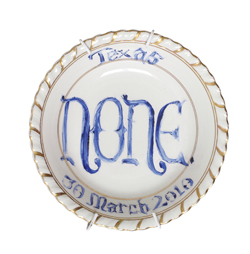 Julie Green, Texas 30 March 2010, from The Last Supper series (2000–ongoing), cobalt blue pigment painted on porcelain, kiln-fired ceramic, 6 x 6 x 1 in. (artwork © Julie Green)
Julie Green. Lore Degenstein Gallery, Susquehanna University Selinsgrove, Pennsylvania, January 18–March 1, 2014. The Last Supper: Final Meals of U.S. Death Row Inmates. 550 painted, kiln-fired ceramic plates.
Midwest

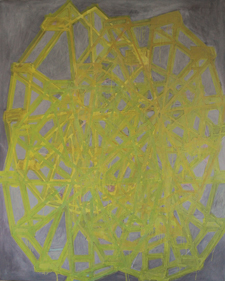 Hartmut Austen, Ferris, 2013, oil on canvas, 75 x 60 in. (artwork © Hartmut Austen)
Hartmut Austen. The Butcher’s Daughter, Detroit, Michigan, January 18–February 23, 2014. Approximate Territory. Painting.

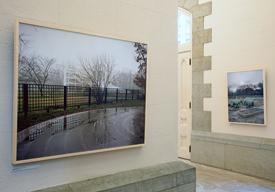 Regina Mamou, Chartres Cathedral (left), 2012, C-print, 40 x 50 in.; and Lustgarten (right), 2012, C-print, 40 x 32 in. (artworks © Regina Mamou)
Regina Mamou. City Gallery in the Historic Water Tower, Chicago, Illinois, October 11, 2013–January 19, 2014. Unfortunately, It Was Paradise. Photography.

Christopher Troutman. Mallin Gallery, Kansas City Artists Coalition, Kansas City, Missouri, December 13, 2013–January 17, 2014. Charcoal and ink drawing.
South

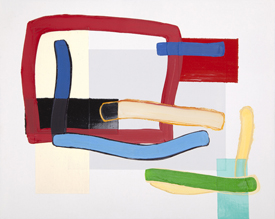 Sharon Louden, Community, 2013, oil and enamel on stretched paper mounted on panel, 11 x 14 x 1½ in. (artwork © Sharon Louden)
Sharon Louden. Beta Pictoris Gallery, Maus Contemporary Art, Birmingham, Alabama, January 7–February 16, 2014. The Dancing Line: New Paintings, New Drawings. Painting and drawing.
West

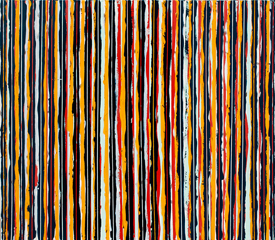 Jeffrey Glossip, Arrival (New Big), 2012, oil on canvas, 72 x 80 in. (artwork © Jeffrey Glossip)
Jeffrey Glossip. Lynnwood Convention Center, Lynnwood, Washington, January 8–July 31, 2014. Big Paint. Large-scale nonrepresentational painting.
President Obama Pens Personal Apology to an Art Historian
posted Feb 20, 2014
This story is reposted with permission from Hyperallergic. Here is a link to the original story:
http://hyperallergic.com/109775/presidents-obama-pens-personal-apology-to-an-art-historian/.
Professor Ann Collins Johns at the University of Texas at Austin was just as peeved as many people were about President Barack Obama’s knock on art history majors. So she did what any self-assured art historian would do and wrote a letter to Obama on January 31, shortly after the President’s remarks, and sent it using the White House website. Then came the surprising part: Obama responded with a handwritten note on February 12.
Johns told Hyperallergic that she did not save her original email because she posted it via the White House website:
However, I’m pretty sure that my email was not so much one of outrage at his statement, but rather a “look at what we do well” statement. I emphasized that we challenge students to think, read, and write critically. I also stressed how inclusive our discipline is these days (even though my own specialty is medieval and Renaissance Italy).
Asked for permission to reproduce the letter, Johns wanted to make it clear that she loves Obama. “What I did NOT expect is that THE MAN HIMSELF would write me an apology. So now I’m totally guilty about wasting his time,” she wrote on her Facebook profile page.
Here is Obama’s response, written on official White House letterhead then scanned and sent to Johns by email. We’ve transcribed the text below; the White House let the professor know that the original will be mailed to her shortly.
Ann —
Let me apologize for my off-the-cuff remarks. I was making a point about the jobs market, not the value of art history. As it so happens, art history was one of my favorite subjects in high school, and it has helped me take in a great deal of joy in my life that I might otherwise have missed.
So please pass on my apology for the glib remark to the entire department, and understand that I was trying to encourage young people who may not be predisposed to a four year college experience to be open to technical training that can lead them to an honorable career.
Sincerely,
Barack Obama
by Alicia Eler on February 18, 2014
News from the Art and Academic Worlds
posted Feb 19, 2014
Each week CAA News publishes summaries of eight articles, published around the web, that CAA members may find interesting and useful in their professional and creative lives.
Obama Picks Low-Profile Arts Center Executive to Chair the NEA
Opting for arts-administration and fundraising credentials over star power, the White House announced last week that President Obama will nominate Jane Chu, president and chief executive of the Kauffman Center for the Performing Arts in Kansas City, Missouri, as the next chairman of the National Endowment for the Arts. (Read more from the Los Angeles Times.)
The Monuments Men Did More Than Rescue Nazi-Looted Art
The greatest Rubens altarpiece in America is in Ohio, at the Toledo Museum of Art. We have the Monuments Men to thank for that. George Clooney’s galumphing all-star movie The Monuments Men did not impress the critics—“inert,” lamented the Los Angeles Times movie critic Kenneth Turan—but the real-life story of soldiers sent to protect and rescue Europe’s great artworks during and after World War II is impressive. So was its aftermath. (Read more from the Los Angeles Times.)
How American Museums Protected Their Art from the Nazis
Last weekend, George Clooney’s newest film, The Monuments Men, arrived in theaters, highlighting a fascinating chapter in World War II. Beginning in 1943, the Monuments Men dutifully retrieved canvases and confiscated heirlooms stashed in salt mines and inconspicuous locations across the continent (and later Japan). Given the inconceivable scope of the cultural upheaval, it’s understandable that one element of the story remains largely overlooked: the precautions taken to protect artworks on American soil. (Read more from the Atlantic.)
Who Owns This Image?
CAA, an organization of about fourteen thousand artists, scholars, and curators, recently released a report on the state of fair use in the visual arts. The association commissioned Patricia Aufderheide and Peter Jaszi, a law professor at American, to be the principal investigators, who found that most professionals have no idea how to employ fair use. As a result, they wrote: “Their work is constrained and censored, most powerfully by themselves, because of that confusion and the resulting fear and anxiety.” (Read more from the New Yorker.)
When Cost Cutting and Staff Costs Are Passed Off as Reductions in Administrative Bloat
At the end of December, the Wall Street Journal published an article by Steve Herbert titled “Colleges Trim Staffing Bloat.” So, if you did not read any further than the title, you might think that all of the attention to administrative bloat as a cost-driver in American higher education was finally producing some results. Think again. (Read more from Academe Blog.)
Great Art Needs an Audience
As the virtual replaces the physical and the world gets globalized, we’ve been hearing that art galleries, settled in a single place, are bound to be on their way out. Collectors are now more likely to buy at a fair than from a dealer’s home base; some may do their art shopping online. A few midrange dealers, especially, are already closing their galleries, to conduct all their business in private, at fairs, or by JPEG. I believe that these changes put art itself at risk. (Read more from the Art Newspaper.)
Art at Arm’s Length: A History of the Selfie
We live in the age of the selfie. A fast self-portrait, made with a smartphone’s camera and immediately distributed and inscribed into a network, is an instant visual communication of where we are, what we’re doing, who we think we are, and who we think is watching. Selfies have changed aspects of social interaction, body language, self-awareness, privacy, and humor, altering temporality, irony, and public behavior. (Read more from Vulture.)
Creativity Becomes an Academic Discipline
The world may be full of problems, but students presenting projects for Introduction to Creative Studies have uncovered a bunch you probably haven’t thought of. Elie Fortune, a freshman, revealed his Sneaks ’n Geeks app to identify the brand of killer sneakers you spot on the street. Jason Cathcart, a senior, sported a bulky martial-arts uniform with sparring pads he had sewn in. No more forgetting them at home. (Read more from the New York Times.)
Serve on a CAA Award Jury
posted Feb 18, 2014
CAA invites nominations and self-nominations for individuals to serve on eight of the twelve juries for the annual Awards for Distinction for three years (2014–17). Terms begin in May 2014; award years are 2015–17. CAA’s twelve awards honor artists, art historians, authors, curators, critics, and teachers whose accomplishments transcend their individual disciplines and contribute to the profession as a whole and to the world at large.
Candidates must possess expertise appropriate to the jury’s work and be current CAA members. They should not be serving on another CAA committee or editorial board. CAA’s president and vice president for committees appoint jury members for service.
The following jury vacancies will be filled this spring:
- Alfred H. Barr Jr. Award: two members
- Arthur Kingsley Porter Prize: one member
- Frank Jewett Mather Award: two members
- Distinguished Teaching of Art History Award: one member
- Distinguished Feminist Award: two members
- Artist Award for Distinguished Body of Work: two members
- Distinguished Artist Award for Lifetime Achievement: one member
- Distinguished Lifetime Achievement Award for Writing on Art: one member
Nominations and self-nominations should include a brief statement (no more than 150 words) outlining the individual’s qualifications and experience and an abbreviated CV (no more than two pages). Please send all materials by email to Lauren Stark, CAA manager of programs; submissions must be sent as Microsoft Word attachments. Deadline: April 25, 2014.