CAA News Today
News from the Art and Academic Worlds
posted May 01, 2013
Each week CAA News publishes summaries of eight articles, published around the web, that CAA members may find interesting and useful in their professional and creative lives.
Cariou v. Prince Decision
We conclude that the district court applied the incorrect standard to determine whether Richard Prince’s artworks make fair use of Patrick Cariou’s copyrighted photographs. We further conclude that all but five of Prince’s works do make fair use of Cariou’s copyrighted photographs. With regard to the remaining five Prince artworks, we remand to the district court to consider, in the first instance, whether Prince is entitled to a fair-use defense. (Read more from the US Court of Appeals for the Second Circuit.)
Appropriate Standards in Appropriation Art? Cariou v. Prince Decision Garners Relief but Fails to Provide Substantive Guidance
One of the most closely watched copyright cases in the legal and contemporary-art worlds was settled last week. On Thursday, April 25, the United States Court of Appeals for the Second Circuit overturned the 2011 District Court decision, holding that the contemporary artist Richard Prince’s appropriation of thirty images from the photographer Patrick Cariou’s book Yes Rasta for his own Canal Zone series was protected under the fair-use doctrine. (Read more from the Center for Art Law.)
Second Circuit Victory for Richard Prince and Appropriation Art
The decision in Cariou v. Prince confirms the principle that a use can be fair even if it doesn’t criticize or comment on the original work. While it’s far from groundbreaking to say that commentary or criticism isn’t necessary for fair use, it is a principle that hasn’t been applied before in the visual-art context. (Read more from the Center for Internet and Society, Stanford Law School.)
Judicial Activism and the Return of Modernism in the Cariou v. Prince Decision
The Cariou v. Prince decision was handed down last Thursday. I have struggled with what to write primarily because I have been shocked into a catatonic state. How two intelligent minds could draft such an epic disaster is beyond any form of comprehension. One would hope that after eleven months of deliberation and critical analysis we would have been given something more than twenty-three pages of judicial poetry. (Read more at Clancco.)
A More Positive Take
You may remember the fantastic piece on art and copyright by the artist and lawyer Alfred Steiner that I linked to couple months ago. I asked him what he thought about the Second Circuit’s decision in Cariou v. Prince, and this is what he had to say. (Read more in the Art Law Blog.)
House Judiciary Chairman to Launch Sweeping Review of US Copyright Law
House Judiciary Chairman Bob Goodlatte (R-Virginia) said last week that his committee will launch a sweeping review of the country’s copyright law and hold a series of hearings on the matter “in the months ahead.” In remarks at the Library of Congress, Goodlatte argued that existing copyright law lags behind the rapid pace of technology, forcing policymakers to make challenging decisions based on these outdated rules. (Read more in the Hill.)
UK Museums Must Pay for Images Where Copyright Is Unknown
Museums will have to pay upfront for orphan images, or images whose copyright owners cannot be found, after an amendment to the Enterprise and Regulatory Reform Bill to limit proposals was narrowly defeated in the House of Lords. Several members condemned the government’s plans, which require holders of orphan works to pay for copyright licensing on use, rather than when a rights holder steps forward. (Read more in the Art Newspaper.)
How Copyright Drives Innovation in Scholarly Publishing
Today’s public-policy debates frame copyright policy solely as a “trade off” between the benefits of incentivizing new works and the social deadweight losses imposed by the access restrictions imposed by these (temporary) “monopolies.” I recently wrote and published a paper, “How Copyright Drives Innovation in Scholarly Publishing,” explaining that this is a fundamental mistake that has distorted the policy debates about scholarly publishing. (Read more from the Copyright Alliance.)
In Sobel v. Eggleston, Limited Edition Is No Limit to Subsequent Editions
It took less than a year for Judge Deborah A. Batts to rule in Sobel v. Eggleston, dismissing the plaintiff Jonathan Sobel’s claims with prejudice. In summary, Sobel purchased eight of the defendant William Eggleston’s photographs between 2008 and 2011. The plaintiff’s belief that the works were part of limited editions supposedly led him to pay a premium for them. Eggleston, however, created reprints of these images different in size, medium, and production date from the set purchased by the plaintiff. Subsequently, according to Sobel, the monetary value of the original limited edition was “substantially diminished.” (Read more from the Center for Art Law.)
News from the Art and Academic Worlds
posted Apr 24, 2013
Each week CAA News publishes summaries of eight articles, published around the web, that CAA members may find interesting and useful in their professional and creative lives.
Colleges Are Slashing Adjuncts’ Hours to Skirt New Rules on Health-Insurance Eligibility
Allison G. Armentrout, an adjunct instructor at Stark State College, doesn’t get paid by the hour. She earns $4,600 to teach two English composition courses. But now she carefully tracks how many hours she works on an electronic time sheet. On a recent week, she spent three hours preparing for her lectures, close to six hours in the classroom, and sixteen more grading assignments for a grand total of about twenty-five hours. She came in under the college’s new twenty-nine-hour-a-week wire designed to keep her ineligible for health-care coverage under the Patient Protection and Affordable Care Act. (Read more in the Chronicle of Higher Education.)
Women on the Verge
A lady in a bonnet is shaking up the art world. When After Lunch, Berthe Morisot’s portrait of a doe-eyed woman, sold for $10.9 million in February, it set a record as the most expensive work by a female artist ever sold at auction. It also helped power a wave of interest among collectors and dealers looking to identify undervalued female artists. While an age-old debate rages over whether talent, sexism, or lack of promotion has held many women out of the art world’s boys club, everyone agrees that prices for female artists have always lagged behind those of their male counterparts. (Read more in the Wall Street Journal.)
Born Digital: Rhizome’s Heather Corcoran
When Heather Corcoran was appointed executive director of the art and technology nonprofit Rhizome last summer—replacing the long-time director Lauren Cornell, who had resigned in the spring to curate the New Museum’s triennial with Ryan Trecartin—she was an unknown quantity in New York. Nevertheless, her entire career has focused on the overlapping fields of contemporary art and technology (mostly in the United Kingdom), making the twenty-nine-year-old Canadian a good fit for Rhizome. (Read more in Art in America.)
Meet the First Digital Generation. Now Get Ready to Play by Their Rules
Anna Daniszewski, a sophomore at Bard College, takes a dozen or more cell-phone pictures daily, usually around dusk or after dark—moody shots of found objects, bare branches against a gray sky, or lighted windows in the distance, evoking the way sensitive, artistic young men and women have always felt about life. You can totally imagine Goethe doing the same thing, preserving each precious instant of angst for the posterity that would someday recognize his genius. Except Daniszewski doesn’t preserve them all—she is embracing the ephemeral. (Read more in Wired.)
Open Access: Four Ways It Could Enhance Academic Freedom
Are politicians stealing our academic freedom? Is their fetish with open-access publishing leading to a “pay to say” system for the rich? And will the trendy goal of making publicly financed research freely available skew the world of scholarship even further toward the natural sciences? I don’t think so. But it took me a while to get there. (Read more in the Guardian.)
Credit without Teaching
Earlier this year Capella University and the new College for America began enrolling hundreds of students in academic programs without courses, teaching professors, grades, deadlines, or credit-hour requirements, but with a path to genuine college credit. The two institutions are among a growing number that are giving competency-based education a try. Students can earn credit by successfully completing assessments that prove their mastery in predetermined competencies or tasks—maybe writing in a business setting or using a spreadsheet to perform calculations. (Read more at Inside Higher Ed.)
Spirituality and Sprite, Aisle 1? What an Artist Sees in Walmart
Most people would be hard-pressed to call Walmart a source of artistic inspiration. Yet that’s exactly what the artist Brendan O’Connell sees in the sprawling big-box stores. For the past decade, O’Connell has been snapping photographs inside dozens of Walmarts. The images have served as inspiration for an ongoing series of paintings of everyday life—much of which involves shopping, which he calls “that great contemporary pastime.” (Read more from National Public Radio.)
Top 10 Online Colleges Names the “Top 30 Most Beautiful College Art Galleries”
A website dedicated to college rankings, Top 10 Online Colleges, recently named the “30 Most Beautiful College Art Galleries” in the world. The international list is based on qualities such as reputation, location, architecture, history, and artistic culture, making a handy web resource for students to learn more about the role of fine arts in college life. (Read more at BWW Art World.)
2013 Arts Advocacy Day
posted Apr 24, 2013
The program for this year’s Arts Advocacy Day, which took place April 8–9 in Washington, DC, consisted of advocacy training and a lecture and performances by the renowned cellist Yo-Yo Ma on the first day, followed by a morning kickoff event with legislators, a briefing on current legislation, and visits to Capitol Hill on the second day. CAA sent two advocates to represent the organization: Hannah O’Reilly Malyn, CAA development associate, and Anne Collins Goodyear, president of the CAA Board of Directors.
Monday’s advocacy training from the event’s sponsor, Americans for the Arts, followed the same format as it has in previous years, with meetings on current legislative issues facing the arts. Leaders offered compelling statistics to help make the case for arts funding as well as useful tips on how to advocate more effectively. Participants even engaged in role-playing sessions to quickly gain experience for the potential directions their conversations might take.
In the evening, Yo-Yo Ma delivered the twenty-sixth annual Nancy Hanks Lecture on Arts and Public Policy at the John F. Kennedy Center for the Performing Arts, discussing the importance of “Art for Life’s Sake.” His moving speech, which centered on how the arts form an integral part of the human experience, was part of a program that included the cellist’s performances with the dancer Lil Buck, the bagpiper and pianist Cristina Pato, and members of MusiCorps, a group that rehabilitates injured soldiers through learning to play instruments and record their music. Watch the lecture and performances on Americans for the Arts’ YouTube channel; more documentation from the night is also available online.
On Tuesday morning, advocates gathered on Capitol Hill for a kickoff event that featured talks from Louise Slaughter and Leonard Lance, cochairs of the Congressional Arts Caucus. Yo-Yo Ma and Matt Sorum, the drummer for Velvet Revolver who was once a member of Guns ‘n’ Roses, also spoke. In partnership with the United States Conference of Mayors, Americans for the Arts honored Senator Tom Harkin with the 2013 National Award for Congressional Arts Leadership for his distinguished contributions to the field. After the event, teams of advocates gathered by home state and paid visits to the offices of their representatives, asking them to support increased funding for the National Endowment for the Arts (NEA), to protect tax deductions for charitable donations, and to introduce fair-market-value tax deductions for artists donating their own works to nonprofit institutions. In addition, advocates proposed the idea of adding the arts to the STEM acronym—converting it into STEAM—and discussed other issues pertaining to the arts in America. CAA’s Hannah O’Reilly Malyn visited the offices of three Democratic representatives from New York: Joseph Crowley, Nydia Velázquez, and Jerrold Nadler.
As a federal employee, Anne Collins Goodyear is ineligible to participate in lobbying activities. (She is currently associate curator of prints and drawings at the Smithsonian Institution’s National Portrait Gallery.) However, on Tuesday, April 9, she attended a White House briefing that featured remarks from Joan Shigekawa, acting NEA chairman, and Abel López, board chairman of Americans for the Arts. The briefing summarized the goals of the NEA and other White House initiatives in the arts. In an attempt to stave off further budget cuts and to guarantee its ability to award grants in every congressional district, the NEA has requested approximately $155 million from the 2014 federal budget. The agency is clearly dedicated to demonstrating the practical benefits of the arts, stressing that “the arts mean business,” according to Victoria McCullough of the White House’s Office of Public Engagement. McCullough emphasized President Barack Obama’s recognition of the importance of the arts nationally and for education in particular. To this end, Bess Evans of the White House’s Office of Science and Technology Policy spoke about the value of the arts in positioning students as creators, not just consumers.
Jamie Bennett, NEA chief of staff and moderator for the briefing, updated attendees on interagency partnerships. Among these are: (1) a Citizens’ Institute on Rural Design (CIRD), sponsored by the NEA with the US Department of Agriculture (USDA), about which Judy Canales, deputy undersecretary for the department, spoke; and (2) the development of an Arts and Cultural Production Satellite Account at the Bureau of Economic Analysis (BEA), discussed by Dave Wasshausen, chief of the bureau’s Industry Sector Division. To further its ability to offer positive benefits, the NEA has partnered with the USDA to fund design workshops in rural communities to help encourage creative solutions to design challenges. In an attempt to assess the quantitative benefit of the arts, the NEA has also joined forces with the BEA to conduct an arts and cultural analysis that will enable the bureau to measure the benefit of the arts for the gross domestic product. A joint report is anticipated in 2014.
CAA Awarded $20,000 NEA Grant for ARTspace
posted Apr 23, 2013
 CAA has been awarded a $20,000 grant from the National Endowment for the Arts (NEA) to support the next ARTspace, taking place during the 2014 Annual Conference in Chicago. Initiated twelve years ago by CAA’s Services to Artists Committee, ARTspace is a forum for presenting programming designed by artists for artists that is free and open to the public. Held at each conference since 2001, ARTspace is intended to reflect the current state of the visual arts and arts education and is among the most vital and exciting aspects of the yearly meeting.
The grant, which is the NEA’s fifth consecutive award to CAA for ARTspace, will help fund ARTexchange, the popular open-portfolio event for artists, and [Meta] Mentors, which has recently addressed such topics as making a living as an artist with and without a dealer. ARTspace programming at the 2013 conference in New York also included several panels on the intersections of art and ethics, law, and social change.
Designed to engage CAA’s artist members as well as the general public, ARTspace offers program sessions free of charge and includes diverse activities such the Annual Artists’ Interviews (most recently with Mira Schor and Janine Antoni); screenings of film, video, and multimedia works; live performances; and papers and presentations that facilitate a conversational yet professional exchange of ideas and practices.
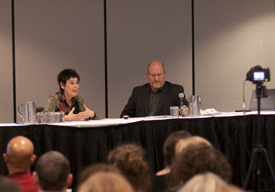
Image: the painter and writer Mira Schor (left) participated in CAA’s Annual Artists’ Interviews, hosted by ARTspace during the 2013 Annual Conference in New York. Schor was interviewed by Stuart Horodner, artistic director of the Atlanta Contemporary Art Center (photograph by Bradley Marks)
NEH Chairman Jim Leach Announces Resignation
posted Apr 23, 2013
 Jim Leach announced today that he is leaving his post as chairman of the National Endowment for the Humanities (NEH). His resignation is effective the first week of May.
“I am grateful for the opportunity to have become associated with an agency that plays such a critical role in humanities research and public programming,” he said. “America needs an infrastructure of ideas as well as bridges, and no institution over the past half century has done more to strengthen the idea base of our democracy than the NEH. The humanities are an essential corollary to the nation’s increasing focus on science, technology, engineering, and math (STEM).”
Under Leach’s leadership, the agency created a Bridging Cultures program designed to promote understanding and mutual respect for diverse groups within the United States and abroad. As part of this effort, the NEH supported programs designed to expand citizen understanding of American history and values, the civil rights movement, and foreign cultures.
In addition, the agency helped launch a National Digital Public Library to establish a unified gateway to digital collections of books, artworks, and artifacts from libraries, museums, and other cultural sites across the country. He presided over the culmination of decades-long projects such as the publication of the Autobiography of Mark Twain and the Dictionary of American Regional English.
Leach is the ninth NEH chairman. Prior to being named to the post in August 2009, he was a professor at the Woodrow Wilson School at Princeton University and interim director of the Institute of Politics and lecturer at the John F. Kennedy School of Government at Harvard University. From 1977 to 2007, he represented Iowa in the House of Representatives, where he chaired the Banking and Financial Services Committee, the Subcommittee on Asian and Pacific Affairs, and the Congressional-Executive Commission on China.
Carole Watson, NEH deputy chairman, will be the acting head of the endowment until a permanent replacement is nominated by President Barack Obama and confirmed by the Senate.
Image: Jim Leach, chairman of the National Endowment for the Humanities (photograph by Greg Powers and Audrey Crewe)
Solo Exhibitions by Artist Members
posted Apr 22, 2013
See when and where CAA members are exhibiting their art, and view images of their work.
Solo Exhibitions by Artist Members is published every two months: in February, April, June, August, October, and December. To learn more about submitting a listing, please follow the instructions on the main Member News page.
April 2013
Abroad

Grimanesa Amorós. Litvak Gallery, Tel Aviv, Israel, February 14–May 23, 2013. Light between the Islands. Installation.

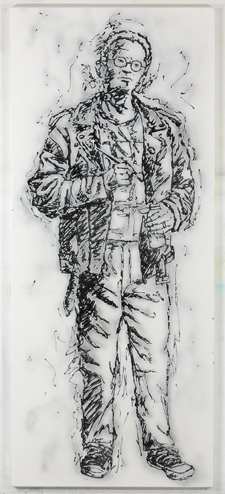 Mark Staff Brandl, Self-Portrait, 2013, oil on canvas, 75 x 32 in. (artwork © Mark Staff Brandl)
Mark Staff Brandl. Jedlitschka Gallery, Zürich, Switzerland, February 28–April 18, 2013. My Metaphor(m): a Painting-Installation. Painting and installation based on his PhD dissertation.
Mid-Atlantic

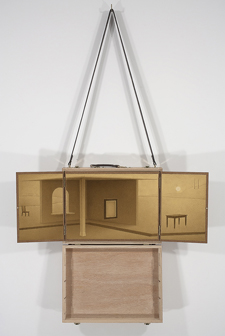 Jeffrey Abt, Wandering Gallery project (workspace), 2013, oil on panel and mixed media, 49 x 29 x 3½ in. (open) (artwork © Jeffrey Abt)
Jeffrey Abt. King Street Gallery, Morris and Gwendolyn Cafritz Foundation Arts Center, Montgomery College, Takoma Park, Maryland, February 8–March 14, 2013. Jeffrey Abt: Observations/Contemplations. Paintings and mixed media.
Ander Mikalson. Temple Contemporary, Temple University, Philadelphia, Pennsylvania, January 30–February 12, 2013. A Score for a Dinosaur. Performance.
Northeast
Ander Mikalson. Institute for Contemporary Art, Maine College of Art, Portland, Maine, January 23–April 7, 2013. A Score for Two Dinosaurs. Performance.
Joseph S. Lewis III. The Phatory, New York, February 2–March 31, 2013. Security Blanket. Dye sublimation prints on polyester quilts.

 Thomas Matsuda, Purification, 2011, rubbing of charred wood from the burning of Purification sculptures at Morton Arboretum in Lisle, Illinois, on handmade paper with flower petals, 24 x 30 in. (artwork © Thomas Matsuda)
Thomas Matsuda. East Wing Gallery, Raymond M. LaFontaine Fine Arts Center, Mount Wachusett Community College, Gardner, Massachusetts, February 18–March 15, 2013. Purification. Sculpture and work on paper.
South
Kathryn Kelley. Art League Houston, Houston, Texas, January 18–March 8, 2013. The Uncontrollable Nature of Grief and Forgiveness (or lack of). Installation.
Sharon Louden. Holly Johnson Gallery, Dallas, Texas, April 6–June 22, 2013. Simple Strokes. Animation, painting, drawing, and sculpture.
West

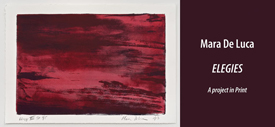 Invitation card for Elegies: A Project in Print (artwork © Mara De Luca)
Mara De Luca. Irvine Fine Arts Center, Irvine, California, March 9–April 20, 2013. Elegies: A Project in Print. Intaglio and silkscreen printmaking.
Mara De Luca. Luis De Jesus Gallery, Los Angeles, California, February 23–March 30, 2013. Cruise Collection 2013: New Paintings by Mara De Luca. Painting.
Micol Hebron. Jancar Gallery, Los Angeles, California, March 9–April 13, 2013. Reverse Engineering. Video, performance, and wall works.

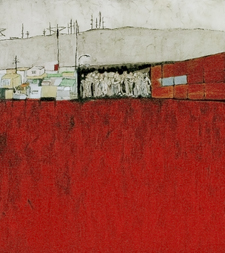 Kim Shifflet, Trapped at the Border, 2010, oil on canvas, 42 x 48 in. (artwork © Kim Shifflet)
Kim Shifflett. Branigan Cultural Center Museum, Las Cruces, New Mexico, April 5–27, 2013. Borderland. Painting.
Molly Springfield. Steven Wolf Fine Arts, San Francisco, California, January 26–March 9, 2013. The Marginalia Archive. Drawing and installation.
Claire Zitzow. White Box, University of Oregon, Portland, Oregon, February 7–March 23, 2013. Remains to Be Seen. Inkjet, silk-screened, and embossed prints, video, light boxes, and installation.
April 2013 Picks from CAA’s Committee on Women in the Arts
posted Apr 19, 2013
 Each month, CAA’s Committee on Women in the Arts produces a curated list, called CWA Picks, of recommended exhibitions and events related to feminist art and scholarship in North America and around the world.
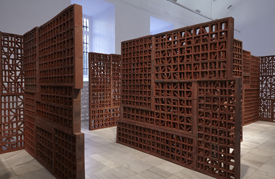
The CWA Picks for April 2013 are composed of seven significant exhibitions now on view in Europe, the United Kingdom, and the United States. The Moderna Museet in Stockholm, Sweden, is hosting the traveling retrospective Hilma af Klint: A Pioneer of Abstraction, and the Museo Nacional Centro de Arte Reina Sofía in Madrid is presenting a survey of work by Cristina Iglesias, who lives and works in the Spanish capital. Visitors to the British Isles can see daring painting and sculpture in Dorothy Iannone: Innocent and Aware at the Camden Arts Centre in London and extraordinary photographs by Edith Tudor-Hart at the Scottish National Portrait Gallery in Edinburgh. Across the pond, institutions in New York are displaying hybrid drawings by the Italian Pop artist Giosetta Fiorni, video installations and photographs by the Belgian filmmaker Chantal Akerman, and strikingly innovative prints by the American Impressionist Mary Cassatt.
Check the archive of CWA Picks at the bottom of the page, as several museum and gallery shows listed in previous months may still be on view or touring.
Image: installation view of Cristina Iglesias: Metonymy at the Museo Nacional Centro de Arte Reina Sofía in Madrid
Resale Royalty Agenda
posted Apr 19, 2013
Anne Collins Goodyear, president of the CAA Board of Directors and associate curator of prints and drawings at the National Portrait Gallery, Smithsonian Institution, will represent CAA at the United States Copyright Office public roundtable on resale royalties for artists, to be held on April 23, 2013, in Washington, DC. Please download and review the agenda for the roundtable.
Act Now – Ask Your Senators to Support the IMLS Office of Museum Services!
posted Apr 18, 2013
The American Alliance of Museums (AAM) sent the following email on April 17, 2013.
Act Now – Ask Your Senators to Support the IMLS Office of Museum Services!
Again this year, museum champion Senator Kirsten Gillibrand is circulating a letter urging the Senate Appropriations Committee to provide robust funding in FY14 for the Office of Museum Services (OMS) at the Institute of Museum and Library Services (IMLS).
The deadline to sign on to this letter is Wednesday, April 24, 2013.
Ask your Senators to sign the OMS appropriations letter today!
House OMS Letter Sets New Record; Keep Momentum Going in the Senate!
The House version of this year’s OMS appropriations letter has already closed and, while we’re still tabulating the final list of signers, we do know that a new record of at least 95 Representatives signed the letter.
“This year’s record-setting effort in the House of Representatives is a testament to the hard work of museum advocates nationwide,” said Alliance President Ford W. Bell. “But we can’t afford to lose any momentum, so I hope everyone will take one minute to contact their Senators today.”
The Office of Museum Services received $30.8 million in the FY12 appropriations cycle, but was cut to $29.2 million in FY13 as a result of across-the-board cuts known as “sequestration.” While President Obama has proposed increasing its budget in FY14, the Office of Museum Services’ funding will ultimately be decided by Congress, so it is imperative that legislators hear from their constituents.
Thank you for taking action on this important issue!
Please visit www.aam-us.org/advocacy to learn more about Alliance advocacy for museums.
News from the Art and Academic Worlds
posted Apr 17, 2013
Each week CAA News publishes summaries of eight articles, published around the web, that CAA members may find interesting and useful in their professional and creative lives.
Arts and Humanities Endowments Would Edge Up under Obama’s Budget
Federal funds for the National Endowments for the Arts and for the Humanities would remain stable under President Barack Obama’s proposed budget for the 2014 fiscal year. His budget proposal, released last week, would raise each endowment’s budgets by roughly $200,000, to $154.5 million for the coming fiscal year. The two endowments offer grants to colleges for research and fellowships in the arts and humanities, among other activities. (Read more in the Chronicle of Higher Education.)
Video of Instructor at USC Sets Off Controversy, but Is Context Missing?
A video of an instructor at the University of Southern California bashing Republicans in class goes viral and is cited as evidence of liberal indoctrination. But critics don’t mention that he was hired as an adjunct instructor for a program that seeks partisans—liberals and conservatives alike. (Read more at Inside Higher Ed.)
How Photographers Joined the Self-Publishing Revolution
Having long since shaken off the kind of stigma that still attaches to, say, self-published fiction, the self-published photobook is currently a mini-phenomenon within the bigger thriving culture of photography book publishing. The wider context for this DIY approach is the availability of relatively cheap digital technology and the attendant rise of social media–led networking, which allows photographers to disseminate, market, and sell their own books without recourse to the traditional artist–publisher relationship. (Read more in the Guardian.)
A Page from Our Handbook: Building Your Internet Presence
Because the internet is contemporary culture’s primary means for communication and information dissemination, having an active online presence is essential for artists. The web continues to rapidly evolve, so what follows are some basic ways to think about building and refining how you represent yourself and your work online. What’s most important is for you to find the best way to communicate the clarity, force, and excellence of your work and put that online. (Read more at Creative Capital.)
Cell Phones in the Classroom: What’s Your Policy
Are we old fuddy-duddies when we ask (demand) students to put away their cell phones in the classroom or clinical areas? Students tell me this is just the way it is now, but I disagree. What is the answer to this problem? Are faculty members being too demanding by placing cell-phone restrictions in syllabi or clinical handbooks? (Read more in Faculty Focus.)
Advocates Say Ethnic Studies Misunderstood, Needlessly under Fire
Ron Scapp, president of the National Association for Ethnic Studies, exited the airplane headed to his annual board meeting last week in Fort Collins, Colorado, ready to galvanize ethnic-studies program chairs from colleges across the country. He said he felt a sense of urgency because there were too many headlines in the news recently that might have detrimental consequences for ethnic-studies programs across the board. (Read more at Diverse Issues in Higher Education.)
Why Not a Two-Tier System?
In recent years, some very smart people—such as Michael Bérubé, Marc Bousquet, Anthony Grafton, and William Pannapacker—have offered their thoughts about how to fix graduate education and, by extension, the academic labor market, which, we all seem to agree, has “unraveled.” I approach this issue from a different perspective: as someone who does not work at a prestigious research university but rather at a two-year teaching college; as someone with several decades of experience on faculty search committees; and as someone who does not hold a PhD but instead something much closer to what Bérubé describes as “a rigorous four-year MA.” (Read more in the Chronicle of Higher Education.)
Pragmatic Advising
My students, especially soon-to-be master’s-degree recipients, frequently ask about whether PhD programs are a good career path. Given the difficulties of this job market, even for students in a professional program who have experience in the field, the prospect of a PhD can seem like a permanent safe harbor. Appearances deceive, though, as a tight academic job market and a deepening reliance on adjuncts make even employment after the PhD a difficult proposition. It’s no surprise, then, that there’s been an increasingly strident pushback to the idea that PhDs are necessary. (Read more at Inside Higher Ed.)