
CAA News Today
Exhibitor and Advertiser Prospectus for the 2013 Annual Conference
posted Aug 10, 2012
 The Exhibitor and Advertiser Prospectus for the 2013 Annual Conference in New York is now available for download. Featuring essential details for participation in the Book and Trade Fair, the booklet also contains options for sponsorship opportunities and advertisements in conference publications and on the conference website.
The Exhibitor and Advertiser Prospectus will help you reach a core audience of artists, art historians, educators, students, and administrators, who will converge in New York for CAA’s 101st Annual Conference, taking place February 13–16, 2013. With three days of exhibit time, the Book and Trade Fair will be centrally located at the Hilton New York, where most programs sessions and special events take place. CAA offers several options for booths and tables that can help you to connect with conference attendees in person.
In addition, sponsorship packages will allow you to maintain a high profile throughout the conference. Companies, organizations, and publishers may choose one of four visibility packages, sponsor specific areas and events such as the Student and Emerging Professionals Lounge, or work with CAA staff to design a custom package. Advertising possibilities include the Conference Program, distributed to over six thousand registrants, and the conference website, seen by thousands more.
The priority deadline for Book and Trade Fair applications has been extended to Friday, November 16, 2012; the final deadline for all applications and full payments, and for sponsorships and advertisements in the Conference Program, is Friday, December 7, 2012.
Questions about the 2013 Book and Trade Fair? Please contact Paul Skiff, CAA assistant director for Annual Conference, at 212-392-4412. For sponsorship and advertising queries, speak to Helen Bayer, CAA marketing and communications associate, at 212-392-4426.
FIELD REPORT
posted Aug 07, 2012
Doralynn Pines is an independent scholar and consultant based in New York and a member of the CAA Board of Directors. She served as associate director of the Metropolitan Museum of Art in New York and was chief librarian of the museum’s central research library.
The Digital World Meets Art History at Princeton University
On July 12, 2012, the Index of Christian Art at Princeton University in New Jersey sponsored a one-day conference that covered topics of digital archiving, research, and technical innovation in art history. Entitled “The Digital World of Art History: Databases, Initiatives, Policies, and Practices,” the conference was attended by almost one hundred art historians, art librarians, and museum and visual-resources curators. The year 2012 marks the ninety-fifth anniversary of the index, which was founded in 1917 by Charles Rufus Morey. The anniversary also celebrates the fact that the index’s information, held in library reserves for decades, has evolved into a growing digital database for use by scholars all over the world.
Organized by Colum Hourihane, director of the index, the conference featured eighteen invited speakers who discussed topics as varied as the future of art bibliography (Carole Ann Fabian, Avery Architectural and Fine Arts Library, Columbia University), copyright, scholarship, and fair use in the fine arts (Gretchen Wagner, ARTstor), art-historical research (Gwen David, Metropolitan Museum of Art and Queens College, City University of New York), and a database of performances of medieval narratives (Evelyn [Timmie] Birge Vitz and Marilyn Lawrence, both from New York University). Melitte Buchman, also of NYU, spoke about current best digital practices. The Morgan Library and Museum was represented by curators and librarians (Maria Oldal, Elizabeth O’Keefe, William Voelkle), who described their recently completed collaboration with the index. Approximately 58,000 images from over nine hundred Western medieval and Renaissance manuscripts will soon be available through the Morgan Library’s website and through the index.
Several talks outlined exciting new digital projects currently underway at Princeton, including databases and new initiatives at the index (Judith Golden, Jessica Savage, Beatrice Radden Keefe, Jon Niola, Henry Schilb), in the Visual Resources Collection (Trudy Jacoby), and in the Digital Humanities Initiative (David Mimno). Sandra Ludig Brooke, a librarian at the Marquand Library of Art and Archeology, spoke about the Blue Mountain Project, a team effort of scholars and librarians to catalogue, and make freely available, digital editions of avant-garde arts journals produced in Europe and North America between 1848 and 1923. The project is off to a running start with a generous grant from the National Endowment for the Humanities.
To wrap up the conference, Eleanor Fink of the World Bank Group presented “Art Clouds: Reminiscences and Prospects for the Future,” a look back at the well-known projects she oversaw during her tenure at the Getty Information Institute, including the Art and Architecture Thesaurus (AAT), the Union List of Artist Names (ULAN), the Thesaurus of Geographic Names (TGN), and the Bibliography of the History of Art (BHA). She also noted how far the field had come, with collaborative and cross-platform efforts being the norm. In looking to future prospects for seamless access to art information, Fink pointed to Linked Open Data and some recent projects that have begun to use it.
Hourihane has just announced the online publication of the papers on the Index of Christian Art website.
CAA Members Receive Discounts with Zipcar
posted Aug 06, 2012
 CAA has partnered with Zipcar to bring car sharing to members at a greatly reduced rate. CAA members can join for a $25 annual fee—as opposed to the regular rate of $60 per year. In addition, if you join through CAA, Zipcar will waive the one-time $25 application fee and also give you $25 in free driving credit.
Zipcar is an easy, economical, and environmentally friendly alternative to traditional car-rental programs. With Zipcar you can reserve a vehicle by the hour or the day and select from a wide range of cars, vans, and trucks. Gas, insurance, and 180 miles are included in each reservation. A membership with Zipcar is universal: pick up a car in over fifteen participating cities in the United States, Canada, and the United Kingdom, including New York, Boston, Chicago, San Francisco, Washington, DC, Toronto, and London. Faculty and students also have the added benefit of being able to access Zipcars right on campus, with more than 250 colleges and universities participating in the car-sharing program.
Join today; don’t forget to use the promotional code member25 to earn $25 in free driving credit to your account.
EDITORS OF THE ART BULLETIN
posted Aug 06, 2012
Nora Griffin is an artist and CAA assistant editor.
Kirk Ambrose (2013–16)
Kirk Ambrose
Kirk Ambrose, associate professor of medieval art history and chair of the Department of Art and Art History at the University of Colorado in Boulder, will become editor-in-chief of The Art Bulletin. His three-year term begins on July 1, 2013, after he concludes a year as editor designate. Ambrose will succeed Karen Lang of the University of Warwick in England, who has led the journal since 2010.
As incoming editor, Ambrose plans to build on the legacies of two previous Art Bulletin editors, Karen Lang and Nancy Troy, and to develop alternative forums for debate within the journal, such as the recently inaugurated special features “Regarding Art and Art History” and “Notes from the Field.” Like Lang, he is also inspired by the journal’s approaching centennial, in 2013, and sees The Art Bulletin’s current moment as intellectually parallel to the “speculative and creative” art history that was being practiced in its pages in the early twentieth century. The recent decision of the German government to fund “clusters of excellence” has resulted in new structures at universities and has spurred Ambrose into dialogue with a group of international scholars from Brazil, France, India, and Turkey, to better understand the nuances of how “art-historical research and pedagogy is now conceived.” This international perspective on art history will be thoroughly addressed in a new series of short essays for The Art Bulletin, tentatively titled “Whither History?” in which invited scholars will “reflect upon how trends toward globalization in the humanities have had an impact on the ways we conceive art history.”
In 1999, Ambrose earned his PhD in the history of art from the University of Michigan in Ann Arbor with a dissertation on “Romanesque Vézelay: the Art of Monastic Contemplation,” completed under the guidance of Ilene Forsyth and Elizabeth Sears. Ambrose’s education also includes a BA from Oberlin College in Oberlin, Ohio, in 1990 and additional study at the Goethe Institut in Düsseldorf, Germany, and McGill University in Montreal, Canada.
A faculty member at the University of Colorado since 1999, Ambrose has taught a range of courses on topics of medieval art history and methodology at the undergraduate and graduate level and has served as an MA and PhD thesis advisor for many students. A specialist in Romanesque sculpture, Ambrose is dedicated to the idea of art history as a global discipline and to this end has worked to diversify his department at Colorado. He recently worked with the administration to create a tenure-track position for an art historian specializing in colonial Latin America.
Within Ambrose’s own field of interest, he has consistently chosen topics and methodologies of inquiry that enlarge the scope of medieval studies. His book Monsters in Twelfth-Century European Sculpture, is forthcoming from Boydell and Brewer, and he received a Samuel H. Kress Foundation grant for the volume The Nave Sculpture of Vézelay: The Art of Monastic Viewing (Toronto: Pontifical Institute of Mediaeval Studies, 2006). Recent book chapters include “Male Nudes and Embodied Spirituality in Romanesque Sculpture,” published in Meanings of Nudity in Medieval Art (Burlington, VT: Ashgate, 2012), edited by Sherry Lindquist. A 2011 essay, “Viollet-le-Duc’s Judith at Vézelay: Romanesque Sculpture Restoration as (National) Art,” published in Nineteenth-Century Art Worldwide, discusses the restoration of a medieval monument in nineteenth-century France as it relates to the country’s republican politics. He recently contributed to The Art Bulletin a review of Friedrich Kittler’s Optical Media: Berlin Lectures 1999, translated by Anthony Enns, that was published in the March 2011 issue, and a short piece on appropriation and medieval art in the multiauthored section “Notes from the Field” in June 2012.
Ambrose’s practice of a socially and culturally mindful art history has led to opportunities beyond the classroom. With colleagues Davide Stimilli and Lisa Tamiris-Becker, he is currently planning a 2014 exhibition at the University of Colorado Art Museum, tentatively titled Aby Warburg and the Beginning of Cultural Studies in the American Southwest. Ambrose states, “Warburg’s 1895–86 expedition to the Southwest is well known, but this journey looks very different when viewed from an American, rather than European, perspective. Much of Warburg’s vision appears indebted to a network of mostly Jewish merchants across the Southwest, who sold photographs of Indian rituals as well as ceramics and other objects that Warburg collected.” For Ambrose the exhibition is a means to explore the multifariousness of art-historical vision, and how “art practices can serve as vehicles of knowledge” for scholars at the turn of both the twentieth and twenty-first centuries.
Travel Grants to Attend the 2013 Annual Conference in New York
posted Aug 02, 2012
 CAA offers Annual Conference Travel Grants to graduate students in art history and studio art and to international artists and scholars. In addition, the Getty Foundation has funded the second year of a program that enables twenty applicants from outside the United States to attend the 2013 Annual Conference in New York. Applicants may apply for more than one grant but can only receive a single award.
CAA Graduate Student Conference Travel Grant
CAA will award a limited number of $250 Graduate Student Conference Travel Grants to advanced PhD and MFA graduate students as partial reimbursement of travel expenses to attend the 101st Annual Conference, taking place February 13–16, 2013, in New York. To qualify for the grant, students must be current CAA members. Successful applicants will also receive a complimentary conference registration. Deadline: September 14, 2012.
CAA International Member Conference Travel Grant
CAA will award a limited number of $500 International Member Conference Travel Grants to artists and scholars from outside the United States as partial reimbursement of travel expenses to attend the 101st Annual Conference, taking place February 13–16, 2013, in New York. To qualify for the grant, applicants must be current CAA members. Successful applicants will also receive a complimentary conference registration. Deadline: September 14, 2012.
CAA International Travel Grant Program
The CAA International Travel Grant Program, generously supported by the Getty Foundation, provides funding to twenty art historians, museum curators, and artists who teach art history to attend the 101st Annual Conference, taking place February 13–16, 2013, in New York. The grant covers travel expenses, hotel accommodations, per diems, conference registrations, and one-year CAA memberships. For 2013, CAA will offer preconference meetings on February 11 and 12 for grant recipients to present and discuss their common professional interests and issues. Applicants do not need to be CAA members. Deadline extended: August 24, 2012.
Donate to the Annual Conference Travel Grants
CAA’s Annual Conference Travel Grants are funded solely by donations from CAA members—please contribute today. Charitable contributions are 100 percent tax deductible. CAA extends a warm thanks to those members who made voluntary contributions to this fund during the past twelve months.
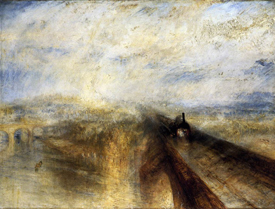
Image: Joseph Mallord William Turner, Rain, Steam and Speed—The Great Western Railway, 1844, oil on canvas, 35⅞ x 49 in. National Gallery, London (artwork in the public domain)
August 2012 Picks from CAA’s Committee on Women in the Arts
posted Aug 01, 2012
 Each month, CAA’s Committee on Women in the Arts produces a curated list, called CWA Picks, of recommended exhibitions and events related to feminist art and scholarship in North Americn and around the world.
The CWA Picks for August 2012 include several important exhibitions in New York and a handful on view this month in Europe. The Solomon R. Guggenheim Museum is hosting a survey of work by the Dutch photographer and video artist Rineke Dijkstra; the Whitney Museum of American Art has given over its third floor to Sharon Hayes, who is incorporating performance into her exhibition of photography and video; and the Brooklyn Museum is presenting a collaborative project led by Ulrike Müller in its Raw/Cooked series, which features artists who live and work in the borough.
Across the Atlantic, MUSAC in León, Spain, has staged Feminist Genealogies in Spanish Art: 1960–2010, organized by Juan Vicente Aliaga and Patricia Mayayo, which investigates the underrecognized role that feminist activism and theory has played in Spanish art since the 1960s. Elsewhere, the Portuguese artist Joana Vasconcelos has created an installation of large-scale sculptures in the Palace of Versailles, and Goldsmiths in London has spread work by Su Richardson across two venues in London.
Check the archive of CWA Picks at the bottom of the page, as several museum and gallery shows listed in previous months may still be on view or touring.
Image: Rineke Dijkstra, The Krazyhouse (Megan, Simon, Nicky, Philip, Dee), Liverpool, UK, 2009, four-channel HD video projection with sound, 32 min., looped (artwork © Rineke Dijkstra; photograph provided by the artist, Marian Goodman Gallery, New York and Paris, and the Solomon R. Guggenheim Museum)
Jens T. Wollesen: In Memoriam
posted Jul 23, 2012
The following obituary was submitted by Jill Caskey, associate professor in the Department of Art at the University of Toronto in Ontario, Canada, and PhD coordinator for the school’s Centre for Medieval Studies.
Jens T. Wollesen, a professor and a specialist in the art of medieval Italy and Cyprus, died in Toronto on April 22, 2013. He received his BA from the University of Hamburg, his PhD from the University of Heidelberg, and his Habilitation from the University of Munich before traversing the Atlantic to join the Department of Art at the University of Toronto in 1985. For the rest of his life Wollesen remained firmly anchored to Toronto, where his contributions to the pedagogical and scholarly missions of the university took many forms. At various times he directed the undergraduate and graduate programs in art and also served on the Art Committee of the University of Toronto’s Victoria University, where he was a fellow.
Wollesen’s work probed several salient issues in medieval art, from the devotional function of panel paintings to images of everyday life. Among his many articles and books are the influential Die Fresken von San Piero a Grado bei Pisa (Bad Oeynhausen, Germany: Theine, 1977), Pictures and Reality: Monumental Frescoes and Mosaics in Rome around 1300 (New York: Peter Lang, 1998), and Patrons and Painters on Cyprus: The Frescoes in the Royal Chapel at Pyrga (Toronto: Pontifical Institute of Mediaeval Studies, 2010). He had recently completed a second book on Cyprus, entitled Acre or Cyprus: A New Approach to Crusader Painting around 1300.
Wollesen could discourse equally on Asian painting, contemporary art, and the medieval artists and patrons who commanded most of his scholarly attention. His intellectual range and curiosity served him well in the classroom. Literally thousands of undergraduates first encountered the discipline of art history in his legendary Intro lectures at Toronto. He garnered legions of fans in such adventurous courses as “The Body: An Exercise,” “The Practice of Art History,” and “Is There Crusader Art?” Wollesen flourished outside the classroom and study as well as within: he was an accomplished painter and photographer, and a passionate sailor who commanded the waves of Lake Ontario at the first sign of spring.
He is survived by his wife, Elena Lemeneva, and his children, Leon Wollesen, Hanna Wollesen, Christina Wollesen, Victor Wollesen, and Kate Wollesen.
Art Journal Publishes Special Issue on Pacific Standard Time
posted Jul 18, 2012
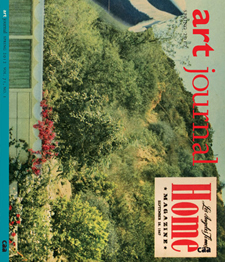 Pacific Standard Time, the massive project on art in southern California that concluded in June, is the topic of a special issue of Art Journal that has just been published. An unprecedented collaboration of some sixty southern Californian cultural institutions brought together by the Getty, the Pacific Standard Time exhibitions and events offered a near-encyclopedic view of the work artists created in the region from 1945 to 1980.
At the center of the journal’s coverage is a conversation with Andrew Perchuk, deputy director of the Getty Research Institute (GRI), and Thomas Crow, former director of the GRI and now a professor at the Institute of Fine Arts of New York University; they speak with the art historian Howard Singerman, reviews editor of Art Journal.
The issue features a commissioned artist’s project by Allen Ruppersberg, PST: Before and After, which appears on the covers of the issue and every interior page. In her introduction to the issue, the editor-in-chief Katy Siegel notes that Ruppersberg “is often seen as the classic Los Angeles artist.” His project draws on press treatment of art in southern California during the years covered by Pacific Standard Time.
In addition, many of the Pacific Standard Time exhibitions are reviewed or discussed in extended essays by historians, curators, and artists: Connie Butler, Jan Tumlir, Lucia Sanromán, Malik Gaines, Michael Ned Holte, and Ken Gonzales-Day. An essay by Lucy Bradnock considers the Angeleno curator Walter Hopps, and Maria Elena Buszek interviews the artists Suzanne Lacy and Andrea Bowers about their joint projects.
This special issue of Art Journal is the leading edge of the flood of scholarship on postwar art in southern California that Pacific Standard Time is expected to engender.
Revised Directory of Affiliated Societies
posted Jul 17, 2012
The Directory of Affiliated Societies, a comprehensive list of all seventy-four groups that have joined CAA as affiliate members, has just been updated. Please visit the directory to view a single webpage that includes the following information for each group: name, date of founding, size of membership, and annual dues; a brief statement on the society’s nature or purpose; and the names of officers and/or contacts for you to get more details about the groups or to join them. In addition, CAA links directly to each affiliated society’s homepage.
New Leaders for CAA’s Publications
posted Jul 10, 2012
The president of the CAA Board of Directors, Anne Collins Goodyear, has confirmed new appointments to the editorial boards of CAA’s three scholarly journals and to the Publications Committee, in consultation with the vice president for publications, Randall C. Griffin. The appointments took effect on July 1, 2012.
The Art Bulletin
The Art Bulletin has announced its next editor-in-chief: Kirk Ambrose, associate professor and chair of the Department of Art and Art History at the University of Colorado in Boulder. In addition to numerous essays and book chapters, he is the author of The Nave Sculpture of Vézelay: The Art of Monastic Viewing (Toronto: Pontifical Institute of Mediaeval Studies, 2006) and the coeditor, with Robert A. Maxwell, of Current Directions in Eleventh- and Twelfth-Century Romanesque Sculpture Studies (Turnhout, Belgium: Brepols, 2010). His book Monsters in Twelfth-Century European Sculpture is forthcoming from Boydell and Brewer. Other future projects include a volume on Portuguese Romanesque sculpture and an exhibition at the University of Colorado Art Museum, tentatively entitled Aby Warburg and the Beginning of Cultural Studies in the American Southwest and scheduled for 2014. Ambrose will succeed Karen Lang of the University of Warwick in England, beginning his three-year term as editor-in-chief on July 1, 2013, with the preceding year as editor designate.
David J. Getsy, the Goldabelle McComb Finn Distinguished Professor of Art History, Theory, and Criticism at the School of the Art Institute of Chicago, has joined the Art Bulletin Editorial Board for a four-year term. His work focuses on modern and contemporary art in Europe and America from the 1870s to the present day. Among his books are Body Doubles: Sculpture in Britain, 1877–1905 (New Haven: Paul Mellon Centre for Studies in British Art and Yale University Press, 2004) and Rodin: Sex and the Making of Modern Sculpture (New Haven: Yale University Press, 2010). Getsy is currently editing the critical writings of the American postminimalist artist Scott Burton, for publication later this year by Soberscove Press.
Rachael DeLue, associate professor of art history at Princeton University in Princeton, New Jersey, has begun a three-year term as the reviews editor of The Art Bulletin, succeeding Michael Cole of Columbia University in New York. Her first section will appear in the March 2013 issue. Thelma K. Thomas, associate professor of fine arts at the Institute of Fine Arts, New York University, has now entered the second year of her two-year service as the chair of the editorial board of the journal.
Art Journal
Michael Corris, professor of art and chair of the Division of Art in the Meadows School of the Arts at Southern Methodist University in Dallas, Texas, was appointed Art Journal reviews editor. He will serve one year as reviews editor designate, taking over from Howard Singerman of the University of Virginia in July 2013. Corris is both an artist and an author of many works on postwar and contemporary art and theory. The Peacock Gallery in London and the Reading Room in Dallas hosted his most recent solo shows; he has also exhibited widely as a member of the collaborative group Art & Language. Among Corris’s many publications are monographs on Ad Reinhardt (London: Reaktion Books, 2008) and David Diao (Beijing: Timezone 8, 2005). Two books forthcoming in 2013 are The Artist Out of Work: Selected Writings on Art (Les Presses du réel and JRP | Ringier) and What Do Artists Know? The Response to Deskilling in Art (Reaktion Books). Corris is a cofounder and editor of Transmission Annual, a collaborative project of Sheffield Hallam University in England and the Meadows School of the Arts.
Joining the Art Journal Editorial Board for four-year terms are Catherine Lord and Hilary Robinson. Lord is a writer, artist, and curator whose work addresses issues of feminism, cultural politics, and colonialism. She is a professor of studio art and women’s studies at the University of California, Irvine. Recent solo exhibitions were held at ONE National Gay and Lesbian Archives and Jancar Gallery, both in Los Angeles. Lord is the author of the text-image experimental narrative The Summer of Her Baldness: A Cancer Improvisation (Austin: University of Texas Press, 2004), and her forthcoming book project coedited with Richard Meyer, to be published by Phaidon, is called Art and Queer Culture, 1885–2005. Robinson is a professor of art theory and criticism in the College of Fine Arts at Carnegie Mellon University in Pittsburgh, Pennsylvania. The focus of her scholarship is the history and theory of feminist art. Her books include Reading Art, Reading Irigaray: The Politics of Art by Women (London: I. B. Tauris, 2006) and Feminism-Art-Theory: A History, forthcoming from Blackwell. She is the editor of Visibly Female: Feminism and Art: An Anthology (London: Camden, 1987) and Feminism-Art-Theory: An Anthology 1968–2000 (Malden, MA: Blackwell, 2001).
Lane Relyea, an art critic and associate professor in the Department of Art Theory and Practice at Northwestern University in Evanston, Illinois, has finished his year as editor designate of Art Journal and now assumes the position of editor-in-chief, succeeding Katy Siegel of Hunter College, City University of New York. His first edited issue will appear in spring 2013. Rachel Weiss, a professor at the School of the Art Institute of Chicago whose work focuses on the art of Cuba, is the new chair of the journal’s editorial board. Weiss recently published To and from Utopia in the New Cuban Art (Minneapolis: University of Minnesota Press, 2011).
caa.reviews
The caa.reviews Editorial Board welcomes a new member, Tanya Sheehan, assistant professor in the Department of Art History at Rutgers University in New Brunswick, New Jersey, who will serve for four years. Currently the journal’s field editor for books on photography, she is the author of Doctored: The Medicine of Photography in Nineteenth-Century America, published by Pennsylvania State University Press in 2011.
Six new field editors for books and exhibitions have recently been chosen by the editorial board to serve three-year terms. Gloria Williams will commission reviews of exhibitions of pre-1800 art on the West Coast; Eve Straussman-Pflanzer will oversee reviews of exhibitions in the Midwest; and Jennifer Kingsley will commission reviews of exhibitions in the Southeast. Kirsten Swenson will assign books on contemporary art for review, and Megan O’Neil will commission reviews of books and related media on Precolumbian art. Michael Schreffler will handle reviews of books on early modern Iberian and colonial Latin American art.
Publications Committee
S. Hollis Clayson, Bergen Evans Professor in the Humanities and professor of art history at Northwestern University in Evanston, Illinois, was appointed to the Publications Committee as member-at-large. Clayson specializes in nineteenth-century modern European art, particularly French art; her most recent book is Paris in Despair: Art and Everyday Life under Siege (1870–71) (Chicago: University of Chicago Press, 2002). She is the recipient of numerous research and teaching awards and, as director of the Alice Kaplan Institute for the Humanities at Northwestern, promotes discussion and projects focusing on humanities in the digital era. A former chair and member of the Art Bulletin Editorial Board, Clayson has served on CAA’s Annual Conference Committee and on the juries for three CAA awards: the Distinguished Lifetime Achievement Award for Writing on Art, the Arthur Kingsley Porter Prize, and the Distinguished Teaching of Art History Award.