CAA News Today
Wi-Fi at the Annual Conference
posted Feb 02, 2011
 Connecting to the internet at the CAA Annual Conference is essential, whether you are searching for a job, contacting friends in New York, or communicating with your school or institution back home. From the conference hotels to the ever-reliable Starbucks, CAA has researched the various ways to get Wi-Fi quickly, easily, and at low or no cost. The information below may be subject to change but should be reliable.
Hilton New York
The Hilton New York offers three types of wireless internet service to its guests and thus has three prices: $14.99 per twenty-four hours for a 1 MB download speed; $16.99 for 2 MB; and $18.99 for 4 MB. The Hilton also allows nonguests to log onto its network in the lobby areas on a pay-per-use basis, at $5.99 an hour. No connection speed is specified. Users must pay by credit card upon opening a browser on their laptop. For full details in advance, please contact the Hilton, not CAA. While onsite, ask a hotel representative from the concierge or check-in desk for more information.
Sheraton New York
The Sheraton New York is generously offering free internet access—both in rooms and in the lobby—to all guests who are attending the conference. When you check in, tell the hotel representative that you are here for CAA and need an access code. The Sheraton also provides free wireless connection to anyone inside the hotel—you need not be a guest (so be nice). To gain access, simply request the log-in information from the check-in desk, as you cannot automatically connect just by opening a browser. For full details in advance, please contact the Sheraton, not CAA. While onsite, ask a hotel representative from the concierge or check-in desk for more information.
The Sheraton has graciously extended its special room-reservation rates for CAA conference attendees to February 6, 2011. To reserve a room by phone, call 800-325-3535 and mention “College Art Association Annual Conference.” Please be sure to request a confirmation number, email, or fax.
Park Central Hotel
The Park Central Hotel, the conference hotel for students, charges $15 a day for a wireless connection that can be used by guests throughout the building. For full details in advance, please contact the Park Central, not CAA. While onsite, ask a hotel representative at the concierge or check-in desk for more information.
SEP Lounge
Thanks to a generous contribution from the Courtauld Institute of Art, the SEP Lounge provides free wireless internet during its opening hours: Wednesday–Friday, 9:00 AM–8:00 PM; and Saturday, 9:00 AM–5:00 PM. The lounge is located on Concourse B, Concourse Level, Hilton New York.
Hosted by CAA’s Student and Emerging Professionals Committee, the SEP Lounge is a space that allows its constituents to convene and converse freely, away from the conference hustle and bustle. On several days, the committee will present special interactive programming, where you can practice your interviewing skills, talk candidly about completing your thesis or dissertation, or get advice on what to do after earning your degree.
Candidate Center
As part of the conference’s Career Services, the Candidate Center—located in Concourse A, Concourse Level, Hilton New York—houses a bank of computers that CAA members may use only for the Online Career Center. No other internet use is allowed. Hours are Wednesday, February 9–Friday, February 11, 9:00 AM–7:00 PM. You must have a CAA membership card to enter the Candidate Center.
Starbucks
Bottoms up, coffee drinkers! A smallish Starbucks—located directly across the street from the Hilton, at the northeast corner of Avenue of the Americas (Sixth Avenue) and West Fifty-third Street—offers free wireless internet to its guests. No special password is needed—just connect when you open a browser. This location may be closed on Saturday and Sunday, according to the company. Another Starbucks a few blocks north, on Sixth Avenue between West Fifty-sixth and Fifty-seventh, has free access according to the company, but this is unconfirmed (meaning I did not enter the store and ask).
Other Area Hot Spots
OpenWiFiSpots, which calls itself a comprehensive directory of free wireless hot spots, lists eighty-two free sources near the Hilton in midtown Manhattan, including hotels, cafés, and restaurants. This website, however, includes the Hilton, which we know is not free.
Revised on February 4, 2011.
Advocate for the Visual Arts, the Humanities, and Museums
posted Feb 02, 2011
Because fifty-one new members of the United States Congress may be unfamiliar with the important contributions made by the visual arts, the humanities, and museums in their communities, now is a crucial time to join the advocacy efforts of your peers, visit the offices of your federal representatives, and make your voice heard.
Join members of the CAA staff and Board of Directors at three upcoming advocacy events in Washington, DC: Museums Advocacy Day (February 28–March 1); Humanities Advocacy Day (March 7–8); and Arts Advocacy Day (April 4–5).
On the first day of each event, advocates receive training on how best to present a concise, compelling message to congressional leaders. On the following day, advocates gather by state and make personal visits to their senators and representatives on Capitol Hill to address the specific needs, interests, and contributions of their constituents—that is to say, you, your friends and colleagues, and your schools and museums.
The nineteen new senators and thirty-two new representatives (PDF) must be updated on the crucial activities in the arts in their respective states and districts. The most effective educational tool is for advocates to meet their members of Congress and administrative staffs in person. Every state needs representation. CAA urges you to sign up today!
Book Signings for The Eye, the Hand, the Mind at the CAA Conference
posted Feb 02, 2011
 Attendees of the 99th Annual Conference and Centennial Kickoff will have three opportunities to meet Susan Ball, CAA executive director emerita, as well as many of the fifteen contributors to The Eye, the Hand, the Mind: 100 Years of the College Art Association, the newly published book that surveys the impressive history of the organization from 1911 to the present.
After Convocation, Ball and others will sign copies of the book at a table in the foyer outside the East Ballroom, 3rd Floor, Hilton New York. This year’s Convocation, which takes place on Wednesday, February 9, 5:30–7:00 PM, features a keynote address by the pioneering eco-artists Newton and Helen Mayer Harrison that you will not want to miss.
In the Book and Trade Fair, Rutgers University Press will host two author signings on Thursday and Friday afternoons, at a time to be announced. CAA encourages you to stop by the press’s booth (#604) near the front entrance of the Americas I Ballroom and say hello to Ball and the other authors.
The impressive 330-page book, published by CAA and Rutgers University Press, celebrates the beginning of CAA’s Centennial year. In honor of this milestone, Rutgers will offer a 50 percent discount on any other press title that is purchased during the conference when you buy a copy of The Eye, The Hand, The Mind at the booth.
The Art Bulletin Seeks Reviews Editor and Two Editorial-Board Members
posted Feb 01, 2011
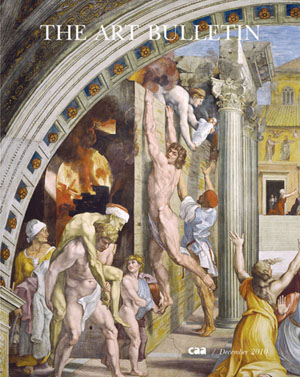 The Art Bulletin is the leading quarterly journal in the English language of scholarship in all areas of art history and visual studies.
Art Bulletin Reviews Editor
The Art Bulletin Editorial Board invites nominations and self-nominations for the position of reviews editor for a three-year term: July 1, 2012–June 30, 2015, with service as incoming reviews editor designate in 2011–12. Candidates should be art scholars with stature in the field and experience in editing book and/or exhibition reviews; institutional affiliation is not required. They should also be published authors of at least one book.
The reviews editor is responsible for commissioning all book and exhibition reviews in The Art Bulletin. He or she selects books and exhibitions for review, commissions reviewers, and determines the appropriate length and character of reviews. The reviews editor also works with authors and CAA’s codirectors of publications in the development and preparation of review manuscripts for publication. He or she is expected to keep abreast of newly published and important books and recent exhibitions in art history, criticism, theory, visual studies, and museum publishing. This three-year term includes membership on the journal’s editorial board.
The reviews editor attends the three annual meetings of the Art Bulletin Editorial Board—held twice in New York in the spring and fall and once at the CAA Annual Conference in February—and submits an annual report to CAA’s Publications Committee. CAA reimburses the reviews editor for travel and lodging expenses for the two New York meetings in accordance with its travel policy, but he or she pays these expenses to attend the conference.
Candidates must be current CAA members and should not be serving on the editorial board of a competitive journal or on another CAA editorial board or committee. Members may not publish their own work in the journal during the term of service. Nominators should ascertain their nominee’s willingness to serve before submitting a name; self-nominations are also welcome. Please send a statement describing your interest in and qualifications for appointment, a CV, and at least one letter of recommendation to: Director of Publications, Art Bulletin Reviews Editor Search, College Art Association, 275 Seventh Avenue, 18th Floor, New York, NY 10001; or email the documents to Alex Gershuny, CAA editorial associate. Deadline extended: April 11, 2011; finalists will be interviewed on Friday, April 29, 2011, in New York.
Art Bulletin Editorial Board
CAA invites nominations and self-nominations for two individuals to serve on the Art Bulletin Editorial Board for a four-year term: July 1, 2011–June 30, 2015. The ideal candidate has published substantially in the field and may be an academic, museum-based, or independent scholar; institutional affiliation is not required.
The editorial board advises the editor-in-chief of The Art Bulletin and assists him or her to seek authors, articles, and other content for the journal; guides its editorial program and may propose new initiatives for it; performs peer reviews and recommends peer reviewers; and may support fundraising efforts on the journal’s behalf. Members also assist the editor-in-chief to keep abreast of trends and issues in the field by attending and reporting on sessions at the CAA Annual Conference and other academic conferences, symposia, and events in their fields.
The Art Bulletin Editorial Board meets three times a year: twice in New York in the spring and fall and once at the CAA Annual Conference in February. CAA reimburses members for travel and lodging expenses for the two New York meetings in accordance with its travel policy, but members pay their own expenses for the conference.
Candidates must be current CAA members and should not be serving on the editorial board of a competitive journal or on another CAA editorial board or committee. Members may not publish their own work in the journal during the term of service. Nominators should ascertain their nominee’s willingness to serve before submitting a name; self-nominations are also welcome. Please send a letter describing your interest in and qualifications for appointment, a CV, and your contact information to: Chair, Art Bulletin Editorial Board, College Art Association, 275 Seventh Avenue, 18th Floor, New York, NY 10001; or email the documents to Alex Gershuny, CAA editorial associate. Deadline: April 15, 2011.
Updated on February 24 and March 30, 2011.
Art Journal Seeks Editor-in-Chief and Two Editorial-Board Members
posted Feb 01, 2011
 Art Journal, issued quarterly by CAA, publishes informed discussion about issues across disciplines in twentieth- and twenty-first-century art, nationally and internationally.
Art Journal Editor-in-Chief
CAA invites nominations and self-nominations for the next editor-in-chief of Art Journal, to serve a three-year term: July 1, 2012–June 30, 2015, with service on the Art Journal Editorial Board in 2011–12 as editor designate and in 2015–16 as past editor. A candidate may be an artist, art historian, art critic, art educator, curator, or other art professional; institutional affiliation is not required.
Working with the editorial board, the editor-in-chief is responsible for the content and character of the journal. He or she solicits content, reads all submitted manuscripts, sends submissions to peer reviewers, and provides guidance to authors concerning the form and content of submissions. The editor-in-chief also develops projects, makes final decisions regarding content, and may support fundraising efforts on the journal’s behalf. He or she works closely with CAA’s staff in New York.
The editor-in-chief attends the three annual meetings of the Art Journal Editorial Board—held twice in New York in the spring and fall and once at the Annual Conference in February—and submits an annual report to CAA’s Publications Committee. CAA reimburses the editor for travel and lodging expenses for the two New York meetings in accordance with its travel policy, but the editor pays his or her own expenses for the Annual Conference.
The position usually requires one-half of a person’s working time. CAA provides financial compensation for course release, usually to an editor’s employer.
Candidates must be current CAA members and should not be serving on the editorial board of a competitive journal or on another CAA editorial board or committee. Nominators should ascertain their nominee’s willingness to serve before submitting a name; self-nominations are also welcome. Please send a statement describing your interest in and qualifications for appointment, a CV, and at least one letter of recommendation to: Art Journal Editor-in-Chief Search, College Art Association, 275 Seventh Avenue, 18th Floor, New York, NY 10001; or email the documents to Alex Gershuny, CAA editorial associate. Deadline: March 25, 2011; finalists will be interviewed on Thursday, April 28, 2011, in New York.
Art Journal Editorial Board
CAA invites nominations and self-nominations for two individuals to serve on the Art Journal Editorial Board for a four-year term: July 1, 2011–June 30, 2015. Candidates are individuals with a broad knowledge of modern and contemporary art; institutional affiliation is not required.
The editorial board advises the editor-in-chief of Art Journal and assists him or her to seek authors, articles, artist’s projects, and other content for the journal; guides its editorial program and may propose new initiatives for it; performs peer reviews and recommends peer reviewers; and may support fundraising efforts on the journal’s behalf. Members also assist the editor-in-chief to keep abreast of trends and issues in the field by attending and reporting on sessions at the CAA Annual Conference and other academic conferences, symposia, and events in their fields.
The Art Journal Editorial Board meets three times a year: twice in New York in the spring and fall and once at the CAA Annual Conference in February. CAA reimburses members for travel and lodging expenses for the two New York meetings in accordance with its travel policy, but members pay their own expenses for the conference.
Candidates must be current CAA members and should not be serving on the editorial board of a competitive journal or on another CAA editorial board or committee. Members may not publish their own work in the journal during the term of service. Nominators should ascertain their nominee’s willingness to serve before submitting a name; self-nominations are also welcome. Please send a letter describing your interest in and qualifications for appointment, a CV, and your contact information to: Chair, Art Journal Editorial Board, College Art Association, 275 Seventh Avenue, 18th Floor, New York, NY 10001; or email the documents to Alex Gershuny, CAA editorial associate. Deadline: April 15, 2011.
Updated on February 24 and March 30, 2011.
caa.reviews Seeks One Editorial-Board Member
posted Feb 01, 2011
 An online journal, caa.reviews is devoted to the peer review of new books, museum exhibitions, and projects relevant to the fields of art history, visual studies, and the arts.
caa.reviews Editorial Board
CAA invites nominations and self-nominations for one individual to serve on the caa.reviews Editorial Board for a four-year term, July 1, 2011–June 30, 2015. Candidates may be artists, art historians, art critics, art educators, curators, or other art professionals with stature in the field and experience in writing or editing book and/or exhibition reviews; institutional affiliation is not required. The journal also seeks candidates with a strong record of scholarship and at least one published book or the equivalent who is committed to the imaginative development of caa.reviews.
The editorial board advises the editor-in-chief of and field editors for caa.reviews and helps them to identify books and exhibitions for review and to solicit reviewers, articles, and other content for the journal; guides its editorial program and may propose new initiatives for it; and may support fundraising efforts on the journal’s behalf. Members also assist the editor-in-chief to keep abreast of trends and issues in the field by attending and reporting on sessions at the CAA Annual Conference and other academic conferences, symposia, and events in their fields.
The caa.reviews Editorial Board meets three times a year: twice in New York in the spring and fall and once at the CAA Annual Conference in February. CAA reimburses members for travel and lodging expenses for the two New York meetings in accordance with its travel policy, but members pay these expenses to attend the conference.
Candidates must be current CAA members and should not be serving on the editorial board of a competitive journal or on another CAA editorial board or committee. Nominators should ascertain their nominee’s willingness to serve before submitting a name; self-nominations are also welcome. Please send a letter describing your interest in and qualifications for appointment, a CV, and your contact information to: caa.reviews Editorial Board, College Art Association, 275 Seventh Avenue, 18th Floor, New York, NY 10001; or email the documents to Alex Gershuny, CAA editorial associate. Deadline: April 15, 2011.
Updated on March 30, 2011.
Centennial Reception at the Metropolitan Museum of Art
posted Jan 27, 2011
 Come one, come all! Renowned for its glamorous parties, the Metropolitan Museum of Art will be hosting the CAA Centennial Reception during the 2011 Annual Conference in New York. Join your friends and colleagues, fellow conference attendees, and special guests for an unforgettable evening that will celebrate the beginning of CAA’s Centennial year.
The reception will take place on Thursday evening, February 10, 7:30–9:00 PM, in the magnificent spaces of the Great Hall and the Temple of Dendur, and the passage of Egyptian art between them. It immediately follows the presentation of CAA’s 2011 Awards for Distinction in the Grace Rainey Rogers Auditorium. Wine, beer, soft drinks, and hors d’oeuvre will be served. The Met Store will be open too, making available its excellent inventory of gift items in addition to its superb collection of art monographs, catalogues, and books. CAA is grateful to Thomas Campbell, director of the Metropolitan, for generously opening the museum for this special occasion.
A $35 ticket is required for admission. Although online sales have ended, you may pick up a ticket at the Events Tickets booth in the Registration Area at the Hilton New York, 2nd Floor Promenade. CAA will not be selling tickets at the museum. The awards presentation, however, is free and open to the public.
The Metropolitan Museum of Art is located at 1000 Fifth Avenue at 82nd Street on Manhattan’s Upper East Side. To attend the reception, climb the stairs and walk through the main museum entrance. To attend the awards ceremony, taking place 6:00–7:30 PM, enter the auditorium through the 83rd Street entrance.
Conference attendees may also visit the museum free of charge during the week just by showing their registrant badges.
CAA Launches Podcast Series on Topics in Professional Development
posted Jan 26, 2011
 Today, CAA introduces a series of podcasts devoted to professional-development topics for artists. Evolving from the National Professional-Development Workshops for Artists and now produced in tandem with them, the series will continue throughout the year, with new audio to be added on a regular basis. While the initial focus is on artists, CAA hopes to develop podcasts for art historians, curators, nonprofit art professionals, and other constituencies in the future.
To download an MP3 file, please visit the Podcasts section and right click or control click on the podcast icon or title. To stream the audio, click the podcast icon or title; the audio will open in a new tab or window.
CAA is committed to assisting its members through a variety of means and at various stages in their careers. The podcasts join CAA’s other Career Services programs, which include workshops and mentoring sessions for artists and scholars at the Annual Conference, fellowships for graduate students, professional Standards and Guidelines, and the Online Career Center.
2011 Regional MFA Exhibition at Hunter College
posted Jan 25, 2011
 Graduate students currently enrolled in MFA programs at twenty schools within one hundred miles of New York will participate in the College Art Association New York Area MFA Exhibition, on view February 9–April 9, 2011, at the spacious Hunter College/Times Square Gallery. Held concurrently with the 99th Annual Conference and Centennial Kickoff in New York, the exhibition marks the seventh time that Hunter College will host this expansive survey exhibition.
An opening reception for the artists, their professors, and CAA conference attendees will take place on Friday evening, February 11, 6:00–9:00 PM. Free and open to the public, the Hunter College/Times Square Gallery is located at 450 West 41st Street, between Ninth and Tenth Avenues—a short walk or cab ride from the Hilton New York. Regular gallery hours are Tuesday–Saturday, 1:00–6:00 PM. CAA is also sponsoring the College Art Association Regional BFA Exhibition, which opens on the same evening at the New York Center for Art and Media Studies (NYCAMS).
RSVP to the exhibition on Facebook.
Participating Schools
Participating institutions are: Bard College, Milton Avery Graduate School of the Arts; Long Island University, C.W. Post Campus; Montclair State University; New Jersey City University; New York Academy of Art; Parsons the New School for Design; Pratt Institute; Rutgers University, Mason Gross School of the Arts; School of Visual Arts; Temple University, Tyler School of Art; University of Connecticut, Storrs; and Yale University, Yale School of Art.
In addition, five art departments in the City University of New York system are participating: Brooklyn College; City College of New York; Hunter College; Herbert H. Lehman College; and Queens College.
Two art departments and one school in the State University of New York system are also sending artists: Purchase College, School of Art and Design; State University of New York, New Paltz; and Stony Brook University.
Hunter College Art Galleries
The Hunter MFA CAA Curatorial Committee comprises three MA students in the art-history program—Sophia Marisa Lucas, Valentina Spalten, and Annie Wischmeyer—and three MFA alumni who are adjunct faculty in the Department of Art: Selena Kimball, Eric Lee, and Nicole Tschampel.
On view at Hunter’s second space, the Bertha and Karl Leubsdorf Art Gallery, is Objects of Devotion and Desire: Medieval Relic to Contemporary Art, organized by Cynthia Hahn, professor of art history at Hunter, with the assistance of MA and MFA students from Hunter and PhD students from the Graduate Center. The exhibition sets up a dialogue between five medieval reliquaries from the Metropolitan Museum of Art and works by postwar artists such as Christian Boltanski, Hannah Wilke, and Joseph Beuys, and by contemporary practitioners Gayil Nalls, Nate Larson, and Jeffrey Mongrain, among others. Hahn also includes examples of early photography in the mix.
The Leubsdorf Gallery is located in the West Lobby at Hunter College, on the southwest corner of East 68th Street and Lexington Avenue; no admission fee is required. The exhibition dates are January 27–April 30, 2011.
VIP Art Fair Invites CAA Members to Attend Its Digital Event
posted Jan 21, 2011
 The VIP Art Fair, the first-ever international contemporary art fair that takes place exclusively online, offers CAA members a complimentary VIP Pass for access to the event.
The fair, which starts tomorrow and continues through January 30, 2011, features hundreds of works of art for sale by 139 galleries from thirty countries. Galleries have constructed “booths,” set up to resemble those in a traditional brick-and-mortar fair, that are presented in an easy-to-navigate digital platform. The roster includes the fair’s founding members—among them James Cohan, David Zwirner, Hauser and Wirth, Gagosian, Sadie Coles, and White Cube—and other blue-chip dealers. Smaller galleries that represent emerging and midcareer artists, such as Winkleman, Johann König, and Lisa Cooley, have also been invited to participate. Some galleries will focus on the work of one artist.
The VIP Art Fair’s organizers invite visitors to contribute to the experience. Curators, critics, professors, artists, and other interested individuals can create virtual tours, both public and private, which they can then share with other fair attendees. Similar to making a playlist in iTunes, the tours allow participants to highlight their favorite works and provide a path with which to navigate the fair—essentially curating an exhibition of the art on sale during the event.
With the special VIP Pass, CAA members receive these benefits:
- Integrated chat and messaging system for live interaction with galleries
- Eligibility to view galleries’ private rooms
- Price ranges for each artwork
- Ability to search for artworks within certain price ranges
The VIP pass contains a unique code (U98B7DE) that you must enter when signing up. After completing the registration form, you will receive a confirmation notice sent to your email address. This communication includes a link that you must click in order to activate your VIP Art Fair account.