
CAA News Today
CAA News Becomes a Weekly Email
posted Sep 02, 2010
This month, CAA News transforms from a bimonthly PDF download into a weekly email. The new format is an excellent way of getting compelling CAA information more quickly; it also offers news essential to your life and career as an artist or scholar. If CAA has your email address, you will automatically receive CAA News every Wednesday, beginning September 8.
Each email newsletter begins with short timely notices about CAA programs and publications, grant and fellowship opportunities, conference updates, advocacy work, and more. Links to the CAA website allow you to read the full articles, and social-networking buttons let you easily share these links with friends and colleagues.
Keeping you up to date with the larger art and academic worlds, CAA News features selected headlines from national and international newspapers and magazines on topics that matter to you: publishing and teaching, contemporary art and its practice, new art-historical research, and copyright and intellectual property, to name a few.
In addition, CAA News brings you something different each week: fresh listings from Opportunities, links to recently published reviews in caa.reviews, news from our many affiliated societies, and monthly listings of Member News, which present a record of your solo exhibitions, books published, fellowships received, and more (starting September 8). As we get closer to the 2011 Annual Conference and Centennial Kickoff, immediate updates on special events and member-discount rates will arrive in your inbox.
To keep CAA News out of your spam folder, you may need to set your email preferences to allow messages from caanews@collegeart.org. If you wish to change your email for the newsletter, or to unsubscribe from it, you can do so at http://multibriefs.com/briefs/caa/index.php. To give your email address to CAA, log into your CAA account and update your Contact Info.
Comments, questions, or suggestions? Write to Christopher Howard, CAA managing editor.
CAA’s Committee on Women in the Arts Presents Its September Picks
posted Sep 02, 2010
Each month, CAA’s Committee on Women in the Arts produces a curated list, called CWA Picks, of recommended exhibitions and events related to feminist art and scholarship from North America and around the world.
The CWA Picks for September 2010 include “Heritage and Hope,” an international symposium on women in higher education, with a focus on the global, to be held at Bryn Mawr College from September 23 to 25. Four special exhibitions on view this month—featuring women Pop artists, the photographer Catherine Opie, female artists from the Hudson River School, and women’s contributions to Fluxus—round out the selections for this month.
Check out past CWA Picks archived at the bottom of the page, as exhibitions highlighted in previous months are often still on view.
September 2010 Issue of The Art Bulletin Published
posted Aug 30, 2010
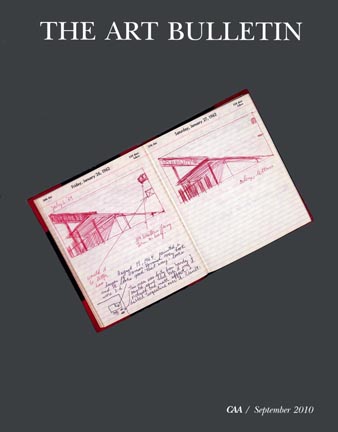 The September 2010 issue of The Art Bulletin, the leading publication of international art-historical scholarship, has just been published. It will be mailed to all individual CAA members who elect to receive the journal, and to all institutional members.
The issue interweaves three essays that focus on art and visual culture in Europe with three texts exploring works from the Americas. On the Continent, Molly Swetnam-Burland looks at issues of reuse, display, and cross-cultural appropriation through the history of the obelisk in the Piazza Montecitorio in Rome. For his essay “Material Futures,” Richard Taws views Philibert-Louis Debucourt’s print Almanach national (1790) as articulating relations between the materiality expressed in the image and changing conceptions of time in the French Revolution. In his contribution, Darius A. Spieth investigates the “politics of nostalgia” in modern Italian culture through the reception history of Giandomenico Tiepolo’s fresco Il Mondo Nuovo (1791).
Across the Atlantic, “Circles of Creation” is Amara L. Solari’s exploration of how the Maya in early colonial Yucatán invented their own cartographic tradition that allowed for the preservation of community identity during the chaos of colonization. In “Rioting Refigured,” Ross Barrett examines the way in which George Henry Hall’s painting A Dead Rabbit (1858) reframes a mid-nineteenth-century rioter in New York City as an ideal nude, both tempering and exacerbating connotations of violence. Moving into the twentieth century, Ken Allen argues that Ed Ruscha’s experimentations with size and scale in his images of 1960s Los Angeles gave viewers a new experiential understanding of the city.
The reviews section presents four books on diverse topics. Timon Screech evaluates Melissa McCormick’s study of an early member of the Tosa School in Tosa Mitsunobu and the Small Scroll in Medieval Japan, and Charles Dempsey examines Stuart Lingo’s book on Federico Barocci: Allure and Devotion in Late Renaissance Painting. Erika Naginski’s Sculpture and Enlightenment, which looks at how historical forces and philosophical debated affected public funerary monuments in eighteenth-century France, is reviewed by Satish Padiyar. Finally, Karen Beckman considers Flesh of My Flesh, the latest book by the film theorist and art historian Kaja Silverman.
Please read the full table of contents for more details. The final Art Bulletin for 2010 will be published in December.
Presentations Sought for 2011 Conference Session on Health and Safety in the Artist’s Studio
posted Aug 27, 2010
Over the last decade, artists and educators have become acutely aware of the environmental and health repercussions of their studio endeavors. How have the serious consequences for personal health and the environment, as well as the legal and ethical responsibilities of institutions of higher education, shaped individual studio practice and the teaching of visual art? This session will examine the wide-ranging responses of artists working today and offer practical solutions for artists to safely create work without sacrificing their vision. We invite proposals for twenty-minute presentations about individual experiences, personal or institutional, dealing with these pressing matters.
This session will be part of ARTspace at the 2011 CAA Annual Conference in New York. Initiated in 2001, ARTspace has grown into one of the most vital and exciting aspects of the annual meeting, with programming is designed by artists for artists that is free and open to the public. Working in tandem with its affiliated programs, the Media Lounge and ARTexchange, ARTspace promotes dialogue about visual-arts practice, its relation to critical discourse, professional-development programming, and opportunities for the creative exchange of ideas.
Interested parties should submit a one-hundred-word abstract and a fifty-word autobiography in a single Word document to session cochairs Brian Bishop and Mark Gottsegen. Deadline: October 1, 2010.
Call for Video of Performance Works for Times, Interludes, and Action at the 2011 Conference
posted Aug 25, 2010
The first decade of the twenty-first century has given rise to new possibilities, new questions, and new challenges. With continued globalization and technological innovation, new platforms for human interaction and exchange have emerged. Simultaneously, we have witnessed an increase in terrorism, an energy crisis, and global economic instability. These problems have generated heated political debate about how we should best prepare for the future. Can we continue to employ the same solutions that worked in the past, or must we fundamentally change the way that we understand and approach these issues? How will this decade be remembered in the future?
To commemorate the tenth anniversary of ARTspace and the Centennial of CAA, the Services to Artists Committee invites artists to submit action-based works that respond in some way to the first decade of this new millennium. These performance works, to be collectively presented as Times, Interludes, and Action, will be displayed in the form of video documentation in the ARTspace Media Lounge at the 2011 Annual Conference in New York.
To be considered, please submit the video that you would like to include; or you may submit a written proposal for a work not completed, along with a portfolio. Please also send your artist statement, résumé, and contact information.
Email submissions limited to three or fewer works are preferred. Video may be sent either as a small email attachment (5 MB or less) or as a link to a website. Please send your submission to both Jeffrey Bird and Joseph Meiser. If an emailed submission is not possible, you can send a CD or DVD along with hard copies of your documents to: Joseph Meiser, Dept. of Art and Art History, Art Bldg., Bucknell University, Lewisburg, PA 17837. Deadline for emailed proposals: October 1, 2010. Mailed items must be postmarked by September 24, 2010.
Society of Architectural Historians and CAA at the Four Seasons in New York
posted Aug 20, 2010
The Society of Architectural Historians (SAH) invites CAA members to gather at the Four Seasons in midtown Manhattan next month for conversation about the restaurant’s historical developments. This free event takes place on Saturday, September 25, 2010, at 9:00 PM.
The gathering concludes a tour day in which SAH members will have spent studying the work of Richard Kelly, who was responsible for the interior and exterior lighting of the Seagram Building and the Four Seasons. Joining the group will be Belmont Freeman, the restaurant’s current restoration architect, and Dietrich Neumann, the tour leader, past SAH president, and editor of the forthcoming book, The Structure of Light: Richard Kelly and the Illumination of Modern Architecture. (The tour is sold out.)
The Four Seasons opened in 1959 to breathless headlines about the “world’s costliest restaurant,” which took an unprecedented $4.5 million to build. Occupying a monumental space on the first floor of Ludwig Mies van der Rohe’s Seagram Building, the restaurant was designed by Philip Johnson in collaboration with a stellar cast of artists, including Kelly, William Pahlman (interior designer to Restaurant Associates), Karl Linn (landscape architect), and Garth Huxtable (industrial designer). In addition, Kelly created the sculptures that hover over the Bar Room, Marie Nichols made the shimmering aluminum chain window shades, and Treitel-Gratz fabricated the Mies-designed Brno and Barcelona chairs (this being before Knoll put them into production.) Blue-chip art, including a stage backdrop painted by Pablo Picasso, adorned the walls.
During his lifetime Johnson kept close control over the maintenance, alteration, and periodic refurbishment of the restaurant, which the New York City Landmarks Preservation Commission named an interior landmark in 1989 and which recently celebrated its fiftieth anniversary. Four years after Johnson’s death in 2005, the owners decided that the Four Seasons needed a new house architect to design and direct urgently needed restorations and, as Phyllis Lambert phrased it in her brief in support of the work, to “monitor and safeguard the architectural and artistic patrimony” of the establishment. Freeman was selected for this role. Since December 2008, Belmont Freeman Architects (BFA) and a team of consultants have been immersed in researching the history, design, and construction of the restaurant, and in designing and managing its phased restoration.
The Four Seasons is not a museum but a busy working restaurant. As such, its renovation is subject to particular functional, logistical, and economic exigencies. Since the restaurant cannot close for renovation, work is planned as a series of surgical interventions that can be performed off hours. After completing an assessment of existing conditions, BFA compiled and ranked discrete restoration subprojects by priority. While the main dining rooms have been admirably maintained over the years, ancillary spaces—entrance, lobby, restrooms, coat check, stairs, bar—have suffered fifty years of abuse and are in urgent need of renovation. Another important object of attention is the lighting: the historical importance of Kelly’s pioneering lighting design is equal to—and inseparable from—that of the architecture. BFA is working with lighting designer WALD Studio and with Edison Price, manufacturers of the original fixtures, on this restoration program.
There is no charge to attend this cash-bar event. On entering the Four Seasons, say you are with the Society of Architectural Historians group. Have questions or need additional information? Please contact Kathy Sturm, SAH director of programs, at 312-543-7243.
CAA Offers Travel Grants to Attend the 2011 Centennial Conference
posted Aug 20, 2010
Although funds are modest, CAA will offer a limited number of Annual Conference Travel Grants to graduate students in art history and studio art and to international artists and scholars. Travel grants are funded solely by donations from CAA members—please contribute today. Charitable contributions are 100 percent tax deductible.
Graduate Student Conference Travel Grant
This $150 grant is awarded to a limited number of advanced PhD and MFA graduate students as partial reimbursement of expenses for travel to the 2011 Centennial Conference in New York. To qualify for the grant, students must be current CAA members. Candidates should include a completed application form, a brief statement by the student stipulating that he or she has no external support for travel to the conference, and a letter of support from the student’s adviser or head of department. For an application and more information, please contact Lauren Stark, CAA manager of programs, at 212-691-1051, ext. 248. Send application materials to: Lauren Stark, Graduate Student Conference Travel Grant, CAA, 275 Seventh Ave., 18th Floor, New York, NY 10001. Deadline: September 24, 2010.
International Member Conference Travel Grant
CAA presents a $300 grant to a limited number of artists or scholars from outside the United States as partial reimbursement of expenses for travel to the Centennial Conference in New York. To qualify for the grant, applicants must be current CAA members. Candidates should include a completed application form, a brief statement by the applicant stipulating that he or she has no external support for travel to the conference, and two letters of support. For an application form and additional information, please contact Lauren Stark, CAA manager of programs, at 212-691-1051, ext. 248. Send materials to: Lauren Stark, International Member Conference Travel Grant, CAA, 275 Seventh Ave., 18th Floor, New York, NY 10001. Deadline: September 24, 2010.
CAA Seeks Award Nominations for the Centennial Conference in 2011
posted Aug 18, 2010
 For CAA’s Centennial Conference in 2011, recognize someone who has made extraordinary contributions to the fields of art and art history by nominating him or her for one of twelve Awards for Distinction. Award juries consider your personal letters of recommendation when making their selections. In the letter, state who you are; how you know (of) the nominee; how the nominee and/or his or her work or publication has affected your practice or studies and the pursuit of your career; and why you think this person (or, in a collaboration, these people) deserves to be recognized.
You should also contact five to ten colleagues, students, peers, collaborators, and/or coworkers of the nominee to write letters. The different perspectives and anecdotes from multiple letters of nomination provide juries with a clearer picture of the qualities and attributes of the candidates.
All nomination campaigns should include one copy of the nominee’s CV (limit: two pages). Nominations for book and exhibition awards should be for authors of books published or works exhibited or staged between September 1, 2009, and August 31, 2010. No more than ten letters per candidate are considered.
Please read descriptions of all twelve awards and see past recipients. Detailed instructions for nominations are available. You may also write to Lauren Stark, CAA manager of programs, for more information. Deadline: July 31, 2010, for the Morey and Barr Awards; August 31, 2010, for all others.
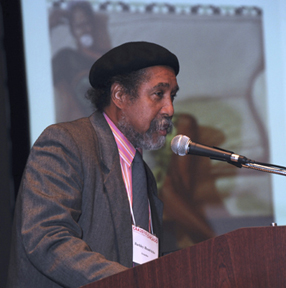
Image: Barkley L. Hendricks accepts the 2010 Artist Award for Distinguished Body of Work at the Annual Conference in Chicago (photograph by Bradley Marks)
New Online Editions of Graduate-Program Directories Coming in Fall 2011
posted Aug 17, 2010
 The next editions of CAA’s two directories of graduate programs in the arts will be published in an online format in fall 2011. First printed in December 2008 and January 2009 and still available for purchase, the CAA directories are the most comprehensive source books for graduate education for artists and art scholars, with program information for hundreds of schools, departments, and programs in the United States, Canada, Great Britain, and elsewhere worldwide. Colleges, universities, and independent art schools are all included.
The pricing structure for the 2011 online editions has not yet been determined. Each current volume costs $49.95—$39.95 for CAA members—plus shipping and handling. You may order them online.
Graduate Programs in Art History includes programs in art history and visual studies, museum studies, curatorial studies, arts administration, library science, and related areas. Graduate Programs in the Visual Arts describes programs in studio art, graphic design, digital media, art education, conservation, historic preservation, film production, and more.
For more information, please send an email to directories@collegeart.org.
Committee on Women in the Arts Picks for August 2010
posted Aug 10, 2010
Each month, CAA’s Committee on Women in the Arts selects the best in feminist art and scholarship. The following exhibitions and panel discussion should not be missed. Check the CWA Picks archive at the bottom of the page, as several exhibitions listed there are still on view.
August 2010

Hilla Rebay, photographed by Eugene Hutchinson in her Carnegie Hall studio in 1935. Hilla von Rebay Foundation Archive, Solomon R. Guggenheim Museum Archives, New York (photograph by Eugene Hutchinson and provided by the Solomon R. Guggenheim Museum)
Hilla Rebay: Art Educator
Sackler Center for Arts Education
Solomon R. Guggenheim Museum, 1071 Fifth Avenue, New York, NY 10128
January 29–August 22, 2010
Hilla Rebay (1890–1967) was not only an accomplished artist whose work was exhibited across Europe, but she also served as the first director and curator of the Museum of Non-Objective Painting in New York, which then became the Guggenheim Museum. The exhibition Hilla Rebay: Art Educator, fittingly appearing at the museum she once led, highlights her underrecognized role as an innovative art and museum educator. With missionary zeal, Rebay gave talks in the museum and trained her staff on how to interpret the kind of abstract art the museum presented for diverse audiences. On view in the Sackler Center, the Guggenheim’s branch for arts education, are examples and documentation of her approach to pedagogy.
Women Only: Folk Art by Female Hands
American Folk Art Museum
45 West 53rd Street, New York, NY 10019-5401
April 6–September 19, 2010
Curated by Stacey C. Hollander, Women Only: Folk Art by Female Hands “evokes a girls’ club, a parallel and self-contained art world,” according to Karen Rosenberg in the New York Times. The exhibition, culled from the museum’s permanent collection, features painting, drawing, samplers, quilts, and more by American women of the eighteenth and nineteenth centuries. Artists range from anonymous younger women from colonial and revolutionary times, whose creativity prepared them for life in the home, to the portraitist Deborah Goldsmith, one of the few female painters in the 1800s making a living from her art. The subject matter in Women Only is just as diverse, covering ornamentation and commemoration as well as religion and politics.

“3G Summit: The Future of Girls, Gaming and Gender”
Ellen Stone Belic Institute for the Study of Women and Gender in the Arts and Media
Columbia College Chicago, Media Production Center Soundstage, 1600 South State Street, Chicago, IL 60605
August 12, 2010
Columbia College Chicago hosts a public forum on Thursday, August 12, 6:00–8:00 PM, as part of “3G Summit: The Future of Girls, Gaming and Gender,” a four-day program of workshops and discussions that will connect fifty teenage girls from the Chicago area with game designers and scholars for intensive dialogue, inquiry, game play, and mentorship. Moderated by the college’s Janell Baxter and Brendan Riley, this free panel features five women at the forefront of gaming theory and practice. Through talks and conversation, they will address intersections of gender equity, technology, digital platforms, and more. Speakers are: Mary Flanagan: artist, scholar, and author of Critical Play; Tracy Fullerton: game designer (Cloud, flOw, The Night Journey), writer, and educator (University of Southern California); Jennifer Jenson: scholar of gender and technology (York University) and game designer (Epidemic and Tafelmusik); Erin Robinson: game designer (Puzzle Bots, Little Girl in Underland, Nanobots); and Susana Ruiz: media artist and game designer (Darfur is Dying, Finding Zoe).
Empowering Women: Artisan Cooperatives That Transform Communities
Museum of International Folk Art
706 Camino Lejo, Museum Hill, Santa Fe, NM 87504
July 4, 2010–January 2, 2011
Empowering Women: Artisan Cooperatives That Transform Communities, guest curated by Suzanne K. Seriff, is the inaugural exhibition at the Museum of International Folk Art’s Gallery of Conscience. Visitors can examine weaving, beadwork, painting, baskets, embroidery, and other traditional folk arts from artists and artisans living and working in Africa, South America, and South and Southeast Asia. The new Gallery of Conscience, according to the museum director Marsha Bol, is “devoted to the examination of issues that threaten the survival of the traditional arts, bringing them to the attention of our visitors.” Empowering Women appears in conjunction with the three-day Santa Fe International Folk Art Market, which took place last month.