CAA News Today
NEA AWARDS NATIONAL STIMULUS GRANTS
posted Apr 15, 2009
The National Endowment for the Arts has awarded $19.8 million in one-time grants under the American Recovery and Reinvestment Act of 2009. National service organizations, state arts agencies, and regional arts organizations—from the Southern Arts Federation to the Arizona Commission on the Arts—have individually received amounts from $25,000 to nearly $600,000 to support the arts sector of the economy; most groups have received awards in the low six figures. The NEA has published the complete list of grants and amounts.
The NEA’s state and regional partners will invest their recovery funds in projects that assist arts organizations in retaining critical staff as well as artists and other contractual personnel. These critical staff will enhance the ability of arts organizations to realize their artistic and public service goals. State and regional agencies will mirror the NEA’s recovery grant program and adapt their programs to respond to the particular needs of their constituents.
In July, the endowment will announce a second category of one-time direct recovery grants, which will support a nonprofit arts sector that has seen declines in philanthropic and other support during the current economic downturn. Please see the NEA’s recovery page for updates on these recovery grants, agency reports, and other information.
Recent Deaths in the Arts
posted Apr 09, 2009
CAA recognizes the lives and achievements of the following artists, scholars, and architects. Of special note is Petra ten-Doesschate Chu and June Hargrove’s obituary for CAA on the Swiss art historian Hans A. Lüthy.
- Robert Delford Brown, an artist who helped create Happenings in the early 1960s, was found dead in Wilmington, North Carolina, on March 24, 2009. He was 78
- Hanne Darboven, a German artist who was a major figure in Conceptual art, died on March 9, 2009, near Hamburg. She was 67
- Johnny Donnels, a New Orleans photographer, died on March 19, 2009, at the age of 84
- Lorenz Eitner, a professor who rebuilt the Stanford University Art Department and directed the school’s museum, died on March 11, 2009. He was 89
- Sverre Fehn, a Norwegian architect who won the Pritzker Architecture Prize, died on February 23, 2009, at age 84
- Mary Hambleton, an artist, teacher, and Guggenheim fellow, died on January 9, 2009. She was 56
- Helen Levitt, an American photographer whose first solo exhibition was at the Museum of Modern Art in 1943, died on March 29, 2009, in New York. She was 95
- Hans A. Lüthy, a Swiss art historian, died on March 8, 2009
- Stephen M. Panella, an artist based in Aurora, Illinois, died on November 29, 2008, at the age of 34
- Susan Peterson, a ceramic artist, writer, and professor, died on March 26, 2009, in Scottsdale, Arizona. She was 83
Read all past obituaries in the arts on the CAA website.
Hans A. Lüthy: In Memoriam
posted Apr 09, 2009
Petra ten-Doesschate Chu works in the Department of Art, Music, and Design at Seton Hall University in South Orange, New Jersey, and June Hargrove teaches nineteenth-century European painting and sculpture at the University of Maryland, College Park.

Hans A. Lüthy
With the death of Hans A. Lüthy, on March 8, 2009, art history has lost a scholar and a leader, a catalyst whose vision and philanthropy contributed to the growth of the discipline in Europe and America.
Born in 1932, Lüthy studied art history in Zurich, where he wrote a dissertation on the nineteenth-century Swiss landscape painter Johann Jakob Ulrich II (1965). In 1963, he was appointed director of the Schweizerisches Institut für Kunstwissenschaft (SIK), or Swiss Institute for Art Research in Zürich, a position that he would hold for more than thirty years. Founded in 1951, the SIK became a major research institute under his directorship, the influence of which was felt both at home and abroad. Lüthy, indeed, pursued a two-pronged agenda: one, to research Switzerland’s artistic patrimony and to disseminate that research through exhibitions and publications; and, two, to promote Swiss art abroad, particularly in the United States. He was responsible for the organization of several exhibitions of Swiss art in the US, including From Liotard to Le Corbusier: 200 Years of Swiss Painting, 1730–1930 in the High Museum of Art in Atlanta and monographic exhibitions of the works of Ferdinand Hodler. His energy and commitment brought a new dimension to the awareness of Swiss art here.
Lüthy’s scholarly pursuits were focused on nineteenth-century French art, and he maintained an active publishing career, which included numerous articles for the press, notably the Neue Zürcher Zeitung.
Since his retirement in 1994, Lüthy remained actively involved in art history. Through a private foundation, he and his wife, Marianne (Mascha), funded several research and writing projects. One of these was Nineteenth-Century Art Worldwide, which would not have come into being if not for his generous start-up grant. For this, the Association of Historians of Nineteenth-Century Art owes him a debt of gratitude. The couple also contributed a scholarship to the Centre allemande d’histoire de l’art (Deutsche Forum für Kunstgeschichte) in Paris.
At the same time, he began to collect art. As a collector his taste tended to French neoclassical and Romantic drawings, a predilection that was no doubt related to his life-long interest in the work of Théodore Géricault. He also assembled a small but significant collection of sculpture of the same period. A selection of drawings and sculpture from his collection was exhibited in 2002 in the Kunstmuseum in Bern, on the occasion of his seventieth birthday.
During the past few years, Lüthy’s ill health prevented him from staying in touch with many former friends and acquaintances. Those who knew him, and I am sure there are many of us in the US, remember him fondly for his genuine kindness, his enthusiasm, and his generosity of spirit. He was a raconteur and bon vivant whose presence enlivened many an occasion, scholarly and otherwise. He will be much missed.
Vigils for Anniversary of Iraq Museum Looting
posted Apr 08, 2009
April 10–12, 2009, is the sixth anniversary of the looting of the National Museum in Baghdad and the subsequent pillaging of archeological sites across Iraq. In the years since 2003, Saving Antiquities for Everyone (SAFE) has held, and has encouraged others to hold, global candlelight vigils in commemoration of the tragic loss suffered by the ransacking of the museum and the looting of artworks and artifacts there—many of which are still missing despite the recent reopening of seven museum galleries.
In New York, a gathering is taking place on April 11, 6:00–7:30 PM, in Washington Square Park. For those living in or near New York, please join the vigil. Donny George, former director of the Iraq Museum, is scheduled to speak.
Elsewhere in the United States, lectures, discussions, and SAFE-related vigils are being held at institutions in Fairbanks, Alaska; St. Paul, Minnesota; Eugene, Oregon; Ceres, California; and Amherst, Massachusetts. Please see the full list of vigil times and locations. You may also host a vigil in your own area.
To show additional support, please light a virtual candle on the SAFE website. By completing a simple form, your name and location will be displayed on your personal candle page and will also be listed on the main virtual-candle page.
For a review of the tragic events of 2003, read an interview with Donny George, conducted by Zainab Bahrani, in the September 2007 CAA News, as well as his detailed talk prepared for the 2008 Annual Conference in the May 2008 issue.
SAFE is a nonprofit organization dedicated to preserving cultural heritage worldwide. Its mission is to raise public awareness about the irreversible damage that results from looting, smuggling, and trading illicit antiquities. SAFE promotes respect for the laws and treaties that enable nations to protect their cultural property and preserve humanity’s most precious nonrenewable resource: the intact evidence of our undiscovered past. While the impetus to found SAFE was the ransacking of the National Museum of Iraq in Baghdad in April 2003, its efforts are global. SAFE has no political affiliations.
VIGILS FOR ANNIVERSARY OF IRAQ MUSEUM LOOTING
posted Apr 08, 2009
April 10–12, 2009, is the sixth anniversary of the looting of the National Museum in Baghdad and the subsequent pillaging of archeological sites across Iraq. In the years since 2003, Saving Antiquities for Everyone (SAFE) has held, and has encouraged others to hold, global candlelight vigils in commemoration of the tragic loss suffered by the ransacking of the museum and the looting of artworks and artifacts there—many of which are still missing despite the recent reopening of seven museum galleries.
In New York, a gathering is taking place on April 11, 6:00–7:30 PM, in Washington Square Park. For those living in or near New York, please join the vigil. Donny George, former director of the Iraq Museum, is scheduled to speak.
Elsewhere in the United States, lectures, discussions, and SAFE-related vigils are being held at institutions in Fairbanks, Alaska; St. Paul, Minnesota; Eugene, Oregon; Ceres, California; and Amherst, Massachusetts. Please see the full listof vigil times and locations. You may also host a vigil in your own area.
To show additional support, please light a virtual candle on the SAFE website. By completing a simple form, your name and location will be displayed on your personal candle page and will also be listed on the main virtual-candle page.
For a review of the tragic events of 2003, read an interview with Donny George, conducted by Zainab Bahrani, in the September 2007 CAA News, as well as his detailed talk prepared for the 2008 Annual Conference in the May 2008 issue.
SAFE is a nonprofit organization dedicated to preserving cultural heritage worldwide. Its mission is to raise public awareness about the irreversible damage that results from looting, smuggling, and trading illicit antiquities. SAFE promotes respect for the laws and treaties that enable nations to protect their cultural property and preserve humanity’s most precious nonrenewable resource: the intact evidence of our undiscovered past. While the impetus to found SAFE was the ransacking of the National Museum of Iraq in Baghdad in April 2003, its efforts are global. SAFE has no political affiliations.
Google Book Settlement Opt-Out Deadline Approaching
posted Apr 07, 2009
The deadline for authors and publishers to opt out of a recent class-action settlement regarding the scanning and electronic distributing of in-copyright books by Google is May 5, 2009.
Last October, the Authors Guild, the Association of American Publishers, and Google announced a settlement agreement on behalf of a broad class of authors and publishers worldwide that would expand online access to millions of in-copyright books and other written materials in the United States from the collections of a number of major US libraries participating in Google Book Search.
For full details on the settlement and to opt out, please visit www.googlebooksettlement.
New Board Officers Elected
posted Mar 31, 2009
New officers for the CAA Board of Directors were chosen by the board at its last meeting, held on March 1, 2009. These officers join the CAA president and executive director in forming the Executive Committee. The new officers start their work at the next board meeting, taking place on May 3.
Andrea Kirsh, an independent scholar and curator, is vice president for external affairs; Mary-Ann Milford-Lutzker of Mills College was reelected to a second year as vice president for committees; Sue Gollifer of the University of Brighton was elected vice president for Annual Conference; Anne Collins Goodyear of the National Portrait Gallery, Smithsonian Institution, is now vice president for publications; and Barbara Nesin of Spelman College was reelected secretary. Jeffrey P. Cunard of Debevoise & Plimpton and John Hyland, Jr., of McFarland, Dewey & Company were both reappointed to their posts of counsel and treasurer, respectively.
Paul Jaskot of DePaul University is in the second and last year of his term as CAA board president, and Linda Downs remains the organization’s executive director.
Results from the 2009–13 board election were announced earlier this month. CAA is still seeking nominations and self-nominations for individuals interested in serving on CAA’s board for the 2010–14 term.
Schools Nationwide Reducing PhD Admissions
posted Mar 31, 2009
Top research schools nationwide—including Emory University, Columbia University, Brown University, and the University of South Carolina—are reducing admissions to their PhD programs. Because of the recession, reports Scott Jaschik of Inside Higher Ed, “some universities’ doctoral classes will be taking a significant hit, with potential ramifications down the road for the academic job market, the availability of teaching assistants, and the education of new professors.”
Reining in stipends and fellowships is one leading factor for limiting admissions, as is the need to cut program budgets. Some believe things will return to normal when the economy picks up, but the recent breadth of graduates compared with a shrinking labor market and dearth of teaching jobs may see admission reductions stay.
In related news, Fay Hansen of Workforce Management analyzes recent surveys by the Collegiate Employment Research Institute and CollegeGrad.com about hiring statistics and practices for freshly minted undergraduates, which “reflect a long-term trend toward producing more college graduates than labor markets can absorb.”
The article—which describes the current situation where “1.5 million undergraduates [who] will receive their bachelor’s degrees this year . . . will collide with 1.85 million workers with bachelor’s degrees or higher who are currently unemployed”—is far from encouraging. Some findings include:
- Some companies are retreating from hiring experienced candidates in favor of new college graduates, “primarily because of costs”
- The disparity between undergraduate majors and available jobs has been exacerbated by the recession. For example, 83,297 students graduated with visual and performing art degrees, and 88,134 in psychology, but only 67,045 and 47,480 students received degrees in engineering and computer and information sciences, respectively. The mismatch continues at the graduate level, with humanities master’s degrees earned outnumbering those in sciences
- Recruiters are pressuring for direct access to professors about the best students, bypassing schools’ own career-services programs
Most troubling for art and art history is that 6 percent of those employers surveyed by CollegeGrad.com are seeking liberal arts and humanities graduates, compared to 36 percent for engineering and 18 percent for computer science.
Session Audio from Los Angeles Conference Available
posted Mar 26, 2009
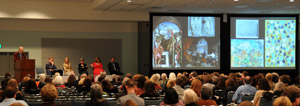 “Toward an Art Pedagogy for the Twenty-First Century,” “Torture, Extraordinary Renditions, and the Aesthetics of Disappearance,” and “About Face: Portrait, Mask, and Facial Expression in Mesoamerica and the Andes, 6000 BC–AD 1600”—these are titles of only three of the many exciting sessions from the 2009 Annual Conference in Los Angeles. They are also available as audio recordings from Conference Media. Nearly eighty sessions—including special Saturday sessions hosted by the Feminist Art Project—are included.
A set of MP3 audio recordings from the conference is available for only $149.95, either as a download or on interactive CD-ROMs. Individual sessions, available only as downloads, are $24.95 each. Please visit Conference Media to view the list of sessions and to order.
Whether you took part in, attended, or missed a particular conference session, these recordings are a must-have for your library, research, or teaching. Listen to them while walking across campus, while driving in your car or using public transportation, or while relaxing in your home.
You can also purchase session audio recordings from the 2006–8 conferences in Boston, New York, and Dallas–Fort Worth.
Photo: A 2009 Annual Conference session (photograph by Brad Marks)
March 2009 Issue of The Art Bulletin Published
posted Mar 20, 2009
 The March 2009 issue of The Art Bulletin, the leading publication of international art-historical scholarship, has been published and was mailed to CAA members earlier this month.
Special to this issue is the publication of Picasso’s Closet, a play by the Chilean American writer and Duke University professor Ariel Dorfman, which examines Pablo Picasso’s thorny politics and raises questions about the role of an artist during wartime. The art historians Pepe Karmel and Patricia Leighton and the theorist Mieke Bal respond.
Two essays examine on art and culture in eighteenth- and nineteenth-century France. Judy Sund reads Antoine Watteau’s Les charmes de la vie as a commentary on the ways that nature was domesticated and aestheticized for wealthy Parisians, with the artist standing as mediator between the realms of culture and nature. Meanwhile, Jennifer Olmsted considers how Eugène Delacroix’s The Sultan of Morocco and His Entourage was at odds with the triumphalist paintings of French domination over North Africa that were also on view at the Salon of 1845 in Paris.
This issue of The Art Bulletin also contains four book reviews on Roman visuality, the Buddhist afterlife in art, the Psalter of Saint Louis, and African architecture. Please read the full table of contents for more details.